
South Korea Nuclear Fusion Market (2026-2031)

The South Korea Nuclear Fusion Market was valued at $155.2 Million in 2026 and projected to reach to $291.5 Million by 2031, representing a compound annual growth rate of 13.4%. South Korea's nuclear fusion market is positioned for significant expansion as the nation accelerates its transition toward sustainable energy solutions.


| Market Size in | USD 26.32 MN |
| Market Forecast in | |
| CAGR | |
| Forecast Period | |
| Units Considered | Value (USD MN) |
South Korea Nuclear Fusion Market Trends and Insights
- Valued at $155.2 million in 2026, South Korea's market is expected to nearly double to $291.5 million by 2031, reflecting a compound annual growth rate of 13.4%.
- This expansion is driven by South Korea's strategic investments in advanced energy technologies and government support for next-generation power solutions. South Korea's nuclear fusion sector benefits from the country's established nuclear infrastructure, skilled workforce, and commitment to carbon neutrality targets.
- The market encompasses research institutions, private fusion ventures, and industrial applications across South Korea's energy landscape.
- Between 2026 and 2031, South Korea is anticipated to strengthen its position as a regional innovation hub, attracting both domestic and international fusion technology investments. South Korea's regulatory environment and public-private partnerships are accelerating commercialization pathways for fusion energy.
- The country's focus on energy security and technological sovereignty positions South Korea as a key player in the global nuclear fusion race, with market growth reflecting broader Asia Pacific momentum toward sustainable power generation..
Key Market Statistics
- CAGR (2026-2031) 13.4% CAGR
- Market Size, 2026 ~USD 155.2 Million
- Forecast, 2031 ~USD 291.5 Million
- Country South Korea
South Korea Nuclear Fusion Market Overview
Market Valuation Growth :
South Korea's nuclear fusion market is valued at $155.2 million in 2026 and is projected to reach $291.5 million by 2031, nearly doubling in size over the five-year forecast period.
Consistent CAGR Performance :
The South Korean market demonstrates a robust 13.4% compound annual growth rate, aligning with global market expansion and reflecting strong domestic demand for advanced fusion technologies.
Government Strategic Support :
South Korea's government has prioritized nuclear fusion as a cornerstone of its clean energy transition strategy, providing substantial investments and policy frameworks to accelerate commercialization.
Asia Pacific Leadership Position :
South Korea is emerging as a critical growth hub within the Asia Pacific region's nuclear fusion sector, leveraging its advanced technological capabilities and energy security objectives.
South Korea Nuclear Fusion Market Dynamics
- With government backing and substantial R&D investments, South Korea is establishing itself as a regional leader in fusion technology development and commercialization.
- The market's 13.4% CAGR reflects growing confidence in fusion's viability as a baseload clean energy source. By 2031, South Korea's fusion market is expected to nearly double, driven by increased private sector participation, technological breakthroughs, and supportive regulatory frameworks.
- The country's existing nuclear expertise, coupled with strategic partnerships and domestic talent, positions it favorably for capturing significant market share in the emerging fusion economy..
Market Ecosystem

NUCLEAR FUSION MARKET: COMMERCIAL USE CASES ACROSS INDUSTRIES
| COMPANY | USE CASE DESCRIPTION | BENEFITS |
|---|---|---|
 |
SHINE is building Chrysalis in Wisconsin, the world's largest source of molybdenum-99 (Mo-99) using fusion-driven neutron generators rather than aging overseas fission reactors | SHINE Technologies also opened Cassiopeia in 2024, North America's largest Lu-177 processing facility, with an initial production capacity of 100,000 cancer therapy doses per year, expandable to 200,000 | Fusion neutron generators demonstrated 99%+ uptime across a 132-hour continuous test run. | Directly replaces 1960s-era fission reactors in the medical supply chain | Produces isotopes for over 40 million diagnostic imaging procedures annually (Tc-99m) | Eliminates US dependence on foreign reactor imports | Delivers a commercially validated, non-power fusion revenue stream, the clearest proof that fusion has near-term monetization pathways beyond electricity generation. |
 |
Helion's seventh prototype, Polaris, pushed plasma to 150 million degrees Celsius in its Everett, Washington laboratory, becoming the first privately developed fusion machine to operate with deuterium-tritium fuel and produce a measurable energy signal | 3DVF Helion also became the first private company licensed by the NRC to handle tritium, unlocking the regulatory pathway for all subsequent private D-T programs. | First private-sector D-T fusion with a measurable energy output, the most commercially significant physics result outside a national laboratory in the history of private fusion | Demonstrates the FRC (Field-Reversed Configuration) approach is viable at D-T conditions | The tritium license precedent directly accelerates the regulatory pathway for every other private D-T company, reducing sector-wide licensing timelines. |
 |
Commonwealth Fusion Systems' SPARC demonstration machine is approximately 75% complete as of 2026 and is expected to start operating by late 2027 | Earth911 CFS's high-temperature superconducting magnets operating at 20 tesla, roughly 40 times stronger than a hospital MRI machine, have already passed stress testing described as "beyond spec." | Verodate, a digital twin of SPARC was unveiled with Siemens and NVIDIA at CES 2026. | Proves that compact tokamaks using HTS magnets can achieve ITER-equivalent plasma performance at a fraction of the size and cost | The 20-tesla magnet validation alone is a standalone industrial achievement; these magnets have applications in MRI, particle accelerators, and maglev transportation beyond fusion | The SIEMENS-NVIDIA digital twin sets the standard for AI-integrated nuclear engineering, with direct applications across the broader nuclear industry. |
Logos and trademarks shown above are the property of their respective owners. Their use here is for informational and illustrative purposes only.
Related Ecosystem
Decarbonization
- Battery Electric Vehicle (BEV)
- Energy Management Systems
- Fuel Cell
- Fuel Cell Electric Vehicle (FCEV)
- Geographical Information System (GIS)
- TotalEnergies SE
- Siemens ag
- Mitsui & Co., Ltd.
- General Electric Company
- Thyssenkrupp ag
Key Takeaways
- South Korea's nuclear fusion market will grow from $155.2M (2026) to $291.5M (2031) at 13.4% CAGR.
- South Korea leverages existing nuclear expertise and infrastructure to accelerate fusion technology development.
- South Korea's government support and energy security priorities drive sustained investment in fusion R&D.
- South Korea is emerging as a regional innovation hub attracting international fusion partnerships and capital.
Nuclear Fusion Market Report Scope
| Report Metric | Details |
|---|---|
| Base Year | 2026 |
| Fastest Growing Segment | INDUSTRIAL USERS (End User) |
| Forecast Period | 2026–2031 |
| Growth Rate | CAGR of 13.4% from 2026 to 2031 |
| Largest Segment | DEUTERIUM–TRITIUM (Fuel) |
| Market Size Base Year (Billions) | ~USD 18.01 (2026) |
| Revenue Forecast (Billions) | ~USD 33.77 (2031) |
| Segments Covered | Fuel, Technology, End User, Capacity |
South Korea Nuclear Fusion Market Report Segmentation
4 segment dimensions are covered across the global market.
By Fuel
- Deuterium–Deuterium
- Deuterium–Helium-3
- Deuterium–Tritium
- Proton–Boron
By Technology
- Inertial Confinement
- Magnetic Confinement
- Other Technologies
By End User
- Industrial Users
- National Laboratories & Research Institutes
- Other End Users
- Utilities
By Capacity
- Capacity
Target Audience
- Energy & Utility Companies : South Korean and international energy providers need market intelligence to evaluate fusion technology integration, assess long-term energy portfolio strategies, and identify partnership opportunities in this emerging sector.
- Technology & Equipment Manufacturers : Suppliers of fusion-related equipment and components require detailed South Korea market data to understand demand drivers, competitive positioning, and commercialization timelines for product development.
- Investment & Private Equity Firms : Investors targeting South Korea's clean energy sector need comprehensive market analysis to identify high-growth opportunities, evaluate startup valuations, and assess risk-return profiles in fusion ventures.
- Government & Policy Makers : South Korean government agencies and policymakers use market research to inform energy policy decisions, allocate R&D funding, and establish regulatory frameworks supporting fusion commercialization.
- Research & Academic Institutions : Universities and research centers in South Korea require market data to align fusion research initiatives with commercial opportunities, secure funding, and collaborate with industry stakeholders.
Key Companies in the South Korea Nuclear Fusion Market
| Company | HQ | Ownership | Strongest segments |
|---|---|---|---|
| LOCKHEED MARTIN | United States | Public Company | Magnetic confinement fusion concepts,Inertial confinement–adjacent systems,Fuel-cycle and tritium-handling capabilities, |
LOCKHEED MARTIN
Lockheed Martin is a public aerospace and defense company founded in 1912 in the United States with 123,000 employees. The company is a major contractor for government and commercial clients worldwide.
Reasons to Buy this Report
- Market-Specific Sizing & Forecasts : Access precise valuation data for South Korea's nuclear fusion market with detailed 2026-2031 projections, enabling accurate investment planning and resource allocation decisions specific to this high-growth market.
- Government Policy & Incentive Analysis : Understand South Korea's strategic government support mechanisms, regulatory frameworks, and clean energy policies driving fusion market growth, critical for identifying partnership and funding opportunities.
- Competitive Landscape Intelligence : Gain insights into South Korean and international players operating in the fusion sector, including technology leaders, startups, and research institutions shaping the market's competitive dynamics.
- Regional Growth Context : Benchmark South Korea's fusion market performance against broader Asia Pacific trends, understanding how the country's growth trajectory compares to neighboring markets and global leaders.
- Investment & Partnership Opportunities : Identify strategic entry points, joint venture prospects, and investment targets within South Korea's expanding nuclear fusion ecosystem, supported by comprehensive market data and trend analysis.
Frequently asked questions
What is the current size of South Korea's nuclear fusion market?
South Korea's nuclear fusion market is estimated at $155.2 million in 2026 and is projected to reach $291.5 million by 2031.
What is the expected growth rate for South Korea's nuclear fusion market?
South Korea's nuclear fusion market is expected to grow at a compound annual growth rate (CAGR) of 13.4% from 2026 to 2031.
What factors are driving growth in South Korea's nuclear fusion sector?
South Korea's growth is driven by government support for clean energy, existing nuclear infrastructure, energy security objectives, and strategic investments in advanced fusion technologies.
How does South Korea's nuclear fusion market compare regionally?
South Korea is positioned as a key regional player within Asia Pacific, leveraging its technological capabilities and policy support to strengthen its competitive position in the global fusion market.
What role do public-private partnerships play in South Korea's fusion market?
South Korea's public-private partnerships accelerate commercialization of fusion technologies, connecting government research institutions with private ventures to advance market development.
RESEARCH METHODOLOGY
This study made significant efforts to determine the current size of the nuclear fusion market. It commenced with a thorough secondary research process to gather data on the market, comparable markets, and the broader industry. Subsequently, these findings, assumptions, and market size calculations were rigorously validated by consulting industry experts across the entire supply chain through primary research. The total market size was assessed by conducting country-specific analyses. Following that, the market was further dissected, and the data was cross-referenced to estimate the size of various segments and sub-segments within the market.
Secondary Research
In this research study, a wide range of secondary sources was utilized, including directories, databases, and reputable references such as the Fusion Industry Association, Hoover's, Bloomberg BusinessWeek, Factiva, World Bank, International Monetary Fund (IMF), the US Department of Energy (DOE), and the International Energy Agency (IEA). These sources played a crucial role in gathering valuable data for a comprehensive analysis of the global market, covering technical, market-oriented, and commercial aspects. Additional secondary sources included annual reports, press releases, investor presentations, whitepapers, authoritative publications, articles authored by well-respected experts, information from industry associations, trade directories, and various database resources.
Primary Research
The nuclear fusion market involves a range of stakeholders, including research institutes & national laboratories, fusion reactor developers, advanced materials & technology providers, and end users. within the supply chain. To gather qualitative and quantitative insights, various primary sources from both the supply and demand sides of the market were interviewed. The following breakdown presents the primary respondents involved in the research study.
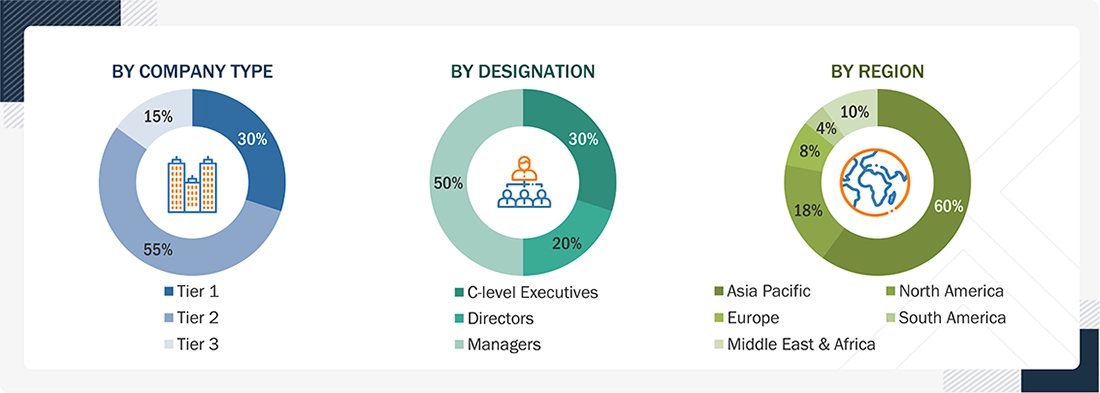
Note: Company tiers are defined by their total revenue. As of 2025: Tier 1: >USD 1 billion, Tier 2: USD 500 million–1 billion, and Tier 3: <USD 500 million.
To know about the assumptions considered for the study, download the pdf brochure
Market Size Estimation
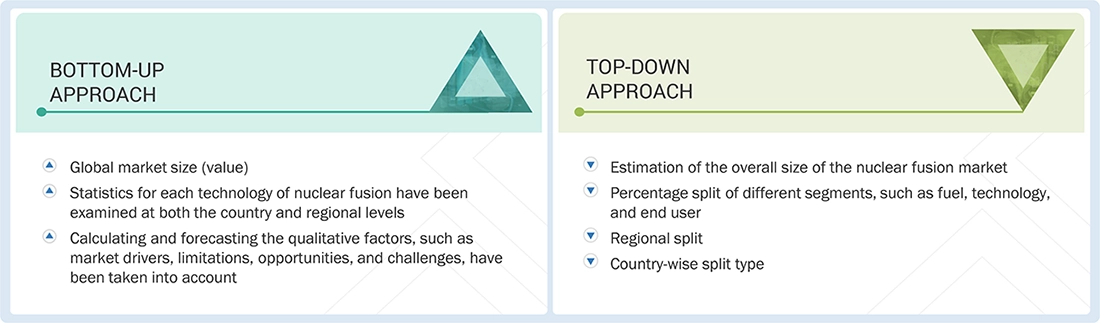
The estimation and validation of the nuclear fusion market size have been conducted using both bottom-up and top-down approaches. This approach was rigorously employed to ascertain the dimensions of multiple subsegments within the market. The research process comprises the following key stages.
- In this method, the statistics for each type of nuclear fusion have been examined at both the country and regional levels.
- Thorough secondary and primary research has been conducted to gain a comprehensive understanding of the global market landscape for various segments of the market.
- When calculating and forecasting the market size, qualitative factors such as market drivers, limitations, opportunities, and challenges have been taken into account.
Data Triangulation
The process of determining the overall market size involved the methodologies described earlier, followed by segmenting the market into multiple segments and subsegments. To finalize the comprehensive market analysis and obtain precise statistics for each market segment and subsegment, data triangulation and market segmentation techniques were applied, as appropriate. Data triangulation was achieved by examining various factors and trends from both the demand and supply perspectives within the market ecosystem.
Market Definition
Nuclear fusion is a process in which two light atomic nuclei combine to form a heavier nucleus, releasing a large amount of energy. The reaction commonly uses hydrogen isotopes such as deuterium and tritium, which can generate energy when heated to extremely high temperatures and converted into plasma. Fusion is considered an advanced clean-energy technology because it has the potential to provide large-scale power generation with very low greenhouse gas emissions and without the long-lived radioactive waste typically associated with conventional nuclear fission.
The global nuclear fusion market encompasses the development, demonstration, and future commercialization of fusion energy systems, as well as supporting technologies, fuel cycles, components, engineering services, and research infrastructure. The market covers companies and institutions working on plasma confinement, superconducting magnets, laser-based fusion systems, tritium handling, fusion fuels, reactor materials, power plant design, diagnostics, and control systems. Although the market is still at an early commercial stage, it is gaining momentum due to rising clean-energy demand, government funding, private investment, and technological progress in magnetic confinement, inertial confinement, magneto-inertial fusion, alternative magnetic systems, and pulsed fusion concepts.
Key Stakeholders
- Fusion technology developers
- Government energy agencies
- National laboratories & research institutes
- Universities & academic institutions
- Utilities & independent power producers
- Industrial energy users
- Aerospace & defense organizations
- Component & equipment suppliers
- Engineering, procurement, and construction companies
- Fuel-cycle & tritium-handling companies
- Investors & venture capital firms
- Nuclear regulators & safety authorities
- Grid operators & transmission companies
- International fusion organizations
- Policy makers & clean-energy program agencies
Report Objectives
- To describe, analyze, and forecast the nuclear fusion market, by technology, fuel, and end user, in terms of value
- To describe and forecast the market for four key regions: North America, Europe, Asia Pacific, and the Rest of World (RoW), along with their country-level market sizes, in terms of value
- To forecast the nuclear fusion plant, by MW, in terms of volume
- To give comprehensive details regarding drivers, restraints, opportunities, and challenges impacting the expansion of the market
- To systematically examine the market for nuclear fusion in terms of each segment’s contributions to the market, growth trends, and prospects
- To provide the supply chain analysis, trends/disruptions impacting customer business, market maps, ecosystem analysis, sustainability and regulatory landscape, pricing analysis, patent analysis, case study analysis, technology analysis, key conferences and events, Porter’s five forces analysis, macroeconomic outlook, customer landscape & buyer behavior, regulatory analysis, and AI/Gen AI impact on the market
- To conduct a strategic analysis of micromarkets concerning their respective growth trends, planned expansions, and market share contributions
- To sketch into a competitive environment for market participants and assess the potential for stakeholders in the nuclear fusion business
- To benchmark players within the market using the company evaluation matrix, which analyzes market players on various parameters within the broad categories of business and product strategies
- To compare key market players for the market share, product specifications, and applications
- To strategically profile key players and comprehensively analyze their market ranking and core competencies
- To analyze competitive developments in the market, such as agreements, investments, expansions, product launches, mergers, partnerships, collaborations, and acquisitions.
Available customizations:
With the given market data, MarketsandMarkets offers customizations based on the company’s specific needs. The following customization options are available for the report:
PRODUCT ANALYSIS
- Product Matrix, which provides a detailed comparison of the product portfolio of each company
COMPANY INFORMATION
- Detailed analyses and profiling of additional market players (up to 5)
Get the Full Nuclear Fusion Market Report
Full forecast, segment splits, and company analysis for all Nuclear Fusion Market.
Need a Tailored Report?
Customize this report to your needs
Get 10% FREE Customization
Customize This Report
