
India Nuclear Medicine Software Market (2025-2030)

The India Nuclear Medicine Software Market was valued at $36.6 Million in 2025 and projected to reach to $61.5 Million by 2030, representing a compound annual growth rate of 11.0%. India's nuclear medicine software market is poised for substantial expansion, driven by increasing healthcare digitalization and infrastructure development across the country.


| Market Size in | USD 26.32 MN |
| Market Forecast in | |
| CAGR | |
| Forecast Period | |
| Units Considered | Value (USD MN) |
India Nuclear Medicine Software Market Trends and Insights
- This 11.0% compound annual growth rate reflects India's increasing adoption of advanced diagnostic imaging technologies and rising healthcare infrastructure investments.
- India's growing patient population and expanding nuclear medicine centers are driving demand for sophisticated software solutions that enhance diagnostic accuracy and operational efficiency. The nuclear medicine software market in India is benefiting from government healthcare initiatives, improved reimbursement policies, and the modernization of diagnostic facilities across urban and emerging metropolitan areas.
- India's healthcare sector is increasingly recognizing the value of nuclear medicine imaging in oncology, cardiology, and neurology applications, spurring software adoption.
- Between 2025 and 2030, India is expected to witness accelerated digitalization of nuclear medicine departments, with enhanced focus on data management, image analysis, and integrated reporting systems that comply with international standards..
Key Market Statistics
- CAGR (2025-2030) 11.0% CAGR
- Market Size, 2025 ~USD 36.6 Million
- Forecast, 2030 ~USD 61.5 Million
- Country India
India Nuclear Medicine Software Market Overview
Market Valuation :
India's nuclear medicine software market is valued at $36.6 million in 2025, with strong growth trajectory driven by modernization of healthcare infrastructure across tier-1 and tier-2 cities.
Accelerated Growth Rate :
At 11% CAGR through 2030, India's market growth outpaces the global average of 9%, reflecting rapid adoption of nuclear imaging technologies and diagnostic capabilities in the country.
Rising Healthcare Investments :
Government initiatives like Ayushman Bharat and increased private sector investments are expanding nuclear medicine centers, creating substantial demand for advanced software solutions across India.
Demographic Opportunity :
India's growing patient population and rising prevalence of chronic diseases are driving demand for nuclear medicine diagnostics, positioning software providers for significant market penetration opportunities.
India Nuclear Medicine Software Market Dynamics
- The projected growth from $36.6 million to $61.5 million by 2030 reflects India's commitment to modernizing diagnostic capabilities and improving patient outcomes through advanced imaging technologies. Key growth catalysts include government healthcare initiatives, rising medical tourism, and growing awareness of nuclear medicine benefits among healthcare providers.
- As India's healthcare sector continues to evolve, nuclear medicine software adoption will accelerate, particularly in metropolitan areas and emerging medical centers seeking to enhance diagnostic accuracy and operational efficiency..
Market Ecosystem
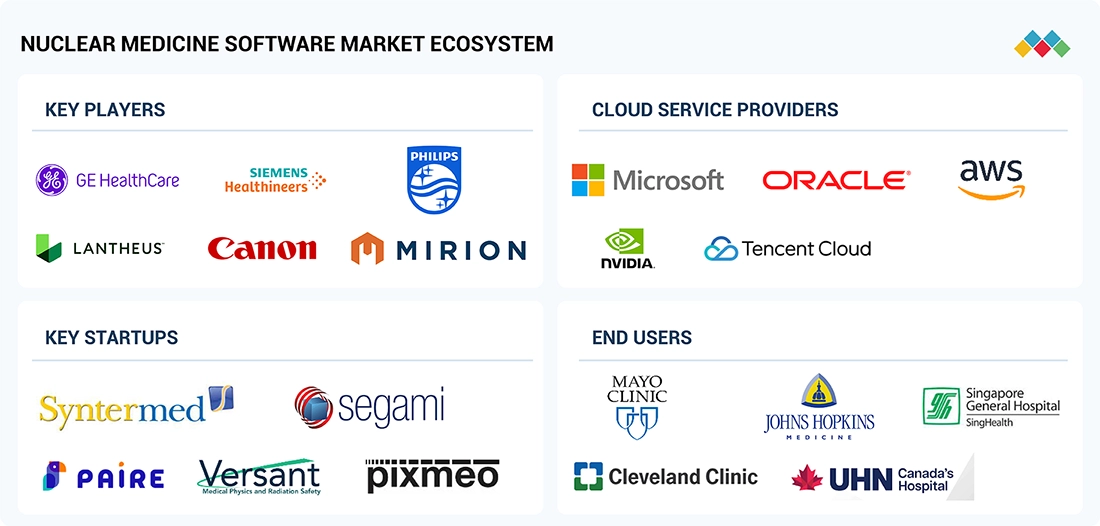
Nuclear Medicine Software Market: COMMERCIAL USE CASES ACROSS INDUSTRIES
| COMPANY | USE CASE DESCRIPTION | BENEFITS |
|---|---|---|
 |
AI-powered nuclear medicine software for PET/CT and SPECT/CT image reconstruction, quantitative analysis, and theranostic workflow automation | Higher diagnostic precision, improved therapy monitoring, streamlined imaging workflows, and reduced reporting times |
 |
Advanced molecular imaging software with AI-assisted lesion detection, radiomics, and personalized dosimetry tools | Personalized treatment planning, faster clinical decision-making, and improved therapy outcomes |
 |
Cloud-enabled nuclear medicine software integrating PACS, AI-based analytics, and workflow management for oncology and cardiology imaging | Enhanced diagnostic accuracy, data-driven decision support, improved patient stratification, and efficient data sharing |
 |
Theranostic software solutions integrating radiopharmaceutical data management, dosimetry, and therapy response tracking | Optimized radiopharmaceutical utilization, enhanced therapy precision, and better patient management |
 |
Cost-effective nuclear medicine software with automated workflow optimization, quality assurance tools, and scalability for emerging markets | Expanded access to digital imaging, reduced operational costs, and improved patient safety and efficiency |
Logos and trademarks shown above are the property of their respective owners. Their use here is for informational and illustrative purposes only.
Related Ecosystem
Healthcare It
- Computed Tomography (CT)
- Machine Learning
- Magnetic Resonance Imaging (MRI)
- Natural Language Processing (NLP)
- Predictive Analytics
- CERNER CORPORATION
- PHILIPS HEALTHCARE
- Oracle Corporation
- GE HealthCare Technologies Inc.
- Siemens healthineers
Key Takeaways
- India's nuclear medicine software market is valued at $36.6 million in 2025 and is forecast to reach $61.5 million by 2030, representing an 11.0% CAGR.
- India's market growth is driven by expanding nuclear medicine infrastructure, government healthcare investments, and rising demand for advanced diagnostic imaging solutions.
- India's healthcare sector is increasingly adopting integrated software platforms for image analysis, data management, and clinical reporting in nuclear medicine departments.
- India's nuclear medicine software market is expected to benefit from improved reimbursement policies and the modernization of diagnostic facilities across metropolitan and emerging regions.
Nuclear Medicine Software Market Report Scope
| Report Metric | Details |
|---|---|
| Base Year | 2025 |
| Fastest Growing Segment | CLOUD-NATIVE PLATFORMS (Integration Complexity) |
| Forecast Period | 2025-2030 |
| Growth Rate | CAGR of 9% from 2025 to 2030 |
| Largest Segment | HEALTHCARE PROVIDERS (End User) |
| Market Size Base Year (Billions) | ~USD 0.97 (2025) |
| Revenue Forecast (Billions) | ~USD 1.49 (2030) |
| Segments Covered | Software Type, Workflow, Integration Complexity, Software Licensing, Revenue Model, Application, Type, Therapeutic Area, Technology Maturity, End User |
India Nuclear Medicine Software Market Report Segmentation
10 segment dimensions are covered across the global market.
By Software Type
- AI & Advanced Analytics Software
- Dosimetry & Treatment Planning Software
- Image Acquisition & Reconstruction Software
- Image Analysis & Quantification Software
- Mobile & Remote Access Software
- Pacs Integration & Data Management Software
- Quality Control & Assurance Software
- Radiopharmaceutical Management Software
- Reporting & Documentation Software
- Workflow Management & Orchestration Software
By Workflow
- Data Management
- Data Processing
- Image Acquisition
- Reporting
By Integration Complexity
- Cloud-Native Platforms
- Integrated Solutions
- Standalone Solutions
By Software Licensing
- Enterprise Agreements
- Perpetual/Traditional Licenses
- Subscription/SaaS Licenses
- Usage-Based Licenses
By Revenue Model
- Cloud Services
- Maintenance & Support
- Professional Services
- Software Licenses
By Application
- Clinical Research
- Diagnostics
- Emergency & Stat Workflows
- Therapeutics
By Type
- AI & Advanced Analytics
- Automated Image Interpretation
- Cloud-Native Platforms
- Diagnostic & Imaging Centers
- Dosimetry & Treatment Planning
- Hospitals
- Image Acquisition & Reconstruction
- Mobile & Remote Access
- Other Healthcare Providers
- Outpatient Settings
- Pacs Integration
- Personalized Dosimetry Calculations
- Predictive Analytics
- Quality Control
- Radiopharmacies
- Theranostics
- Tumor Segmentation & Quantification
- Workflow Optimization & Quality Control
By Therapeutic Area
- Cardiology
- Neurology
- Oncology
- Other Therapeutic Areas
By Technology Maturity
- Mature Technologies
- Upcoming Technologies
By End User
- Healthcare Providers
- Medtech Companies
- Other End Users
- Pharmaceutical & Biotechnology Companies
INDIA: NUCLEAR MEDICINE SOFTWARE MARKET, BY END USER, 2023–2030
| Segment | 2023 | 2024 | 2025 | 2026 | 2027 | 2028 | 2029 | 2030 | CAGR (%) |
|---|---|---|---|---|---|---|---|---|---|
| HEALTHCARE PROVIDERS | 16.8 | 18.8 | 20.9 | 23.3 | 25.9 | 28.8 | 32 | 35.6 | 11.2 |
| MEDTECH COMPANIES | 4 | 4.5 | 5 | 5.5 | 6.1 | 6.8 | 7.5 | 8.3 | 10.6 |
| OTHER END USERS | 2.2 | 2.4 | 2.6 | 2.8 | 3 | 3.2 | 3.4 | 3.6 | 7.1 |
| PHARMACEUTICAL & BIOTECHNOLOGY COMPANIES | 6.4 | 7.2 | 8.1 | 9 | 10.1 | 11.3 | 12.6 | 14 | 11.7 |
| TOTAL | 29.5 | 32.9 | 36.6 | 40.6 | 45.1 | 50.1 | 55.5 | 61.5 | 11 |
Target Audience
- Software Vendors & Developers : Need India-specific market data to develop localized solutions, understand regulatory requirements, and identify partnership opportunities with healthcare providers and imaging centers.
- Healthcare Providers & Hospitals : Require market insights to evaluate software investments, benchmark against peers, and make informed procurement decisions aligned with India's healthcare modernization initiatives.
- Medical Device Manufacturers : Need understanding of India's nuclear medicine software ecosystem to develop integrated solutions, identify distribution channels, and support equipment sales with complementary software offerings.
- Investment & Private Equity Firms : Seek India-specific market intelligence to evaluate investment opportunities, assess portfolio company growth potential, and identify acquisition targets in the healthcare technology sector.
- Healthcare Consultants & Advisors : Require detailed market data to advise clients on technology adoption strategies, competitive positioning, and business development opportunities within India's nuclear medicine market.
Reasons to Buy this Report
- Market Entry Strategy : Comprehensive insights into India's specific market dynamics, regulatory environment, and competitive landscape enable informed market entry decisions and localized business strategies.
- Growth Opportunity Assessment : Detailed analysis of the 11% CAGR trajectory and $24.9 million market expansion opportunity helps identify high-potential segments and investment priorities within India's nuclear medicine sector.
- Competitive Positioning : India-specific data on adoption rates, key players, and customer preferences provides actionable intelligence for competitive differentiation and market share capture strategies.
- Investment Decision Support : Validated market forecasts and growth drivers specific to India support capital allocation decisions, partnership evaluations, and resource planning for healthcare technology investments.
- Stakeholder Alignment : Country-level market insights facilitate executive presentations, board discussions, and stakeholder communications regarding India's nuclear medicine software opportunity and strategic importance.
Frequently asked questions
What is the current size of India's nuclear medicine software market?
India's nuclear medicine software market is valued at $36.6 million in 2025 and is projected to grow to $61.5 million by 2030.
What is the expected growth rate for India's nuclear medicine software market?
India's nuclear medicine software market is expected to grow at a compound annual growth rate (CAGR) of 11.0% from 2025 to 2030.
What factors are driving growth in India's nuclear medicine software market?
Growth in India's nuclear medicine software market is driven by expanding healthcare infrastructure, government healthcare initiatives, rising patient populations, and increased adoption of advanced diagnostic imaging technologies.
Which applications are most prominent in India's nuclear medicine software market?
India's nuclear medicine software is increasingly used in oncology, cardiology, and neurology applications, with growing emphasis on image analysis, data management, and integrated clinical reporting systems.
How is India's nuclear medicine software market expected to evolve by 2030?
By 2030, India's nuclear medicine software market is expected to see accelerated digitalization, enhanced integration with hospital information systems, and greater adoption of AI-powered diagnostic tools across metropolitan and emerging regions.
RESEARCH METHODOLOGY
This market research study involved the extensive use of secondary sources, directories, and databases to identify and collect information useful for this technical, market-oriented, and financial study of the nuclear medicine software market. In-depth interviews were conducted with various primary respondents, including key industry participants, subject-matter experts (SMEs), C-level executives of key market players, and industry consultants, among other experts, to obtain and verify critical qualitative and quantitative information and to assess market prospects. The size of the nuclear medicine software market was estimated through various secondary research approaches and triangulated with inputs from primary research to arrive at the final market size.
Secondary Research
The secondary research process involved the widespread use of secondary sources, directories, databases (such as Bloomberg Businessweek, Factiva, and D&B Hoovers), white papers, annual reports, company house documents, investor presentations, and SEC filings of companies. Some non-exclusive secondary sources include the World Health Organization (WHO), the Organisation for Economic Co-operation and Development (OECD), Healthcare Information and Management Systems Society (HIMSS), Centers for Disease Control and Prevention (CDC), ClinicalTrials.gov, Expert Interviews, and MarketsandMarkets Analysis.
Secondary research was used to identify and collect information useful for the extensive, technical, market-oriented, and commercial study of the nuclear medicine software market. It was also used to obtain important information about the key players and market classification and segmentation according to industry trends, to the bottom-most level, and key developments related to market and technology perspectives. A database of the key industry leaders was also prepared using secondary research.
Primary Research
In the primary research process, various sources from both the supply and demand sides were interviewed to obtain qualitative and quantitative information for this report. Primary sources are mainly industry experts from the core and related industries and preferred suppliers, manufacturers, distributors, technology developers, researchers, and organizations related to all segments of this industry’s value chain. In-depth interviews were conducted with various primary respondents, including key industry participants, subject-matter experts (SMEs), C-level executives of key market players, and industry consultants, among other experts, to obtain and verify the critical qualitative and quantitative information as well as assess prospects.
Primary research was conducted to identify segmentation types, industry trends, key players, and key market dynamics such as drivers, restraints, opportunities, challenges, industry trends, and strategies adopted by key players.
After completing the market engineering process, which includes calculations for market statistics, market breakdown, size estimations, forecasting, and data triangulation, extensive primary research was conducted. This research aimed to gather information and verify the critical numbers obtained during the market analysis. Additionally, primary research was conducted to identify different types of market segmentation, analyze industry trends, evaluate the competitive landscape of nuclear medicine software offered by various players, and understand key market dynamics such as drivers, restraints, opportunities, challenges, industry trends, and strategies employed by key market participants.
In the complete market engineering process, the top-down and bottom-up approaches and several data triangulation methods were extensively used to perform the market estimation and market forecasting for the overall market segments and subsegments listed in this report. Extensive qualitative and quantitative analysis was performed on the complete market engineering process to list the key information/insights throughout the report.
Breakdown of Primary Interviews
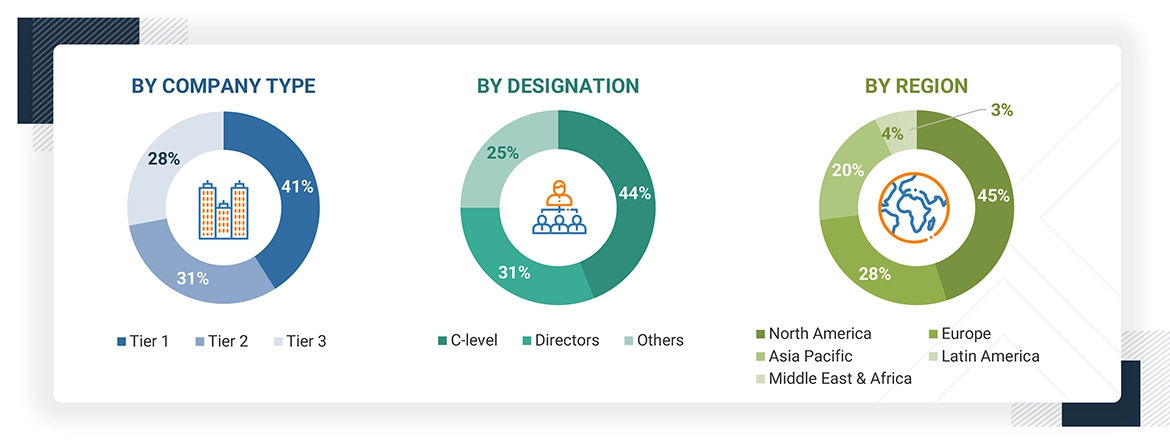
Note 1: Others include sales managers, marketing managers, and product managers.
Note 2: Tiers are defined based on a company’s total revenue, as of 2023: Tier 1 = >USD 1 billion, Tier 2 = USD 500 million to USD 1 billion, and Tier 3 = < USD 500 million.
To know about the assumptions considered for the study, download the pdf brochure
Market Size Estimation
The market size estimates and forecasts provided in this study are derived through a mix of the bottom-up approach (revenue share analysis of leading players) and top-down approach (assessment of utilization/adoption/penetration trends, by software type, workflow, integration complexity, software licensing model, revenue model, application, therapeutic area, technology maturity, end user, and region).
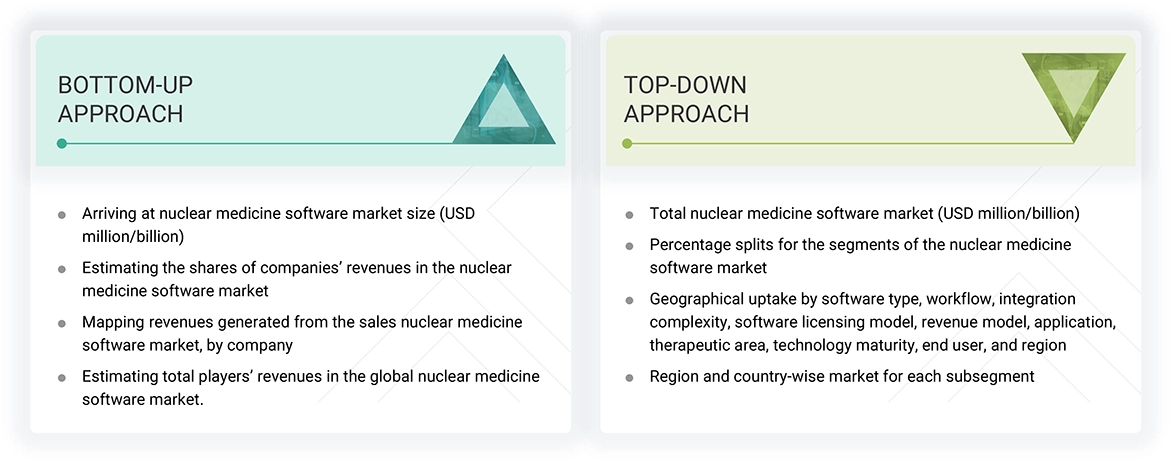
Data Triangulation
After arriving at the overall market size, from the market size estimation process explained above, the nuclear medicine software market was split into segments and subsegments. To complete the overall market engineering process and to arrive at the exact statistics for all segments and subsegments, data triangulation and market breakdown procedures were employed, wherever applicable. The data was triangulated by studying various factors and trends from both the demand and supply sides in the nuclear medicine software market.
Market Definition
Nuclear medicine software refers to specialized platforms and solutions used for visualizing, analyzing, interpreting, and processing medical images and data obtained from nuclear medicine procedures. These solutions are vital for healthcare professionals who are analyzing images from PET and SPECT scans. These software solutions aid in various tasks such as image acquisition, reconstruction, analysis, quantification, dosimetry, treatment planning, radiopharmaceutical management, data management, analytics, and reporting.
Stakeholders
- Nuclear Medicine Software Vendors & Imaging Device Manufacturers
- Healthcare Providers (Hospitals, outpatient settings, diagnostics and imaging centers, radiopharmacies, other healthcare providers)
- Clinical research organizations (CROs)
- Research & development (R&D) companies
- Business research & consulting service providers
- Medical research laboratories
- Academic medical centers/universities/hospitals/research institutes
- Regulatory bodies (FDA, EMA, IAEA)
- AI & Algorithm Developers
- Venture capitalists
- Advocacy groups
- Investors & financial institutions
- Contract Manufacturing Organizations (CMOs)
- Contract Research Organizations (CROs)
Report Objectives
- To define, describe, and forecast the nuclear medicine software market by software type, workflow, integration complexity, software licensing model, revenue model, application, therapeutic area, technology maturity, end user, and region
- To provide detailed information regarding the major drivers, restraints, opportunities, and challenges influencing market growth
- To strategically analyze micromarkets with respect to individual growth trends, prospects, and contributions to the overall nuclear medicine software market
- To analyze market opportunities for stakeholders and provide details of the competitive landscape for key players.
- To forecast the size of the nuclear medicine software market in five main regions (and their respective countries): North America, Europe, the Asia Pacific, the Middle East & Africa, and Latin America
- To provide key industry insights, such as supply chain, regulatory, patent, and the impact of AI/Gen AI analysis.
- To profile the key players in the market and comprehensively analyze their core competencies
- To track and analyze competitive developments, such as product launches & upgrades, collaborations, partnerships, acquisitions, investments, contracts, agreements, alliances, mergers, funding, and expansions of the leading players in the market
- To benchmark players within the market using the company evaluation matrix, which analyzes market players on various parameters within the broad categories of business strategy, market share, and product offering
Get the Full Nuclear Medicine Software Market Report
Full forecast, segment splits, and company analysis for all Nuclear Medicine Software Market.
- US Nuclear Medicine Software Market
- Canada Nuclear Medicine Software Market
- Germany Nuclear Medicine Software Market
- UK Nuclear Medicine Software Market
- France Nuclear Medicine Software Market
- Italy Nuclear Medicine Software Market
- Spain Nuclear Medicine Software Market
- Japan Nuclear Medicine Software Market
- China Nuclear Medicine Software Market
- Brazil Nuclear Medicine Software Market
- Mexico Nuclear Medicine Software Market
- Roe Nuclear Medicine Software Market
- Roapac Nuclear Medicine Software Market
- Rolatam Nuclear Medicine Software Market
Need a Tailored Report?
Customize this report to your needs
Get 10% FREE Customization
Customize This Report
