
France OLED-on-Silicon (OLEDoS) Market (2024-2029)

The France OLED-on-Silicon (OLEDoS) Market was valued at $22.3 Million in 2024 and projected to reach to $76.4 Million by 2029, representing a compound annual growth rate of 27.9%. France's OLEDoS market is poised for substantial growth through 2029, driven by increasing investments in advanced display technologies and microdisplay applications across the country's semiconductor ecosystem.


| Market Size in | USD 26.32 MN |
| Market Forecast in | |
| CAGR | |
| Forecast Period | |
| Units Considered | Value (USD MN) |
France OLED-on-Silicon (OLEDoS) Market Trends and Insights
- This represents a compound annual growth rate of 27.9%, reflecting strong demand for advanced microdisplay technologies across France's semiconductor and electronics sectors.
- France is positioning itself as a key player in the European OLEDoS ecosystem, driven by investments in AR/VR applications, military-grade displays, and high-resolution imaging solutions. The growth trajectory in France is underpinned by increasing adoption of OLEDoS technology in consumer electronics, defense systems, and industrial applications.
- Between 2024 and 2029, France's market is expected to more than triple in value, outpacing broader European trends.
- France's established semiconductor manufacturing base and innovation hubs are catalyzing development of next-generation microdisplay solutions, positioning the country as a strategic hub for OLEDoS innovation and commercialization within Europe..
Key Market Statistics
- CAGR (2024-2029) 27.9% CAGR
- Market Size, 2024 ~USD 22.3 Million
- Forecast, 2029 ~USD 76.4 Million
- Country France
France OLED-on-Silicon (OLEDoS) Market Overview
Strong CAGR Growth :
France's OLEDoS market is expanding at 27.9% CAGR from 2024-2029, demonstrating accelerating adoption of microdisplay technologies in the French semiconductor sector.
Significant Market Expansion :
Market valuation is projected to grow from $22.3 million in 2024 to $76.4 million by 2029, representing a 242% increase over five years in France's OLEDoS segment.
European Leadership Position :
France is establishing itself as a key hub in the European OLEDoS ecosystem, leveraging its advanced semiconductor manufacturing capabilities and R&D infrastructure.
Advanced Microdisplay Demand :
Robust demand for advanced microdisplay technologies across French electronics and semiconductor sectors is driving market growth and innovation in OLEDoS applications.
France OLED-on-Silicon (OLEDoS) Market Dynamics
- The 27.9% CAGR reflects strong market fundamentals and growing adoption among French electronics manufacturers and technology innovators. The French market benefits from the country's established semiconductor infrastructure, skilled workforce, and commitment to emerging technologies.
- Strategic positioning within Europe's broader OLEDoS landscape presents significant opportunities for French companies to capture market share in high-value microdisplay applications, particularly in AR/VR, defense, and industrial sectors..
Market Ecosystem
Related Ecosystem
Display Technology
- Augmented Reality
- Liquid Crystal Display (LCD)
- Sensors
- Virtual Reality Devices
- Liquid Crystal on Silicon (LCOS)
- VIVITEK CORPORATION
- Samsung
- Lenovo
- Panasonic Holdings Corporation
- Lg corp
Augmented Virtual Reality
- Sensors
- Virtual Reality Devices
- Augmented Reality
- Virtual Reality
- Augmented Reality Devices
- MICROSOFT CORPORATION
- Lenovo
- VIVITEK CORPORATION
- Apple Inc.
Key Takeaways
- France's OLEDoS market will grow from $22.3M (2024) to $76.4M (2029), a 27.9% CAGR expansion.
- France is leveraging its semiconductor expertise to drive OLEDoS adoption in AR/VR and defense applications.
- France's market growth outpaces global trends, reflecting strong regional demand and innovation investment.
- France's established tech ecosystem positions it as a critical European hub for OLEDoS commercialization by 2029.
OLED-on-Silicon (OLEDoS) Market Report Scope
| Report Metric | Details |
|---|---|
| Base Year | 2024 |
| Fastest Growing Segment | MORE THAN 1" (Display Size) |
| Forecast Period | 2024-2029 |
| Growth Rate | CAGR of 34.5% from 2024 to 2029 |
| Largest Segment | NEAR-EYE DISPLAYS (Product Type) |
| Market Size Base Year (Billions) | ~USD 0.53 (2024) |
| Revenue Forecast (Billions) | ~USD 2.35 (2029) |
| Segments Covered | Display Size, Product Type, Near-Eye Display, Vertical |
France OLED-on-Silicon (OLEDoS) Market Report Segmentation
4 segment dimensions are covered across the global market.
By Display Size
- Less Than 1"
- Less Than 1"
- More Than 1"
- More Than 1"
By Product Type
- Head-Up Displays
- Huds
- Near-Eye Displays
- Other Product Types
By Near-Eye Display
- Evfs
- Hmds
By Vertical
- Aerospace & Defense
- Aerospace And Defense
- Consumer
- Industrial & Enterprise
- Industrial And Enterprise
- Other Verticals
Target Audience
- French Semiconductor Manufacturers : Need detailed market data to assess OLEDoS opportunities, plan production capacity, and develop competitive strategies within France's growing microdisplay technology sector.
- Electronics & Display Companies : Require France-specific market insights to identify OLEDoS application opportunities, evaluate supplier partnerships, and make informed investment decisions in advanced display technologies.
- Investment & Private Equity Firms : Seek comprehensive France market analysis to identify high-growth OLEDoS companies, assess investment potential, and evaluate market entry strategies in the French semiconductor ecosystem.
- Technology Consultants & Analysts : Need accurate France OLEDoS data to support client advisory services, competitive benchmarking, and strategic planning for companies targeting the French and European markets.
- Government & Policy Organizations : Require market intelligence on France's OLEDoS sector to inform technology policy, support domestic industry development, and align with European semiconductor strategic initiatives.
Reasons to Buy this Report
- France-Specific Market Sizing : Obtain precise valuation data for France's OLEDoS market with detailed 2024-2029 forecasts, enabling accurate budgeting and investment planning for French market entry or expansion.
- Competitive Intelligence : Understand France's unique market dynamics, local player positioning, and competitive landscape to identify partnership opportunities and differentiation strategies within the French semiconductor sector.
- Growth Opportunity Assessment : Leverage the 27.9% CAGR data to evaluate France as a high-growth market for OLEDoS technologies, supporting strategic decisions on resource allocation and market prioritization.
- Regulatory & Infrastructure Insights : Access France-specific information on semiconductor manufacturing capabilities, R&D ecosystems, and regulatory environment critical for successful market operations and compliance.
- Demand Forecasting : Utilize detailed French market projections to forecast demand for OLEDoS components, microdisplay applications, and related technologies across key French industry verticals.
Frequently asked questions
What is the current size of France's OLEDoS market?
France's OLED-on-Silicon market was valued at $22.3 million in 2024 and is expected to grow to $76.4 million by 2029.
What is the projected growth rate for OLEDoS in France?
France's OLEDoS market is projected to grow at a compound annual growth rate (CAGR) of 27.9% from 2024 to 2029.
Which industries are driving OLEDoS adoption in France?
Key drivers in France include augmented reality/virtual reality applications, military and defense systems, consumer electronics, and high-resolution industrial imaging solutions.
How does France's OLEDoS market compare to global trends?
France's 27.9% CAGR outpaces the global OLEDoS CAGR of 34.5%, demonstrating strong regional momentum and market maturation specific to France's technology landscape.
What factors support France's OLEDoS market expansion through 2029?
France's growth is supported by its established semiconductor manufacturing base, innovation hubs, increasing AR/VR investments, and rising demand for advanced microdisplay technologies in defense and consumer sectors.
RESEARCH METHODOLOGY
The research study involved 4 major activities in estimating the size of the OLED-on-Silicon (OLEDoS) market. Exhaustive secondary research has been done to collect important information about the market and peer markets. The validation of these findings, assumptions, and sizing with the help of primary research with industry experts across the value chain has been the next step. Both top-down and bottom-up approaches have been used to estimate the market size. Post which the market breakdown and data triangulation have been adopted to estimate the market sizes of segments and sub-segments.
Secondary Research
In secondary research, various secondary sources have been referred to for obtaining the information that was needed for the study. Various secondary sources that were used for the research include, corporate filings such as annual reports, press releases, investor presentations, and financial statements, trade, business, and professional associations, whitepapers, journals, certified publications, and articles from recognized authors and databases.
In the OLED-on-Silicon (OLEDoS) market report, the top-down as well as the bottom-up approaches have been used for the estimation of the global market size, along with several other dependent submarkets. The major players in the market were identified with the help of extensive secondary research and their presence in the market was determined using secondary and primary research. All the percentage shares, splits, and breakdowns have been determined using secondary sources and verified through primary sources.
Primary Research
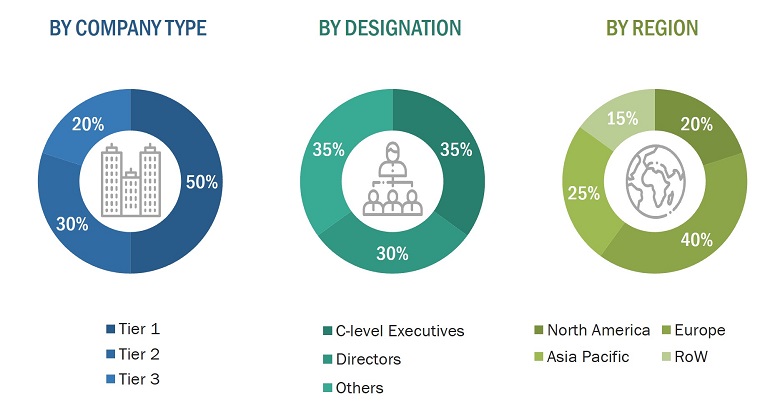
Extensive primary research has been conducted after understanding the OLED-on-Silicon (OLEDoS) market scenario through secondary research. Several primary interviews have been conducted with key opinion leaders from both demand- and supply-side vendors across 4 major regions— North America, Europe, Asia Pacific, and the Rest of the World. Approximately 25% of the primary interviews have been conducted with the demand-side vendors and 75% with the supply-side vendors. Primary data has been collected mainly through telephonic interviews, which consist of 80% of the total primary interviews; questionnaires and emails have also been used to collect the data.
After successful interaction with industry experts, brief sessions were conducted with highly experienced independent consultants to reinforce the findings of our primary research. This, along with the in-house subject matter experts’ opinions, has led us to the findings as described in the report.
To know about the assumptions considered for the study, download the pdf brochure
Market Size Estimation
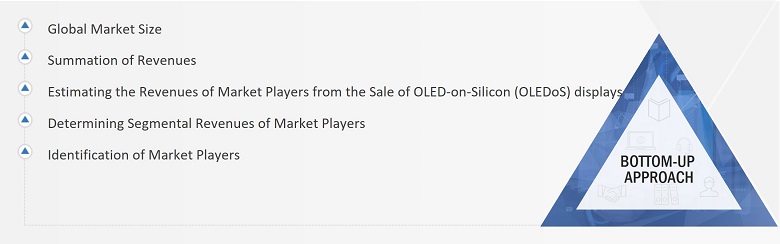
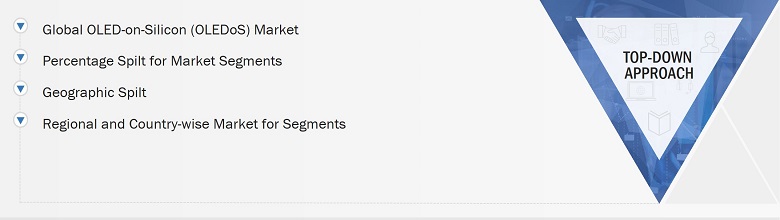
In the market engineering process, both top-down and bottom-up approaches along with data triangulation methods have been used to estimate and validate the size of the OLED-on-Silicon (OLEDoS) market and other dependent submarkets. The research methodology used to estimate the market sizes includes the following:
- Identifying top-line investments and spending in the ecosystem and considering segment-level splits and major market developments
- Identifying different stakeholders in the OLED-on-Silicon (OLEDoS) market that influence the entire market, along with participants across the supply chain
- Analyzing major manufacturers of OLEDoS displays and studying their product portfolios
- Analyzing trends related to the adoption of OLEDoS display
- Tracking recent and upcoming market developments, including investments, R&D activities, product launches, collaborations, mergers and acquisitions, and partnerships, as well as forecasting the market size based on these developments and other critical parameters
- Carrying out multiple discussions with key opinion leaders to identify the adoption trends of OLEDoS display in different applications
- Segmenting the overall market into various other market segments
- Validating the estimates at every level through discussions with key opinion leaders, such as chief executives (CXOs), directors, and operation managers, and finally with the domain experts at MarketsandMarkets
Market Size Estimation Methodology-Bottom-up Approach
Market Size Estimation Methodology-Top-Down Approach
Data Triangulation
After arriving at the overall market size through the market size estimation process explained in the earlier section, the overall OLED-on-Silicon (OLEDoS) market has been divided into several segments and subsegments. To complete the overall market engineering process and arrive at the exact statistics for all segments, the data triangulation and market breakdown procedures have been used, wherever applicable. The data has been triangulated by studying various factors and trends from both the demand and supply side perspectives. Along with data triangulation and market breakdown, the market has been validated by top-down and bottom-up approaches.
Market Definition
The OLED-on-Silicon (OLEDoS) market focuses on designing and manufacturing microdisplays that combines OLED technology with silicon substrate. This combination takes advantage of OLEDs' high contrast ratios, wide color range, and quick response times, combined with the precision and scalability of silicon manufacturing. The key applications are AR/VR headsets, HUDs for automotive and aerospace, medical devices such as surgical headsets, military devices such as night vision goggles, and consumer electronics such as high-resolution camera viewfinders. Some of the key factors driving this market include technological advancements, increased demand for pocket-sized high-resolution display devices, and ever-growing applications across industries.
Driving the growth of the OLEDoS market is the significant investment in the ecosystem, covering various stages from raw material suppliers to end users. Raw material suppliers supply OLED chemicals and silicon wafers, two vital components used in making OLEDoS displays. Display manufacturers come up with innovations in products and scale them up to meet increasing demand. These microdisplays are then integrated into their products by the end users, who are spread across multiple industries, to bring an added dimension to performance and user experience. This ensures the market's growth and evolution, as cohesion in supply chain management acts as a driver for continuous technological development in this market, making OLEDoS a fundamental technology in the display industry.
Key Stakeholders
- Raw Material Suppliers
- Equipment Manufacturers
- OLEDoS Display Manufacturers
- Component Manufacturers
- End Users
- Research and Development Organizations
- Government and Regulatory Bodies
- Investors and Financial Institutions
- Supply Chain and Logistics Providers
- Technology Integrators and System Developers
The main objectives of this study are as follows:
- To define, describe, and forecast the OLED-on-Silicon (OLEDoS) market by product type, display size, vertical, service type, and region, in terms of value
- To describe and forecast the market size for various segments with respect to four main regions: North America, Europe, Asia Pacific, and Rest of the World (RoW), in terms of value
- To define, describe, and forecast the OLED-on-Silicon (OLEDoS) market, in terms of volume, on the basis of display size.
- To provide detailed information regarding the major drivers, restraints, opportunities, and challenges influencing the growth of the OLED-on-Silicon (OLEDoS) market
- To study the complete supply chain and related industry segments for the OLED-on-Silicon (OLEDoS) market
- To strategically analyze the micromarkets1 with respect to individual growth trends, prospects, and contributions to the total market
- To provide ecosystem analysis, trade analysis, case study analysis, patent analysis, technology analysis, pricing analysis, Porter’s five forces analysis, key stakeholders and buying criteria, key conferences and events, regulatory bodies, government agencies, and regulations pertaining to the market under study
- To analyze opportunities in the market for various stakeholders by identifying high-growth segments of the market
- To strategically profile the key players and comprehensively analyze their market position in terms of ranking and core competencies2, along with detailing the competitive landscape for the market leaders
- To analyze competitive developments such as service launches, collaborations, mergers and acquisitions, agreements, partnerships, and expansion activities carried out by players in the OLED-on-Silicon (OLEDoS) market
Available Customizations:
With the given market data, MarketsandMarkets offers customizations according to the specific requirements of companies. The following customization options are available for the report:
Country-wise Information:
- Country-wise breakdown for North America, Europe, Asia Pacific, and Rest of the World
Company Information:
- Detailed analysis and profiling of additional market players (up to five)
Get the Full OLED-on-Silicon (OLEDoS) Market Report
Full forecast, segment splits, and company analysis for all OLED-on-Silicon (OLEDoS) Market.
- Canada OLED-on-Silicon (OLEDoS) Market
- Mexico OLED-on-Silicon (OLEDoS) Market
- US OLED-on-Silicon (OLEDoS) Market
- Germany OLED-on-Silicon (OLEDoS) Market
- UK OLED-on-Silicon (OLEDoS) Market
- Rest Of Europe OLED-on-Silicon (OLEDoS) Market
- China OLED-on-Silicon (OLEDoS) Market
- Japan OLED-on-Silicon (OLEDoS) Market
- South Korea OLED-on-Silicon (OLEDoS) Market
- Taiwan OLED-on-Silicon (OLEDoS) Market
- Rest Of Asia Pacific OLED-on-Silicon (OLEDoS) Market
- GCC Countries OLED-on-Silicon (OLEDoS) Market
- Rest Of Middle East OLED-on-Silicon (OLEDoS) Market
Need a Tailored Report?
Customize this report to your needs
Get 10% FREE Customization
Customize This Report
