
Rest Of South America Onshore Wind Market (2026-2031)

The Rest Of South America Onshore Wind Market was valued at $1639.5 Million in 2026 and projected to reach to $6240 Million by 2031, representing a compound annual growth rate of 16.0%. Rest Of South America's onshore wind market is poised for exceptional growth, driven by increasing energy demand, climate commitments, and improving wind resource utilization across the region.


| Market Size in | USD 26.32 MN |
| Market Forecast in | |
| CAGR | |
| Forecast Period | |
| Units Considered | Value (USD MN) |
Rest Of South America Onshore Wind Market Trends and Insights
- This represents a compound annual growth rate of 16.0%, significantly outpacing global trends and reflecting the region's accelerating commitment to renewable energy infrastructure.
- Rest Of South America is capitalizing on favorable wind resources, supportive regulatory frameworks, and increasing investment in clean energy transition initiatives. The growth trajectory for Rest Of South America demonstrates strong momentum driven by rising electricity demand, climate commitments, and technological advancements in wind turbine efficiency.
- Rest Of South America's onshore wind sector is attracting both domestic and international developers seeking to diversify energy portfolios across South America.
- By 2031, Rest Of South America is positioned to become a critical hub for wind energy generation, with expanding capacity additions and grid modernization efforts supporting market expansion..
Key Market Statistics
- CAGR (2026-2031) 16.0% CAGR
- Market Size, 2026 ~USD 1639.5 Million
- Forecast, 2031 ~USD 6240 Million
- Country Rest Of South America
Rest Of South America Onshore Wind Market Overview
Exceptional Growth Trajectory :
Rest Of South America's onshore wind market is projected to grow from USD 1,639.5 million in 2026 to USD 6,240 million by 2031, representing a 16% CAGR that significantly exceeds the global average of 10.3%.
Regional Renewable Energy Leadership :
The region is demonstrating accelerating commitment to renewable energy infrastructure, positioning itself as a key player in South America's energy transition and sustainability goals.
Investment Opportunity Window :
The 281% market expansion over five years creates substantial opportunities for developers, investors, and equipment manufacturers entering or expanding operations in Rest Of South America.
Policy-Driven Market Expansion :
Government incentives, renewable energy targets, and favorable regulatory frameworks are driving the rapid deployment of onshore wind capacity across the region's diverse geography.
Rest Of South America Onshore Wind Market Dynamics
- The 16% CAGR reflects strong government support for renewable energy transitions and substantial private sector investment in wind infrastructure development.
- By 2031, the market is expected to nearly quadruple, establishing Rest Of South America as a critical hub for wind energy in the Southern Hemisphere. Key growth catalysts include technological advancements in turbine efficiency, declining installation costs, and expanding grid infrastructure to accommodate renewable generation.
- The region's favorable wind conditions, combined with competitive manufacturing capabilities and skilled workforce development, position Rest Of South America for sustained market expansion.
- Strategic partnerships between international developers and local stakeholders will further accelerate capacity additions and market maturation..
Market Ecosystem
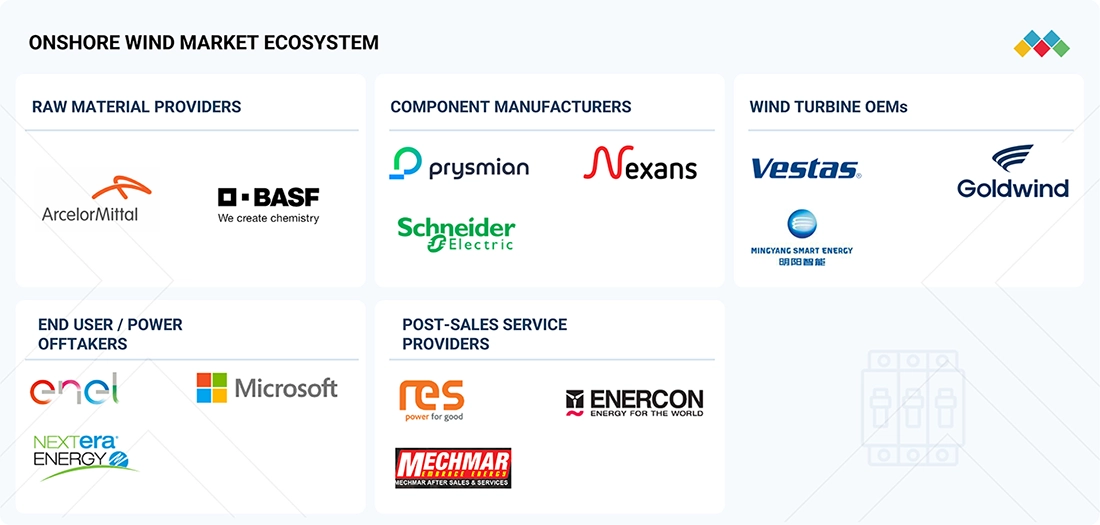
ONSHORE WIND MARKET: COMMERCIAL USE CASES ACROSS INDUSTRIES
| COMPANY | USE CASE DESCRIPTION | BENEFITS |
|---|---|---|
 |
Whitelee Wind Farm, one of the UK’s largest onshore wind facilities, required modernization to improve energy output and operational efficiency while supporting the country’s renewable energy targets. Aging assets and evolving grid requirements made repowering and digital optimization increasingly important. | Modernization enhanced annual energy production, reduced maintenance-related downtime, extended asset life, and improved overall project economics. It also supported lower lifecycle costs and increased reliability, enabling the wind farm to continue supplying renewable electricity efficiently. |
 |
The 372 MW Björnberget project in Sweden was developed to strengthen renewable electricity generation in the Nordic region while taking advantage of favorable wind resources and modern high-capacity turbine technology | The project achieved higher energy capture, improved operational efficiency, and enhanced reliability, contributing substantial clean electricity to the regional grid while reducing the levelized cost of energy over the project lifetime. |
Logos and trademarks shown above are the property of their respective owners. Their use here is for informational and illustrative purposes only.
Related Ecosystem
Decarbonization
- Battery Electric Vehicle (BEV)
- Energy Management Systems
- Fuel Cell
- Fuel Cell Electric Vehicle (FCEV)
- Geographical Information System (GIS)
- TotalEnergies SE
- Siemens ag
- Mitsui & Co., Ltd.
- General Electric Company
- Thyssenkrupp ag
Key Takeaways
- Rest Of South America's onshore wind market will grow from USD 1,639.5M (2026) to USD 6,240M (2031) at a 16.0% CAGR, outpacing global growth rates.
- Rest Of South America benefits from abundant wind resources and supportive policy environments that accelerate renewable energy adoption and infrastructure investment.
- Rest Of South America is attracting significant capital from international developers and domestic players expanding clean energy portfolios across the region.
- Rest Of South America's market expansion is driven by rising electricity demand, climate commitments, and technological improvements in turbine efficiency and grid integration.
Onshore Wind Market Report Scope
| Report Metric | Details |
|---|---|
| Base Year | 2026 |
| Fastest Growing Segment | ABOVE 5 MW (Turbine Rating) |
| Forecast Period | 2026-2031 |
| Growth Rate | CAGR of 10.3% from 2026 to 2031 |
| Largest Segment | TURBINES (Component) |
| Market Size Base Year (Billions) | ~USD 132.9 (2026) |
| Revenue Forecast (Billions) | ~USD 216.97 (2031) |
| Segments Covered | Component, Turbine Rating |
Rest Of South America Onshore Wind Market Report Segmentation
2 segment dimensions are covered across the global market.
By Component
- Electrical Infrastructure
- Turbines
By Turbine Rating
- 2-3 Mw
- 4-5 Mw
- Above 5 Mw
- Below 2 Mw
Target Audience
- Wind Energy Developers : Need detailed market forecasts and regional growth drivers to identify optimal project locations, assess pipeline opportunities, and plan capacity expansion strategies in Rest Of South America.
- Investment & Private Equity Firms : Require market sizing, growth projections, and risk assessments specific to Rest Of South America to evaluate investment returns, portfolio diversification, and fund allocation in renewable energy.
- Equipment Manufacturers & Suppliers : Need demand forecasts and market dynamics for Rest Of South America to optimize production capacity, supply chain logistics, and sales strategies for turbines and components.
- Government & Policy Makers : Utilize market intelligence to design renewable energy policies, set capacity targets, allocate subsidies, and evaluate the effectiveness of incentive programs in Rest Of South America.
- Utility Companies & Energy Traders : Require market outlook and capacity forecasts for Rest Of South America to plan grid integration, power procurement strategies, and long-term energy portfolio management.
Reasons to Buy this Report
- Market Size & Growth Validation : Obtain precise market valuation for Rest Of South America (USD 1,639.5M in 2026, USD 6,240M in 2031) to support investment decisions, business planning, and competitive positioning in this high-growth region.
- Regional Opportunity Assessment : Identify specific growth drivers, policy frameworks, and infrastructure developments unique to Rest Of South America that differentiate it from other South American markets and global trends.
- Competitive Intelligence : Benchmark Rest Of South America's 16% CAGR against global performance (10.3%) to understand competitive advantages, market maturity levels, and strategic entry points for new players.
- Investment Risk Mitigation : Access detailed market segmentation, regulatory landscape, and demand forecasts specific to Rest Of South America to reduce investment risk and optimize capital allocation decisions.
- Strategic Planning & Expansion : Leverage region-specific insights to develop targeted expansion strategies, partnership opportunities, and supply chain optimization for onshore wind operations in Rest Of South America.
Frequently asked questions
What is the market size of onshore wind in Rest Of South America?
Rest Of South America's onshore wind market is valued at USD 1,639.5 million in 2026 and is projected to reach USD 6,240 million by 2031.
What is the CAGR for Rest Of South America's onshore wind market?
Rest Of South America's onshore wind market is expected to grow at a compound annual growth rate of 16.0% between 2026 and 2031.
What factors are driving growth in Rest Of South America's onshore wind sector?
Rest Of South America's market growth is driven by rising electricity demand, climate commitments, favorable wind resources, supportive regulatory frameworks, and technological advancements in turbine efficiency.
Who are the key investors in Rest Of South America's onshore wind market?
Rest Of South America is attracting both international developers and domestic players seeking to expand clean energy portfolios and capitalize on the region's renewable energy potential.
How does Rest Of South America's growth compare to global onshore wind market trends?
Rest Of South America's 16.0% CAGR significantly outpaces the global onshore wind market CAGR of 10.3%, reflecting the region's accelerating renewable energy transition.
RESEARCH METHODOLOGY
The study involved major activities in estimating the current size of the onshore wind market. Exhaustive secondary research was done to collect information on the peer and parent markets. The next step was to validate these findings, assumptions, and sizing with industry experts across the value chain through primary research. Both top-down and bottom-up approaches were employed to estimate the complete market size. Thereafter, market breakdown and data triangulation were used to estimate the market size of the segments and subsegments.
Secondary Research
This research study on the onshore wind market involved the use of extensive secondary sources, directories, and databases, such as D&B Hoovers, Bloomberg, Businessweek, Factiva, International Energy Agency, and BP Statistical Review of World Energy, to identify and collect valuable information for a technical, market-oriented, and commercial study of the global onshore wind market. The other secondary sources included companies' annual reports, press releases, and investor presentations; white papers; certified publications; articles by recognized authors; manufacturer associations; trade directories; and databases.
Primary Research
The onshore wind market comprises stakeholders across the value chain, including onshore wind turbine manufacturers, component suppliers, onshore cable manufacturers, onshore substation providers, EPC contractors, project developers, utilities, transmission system operators, engineering consultants, digital technology providers, and operations & maintenance service providers. On the demand side, the market is driven by the increasing deployment of onshore wind projects across key regions, including Europe, Asia Pacific, and North America, supported by growing investments from utilities, independent power producers (IPPs), governments, and industrial energy consumers seeking large-scale renewable energy solutions. On the supply side, turbine manufacturers, foundation suppliers, electrical infrastructure providers, and onshore service companies are benefiting from increasing project awards, long-term supply agreements, and investments in onshore renewable energy infrastructure. Various primary sources from both the supply and demand sides of the market were interviewed to obtain qualitative and quantitative information. The following is the breakdown of primary respondents:
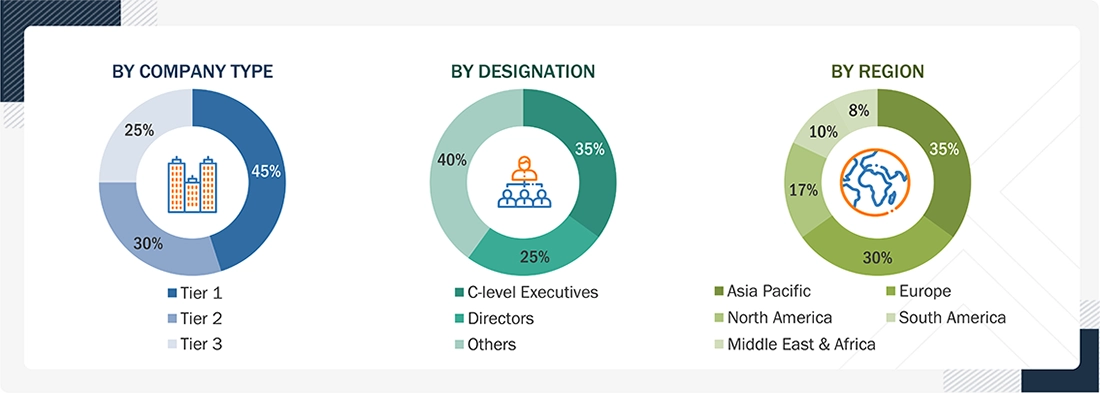
Note: Others include sales managers, engineers, and regional managers.
The tiers of the companies are defined by their total revenue as of 2024: Tier 1: > USD 1 billion; Tier 2: USD 500 million–1 billion; and Tier 3: < USD 500 million.
To know about the assumptions considered for the study, download the pdf brochure
Market Size Estimation
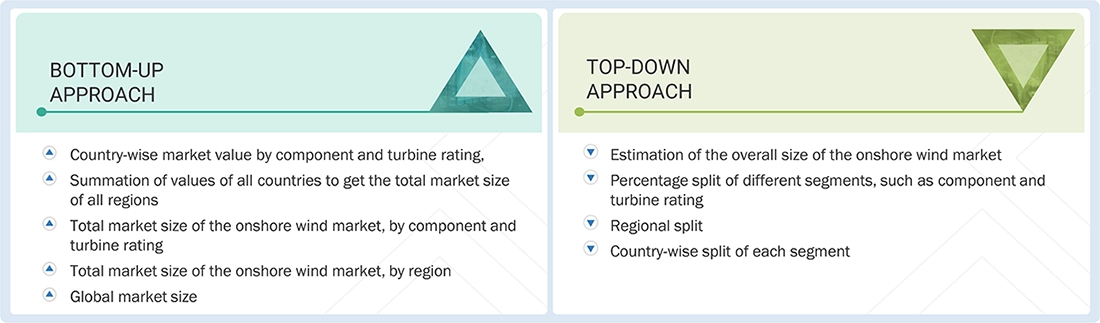
Both top-down and bottom-up approaches were employed to estimate and validate the size of the onshore wind market and its dependent submarkets. The key players in the market were identified through secondary research, and their market share in the respective regions was determined through a combination of primary and secondary research. The research methodology involves analyzing the annual and financial reports of leading market players and conducting interviews with industry experts, including chief executive officers, vice presidents, directors, sales managers, and marketing executives, to gather key quantitative and qualitative insights into the onshore wind market.
Data Triangulation
After determining the overall market size through the estimation process explained above, the total market has been divided into several segments and subsegments. To complete the overall market engineering process and obtain exact statistics for all segments and subsegments, data triangulation and market breakdown have been employed where applicable. The data has been triangulated by studying various factors and trends from both the demand and supply sides. Additionally, the market has been validated using both top-down and bottom-up approaches.
Market Definition
The onshore wind market encompasses the development, manufacturing, and installation of land-based wind energy systems that generate electricity from wind. It includes key components such as wind turbines, nacelles, rotors and blades, towers, and supporting electrical infrastructure, including wires and cables, substations, and related balance-of-plant equipment. The market covers turbine capacity segments ranging from up to 2 MW to above 5 MW and serves utility-scale, commercial, industrial, and government-backed renewable energy projects. Market growth is driven by decarbonization initiatives, favorable regulatory policies, technological advancements in turbine design, declining electricity generation costs, and increasing investments in sustainable and energy-secure power infrastructure.
Key Stakeholders
- Project Developers & Owners
- Turbine Manufacturers
- EPC Contractors & Marine Engineering Firms
- Mooring, Anchoring, & Subsea System Providers
- Electrical Infrastructure & Grid Connection Providers
- Governments & Regulatory Authorities
- Investors & Financial Institutions
- Research Institutions & Certification Bodies
- Energy Associations
- Environmental Associations
- Energy Efficiency Consultants
Report Objectives
- To describe and forecast the onshore wind market, by turbine rating and component, in terms of value
- To describe and forecast the onshore wind market for various segments with respect to five main regions: North America, Europe, Asia Pacific, South America, and Middle East & Africa, along with their country-level analysis, in terms of value
- To provide detailed information regarding the major drivers, restraints, opportunities, and challenges influencing the growth of the onshore wind market
- To analyze market opportunities for stakeholders and provide a detailed competitive landscape for market leaders
- To strategically analyze micromarkets about individual growth trends, prospects, and contributions to the total market
- To strategically profile the key players and comprehensively analyze their market shares and core competencies
- To provide a detailed overview of the unmet needs and white spaces, interconnected markets and cross-sector opportunities, strategic moves by tier-1/2/3 players, onshore wind market value chain analysis, ecosystem analysis, key conferences and events, key stakeholders and buying criteria, patent analysis, trends/disruptions impacting customer business, trade analysis, tariff analysis, investment and funding scenario, technology analysis, technology/product roadmap, case study analysis, regulations, future applications, macroeconomic outlook, pricing analysis, Porter’s five forces analysis, sustainability initiatives, adoption barriers and internal challenges, market profitability, impact of regulatory policies on sustainability initiatives, certifications, labeling and eco-standards, decision making process, impact of gen AI, and the 2024 US tariff impact
- To analyze competitive developments, such as agreements, product launches, expansions, contracts, investments, partnerships, collaborations, announcements, and acquisitions in the market
Available customizations:
MarketsandMarkets offers customizations tailored to the specific needs of companies using the given market data.
The following customization options are available for the report:
Product Analysis
- Product matrix, which gives a detailed comparison of the product portfolio of each company
Regional Analysis
- Further breakdown of the onshore wind systems, by country
Company Information
- Detailed analysis and profiling of additional market players (up to five)
Get the Full Onshore Wind Market Report
Full forecast, segment splits, and company analysis for all Onshore Wind Market.
- China Onshore Wind Market
- India Onshore Wind Market
- Australia Onshore Wind Market
- Vietnam Onshore Wind Market
- Canada Onshore Wind Market
- US Onshore Wind Market
- Germany Onshore Wind Market
- UK Onshore Wind Market
- Spain Onshore Wind Market
- France Onshore Wind Market
- Italy Onshore Wind Market
- Sweden Onshore Wind Market
- Saudi Arabia Onshore Wind Market
- South Africa Onshore Wind Market
- Brazil Onshore Wind Market
- Rest Of Europe Onshore Wind Market
- Rest Of Asia Pacific Onshore Wind Market
Need a Tailored Report?
Customize this report to your needs
Get 10% FREE Customization
Customize This Report
