
South America Organic Fertilizers Market (2024-2029)

The South America Organic Fertilizers Market was valued at $691.6 Million in 2024 and projected to reach to $1061 Million by 2029, representing a compound annual growth rate of 8.9%. South America's organic fertilizers market is positioned for sustained growth through 2029, supported by regulatory incentives for sustainable agriculture and growing export opportunities for organic produce.


| Market Size in | USD 26.32 MN |
| Market Forecast in | |
| CAGR | |
| Forecast Period | |
| Units Considered | Value (USD MN) |
South America Organic Fertilizers Market Trends and Insights
- This 8.9% compound annual growth rate reflects South America's increasing adoption of sustainable agricultural practices and rising consumer demand for organic produce.
- South America's agricultural sector is leveraging organic fertilizers to enhance soil health, reduce chemical dependency, and meet stringent export standards for organic certification. The region's growth is driven by favorable government policies promoting sustainable farming, expanding organic certification infrastructure, and growing export opportunities for organic products.
- South America benefits from diverse agroecological zones and established agricultural expertise, positioning it as a key player in the global organic fertilizers market.
- Between 2024 and 2029, South America is expected to capture significant market share as farmers transition from conventional to organic farming methods and multinational agribusinesses expand their organic portfolios in the region..
Key Market Statistics
- CAGR (2024-2029) 8.9% CAGR
- Market Size, 2024 ~USD 691.6 Million
- Forecast, 2029 ~USD 1061 Million
- Geography South America
South America Organic Fertilizers Market Overview
Strong Regional Growth Trajectory :
South America's organic fertilizers market is expanding at 8.9% CAGR, growing from USD 691.6 million in 2024 to USD 1,061.0 million by 2029, driven by increasing adoption of sustainable farming practices across the region.
Brazil Leads Market Expansion :
Brazil dominates South America's organic fertilizers sector with a market size of USD 475.4 million, representing the largest agricultural economy in the region and primary driver of organic product demand.
Rising Organic Produce Demand :
Consumer preference for organic products is accelerating across South American markets, with retailers and exporters increasingly sourcing from certified organic farms utilizing sustainable fertilizer solutions.
Sustainable Agriculture Adoption :
South American farmers are transitioning to organic fertilizers to meet international certification standards, reduce environmental impact, and access premium markets for organic agricultural exports.
South America Organic Fertilizers Market Dynamics
- Brazil and Argentina are leading this transition, with farmers increasingly recognizing the long-term economic and environmental benefits of organic fertilizer adoption.
- The region's favorable climate and agricultural infrastructure create ideal conditions for scaling organic farming operations. Market expansion will be further accelerated by rising consumer awareness of food safety and sustainability across South American countries.
- Investment in organic certification programs, government subsidies for sustainable practices, and partnerships between agricultural cooperatives and fertilizer manufacturers are expected to drive market penetration.
- By 2029, South America is projected to capture a significant share of global organic fertilizer demand, positioning the region as a key supplier of organic agricultural products..
Market Ecosystem
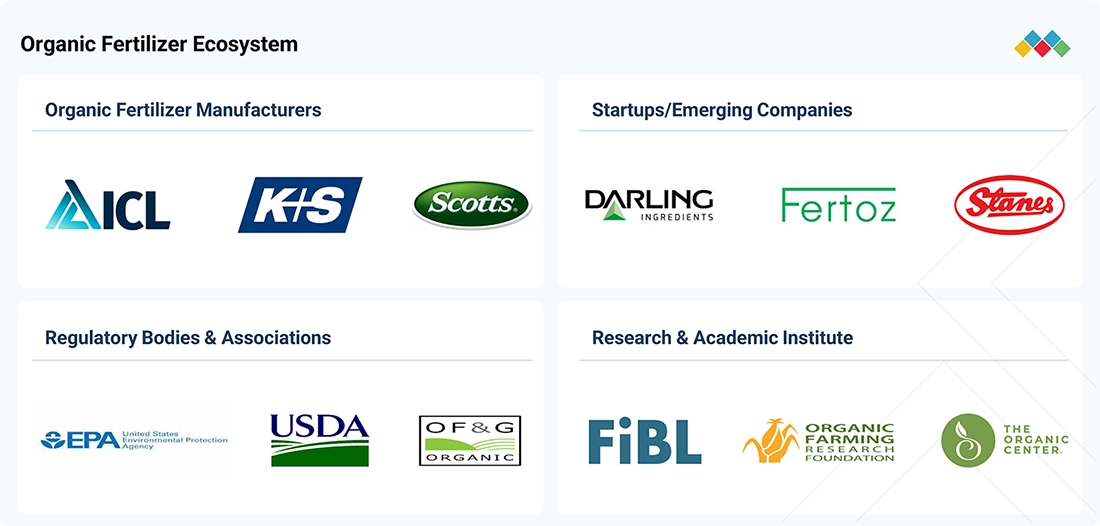
ORGANIC FERTILIZERS MARKET: COMMERCIAL USE CASES ACROSS INDUSTRIES
| COMPANY | USE CASE DESCRIPTION | BENEFITS |
|---|---|---|
 |
Supply of certified organic amendments and blended fertilizers for fruits, vegetables, and row crops | Enhances soil fertility, ensures balanced nutrient supply, and supports sustainable and climate-friendly farming |
 |
Production and distribution of plant- and animal-based organic fertilizers for smallholder and commercial farms | Improves soil health, microbial activity, and crop yield while reducing reliance on chemical fertilizers |
 |
Organic lawn and garden fertilizers for residential and professional applications | Promotes healthy plant growth, improves soil structure, and provides eco-friendly alternatives for consumers |
 |
Specialized organic fertilizers for high-value crops and horticulture | Delivers targeted nutrition, enhances soil microbiome, and supports sustainable agricultural practices |
Logos and trademarks shown above are the property of their respective owners. Their use here is for informational and illustrative purposes only.
Related Ecosystem
Agricultural Biologicals
- Bionematicides
- Auxins
- Cytokinins
- Ethylene
- Humic Substances
- NICHINO INDIA PVT LTD.
- Corteva, Inc.
- Basf se
- AZELIS HOLDINGS SA
- BAYER AG
Agrochemicals
- Phosphatic Fertilizers
- Potassic Fertilizers
- Fungicides
- Ammonium Nitrate
- Anticoagulant Rodenticides
- AZELIS HOLDINGS SA
- Basf se
- Origin Enterprises plc
- MITSUI AGRO BUSINESS SACO
- SNF HOLDING COMPANY INC.
Key Takeaways
- South America's organic fertilizers market will grow from $691.6M (2024) to $1,061M (2029) at an 8.9% CAGR.
- South America is leveraging sustainable agriculture policies and organic certification to drive market expansion.
- South America's diverse agroecological zones support varied organic fertilizer applications across multiple crop types.
- South America is positioned as a major exporter of organic products, strengthening demand for certified organic fertilizers.
Organic Fertilizers Market Report Scope
| Report Metric | Details |
|---|---|
| Base Year | 2024 |
| Fastest Growing Segment | PLANT (Source) |
| Forecast Period | 2024-2029 |
| Growth Rate | CAGR of 11.5% from 2024 to 2029 |
| Largest Segment | NITROGENOUS (Type) |
| Market Size Base Year (Billions) | ~USD 7.89 (2024) |
| Revenue Forecast (Billions) | ~USD 13.6 (2029) |
| Segments Covered | Source, Crop Type, Form, Mode Of Application, Type |
South America Organic Fertilizers Market Report Segmentation
5 segment dimensions are covered across the global market.
By Source
- Animal
- Mineral
- Plant
By Crop Type
- Cereals & Grains
- Fruits & Vegetables
- Oilseeds & Pulses
- Other Crop Types
By Form
- Dry
- Liquid
By Mode Of Application
- Fertigation
- Foliar
- Soil Treatment
By Type
- Micronutrients
- Nitrogen-Fixing Biofertilizers
- Nitrogenous
- Other Types
- Phosphate Solubilizing & Mobilizing Biofertilizers
- Phosphatic
- Potassic
- Potassium Solubilizing & Mobilizing Biofertilizers
Target Audience
- Fertilizer Manufacturers & Suppliers : Manufacturers need South America-specific market data to develop regional product portfolios, establish distribution networks, and capitalize on the 8.9% CAGR growth opportunity.
- Agricultural Cooperatives & Farmers : Farming organizations require market insights to make informed decisions about transitioning to organic fertilizers and understanding regional demand trends for organic produce.
- Investment & Private Equity Firms : Investors need detailed South American market analysis to evaluate acquisition targets, assess growth potential, and identify emerging opportunities in the organic agriculture sector.
- Agricultural Export Companies : Export-focused businesses require regional market intelligence to understand organic certification requirements, competitive positioning, and demand drivers across South American markets.
- Government & Policy Makers : Agricultural policy officials need market data to develop sustainable farming incentives, set certification standards, and align regional agricultural strategies with organic market growth.
Countries within South America - compare and drill down
| Country | 2025 size (native) |
|---|---|
| Brazil | USD 475.4 Million |
| Argentina | USD 325.9 Million |
Country market size visualization
Reasons to Buy this Report
- Market Size & Growth Projections : Access detailed forecasts showing South America's organic fertilizers market expanding from USD 691.6M to USD 1,061.0M by 2029, enabling strategic investment and capacity planning decisions.
- Country-Level Market Intelligence : Gain granular insights into Brazil, Argentina, and other South American markets with specific market valuations, allowing targeted market entry and localized business strategies.
- Competitive Landscape Analysis : Understand regional market dynamics, key players, and competitive positioning specific to South America's organic fertilizers sector to identify partnership and acquisition opportunities.
- Regulatory & Sustainability Trends : Stay informed on South American organic certification standards, government incentives, and sustainability regulations driving market adoption and shaping future demand.
- Export & Supply Chain Opportunities : Identify high-growth segments and distribution channels across South America's agricultural supply chain to optimize market penetration and revenue generation.
Frequently asked questions
What is the current size of South America's organic fertilizers market?
South America's organic fertilizers market was valued at USD 691.6 million in 2024.
What is the projected market size for South America by 2029?
South America's organic fertilizers market is forecast to reach USD 1,061.0 million by 2029.
What is the CAGR for South America's organic fertilizers market?
South America's organic fertilizers market is expected to grow at a compound annual growth rate of 8.9% from 2024 to 2029.
What factors are driving growth in South America's organic fertilizers market?
South America's market growth is driven by sustainable agriculture policies, expanding organic certification infrastructure, rising export demand for organic products, and farmer transition from conventional to organic farming methods.
Why is South America important for the global organic fertilizers market?
South America is a major exporter of organic agricultural products with diverse agroecological zones, established farming expertise, and strong government support for sustainable practices, making it a key regional market.
RESEARCH METHODOLOGY
The study involved four major activities in estimating the current size of the organic fertilizer market. Exhaustive secondary research was done to collect information on the market, peer, and parent markets. The next step was to validate these findings, assumptions, and sizing with industry experts across the value chain through primary research. Both top-down and bottom-up approaches were employed to estimate the complete market size. After that, market breakdown and data triangulation were used to estimate the market size of segments and subsegments.
Secondary Research
This research study involved the extensive use of secondary sources—directories and databases such as Bloomberg Businessweek and Factiva—to identify and collect information useful for a technical, market-oriented, and commercial study of the organic fertilizer market.
In the secondary research process, various sources such as annual reports, press releases & investor presentations of companies, white papers, certified publications, articles from recognized authors, gold & silver standard websites, directories, and databases were referred to identify and collect information. This research study involved the extensive use of secondary sources—directories and databases such as Bloomberg Businessweek and Factiva—to identify and collect information useful for a technical, market-oriented, and commercial study of the organic fertilizer market.
Secondary research was mainly used to obtain key information about the industry’s supply chain, the total pool of key players, and market classification and segmentation as per industry trends to the bottom-most level, regional markets, and key developments from both market- and technology-oriented perspectives.
Primary Research
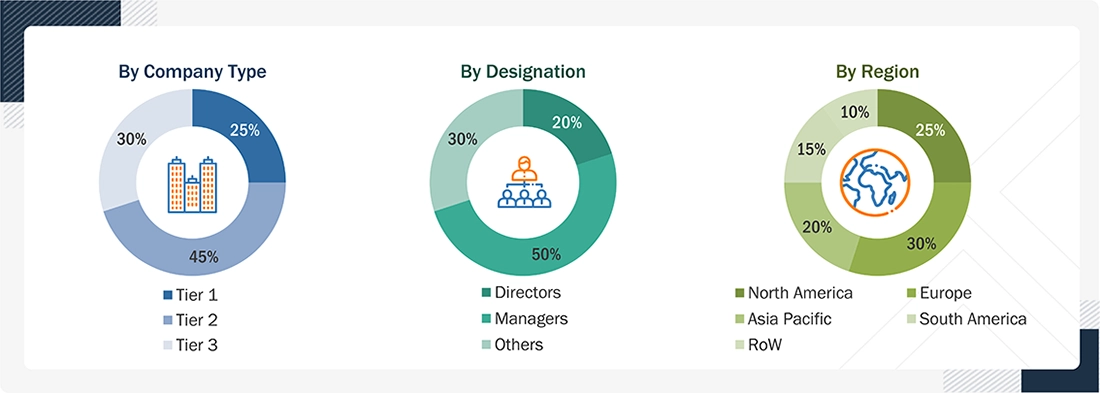
Extensive primary research was conducted after obtaining information regarding the organic fertilizer market scenario through secondary research. Several primary interviews were conducted with market experts from both the demand and supply sides across major countries of North America, Europe, Asia Pacific, the Middle East & Africa, and South America. Primary data were collected through questionnaires, emails, and telephonic interviews. The primary sources from the supply side included various industry experts, such as Chief X Officers (CXOs), Vice Presidents (VPs), Directors from business development, marketing, research, and development teams, and related key executives from distributors and key opinion leaders. Primary interviews were conducted to gather insights such as market statistics, data on revenue collected from the products and services, market breakdowns, market size estimations, market forecasting, and data triangulation. Primary research also helped in understanding the various trends related to crop type, source, form, and region.
To know about the assumptions considered for the study, download the pdf brochure
Market Size Estimation
Both the top-down and bottom-up approaches were used to estimate and validate the total size of the organic fertilizer market. These approaches were also used extensively to estimate the size of various dependent submarkets. The research methodology used to estimate the market size includes the following:
- Key players were identified through extensive secondary research.
- Primary and secondary research determined the industry’s value chain and market size.
- All percentage share splits and breakdowns were determined using secondary sources and verified through primary sources.
- All the possible parameters that affect the markets covered in this research study were accounted for, viewed in extensive detail, verified through primary research, and analyzed to obtain the final quantitative and qualitative data.
- The following figure provides an illustrative representation of the complete market size estimation process implemented in this research study for an overall estimation of the organic fertilizer market in a consolidated format.
The following sections (bottom-up & top-down) depict the overall market size estimation process employed for the purpose of this study.
Global Organic Fertilizer Market: Bottom-Up & Top-Down Approach
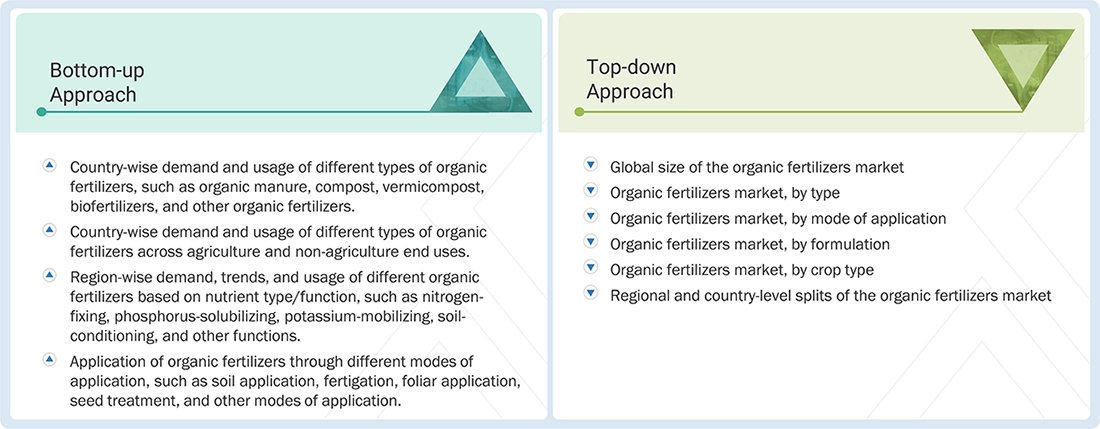
Note: The three tiers of the companies are defined based on their total revenues in 2024 or 2025, as per the availability of financial data: Tier 1: Revenue > USD 1 billion; Tier 2: USD 100 million - USD 1 billion; Tier 3: Revenue < USD 100 million.
|
COMPANY NAME |
DESIGNATION |
|
Yara (Norway) |
Sales Manager |
|
ICL (Israel) |
Territory Sales Manager |
|
K+S Aktiengesellschaft (Germany) |
Regional Marketing Manager |
|
The Scotts Company LLC (United States) |
Operation Manager |
|
Coromandel International Limited (India) |
Marketing Manager |
Data Triangulation
After arriving at the overall market size from the estimation process explained above, the total market was split into several segments and subsegments. Data triangulation and market breakdown procedures were employed, wherever applicable, to estimate the overall organic fertilizer market and arrive at the exact statistics for all segments and subsegments. The data were triangulated by studying various factors and trends from the demand and supply sides. The market size was also validated using both the top-down and bottom-up approaches.
Market Definition
According to the definition given by the International Fertilizer Industry Association (IFA), “fertilizers are any solid, liquid or gaseous substances containing one or more plant nutrients, which are either applied to the soil, directly on the plant (foliage) or added to aqueous solutions (fertigation), in order to maintain soil fertility, improve crop development, yield, and crop quality.” Organic fertilizers refer to categories of fertilizers that are produced from naturally derived components and do not include synthetic chemicals or materials in their preparation.
For this study, the global organic fertilizer market is defined as the market for commercially produced, naturally derived fertilizers that are certified “organic” by credible, relevant, and respective regulatory authorities pertaining to their jurisdiction, across the globe.
Key Stakeholders
- Manufacturers, dealers, and suppliers of organic fertilizers
- Government bodies
- Farmers (Growers)
- Intermediate suppliers, such as retailers, wholesalers, and distributors
- Raw material suppliers
- Technology providers
- Industry associations
- Regulatory bodies and institutions
- World Health Organization (WHO)
- US Food and Drug Administration (FDA)
- Codex Alimentarius Commission (CAC)
- EUROPA
- United States Department of Agriculture (USDA)
- International Fertilizer Society (IFS)
- Research Institute of Organic Agriculture (FiBL)
- Logistics providers & transporters
- Research institutes and organizations
- Consulting companies/consultants in the agricultural and animal farming technology sectors
Report Objectives
MARKET INTELLIGENCE
- Determining and projecting the size of the organic fertilizer market with respect to crop type, source, form, and region
- Identifying the attractive opportunities in the market by determining the largest and fastest-growing segments
- Providing detailed information about the key factors influencing the market growth (drivers, restraints, opportunities, and industry-specific challenges)
- Providing the regulatory framework and market entry process related to the organic fertilizer market
- Analyzing the micromarkets with respect to individual growth trends, prospects, and their contribution to the total market
COMPETITIVE INTELLIGENCE
- Identifying and profiling the key players in the organic fertilizer market
- Providing a comparative analysis of market leaders based on the following:
- Product offerings
- Business strategies
- Strengths and weaknesses
- Key financials
- Understanding the competitive landscape and identifying the major growth strategies adopted by market players
- Providing insights on key product innovations and investments in the organic fertilizer market
Available customizations:
With the given market data, MarketsandMarkets offers customizations according to company-specific scientific needs.
The following customization options are available for the report:
PRODUCT ANALYSIS
- Product Matrix, which gives a detailed comparison of the product portfolio of each company.
GEOGRAPHIC ANALYSIS
With the given market data, MarketsandMarkets offers customizations according to company-specific needs.
- Further breakdown of the Rest of Europe into Austria, Sweden, Switzerland, Greece, Romania, Luxembourg, Poland, and other EU & non-EU countries
- Further breakdown of the Rest of Asia Pacific into Kazakhstan, Vietnam, and the Republic of Korea
- Further breakdown of the Rest of South America into Uruguay, Peru, Ecuador, Paraguay, Colombia, and other South American countries
COMPANY INFORMATION
- Detailed analyses and profiling of additional market players (up to five)
Get the Full Organic Fertilizers Market Report
Full forecast, segment splits, and company analysis for all Organic Fertilizers Market.
- Kenya Organic Fertilizers Market
- Tanzania Organic Fertilizers Market
- Rest Of Europe Organic Fertilizers Market
- Rest Of Asia Pacific Organic Fertilizers Market
- Rest Of South America Organic Fertilizers Market
- Rest Of Africa Organic Fertilizers Market
- US Organic Fertilizers Market
- Canada Organic Fertilizers Market
- Mexico Organic Fertilizers Market
- France Organic Fertilizers Market
- Germany Organic Fertilizers Market
- Italy Organic Fertilizers Market
- Spain Organic Fertilizers Market
- UK Organic Fertilizers Market
- China Organic Fertilizers Market
- India Organic Fertilizers Market
- Indonesia Organic Fertilizers Market
- Philippines Organic Fertilizers Market
- Thailand Organic Fertilizers Market
- Brazil Organic Fertilizers Market
- Argentina Organic Fertilizers Market
- South Africa Organic Fertilizers Market
Need a Tailored Report?
Customize this report to your needs
Get 10% FREE Customization
Customize This Report
