
South Korea Oxygen Concentrators Market (2025-2030)

The South Korea Oxygen Concentrators Market was valued at $22.02 Million in 2025 and projected to reach to $32.57 Million by 2030, representing a compound annual growth rate of 8.1%. South Korea's oxygen concentrators market is positioned for sustained growth through 2030, driven by demographic shifts and healthcare modernization initiatives.


| Market Size in | USD 26.32 MN |
| Market Forecast in | |
| CAGR | |
| Forecast Period | |
| Units Considered | Value (USD MN) |
South Korea Oxygen Concentrators Market Trends and Insights
- This 8.1% compound annual growth rate reflects South Korea's aging population, rising prevalence of respiratory diseases, and increasing healthcare infrastructure investment.
- South Korea's advanced medical device manufacturing capabilities and strong regulatory framework position the country as a key player in the Asia Pacific oxygen concentrators segment. The South Korea market is driven by growing demand for home-based oxygen therapy solutions and hospital-grade equipment across both public and private healthcare facilities.
- South Korea's emphasis on preventive care and chronic disease management has accelerated adoption of portable and stationary oxygen concentrators.
- Between 2025 and 2030, South Korea is expected to see increased penetration in rural healthcare settings and enhanced reimbursement policies supporting patient access to oxygen therapy devices..
Key Market Statistics
- CAGR (2025-2030) 8.1% CAGR
- Market Size, 2025 ~USD 22.02 Million
- Forecast, 2030 ~USD 32.57 Million
- Country South Korea
South Korea Oxygen Concentrators Market Overview
Aging Population Driving Demand :
South Korea's rapidly aging demographic, with over 17% of the population aged 65+, is significantly increasing the prevalence of chronic respiratory conditions and oxygen therapy requirements.
Advanced Manufacturing Ecosystem :
South Korea's world-class medical device manufacturing capabilities and export-oriented industry position local manufacturers to capture both domestic and regional market opportunities.
Healthcare Infrastructure Investment :
Substantial government investment in healthcare modernization and home healthcare services is expanding oxygen concentrator adoption across hospitals, clinics, and home care settings.
Rising Respiratory Disease Prevalence :
Increasing incidence of COPD, asthma, and post-COVID respiratory complications among South Korean patients is driving clinical demand for portable and stationary oxygen concentrators.
South Korea Oxygen Concentrators Market Dynamics
- The country's advanced manufacturing infrastructure and strong medical device sector provide competitive advantages for both domestic producers and international players seeking regional distribution hubs.
- Government healthcare policies emphasizing home-based care and chronic disease management are expected to accelerate market expansion. The market will benefit from technological innovations in portable oxygen concentrator design and smart monitoring capabilities.
- South Korea's high healthcare spending per capita and strong reimbursement frameworks support premium product adoption.
- Strategic partnerships between local manufacturers and international companies will likely intensify, positioning South Korea as a key growth market within the Asia-Pacific region through 2030..
Market Ecosystem
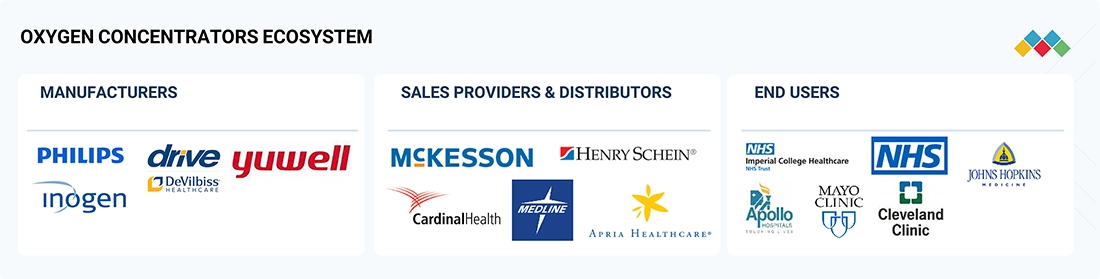
Oxygen Concentrators Market: COMMERCIAL USE CASES ACROSS INDUSTRIES
| COMPANY | USE CASE DESCRIPTION | BENEFITS |
|---|---|---|
 |
Provides stationary and portable oxygen concentrators widely used in hospitals, clinics, and homecare for chronic respiratory diseases (COPD, asthma, sleep apnea) | Ensures reliable long-term oxygen therapy, enhances patient comfort with user-friendly devices, and reduces dependence on cylinder refills |
 |
Specializes in portable oxygen concentrators for homecare and travel use, targeting patients with active lifestyles and mobility needs | Enables patient independence, increases adherence to oxygen therapy, and improves quality of life |
 |
Offers a range of oxygen concentrators for clinical, homecare, and emergency applications, including compact units for mobility | Provides versatile, cost-effective solutions, reduces hospital burden, and supports patients across both acute and chronic care needs |
 |
Supplies affordable oxygen concentrators across hospitals, homecare, and wellness segments, with strong penetration in emerging markets | Improves accessibility, expands adoption in price-sensitive markets, and supports healthcare system strengthening |
 |
Focuses on high-purity stationary and portable oxygen concentrators for healthcare, aviation, military, and emergency applications | Delivers high-efficiency oxygen supply, supports critical missions and specialized use cases, and ensures safety in demanding environments |
Logos and trademarks shown above are the property of their respective owners. Their use here is for informational and illustrative purposes only.
Related Ecosystem
Medical Devices
- Polymerase Chain Reaction (PCR)
- Magnetic Resonance Imaging (MRI)
- Disposable Autoinjectors
- Pulse Oximeters
- Blood Pressure Monitors
- Medtronic plc
- Abbott Laboratories
- Stryker Corporation
- Becton, Dickinson and Company
- JOHNSON & JOHNSON
Key Takeaways
- South Korea's oxygen concentrators market will grow from $22.02M (2025) to $32.57M (2030) at an 8.1% CAGR.
- South Korea's aging demographic and rising respiratory disease prevalence are primary growth catalysts for oxygen concentrator demand.
- South Korea's advanced manufacturing and regulatory infrastructure support competitive positioning in the Asia Pacific region.
- South Korea's home healthcare expansion and improved reimbursement policies will drive market penetration through 2030.
Oxygen Concentrators Market Report Scope
| Report Metric | Details |
|---|---|
| Base Year | 2025 |
| Fastest Growing Segment | PORTABLE (Type) |
| Forecast Period | 2025-2030 |
| Growth Rate | CAGR of 6.1% from 2025 to 2030 |
| Largest Segment | PORTABLE (Type) |
| Market Size Base Year (Billions) | ~USD 1.26 (2025) |
| Revenue Forecast (Billions) | ~USD 1.7 (2030) |
| Segments Covered | Type, Technology, Flowrate, Application, End User |
South Korea Oxygen Concentrators Market Report Segmentation
5 segment dimensions are covered across the global market.
By Type
- Portable
- Stationary
By Technology
- Continuous Flow
- Pulse Flow
By Flowrate
- 0-5 L/Min
- 5-10 L/Min
- Above 10 L/Min
- Above-10 L/Min
By Application
- Asthma
- Copd
- Other Applications
- Respiratory Distress
By End User
- Ambulatory Surgical Centers & Physicians' Offices
- Home Care Settings
- Hospitals & Clinics
Target Audience
- Medical Device Manufacturers : Oxygen concentrator producers need South Korea-specific market data to evaluate manufacturing partnerships, distribution opportunities, and competitive positioning in this high-growth Asian market.
- Healthcare Providers & Hospital Networks : South Korean hospitals and home care providers require market insights to inform procurement decisions, equipment investment planning, and service expansion strategies aligned with patient demand trends.
- Investors & Private Equity Firms : Investment professionals targeting South Korea's healthcare sector need validated market sizing and growth forecasts to assess acquisition targets, portfolio companies, and capital allocation decisions.
- Healthcare Distributors & Retailers : Medical equipment distributors and pharmacy chains operating in South Korea require market intelligence to optimize inventory management, supplier negotiations, and sales forecasting.
- Government & Policy Makers : South Korean health ministry officials and policy advisors use market data to inform healthcare infrastructure planning, reimbursement policy development, and chronic disease management initiatives.
Reasons to Buy this Report
- Market Size & Growth Validation : Precise valuation of South Korea's oxygen concentrators market at $22.02M (2025) with 8.1% CAGR forecast enables accurate financial planning and ROI projections for market entry or expansion strategies.
- Demographic & Clinical Insights : Detailed analysis of South Korea's aging population trends and rising respiratory disease prevalence provides evidence-based understanding of demand drivers specific to the Korean market context.
- Competitive Positioning Intelligence : Comprehensive assessment of South Korea's advanced manufacturing capabilities and healthcare infrastructure helps identify competitive advantages and partnership opportunities for market participants.
- Regulatory & Reimbursement Framework : South Korea-specific insights into healthcare policies, government investment priorities, and reimbursement mechanisms inform product development and market access strategies.
- Regional Distribution Hub Potential : Strategic analysis of South Korea's position as a manufacturing and distribution hub for Asia-Pacific markets supports supply chain optimization and regional expansion planning.
Frequently asked questions
What is the current market size of oxygen concentrators in South Korea?
South Korea's oxygen concentrators market was valued at $22.02 million in 2025 and is expected to reach $32.57 million by 2030.
What is the projected growth rate for South Korea's oxygen concentrators market?
South Korea's oxygen concentrators market is projected to grow at a compound annual growth rate (CAGR) of 8.1% from 2025 to 2030.
What factors are driving growth in South Korea's oxygen concentrators market?
Key drivers in South Korea include an aging population, increasing prevalence of respiratory diseases, expansion of home healthcare services, and improved reimbursement policies for oxygen therapy devices.
How does South Korea's oxygen concentrators market compare to the Asia Pacific region?
South Korea represents a significant segment within Asia Pacific, leveraging advanced manufacturing capabilities, strong regulatory frameworks, and high healthcare spending to maintain competitive market positioning.
What types of oxygen concentrators are most in demand in South Korea?
South Korea shows strong demand for both portable oxygen concentrators for home use and stationary hospital-grade equipment, driven by the shift toward home-based care and chronic disease management.
RESEARCH METHODOLOGY
The study involved major activities in estimating the current market size for the OC market. Exhaustive secondary research was done to collect information on the OC market. The next step was to validate these findings, assumptions, and sizing with industry experts across the value chain using primary research. Different approaches, such as top-down and bottom-up, were employed to estimate the total market size. After that, the market breakup and data triangulation procedures were used to estimate the market size of the segments and subsegments of the OC market.
Secondary Research
This research involved extensive use of secondary sources, including directories, databases such as Dun & Bradstreet, Bloomberg Businessweek, Factiva, whitepapers, and companies’ house documents. Secondary research was conducted to gather information for this detailed, technical, market-focused, and commercial study of the oxygen concentrators (OC) market. It also aimed to gather key data on top players, market classification and segmentation based on industry trends down to the most detailed levels, geographic markets, and significant market developments. Additionally, a database of leading industry players was created through secondary research.
Primary Research
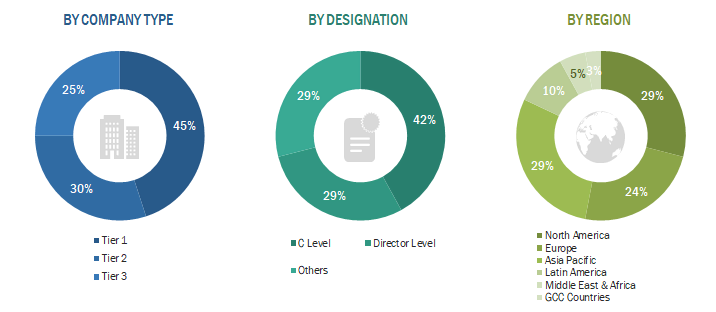
In the primary research process, various supply- and demand-side sources were interviewed to gather both qualitative and quantitative information for this report. Supply-side primary sources included industry experts such as CEOs, vice presidents, marketing and sales directors, technology & innovation directors, engineers, and other key executives from different companies and organizations operating in the OC market. Demand-side primary sources encompassed home care settings, hospitals and clinics, ambulatory surgical centers, physician offices, researchers, lab technicians, purchase managers, and stakeholders from corporate and government bodies.
The following is a breakdown of the primary respondents:
To know about the assumptions considered for the study, download the pdf brochure
Market Size Estimation
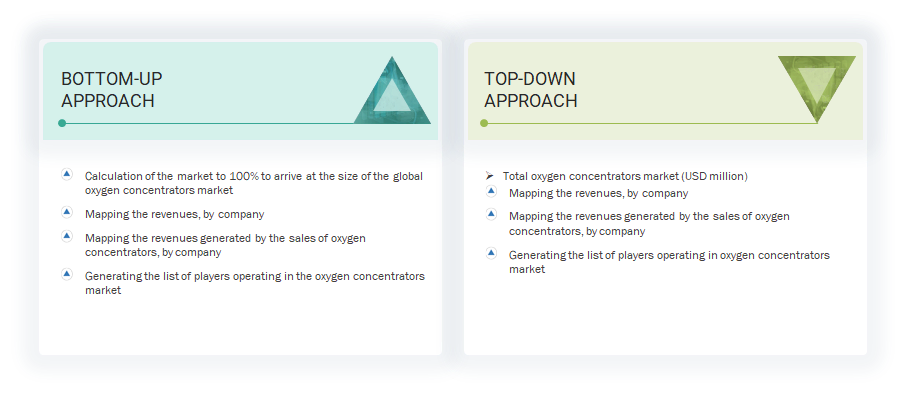
Both top-down and bottom-up approaches were employed to estimate and validate the total market size of the OC sector. These methods were also widely used to assess the size of various subsegments within the market. The research methodology for estimating the market size includes the following:
Data Triangulation
The entire market was divided into three segments when determining its size. Data triangulation and market breakdown methods were used to complete the market analysis and obtain accurate statistics for all segments.
Approach to derive the market size and estimate market growth.
Using secondary data from both paid and unpaid sources, the market rankings for the major players were established through a comprehensive analysis of their OC sales. Due to data restrictions, the revenue share in some cases was determined by carefully examining the product portfolios of large corporations and their individual sales performance. This information was validated at each stage through in-depth interviews with industry professionals.
Market Definition
An oxygen concentrator is a medical device that extracts and concentrates oxygen from surrounding air to provide high-purity oxygen (90–95%) to patients with respiratory problems. It is mainly used for long-term oxygen therapy in clinical and home care settings.
Stakeholders
- Manufacturers of oxygen concentrators
- Suppliers and distributors of oxygen concentrators
- Hospitals, clinics, ambulatory surgical centers, and physician offices
- Home care settings
- Medical device procurement agencies
- Government bodies/municipal corporations
- Business research and consulting service providers
- Venture capitalists
- US Food and Drug Administration (US FDA)
- European Union (EU)
Report Objectives
- To define, describe, and forecast the oxygen concentrators market based on type, technology, flow rate, application, indication, end user, and region
- To provide detailed information regarding the major factors influencing market growth (drivers, restraints, opportunities, and challenges)
- To analyze the micromarkets with respect to individual growth trends, prospects, and contributions to the overall oxygen concentrators market
- To analyze market opportunities for stakeholders and provide details of the competitive landscape for key players
- To forecast the size of the oxygen concentrators market in six regions: North America (US and Canada), Europe (Germany, UK, France, Spain, Italy, and Rest of Europe), the Asia Pacific (Japan, China, India, Australia, South Korea, and Rest of Asia Pacific), Latin America (Brazil, Mexico, and Rest of Latin America), Middle East & Africa, and GCC Countries
- To strategically profile the key players in the global market and comprehensively analyze their core competencies
- To track and analyze competitive developments, such as product launches, expansions, agreements, and acquisitions, of the leading players in the market
Get the Full Oxygen Concentrators Market Report
Full forecast, segment splits, and company analysis for all Oxygen Concentrators Market.
- Canada Oxygen Concentrators Market
- US Oxygen Concentrators Market
- Germany Oxygen Concentrators Market
- France Oxygen Concentrators Market
- UK Oxygen Concentrators Market
- Italy Oxygen Concentrators Market
- Spain Oxygen Concentrators Market
- China Oxygen Concentrators Market
- Japan Oxygen Concentrators Market
- India Oxygen Concentrators Market
- Australia Oxygen Concentrators Market
- Brazil Oxygen Concentrators Market
- Mexico Oxygen Concentrators Market
- GCC Countries Oxygen Concentrators Market
- Rest Of Europe Oxygen Concentrators Market
- Rest Of Asia Pacific Oxygen Concentrators Market
- Rest Of Latin America Oxygen Concentrators Market
Need a Tailored Report?
Customize this report to your needs
Get 10% FREE Customization
Customize This Report
