
US Painting Robot Market (2024-2029)

The US Painting Robot Market was valued at $491.2 Million in 2024 and projected to reach to $879.4 Million by 2029, representing a compound annual growth rate of 12.4%. The US painting robot market is positioned for sustained growth through 2029, driven by continued automation investments in automotive manufacturing and expanding adoption in electronics and industrial sectors.


| Market Size in | USD 26.32 MN |
| Market Forecast in | |
| CAGR | |
| Forecast Period | |
| Units Considered | Value (USD MN) |
US Painting Robot Market Trends and Insights
- This 12.4% compound annual growth rate reflects strong demand across automotive, electronics, and industrial manufacturing sectors in the US.
- The US market benefits from advanced automation adoption, high labor costs driving robotics investment, and increasing quality standards in semiconductor and electronics production. In 2024, the US painting robot market is characterized by significant capital expenditure in manufacturing facilities and a shift toward Industry 4.0 integration.
- By 2029, the US is expected to see accelerated adoption driven by supply chain resilience initiatives and nearshoring trends.
- The US market's growth outpaces global averages due to technological innovation hubs, established OEM presence, and regulatory support for advanced manufacturing in the US..
Key Market Statistics
- CAGR (2024-2029) 12.4% CAGR
- Market Size, 2024 ~USD 491.2 Million
- Forecast, 2029 ~USD 879.4 Million
- Country US
US Painting Robot Market Overview
Market Valuation :
The US painting robot market reached $491.2 million in 2024, with projections to grow to $879.4 million by 2029, representing a 12.4% CAGR driven by automation investments across manufacturing sectors.
Automotive Sector Leadership :
US automotive manufacturers are the primary adopters of painting robots, leveraging advanced automation to improve paint application precision, reduce waste, and meet stringent quality standards in vehicle production.
Labor Cost Pressures :
High labor costs in the US manufacturing sector are accelerating the adoption of painting robots as companies seek to improve operational efficiency and reduce dependency on manual painting workforce.
Technology Integration :
US manufacturers are increasingly integrating AI, IoT, and vision systems into painting robots, enabling real-time quality control, predictive maintenance, and enhanced customization capabilities for diverse production needs.
US Painting Robot Market Dynamics
- Rising labor costs, coupled with technological advancements in robotics and AI integration, are compelling US manufacturers to upgrade their painting operations.
- The market will benefit from increased focus on sustainability, as modern painting robots reduce material waste and environmental impact.
- Additionally, supply chain resilience initiatives are encouraging domestic manufacturing expansion, further boosting demand for advanced automation solutions in the US..
Market Ecosystem
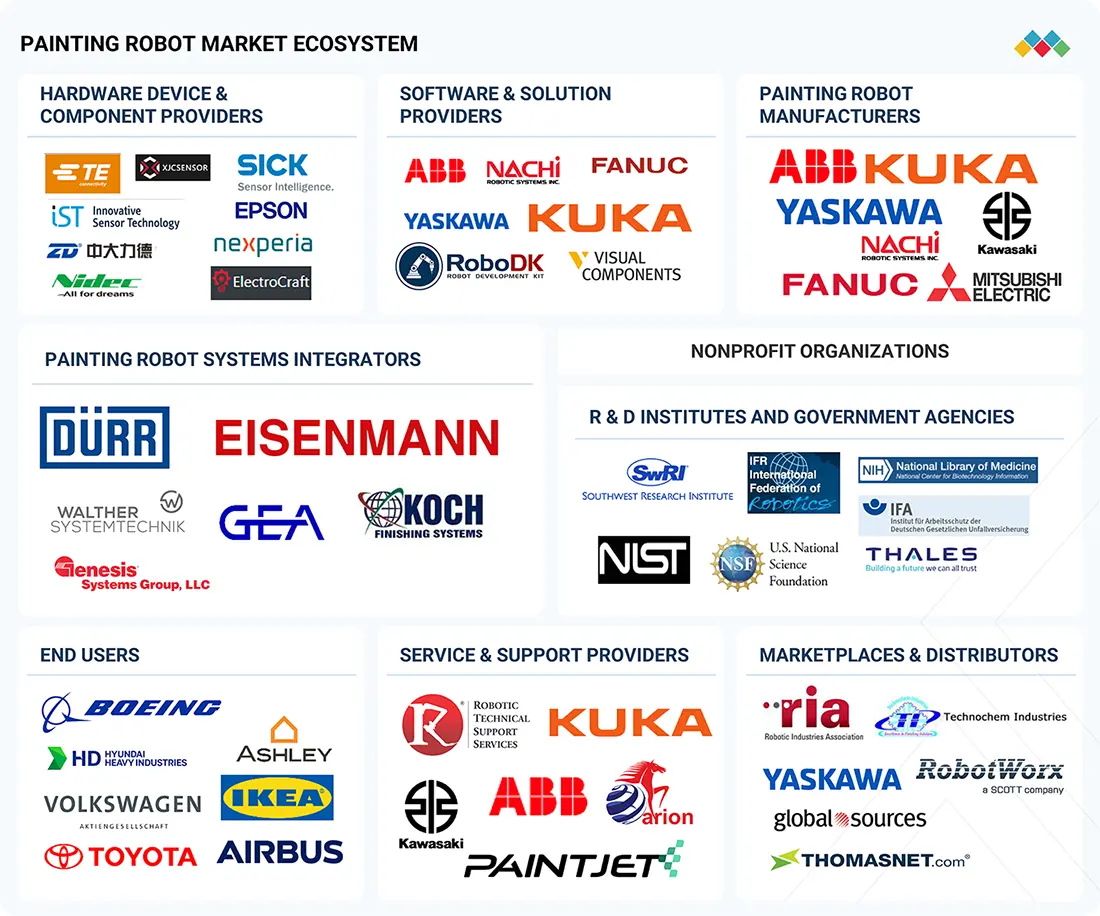
PAINTING ROBOT MARKET SIZE & SHARE: COMMERCIAL USE CASES ACROSS INDUSTRIES
| COMPANY | USE CASE DESCRIPTION | BENEFITS |
|---|---|---|
 |
Deployment of 6-axis robotic painting systems across automotive body shops for base coat and clear coat applications. | Uniform paint thickness, reduced paint wastage by up to 30%, higher line throughput |
 |
Automated robotic paint booths for multi-layer color coating at Gigafactories; robots handle primer, base coat, and finishing. | Higher consistency in premium finishes, minimized defects, shorter cycle time per vehicle. |
 |
Use of electrostatic painting robots to coat car bodies in flexible lines that switch models without tooling changes. | Improved transfer efficiency, lower VOC emissions, and reduced operational cost. |
 |
Robotic painting of A320 fuselage sections using large-reach robotic arms for primer and topcoat. | Increased precision on large surfaces, reduced manual labor dependency, better corrosion protection. |
Logos and trademarks shown above are the property of their respective owners. Their use here is for informational and illustrative purposes only.
Related Ecosystem
Drones And Robotics
- Sensors
- Articulated Robots
- Cartesian Robots
- Scara Robots
- Actuators
- ABB India Limited
- KUKA AG
- MOMENTIVE PERFORMANCE MATERIALS INC.
- STAUBLI INTERNATIONAL AG
- Fanuc Corporation
Automotive Materials
- Light Commercial Vehicles (LCVs)
- Battery Electric Vehicle (BEV)
- Hybrid Electric Vehicle (HEV)
- Fuel Cell Electric Vehicle (FCEV)
- Agricultural Tractors
- AISIN CORPORATION
- GORKOVSKY AVTOMOBILNY ZAVOD
- Continental ag
- Basf se
- BOSCH LIMITED
Automotive Systems
- Light Commercial Vehicles (LCVs)
- Battery Electric Vehicle (BEV)
- Hybrid Electric Vehicle (HEV)
- Agricultural Tractors
- Fuel Cell Electric Vehicle (FCEV)
- BOSCH LIMITED
- DENSO Corporation
- Continental ag
- ZF FRIEDRICHSHAFEN AG
- TENNECO
Key Takeaways
- The US painting robot market will grow from $491.2M (2024) to $879.4M (2029) at a 12.4% CAGR, driven by automation demand in US manufacturing.
- High labor costs and quality requirements in the US semiconductor and electronics sectors accelerate painting robot adoption.
- The US market benefits from advanced technology integration, nearshoring initiatives, and Industry 4.0 transformation across US facilities.
- By 2029, the US painting robot market will represent significant capital investment in precision manufacturing and supply chain localization.
Painting Robot Market Report Scope
| Report Metric | Details |
|---|---|
| Base Year | 2024 |
| Fastest Growing Segment | COLLABORATIVE ROBOTS (Robot Arm) |
| Forecast Period | 2024-2029 |
| Growth Rate | CAGR of 13.1% from 2024 to 2029 |
| Largest Segment | ARTICULATED ROBOTS (Robot Type) |
| Market Size Base Year (Billions) | ~USD 3.13 (2024) |
| Revenue Forecast (Billions) | ~USD 5.8 (2029) |
| Segments Covered | Component, Mounting Type, Robot Type, Function, Painting Technology, End-Use Industry, Automotive & Transportation Industry, Robot Arm, Payload, Reach, Type, Paint Applicator |
US Painting Robot Market Report Segmentation
12 segment dimensions are covered across the global market.
By Component
- Additional Robotic Hardware (Safety Fencing, Fixtures, Conveyors)
- Paint Robot Arms
- Robot Accessories (Air Control Units (Acu), Atomizers, Fluid Regulators, Gear Pumps, Etc.)
- Software & Programming
- System Engineering
By Mounting Type
- Floor Mounted Painting Robots
- Rail Mounted Painting Robots
- Wall Mounted Painting Robots
By Robot Type
- Articulated Robots
- Cartesian Robots
- Collaborative Robots
- Scara Robots
By Function
- Painting
- Spraying & Coating
By Painting Technology
- Solvent-Borne
- Uv -Cured
- Uv-Cured
- Waterborne
By End-Use Industry
- Automotive & Transportation
- Construction
- Consumer Appliances
- Furniture
- Heavy Engineering Equipment
- Other Industries
By Automotive & Transportation Industry
- Aircraft
- Automotive
- Railway
- Ships
By Robot Arm
- Articulated Robots
- Cartesian Robots
- Collaborative Robots
- Scara Robots
By Payload
- 10.01-30 Kg
- 30.01-45 Kg
- More Than 45 Kg
- Up To 10 Kg
By Reach
- 1,000 Mm To 2,000 Mm
- 2,000 Mm To 3,000 Mm
- Less Than 1,000 Mm
- More Than 3,000 Mm
By Type
- Aircraft
- Automotive
- Railway
- Ships
- Solvent-Borne
- Uv-Cured
- Waterborne
By Paint Applicator
- Air Guns
- Atomizers
Target Audience
- Automotive Manufacturers : US automotive OEMs and suppliers need detailed market insights to optimize painting operations, justify automation investments, and maintain competitive advantage in vehicle production quality and efficiency.
- Robotics & Automation Vendors : Painting robot manufacturers and automation solution providers require US market data to identify growth opportunities, understand customer needs, and develop targeted sales and marketing strategies for regional expansion.
- Electronics & Industrial Companies : US electronics and industrial manufacturers seeking to adopt painting automation need market intelligence to evaluate technology options, benchmark costs, and plan capital expenditure for production upgrades.
- Private Equity & Investors : Investment firms and venture capitalists evaluating opportunities in US manufacturing automation require validated market size, growth projections, and sector trends to assess portfolio companies and investment viability.
- Consultants & System Integrators : Technology consultants and system integrators advising US manufacturers on automation strategies need comprehensive market data to provide credible recommendations and support client decision-making processes.
Reasons to Buy this Report
- Market Size & Growth Validation : Obtain precise US market valuation ($491.2M in 2024) and verified forecast data ($879.4M by 2029) to support investment decisions, business planning, and competitive positioning in the American painting robot sector.
- Sector-Specific Insights : Access detailed analysis of US automotive, electronics, and industrial manufacturing adoption patterns, enabling targeted market entry strategies and product development aligned with regional demand drivers.
- Competitive Intelligence : Understand the US competitive landscape, key market players, technology trends, and differentiation opportunities to benchmark performance and identify gaps in the American painting robot market.
- Investment & Expansion Planning : Leverage comprehensive US market data to evaluate expansion opportunities, assess ROI potential, and make informed decisions about manufacturing facility investments and automation upgrades.
- Strategic Decision Support : Utilize region-specific growth drivers, labor cost analysis, and technology adoption trends to develop data-backed strategies for market penetration, partnerships, and long-term business development in the US.
Frequently asked questions
What is the current size of the US painting robot market?
The US painting robot market was valued at $491.2 million in 2024 and is projected to reach $879.4 million by 2029.
What is the growth rate of the US painting robot market?
The US painting robot market is expected to grow at a compound annual growth rate (CAGR) of 12.4% from 2024 to 2029.
Which industries drive the US painting robot market?
The US painting robot market is primarily driven by automotive, semiconductor, electronics manufacturing, and industrial sectors requiring precision coating applications.
What factors are accelerating painting robot adoption in the US?
Key factors include high labor costs, stringent quality standards, Industry 4.0 adoption, nearshoring trends, and supply chain resilience initiatives across US manufacturing facilities.
How does the US market compare to global painting robot trends?
The US painting robot market grows at 12.4% CAGR, slightly outpacing the global rate of 13.1%, reflecting strong domestic automation investment and technological leadership in the US.
RESEARCH METHODOLOGY
The research process for this technical, market-oriented, and commercial study of the painting robot market included the systematic gathering, recording, and analysis of data about customers and companies operating in the market. It involved the extensive use of secondary sources, directories, and databases (Factiva, Oanda, and OneSource) to identify and collect relevant information. In-depth interviews were conducted with various primary respondents, including experts from core and related industries and preferred manufacturers, to obtain and verify critical qualitative and quantitative information as well as to assess the growth prospects of the market. Key players in the painting robot market were identified through secondary research, and their market rankings were determined through primary and secondary research. This included studying annual reports of top players and interviewing key industry experts, such as CEOs, directors, and marketing executives.
Secondary Research
Various In the secondary research process, various secondary sources were used to identify and collect information for this study. These include annual reports, press releases, and investor presentations of companies, whitepapers, certified publications, and articles from recognized associations and government publishing sources. Research reports from a few consortiums and councils were also consulted to structure qualitative content. Secondary sources included corporate filings (such as annual reports, investor presentations, and financial statements); trade, business, and professional associations; white papers; Robotics journals and certified publications; articles by recognized authors; gold-standard and silver-standard websites; directories; and databases. Data was also collected from secondary sources, such as the International Federation of Robotics (IFR), the International Trade Centre (ITC) (Switzerland), and the Robotics Business Review (RBR).
Primary Research
Extensive primary research was accomplished after understanding and analyzing the painting robot market scenario through secondary research. Several primary interviews were conducted with key opinion leaders from both demand- and supply-side vendors across four major regions—North America, Europe, Asia Pacific, and RoW. Approximately 30% of the primary interviews were conducted with the demand side, and 70% with the supply side. Primary data was collected through questionnaires, emails, and telephonic interviews. Various departments within organizations, such as sales, operations, and administration, were contacted to provide a holistic viewpoint in the report.
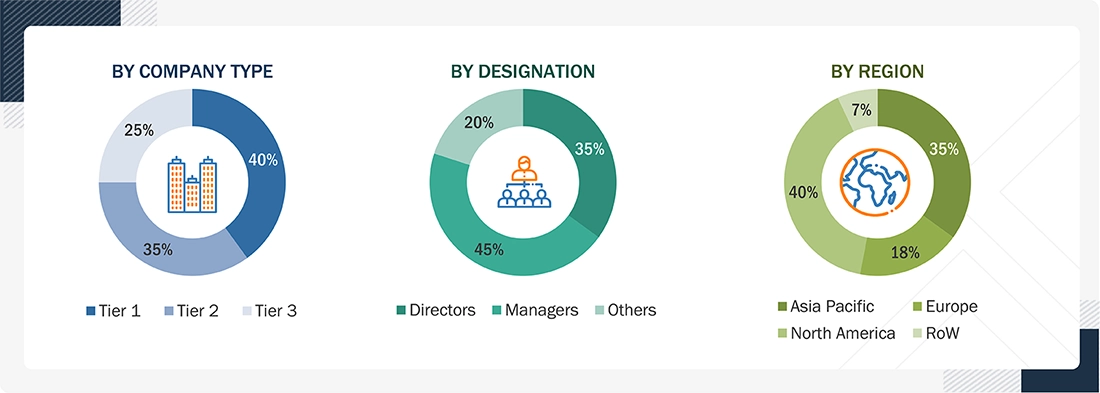
To know about the assumptions considered for the study, download the pdf brochure
Market Size Estimation
In the complete market engineering process, both top-down and bottom-up approaches were used, along with several data triangulation methods, to estimate and forecast the size of the market and its segments and subsegments listed in the report. Extensive qualitative and quantitative analyses were carried out on the complete market engineering process to list the key information/insights pertaining to painting robot market.
The key players in the market were identified through secondary research, and their rankings in the respective regions determined through primary and secondary research. This entire procedure involved the study of the annual and financial reports of top players, and interviews with industry experts such as chief executive officers, vice presidents, directors, and marketing executives for quantitative and qualitative key insights. All percentage shares, splits, and breakdowns were determined using secondary sources and verified through primary sources. All parameters that affect the markets covered in this research study were accounted for, viewed in extensive detail, verified through primary research, and analyzed to obtain the final quantitative and qualitative data. This data was consolidated, supplemented with detailed inputs and analysis from MarketsandMarkets, and presented in this report.
Painting Robot Market: Bottom-Up Approach and Top-Down Approach
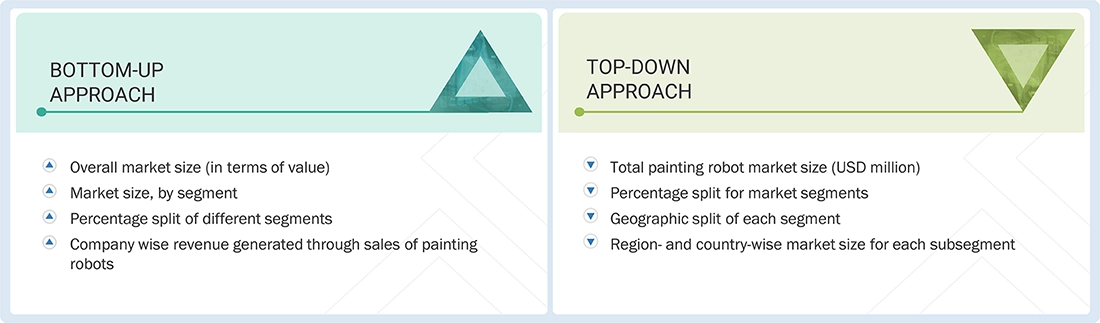
The bottom-up procedure was employed to arrive at the overall size of the Painting robot market from revenues of the key players and their share in the market. The overall market size was calculated on the basis of the revenues of the key companies identified in the market.
In the top-down approach, the overall size of the Painting robot market was used to estimate the size of the individual markets (mentioned in the market segmentation) through percentage splits obtained from secondary and primary research. To calculate the size of the specific market segments, the size of the most appropriate parent market was used to implement the top-down approach. The bottom-up approach was also implemented for the data extracted from the secondary research to validate the size of various segments of the Painting robot market. The share of each company in the market was estimated to verify the revenue shares used earlier in the bottom-up approach. With the data triangulation procedure and the validation of data through primaries, sizes of the parent market and each individual market were determined and confirmed. The data triangulation procedure used for this study has been explained in the next section.
Data Triangulation
After arriving at the overall market size from the market size estimation process explained above, the total market was split into several segments and subsegments. Data triangulation and market breakdown procedures were employed, wherever applicable, to complete the overall market engineering process and arrive at the exact statistics for all segments and subsegments. The data was triangulated by studying various factors and trends from both demand and supply sides. Along with this, the market size was validated using both top-down and bottom-up approaches.
Market Definition
A painting robot is an automated system designed to apply paint to surfaces independently, without human intervention. It utilizes specialized mechanisms and sophisticated software to achieve precise and uniform paint application on objects of diverse shapes and sizes. Known for their high accuracy and stability, these robots can meticulously control the thickness of the paint layer, delivering superior quality coatings.
The study covers painting robots equipped with robot arms, end effectors, software, and other hardware components, designed to apply paint or coatings on surfaces with precision. The robots are often used in the automotive & transportation, consumer appliances, furniture, construction, heavy engineering equipment, and other industries.
Key Stakeholders
- Painting robot manufacturers
- Painting robot component providers
- Technology investors
- Governments and financial institutions
- Analysts and strategic business planners
- Existing and prospective end users
- Painting robot software providers
- Painting robot-related associations, organizations, forums, and alliances
- Venture capitalists, private equity firms, and startup companies
- Distributors and traders
- Research institutes and organizations
Report Objectives
- To define, describe, segment, and forecast the painting robot market size, in terms of value, based on mounting type, robot type, payload, reach, function, paint applicator, and end-use industry
- To define, describe, segment, and forecast the painting robot market size, in terms of volume, for painting robot arms
- To forecast the market size, in terms of value, across North America, Europe, Asia Pacific, and the Rest of the World (RoW)
- To present detailed information regarding the major factors influencing the growth of the market (drivers, restraints, opportunities, and challenges)
- To provide an ecosystem analysis, case study analysis, patent analysis, technology analysis, ASP analysis, Porter’s Five Forces analysis, and regulations pertaining to the market.
- To offer a comprehensive overview of the value chain of the painting robot market ecosystem
- To critically analyze micromarkets1 with respect to individual growth trends, prospects, and contributions to the total market
- To strategically profile the key players and comprehensively analyze their market shares and core competencies
- To assess the opportunities in the market for stakeholders and describe the competitive landscape of the market
- To analyze competitive developments in the market, such as collaborations, agreements, partnerships, product developments, and research and development (R&D)
- To evaluate the impact of the recession on the painting robot market
Available Customizations:
With the given market data, MarketsandMarkets offers customizations according to the company’s specific needs. The following customization options are available for the report:
Company Information
- Detailed analysis and profiling of additional market players (up to 7)
Get the Full Painting Robot Market Report
Full forecast, segment splits, and company analysis for all Painting Robot Market.
- South Korea Painting Robot Market
- India Painting Robot Market
- Rest Of Asia Pacific Painting Robot Market
- GCC Countries Painting Robot Market
- Rest Of Middle East Painting Robot Market
- Canada Painting Robot Market
- Mexico Painting Robot Market
- Germany Painting Robot Market
- UK Painting Robot Market
- France Painting Robot Market
- Spain Painting Robot Market
- Italy Painting Robot Market
- Rest Of Europe Painting Robot Market
- China Painting Robot Market
- Japan Painting Robot Market
Need a Tailored Report?
Customize this report to your needs
Get 10% FREE Customization
Customize This Report
