Painting Robot Market Size & Share

Painting Robot Market by Mounting Type (Floor Mounted, Wall Mounted, Rail Mounted), Robot Type (Articulated, Cartesian, Scara, Collaborative), Function ,Payload, Reach, Paint Applicator, End-user Industry and Region - Global Forecast to 2029




OVERVIEW
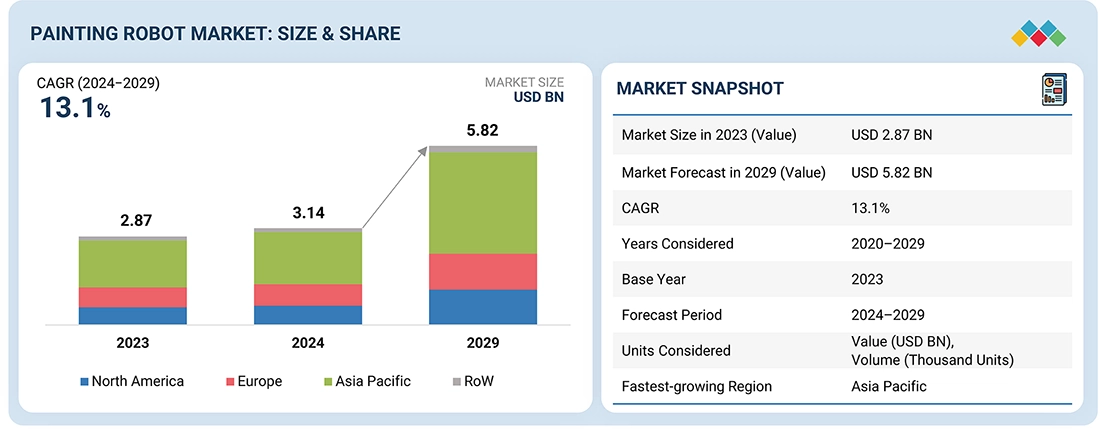
Source: Secondary Research, Interviews with Experts, MarketsandMarkets Analysis
The painting robot market is projected to reach USD 5.82 billion by 2029 from USD 3.14 billion in 2024, at a CAGR of 13.1% from 2024 to 2029. The growth of painting robots is driven by rising demand for automation to enhance paint quality, reduce operational costs, address labor shortages, and improve worker safety.
KEY TAKEAWAYS
-
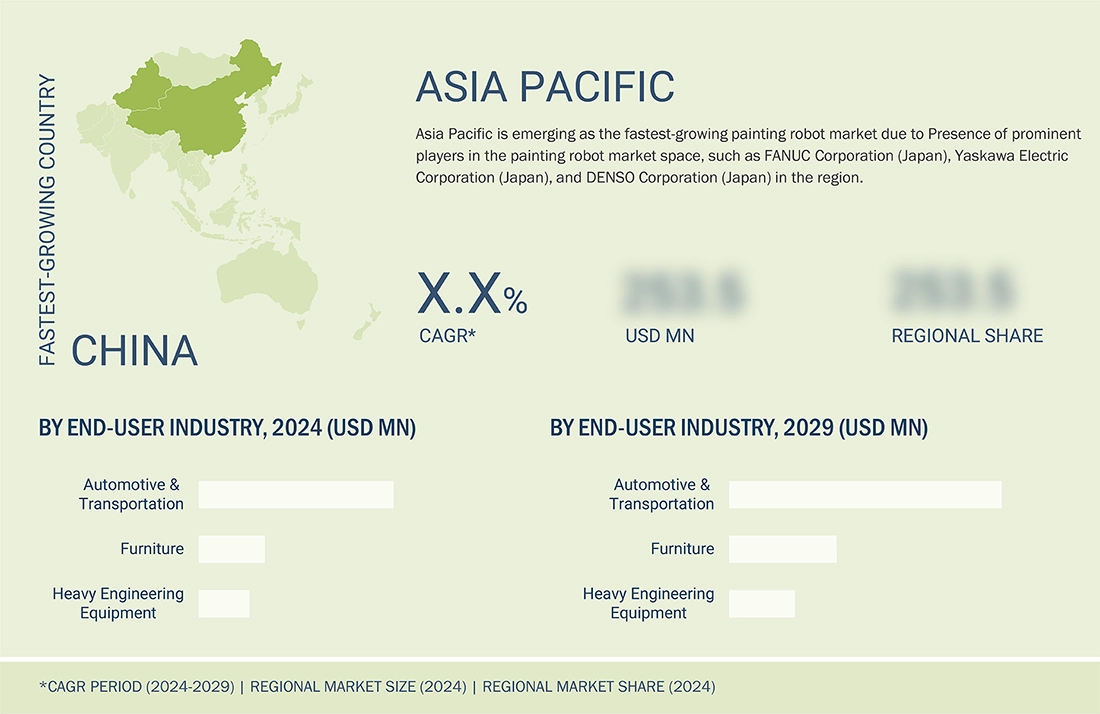
By RegionThe Asia Pacific painting robot market accounted for a 53.2% revenue share in 2023.
-
By Robot TypeBy robot type, articulated robot accounts for major share of 84.2% in the painting robot market in 2023.
-
By FunctionBy function, the spraying & coating segment is expected to register the highest CAGR of 13.9%.
-
By End user IndustryBy end user, the furniture segment is projected to grow at the fastest rate from 2024 to 2029.
-
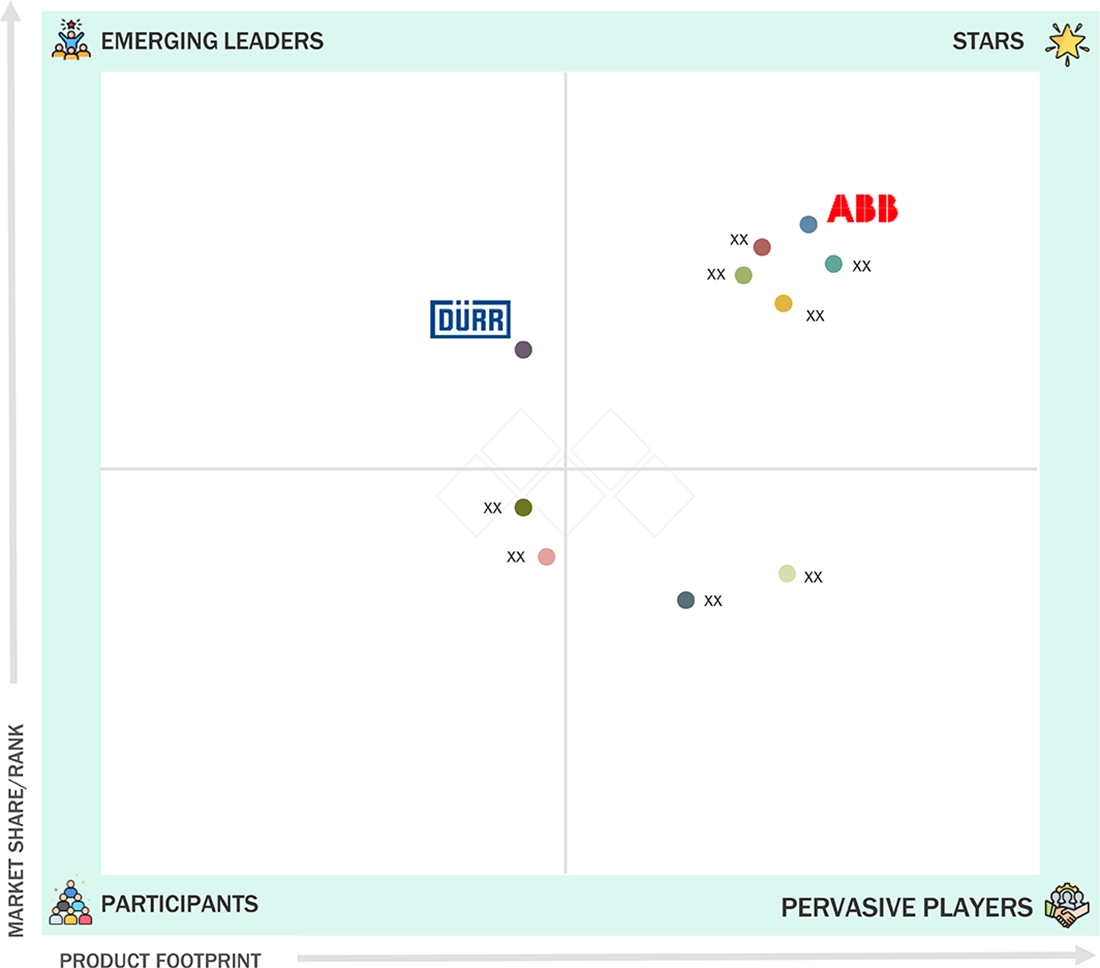
Competitive LandscapeABB (Switzerland), FANUC CORPORATION (Japan), and Kawasaki Heavy Industries, Ltd. (Japan) were identified as some of the star players in the painting robot market (global), given their strong market share and product footprint.
-
Competitive LandscapeGruppo Sacmi (Italy), Universal Robots (Denmark), among others, have distinguished themselves among startups and SMEs by securing strong footholds in specialized niche areas, underscoring their potential as emerging market leaders
The growth of painting robots is driven by increasing adoption in automotive and industrial manufacturing, the need for higher production efficiency, consistent coating accuracy, and reduced paint wastage. Along with this, stringent environmental regulations, the shift toward VOC-free processes, and automated systems that enable optimized material usage and cleaner production will also drive painting robot market demand
TRENDS & DISRUPTIONS IMPACTING CUSTOMERS' CUSTOMERS
The painting robot industry is rapidly shifting from traditional automation toward advanced, intelligent, and sustainable technologies, driven by evolving customer requirements and industry innovation. With growing adoption of collaborative robots, AI-enabled robotics, cloud-based control, and next-generation coating methods such as ultrasonic atomization and low-VOC paints, major manufacturers including Volkswagen, Toyota, Boeing, Airbus, and Hyundai Heavy Industries are accelerating digital transformation. Key growth areas such as digital twins, smart factory integration, robotic consulting, automated paint parameter adjustment, and RaaS (Robot-as-a-Service) are opening new revenue opportunities and redefining the future revenue mix of painting automation solutions.
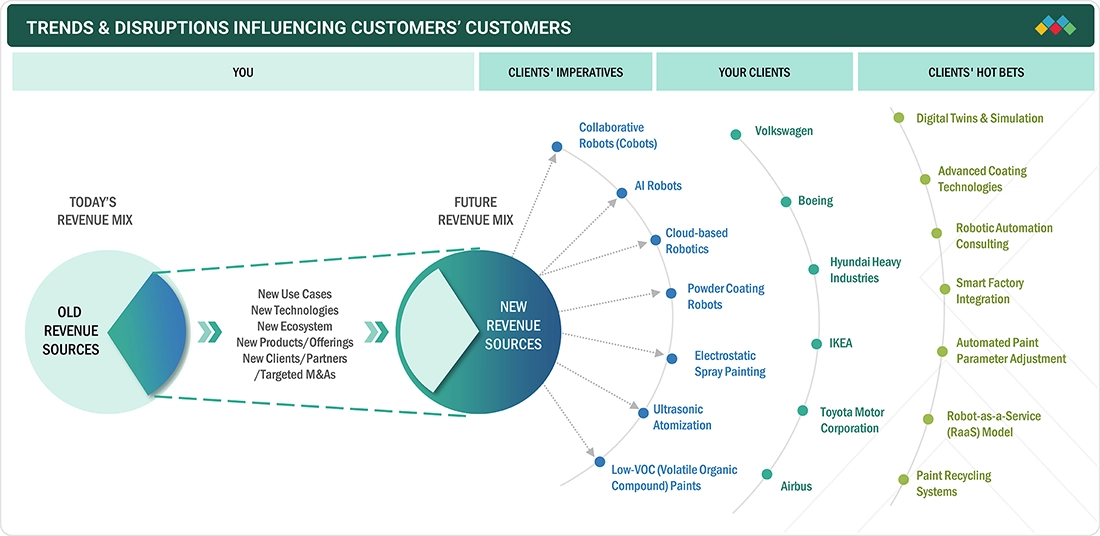
Source: Secondary Research, Interviews with Experts, MarketsandMarkets Analysis
MARKET DYNAMICS

Level
-
Increasing demand for automation in manufacturing processes

-
Rising adoption of paint robots by automotive manufacturers


Level
-
High purchase price and integration costs

-
Programming complexity and need for skilled personnel


Level
-
Increasing preference for automated painting solutions in aerospace, furniture, and construction industries

-
Rising labor costs and shortage of workers


Level
-
Cybersecurity risks and potential vulnerabilities in robotic systems

Source: Secondary Research, Interviews with Experts, MarketsandMarkets Analysis
Driver: Increasing demand for automation in manufacturing processes
Manufacturers are actively seeking ways to increase efficiency and productivity due to labor shortages and rising costs. Automation will continue to be a major trend, with painting robots becoming increasingly sophisticated and integrated into production lines. This will drive sustained market growth.
Restraint: High purchase price and integration costs
As companies experience the long-term benefits of painting robots (increased productivity, labor savings), and potentially see advancements in financing options (leasing, pay-per-use), adoption is expected to rise. However, the initial investment will still be a hurdle for some companies, especially smaller ones.
Opportunity: Increasing preference for automated painting solutions in aerospace, furniture, and construction industries
Entering new industries like aerospace, furniture, and construction offers significant potential, but initial adoption will be cautious. Companies might require time to assess the cost-benefit analysis and how to adapt robots to specific needs. Market growth will be moderate . Standardized solutions tailored to each sector will broaden the market reach.
Challenge: Cybersecurity risks and potential vulnerabilities in robotic systems
Awareness of cybersecurity threats in industrial robots is growing, but many companies might not fully understand the specific risks associated with painting robots. As the adoption of painting robots increases, the attack surface becomes larger, making them more vulnerable to cyberattacks. High-profile incidents targeting these robots could erode confidence in the technology and slow market growth.
PAINTING ROBOT MARKET SIZE & SHARE: COMMERCIAL USE CASES ACROSS INDUSTRIES
| COMPANY | USE CASE DESCRIPTION | BENEFITS |
|---|---|---|
 |
Deployment of 6-axis robotic painting systems across automotive body shops for base coat and clear coat applications. | Uniform paint thickness, reduced paint wastage by up to 30%, higher line throughput |
 |
Automated robotic paint booths for multi-layer color coating at Gigafactories; robots handle primer, base coat, and finishing. | Higher consistency in premium finishes, minimized defects, shorter cycle time per vehicle. |
 |
Use of electrostatic painting robots to coat car bodies in flexible lines that switch models without tooling changes. | Improved transfer efficiency, lower VOC emissions, and reduced operational cost. |
 |
Robotic painting of A320 fuselage sections using large-reach robotic arms for primer and topcoat. | Increased precision on large surfaces, reduced manual labor dependency, better corrosion protection. |
Logos and trademarks shown above are the property of their respective owners. Their use here is for informational and illustrative purposes only.
MARKET ECOSYSTEM
The ecosystem of the painting robot market includes hardware device & component roviders, software & solution providers, painting robot manufacturers, painting robot systems integrators, service & support providers, marketplaces & distributors, and end uses
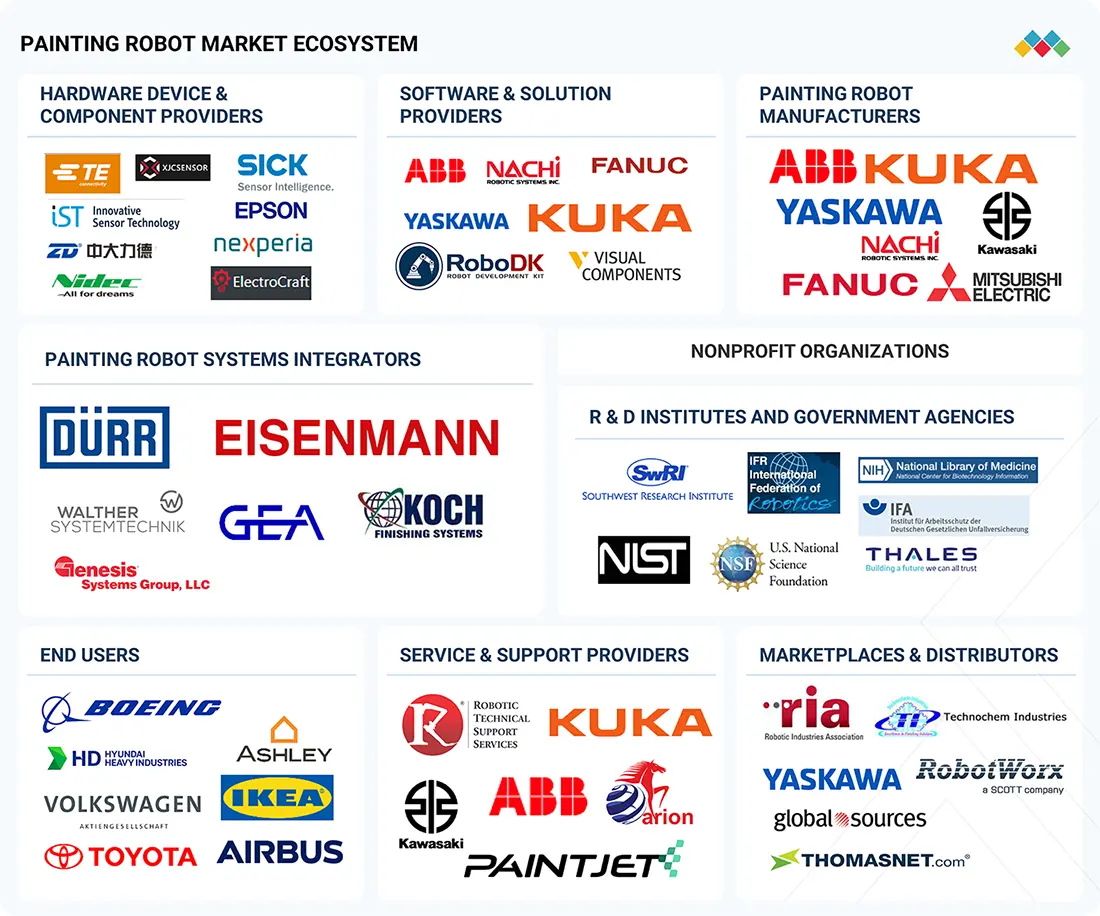
Logos and trademarks shown above are the property of their respective owners. Their use here is for informational and illustrative purposes only.
MARKET SEGMENTS
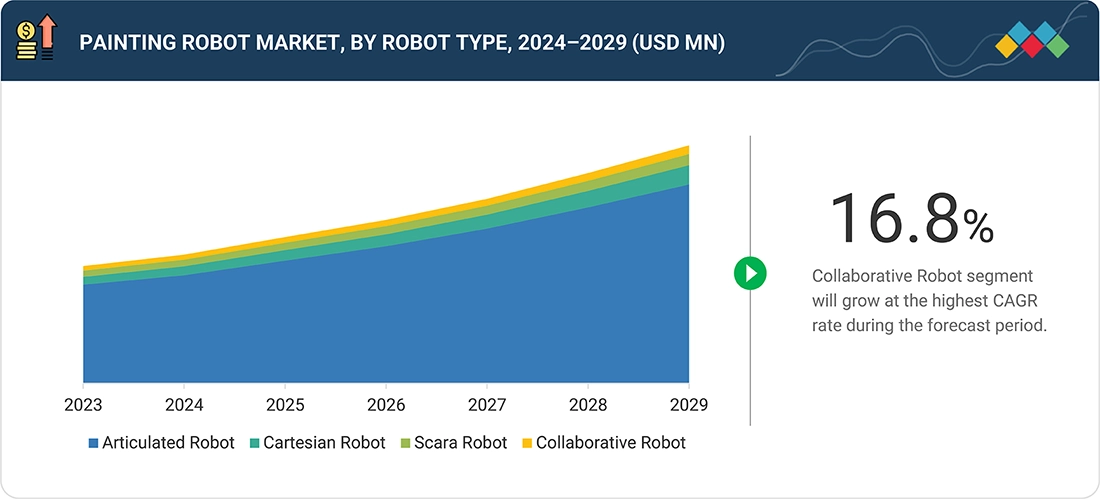
Source: Secondary Research, Interviews with Experts, MarketsandMarkets Analysis
Painting Robot Market, By Robot Type
Articulated robots will hold the major market share in the painting robot market due to their superior flexibility, multi-axis movement, and ability to perform highly precise and complex coating tasks across a wide range of surfaces and geometries. Their adaptability makes them ideal for automotive, aerospace, furniture, and heavy machinery industries where consistent finish quality and accuracy are critical.
Painting Robot Market, By Function
Spraying and coating functions will grow at a high CAGR in the painting robot market due to increasing demand for precise, consistent, and high-quality surface finishing across industries such as automotive, aerospace, furniture, and industrial equipment. As manufacturers focus on improving productivity and reducing paint consumption, robotic spraying offers superior accuracy, reduced overspray, and optimized paint usage.
Painting Robot Market, By End User Industry
The automotive & transportation industry holds the major market share in the painting robot market due to its need for high-precision, high-volume, and consistent surface finishing. Robotic painting reduces defects, speeds production, ensures safety, and supports smart factory automation.
REGION
Asia Pacific to be fastest-growing region in global painting robot market during forecast period
Asia Pacific will grow at a high CAGR in the painting robot market due to rapid industrial expansion, increasing automotive production, and strong investments in automation across manufacturing sectors. Countries such as China, Japan, South Korea, and India are aggressively adopting robotic painting to enhance productivity, improve finish quality, and reduce labor-intensive processes.
PAINTING ROBOT MARKET SIZE & SHARE: COMPANY EVALUATION MATRIX
In the painting robot market matrix, ABB (Star) leads with a dominant global presence and strong automotive and industrial penetration, driven by its advanced robotic painting platforms, proven reliability, and deep integration with automation, vision, and digital control systems. DÜRR (Emerging Leader) is rapidly gaining momentum with its innovative eco-efficient painting systems, cutting-edge atomization and application technologies, and strong expansion in both automotive and general industrial segments.
Source: Secondary Research, Interviews with Experts, MarketsandMarkets Analysis
KEY MARKET PLAYERS - Top Painting Robot Companies
- ABB (Switzerland)
- FANUC CORPORATION (Japan)
- KUKA AG (Germany)
- YASKAWA ELECTRIC CORPORATION (Japan)
- Kawasaki Heavy Industries, Ltd. (Japan)
- DURR AG (Germany)
- Epistolio (Italy)
- krautzberger (Germany)
- CMA robotics (Italy)
- Stäubli International AG. (Switzerland)
MARKET SCOPE
| REPORT METRIC | DETAILS |
|---|---|
| Market Size in 2023 (Value) | USD 2.87 Billion |
| Market Forecast in 2029 (Value) | USD 5.82 Billion |
| Growth Rate | CAGR of 13.1% from 2024-2029 |
| Years Considered | 2020-2029 |
| Base Year | 2023 |
| Forecast Period | 2024-2029 |
| Units Considered | Value (USD Million), Volume (Thousand Units) |
| Report Coverage | Revenue forecast, company ranking, competitive landscape, growth factors, and trends |
| Segments Covered |
|
| Regions Covered | North America, Asia Pacific, Europe, RoW |
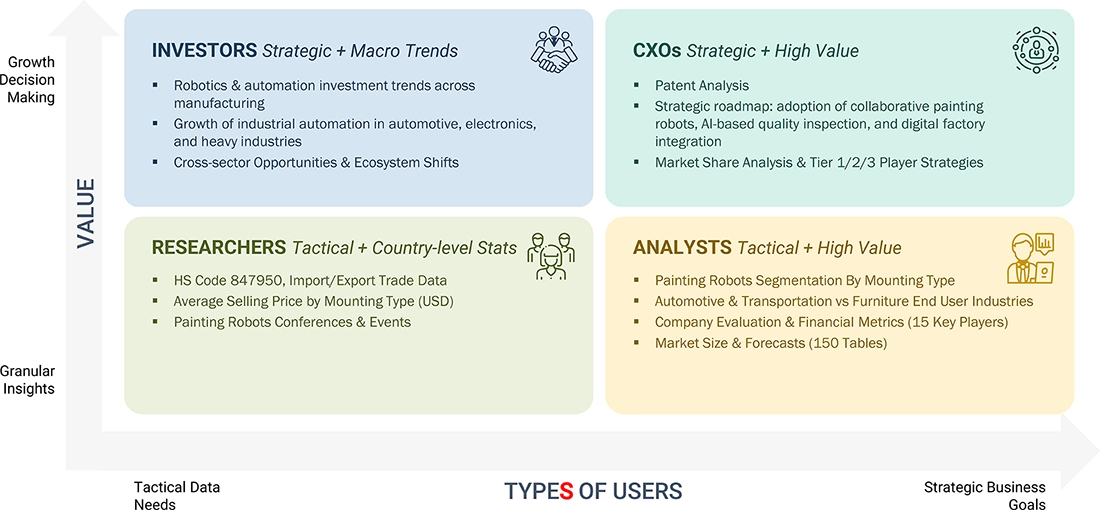
WHAT IS IN IT FOR YOU: PAINTING ROBOT MARKET SIZE & SHARE REPORT CONTENT GUIDE
DELIVERED CUSTOMIZATIONS
We have successfully delivered the following deep-dive customizations:
| CLIENT REQUEST | CUSTOMIZATION DELIVERED | VALUE ADDS |
|---|---|---|
| Automotive OEMs & Tier-1 Suppliers | Benchmarking robotic painting solutions across transfer efficiency, cycle time, material usage, and multi-color changeover performance | Comparative evaluation of atomizers, spray guns, controllers, and paint management systems; analysis of ROI through reduced wastage & improved finish quality |
| General Industrial Manufacturers (Metal, Appliances, Furniture, Heavy Machinery) | Assessment of painting robot adaptability to varying part geometries, production throughput, coating types, and integration with conveyors | Optimization roadmap for automating manual paint lines, productivity improvement modelling, safety compliance review, and cost-benefit analysis |
| System Integrators & Automation Solution Providers | Mapping integration requirements for robotic control software, vision systems, and MES/SCADA connectivity in brownfield vs. greenfield deployments | Evaluation of interoperability, commissioning complexity, offline programming advantages, and predictive maintenance enablement |
| Paint & Coating Material Companies | Analysis of paint–robot compatibility, coating behavior, curing dynamics, and process parameters required for defect-free finishing | Benchmarking paint film quality (thickness, uniformity, gloss, edge coverage), VOC reduction effectiveness, and sustainability improvement assessment |
| Body & Custom Paint Shops / Tier-2 Vendors | Performance comparison of compact painting robots for small-batch production, multi-axis flexibility, and booth footprint optimization | Recommendations on best-fit models for space-constrained layouts, operator training, and hybrid (human + robot) workflow transition strategies |
RECENT DEVELOPMENTS
- October 2023 : Dürr Systems and Kawasaki Robotics collaborated to offer the ‘ready2integrate’ concept, streamlining the integration of robotic solutions into painting processes for various industries. This partnership aligns Dürr's painting technology with Kawasaki's robots, enabling faster implementation of automated painting systems. The concept includes electromechanically adapted products from both portfolios, facilitating seamless integration and operation with a simple selection matrix, minimizing effort for integrators and end customers.
- May 2022 : ABB launched the Ability Connected Atomizer, a sensor-equipped paint atomizer for real-time diagnostics, enhancing transfer efficiency by 10% and reducing paint loss by 75%. The atomizer minimizes overspray with advanced pattern control and automates cleaning functions, reducing maintenance time and improving paint line operation. It is ideal for increasing uptime and ensuring zero quality defects.
- COLUMN 'A' SHOULD BE IN TEXT FORMAT AND NOT DATE FORMAT :
Table of Contents
 Exclusive indicates content/data unique to MarketsandMarkets and not available with any competitors.
Methodology
The research process for this technical, market-oriented, and commercial study of the painting robot market included the systematic gathering, recording, and analysis of data about customers and companies operating in the market. It involved the extensive use of secondary sources, directories, and databases (Factiva, Oanda, and OneSource) to identify and collect relevant information. In-depth interviews were conducted with various primary respondents, including experts from core and related industries and preferred manufacturers, to obtain and verify critical qualitative and quantitative information as well as to assess the growth prospects of the market. Key players in the painting robot market were identified through secondary research, and their market rankings were determined through primary and secondary research. This included studying annual reports of top players and interviewing key industry experts, such as CEOs, directors, and marketing executives.
Secondary Research
Various In the secondary research process, various secondary sources were used to identify and collect information for this study. These include annual reports, press releases, and investor presentations of companies, whitepapers, certified publications, and articles from recognized associations and government publishing sources. Research reports from a few consortiums and councils were also consulted to structure qualitative content. Secondary sources included corporate filings (such as annual reports, investor presentations, and financial statements); trade, business, and professional associations; white papers; Robotics journals and certified publications; articles by recognized authors; gold-standard and silver-standard websites; directories; and databases. Data was also collected from secondary sources, such as the International Federation of Robotics (IFR), the International Trade Centre (ITC) (Switzerland), and the Robotics Business Review (RBR).
Primary Research
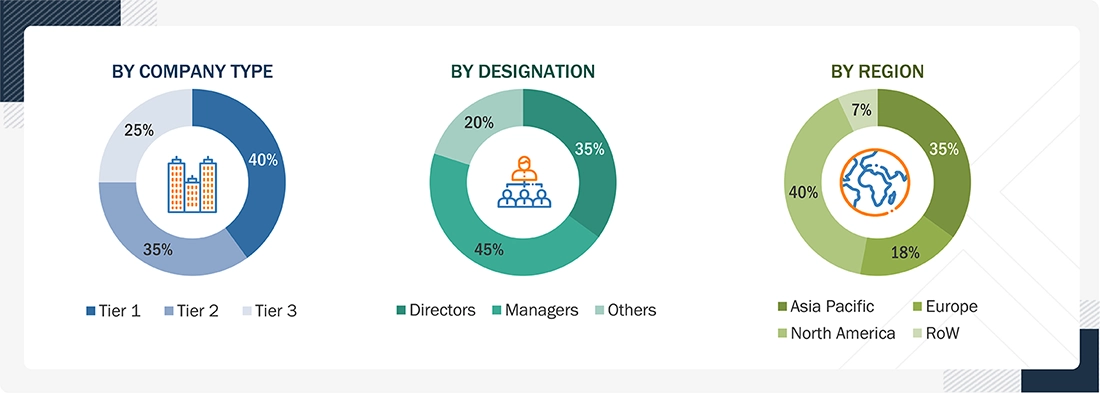
Extensive primary research was accomplished after understanding and analyzing the painting robot market scenario through secondary research. Several primary interviews were conducted with key opinion leaders from both demand- and supply-side vendors across four major regions—North America, Europe, Asia Pacific, and RoW. Approximately 30% of the primary interviews were conducted with the demand side, and 70% with the supply side. Primary data was collected through questionnaires, emails, and telephonic interviews. Various departments within organizations, such as sales, operations, and administration, were contacted to provide a holistic viewpoint in the report.
To know about the assumptions considered for the study, download the pdf brochure
Market Size Estimation
In the complete market engineering process, both top-down and bottom-up approaches were used, along with several data triangulation methods, to estimate and forecast the size of the market and its segments and subsegments listed in the report. Extensive qualitative and quantitative analyses were carried out on the complete market engineering process to list the key information/insights pertaining to painting robot market.
The key players in the market were identified through secondary research, and their rankings in the respective regions determined through primary and secondary research. This entire procedure involved the study of the annual and financial reports of top players, and interviews with industry experts such as chief executive officers, vice presidents, directors, and marketing executives for quantitative and qualitative key insights. All percentage shares, splits, and breakdowns were determined using secondary sources and verified through primary sources. All parameters that affect the markets covered in this research study were accounted for, viewed in extensive detail, verified through primary research, and analyzed to obtain the final quantitative and qualitative data. This data was consolidated, supplemented with detailed inputs and analysis from MarketsandMarkets, and presented in this report.
Painting Robot Market: Bottom-Up Approach and Top-Down Approach
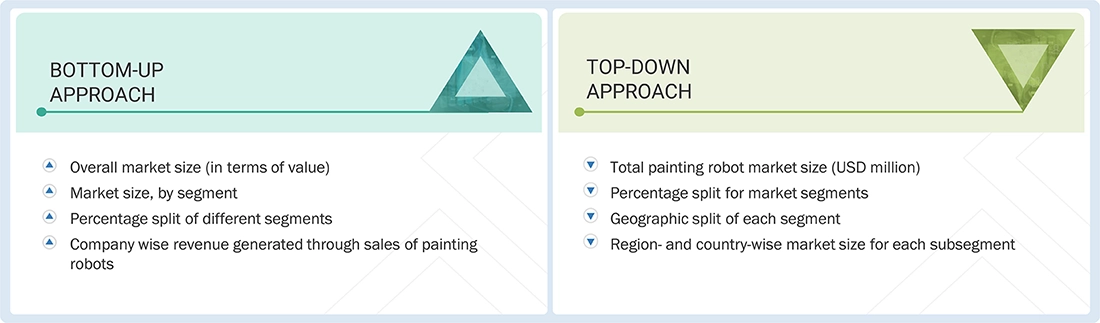
The bottom-up procedure was employed to arrive at the overall size of the Painting robot market from revenues of the key players and their share in the market. The overall market size was calculated on the basis of the revenues of the key companies identified in the market.
In the top-down approach, the overall size of the Painting robot market was used to estimate the size of the individual markets (mentioned in the market segmentation) through percentage splits obtained from secondary and primary research. To calculate the size of the specific market segments, the size of the most appropriate parent market was used to implement the top-down approach. The bottom-up approach was also implemented for the data extracted from the secondary research to validate the size of various segments of the Painting robot market. The share of each company in the market was estimated to verify the revenue shares used earlier in the bottom-up approach. With the data triangulation procedure and the validation of data through primaries, sizes of the parent market and each individual market were determined and confirmed. The data triangulation procedure used for this study has been explained in the next section.
Data Triangulation
After arriving at the overall market size from the market size estimation process explained above, the total market was split into several segments and subsegments. Data triangulation and market breakdown procedures were employed, wherever applicable, to complete the overall market engineering process and arrive at the exact statistics for all segments and subsegments. The data was triangulated by studying various factors and trends from both demand and supply sides. Along with this, the market size was validated using both top-down and bottom-up approaches.
Market Definition
A painting robot is an automated system designed to apply paint to surfaces independently, without human intervention. It utilizes specialized mechanisms and sophisticated software to achieve precise and uniform paint application on objects of diverse shapes and sizes. Known for their high accuracy and stability, these robots can meticulously control the thickness of the paint layer, delivering superior quality coatings.
The study covers painting robots equipped with robot arms, end effectors, software, and other hardware components, designed to apply paint or coatings on surfaces with precision. The robots are often used in the automotive & transportation, consumer appliances, furniture, construction, heavy engineering equipment, and other industries.
Key Stakeholders
- Painting robot manufacturers
- Painting robot component providers
- Technology investors
- Governments and financial institutions
- Analysts and strategic business planners
- Existing and prospective end users
- Painting robot software providers
- Painting robot-related associations, organizations, forums, and alliances
- Venture capitalists, private equity firms, and startup companies
- Distributors and traders
- Research institutes and organizations
Report Objectives
- To define, describe, segment, and forecast the painting robot market size, in terms of value, based on mounting type, robot type, payload, reach, function, paint applicator, and end-use industry
- To define, describe, segment, and forecast the painting robot market size, in terms of volume, for painting robot arms
- To forecast the market size, in terms of value, across North America, Europe, Asia Pacific, and the Rest of the World (RoW)
- To present detailed information regarding the major factors influencing the growth of the market (drivers, restraints, opportunities, and challenges)
- To provide an ecosystem analysis, case study analysis, patent analysis, technology analysis, ASP analysis, Porter’s Five Forces analysis, and regulations pertaining to the market.
- To offer a comprehensive overview of the value chain of the painting robot market ecosystem
- To critically analyze micromarkets1 with respect to individual growth trends, prospects, and contributions to the total market
- To strategically profile the key players and comprehensively analyze their market shares and core competencies
- To assess the opportunities in the market for stakeholders and describe the competitive landscape of the market
- To analyze competitive developments in the market, such as collaborations, agreements, partnerships, product developments, and research and development (R&D)
- To evaluate the impact of the recession on the painting robot market
Available Customizations:
With the given market data, MarketsandMarkets offers customizations according to the company’s specific needs. The following customization options are available for the report:
Company Information
- Detailed analysis and profiling of additional market players (up to 7)
Key Questions Addressed by the Report


Personalize This Research
- Triangulate with your Own Data
- Get Data as per your Format and Definition
- Gain a Deeper Dive on a Specific Application, Geography, Customer or Competitor
- Any level of Personalization
Let Us Help You
- What are the Known and Unknown Adjacencies Impacting the Painting Robot Market
- What will your New Revenue Sources be?
- Who will be your Top Customer; what will make them switch?
- Defend your Market Share or Win Competitors
- Get a Scorecard for Target Partners

Custom Market Research Services
We Will Customise The Research For You, In Case The Report Listed Above Does Not Meet With Your Requirements
Get 10% Free CustomisationTESTIMONIALS

Tetsuya Ohhira
Business Development Manager-Technology Business
Nikon Corporation,
Leading Japanese MNC specializing in optics and imaging productswww.nikon.com
MarketsandMarkets™ response
is quick. Their attitude is flexible and positive. Analyst Insights are globally considered and
significant. Client Services quickly respond to our inquiry and demand. Their wide range of global
surveys help us make our strategic plan.
We hope Knowledge Store will be easier to search
for a report.
VP - Marketing & Business Development
Leading Provider of Process Control Solutions
We engaged with MarketsandMarkets on a study to perform an analysis and recommend a Go-To-Market strategy for metrology and process control in the semiconductor market. The study was tailored to our targets and needs with well-defined milestones. Our overall experience with the MarketsandMarkets team was very good throughout the project in all aspects including the analysis methodologies used, the quality and depth of primary and secondary data sets, the professionalism and flexibility of the team and the ability to meet the target schedule and milestones. We want to thank MarketsandMarkets team for a job well done.
- South Korea Painting Robot Market
- India Painting Robot Market
- Rest Of Asia Pacific Painting Robot Market
- GCC Countries Painting Robot Market
- Rest Of Middle East Painting Robot Market
- US Painting Robot Market
- Canada Painting Robot Market
- Mexico Painting Robot Market
- Germany Painting Robot Market
- UK Painting Robot Market
- France Painting Robot Market
- Spain Painting Robot Market
- Italy Painting Robot Market
- Rest Of Europe Painting Robot Market
- China Painting Robot Market
- Japan Painting Robot Market
Growth opportunities and latent adjacency in Painting Robot Market






Jaime
Apr, 2026
What are the key insights provided in this report regarding the adoption of painting robots in automotive and aerospace manufacturing sectors?.
Kyle
Apr, 2026
Can we request a more detailed breakdown of collaborative robots (cobots) in painting applications separately from traditional industrial robots?.