
Canada Particle Size Analysis Market (2026-2031)

The Canada Particle Size Analysis Market was valued at $46.28 Million in 2026 and projected to reach to $57.81 Million by 2031, representing a compound annual growth rate of 4.5%. Canada's particle size analysis market is poised for steady growth as pharmaceutical manufacturers and healthcare providers prioritize precision diagnostics and quality assurance.


| Market Size in | USD 26.32 MN |
| Market Forecast in | |
| CAGR | |
| Forecast Period | |
| Units Considered | Value (USD MN) |
Canada Particle Size Analysis Market Trends and Insights
- In Canada, the healthcare sector's increasing demand for precision diagnostics and pharmaceutical quality control is driving adoption of advanced particle size analysis technologies.
- Canada's regulatory environment and investment in life sciences infrastructure continue to support market expansion through 2031. The Canadian market benefits from strong pharmaceutical manufacturing capabilities and research institutions focused on drug development and characterization.
- In Canada, healthcare providers and pharmaceutical companies are increasingly integrating particle size analysis into their quality assurance and product development workflows.
- Canada's position within North America and its emphasis on healthcare innovation position it as a steady contributor to regional particle size analysis demand..
Key Market Statistics
- CAGR (2026-2031) 4.5% CAGR
- Market Size, 2026 ~USD 46.28 Million
- Forecast, 2031 ~USD 57.81 Million
- Country Canada
Canada Particle Size Analysis Market Overview
Market Valuation :
Canada's particle size analysis market is valued at $46.28 million in 2026 and is projected to reach $57.81 million by 2031, representing steady growth in the healthcare sector.
Growth Rate :
The Canadian market is expanding at a CAGR of 4.5% from 2026 to 2031, driven by increasing demand for precision diagnostics and pharmaceutical quality control applications.
Regulatory Environment :
Canada's stringent regulatory framework and Health Canada's quality standards are accelerating adoption of advanced particle size analysis technologies across pharmaceutical and medical device manufacturers.
Healthcare Sector Demand :
Canadian healthcare institutions and pharmaceutical companies are increasingly investing in particle size analysis for drug formulation, bioavailability studies, and compliance with international quality standards.
Canada Particle Size Analysis Market Dynamics
- The country's robust regulatory framework and emphasis on drug safety are key drivers for technology adoption.
- Canadian biopharmaceutical companies are increasingly leveraging particle size analysis for product development and regulatory compliance, particularly in oncology and biologics sectors. The market outlook remains positive with growing investments in R&D infrastructure and healthcare innovation.
- Canadian academic institutions and contract research organizations are expanding their analytical capabilities, creating demand for advanced particle sizing instruments.
- As the country strengthens its position in the global pharmaceutical supply chain, particle size analysis technologies will become increasingly critical for maintaining competitive advantage and meeting international quality standards..
Market Ecosystem
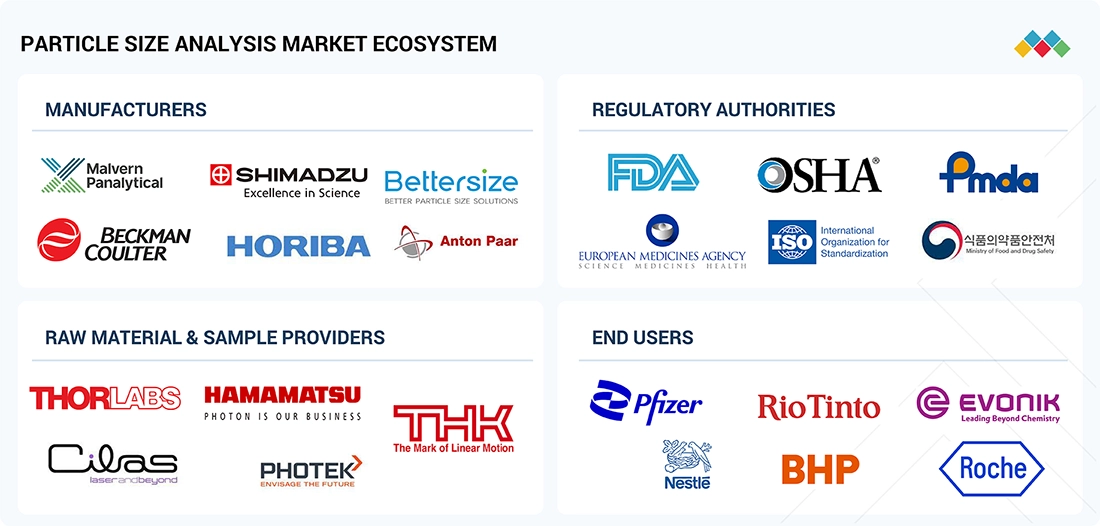
PARTICLE SIZE ANALYSIS MARKET: COMMERCIAL USE CASES ACROSS INDUSTRIES
| COMPANY | USE CASE DESCRIPTION | BENEFITS |
|---|---|---|
 |
Uses particle size analysis in API development, formulation design, and inhalation drug delivery to control particle size distribution affecting drug dissolution and bioavailability | Improved drug efficacy, controlled release profiles, enhanced bioavailability, and regulatory compliance. |
 |
Develops PSA instruments (e.g., laser diffraction systems) used across pharma, food, and materials industries for particle characterization | High-precision measurements, faster analysis, and broad application across R&D and QC workflows. |
 |
Applies PSA to control powder properties in food products (e.g., cocoa, milk powders) affecting texture, solubility, and taste | Consistent product texture, improved mouthfeel, optimized processing, and consumer satisfaction. |
 |
Uses PSA in analytical testing services for pharmaceuticals, ensuring particle size distribution meets quality specifications | Regulatory compliance, validated quality control, and reliable batch-to-batch consistency |
Logos and trademarks shown above are the property of their respective owners. Their use here is for informational and illustrative purposes only.
Related Ecosystem
Analytical And Scientific Instrumentation
- Environmental Testing
- Gas Chromatography
- Polymerase Chain Reaction (PCR)
- Automated Liquid Handling Systems
- Flow Cytometry
- Thermo Fisher Scientific Inc.
- Danaher Corporation
- Agilent Technologies, Inc.
- Merck KGaA
- Shimadzu Corporation
Key Takeaways
- Canada's particle size analysis market is valued at $46.28 million in 2026 and will reach $57.81 million by 2031.
- Canada experiences a 4.5% CAGR, reflecting steady growth driven by pharmaceutical quality control and healthcare diagnostics.
- In Canada, regulatory compliance and life sciences investment are key factors supporting market expansion.
- Canada's healthcare sector integration of particle size analysis technologies continues to accelerate through the forecast period.
Particle Size Analysis Market Report Scope
| Report Metric | Details |
|---|---|
| Base Year | 2026 |
| Fastest Growing Segment | NANOPARTICLE TRACKING ANALYSIS (Technology) |
| Forecast Period | 2026–2031 |
| Growth Rate | CAGR of 6.5% from 2026 to 2031 |
| Largest Segment | BENCHTOP ANALYZERS (Type) |
| Market Size Base Year (Billions) | ~USD 5.64 (2026) |
| Revenue Forecast (Billions) | ~USD 7.73 (2031) |
| Segments Covered | Technology, Type, End User, Application, Dispersion, Subindustry, Sub-Type |
Canada Particle Size Analysis Market Report Segmentation
7 segment dimensions are covered across the global market.
By Technology
- Coulter Principle
- Dynamic Light Scattering
- Imaging
- Laser Diffraction
- Nanoparticle Tracking Analysis
- Other Technologies
- Sieve Analysis
By Type
- Academic Institutions
- Benchtop Analyzers
- Dynamic Imaging
- Pharma And Biotech Companies
- Portable Analyzers
- Public & Private Research Institutes
- Static Imaging
By End User
- Biopharma Cos
- Chemicals & Petroleum Industry
- Chemicals And Petroleum Industry
- Cosmetic Industry
- Cosmetics Industry
- Food & Beverage Industry
- Food And Beverage Industry
- Healthcare Industry
- Mining, Minerals, And Cement Industry
- Other End Users
- Other Industries
- Other Technologies
- Pharma Cos
By Application
- Other Applications
- Process Analytical Technology
By Dispersion
- Dry Dispersion
- Spray Dispersion
- Wet Dispersion
By Subindustry
- Academic Institutions
- Pharmaceutical & Biotechnology Companies
- Public & Private Research Institutions
By Sub-Type
- Academic Institutions
- Pharmaceutical & Biotechnology Companies
- Public & Private Research Institutions
Target Audience
- Pharmaceutical Manufacturers : Canadian and international pharma companies need market data to optimize particle size analysis investments, ensure Health Canada compliance, and improve drug formulation efficiency.
- Medical Device Companies : Device manufacturers require Canada-specific market insights to understand demand for particle analysis instruments and identify opportunities in the growing healthcare diagnostics sector.
- Contract Research Organizations : Canadian CROs need detailed market forecasts to plan analytical service expansion, invest in advanced instrumentation, and capture growing demand from biopharmaceutical clients.
- Healthcare Institutions : Canadian hospitals, diagnostic labs, and research centers require market intelligence to justify capital expenditures on particle sizing technology and optimize procurement strategies.
- Investment & Strategy Teams : Investors, consultants, and corporate strategists need Canada-focused market data to evaluate acquisition targets, assess market entry viability, and identify growth opportunities in healthcare analytics.
Key Companies in the Canada Particle Size Analysis Market
| Company | HQ | Ownership | Strongest segments |
|---|---|---|---|
| BECKMAN COULTER | United States | Private Company | Laser Diffraction,Dynamic Light Scattering (DLS),Imaging, |
| SPECTRIS | United Kingdom | Private Company | Laser Diffraction,Dynamic Light Scattering (DLS),Imaging, |
| HORIBA | Japan | Public Company | Laser Diffraction,Dynamic Light Scattering (DLS),Imaging-based Analyzers, |
| DANAHER CORPORATION | United States | Public Company | Laser Diffraction Systems,Dynamic Light Scattering (DLS),Imaging-based Particle Analysis, |
| METTLER TOLEDO | Switzerland | Public Company | Laser Diffraction,Dynamic Light Scattering (DLS),Imaging, |
| SHIMADZU CORPORATION | Japan | Public Company | Laser Diffraction,Dynamic Light Scattering (DLS),Imaging-based Analyzers, |
| TSI | China | Public Company | Beer and Beverage Products,Wealth Management and Finance Company Services,Real Estate, Software, IT, and Payment Services, |
BECKMAN COULTER
Beckman Coulter is a private company founded in 1935 in the United States with 11,900 employees. The company operates in the life sciences and diagnostics sector.
SPECTRIS
Spectris is a private company founded in 1986 in the United Kingdom with 7,400 employees. The company specializes in precision instrumentation and controls.
HORIBA
HORIBA is a public company founded in 1945 in Japan with 9,101 employees. The company manufactures analytical and measurement instruments.
DANAHER CORPORATION
Danaher Corporation is a public company founded in 1969 in the United States with 59,000 employees. The company operates across multiple sectors including life sciences, diagnostics, and environmental solutions.
METTLER TOLEDO
Mettler Toledo is a public company founded in 1991 in Switzerland with 16,600 employees. The company manufactures precision instruments for laboratory and industrial applications.
SHIMADZU CORPORATION
Shimadzu Corporation is a public company founded in 1875 in Japan with 14,649 employees. The company manufactures analytical and measuring instruments across multiple industries.
TSI
TSI is a public company founded in 1903 in China with 29,257 employees. The company manufactures precision instruments and measurement equipment.
Reasons to Buy this Report
- Market-Specific Sizing Data : Access precise valuation figures for Canada's particle size analysis market with detailed 2026-2031 forecasts, enabling accurate budget allocation and investment planning for Canadian operations.
- Regulatory Insights : Understand Health Canada's quality standards and regulatory requirements driving technology adoption, helping manufacturers align product strategies with Canadian compliance frameworks.
- Competitive Landscape Analysis : Identify key players and market dynamics specific to Canada's healthcare and pharmaceutical sectors, enabling informed competitive positioning and partnership strategies.
- Growth Opportunity Assessment : Evaluate the 4.5% CAGR growth trajectory and identify high-potential segments within Canadian biopharmaceuticals, medical devices, and contract research organizations.
- Strategic Market Entry : Leverage Canada-specific market intelligence to develop targeted go-to-market strategies, distribution partnerships, and customer acquisition plans for the North American healthcare market.
Frequently asked questions
What is the current size of Canada's particle size analysis market?
Canada's particle size analysis market is valued at $46.28 million in 2026.
What is the projected market size for Canada by 2031?
Canada's particle size analysis market is projected to reach $57.81 million by 2031.
What is the CAGR for Canada's particle size analysis market?
Canada's particle size analysis market is growing at a compound annual growth rate of 4.5% from 2026 to 2031.
What drives growth in Canada's particle size analysis market?
Growth in Canada is driven by increased pharmaceutical quality control requirements, healthcare diagnostics demand, and regulatory compliance needs in the life sciences sector.
How does Canada's market compare to global trends?
Canada's 4.5% CAGR is slightly below the global average of 6.5%, reflecting a more mature but stable healthcare market with consistent regulatory-driven demand.
RESEARCH METHODOLOGY
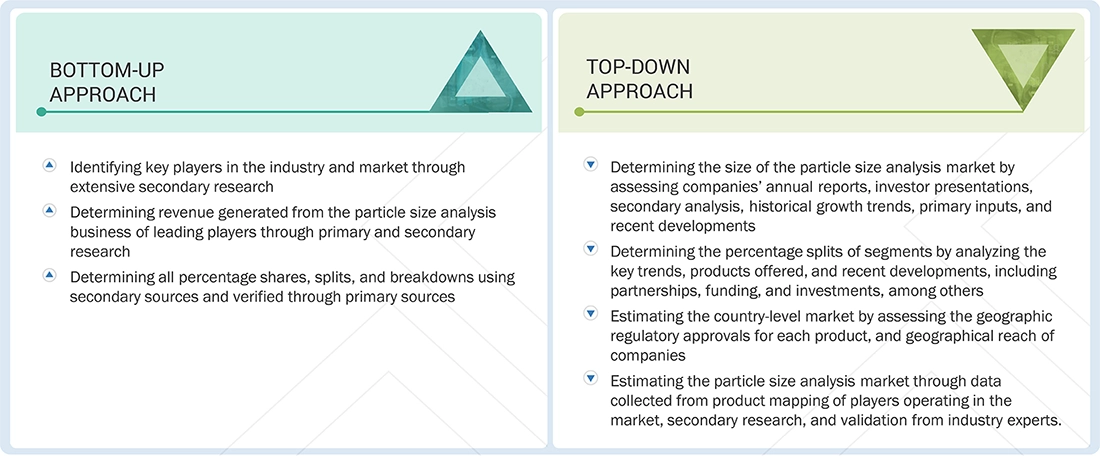
The study involved four major activities in estimating the current size of the particle size analysis market. Exhaustive secondary research was conducted to gather information on the market, peer markets, and parent markets. The next step was to validate these findings, assumptions, and sizing with industry experts across the value chain through primary research. Both top-down and bottom-up approaches were employed to estimate the complete market size. After that, market breakdown and data triangulation were used to estimate the market size of segments and subsegments.
Secondary Research
The secondary research process involves the widespread use of secondary sources, directories, databases (such as Bloomberg Businessweek, Factiva, and D&B Hoovers), white papers, annual reports, company house documents, investor presentations, and companies' SEC filings. Secondary research was used to identify and collect information for the extensive, technical, market-oriented, and commercial particle-size analysis market study. It was also used to obtain important information about the key players, market classification & segmentation according to industry trends down to the bottom-most level, and key developments from market and technology perspectives. A database of key industry leaders was also compiled through secondary research.
Primary Research
In the primary research process, various supply and demand sources were interviewed to obtain qualitative and quantitative information for this report. The primary sources from the supply side include industry experts such as CEOs, vice presidents, marketing and sales directors, technology & innovation directors, and other key executives from various companies and organizations in the particle size analysis market. The primary sources from the demand side include pharma-biopharma companies, CDMOs, research labs, F&B companies, and service providers. Primary research was conducted to validate the market segmentation, identify key players, and gather insights into key industry trends and market dynamics.
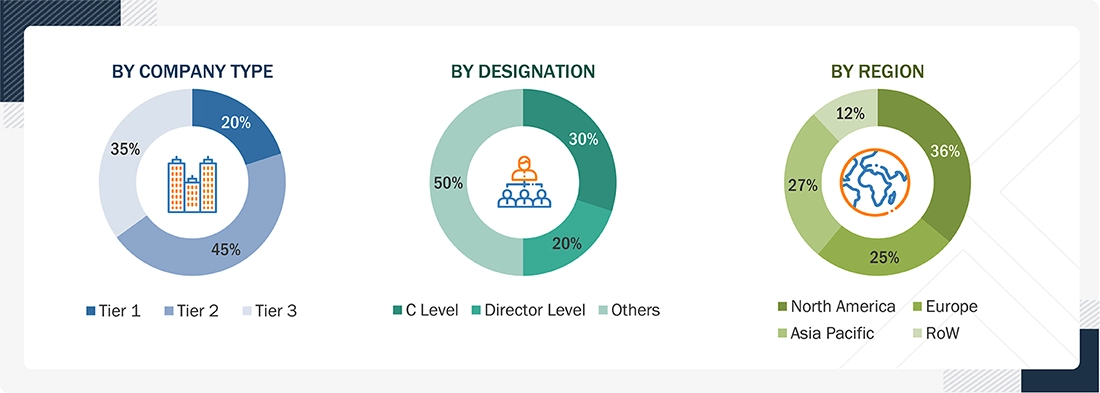
Others include sales managers, marketing managers, business development managers, product managers, distributors, and suppliers.
Note: Companies are classified into tiers based on their total revenue. As of 2025, Tier 1 = >USD 4 billion, Tier 2 = USD 1-2 Billion, and Tier 3 = <USD 1 Billion.
To know about the assumptions considered for the study, download the pdf brochure
Market Size Estimation
In this report, the particle size analysis market size was determined using revenue share analysis of leading players. To this end, key players in the market were identified, and their revenues from market operations were determined through insights gathered during the primary and secondary research phases. Secondary research included the study of the annual and financial reports of the top market players. In contrast, primary research included extensive interviews with key opinion leaders, such as CEOs, directors, and key marketing executives.
Segmental revenue was calculated based on the revenue mapping of major solution/service providers to calculate the global market value. This process involved the following steps:
- Generating a list of major global players operating in the particle size analysis market.
- Mapping annual revenues generated by major global players from the technology segment (or nearest reported business unit/product category)
- Revenue mapping of major players to cover a major share of the global market, as of 2025
- Extrapolating the global value of the particle size analysis market industry
Data Triangulation
After determining the overall market size through the market size estimation process described above, the global particle size analysis market was segmented into segments and subsegments. Data triangulation and market breakdown procedures were used to complete the overall market engineering process and arrive at precise statistics for all segments and subsegments. The data was triangulated by analyzing various factors and trends from both the demand and supply sides. Additionally, the particle size analysis market was validated using top-down and bottom-up approaches.
Market Definition
The particle size analysis market is a segment of analytical instrumentation that measures and characterizes particle size distributions in solids, liquids, and gases to ensure product quality and process efficiency. These instruments are widely used across industries such as pharmaceuticals, chemicals, food, cosmetics, and materials because particle size directly affects properties such as stability, flow, appearance, and reactivity, making it critical for formulation, manufacturing, and quality control.
Key Stakeholders
- Product Manufacturers, Distributors, and Suppliers
- Biotechnology and Pharmaceutical Companies and CROs
- Laboratory Technicians and Workers
- Instruments Manufacturers, Vendors, and Distributors
- Venture Capitalists and Other Government Funding Organizations
- Research and Consulting Firms
- Healthcare Equipment or Product Suppliers and Distributors
- Group Purchasing Organizations (GPOs)
- Academic Universities and Medical Research Centers
- Environmental Testing Laboratories
- Food and Beverage Testing Centers
- Hospitals and Diagnostic Centers
- Clinical Research Organizations
- R&D Centers
- Business Research and Consulting Firms
- Medical Research Laboratories End Users
- R&D Department
- Finance/Procurement Department
Report Objectives
- To define, describe, and forecast the size of the particle size analysis market based on technology, dispersion, type, end user, and region
- To provide detailed information regarding the major factors influencing the growth potential of the global particle size analysis market (drivers, restraints, opportunities, challenges, and trends)
- To analyze the micromarkets with respect to individual growth trends, prospects, and contributions to the global particle size analysis market
- To analyze key growth opportunities in the global particle size analysis market for key stakeholders and provide details of the competitive landscape for market leaders
- To forecast the size of market segments and/or subsegments with respect to five major regions, namely, North America (US and Canada), Europe (Germany, France, the UK, Italy, Spain, and the Rest of Europe), Asia Pacific (Japan, China, India, Australia, South Korea, and the Rest of Asia Pacific), Latin America (Brazil, Mexico, and the Rest of Latin America), and the Middle East & Africa
- To profile the key players in the particle size analysis market and comprehensively analyze their market share and core competencies
- To analyze the competitive developments undertaken in the global particle size analysis market, such as product launches; agreements; expansions; and mergers & acquisitions
Available customizations:
With the given market data, MarketsandMarkets offers customizations per the company’s specific needs. The following customization options are available for the present global particle size analysis market report:
Product Analysis
- Product matrix, which gives a detailed comparison of the product portfolios of the top five companies
Company Information
- Detailed analysis and profiling of additional market players (up to five)
Geographic Analysis
- Further breakdown of the Rest of Europe particle size analysis market into Russia, Belgium, the Netherlands, Switzerland, Austria, Finland, Sweden, Poland, and Portugal, among others
- Further breakdown of the Rest of Asia Pacific particle size analysis market into Singapore, Taiwan, New Zealand, Philippines, Malaysia, and other APAC countries
- Further breakdown of the Latin American particle size analysis market into Colombia, Chile, Argentina, and Peru, among others
Get the Full Particle Size Analysis Market Report
Full forecast, segment splits, and company analysis for all Particle Size Analysis Market.
- US Particle Size Analysis Market
- Germany Particle Size Analysis Market
- UK Particle Size Analysis Market
- France Particle Size Analysis Market
- Italy Particle Size Analysis Market
- Spain Particle Size Analysis Market
- China Particle Size Analysis Market
- Japan Particle Size Analysis Market
- India Particle Size Analysis Market
- Australia Particle Size Analysis Market
- South Korea Particle Size Analysis Market
- Brazil Particle Size Analysis Market
- Mexico Particle Size Analysis Market
- Rest Of Europe Particle Size Analysis Market
- Rest Of Asia Pacific Particle Size Analysis Market
- Rest Of Latin America Particle Size Analysis Market
- GCC Countries Particle Size Analysis Market
- Rest Of Middle East And Africa Particle Size Analysis Market
Need a Tailored Report?
Customize this report to your needs
Get 10% FREE Customization
Customize This Report
