Particle Size Analysis Market

Particle Size Analysis Market by Product (Laser Diffraction, DLS, Imaging, Coulter Principle, Sieving, Nanoparticle Tracking), Dispersion (Wet, Dry, Spray), Enduser (Pharma-Biopharma, Cosmeceutical, Chemical, Mining, F&B, Academia) Global Forecast to 2031



PARTICLE SIZE ANALYSIS MARKET SIZE, SHARE & GROWTH SNAPSHOT
Source: Secondary Research, Interviews with Experts, MarketsandMarkets Analysis
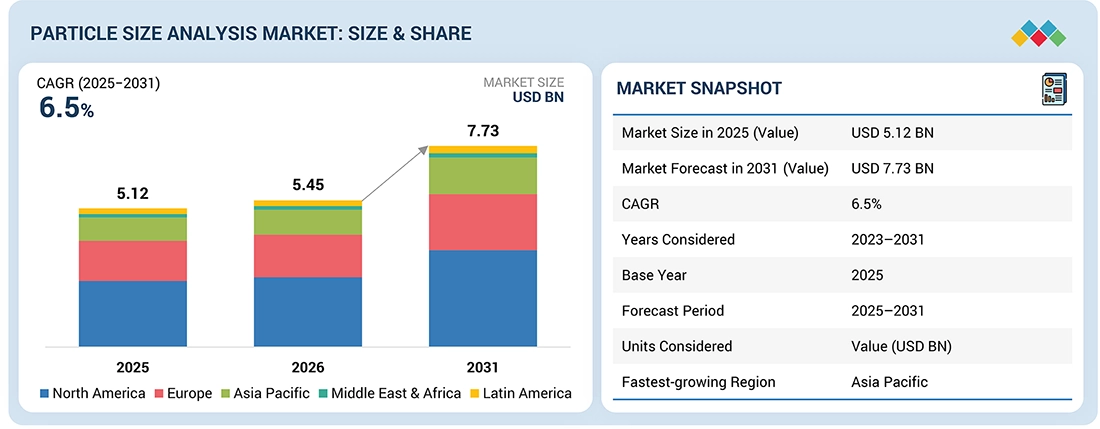
The global particle size analysis market is projected to grow from USD 5.45 billion in 2026 to USD 7.73 billion by 2031, at a CAGR of 6.5% during the forecast period. The market was valued at USD 5.12 billion in 2025. Growing demand for AI-enabled and automated analytical systems, which enable faster, more accurate, and high-throughput particle characterization while reducing manual intervention and improving overall laboratory efficiency.
KEY TAKEAWAYS
-
MARKET SNAPSHOT:
Base Year Market Size (2025): USD 5.12 Billion
Current Market Size (2026): USD 5.45 Billion
Forecast Market Size (2031): USD 7.73 Billion
CAGR (2026–2031): 6.5% -
SEGMENT LEADERSHIP:
Regional Outlook: Asia Pacific is expected to register the highest CAGR of 7.5% during the forecast period from 2026 to 2031.
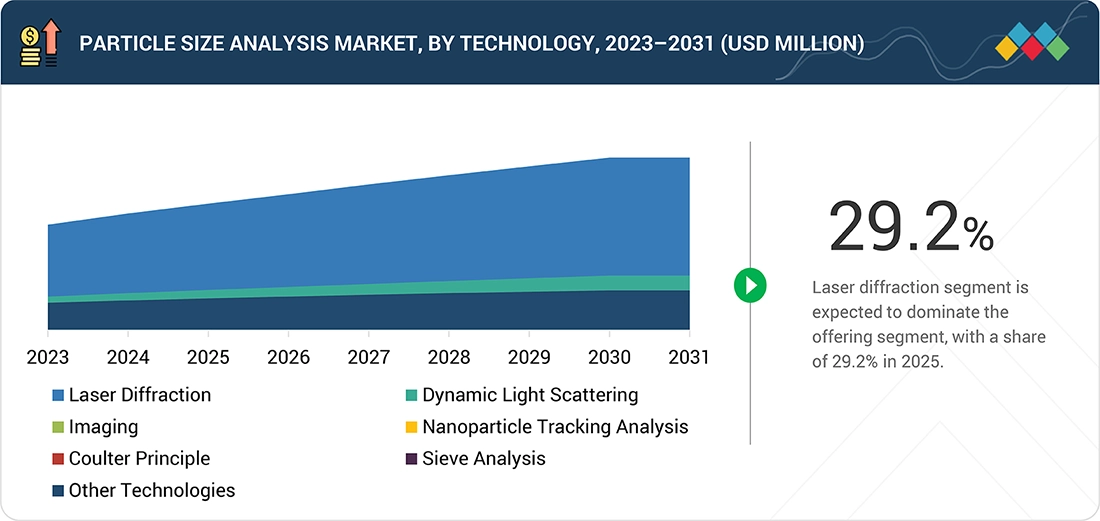
Technology Leader: Laser diffraction dominated the technology segment, with a share of 29.2% in 2025.
Dispersion Leader: Wet dispersion dominated the dispersion segment, with a share of 71.5% in 2025.
Type Leader: Bench-top analyzers accounted for the major market share in 2025.
Industry Leader: Healthcare industry is projected to account for a 41.5% market share in 2025. -
MARKET OUTLOOK & COMPETITIVE LANDSCAPE:
Spectris (UK), HORIBA (Japan), Danaher (US), Anton Paar GmbH (Austria), and Bettersize Instruments Ltd. (China) are key players in this market. They are leveraging strategic partnerships, acquisitions, and strong R&D investments in automation and AI to expand their portfolios and strengthen their competitive position.
Companies such as Brookhaven Instruments (US), Fritsch GmbH (Germany), LS Instruments (Switzerland), Metller Toledo (US), Micromeritics Instrument Corporation (US), and Microtrac Retsch GmbH (Germany), among others, are key startups. A key trend among SME players in the particle size analysis market is the growing focus on cost-effective, portable, and application-specific solutions, enabling them to compete through niche innovation and flexible customer-centric offerings.
The particle size analysis market is being driven by the increasing adoption of real-time and inline particle monitoring systems in manufacturing, which is transforming quality control by enabling continuous, in-process measurement of particle size. This trend allows manufacturers to detect variations instantly, reduce production errors, minimize waste, and ensure consistent product quality, while also supporting automated process optimization and compliance with stringent regulatory standards.
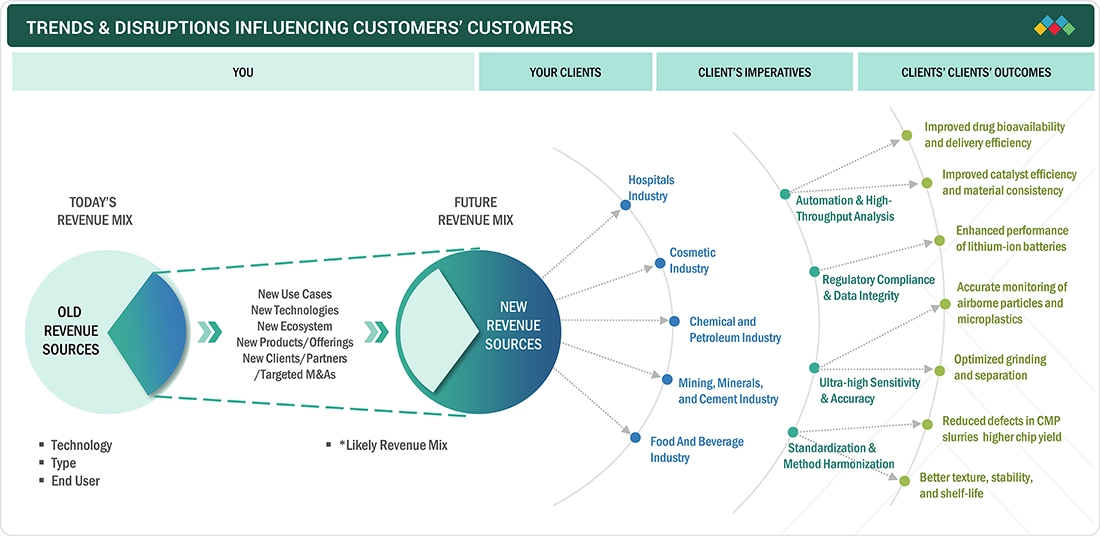
TRENDS & DISRUPTIONS IMPACTING CUSTOMERS' CUSTOMERS
The rapid shift toward digitalization, automation, and AI-driven workflows is significantly shaping customer behavior in the particle size analyzers market, as end users increasingly demand faster, more accurate, and fully integrated analytical solutions for real-time decision-making. Industries such as pharmaceuticals, healthcare, food, and environmental testing are prioritizing instruments that offer high sensitivity, data connectivity, and compliance with stringent regulatory standards, prompting customers to upgrade from conventional systems to advanced, automated platforms. At the same time, trends such as precision medicine, sustainable manufacturing, and continuous process monitoring are driving the need for reliable, reproducible particle characterization, encouraging businesses to invest in next-generation analyzers that improve efficiency, reduce errors, and enhance overall productivity and transparency.
Source: Secondary Research, Interviews with Experts, MarketsandMarkets Analysis
MARKET DYNAMICS

Level
-
Growing demand for precision in pharmaceuticals & biologics

-
Rise of nanotechnology and advanced materials


Level
-
High cost of advanced instruments

-
Lack of standardization across technologies


Level
-
Inline & real-time monitoring in manufacturing

-
Expansion in emerging markets & CRO/CDMO growth


Level
-
Skill gap in advanced analytics

-
Sample preparation & data reliability issues

Source: Secondary Research, Interviews with Experts, MarketsandMarkets Analysis
Driver: Growing demand for precision in pharmaceuticals & biologics
Particle size has emerged as a critical quality attribute (CQA) in pharmaceutical and biologic development because it directly affects drug efficacy, stability, and regulatory approval outcomes. As a result, companies are increasingly investing in advanced particle characterization technologies to minimize risks and avoid costly delays in later stages of development. For instance, a global pharmaceutical company improved drug bioavailability consistency by integrating advanced particle-sizing techniques in early-stage formulation, ultimately reducing the risk of late-stage failure.
Restraint: Lack of standardization across technologies
The particle size analysis market features a fragmented technology landscape, with various techniques such as dynamic light scattering (DLS), nanoparticle tracking analysis (NTA), and laser diffraction in use. This variety can lead to complexity in decision-making and variability in results. The lack of standardization makes it difficult for organizations to rely on a single method, prompting many companies to employ multiple techniques to validate their data. Consequently, this approach increases operational costs and reduces overall efficiency.
Opportunity: Expansion in Emerging Markets & CRO/CDMO Growth
The expansion of emerging markets, particularly in Asia Pacific, along with the rapid growth of pharmaceutical manufacturing and contract research and development organizations (CROs/CDMOs), is significantly driving demand for cost-effective yet advanced particle-size analysis solutions. As more pharmaceutical companies outsource drug development and manufacturing to this region, the need for reliable analytical instrumentation in regional laboratories is increasing, supporting market growth and technology adoption.
Challenge: Sample Preparation & Data Reliability Issues
Sample preparation and data reliability remain key challenges in particle size analysis, as inconsistent sample handling can significantly affect measurement accuracy and overall results. This makes implementing strict standard operating procedures (SOPs) essential to ensure consistency and reliability. In many cases, organizations find that measurement variability is driven more by differences in sample preparation methods than by limitations of the analytical instruments themselves.
PARTICLE SIZE ANALYSIS MARKET: COMMERCIAL USE CASES ACROSS INDUSTRIES
| COMPANY | USE CASE DESCRIPTION | BENEFITS |
|---|---|---|
 |
Uses particle size analysis in API development, formulation design, and inhalation drug delivery to control particle size distribution affecting drug dissolution and bioavailability | Improved drug efficacy, controlled release profiles, enhanced bioavailability, and regulatory compliance. |
 |
Develops PSA instruments (e.g., laser diffraction systems) used across pharma, food, and materials industries for particle characterization | High-precision measurements, faster analysis, and broad application across R&D and QC workflows. |
 |
Applies PSA to control powder properties in food products (e.g., cocoa, milk powders) affecting texture, solubility, and taste | Consistent product texture, improved mouthfeel, optimized processing, and consumer satisfaction. |
 |
Uses PSA in analytical testing services for pharmaceuticals, ensuring particle size distribution meets quality specifications | Regulatory compliance, validated quality control, and reliable batch-to-batch consistency |
Logos and trademarks shown above are the property of their respective owners. Their use here is for informational and illustrative purposes only.
MARKET ECOSYSTEM
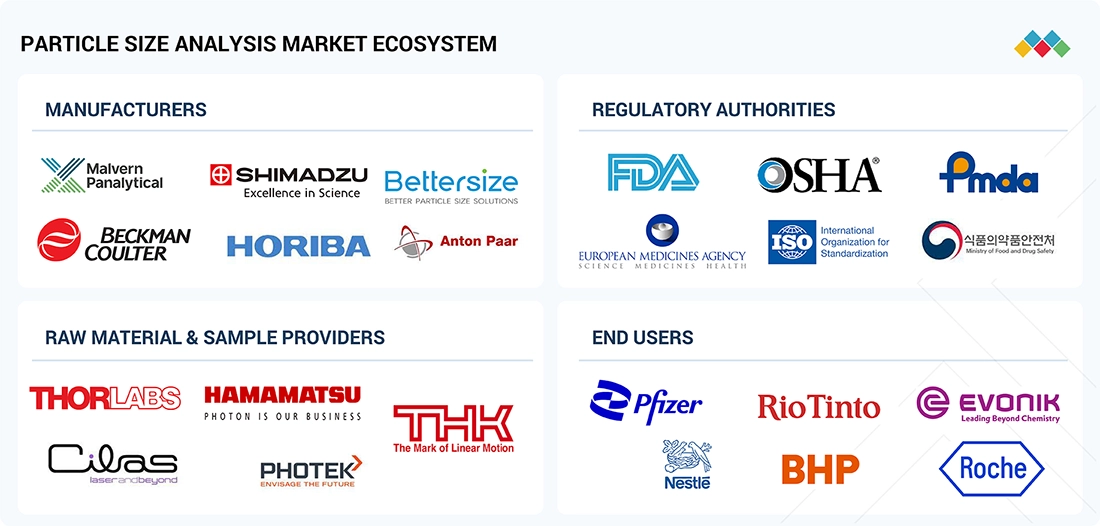
The particle size analysis market ecosystem is driven by advanced instrument manufacturers such as Malvern Panalytical, Shimadzu Corporation, and Beckman Coulter, supported by component providers including Thorlabs and Hamamatsu Photonics. Strict oversight from the US Food and Drug Administration and the International Organization for Standardization ensures quality and standardization. Demand comes from industries led by Pfizer, Rio Tinto, and Roche, highlighting a tightly linked ecosystem where innovation, regulation, and multi-industry applications collectively drive growth.
Logos and trademarks shown above are the property of their respective owners. Their use here is for informational and illustrative purposes only.
MARKET SEGMENTS
Source: Secondary Research, Interviews with Experts, MarketsandMarkets Analysis
Particle Size Analysis Market, By Technology
The particle size analysis market, by technology, is segmented into laser diffraction, dynamic light scattering, imaging, Coulter principle, nanoparticle tracking analysis, sieve analysis, and other methods. In 2025, the laser diffraction segment accounts for the largest share of the market. Its strong growth is driven by high accuracy, rapid measurement, and versatility across a broad particle size range, making it suitable for both wet and dry sample analysis in industries such as pharmaceuticals, chemicals, food, and mining. Additionally, increasing demand for stringent quality control and regulatory compliance, particularly in biopharma and advanced materials, is further boosting the adoption of laser diffraction technology, where consistent particle size is critical to product performance.
Particle Size Analysis Market, By Dispersion
By dispersion type, the particle size analysis market is segmented into wet, dry, and spray dispersion. In 2025, the wet dispersion segment accounts for the largest share of the market. Its growth is driven by its ability to deliver highly accurate, consistent, and reliable measurements for fine particles, suspensions, and emulsions, which are widely used in pharmaceuticals, nanotechnology, and advanced materials. Increasing demand for liquid-based formulations, such as biologics, drug suspensions, and chemical slurries, is a key factor supporting this trend, as wet dispersion ensures better particle separation, reduces agglomeration, and enhances overall measurement precision.
Particle Size Analysis Market, By End User
Based on end users, the particle size analysis market is segmented into the healthcare industry (including pharmaceutical and biotechnology companies, public and private research organizations, and academic institutions), cosmetics, chemical and petroleum, mining, minerals and cement, food and beverages, and other industries. In 2025, the healthcare segment holds the largest share of the market. This dominance is driven by growing demand for advanced drug development, biologics, and nanoparticle-based therapies, where precise particle characterization is essential for safety and effectiveness. An increasing focus on drug delivery systems, vaccines, diagnostics, and medical devices is further accelerating adoption, as particle size directly influences bioavailability, stability, and overall performance.
REGION
Asia-Pacific to be fastest-growing region in global life science instrumentation market during forecast period
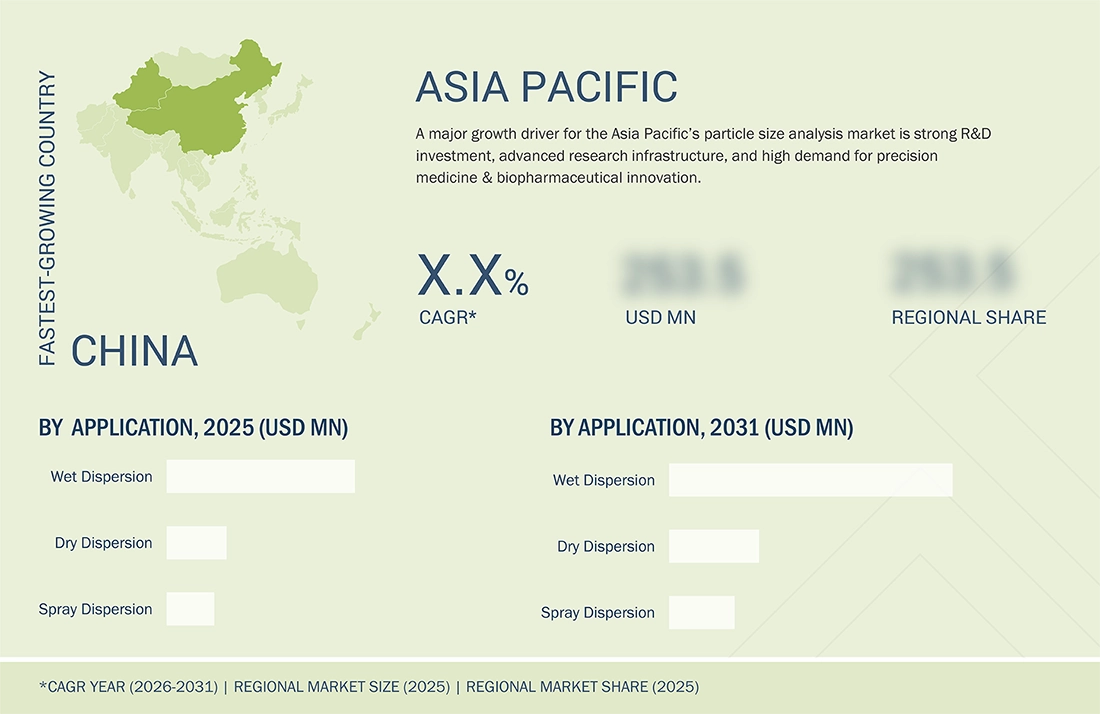
Asia Pacific is emerging as the fastest-growing region in the particle size analysis market, driven by rapid industrialization, expanding pharmaceutical and chemical manufacturing, and increasing investments in nanotechnology and R&D across countries such as China, India, Japan, and South Korea. The region benefits from strong government support, a growing regulatory focus on product quality, and rising adoption of advanced analytical technologies in industries such as healthcare, electronics, and materials science. Additionally, cost-effective manufacturing, a large skilled workforce, and expanding global company presence in emerging markets are accelerating demand for particle size analysis instruments, making Asia Pacific the key growth engine for the market.
PARTICLE SIZE ANALYSIS MARKET: COMPANY EVALUATION MATRIX
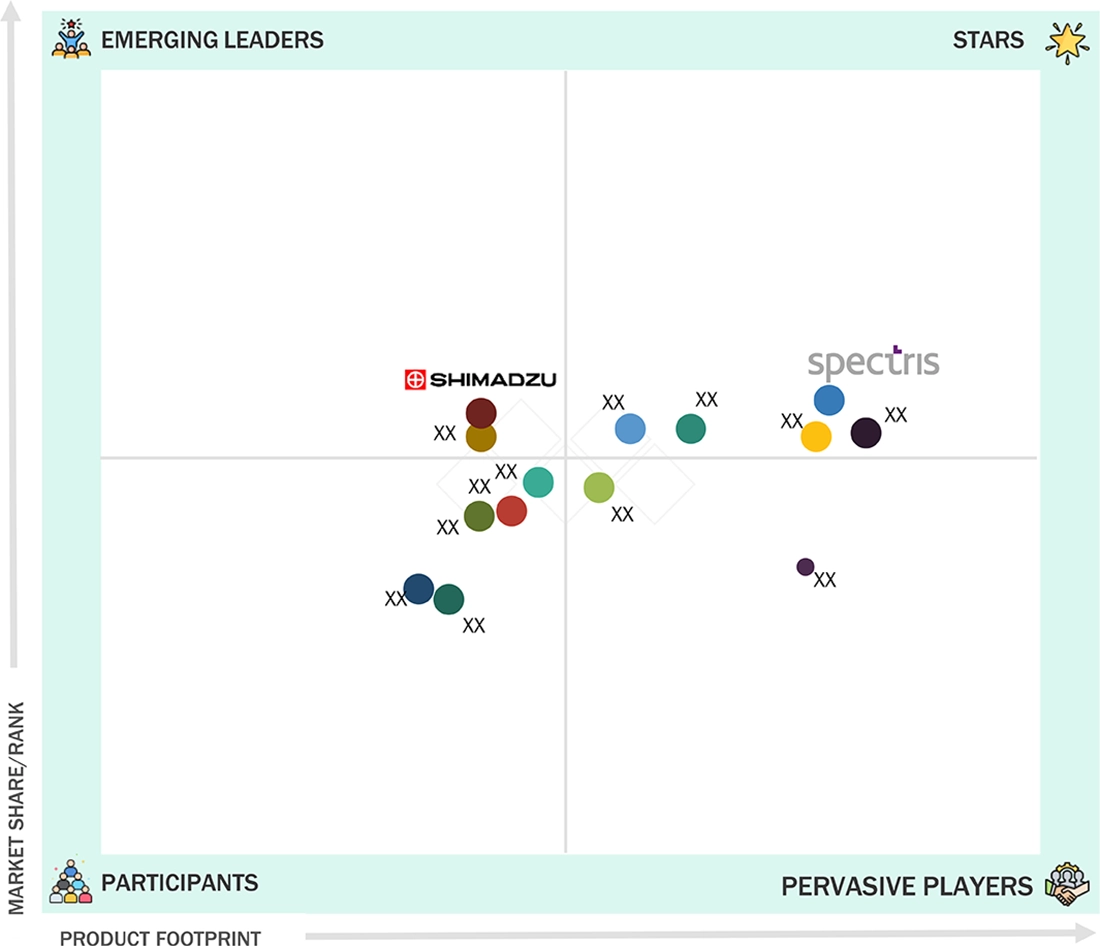
The positioning chart illustrates a clear progression of companies in the particle size analysis market from “Participants” to “Stars,” driven by enhancements in both product portfolio and market share. Companies in the lower-left quadrant represent niche or emerging players with limited market presence, while those moving toward the right demonstrate broader product offerings and stronger commercialization capabilities. The upper-right quadrant, where leaders like Spectris plc are positioned, reflects companies that have successfully combined comprehensive portfolios with strong global penetration, indicating high competitive maturity. In contrast, firms such as Shimadzu Corporation, positioned closer to the upper-left, exhibit solid market presence but relatively narrower product portfolios, highlighting opportunities for further expansion. Overall, the chart emphasizes a steady growth trajectory in which innovation, strategic collaborations, and portfolio diversification are key factors enabling companies to advance to leadership positions.
Source: Secondary Research, Interviews with Experts, MarketsandMarkets Analysis
KEY MARKET PLAYERS
- Spectris (UK)
- HORIBA (Japan)
- Danaher (US)
- Anton Paar GmbH (Austria)
- Bettersize Instruments Ltd. (China),
- Shimadzu Corporation (Japan)
- Fritsch GmbH (Germany)
- Metller Toledo (US)
- Sympatec GmbH (Germany)
MARKET SCOPE
| REPORT METRIC | DETAILS |
|---|---|
| Market Size in 2025 (Value) | USD 5.12 Billion |
| Market Forecast in 2026 (Value) | USD 5.45 Billion |
| Market Forecast in 2031 (Value) | USD 7.73 Billion |
| Growth Rate | CAGR of 6.5% from 2026-2031 |
| Years Considered | 2024-2031 |
| Base Year | 2025 |
| Forecast Period | 2025-2031 |
| Units Considered | Value (USD Million/Billion) |
| Report Coverage | Revenue forecast, company ranking, competitive landscape, growth factors, and trends |
| Segments Covered |
|
| Regions Covered | North America, Asia Pacific, Europe, Latin America, Middle East & Africa |
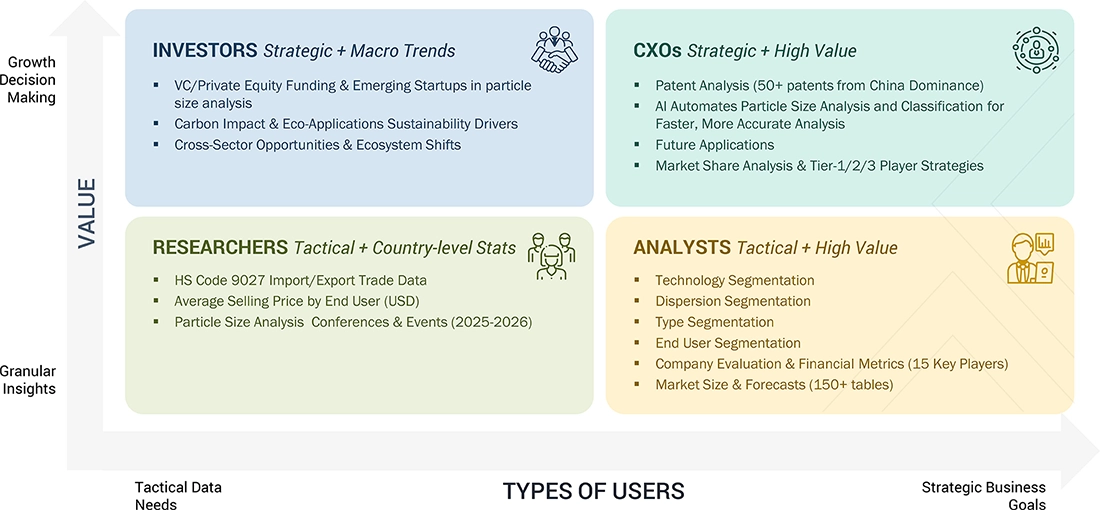
WHAT IS IN IT FOR YOU: PARTICLE SIZE ANALYSIS MARKET REPORT CONTENT GUIDE
DELIVERED CUSTOMIZATIONS
We have successfully delivered the following deep-dive customizations:
| CLIENT REQUEST | CUSTOMIZATION DELIVERED | VALUE ADDS |
|---|---|---|
| Requirement for compact and space-efficient instruments for smaller lab setups | Benchtop and miniaturized instrument designs without compromising performance | Better space utilization, cost savings on infrastructure, and suitability for decentralized or mobile labs |
RECENT DEVELOPMENTS
- March 2026 : HORIBA, Ltd. launched the .“Partica” Laser Diffraction and Dynamic Imaging Particle Size and Shape Analyzer
- October 2025 : Malvern Panalytical released the Mastersizer 3000E, enhancing quality control in pharmaceutical and battery applications with AI-based anomaly detection and automated optical alignment for improved speed and efficiency.
- September 2025 : Horiba collaborated with Contemporary Amperex Technology to develop durable inline laser-diffraction probes designed for real-time monitoring of lithium-ion cathode slurries.
- July 2025 : Beckman Coulter launched the LS 13 320 XR Plus, featuring a lower detection limit of 10 nm and automated handling of up to 120 vials, enabling more efficient high-throughput drug release testing.
Table of Contents
 Exclusive indicates content/data unique to MarketsandMarkets and not available with any competitors.
Methodology
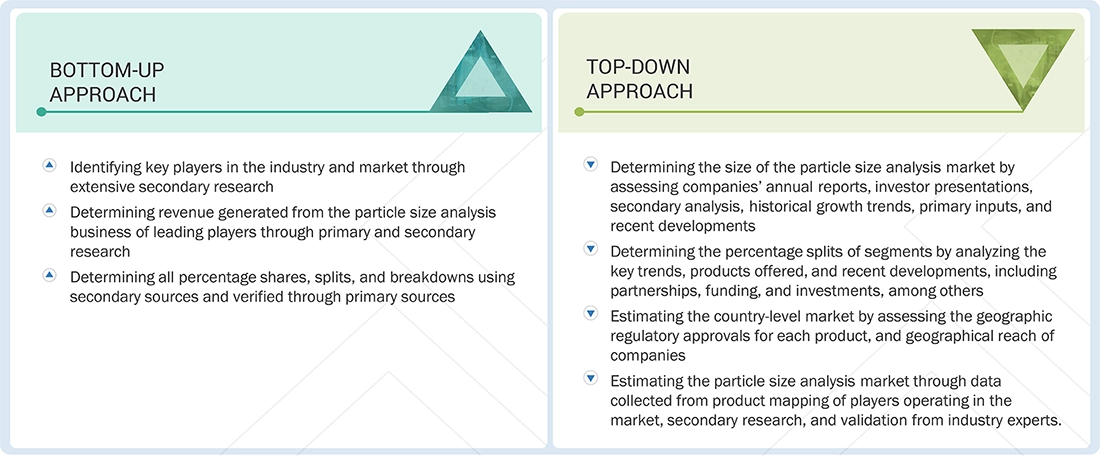
The study involved four major activities in estimating the current size of the particle size analysis market. Exhaustive secondary research was conducted to gather information on the market, peer markets, and parent markets. The next step was to validate these findings, assumptions, and sizing with industry experts across the value chain through primary research. Both top-down and bottom-up approaches were employed to estimate the complete market size. After that, market breakdown and data triangulation were used to estimate the market size of segments and subsegments.
Secondary Research
The secondary research process involves the widespread use of secondary sources, directories, databases (such as Bloomberg Businessweek, Factiva, and D&B Hoovers), white papers, annual reports, company house documents, investor presentations, and companies' SEC filings. Secondary research was used to identify and collect information for the extensive, technical, market-oriented, and commercial particle-size analysis market study. It was also used to obtain important information about the key players, market classification & segmentation according to industry trends down to the bottom-most level, and key developments from market and technology perspectives. A database of key industry leaders was also compiled through secondary research.
Primary Research
In the primary research process, various supply and demand sources were interviewed to obtain qualitative and quantitative information for this report. The primary sources from the supply side include industry experts such as CEOs, vice presidents, marketing and sales directors, technology & innovation directors, and other key executives from various companies and organizations in the particle size analysis market. The primary sources from the demand side include pharma-biopharma companies, CDMOs, research labs, F&B companies, and service providers. Primary research was conducted to validate the market segmentation, identify key players, and gather insights into key industry trends and market dynamics.
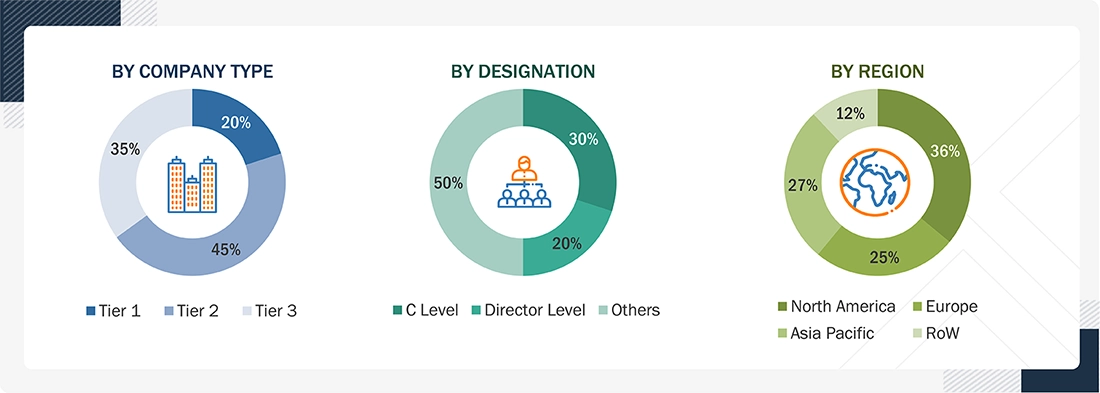
Others include sales managers, marketing managers, business development managers, product managers, distributors, and suppliers.
Note: Companies are classified into tiers based on their total revenue. As of 2025, Tier 1 = >USD 4 billion, Tier 2 = USD 1-2 Billion, and Tier 3 = <USD 1 Billion.
To know about the assumptions considered for the study, download the pdf brochure
Market Size Estimation
In this report, the particle size analysis market size was determined using revenue share analysis of leading players. To this end, key players in the market were identified, and their revenues from market operations were determined through insights gathered during the primary and secondary research phases. Secondary research included the study of the annual and financial reports of the top market players. In contrast, primary research included extensive interviews with key opinion leaders, such as CEOs, directors, and key marketing executives.
Segmental revenue was calculated based on the revenue mapping of major solution/service providers to calculate the global market value. This process involved the following steps:
- Generating a list of major global players operating in the particle size analysis market.
- Mapping annual revenues generated by major global players from the technology segment (or nearest reported business unit/product category)
- Revenue mapping of major players to cover a major share of the global market, as of 2025
- Extrapolating the global value of the particle size analysis market industry
Data Triangulation
After determining the overall market size through the market size estimation process described above, the global particle size analysis market was segmented into segments and subsegments. Data triangulation and market breakdown procedures were used to complete the overall market engineering process and arrive at precise statistics for all segments and subsegments. The data was triangulated by analyzing various factors and trends from both the demand and supply sides. Additionally, the particle size analysis market was validated using top-down and bottom-up approaches.
Market Definition
The particle size analysis market is a segment of analytical instrumentation that measures and characterizes particle size distributions in solids, liquids, and gases to ensure product quality and process efficiency. These instruments are widely used across industries such as pharmaceuticals, chemicals, food, cosmetics, and materials because particle size directly affects properties such as stability, flow, appearance, and reactivity, making it critical for formulation, manufacturing, and quality control.
Key Stakeholders
- Product Manufacturers, Distributors, and Suppliers
- Biotechnology and Pharmaceutical Companies and CROs
- Laboratory Technicians and Workers
- Instruments Manufacturers, Vendors, and Distributors
- Venture Capitalists and Other Government Funding Organizations
- Research and Consulting Firms
- Healthcare Equipment or Product Suppliers and Distributors
- Group Purchasing Organizations (GPOs)
- Academic Universities and Medical Research Centers
- Environmental Testing Laboratories
- Food and Beverage Testing Centers
- Hospitals and Diagnostic Centers
- Clinical Research Organizations
- R&D Centers
- Business Research and Consulting Firms
- Medical Research Laboratories End Users
- R&D Department
- Finance/Procurement Department
Report Objectives
- To define, describe, and forecast the size of the particle size analysis market based on technology, dispersion, type, end user, and region
- To provide detailed information regarding the major factors influencing the growth potential of the global particle size analysis market (drivers, restraints, opportunities, challenges, and trends)
- To analyze the micromarkets with respect to individual growth trends, prospects, and contributions to the global particle size analysis market
- To analyze key growth opportunities in the global particle size analysis market for key stakeholders and provide details of the competitive landscape for market leaders
- To forecast the size of market segments and/or subsegments with respect to five major regions, namely, North America (US and Canada), Europe (Germany, France, the UK, Italy, Spain, and the Rest of Europe), Asia Pacific (Japan, China, India, Australia, South Korea, and the Rest of Asia Pacific), Latin America (Brazil, Mexico, and the Rest of Latin America), and the Middle East & Africa
- To profile the key players in the particle size analysis market and comprehensively analyze their market share and core competencies
- To analyze the competitive developments undertaken in the global particle size analysis market, such as product launches; agreements; expansions; and mergers & acquisitions
Available customizations:
With the given market data, MarketsandMarkets offers customizations per the company’s specific needs. The following customization options are available for the present global particle size analysis market report:
Product Analysis
- Product matrix, which gives a detailed comparison of the product portfolios of the top five companies
Company Information
- Detailed analysis and profiling of additional market players (up to five)
Geographic Analysis
- Further breakdown of the Rest of Europe particle size analysis market into Russia, Belgium, the Netherlands, Switzerland, Austria, Finland, Sweden, Poland, and Portugal, among others
- Further breakdown of the Rest of Asia Pacific particle size analysis market into Singapore, Taiwan, New Zealand, Philippines, Malaysia, and other APAC countries
- Further breakdown of the Latin American particle size analysis market into Colombia, Chile, Argentina, and Peru, among others


Personalize This Research
- Triangulate with your Own Data
- Get Data as per your Format and Definition
- Gain a Deeper Dive on a Specific Application, Geography, Customer or Competitor
- Any level of Personalization
Let Us Help You
- What are the Known and Unknown Adjacencies Impacting the Particle Size Analysis Market
- What will your New Revenue Sources be?
- Who will be your Top Customer; what will make them switch?
- Defend your Market Share or Win Competitors
- Get a Scorecard for Target Partners

Custom Market Research Services
We Will Customise The Research For You, In Case The Report Listed Above Does Not Meet With Your Requirements
Get 10% Free CustomisationTESTIMONIALS

JAYANT RAJPUROHIT
Director of Market Insights, Data and Analytics
SFI Health,
Leading Pharmaceutical Companywww.sfihealth.com/

We at SFI Health approached MarketsandMarkets for an Opportunity Assessment on "Incidence and Prevalence of Focus Indications" as we wanted to know the most attractive HCPs like Physician, Functional MD, Naturopath and Pharmacist. The project was critical for us to ensure our focus on the right target which would enable sustainable growth and profitability for SFI Health. The business insights provided exceeded our expectations and we were extremely impressed. The team at MarketsandMarkets is highly professional and detail oriented and very well understood our business needs. MarketsandMarkets offers a unique combination of expertise and dedicated engagement model. We identified 2 new products to be launched in coming months, based on the research findings provided by MarketsandMarkets. We are happy with the services and would strongly recommend MarketsandMarkets to my peers in the industry.

BEATRIZ DE LA CALLE
Head of Commercial Analytics
Qualicaps,
Leading Pharmaceutical Companywww.qualicaps.com/

We partnered with MarketsandMarkets for an assessment study on hard empty capsules. The team was extremely professional in understanding our business requirements and we received timely responses to all our queries. The market intelligence and the recommendations has met our business requirements. We were extremely impressed to see the final study results; it really exceeded our expectations. The market intelligence offered by MarketsandMarkets, and clarity on next steps will help us achieve our business objective for the Year 2021. We are happy with the services and would strongly recommend MarketsandMarkets to my peers in the industry.

Bob Williams,
Senior Director Business Development & Innovation
Bracco Diagnostics Inc.,
Italian Multinational in life sciences sector and a World Leader in imaging diagnosticsimaging.bracco.com/us-en
We were pleased with targeted insights that MarketsandMarkets identified from a custom study on the 'Radiation Dose Management Solutions Market'. Your team identified and characterized the market participants as well as underlying trends accurately. This study was useful to Bracco in formulating business strategies for our dose monitoring product lines and we thank MarketsandMarkets for the job well done.
Cody Coonradt,
Market Development and Strategy Manager
3M Health Information Systems,
Leader in Health care Coding, Payment & Analytics Solutions.www.3m.com/3M/en_US/health-information-systems-us
The value for our organization comes from three things: depth of research, specificity of segments and being easy to work with. As important as the first two are, the third can't be underestimated. MarketsandMarkets, maybe more than any other research vendor, wants to know what is top of mind for our team and what big questions we are grappling to answer.
Their customer first approach and high value engagement model, have given us great analysis and excellent value for money
- US Particle Size Analysis Market
- Canada Particle Size Analysis Market
- Germany Particle Size Analysis Market
- UK Particle Size Analysis Market
- France Particle Size Analysis Market
- Italy Particle Size Analysis Market
- Spain Particle Size Analysis Market
- China Particle Size Analysis Market
- Japan Particle Size Analysis Market
- India Particle Size Analysis Market
- Australia Particle Size Analysis Market
- South Korea Particle Size Analysis Market
- Brazil Particle Size Analysis Market
- Mexico Particle Size Analysis Market
- Rest Of Europe Particle Size Analysis Market
- Rest Of Asia Pacific Particle Size Analysis Market
- Rest Of Latin America Particle Size Analysis Market
- GCC Countries Particle Size Analysis Market
- Rest Of Middle East And Africa Particle Size Analysis Market






Growth opportunities and latent adjacency in Particle Size Analysis Market