
South Korea Power Electronic Testing Market (2024-2029)

The South Korea Power Electronic Testing Market was valued at $33 Million in 2024 and projected to reach to $61.8 Million by 2029, representing a compound annual growth rate of 13.4%. South Korea's power electronic testing market is poised for sustained expansion through 2029, driven by the country's robust semiconductor manufacturing ecosystem and increasing complexity of electronic devices.


| Market Size in | USD 26.32 MN |
| Market Forecast in | |
| CAGR | |
| Forecast Period | |
| Units Considered | Value (USD MN) |
South Korea Power Electronic Testing Market Trends and Insights
- This 13.4% compound annual growth rate significantly outpaces global trends, reflecting South Korea's strategic position as a semiconductor and electronics manufacturing hub.
- South Korea's advanced industrial infrastructure and heavy investment in power electronics innovation are driving demand for sophisticated testing solutions across automotive, renewable energy, and consumer electronics sectors. The market expansion in South Korea is underpinned by the country's leadership in electric vehicle production and semiconductor manufacturing.
- South Korea's commitment to green energy transition and industrial automation is accelerating adoption of power electronic testing technologies.
- By 2029, South Korea is expected to consolidate its position as a critical testing market within Asia Pacific, supported by domestic demand from major electronics manufacturers and increasing exports of power electronic components requiring rigorous quality assurance..
Key Market Statistics
- CAGR (2024-2029) 13.4% CAGR
- Market Size, 2024 ~USD 33 Million
- Forecast, 2029 ~USD 61.8 Million
- Country South Korea
South Korea Power Electronic Testing Market Overview
Exceptional Growth Trajectory :
South Korea's power electronic testing market is expanding at 13.4% CAGR, significantly outpacing the global rate of 10.2%, driven by the country's dominance in semiconductor manufacturing and electronics exports.
Market Valuation Surge :
The market is projected to nearly double from $33.0 million in 2024 to $61.8 million by 2029, reflecting strong demand for advanced testing solutions across South Korea's thriving electronics sector.
Strategic Manufacturing Hub :
South Korea's position as a global semiconductor and electronics manufacturing powerhouse creates sustained demand for sophisticated power electronic testing capabilities to ensure product quality and compliance.
Technology Investment Focus :
Heavy investment in advanced industrial infrastructure and R&D initiatives positions South Korea as a leader in adopting cutting-edge power electronic testing technologies and methodologies.
South Korea Power Electronic Testing Market Dynamics
- The 13.4% CAGR reflects growing investments in testing infrastructure by major electronics manufacturers and semiconductor producers operating in the region.
- South Korea's commitment to technological advancement and quality assurance standards will continue to fuel demand for sophisticated testing solutions.
- The market benefits from strong government support for industrial innovation and the presence of leading global electronics companies with significant South Korean operations, ensuring continued market momentum and opportunities for testing solution providers..
Market Ecosystem
Related Ecosystem
Key Takeaways
- South Korea's power electronic testing market will nearly double from $33.0M (2024) to $61.8M (2029), driven by 13.4% CAGR.
- South Korea's EV and semiconductor sectors are primary growth catalysts for testing equipment and service demand.
- South Korea's advanced manufacturing ecosystem positions it as a regional leader in power electronics quality assurance.
- South Korea's green energy initiatives and industrial automation investments will sustain above-global-average market expansion through 2029.
Power Electronic Testing Market Report Scope
| Report Metric | Details |
|---|---|
| Base Year | 2024 |
| Fastest Growing Segment | POWER MODULE (Device Type) |
| Forecast Period | 2024-2029 |
| Growth Rate | CAGR of 10.2% from 2024 to 2029 |
| Largest Segment | TESTING SERVICES (Offering) |
| Market Size Base Year (Billions) | ~USD 5.72 (2024) |
| Revenue Forecast (Billions) | ~USD 9.3 (2029) |
| Segments Covered | Offering, Type, Device Type, Vertical |
South Korea Power Electronic Testing Market Report Segmentation
4 segment dimensions are covered across the global market.
By Offering
- Testing Equipment
- Testing Services
By Type
- Automated Test Equipment
- Bert
- Bjt
- Diode
- Electrical Safety Testing
- Electromagnetic Compatibility (Emc) Testing
- Energy Efficiency Testing
- Fet
- Igbt
- Ipm
- Logic Analyzers
- Multimeters
- Network Analyzers
- Oscilloscopes
- Other Standard & Power Integrated Module Types
- Other Testing Equipment
- Other Testing Services
- Radio Frequency Testing
- Signal Generators
- Spectrum Analyzers
- Standard & Power Integrated Module
- Thyristor
- Transistor
By Device Type
- Power Discrete
- Power Integrated Circuit (Ic)
- Power Module
By Vertical
- Aerospace & Defense
- Automotive & Transportation
- Consumer Electronics
- Ict
- Industrial
- Other Verticals
Target Audience
- Semiconductor Manufacturers : South Korean semiconductor producers require detailed market insights to optimize testing investments and stay competitive in the rapidly evolving power electronics segment.
- Electronics Equipment Suppliers : Testing equipment manufacturers need South Korea-specific data to develop localized solutions and establish partnerships with major electronics manufacturers in the region.
- Market Entry Strategists : Companies planning to enter or expand in South Korea's electronics sector require comprehensive market analysis to assess opportunity size, growth potential, and competitive landscape.
- Investment & Private Equity Firms : Investors evaluating opportunities in South Korea's semiconductor and electronics testing space need detailed market forecasts and growth metrics to inform investment decisions.
- Technology Consultants & Analysts : Industry consultants advising clients on South Korean market expansion require authoritative data on market size, CAGR, and regional dynamics to support strategic recommendations.
Reasons to Buy this Report
- Market-Specific Growth Intelligence : Gain detailed insights into South Korea's 13.4% CAGR growth trajectory, which significantly outpaces global benchmarks, enabling strategic planning tailored to this high-growth market segment.
- Competitive Positioning Data : Understand South Korea's unique market dynamics as a semiconductor manufacturing hub, identifying opportunities to capture market share from competitors in this strategically important region.
- Investment Decision Support : Access comprehensive market valuation data ($33M to $61.8M projection) to support capital allocation decisions, facility expansion plans, and market entry strategies specific to South Korea.
- Regulatory & Infrastructure Insights : Leverage detailed analysis of South Korea's advanced industrial infrastructure, quality standards, and government support initiatives to align product offerings with regional requirements.
- Customer Identification & Targeting : Identify key customer segments within South Korea's electronics and semiconductor manufacturing ecosystem, enabling focused sales and partnership development strategies in this concentrated market.
Frequently asked questions
What is the current size of South Korea's power electronic testing market?
South Korea's power electronic testing market was valued at $33.0 million in 2024 and is forecast to reach $61.8 million by 2029.
What is the projected growth rate for South Korea's power electronic testing market?
South Korea's power electronic testing market is expected to grow at a compound annual growth rate (CAGR) of 13.4% from 2024 to 2029.
Which industries are driving demand for power electronic testing in South Korea?
South Korea's automotive (particularly electric vehicles), semiconductor manufacturing, renewable energy, and consumer electronics sectors are primary drivers of power electronic testing demand.
Why is South Korea's growth rate higher than the global average?
South Korea's 13.4% CAGR exceeds the global 10.2% rate due to the country's leadership in EV production, semiconductor manufacturing, and aggressive green energy transition initiatives.
What factors will support South Korea's power electronic testing market through 2029?
South Korea's continued investment in industrial automation, electric vehicle expansion, semiconductor innovation, and renewable energy infrastructure will sustain market growth through 2029.
RESEARCH METHODOLOGY
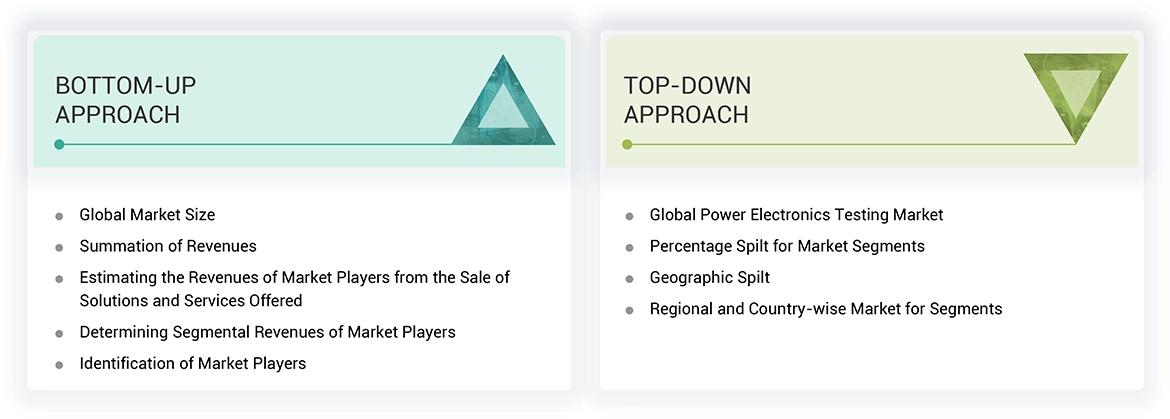
The research study involved 4 major activities in estimating the size of the power electronics testing market. Exhaustive secondary research has been done to collect important information about the market and peer markets. The validation of these findings, assumptions, and sizing with the help of primary research with industry experts across the value chain has been the next step. Both top-down and bottom-up approaches have been used to estimate the market size. Post which the market breakdown and data triangulation have been adopted to estimate the market sizes of segments and sub-segments.
Secondary Research
In the secondary research process, various secondary sources have been referred to for identifying and collecting information required for this study. The secondary sources include annual reports, press releases, investor presentations of companies, white papers, and articles from recognized authors. Secondary research has been mainly done to obtain key information about the market’s value chain, the pool of key market players, market segmentation according to industry trends, regional outlook, and developments from both market and technology perspectives.
In the power electronics testing market report, the global market size has been estimated using both the top-down and bottom-up approaches, along with several other dependent submarkets. The major players in the market were identified using extensive secondary research, and their presence in the market was determined using secondary and primary research. All the percentage shares splits, and breakdowns have been determined using secondary sources and verified through primary sources.
Primary Research
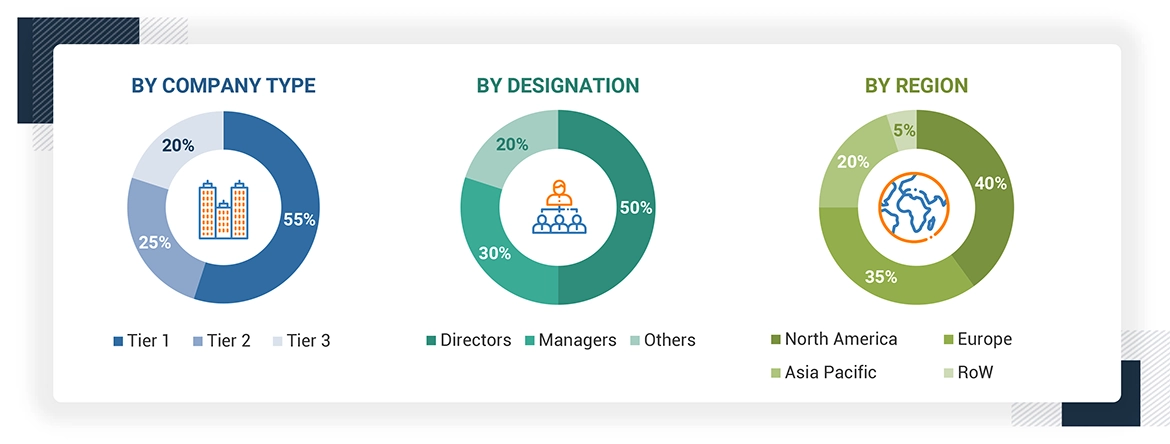
Extensive primary research has been conducted after understanding the power electronics testing market scenario through secondary research. Several primary interviews have been conducted with key opinion leaders from both demand- and supply-side vendors across 4 major regions— North America, Europe, Asia Pacific, and the Rest of the World. Approximately 25% of the primary interviews have been conducted with the demand-side vendors and 75% with the supply-side vendors. Primary data has been collected mainly through telephonic interviews, which consist of 80% of the total primary interviews; questionnaires and emails have also been used to collect the data.
After successful interaction with industry experts, brief sessions were conducted with highly experienced independent consultants to reinforce the findings of our primary research. This, along with the in-house subject matter experts’ opinions, has led us to the findings as described in the report. The breakdown of primary respondents is as follows:
About the assumptions considered for the study, To know download the pdf brochure
Market Size Estimation
In the market engineering process, both top-down and bottom-up approaches, along with data triangulation methods, have been used to estimate and validate the size of the power electronics testing and other dependent submarkets. The research methodology used to estimate the market sizes includes the following:
- Identifying top-line investments and spending in the ecosystem and considering segment-level splits and major market developments
- Identifying different stakeholders in the power electronics testing market that influence the entire market, along with participants across the supply chain
- Analyzing major manufacturers and service providers in the power electronics testing market and studying their solutions and service portfolios
- Analyzing trends related to the adoption of power electronics testing solutions and services
- Tracking recent and upcoming market developments, including investments, R&D activities, solution and service launches, collaborations, acquisitions, and partnerships, as well as forecasting the market size based on these developments and other critical parameters
- Carrying out multiple discussions with key opinion leaders to identify the adoption trends of power electronics testing solutions and services
- Segmenting the overall market into various other market segments
- Validating the estimates at every level through discussions with key opinion leaders, such as chief executives (CXOs), directors, and operation managers, and finally with the domain experts at MarketsandMarkets
Power Electronic Testing Market : Top-Down and Bottom-Up Approach
Data Triangulation
After arriving at the overall market size—using the market size estimation processes as explained above—the market has been split into several segments and subsegments. To complete the entire market engineering process and arrive at the exact statistics of each market segment and subsegment, data triangulation and market breakdown procedures have been employed, wherever applicable. The data has been triangulated by studying various factors and trends from the demand and supply sides in the power electronics testing market.
Market Definition
Power electronics is the application of solid-state electronics, in which electric power is converted from one form to another and controlled effectively and efficiently. This conversion is performed using semiconductor devices such as diodes, thyristors, MOSFETs, and IGBTs. Currently, most electrical and electromechanical devices are integrated with power circuits wherein such semiconductor devices are utilized. Power electronics has a wide range of applications in the automotive and transportation, industrial, renewable energy, and consumer electronics sectors. The power electronics testing market encompasses a range of products and services designed to evaluate the performance, durability, and reliability of power electronic devices such as converters, inverters, and power management systems. This market is driven by the increasing demand for efficient energy conversion in sectors like automotive (electric vehicles), renewable energy, and industrial applications. Key testing types include functional testing, which ensures that devices perform their intended functions under normal conditions; reliability testing, which assesses the device’s lifespan under stress or extreme conditions; thermal testing to monitor temperature performance; and electromagnetic compatibility (EMC) testing, which checks for interference issues. Additionally, electrical safety testing is performed to ensure compliance with regulatory standards.
Key Stakeholders
- Raw Material Suppliers
- Test Equipment Manufacturers
- Service Providers
- Device Manufacturers
- Network Operators
- Research and Development Organizations
- Government and Regulatory Bodies
- Industry Associations
- System Integrators
- Component Suppliers
- Certification Bodies
Report Objectives
- To define, describe, segment, and forecast the power electronic testing market, offering, device type, and vertical, in terms of value
- To describe and forecast the market for various segments, with respect to four main regions, namely, North America, Europe, Asia Pacific, and the Rest of the World (RoW), in terms of value
- To provide detailed information regarding drivers, restraints, opportunities, and challenges influencing the growth of the power electronic testing market
- To provide a detailed overview of the power electronic testing market’s supply chain, along with the ecosystem, technology trends, use cases, regulatory environment, and porter’s five forces analysis for the market
- To analyze industry trends, pricing data, patents and innovations, and trade data (export and import data) related to the power electronic testing.
- To strategically analyze the micromarkets1 with respect to individual growth trends, prospects, and contributions to the total market
- To strategically profile the key players and comprehensively analyze their market share and core competencies2
- To analyze opportunities for stakeholders and provide a detailed competitive landscape of the market
- To analyze competitive developments, such as product launches/developments, collaborations, partnerships, acquisitions, and research & development (R&D) activities, carried out by players in the power electronic testing market
- To profile key players in the power electronic testing market and comprehensively analyze their market ranking based on their revenue, market share, and core competencies
Available Customizations
With the given market data, MarketsandMarkets offers customizations according to the specific requirements of companies. The following customization options are available for the report:
- Detailed analysis and profiling of additional market players based on various blocks of the supply chain
Get the Full Power Electronic Testing Market Report
Full forecast, segment splits, and company analysis for all Power Electronic Testing Market.
- US Power Electronic Testing Market
- Canada Power Electronic Testing Market
- Mexico Power Electronic Testing Market
- UK Power Electronic Testing Market
- Germany Power Electronic Testing Market
- France Power Electronic Testing Market
- Italy Power Electronic Testing Market
- China Power Electronic Testing Market
- Japan Power Electronic Testing Market
- India Power Electronic Testing Market
- Rest Of Europe Power Electronic Testing Market
- Rest Of Asia Pacific Power Electronic Testing Market
Need a Tailored Report?
Customize this report to your needs
Get 10% FREE Customization
Customize This Report
