
South Korea Power Factor Correction Market (2024-2029)

The South Korea Power Factor Correction Market was valued at $70 Million in 2024 and projected to reach to $94.6 Million by 2029, representing a compound annual growth rate of 5.1%. South Korea's power factor correction market is positioned for steady expansion through 2029, supported by the nation's advanced industrial infrastructure and regulatory focus on energy efficiency.


| Market Size in | USD 26.32 MN |
| Market Forecast in | |
| CAGR | |
| Forecast Period | |
| Units Considered | Value (USD MN) |
South Korea Power Factor Correction Market Trends and Insights
- The market in South Korea is driven by increasing industrial energy efficiency mandates and the nation's commitment to reducing carbon emissions across manufacturing and utility sectors.
- South Korea's advanced industrial base and stringent power quality regulations create strong demand for power factor correction solutions among large-scale manufacturers and data centers. The forecast period through 2029 reflects South Korea's strategic focus on smart grid modernization and renewable energy integration.
- South Korea continues to invest heavily in electrical infrastructure upgrades, particularly in semiconductor fabrication plants and automotive manufacturing facilities that require precise power quality management.
- The 5.1% compound annual growth rate in South Korea underscores the market's resilience and the country's ongoing transition toward more efficient and sustainable power systems..
Key Market Statistics
- CAGR (2024-2029) 5.1% CAGR
- Market Size, 2024 ~USD 70 Million
- Forecast, 2029 ~USD 94.6 Million
- Country South Korea
South Korea Power Factor Correction Market Overview
Market Valuation & Growth :
South Korea's power factor correction market is valued at $70.0 million in 2024, with a projected CAGR of 5.1% through 2029, reaching $94.6 million by forecast end.
Industrial Energy Efficiency Mandates :
South Korea's stringent industrial regulations and energy efficiency standards are driving adoption of power factor correction solutions across manufacturing and utility sectors.
Carbon Emission Reduction Goals :
The nation's commitment to reducing carbon emissions and achieving sustainability targets is accelerating investment in power factor correction technologies to optimize energy consumption.
Advanced Industrial Base :
South Korea's sophisticated manufacturing ecosystem and technology-driven industries create strong demand for advanced power factor correction systems and smart grid solutions.
South Korea Power Factor Correction Market Dynamics
- Manufacturing facilities, data centers, and utility operators are increasingly investing in power factor correction technologies to comply with government mandates and reduce operational costs.
- The market benefits from South Korea's technological leadership and commitment to smart grid modernization, creating opportunities for innovative solutions that enhance power quality and reduce energy waste across industrial applications..
Market Ecosystem
Related Ecosystem
Power Infrastructure
- Geographical Information System (GIS)
- Cogeneration
- Battery Electric Vehicle (BEV)
- Cellular Network
- Fuel Cell
- ABB India Limited
- Siemens ag
- SCHNEIDER ELECTRIC SE
- General Electric Company
- Eaton Corporation plc
Key Takeaways
- South Korea's power factor correction market is valued at $70.0 million in 2024 and is expected to reach $94.6 million by 2029, representing a 5.1% CAGR.
- South Korea's advanced manufacturing sector, including semiconductors and automotive, drives significant demand for power quality solutions and efficiency improvements.
- Stringent energy efficiency regulations and carbon reduction targets in South Korea are accelerating adoption of power factor correction technologies across industrial facilities.
- South Korea's smart grid modernization initiatives and renewable energy integration plans create sustained growth opportunities for power factor correction market participants through 2029.
Power Factor Correction Market Report Scope
| Report Metric | Details |
|---|---|
| Base Year | 2024 |
| Fastest Growing Segment | DATA CENTER (Application) |
| Forecast Period | 2024-2029 |
| Growth Rate | CAGR of 5.5% from 2024 to 2029 |
| Largest Segment | AUTOMATIC (Type) |
| Market Size Base Year (Billions) | ~USD 2.39 (2024) |
| Revenue Forecast (Billions) | ~USD 3.13 (2029) |
| Segments Covered | Reactive Power, Type, Sales Channel, Application, End User, Source |
South Korea Power Factor Correction Market Report Segmentation
6 segment dimensions are covered across the global market.
By Reactive Power
- 0-200 Kvar
- 200-500 Kvar
- 500-1,500 Kvar
- Above 1,500 Kvar
By Type
- Automatic
- Fixed
By Sales Channel
- Distributors
- OEM Direct
By Application
- Commercial
- Data Center
- EV Charging
- Industrial
- Renewable
By End User
- Automobile Companies
- Metal & Mineral Plants
- Mining Facilities
- Oil & Gas Plants
- Other Manufacturing Plants
- Others Manufacturing Plants
By Source
- Bess
- Solar
- Wind
Target Audience
- Industrial Manufacturers : South Korean manufacturers need market intelligence to optimize power factor correction investments, ensure regulatory compliance, and reduce energy costs across production facilities.
- Utility & Energy Providers : Power utilities operating in South Korea require detailed market data to plan grid modernization strategies, improve power quality, and meet national carbon reduction targets.
- Technology & Equipment Vendors : PFC solution providers need South Korea-specific market insights to identify growth opportunities, understand customer requirements, and develop competitive strategies in this advanced market.
- Investment & Financial Analysts : Investors evaluating opportunities in South Korea's energy sector need accurate market sizing, growth forecasts, and regulatory context to make informed investment decisions.
- Government & Policy Makers : South Korean energy policy officials and regulatory bodies require market data to assess the effectiveness of efficiency mandates and guide future sustainability and industrial policy.
Reasons to Buy this Report
- Regulatory Compliance Insights : Understand South Korea's specific industrial energy efficiency mandates and regulatory requirements that are driving power factor correction adoption across manufacturing and utility sectors.
- Market Sizing & Forecasting : Access precise market valuation data for South Korea ($70.0M in 2024) with detailed 5-year forecasts to support investment decisions and strategic planning in this growing market.
- Competitive Landscape Analysis : Identify key players, market dynamics, and competitive positioning specific to South Korea's advanced industrial base and technology-driven power factor correction sector.
- Growth Opportunity Assessment : Evaluate the 5.1% CAGR growth trajectory and identify high-potential segments within South Korea's manufacturing, data center, and utility industries for targeted expansion.
- Sustainability & ESG Alignment : Leverage insights on South Korea's carbon emission reduction goals and sustainability initiatives to align product offerings with the nation's environmental policy priorities.
Frequently asked questions
What is the current size of South Korea's power factor correction market?
South Korea's power factor correction market was valued at $70.0 million in 2024 and is projected to grow to $94.6 million by 2029.
What is the expected growth rate for South Korea's power factor correction market?
South Korea's power factor correction market is expected to grow at a compound annual growth rate (CAGR) of 5.1% from 2024 to 2029.
Which industries in South Korea are driving power factor correction demand?
South Korea's semiconductor manufacturing, automotive production, data centers, and utility sectors are primary drivers of power factor correction market growth due to stringent power quality requirements.
How are regulatory policies affecting South Korea's power factor correction market?
South Korea's energy efficiency mandates and carbon reduction targets are accelerating the adoption of power factor correction solutions across industrial and commercial facilities.
What role does smart grid development play in South Korea's power factor correction market?
South Korea's ongoing smart grid modernization and renewable energy integration initiatives are creating sustained demand for advanced power factor correction technologies to maintain grid stability and efficiency.
RESEARCH METHODOLOGY
The study involved major activities in estimating the current size of the power factor correction market. Exhaustive secondary research was done to collect information on the peer and parent markets. The next step was to validate these findings, assumptions, and sizing with industry experts across the value chain through primary research. Both top-down and bottom-up approaches were employed to estimate the complete market size. Thereafter, market breakdown and data triangulation were used to estimate the market size of the segments and subsegments.
Secondary Research
This research study on the power factor correction market involved the use of extensive secondary sources, directories, and databases, such as Hoovers, Bloomberg, Businessweek, Factiva, International Energy Agency, and United States Energy Association, to identify and collect information useful for a technical, market-oriented, and commercial study of the global power factor correction market. The secondary sources referred to for this research study included annual reports, press releases, investor presentations of companies, white papers, certified publications, articles from recognized authors, and various companies and association databases. Secondary research was conducted to obtain key information about the industry’s supply chain, the market’s monetary chain, the total pool of key players, market classification and segmentation according to industry trends to the bottom-most level, country-level markets, and key developments from the market- and technology-oriented perspectives.
Primary Research
The power factor correction market comprises several stakeholders such as power factor correction manufacturers, suppliers and distributors of power factor correction in the supply chain. The demand side of this market is characterized by the adoption of power factor correction across various end use industries. The supply side is characterized by products offered by various power factor correction manufacturers and mergers & acquisitions among big players. Various primary sources from both the supply and demand sides of the market were interviewed to obtain qualitative and quantitative information.
Following is the breakdown of primary respondents:
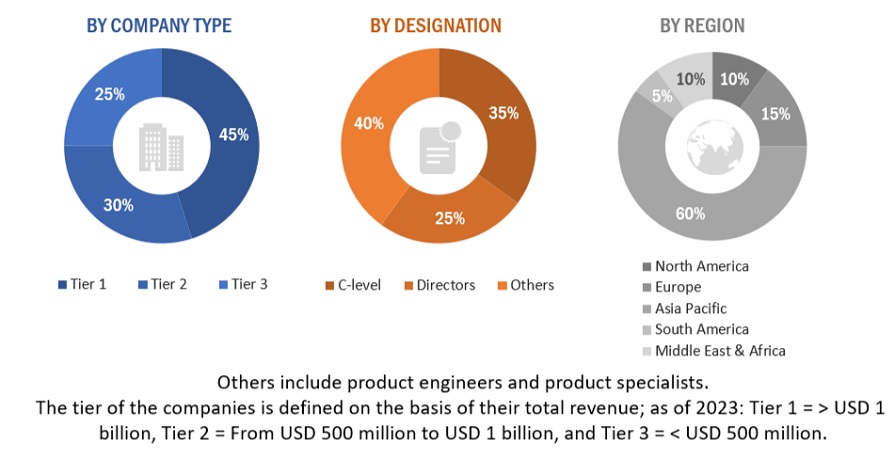
To know about the assumptions considered for the study, download the pdf brochure
Market Size Estimation
Both top-down and bottom-up approaches were used to estimate and validate the total size of the power factor correction market. These methods were also used extensively to estimate the size of various subsegments in the market. The research methodology used to estimate the market size includes the following:
- The key players in the industry and market have been identified through extensive secondary research, and their market share in the respective regions has been determined through both secondary and primary research.
- The industry’s supply chain and market size, in terms of value, have been determined through primary and secondary research processes.
- All percentage shares, splits, and breakdowns have been determined using secondary sources and verified through primaries.
Global Power factor correction Market Size: Top-down Approach
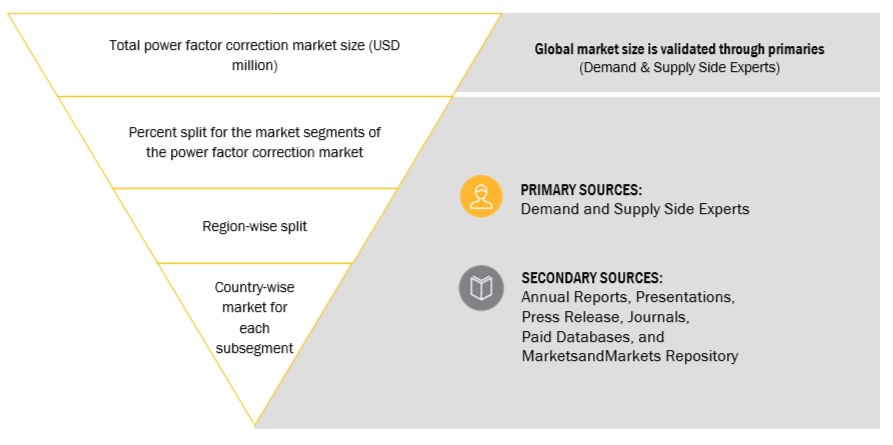
To know about the assumptions considered for the study, Request for Free Sample Report
Global Power factor correction Market Size: Bottom-Up Approach
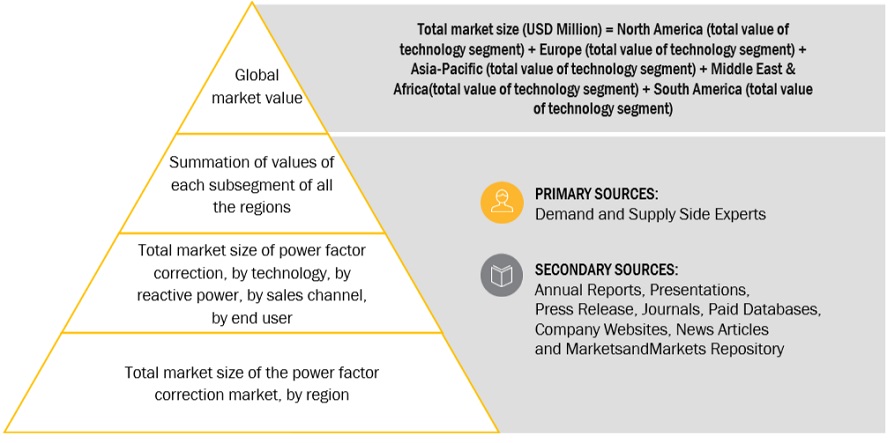
Data Triangulation
After arriving at the overall market size from the estimation process explained above, the total market has been split into several segments and subsegments. The complete market engineering process is done to arrive at the exact statistics for all the segments and subsegments, also data triangulation and market breakdown processes have been employed, wherever applicable. The data has been triangulated by examining various factors and trends from both the demand- and supply sides. Along with this, the market has been validated through both the top-down and bottom-up approaches.
Market Definition
The power factor correction refers to the utilization of capacitor banks that are designed to improve the efficiency of an electrical power system by compensating for the lagging power factor caused by inductive loads such as motors, transformers, and other inductive devices. Capacitor banks are strategically installed to supply reactive power (KVARs) to the system, which reduces the amount of reactive power that needs to be supplied by the utility, thereby improving the power factor.
Key Stakeholders
- Suppliers of raw materials
- Technology investors
- Manufacturers of wide variety of power factor correction systems
- Integrator and service provider of power factor correction systems
- Component providers
- System integrators
- Consulting service providers
- Distributors, resellers, and traders
- Organizations, forums, alliances, and associations
- State and national regulatory authorities
- Venture capital firms
- Financial organizations
- Healthcare organizations
- Research Institutes and organizations
- Energy associations
- Environment associations
- Energy efficiency consultants
- State and national regulatory authorities
Objectives of the Study
- To describe and forecast the power factor correction market in terms of value and volume based on reactive power, type, sales channel, application, and region
- To provide detailed information about the key factors such as drivers, restraints, opportunities, and challenges influencing the growth of the power factor correction market
- To strategically analyze the subsegments with respect to individual growth trends, prospects, and contributions of each segment to the overall market size
- To forecast the market size for five key regions: North America, Europe, Asia Pacific, Middle East & Africa, and South America, along with their key countries
- To strategically analyze micromarkets1 with respect to individual growth trends, prospects, and contributions to the total market
- To study the complete supply chain and allied industry segments and perform a supply chain analysis of the power factor correction market’ landscape
- To study market trends, patent analysis, trade analysis, tariff and regulatory landscape, Porter’s five forces analysis, ecosystem mapping, technologies, investment and funding scenario, key stakeholders & buying criteria, case studies pertaining to off power factor correction market
- To analyze the opportunities for various stakeholders by identifying the high-growth segments of the power factor correction market
- To profile the key players and comprehensively analyze their market positions in terms of ranking and core competencies2, along with detailing the competitive landscape for the market leaders
- To analyze competitive developments, such as contracts, collaborations, expansions, product launches, investments, and acquisitions, in the power factor correction market
Available Customizations:
With the given market data, MarketsandMarkets offers customizations as per the client’s specific needs. The following customization options are available for this report:
Geographic Analysis
- Further breakdown of region or country-specific analysis
Company Information
- Detailed analyses and profiling of additional market players (up to 5)
Get the Full Power Factor Correction Market Report
Full forecast, segment splits, and company analysis for all Power Factor Correction Market.
- US Power Factor Correction Market
- Canada Power Factor Correction Market
- Mexico Power Factor Correction Market
- Germany Power Factor Correction Market
- UK Power Factor Correction Market
- France Power Factor Correction Market
- Italy Power Factor Correction Market
- Russia Power Factor Correction Market
- China Power Factor Correction Market
- Japan Power Factor Correction Market
- India Power Factor Correction Market
- Australia Power Factor Correction Market
- Saudi Arabia Power Factor Correction Market
- UAE Power Factor Correction Market
- South Africa Power Factor Correction Market
- Brazil Power Factor Correction Market
- Argentina Power Factor Correction Market
- Rest Of Europe Power Factor Correction Market
- Rest Of Asia Pacific Power Factor Correction Market
- GCC Power Factor Correction Market
- Rest Of GCC Power Factor Correction Market
- Rest Of South America Power Factor Correction Market
Need a Tailored Report?
Customize this report to your needs
Get 10% FREE Customization
Customize This Report
