
Asia Pacific Precision Biotics Market (2026-2031)

The Asia Pacific Precision Biotics Market was valued at $1368.2 Million in 2026 and projected to reach to $2812.4 Million by 2031, representing a compound annual growth rate of 15.5%. The Asia Pacific precision biotics market is poised for exceptional growth, driven by increasing health consciousness and digital health adoption across the region.


| Market Size in | USD 26.32 MN |
| Market Forecast in | |
| CAGR | |
| Forecast Period | |
| Units Considered | Value (USD MN) |
Asia Pacific Precision Biotics Market Trends and Insights
- Asia Pacific's 15.5% compound annual growth rate significantly outpaces the global average, driven by rising consumer awareness of personalized nutrition and increasing adoption of microbiome-based health solutions across the region.
- The market in Asia Pacific is benefiting from growing middle-class populations, expanding e-commerce infrastructure, and heightened investment in biotechnology innovation. Asia Pacific's precision biotics sector is characterized by strong demand from both developed and emerging economies, with countries investing heavily in preventive healthcare and functional food products.
- The region's regulatory environment is gradually becoming more supportive of precision nutrition claims, enabling manufacturers to launch targeted products.
- Between 2026 and 2031, Asia Pacific is expected to capture an increasing share of global precision biotics revenue as consumer spending on personalized health solutions accelerates..
Key Market Statistics
- CAGR (2026-2031) 15.5% CAGR
- Market Size, 2026 ~USD 1368.2 Million
- Forecast, 2031 ~USD 2812.4 Million
- Geography Asia Pacific
Asia Pacific Precision Biotics Market Overview
Outpacing Global Growth :
Asia Pacific's 15.5% CAGR significantly exceeds the global average of 13.5%, positioning the region as the fastest-growing precision biotics market worldwide through 2031.
Personalized Nutrition Adoption :
Rising consumer awareness across Asia Pacific regarding personalized nutrition and tailored health solutions is driving unprecedented demand for precision biotic products and services.
Microbiome-Based Solutions Expansion :
Increasing adoption of microbiome-based health solutions across the region reflects growing consumer interest in science-backed, individualized wellness approaches.
Market Doubling by 2031 :
The Asia Pacific precision biotics market is projected to more than double from USD 1,368.2 million in 2026 to USD 2,812.4 million by 2031, representing substantial investment opportunities.
Asia Pacific Precision Biotics Market Dynamics
- Consumer demand for personalized nutrition solutions continues to accelerate, particularly in developed markets like Japan and Australia, while emerging economies such as India and China present significant expansion opportunities.
- The region's growing middle class and rising disposable incomes are fueling investment in preventive healthcare and microbiome-based wellness products. Key growth catalysts include advancing genomic sequencing technologies, expanding e-commerce platforms for health products, and strengthening regulatory frameworks supporting precision medicine.
- Strategic partnerships between biotech firms and regional food & beverage companies are accelerating product innovation and market penetration.
- By 2031, Asia Pacific is expected to capture an increasingly larger share of the global precision biotics market, establishing itself as a critical hub for personalized nutrition innovation and commercialization..
Market Ecosystem

PRECISION BIOTICS MARKET: COMMERCIAL USE CASES ACROSS INDUSTRIES
| COMPANY | USE CASE DESCRIPTION | BENEFITS |
|---|---|---|
 |
Pendulum developed Pendulum Glucose Control, a precision probiotic formulated with proprietary next-generation bacterial strains to increase butyrate production, support GLP-1 secretion, and improve blood glucose metabolism using an acid-resistant delivery capsule. | Supports healthy blood glucose levels, improves gut barrier function, enhances butyrate production, and ensures effective delivery of live probiotic strains. |
 |
Seed developed DS-01 Daily Synbiotic, a strain-specific synbiotic formulated using microbiome science and advanced capsule technology to support digestive, immune, skin, and cardiovascular health. | Enhances probiotic survival, supports multiple health outcomes, and provides clinically researched strain-specific benefits |
Logos and trademarks shown above are the property of their respective owners. Their use here is for informational and illustrative purposes only.
Related Ecosystem
Nutraceuticals And Dietary Supplements
- Dairy Products
- Animal-Based Sealants
- Carbohydrates
- Porcine
- Acrylic Polymers
- AZELIS HOLDINGS SA
- Amway
- Nestle s.a
- Kerry Group plc
- Basf se
Key Takeaways
- Asia Pacific precision biotics market will double from $1,368.2M (2026) to $2,812.4M (2031), representing 15.5% CAGR growth.
- Asia Pacific's growth rate of 15.5% exceeds the global CAGR of 13.5%, positioning the region as a key growth engine.
- Asia Pacific consumers are increasingly adopting personalized nutrition and microbiome-based health solutions driven by rising health consciousness.
- Asia Pacific's expanding middle class, e-commerce penetration, and supportive regulatory trends are accelerating precision biotics adoption through 2031.
Precision Biotics Market Report Scope
| Report Metric | Details |
|---|---|
| Base Year | 2026 |
| Fastest Growing Segment | NEXT-GENERATION PROBIOTICS (Type) |
| Forecast Period | 2026-2031 |
| Growth Rate | CAGR of 13.5% from 2026 to 2031 |
| Largest Segment | HUMAN (End User) |
| Market Size Base Year (Billions) | ~USD 4.92 (2026) |
| Revenue Forecast (Billions) | ~USD 9.26 (2031) |
| Segments Covered | Type, End-Use Industry, Distribution Channel, Health/Functional Positioning, Health & Functional Positioning, Application, Type 2026-2031, Ingredient, End User |
Asia Pacific Precision Biotics Market Report Segmentation
9 segment dimensions are covered across the global market.
By Type
- Next-Generation Probiotics
- Postbiotics
- Precision Probiotics
- Synbiotics
By End-Use Industry
- Animal Feed
- Cosmetics
- Dietary Supplements
- Functional Food & Beverages
- Infant Formula
- Pet Supplements
- Pharmaceutical (Otc)
By Distribution Channel
- Dtc Subscription Platforms
- E-Commerce
- Pharmacies
- Retail
- Specialty Stores
By Health/Functional Positioning
- Digestive & Gastrointestinal Health
- Gut & Brain Health
- Immune Health
- Metabolic Health
- Oral & Dental Health
- Pediatric & Infant Health
- Skin Health
- Women'S Health
By Health & Functional Positioning
- Digestive & Gastrointestinal Health
- Gut & Brain Health
- Immune Health
- Metabolic Health
- Oral & Dental Health
- Pediatric & Infant Health
- Skin Health
- Women'S Health
By Application
- Next-Generation Probiotics
- Postbiotics
- Precision Probiotics
- Synbiotics
By Type 2026-2031
- Next-Generation Probiotics
- Postbiotics
- Precision Probiotics
- Synbiotics
By Ingredient
- Bacteria
- Yeast
By End User
- Animal
- Human
Target Audience
- Food & Beverage Manufacturers : Develop precision biotic product lines tailored to Asia Pacific consumers seeking personalized nutrition solutions and microbiome-optimized functional foods.
- Biotech & Diagnostics Companies : Expand microbiome testing and analysis services across Asia Pacific's growing health-conscious population willing to invest in personalized health insights.
- Investors & Private Equity : Identify high-growth acquisition and investment targets in the Asia Pacific precision biotics sector, capitalizing on the region's 15.5% CAGR and market doubling potential.
- Healthcare & Wellness Retailers : Stock and promote precision biotic products to Asia Pacific consumers increasingly seeking science-backed, individualized wellness solutions through retail and e-commerce channels.
- Market Research & Strategy Teams : Inform go-to-market strategies, product development roadmaps, and regional expansion plans with granular Asia Pacific precision biotics market data and forecasts.
Countries within Asia Pacific - compare and drill down
| Country | 2025 size (native) |
|---|---|
| China | USD 1054.7 Million |
| India | USD 450 Million |
| Japan | USD 660.9 Million |
| Australia & New Zealand | USD 267.2 Million |
| Rest Of Asia Pacific | USD 379.6 Million |
Country market size visualization
Reasons to Buy this Report
- Regional Growth Intelligence : Gain comprehensive insights into Asia Pacific's 15.5% CAGR trajectory, significantly outpacing global benchmarks and identifying high-potential market segments within the region.
- Country-Level Market Data : Access detailed market sizing and forecasts for key Asia Pacific markets including China, India, Japan, and Australia & New Zealand to inform localized business strategies.
- Consumer Trend Analysis : Understand rising consumer awareness of personalized nutrition and microbiome-based solutions driving demand across diverse Asia Pacific demographics and geographies.
- Investment & Expansion Planning : Leverage market projections showing the market doubling to USD 2,812.4M by 2031 to identify optimal entry points and expansion opportunities across the region.
- Competitive Positioning : Benchmark your organization against regional competitors and identify white-space opportunities in emerging Asia Pacific markets with untapped precision biotics potential.
Frequently asked questions
What is the current size of the Asia Pacific precision biotics market?
The Asia Pacific precision biotics market is valued at USD 1,368.2 million in 2026 and is expected to grow to USD 2,812.4 million by 2031.
What is the projected growth rate for Asia Pacific precision biotics?
Asia Pacific precision biotics market is projected to grow at a CAGR of 15.5% from 2026 to 2031, outpacing the global average of 13.5%.
Which factors are driving growth in the Asia Pacific precision biotics market?
Key drivers include rising consumer awareness of personalized nutrition, increasing microbiome health consciousness, expanding e-commerce platforms, growing middle-class populations, and supportive regulatory environments across Asia Pacific.
How does Asia Pacific's precision biotics market compare to global trends?
Asia Pacific's 15.5% CAGR exceeds the global CAGR of 13.5%, indicating that the region is growing faster than the overall market and becoming increasingly important to global precision biotics manufacturers.
What consumer segments are driving Asia Pacific precision biotics demand?
Asia Pacific demand is driven by health-conscious consumers, growing middle-class populations seeking preventive healthcare solutions, and early adopters of personalized nutrition and functional food products.
RESEARCH METHODOLOGY
This study employed two primary approaches to estimate the current size of the precision biotics market. Exhaustive secondary research was carried out to collect information on the precision biotics type, end-user industry, health/functional positioning, distribution channel, and region. The next step involved validating these findings, assumptions, and sizing with industry experts across the value chain through primary research. The top-down and bottom-up approaches were employed to estimate the complete market size. Thereafter, data triangulation was used to estimate the market size of segments and subsegments.
Secondary Research
This research study used extensive secondary sources—directories and databases such as Bloomberg Businessweek and Factiva—to identify and collect information for a technical, market-oriented, and commercial market study. In the secondary research process, sources such as annual reports, press releases & investor presentations of companies, white papers, agriculture and precision biotics-related journals, certified publications, articles from recognized authors, directories, and databases were referred to identify and collect information. Secondary research was mainly used to obtain key information about the industry’s supply chain, the pool of key players, and market classification and segmentation based on industry trends to the bottom-most level, regional markets, and key developments from market- and technology-oriented perspectives.
Primary Research
Extensive primary research was conducted after obtaining information regarding the precision biotics market scenario through secondary research. Several primary interviews were conducted with market experts from the demand and supply sides. Primary data was collected through questionnaires, emails, and telephone interviews. The primary sources from the supply side included various industry experts, such as chief experience officers (CXOs), vice presidents (VPs), directors from business development, marketing, research, and development teams, and related key executives from distributors and key opinion leaders.
Primary interviews were conducted to gather insights, including market statistics, revenue data from products and services, market breakdowns, market size estimations, market forecasting, and data triangulation. Primary research also helped to understand the various trends related to precision biotics type, end-use industry, health/functional positioning, distribution channel, and region. Stakeholders from the demand side, including consumers, healthcare professionals, gastroenterologists, dietitians, nutritionists, functional medicine practitioners, hospitals and specialty clinics, pharmacies, e-commerce retailers, health & wellness retailers, and personalized nutrition platforms, were interviewed to understand buyers' perspectives on product efficacy, brand preferences, purchasing behavior, distribution channels, pricing trends, and the future outlook of the precision biotics market.
Breakdown of Primary Interviews
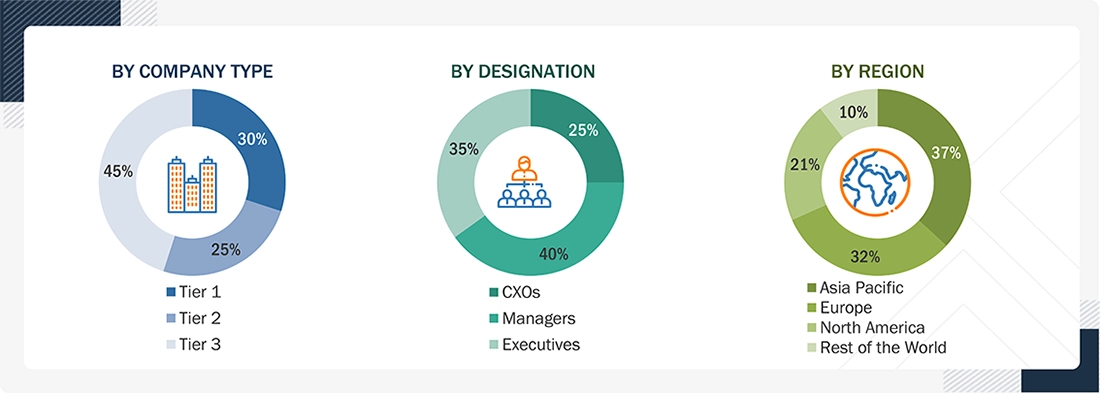
Note: The three tiers of the companies are defined based on their total revenues in 2023 or 2024, based on the availability of financial data: Tier 1: Revenue >USD 1 billion; Tier 2: USD 100 million ≤ revenue ≤ USD 1 billion; Tier 3: Revenue <USD 100 million.
|
COMPANY |
DESIGNATION |
|
BioGaia (Sweden) |
Regional Sales Manager |
|
Pendulum (US) |
Marketing Manager |
|
Seed Health, Inc (US) |
General Manager |
|
Infinant Health Inc (US) |
Sales Manager |
|
thegoodbug (India) |
Sales Manager |
|
Symrise (Germany)- (Probi) |
Sales Executive |
To know about the assumptions considered for the study, download the pdf brochure
Market Size Estimation
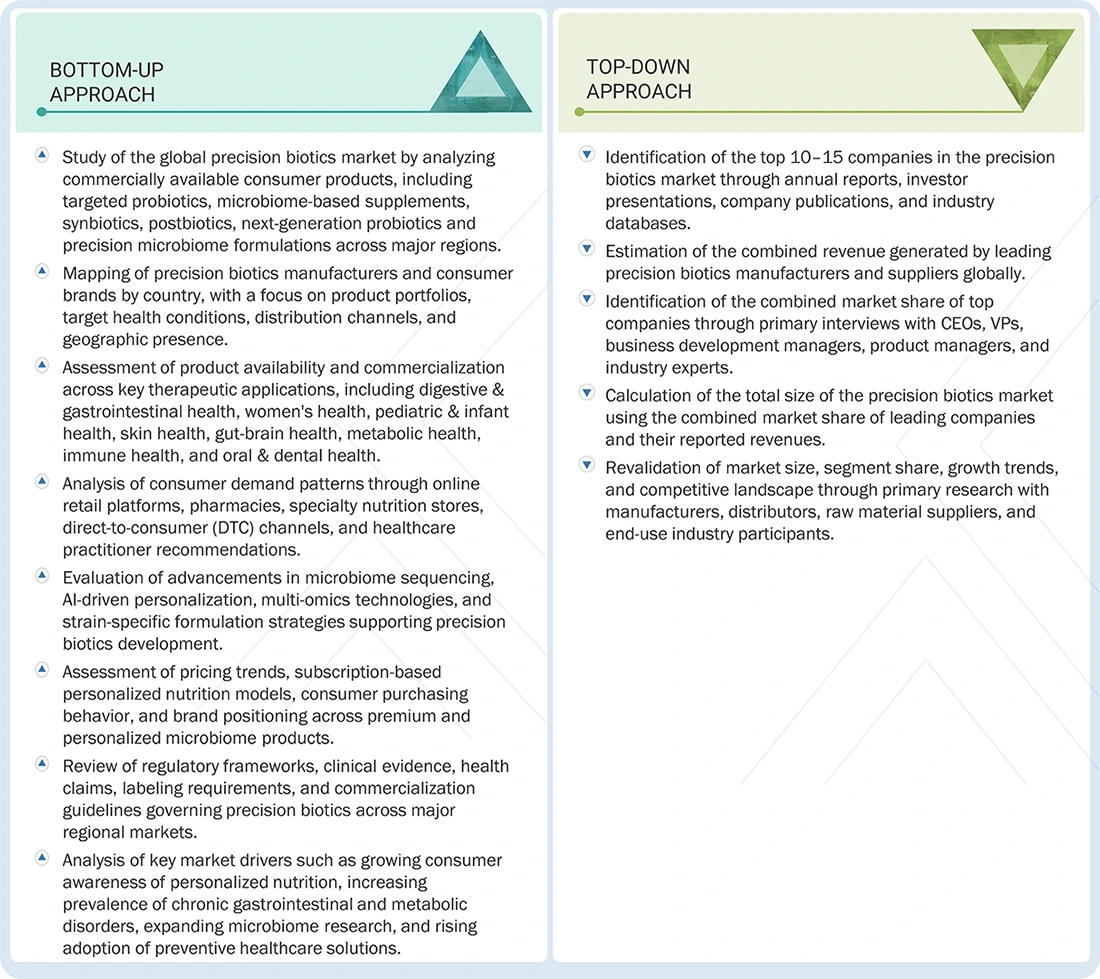
The top-down and bottom-up approaches were used to estimate and validate the total size of the precision biotics market. These approaches were also used extensively to determine the size of various subsegments in the market. The research methodology used to estimate the market size includes the following details:
- The key players in the industry and the overall markets were identified through extensive secondary research.
- All shares, splits, and breakdowns were determined using secondary sources and verified through primary sources.
- All possible parameters that affect the market covered in this research study were accounted for, viewed in extensive detail, verified through primary research, and analyzed to obtain final quantitative and qualitative data.
- The research included the study of reports, reviews, and newsletters of top market players, along with extensive interviews for opinions from leaders, such as CEOs, directors, and marketing executives.
Precision Biotics Market: Top-Down and Bottom-Up Approach
Data Triangulation
After determining the overall market size from the estimation process explained above, the total market was split into several segments and subsegments. The data triangulation procedure was employed, wherever applicable, to estimate the overall precision biotics market and obtain precise statistics for all segments and subsegments. The data was triangulated by studying various factors and trends from the demand and supply sides. The market size was also validated using the top-down and bottom-up approaches.
Market Definition
The precision biotics market encompasses the development, manufacturing, distribution, and commercialization of targeted microbiome-based products designed to deliver specific health benefits using scientifically validated probiotic strains and personalized formulations. Leveraging microbiome science, AI, genomics, and multi-omics technologies, these products support applications such as digestive, metabolic, immune, gut-brain, skin, women's, pediatric, and oral health.
The market is driven by the growing demand for personalized nutrition, increasing prevalence of chronic diseases, expanding microbiome research, and advancements in precision health technologies. Rising consumer awareness of preventive healthcare and the availability of clinically validated strain-specific probiotic products continue to support the global growth of the precision biotics market.
Key Stakeholders
- Supply-side: Precision biotics manufacturers, probiotic strain developers, microbiome sequencing companies, ingredient suppliers, contract development and manufacturing organizations (CDMOs), packaging providers, distributors, and logistics partners
- Demand-side: Consumers, pharmacies, e-commerce retailers, health & wellness stores, hospitals, specialty clinics, gastroenterologists, dietitians, nutritionists, functional medicine practitioners, and personalized nutrition platforms adopting precision biotics for targeted health management
- Regulatory side: Food safety authorities, pharmaceutical regulatory agencies, dietary supplement regulatory bodies, quality assurance organizations, and standards agencies overseeing probiotic safety, health claims, clinical evidence, labeling, and manufacturing compliance
-
Associations and industry bodies:
- European Food Safety Authority (EFSA)
- World Health Organization (WHO)
- US Food and Drug Administration (USFDA)
- Food Safety and Standards Authority of India (FSSAI)
- Food and Agriculture Organization (FAO)
- International Scientific Association for Probiotics and Prebiotics (ISAPP)
- International Probiotics Association (IPA)
- Consumer Healthcare Products Association (CHPA)
Report Objectives
- To determine and project the size of the precision biotics market based on type, end-use industry, health/functional positioning, distribution channel, and region over the forecast period
- To identify key growth opportunities by analyzing the largest and fastest-growing segments across regions
- To provide detailed insights on factors influencing market growth, including drivers, restraints, opportunities, and challenges
- To evaluate market opportunities for stakeholders and present the competitive landscape of leading players
- To analyze micro-markets with respect to individual growth trends, future potential, and their contribution to the overall market
- To identify and profile key companies operating in the precision biotics market
- To assess the competitive environment and highlight key strategies adopted by major players across regions
Available customizations:
With the given market data, MarketsandMarkets offers customizations according to company-specific scientific needs. The following customization options are available for the report:
Product Analysis
-
Product matrix, which gives a detailed comparison of the product portfolio of each company.
Segmental Analysis
-
With the given market data, MarketsandMarkets offers customizations according to company-specific scientific needs.
- Further breakdown of the Rest of Europe precision biotics market into key countries
- Further breakdown of the Rest of Asia Pacific precision biotics market into key countries
Company Information
- Detailed analyses and profiling of additional market players (up to five)
Get the Full Precision Biotics Market Report
Full forecast, segment splits, and company analysis for all Precision Biotics Market.
- Canada Precision Biotics Market
- US Precision Biotics Market
- Germany Precision Biotics Market
- UK Precision Biotics Market
- France Precision Biotics Market
- Italy Precision Biotics Market
- Spain Precision Biotics Market
- China Precision Biotics Market
- India Precision Biotics Market
- Japan Precision Biotics Market
- Rest Of Europe Precision Biotics Market
- Rest Of Asia Pacific Precision Biotics Market
Need a Tailored Report?
Customize this report to your needs
Get 10% FREE Customization
Customize This Report
