
South Korea Pressure Vessels Market (2026-2031)

The South Korea Pressure Vessels Market was valued at $2213.2 Million in 2026 and projected to reach to $2856.8 Million by 2031, representing a compound annual growth rate of 5.2%. South Korea's pressure vessels market is experiencing accelerated growth driven by the nation's robust industrial base and strategic focus on energy infrastructure modernization.


| Market Size in | USD 26.32 MN |
| Market Forecast in | |
| CAGR | |
| Forecast Period | |
| Units Considered | Value (USD MN) |
South Korea Pressure Vessels Market Trends and Insights
- Valued at USD 2,213.2 million in 2026, South Korea's market is projected to expand to USD 2,856.8 million by 2031, reflecting a compound annual growth rate of 5.2%.
- This growth trajectory underscores South Korea's strategic importance in regional industrial infrastructure and energy transition initiatives. The expansion of South Korea's pressure vessels market is driven by robust demand from petrochemical refineries, power generation facilities, and hydrogen production initiatives.
- South Korea's advanced manufacturing capabilities and investment in clean energy technologies position the country as a key growth engine within Asia Pacific.
- Between 2026 and 2031, South Korea is expected to capture increasing market share through technological innovation and capacity expansion in high-pressure applications. South Korea's competitive advantage stems from its skilled workforce, established supply chains, and government support for energy infrastructure modernization.
- The market's 5.2% CAGR reflects South Korea's commitment to industrial resilience and alignment with regional decarbonization targets, making it an essential market for global pressure vessel manufacturers and suppliers..
Key Market Statistics
- CAGR (2026-2031) 5.2% CAGR
- Market Size, 2026 ~USD 2213.2 Million
- Forecast, 2031 ~USD 2856.8 Million
- Country South Korea
South Korea Pressure Vessels Market Overview
Market Valuation Growth :
South Korea's pressure vessels market is valued at USD 2,213.2 million in 2026 and is projected to reach USD 2,856.8 million by 2031, demonstrating robust expansion in the regional industrial sector.
Outpacing Global Growth :
With a CAGR of 5.2%, South Korea's market growth rate exceeds the global average of 4.9%, indicating stronger regional demand and industrial investment compared to worldwide trends.
Strategic Industrial Hub :
South Korea's advanced manufacturing capabilities and energy infrastructure position it as a critical component supplier within the Asia Pacific region, driving sustained demand for high-quality pressure vessels.
Energy Sector Expansion :
Growing investments in power generation, petrochemical processing, and industrial applications across South Korea are fueling the adoption of pressure vessel technologies and equipment.
South Korea Pressure Vessels Market Dynamics
- The market's 5.2% CAGR reflects increasing demand from power generation facilities, petrochemical plants, and manufacturing sectors that rely on advanced pressure vessel solutions.
- Government initiatives supporting industrial competitiveness and technological innovation are further bolstering market expansion.
- By 2031, the market is expected to reach USD 2,856.8 million, solidifying South Korea's position as a key regional player in pressure vessel manufacturing and supply.
- Continued investments in renewable energy infrastructure and industrial automation will sustain growth momentum throughout the forecast period..
Market Ecosystem
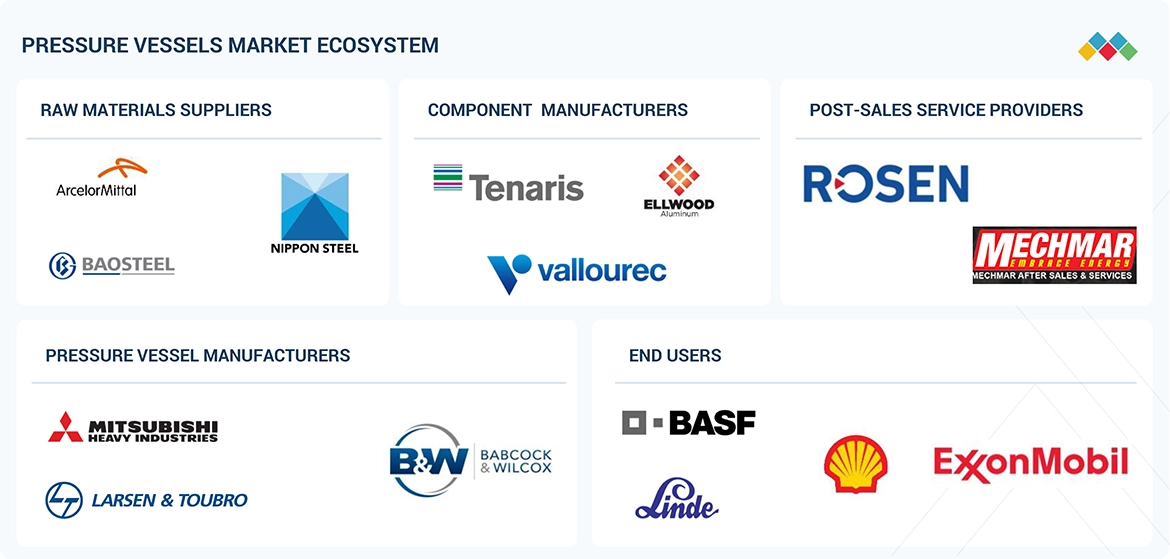
PRESSURE VESSELS MARKET: COMMERCIAL USE CASES ACROSS INDUSTRIES
| COMPANY | USE CASE DESCRIPTION | BENEFITS |
|---|---|---|
 |
A large-scale hydrogen production facility implemented SynCOR technology, which integrates multiple process steps within a single refractory-lined pressure vessel reactor designed for syngas generation under high-temperature and high-pressure conditions. | This approach resulted in a more compact plant configuration with reduced capital costs and improved thermal efficiency. The enhanced durability and operational performance of the pressure vessel contributed to longer lifecycle and lower maintenance requirements, making the technology economically and operationally advantageous. |
|
|
A US-based port decarbonization initiative evaluated large-scale hydrogen storage solutions, incorporating pressure vessels as a key component for energy storage and distribution within port infrastructure. | The implementation enabled scalable and flexible hydrogen storage infrastructure, improving energy resilience and supporting decarbonization goals. The project demonstrated the viability of pressure vessels in large-scale energy ecosystems while ensuring operational safety and efficiency. |
Logos and trademarks shown above are the property of their respective owners. Their use here is for informational and illustrative purposes only.
Related Ecosystem
Industrial Equipment
Power Infrastructure
Key Takeaways
- South Korea's pressure vessels market will grow from USD 2,213.2M (2026) to USD 2,856.8M (2031) at a 5.2% CAGR.
- South Korea's advanced manufacturing and clean energy investments drive sustained demand for high-pressure industrial equipment.
- South Korea's hydrogen economy development and petrochemical sector modernization are primary growth catalysts through 2031.
- South Korea's strategic position in Asia Pacific makes it essential for regional supply chain resilience and technology deployment.
Pressure Vessels Market Report Scope
| Report Metric | Details |
|---|---|
| Base Year | 2026 |
| Fastest Growing Segment | COMPOSITES (Material) |
| Forecast Period | 2026–2031 |
| Growth Rate | CAGR of 4.9% from 2026 to 2031 |
| Largest Segment | PROCESSING VESSELS (Type) |
| Market Size Base Year (Billions) | ~USD 57.66 (2026) |
| Revenue Forecast (Billions) | ~USD 73.24 (2031) |
| Segments Covered | Type, Pressure Rating, Material, End-Use Industry, Processing Vessels |
South Korea Pressure Vessels Market Report Segmentation
5 segment dimensions are covered across the global market.
By Type
- Boilers
- Other Processing Vessels
- Processing Vessels
- Reactors
- Separators
- Storage Vessels
By Pressure Rating
- 0–10 Bar
- 11–50 Bar
- 51–100 Bar
- Above 100 Bar
By Material
- Aluminum
- Composites
- Nickel Alloys
- Other Materials
- Steel
- Titanium
By End-Use Industry
- Chemicals
- Food & Beverages
- Oil & Gas
- Other End-Use Industries
- Pharmaceuticals
- Power Generation
By Processing Vessels
- Boilers
- Other Processing Vessels
- Reactors
- Separators
Target Audience
- Equipment Manufacturers & Suppliers : Pressure vessel manufacturers and industrial equipment suppliers need South Korea-specific market data to identify growth opportunities, assess competitive positioning, and develop localized product strategies.
- Energy & Power Sector Operators : Power generation companies, petrochemical facilities, and industrial operators require market insights to benchmark procurement strategies, evaluate supplier capabilities, and plan infrastructure investments.
- Investment & Private Equity Firms : Investors evaluating opportunities in South Korea's industrial sector need detailed market analysis to assess growth potential, identify acquisition targets, and support due diligence processes.
- Business Development & Strategy Teams : Corporate strategists and business development professionals need South Korea market intelligence to support market entry decisions, partnership evaluations, and regional expansion planning.
- Government & Policy Organizations : Government agencies and industrial policy bodies require market data to inform infrastructure planning, industrial development initiatives, and regulatory frameworks for South Korea's energy sector.
Key Companies in the South Korea Pressure Vessels Market
| Company | HQ | Ownership | Strongest segments |
|---|---|---|---|
| THYSSENKRUPP AG | Germany | Public Company | Materials Services (alloys, metals, plastics, logistics),Steel Europe (flat carbon and specialty steels),Automotive Technology (components, systems, carValoo), |
| INTERTEK GROUP PLC | United Kingdom | Public Company | Consumer Products,Industry and Infrastructure,World of Energy, |
| QATAR PETROLEUM | Qatar | Private Company | LNG and pipeline gas,Refined products and NGLs,Petrochemicals and fertilizers, |
| WARTSILA | United States | Public Company | Engine and hybrid power plants,Battery energy storage (Quantum BESS),GEMS Digital Energy Platform and software, |
| WORLEYPARSONS LIMITED | United States | Public Company | Project delivery (EPC, supply chain, construction, commissioning),Asset performance (operations, maintenance, optimization),Professional & consulting (planning, investment, capital project support), |
| GODREJ GROUP | India | Private Company | Home appliances (refrigerators, washing machines, ACs, microwaves, coolers, disinfecting appliances),Commercial appliances (medical refrigerators, deep freezers, personal cooling, disinfecting solutions),Locks, security products, architectural hardware, kitchen fittings, |
| MITSUI & CO LTD | Japan | Public Company | Energy (LNG, oil, coal, carbon solutions, new fuels),Mobility, Digital & Infrastructure,Chemicals (gas, basic chemicals, performance monomers), |
| BHARAT HEAVY ELECTRICALS LIMITED | India | Public Company | Coal and gas-based power plant equipment & EPC,Industrial systems, transmission, and process industries,Hydro, nuclear, and renewables (solar, BESS, e-mobility), |
| MITSUBISHI HEAVY INDUSTRIES, LTD. | Japan | Public Company | Energy Systems (thermal, nuclear, wind, CO2 capture, services),Plants & Infrastructure Systems (metals, environmental, engineering, water),Logistics, Thermal & Drive Systems (HVAC, refrigeration, industrial machinery, carriers), |
| IHI CORPORATION | Japan | Public Company | Resources, Energy and Environment,Social Infrastructure,Industrial Systems and General-Purpose Machinery, |
| LARSEN & TOUBRO LIMITED | India | Public Company | Infrastructure Projects,Energy Projects,Hi-Tech Manufacturing, |
| BABCOCK & WILCOX ENTERPRISES, INC. | United States | Public Company | Steam generation equipment (package, watertube, firetube, waste heat boilers),Aftermarket parts, construction, maintenance, and field services,BrightLoop chemical looping and advanced decarbonization solutions, |
| GE VERNOVA | United States | Public Company | Power (Gas, Nuclear, Hydro, Steam),Wind (Onshore and Offshore),Electrification (Grid, Power Conversion, Solar & Storage, Software), |
THYSSENKRUPP AG
ThyssenKrupp AG is a German industrial conglomerate founded in 1811 that operates as a public company with approximately 90,916 employees. The company is a major player in steel production, industrial engineering, and related manufacturing sectors.
INTERTEK GROUP PLC
Intertek Group PLC is a United Kingdom-based public company established in 1885 with 45,425 employees. The company provides quality assurance, testing, inspection, and certification services across multiple industries.
QATAR PETROLEUM
Qatar Petroleum is a private Qatari energy company founded in 1974 with 8,270 employees. The company operates in oil and gas exploration, production, and related petroleum operations.
WARTSILA
Wärtsilä is a United States-based public company founded in 1834 with 17,938 employees. The company specializes in marine and energy solutions, including engines, power systems, and related technologies.
WORLEYPARSONS LIMITED
WorleyParsons Limited is a United States-based public company established in 1971 with 38,224 employees. The company provides engineering, procurement, and construction services primarily for the energy and industrial sectors.
GODREJ GROUP
Godrej Group is an Indian private conglomerate founded in 1897 with 13,316 employees. The company operates across multiple sectors including consumer goods, real estate, and industrial products.
MITSUI & CO LTD
Mitsui & Co Ltd is a Japanese public trading company established in 1947 with 55,463 employees. The company engages in diverse business operations including energy, metals, machinery, and chemicals trading and development.
BHARAT HEAVY ELECTRICALS LIMITED
Bharat Heavy Electricals Limited is an Indian public sector company founded in 1964 with 62,445 employees. The company manufactures heavy electrical equipment, power generation systems, and related industrial products.
MITSUBISHI HEAVY INDUSTRIES, LTD.
Mitsubishi Heavy Industries, Ltd. is a Japanese public company established in 1884 with 78,793 employees. The company operates across aerospace, energy, industrial machinery, and defense sectors with a global presence.
IHI CORPORATION
IHI Corporation is a Japanese public company founded in 1853 with 26,224 employees. The company manufactures industrial machinery, power systems, aerospace components, and provides related engineering services.
LARSEN & TOUBRO LIMITED
Larsen & Toubro Limited is an Indian public company established in 1938 with 55,662 employees. The company operates in engineering, procurement, construction, and technology services across infrastructure and industrial sectors.
BABCOCK & WILCOX ENTERPRISES, INC.
Babcock & Wilcox Enterprises, Inc. is a United States-based public company founded in 1867 with 1,625 employees. The company provides engineering and manufacturing services for nuclear, fossil, and renewable energy sectors.
GE VERNOVA
GE Vernova is a United States-based public company established in 2023 with 78,000 employees. The company focuses on energy transition solutions including power generation, grid services, and energy storage technologies.
Reasons to Buy this Report
- Market-Specific Sizing & Forecasts : Access precise valuation data for South Korea's pressure vessels market with detailed projections through 2031, enabling accurate budget allocation and investment planning specific to this high-growth regional market.
- Competitive Landscape Intelligence : Understand South Korea's unique competitive dynamics, local manufacturer capabilities, and market positioning relative to regional competitors, critical for market entry or expansion strategies.
- Sector-Specific Growth Drivers : Identify key demand catalysts within South Korea's energy, power, petrochemical, and manufacturing sectors that are driving the 5.2% CAGR, enabling targeted business development initiatives.
- Regional Supply Chain Insights : Gain actionable intelligence on South Korea's role within Asia Pacific supply chains, sourcing opportunities, and distribution networks for pressure vessel products and services.
- Strategic Decision Support : Leverage South Korea-specific market data to support investment decisions, partnership evaluations, and go-to-market strategies with confidence in localized, validated market intelligence.
Frequently asked questions
What is the market size of pressure vessels in South Korea in 2026?
South Korea's pressure vessels market is estimated at USD 2,213.2 million in 2026.
What is the projected market size for South Korea's pressure vessels market by 2031?
South Korea's pressure vessels market is forecast to reach USD 2,856.8 million by 2031.
What is the CAGR for South Korea's pressure vessels market?
South Korea's pressure vessels market is expected to grow at a compound annual growth rate of 5.2% from 2026 to 2031.
Which industries drive demand for pressure vessels in South Korea?
South Korea's pressure vessels demand is primarily driven by petrochemical refineries, power generation facilities, hydrogen production, and industrial manufacturing sectors.
Why is South Korea important for the Asia Pacific pressure vessels market?
South Korea's advanced manufacturing capabilities, skilled workforce, and investment in clean energy technologies make it a strategic hub for pressure vessel innovation and production within Asia Pacific.
RESEARCH METHODOLOGY
The study involved major activities in estimating the current size of the pressure vessels market. Exhaustive secondary research was done to collect information on the peer and parent markets. The next step was to validate these findings, assumptions, and sizing with industry experts across the value chain through primary research. Both top-down and bottom-up approaches were employed to estimate the complete market size. Thereafter, market breakdown and data triangulation were used to estimate the market size of the segments and subsegments.
Secondary Research
This research study on the pressure vessels market involved the use of extensive secondary sources, directories, and databases, such as Hoovers, Bloomberg, Businessweek, Factiva, the International Energy Agency, and BP Statistical Review of World Energy, to identify and collect valuable information for a technical, market-oriented, and commercial study of the global pressure vessels market. Other secondary sources included annual reports, press releases, and investor presentations from companies; white papers; certified publications; articles by recognized authors; manufacturer associations; trade directories; and databases.
Primary Research
The pressure vessels market comprises stakeholders such as pressure vessel manufacturers, technology providers, and support providers in the supply chain. On the demand side, the pressure vessels market is driven by growing adoption of pressure vessels in power generation, oil & gas, and chemicals sectors, due to surging energy demand, rapid industrialization, and infrastructure investments worldwide. Additional factors include the expansion of oil & gas refining, the growing adoption of renewables, and advancements in power generation technologies. On the supply side, manufacturers are seeing increasing opportunities through contracts with utility and industrial distribution networks, as well as through strategic initiatives such as mergers, acquisitions, and partnerships among major players to expand their market presence and technological capabilities. Various primary sources from both the supply and demand sides of the market were interviewed to obtain qualitative and quantitative information. The following is the breakdown of primary respondents:
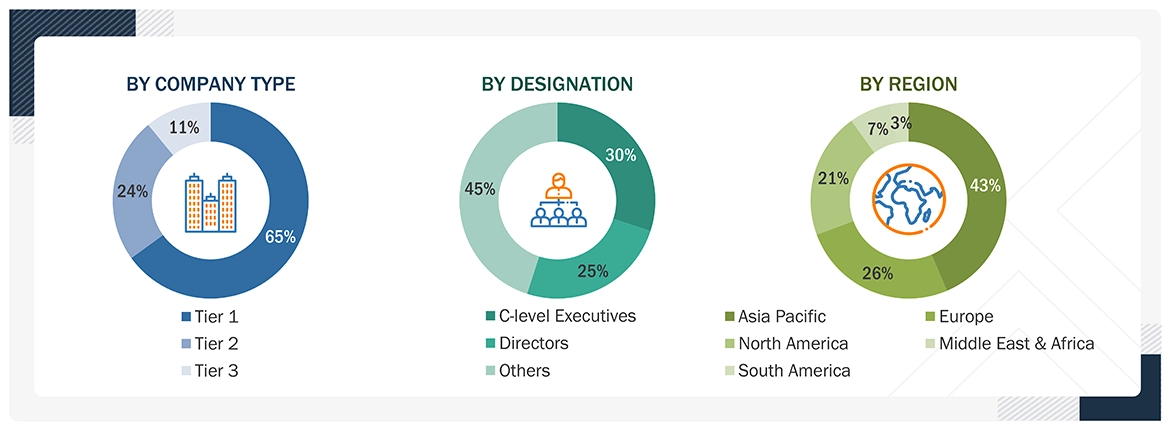
Note: “Others” include sales managers, engineers, and regional managers.
The tiers of the companies are defined by their total revenue as of 2025: Tier 1: >USD 1 billion; Tier 2: USD 500 million–1 billion; and Tier 3: USD 500 million.
To know about the assumptions considered for the study, download the pdf brochure
Market Size Estimation
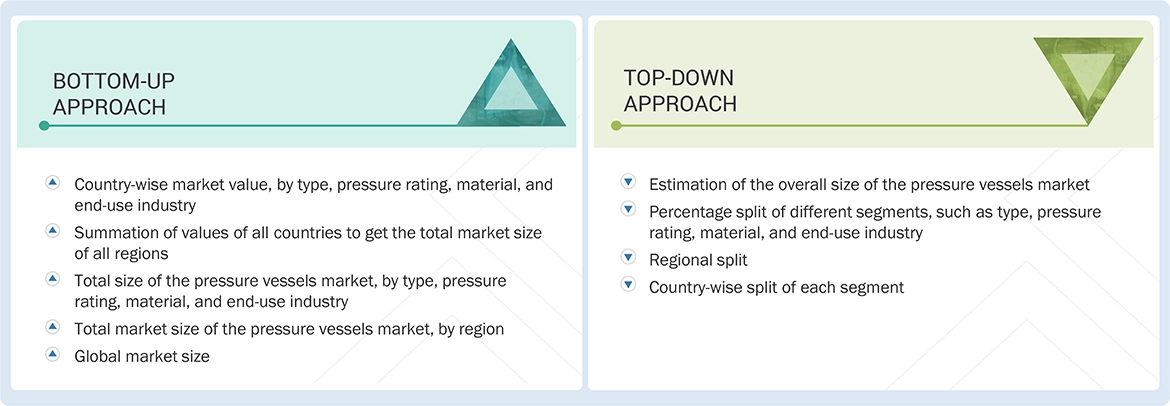
Both top-down and bottom-up approaches were employed to estimate and validate the size of the pressure-vessel market and its dependent submarkets. The key players in the market were identified through secondary research, and their market share in each region was determined through a combination of primary and secondary research. The research methodology involves analyzing the annual and financial reports of leading market players and conducting interviews with industry experts, including chief executive officers, vice presidents, directors, sales managers, and marketing executives, to gather key quantitative and qualitative insights into the pressure vessels market.
Pressure Vessels Market : Top-Down and Bottom-Up Approach
Data Triangulation
After determining the overall market size through the estimation process explained above, the total market has been divided into several segments and subsegments. To complete the overall market engineering process and obtain the exact statistics for all segments and subsegments, data triangulation and market breakdown processes have been employed, where applicable. The data has been triangulated by studying various factors and trends from both the demand and supply sides. Additionally, the market has been validated using both top-down and bottom-up approaches.
Market Definition
A pressure vessel is a container designed to hold gases or liquids at a pressure significantly different from ambient pressure. The pressure within the vessel may be higher or lower than the atmospheric pressure outside. Pressure vessels are used in a variety of industrial and commercial applications, including chemical processing, oil and gas production, power generation, and manufacturing. They can be made from various materials, including metals, plastics, and composites, and are typically designed to meet specific safety standards and regulations, ensuring they can withstand the pressure and stress they experience during operation.
Key Stakeholders
- pressure vessel manufacturers
- pressure vessel associations
- Oilfield service players
- Public and private oil & gas and power generation operators
- Government and research organizations
- Pressure vessel raw material providers
- Consulting companies
- Industrial users
Report Objectives
- To describe and forecast the pressure vessels market, by type, pressure rating, material, end-use industry, and region, in terms of value
- To describe and forecast the pressure vessels market for various segments with respect to five main regions: North America, Europe, Asia Pacific, Latin America, and the Middle East & Africa, in terms of value
- To describe and forecast the pressure vessels market, by region, in terms of volume
- To provide detailed information regarding drivers, restraints, opportunities, and challenges influencing the growth of the market
- To provide a detailed overview of the pressure vessels chain analysis, use case analysis, key stakeholders and buying criteria, patent analysis, trade analysis, tariff analysis, regulations, macroeconomic outlook, pricing analysis, Porter’s five forces analysis, impact of gen AI/AI, and the US tariff impact
- To strategically analyze micromarkets1 with respect to individual growth trends, prospects, and contributions to the total market
- To analyze opportunities in the market for various stakeholders by identifying high-growth segments
- To strategically profile key players and comprehensively analyze their market position in terms of ranking and core competencies2, along with detailing the market’s competitive landscape.
- To analyze growth strategies, such as acquisitions, investments, expansions, and product launches, adopted by market players in the pressure vessels market
1 Micromarkets are defined as the segments and subsegments of the pressure vessels market included in the report.
2 Core competencies of companies are defined in terms of key developments and strategies adopted to sustain their positions in the pressure vessels market.
Available customizations:
MarketsandMarkets offers customizations tailored to the specific needs of companies using the given market data.
The following customization options are available for the report:
Product Analysis
- Product matrix, which gives a detailed comparison of the product portfolio of each company
Regional Analysis
- Further breakdown of the pressure vessels, by country
Company Information
- Detailed analysis and profiling of additional market players (up to five)
Get the Full Pressure Vessels Market Report
Full forecast, segment splits, and company analysis for all Pressure Vessels Market.
- Canada Pressure Vessels Market
- Mexico Pressure Vessels Market
- US Pressure Vessels Market
- China Pressure Vessels Market
- India Pressure Vessels Market
- Japan Pressure Vessels Market
- Malaysia Pressure Vessels Market
- Australia Pressure Vessels Market
- Indonesia Pressure Vessels Market
- UK Pressure Vessels Market
- France Pressure Vessels Market
- Germany Pressure Vessels Market
- Russia Pressure Vessels Market
- Nigeria Pressure Vessels Market
- South Africa Pressure Vessels Market
- Brazil Pressure Vessels Market
- Argentina Pressure Vessels Market
- Rest Of Europe Pressure Vessels Market
- Rest Of Asia Pacific Pressure Vessels Market
- Algeria Pressure Vessels Market
- GCC Countries Pressure Vessels Market
- Rest Of South America Pressure Vessels Market
Need a Tailored Report?
Customize this report to your needs
Get 10% FREE Customization
Customize This Report
