
GCC Countries Produced Water Treatment Market (2024-2029)

The GCC Countries Produced Water Treatment Market was valued at $1361.2 Million in 2024 and projected to reach to $1769.9 Million by 2029, representing a compound annual growth rate of 5.4%. The GCC produced water treatment market is poised for significant expansion through 2029, driven by the region's dominant position in global oil and gas production and increasing environmental pressures.


| Market Size in | USD 26.32 MN |
| Market Forecast in | |
| CAGR | |
| Forecast Period | |
| Units Considered | Value (USD MN) |
GCC Countries Produced Water Treatment Market Trends and Insights
- GCC Countries, as major oil and gas producers, generate substantial volumes of produced water requiring advanced treatment solutions to meet environmental regulations and enable water reuse.
- The market in GCC Countries is driven by increasing regulatory pressure, water scarcity concerns, and the region's commitment to sustainable resource management across its hydrocarbon sector. GCC Countries' produced water treatment sector benefits from significant capital investment in infrastructure modernization and technological adoption.
- The region's focus on circular economy principles and zero-liquid discharge initiatives is accelerating demand for innovative treatment technologies in GCC Countries.
- Between 2024 and 2029, GCC Countries will see heightened competition among treatment solution providers, with emphasis on cost-effective and environmentally compliant systems tailored to the region's unique operational challenges..
Key Market Statistics
- CAGR (2024-2029) 5.4% CAGR
- Market Size, 2024 ~USD 1361.2 Million
- Forecast, 2029 ~USD 1769.9 Million
- Country GCC Countries
GCC Countries Produced Water Treatment Market Overview
Market Valuation :
The GCC produced water treatment market is valued at USD 1,361.2 million in 2024, with strong growth trajectory driven by intensive oil and gas operations across the region.
Regional Growth Rate :
GCC Countries demonstrate a 5.4% CAGR from 2024-2029, outpacing the global average of 4.7%, reflecting accelerated investment in water treatment infrastructure and environmental compliance.
Regulatory Drivers :
Stringent environmental regulations and water reuse mandates across GCC nations are compelling oil and gas operators to adopt advanced produced water treatment technologies for sustainable operations.
Production Volume Challenge :
As major global oil and gas producers, GCC Countries generate massive volumes of produced water daily, creating substantial demand for efficient, cost-effective treatment solutions and recycling capabilities.
GCC Countries Produced Water Treatment Market Dynamics
- GCC nations are investing heavily in advanced treatment technologies to manage produced water volumes while meeting stringent regulatory standards and sustainability goals.
- The market will benefit from growing adoption of zero-liquid discharge systems, membrane technologies, and water recycling solutions that enable operators to reduce environmental impact and operational costs simultaneously. Government initiatives promoting circular economy principles and water conservation across GCC Countries will further accelerate market growth.
- Major oil and gas operators are prioritizing produced water treatment as a critical component of their operational strategy, creating opportunities for technology providers and service companies.
- The projected growth to USD 1,769.9 million by 2029 reflects sustained capital investment in treatment infrastructure and the region's commitment to balancing energy production with environmental stewardship..
Market Ecosystem
Related Ecosystem
Energy Circularity
- Epoxy Resin
- Progressive Cavity Pumps
- Amphoteric
- Bisphenol-A
- Cartridge Filters
- TotalEnergies SE
- ENEOS Holdings, Inc.
- Hess Corporation
- Baker Hughes Company
- Weatherford International plc
Key Takeaways
- GCC Countries' produced water treatment market is valued at USD 1,361.2 million in 2024 and will grow to USD 1,769.9 million by 2029 at a 5.4% CAGR.
- Water scarcity and stringent environmental regulations in GCC Countries are primary drivers of market expansion and technology adoption.
- GCC Countries' oil and gas operators are increasingly investing in advanced treatment solutions to enable water recycling and achieve sustainability targets.
- The competitive landscape in GCC Countries is intensifying, with providers focusing on cost-effective, modular, and environmentally compliant treatment systems.
Produced Water Treatment Market Report Scope
| Report Metric | Details |
|---|---|
| Base Year | 2024 |
| Fastest Growing Segment | TERTIARY (Treatment) |
| Forecast Period | 2024-2029 |
| Growth Rate | CAGR of 4.7% from 2024 to 2029 |
| Largest Segment | CONVENTIONAL (Source) |
| Market Size Base Year (Billions) | ~USD 10.65 (2024) |
| Revenue Forecast (Billions) | ~USD 13.4 (2029) |
| Segments Covered | Treatment, Source, Application |
GCC Countries Produced Water Treatment Market Report Segmentation
3 segment dimensions are covered across the global market.
By Treatment
- Other Treatments
- Primary
- Secondary
- Tertiary
By Source
- Conventional
- Unconventional
By Application
- Offshore
- Onshore
Target Audience
- Oil & Gas Operators : GCC-based and international oil and gas companies operating in the region need detailed market insights to optimize produced water treatment investments and meet environmental compliance standards.
- Water Treatment Technology Providers : Equipment manufacturers and technology solution providers require GCC-specific market data to identify growth opportunities, understand customer needs, and develop region-tailored product offerings.
- Environmental Consultants : Consulting firms advising GCC energy companies need comprehensive market intelligence to guide clients on produced water treatment strategies aligned with regional regulations and sustainability goals.
- Investment & Private Equity Firms : Investors evaluating opportunities in GCC energy infrastructure require detailed market forecasts and growth drivers to assess investment potential in produced water treatment ventures.
- Government & Regulatory Bodies : GCC government agencies and environmental regulators need market data to inform policy decisions, infrastructure planning, and sustainability initiatives related to produced water management.
Reasons to Buy this Report
- Regional Market Intelligence : Gain comprehensive insights specific to GCC Countries' produced water treatment landscape, including market size, growth rates, and competitive dynamics distinct from global market trends.
- Investment Decision Support : Make informed investment and expansion decisions with detailed forecasts through 2029, understanding GCC-specific growth opportunities and market potential in this high-value region.
- Regulatory Compliance Insights : Understand GCC-specific environmental regulations and compliance requirements driving produced water treatment adoption, enabling strategic alignment with regional regulatory frameworks.
- Competitive Positioning : Identify market gaps and competitive opportunities within GCC Countries' produced water treatment sector, supporting product development and market entry strategies tailored to regional needs.
- Stakeholder Engagement : Access targeted data on GCC oil and gas operators, technology providers, and government initiatives to effectively engage stakeholders and develop region-specific business strategies.
Frequently asked questions
What is the market size of produced water treatment in GCC Countries?
The produced water treatment market in GCC Countries was valued at USD 1,361.2 million in 2024 and is forecast to reach USD 1,769.9 million by 2029.
What is the growth rate for produced water treatment in GCC Countries?
GCC Countries' produced water treatment market is expected to grow at a compound annual growth rate (CAGR) of 5.4% from 2024 to 2029.
What are the main drivers of the produced water treatment market in GCC Countries?
Key drivers in GCC Countries include water scarcity, stringent environmental regulations, the need for water reuse in oil and gas operations, and regional sustainability commitments.
Which technologies are most in demand in GCC Countries' produced water treatment market?
GCC Countries shows strong demand for advanced separation technologies, membrane systems, chemical treatment solutions, and zero-liquid discharge systems that enable water recycling.
How does the GCC Countries market compare to global trends?
GCC Countries' produced water treatment market is growing faster than the global average (5.4% CAGR vs. 4.7% global CAGR), reflecting the region's acute water challenges and regulatory focus.
RESEARCH METHODOLOGY
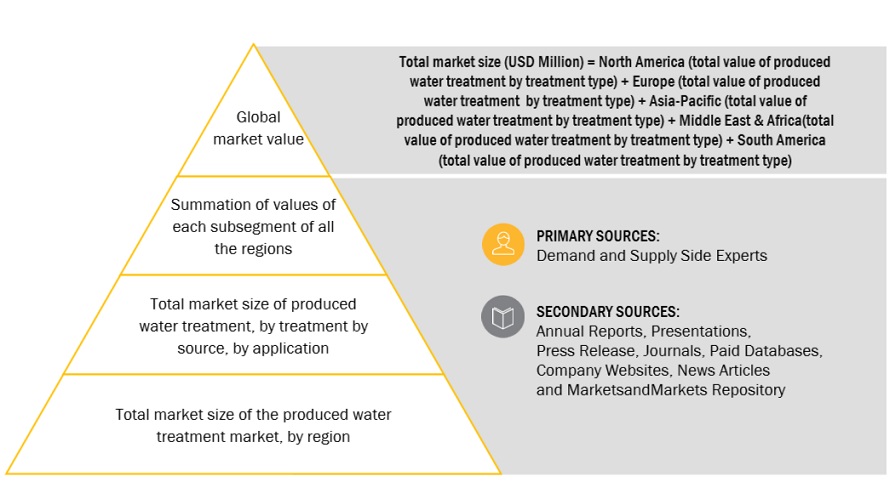
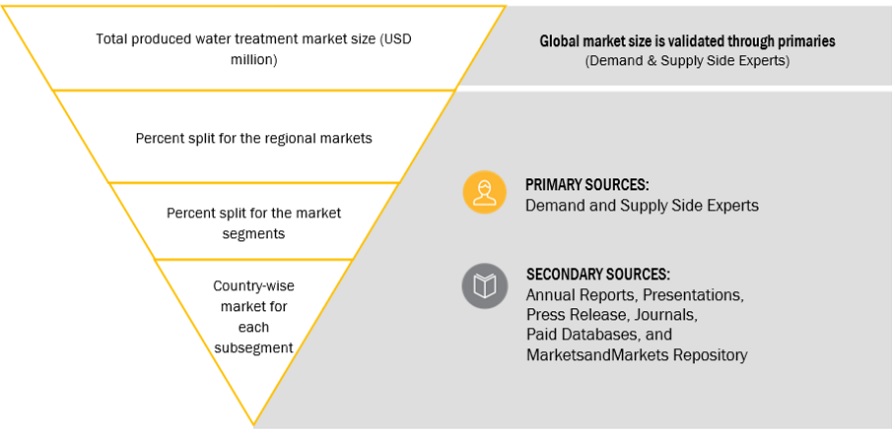
The study involved major activities in estimating the current size of the produced water treatment market. Exhaustive secondary research was done to collect information on the peer and parent markets. The next step was to validate these findings, assumptions, and sizing with industry experts across the value chain through primary research. Both top-down and bottom-up approaches were employed to estimate the complete market size. Thereafter, market breakdown and data triangulation were used to estimate the market size of the segments and subsegments.
Secondary Research
This research study on the produced water treatment market involved the use of extensive secondary sources, directories, and databases, such as Hoovers, Bloomberg, Businessweek, Factiva, International Energy Agency, and United States Energy Association, to identify and collect information useful for a technical, market-oriented, and commercial study of the global market. The other secondary sources included annual reports of the companies involved in the market, press releases & investor presentations of companies, white papers, certified publications, articles by recognized authors, manufacturer associations, trade directories, and databases.
Primary Research
The produced water treatment market comprises several stakeholders such as produced water treatment manufacturers, produced water treatment service companies, suppliers and distributors of produced water treatment in the supply chain. The demand side of this market is characterized by the increasing oil & gas exploration activities. The supply side is characterized by rising demand for contracts from the oil & gas sector and mergers & acquisitions among big players. Various primary sources from both the supply and demand sides of the market were interviewed to obtain qualitative and quantitative information.
Following is the breakdown of primary respondents:
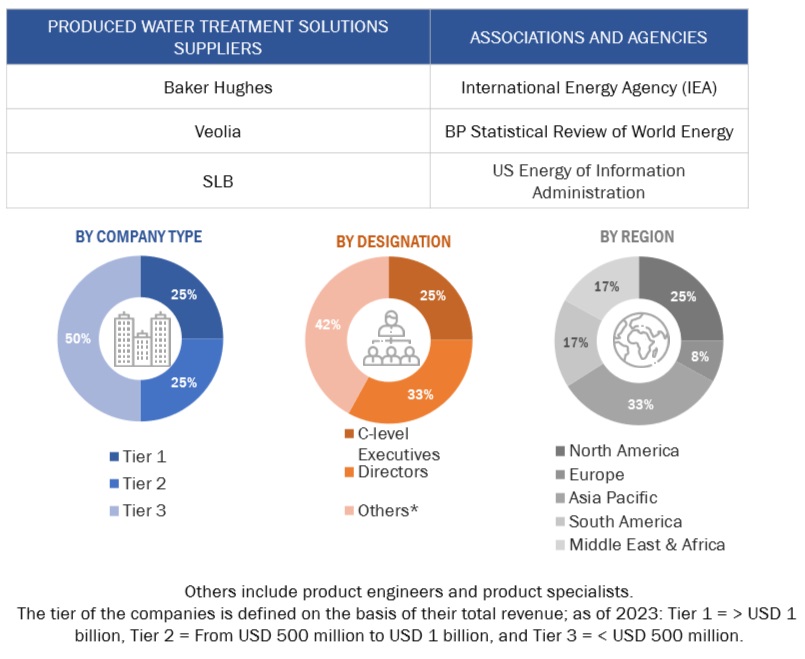
To know about the assumptions considered for the study, download the pdf brochure
Market Size Estimation
Both top-down and bottom-up approaches were used to estimate and validate the total size of the produced water treatment market. These methods were also used extensively to estimate the size of various subsegments in the market. The research methodology used to estimate the market size includes the following:
- The key players in the industry and market have been identified through extensive secondary research, and their market share in the respective regions has been determined through both secondary and primary research.
- The industry’s value chain and market size, in terms of value, have been determined through primary and secondary research processes.
- All percentage shares, splits, and breakdowns have been determined using secondary sources and verified through primaries.
Global Produced Water Treatment Market Size: Top-down Approach
Global produced water treatment Market Size: Bottom-Up Approach
Data Triangulation
After arriving at the overall market size from the estimation process explained above, the total market has been split into several segments and subsegments. The complete market engineering process is done to arrive at the exact statistics for all the segments and subsegments, also data triangulation and market breakdown processes have been employed, wherever applicable. The data has been triangulated by examining various factors and trends from both the demand- and supply sides. Along with this, the market has been validated through both the top-down and bottom-up approaches.
Market Definition
Produced water, which is a byproduct of oil and gas exploration process, requires active treatment to meet environmental regulations and helps in reuse or safe disposal. This produced water has a mixture of injected water, Natural formation water, and any other chemicals used in the exploration and drilling process.
Key Stakeholders
- Produced water treatment manufacturers and providers
- Manufacturing industries
- R&D laboratories
- Consulting companies from the energy & power sector
- Distributors of produced water treatment
- Government and research organizations
- State and national regulatory authorities
Objectives of the Study
- To define, describe, segment, and forecast the produced water treatment market by application, by source, and by treatment in terms of value and volume.
- To describe and forecast the market for six key regions: North America, Europe, Asia Pacific, South America, the Middle East, and Africa, along with their country-level market sizes, in terms of value.
- To provide detailed information regarding key drivers, restraints, opportunities, and challenges influencing market growth
- To strategically analyze the micro markets with respect to individual growth trends, prospects, and contributions to the overall market size
- To provide supply chain analysis, trends/disruptions impacting customer business, ecosystem/market map, pricing analysis, Porter’s five forces analysis, case study analysis, and regulatory standards pertaining to produced water treatment
- To analyze opportunities for stakeholders in the produced water treatment and draw a competitive landscape of the market.
- To strategically analyze the ecosystem, tariffs and regulations, patents, and trading scenarios pertaining to produced water treatment
- To compare key market players based on product specifications and applications.
- To strategically profile key players and comprehensively analyze their market rankings and core competencies
- To analyze competitive developments, such as contracts and agreements, investments and expansions, mergers and acquisitions, partnerships, joint ventures, and collaborations, in produced water treatment
Available Customizations:
With the given market data, MarketsandMarkets offers customizations as per the client’s specific needs. The following customization options are available for this report:
Geographic Analysis
- Further breakdown of region or country-specific analysis
Company Information
- Detailed analysis and profiling of additional market players (up to 5)
Get the Full Produced Water Treatment Market Report
Full forecast, segment splits, and company analysis for all Produced Water Treatment Market.
- US Produced Water Treatment Market
- Canada Produced Water Treatment Market
- Mexico Produced Water Treatment Market
- Brazil Produced Water Treatment Market
- Colombia Produced Water Treatment Market
- Venezuela Produced Water Treatment Market
- Norway Produced Water Treatment Market
- Russia Produced Water Treatment Market
- UK Produced Water Treatment Market
- China Produced Water Treatment Market
- India Produced Water Treatment Market
- Indonesia Produced Water Treatment Market
- Saudi Arabia Produced Water Treatment Market
- UAE Produced Water Treatment Market
- Iraq Produced Water Treatment Market
- Iran Produced Water Treatment Market
- Rest Of Europe Produced Water Treatment Market
- Kazakhstan Produced Water Treatment Market
- Rest Of Asia Pacific Produced Water Treatment Market
- Rest Of GCC Countries Produced Water Treatment Market
- Rest Of South America Produced Water Treatment Market
Need a Tailored Report?
Customize this report to your needs
Get 10% FREE Customization
Customize This Report
