
Rest Of Europe Protective Films Market (2026-2031)

The Rest Of Europe Protective Films Market was valued at $252.4 Million in 2026 and projected to reach to $322.1 Million by 2031, representing a compound annual growth rate of 5.0%. Rest Of Europe's protective films market demonstrates consistent growth potential driven by robust demand from construction, automotive, and electronics sectors.


| Market Size in | USD 26.32 MN |
| Market Forecast in | |
| CAGR | |
| Forecast Period | |
| Units Considered | Value (USD MN) |
Rest Of Europe Protective Films Market Trends and Insights
- The region is projected to expand to $322.1 million by 2031, reflecting a compound annual growth rate of 5.0%.
- This steady growth trajectory in Rest Of Europe is driven by increasing demand across construction, automotive, and electronics sectors, where protective films serve critical roles in surface protection and damage prevention during manufacturing and transportation. The protective films market in Rest Of Europe is characterized by rising adoption of advanced film technologies and growing awareness of product quality and durability.
- Rest Of Europe's market expansion is supported by regional manufacturing capabilities and a strong emphasis on industrial safety standards.
- Between 2026 and 2031, Rest Of Europe is expected to maintain consistent growth momentum, with market participants focusing on innovation and regional distribution networks to capture emerging opportunities in secondary European markets..
Key Market Statistics
- CAGR (2026-2031) 5.0% CAGR
- Market Size, 2026 ~USD 252.4 Million
- Forecast, 2031 ~USD 322.1 Million
- Country Rest Of Europe
Rest Of Europe Protective Films Market Overview
Market Size & Growth :
Rest Of Europe's protective films market is valued at $252.4 million in 2026, expanding to $322.1 million by 2031, representing a steady 5.0% CAGR over the forecast period.
Regional Growth Drivers :
Construction, automotive, and electronics sectors are primary demand drivers in Rest Of Europe, with increasing infrastructure investments and manufacturing activities fueling protective film adoption.
Market Positioning :
Rest Of Europe maintains a significant position within the broader European protective films landscape, with growth rates aligned to regional industrial expansion and regulatory compliance requirements.
Forecast Trajectory :
The region is projected to add $69.7 million in market value between 2026 and 2031, indicating sustained demand momentum across multiple end-use applications and verticals.
Rest Of Europe Protective Films Market Dynamics
- The region benefits from ongoing infrastructure development, rising manufacturing activities, and increasing adoption of protective solutions across industrial applications.
- Market expansion is supported by growing awareness of product protection benefits and regulatory compliance needs. By 2031, the market is expected to reach $322.1 million, reflecting the region's economic development and industrial diversification.
- Key opportunities exist in emerging applications, technological innovations, and expansion into secondary markets.
- The 5.0% CAGR indicates stable, predictable growth suitable for long-term strategic planning and investment decisions in Rest Of Europe..
Market Ecosystem
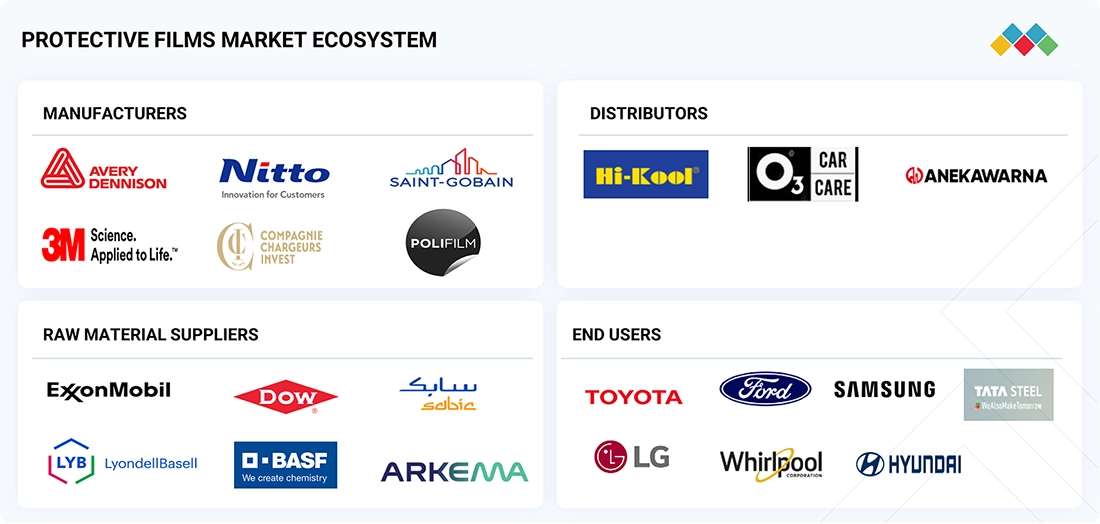
PROTECTIVE FILMS MARKET: COMMERCIAL USE CASES ACROSS INDUSTRIES
| COMPANY | USE CASE DESCRIPTION | BENEFITS |
|---|---|---|
 |
Protective surface film (Polymask) was applied to automotive fenders during manufacturing and transportation to shield painted metal panels from scratches, dust, and handling damage throughout the supply chain and assembly process. | Helps maintain paint quality and surface finish, reduces rework and repair costs, and ensures that automotive components reach assembly lines and dealerships in optimal condition. |
 |
Automotive customization shop SS Customs used Avery Dennison Supreme Defense Matte Paint Protection Film (PPF) to protect high-end vehicles from scratches, debris, and environmental damage while maintaining a premium matte finish during vehicle customization and detailing. | Provides high scratch resistance, self-healing properties, and a smooth OEM-like finish, while improving installation quality and protecting luxury vehicles from daily wear, road debris, and environmental exposure. |
Logos and trademarks shown above are the property of their respective owners. Their use here is for informational and illustrative purposes only.
Related Ecosystem
Resins And Polymers
- Polycarbonate
- Acrylonitrile Butadiene Styrene (ABS)
- Epoxy Resin
- Light Commercial Vehicles (LCVs)
- Polypropylene (PP)
- Basf se
- DOW CHEMICAL COMPANY
- Solvay sa
- Saudi arabia basic industries corporation (sabic)
- DuPont de Nemours, Inc.
Key Takeaways
- Rest Of Europe protective films market valued at $252.4 million in 2026, expanding to $322.1 million by 2031 at 5.0% CAGR
- Rest Of Europe demonstrates steady growth driven by construction, automotive, and electronics sector demand for surface protection solutions
- Rest Of Europe benefits from established manufacturing infrastructure and stringent industrial safety compliance requirements
- Rest Of Europe market participants are investing in advanced film technologies and regional distribution to capture secondary market opportunities
Protective Films Market Report Scope
| Report Metric | Details |
|---|---|
| Base Year | 2026 |
| Fastest Growing Segment | OTHER END-USE INDUSTRIES (End-Use Industry) |
| Forecast Period | 2026–2031 |
| Growth Rate | CAGR of 5.6% from 2026 to 2031 |
| Largest Segment | PSA FILMS (Type) |
| Market Size Base Year (Billions) | ~USD 5.8 (2026) |
| Revenue Forecast (Billions) | ~USD 7.62 (2031) |
| Segments Covered | Type, Material, End-Use Industry |
Rest Of Europe Protective Films Market Report Segmentation
3 segment dimensions are covered across the global market.
By Type
- Non-Adhesive/Cling Films
- Psa Films
- Specialty Removable/ Clean-Peel Films
- Specialty Removable/Clean-Peel Films
By Material
- Other Materials
- Polycarbonate (Pc)
- Polyethylene (Pe)
- Polyethylene Terephthalate (Pet)
- Polypropylene (Pp)
- Polyurethane (Pu)
- Polyvinyl Chloride (Pvc)
By End-Use Industry
- Automotive & Transportation
- Building & Construction
- Electronics & Electrical
- Furniture & Interior
- Industrial Manufacturing/ Metal Processing
- Industrial Manufacturing/Metal Processing
- Medical & Pharmaceutical
- Other End-Use Industries
- Packaging & Logistics
Target Audience
- Regional Business Managers : Need Rest Of Europe-specific market data to develop regional strategies, set sales targets, and allocate resources effectively across the protective films segment.
- Product Development Teams : Require insights into Rest Of Europe sector demands (construction, automotive, electronics) to prioritize product innovations and tailor solutions for regional market needs.
- Investment & Finance Professionals : Seek validated market sizing and growth forecasts for Rest Of Europe to evaluate investment opportunities, assess ROI potential, and support M&A decisions.
- Supply Chain & Operations Leaders : Need regional demand projections and market trends for Rest Of Europe to optimize inventory, plan capacity expansion, and establish distribution networks.
- Market Entry & Expansion Teams : Require competitive landscape and growth trajectory data for Rest Of Europe to identify market gaps, assess entry feasibility, and develop localized go-to-market strategies.
Key Companies in the Rest Of Europe Protective Films Market
| Company | HQ | Ownership | Strongest segments |
|---|---|---|---|
| BOYD CORPORATION | Canada | Public Company | Pressure-Sensitive Adhesive (PSA) Films,Non-adhesive/Cling Films,Polyethylene (PE), |
| AVERY DENNISON CORPORATION | United States | Public Company | Pressure-Sensitive Adhesive (PSA) Films,Non-adhesive/Cling Films,Polyethylene (PE) Films, |
| NITTO DENKO CORPORATION | Japan | Public Company | Pressure-Sensitive Adhesive (PSA) Films,Non-adhesive/Cling Films,Polyethylene (PE)-based Protective Films, |
| SAINT-GOBAIN | France | ||
| 3M | United States | Public Company | Pressure-Sensitive Adhesive (PSA) Films,Non-adhesive/Cling Films,Polyethylene (PE)-based Films, |
| COMPAGNIE CHARGEURS INVEST | France | Public Company | Pressure-Sensitive Adhesive (PSA) Films,Non-adhesive/Cling Films,Polyethylene (PE)-based Films, |
| DUPONT | United States | Public Company | Pressure-Sensitive Adhesive (PSA) Films,Non-adhesive/Cling Films,Polyethylene (PE) Films, |
| EASTMAN CHEMICAL COMPANY | United States | Public Company | Pressure-Sensitive Adhesive (PSA) Films,Non-adhesive/Cling Films,Polyethylene (PE)-based Protective Films, |
| XPEL | United States | Public Company | Pressure-Sensitive Adhesive (PSA) Paint Protection Films,Automotive & Architectural Window Films,Non-adhesive/Cling and Commodity PE/PP Protective Films, |
| TORAY INDUSTRIES, INC. | Japan | Public Company | Pressure-Sensitive Adhesive (PSA) Films,Non-adhesive/Cling Films,Polyethylene (PE) Films, |
| PREGIS LLC | United States | Private Company | Pressure-Sensitive Adhesive (PSA) Films,Non-adhesive/Cling Films,Polyethylene (PE) Films, |
| ECOPLAST LTD | South Korea | Public Company | Pressure-Sensitive Adhesive (PSA) Films – Automotive & Transportation,Non-adhesive/Cling Films – Automotive & Transportation,PSA Films – Building & Construction (indirect, tooling and panel protection), |
| LINTEC CORPORATION | Japan | Public Company | Pressure-Sensitive Adhesive (PSA) Films,Non-adhesive/Cling Films,Polyethylene (PE) Protective Films, |
BOYD CORPORATION
Boyd Corporation is a Canadian diversified manufacturer founded in 1990 with 13,424 employees, operating as a public company.
AVERY DENNISON CORPORATION
Avery Dennison Corporation is a United States-based materials science company founded in 1935 with 35,000 employees, publicly traded.
NITTO DENKO CORPORATION
Nitto Denko Corporation is a Japanese manufacturer founded in 1918 with 26,477 employees, operating as a public company.
SAINT-GOBAIN
Saint-Gobain is a French company with insufficient data provided for a complete description.
3M
3M is a United States-based diversified technology company founded in 1902 with 60,500 employees, publicly traded.
COMPAGNIE CHARGEURS INVEST
Compagnie Chargeurs Invest is a French company founded in 1872 with 2,163 employees, operating as a public company.
DUPONT
DuPont is a United States-based chemical and materials company founded in 2015 with 15,000 employees, publicly traded.
EASTMAN CHEMICAL COMPANY
Eastman Chemical Company is a United States-based specialty chemicals manufacturer founded in 1920 with 13,000 employees, publicly traded.
XPEL
XPEL is a United States-based protective films company founded in 1997 with 1,337 employees, publicly traded.
TORAY INDUSTRIES, INC.
Toray Industries, Inc. is a Japanese advanced materials manufacturer founded in 1926 with 46,294 employees, operating as a public company.
PREGIS LLC
Pregis LLC is a United States-based protective packaging manufacturer founded in 1997 with 4,000 employees, operating as a private company.
ECOPLAST LTD
Ecoplast Ltd is a South Korean plastics manufacturer founded in 1984 with 618 employees, operating as a public company.
LINTEC CORPORATION
Lintec Corporation is a Japanese adhesive and coating materials manufacturer founded in 1927 with 5,237 employees, publicly traded.
Reasons to Buy this Report
- Regional Market Sizing : Obtain precise market valuation for Rest Of Europe ($252.4M in 2026), enabling accurate budget allocation and regional investment decisions specific to this European segment.
- Sector-Specific Insights : Understand demand patterns across construction, automotive, and electronics sectors in Rest Of Europe, allowing targeted product development and market entry strategies.
- Competitive Positioning : Benchmark your business against regional market growth rates (5.0% CAGR) to identify competitive advantages and market share opportunities in Rest Of Europe.
- Forecast-Driven Planning : Leverage 5-year projections through 2031 to develop long-term strategic plans, supply chain optimization, and resource allocation for Rest Of Europe operations.
- Investment Justification : Support capital investment decisions and stakeholder presentations with credible market data demonstrating $69.7M growth potential in Rest Of Europe through 2031.
Frequently asked questions
What is the market size of protective films in Rest Of Europe?
Rest Of Europe's protective films market is estimated at $252.4 million in 2026 and is projected to reach $322.1 million by 2031.
What is the growth rate for protective films in Rest Of Europe?
Rest Of Europe's protective films market is expected to grow at a compound annual growth rate (CAGR) of 5.0% from 2026 to 2031.
Which industries drive demand for protective films in Rest Of Europe?
Rest Of Europe's protective films demand is primarily driven by construction, automotive, and electronics sectors requiring surface protection during manufacturing and transportation.
What factors support market expansion in Rest Of Europe?
Rest Of Europe's market expansion is supported by established manufacturing capabilities, stringent industrial safety standards, and increasing adoption of advanced film technologies.
How is Rest Of Europe positioned within the broader European market?
Rest Of Europe represents a significant secondary market segment within Europe, with steady growth momentum and strong regional distribution networks supporting market development.
RESEARCH METHODOLOGY
The study involved four major activities to estimate the current size of the global protective films market. Exhaustive secondary research was conducted to gather information on the market, the peer product market, and the parent product group market. The next step was to validate these findings, assumptions, and sizes with industry experts across the protective films value chain through primary research. The top-down and bottom-up approaches were employed to estimate the overall size of the protective films market. After that, market breakdown and data triangulation were used to determine the sizes of the market's segments
Secondary Research
The market for companies offering protective films is derived from secondary data from paid and unpaid sources, analysis of the product portfolios of major companies in the ecosystem, and ratings based on performance and quality. For this study, various secondary sources, such as Business Standard, Bloomberg, the World Bank, and Factiva, were referred to identify and collect information on the protective films market. In the secondary research process, various sources were consulted to identify and collect information for the study. Secondary sources included annual reports, press releases, and investor presentations of protective films vendors, forums, certified publications, and whitepapers. The secondary research was used to obtain critical information on the industry’s value chain, the total pool of key players, market classification, and segmentation from the market and technology-oriented perspectives.
Primary Research
In the primary research process, various primary sources from the supply and demand sides were interviewed to obtain qualitative and quantitative information for this report. The primary sources on the supply side included industry experts, such as chief executive officers (CEOs), vice presidents (VPs), marketing directors, technology and innovation directors, and other key executives from several companies and organizations operating in the protective films market. After the complete market engineering (calculations for market statistics, market breakdown, market size estimations, market forecasting, and data triangulation), extensive primary research was conducted to gather information and verify and validate the critical numbers arrived at.
Primary research was also conducted to identify segmentation types, industry trends, the competitive landscape of protective films offered by various market players, and key market dynamics, including drivers, restraints, opportunities, challenges, trends, and key player strategies. In the complete market engineering process, the top-down and bottom-up approaches and several data triangulation methods were extensively used to perform the market estimation and market forecasting for the overall market segments and subsegments listed in this report. Extensive qualitative and quantitative analysis was performed across the complete market engineering process to present key information/insights throughout the report.
The following is the breakdown of primary respondents:
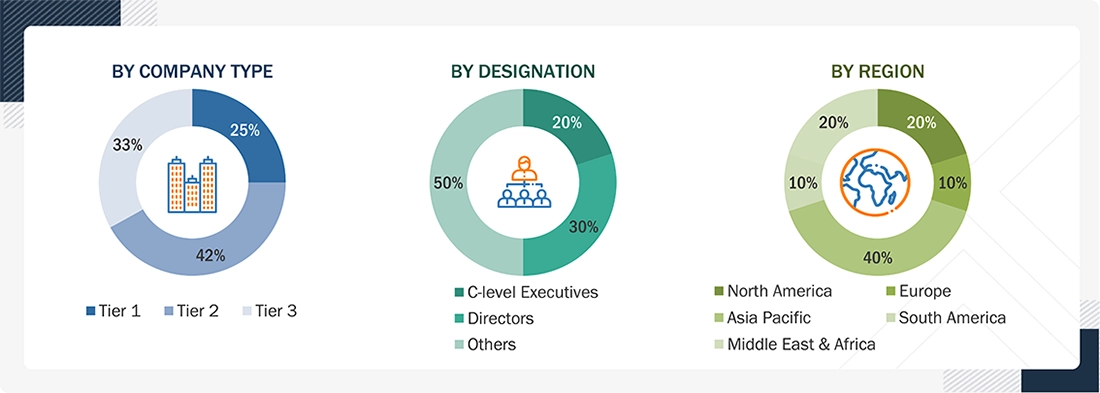
Notes: Other designations include sales, marketing, and product managers.
Tier 1: >USD 1 Billion; Tier 2: USD 500 million–1 Billion; and Tier 3: <USD 500 million
To know about the assumptions considered for the study, download the pdf brochure
Market Size Estimation
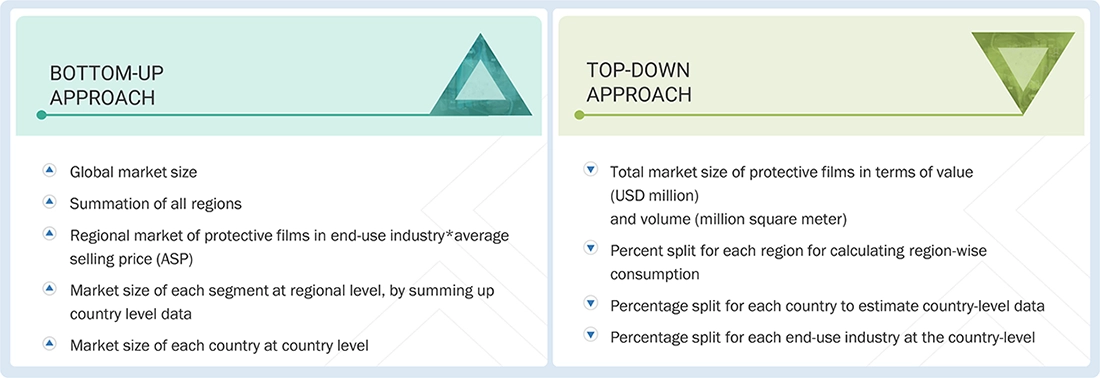
The top-down and bottom-up approaches were used to estimate and validate the size of the global protective films market. These approaches were also widely used to estimate the sizes of various dependent market segments. The research methodology used to estimate the market size included the following:
Protective Films Market: Top-Down and Bottom-Up Approach
Data Triangulation
After determining the overall market size using market sizing processes, the market was split into several segments and subsegments. The data triangulation and market breakup procedures were employed, wherever applicable, to complete the overall market engineering process and arrive at the exact statistics of each market segment and subsegment. The data was triangulated by examining various factors and trends on both the demand and supply sides.
Market Definition
A protective film is a thin, flexible layer of material applied to surfaces to protect them from damage such as scratches, abrasion, dust, moisture, and chemical exposure. These films serve as temporary or permanent protective barriers during manufacturing, transportation, storage, installation, or end use. They are commonly produced from materials such as polyethylene (PE), polypropylene (PP), polyvinyl chloride (PVC), polyethylene terephthalate (PET), polyurethane (PU), polycarbonate (PC), and others. Protective films may be designed with pressure-sensitive adhesives (PSA), non-adhesive or cling layers, or specialty removable and clean-peel adhesives that allow easy application and residue-free removal.
Over time, protective film technology has evolved substantially, resulting in modern films that are lightweight, durable, highly transparent, and provide strong surface protection. Advancements in polymer materials, adhesives, and coating technologies have enhanced the overall performance and functionality of these films. As a result, modern protective films can incorporate advanced features such as UV resistance, anti-static properties, and self-healing capabilities. These innovations improve durability, extend the lifespan of protected surfaces, and enable protective films to meet the increasingly demanding requirements of various industrial and commercial applications.
Protective films are widely used across numerous industries to maintain product quality, appearance, and durability. Key end-use sectors include building & construction, automotive & transportation, electronics & electrical, industrial manufacturing & metal processing, packaging & logistics, furniture & interior, and medical & pharmaceutical industries. By protecting surfaces such as painted panels, glass, metals, plastics, and electronic displays from damage during handling and use, protective films help extend product lifespan, reduce repair or replacement costs, and preserve the aesthetic and functional value of materials and finished products.
Key Stakeholders
- Raw material suppliers
- Protective films manufacturers
- Adhesive & coating technology providers
- Film converters and processors
- Distributors and suppliers
- OEMs (Original Equipment Manufacturers)
- Installers and applicators
- R&D institutions
- Regulatory bodies and standards organizations
- End-users
Report Objectives
- To define, describe, and forecast the size of the global protective films market, by type, material, and end-use industry, in terms of value and volume
- To forecast the market size of segments for North America, Europe, Asia Pacific, South America, and the Middle East & Africa, along with their respective countries, in terms of value and volume
- To provide detailed information on the significant drivers, restraints, opportunities, and challenges influencing the market
- To strategically analyze micromarkets concerning individual growth trends, prospects, and their contribution to the market
- To assess the growth opportunities in the market for stakeholders and provide details on the competitive landscape for market leaders
- To strategically profile key players and comprehensively analyze their market shares and core competencies
- To analyze competitive developments, such as product launches, expansion, acquisitions, and agreements in the protective films market
- To provide the impact of AI/Gen AI on the market
- To provide the macroeconomic outlook for each region covered under the study, and the impact of the US tariffs on the market
Available customizations:
Based on the given market data, MarketsandMarkets offers customizations tailored to client-specific needs.
The following customization options are available for the protective films report:
Product Analysis
-
A product matrix that gives a detailed comparison of the product portfolio of each company
Regional Analysis
- A further breakdown of the protective films market for additional countries
Company Information
-
Detailed analysis and profiling of additional market players (up to five)
Get the Full Protective Films Market Report
Full forecast, segment splits, and company analysis for all Protective Films Market.
- China Protective Films Market
- Japan Protective Films Market
- India Protective Films Market
- South Korea Protective Films Market
- US Protective Films Market
- Canada Protective Films Market
- Mexico Protective Films Market
- Germany Protective Films Market
- UK Protective Films Market
- France Protective Films Market
- Italy Protective Films Market
- Spain Protective Films Market
- Brazil Protective Films Market
- Argentina Protective Films Market
- South Africa Protective Films Market
- Rest Of Asia Pacific Protective Films Market
Need a Tailored Report?
Customize this report to your needs
Get 10% FREE Customization
Customize This Report
