
Asia Pacific Power Rental Market (2025-2030)

The Asia Pacific Power Rental Market was valued at $2944.4 Million in 2025 and projected to reach to $4141.9 Million by 2030, representing a compound annual growth rate of CAGR 7.1%. The Asia Pacific power rental market is poised for substantial expansion, driven by rapid industrialization, urbanization, and infrastructure modernization across the region.


| Market Size in | USD 26.32 MN |
| Market Forecast in | |
| CAGR | |
| Forecast Period | |
| Units Considered | Value (USD MN) |
Asia Pacific Power Rental Market Trends and Insights
- Asia Pacific's 7.1% compound annual growth rate outpaces the global average, driven by rapid industrialization, infrastructure development, and increasing demand for temporary power solutions across the region.
- Key markets within Asia Pacific are leveraging rental power systems to support construction projects, data centers, and emergency backup requirements. Asia Pacific's power rental sector benefits from rising energy consumption and grid reliability challenges in developing economies.
- The region's manufacturing boom and urbanization trends are creating sustained demand for flexible, cost-effective power solutions.
- Asia Pacific stakeholders are increasingly adopting rental models to avoid capital expenditure on permanent generation assets, particularly in countries with volatile power supply conditions. By 2030, Asia Pacific is expected to consolidate its position as a critical growth engine for the global power rental market.
- The region's expanding middle class, digital transformation initiatives, and renewable energy integration projects will continue to drive demand for reliable temporary power infrastructure throughout the forecast period..
Key Market Statistics
- CAGR (2025-2030) CAGR 7.1%
- Market Size, 2025 ~USD 2944.4 Million
- Forecast, 2030 ~USD 4141.9 Million
- Geography Asia Pacific
Asia Pacific Power Rental Market Overview
Fastest Growing Region Globally :
Asia Pacific's 7.1% CAGR significantly outpaces the global average of 5.6%, positioning the region as the primary growth engine for the power rental market through 2030.
Rapid Industrialization Driving Demand :
Accelerating manufacturing expansion, construction projects, and industrial development across Asia Pacific are creating sustained demand for temporary and mobile power solutions.
Infrastructure Development Catalyst :
Large-scale infrastructure initiatives, smart city projects, and energy transition investments throughout the region are fueling adoption of rental power equipment.
Market Expansion Trajectory :
The region is projected to grow from USD 2,944.4 million in 2025 to USD 4,141.9 million by 2030, representing a USD 1,197.5 million increase in market value.
Asia Pacific Power Rental Market Dynamics
- Countries like China and India are leading growth through massive construction projects, manufacturing capacity additions, and renewable energy integration initiatives.
- The region's 7.1% CAGR reflects strong demand for temporary power solutions in sectors including construction, mining, telecommunications, and event management. Looking ahead to 2030, Asia Pacific will continue benefiting from economic growth, grid modernization efforts, and increasing adoption of rental models over capital-intensive ownership.
- Emerging markets within the region present untapped opportunities, while established economies drive innovation in portable power technology.
- Strategic investments in power rental infrastructure and fleet expansion will be critical for market participants to capture this high-growth opportunity..
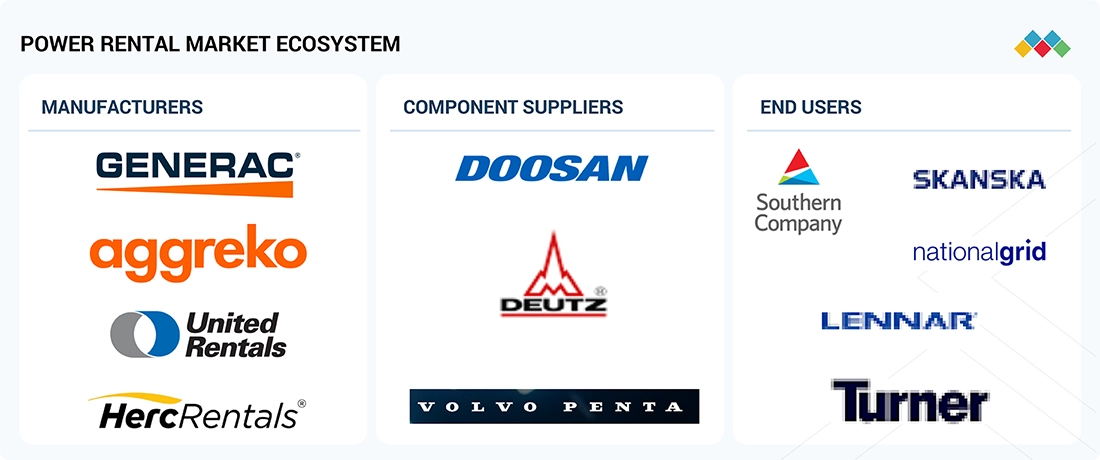
Market Ecosystem
POWER RENTAL MARKET: COMMERCIAL USE CASES ACROSS INDUSTRIES
| COMPANY | USE CASE DESCRIPTION | BENEFITS |
|---|---|---|
 |
Temporary standby and backup power deployed at the NHS Nightingale Hospital London to ensure uninterrupted electricity supply for critical care operations during outages | Rapid deployment of temporary rental power by MEMS by supplying 21,850 kVA with generators, cables, and distribution equipment | Enable NHS Nightingale Hospital to operate with reliable electricity for critical care without risking outages |
 |
Off-grid power solutions were required at the La Parrilla tungsten mine in Extremadura to provide a stable and reliable electricity supply in a remote location without grid access | Provided a stable, long-term and environmentally cost-effective power supply | Enabled continuous mining operations at the remote La Parrilla tungsten min |
Logos and trademarks shown above are the property of their respective owners. Their use here is for informational and illustrative purposes only.
Related Ecosystem
Engines And Gensets
Power Infrastructure
Key Takeaways
- Asia Pacific power rental market grows from $2,944.4M (2025) to $4,141.9M (2030) at 7.1% CAGR, outpacing global growth.
- Asia Pacific's rapid industrialization and infrastructure projects drive sustained demand for temporary power solutions.
- Asia Pacific's grid reliability challenges and energy supply volatility accelerate adoption of flexible rental power models.
- Asia Pacific is positioned as the fastest-growing regional market, supported by digital transformation and renewable energy integration.
Power Rental Market Report Scope
| Report Metric | Details |
|---|---|
| Base Year | 2025 |
| Fastest Growing Segment | NATURAL GAS (Generator Fuel Type) |
| Forecast Period | 2025–2030 |
| Growth Rate | CAGR of 5.6% from 2025 to 2030 |
| Largest Segment | GENERATORS (Equipment) |
| Market Size Base Year (Billions) | ~USD 11.46 (2025) |
| Revenue Forecast (Billions) | ~USD 15.05 (2030) |
| Segments Covered | Generator Fuel Type, Equipment, Generator Power Rating, Rental Type, End User, Application |
Asia Pacific Power Rental Market Report Segmentation
6 segment dimensions are covered across the global market.
By Generator Fuel Type
- Diesel
- Natural Gas
- Other Generator Fuel Types
By Equipment
- Generators
- Load Banks
- Other Equipment
- Transformers
By Generator Power Rating
- 501–2,500 Kw
- 51–500 Kw
- Above 2,500 Kw
- Up To 50 Kw
By Rental Type
- Long-Term Project Rental
- Short-Term Retail Rental
By End User
- Construction
- Corporate & Retail
- Events
- It & Data Centers
- Manufacturing
- Metals & Mining
- Mining & Metals
- Oil & Gas
- Other End Users
- Utilities
By Application
- Base Load/Continuous Power
- Peak Shaving
- Standby Power
Target Audience
- Power Rental Equipment Manufacturers : Manufacturers need Asia Pacific market data to identify demand hotspots, plan production capacity, and develop region-specific product offerings for construction and industrial sectors.
- Rental Service Providers & Fleet Operators : Rental companies require detailed market forecasts and country-level insights to optimize fleet deployment, expand operations, and capture growth in high-demand Asia Pacific markets.
- Construction & Infrastructure Companies : Construction firms need market intelligence on power rental availability, pricing trends, and supplier capabilities across Asia Pacific to plan project logistics and budgets.
- Private Equity & Investment Firms : Investors seeking Asia Pacific exposure need comprehensive market analysis to evaluate acquisition targets, assess growth potential, and make informed investment decisions in the power rental sector.
- Energy & Utility Companies : Utilities and energy providers require market insights to understand temporary power demand patterns, competitive threats, and opportunities for service diversification in Asia Pacific.
Key Companies in the Asia Pacific Power Rental Market
| Company | HQ | Ownership | Strongest segments |
|---|---|---|---|
| ACTUANT | United States |
ACTUANT
ACTUANT is a United States-based industrial tools and equipment manufacturer serving diverse markets including automotive, industrial, and energy sectors.
Countries within Asia Pacific - compare and drill down
| Country | 2025 size (native) |
|---|---|
| China | USD 2019.6 Million |
| India | USD 966.9 Million |
| Japan | USD 453.7 Million |
| Australia | USD 238 Million |
| South Korea | USD 180.3 Million |
Country market size visualization
Reasons to Buy this Report
- Regional Growth Outperformance : Gain insights into why Asia Pacific's 7.1% CAGR exceeds global benchmarks, enabling strategic positioning in the fastest-growing power rental region.
- Country-Level Market Intelligence : Access detailed market sizing and forecasts for key Asia Pacific economies including China, India, Japan, South Korea, and Australia to identify high-potential markets.
- Industrialization & Infrastructure Trends : Understand how rapid industrialization, construction booms, and infrastructure projects across Asia Pacific are creating sustained demand for rental power solutions.
- Competitive Landscape Analysis : Identify market leaders, emerging players, and competitive dynamics specific to Asia Pacific to inform market entry and expansion strategies.
- Investment & Growth Opportunities : Discover untapped market segments, emerging applications, and geographic pockets within Asia Pacific offering the highest growth potential through 2030.
Frequently asked questions
What is the current size of the Asia Pacific power rental market?
The Asia Pacific power rental market is valued at USD 2,944.4 million in 2025, representing significant regional demand for temporary power infrastructure.
What is the projected market size for Asia Pacific by 2030?
Asia Pacific's power rental market is forecast to reach USD 4,141.9 million by 2030, reflecting a 7.1% compound annual growth rate.
Why is Asia Pacific's growth rate higher than the global average?
Asia Pacific's 7.1% CAGR exceeds the global 5.6% rate due to rapid industrialization, infrastructure expansion, and grid reliability challenges across developing economies in the region.
Which sectors drive power rental demand in Asia Pacific?
Asia Pacific power rental demand is driven by construction, manufacturing, data centers, telecommunications, and emergency backup applications across the region's growing industrial base.
How does Asia Pacific compare to other global regions in power rental adoption?
Asia Pacific is the fastest-growing region for power rentals, with its 7.1% CAGR and expanding market size positioning it as a critical growth driver for the global power rental industry.
RESEARCH METHODOLOGY
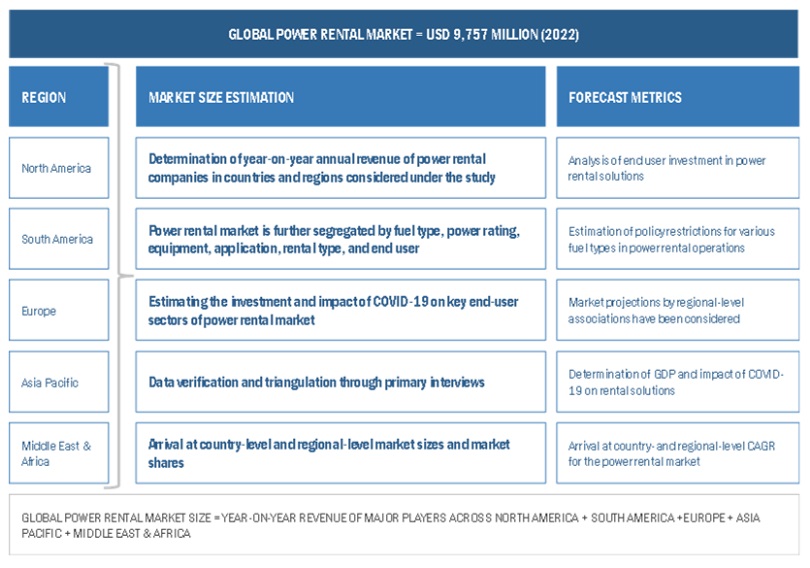
The study involved major activities in estimating the current size of the power rental market. Exhaustive secondary research was done to collect information on the peer and parent markets. The next step was to validate these findings, assumptions, and sizing with industry experts across the value chain through primary research. Both top-down and bottom-up approaches were employed to estimate the complete market size. Thereafter, market breakdown and data triangulation were used to estimate the market size of the segments and subsegments.
Secondary Research
This research study on the market involved the use of extensive secondary sources, directories, and databases, such as Hoovers, Bloomberg, Businessweek, Factiva, International Energy Agency, and United States Energy Association, to identify and collect information useful for a technical, market-oriented, and commercial study of the global power rental market. The other secondary sources included annual reports of the companies involved in the market, press releases & investor presentations of companies, white papers, certified publications, articles by recognized authors, manufacturer associations, trade directories, and databases.
Primary Research
The power rental market comprises power rental providers, manufacturers of subcomponents of power plant, manufacturing technology providers, and technology support providers in the supply chain. The demand side of this market is characterized by the rising demand for clean energy and energy efficiency. The supply side industry experts such as vice presidents, CEOs, marketing directors, technology directors, and related key executives from various companies and organizations operating in the market. Various primary sources from both the supply and demand sides of the market were interviewed to obtain qualitative and quantitative information.
Following is the breakdown of primary respondents:
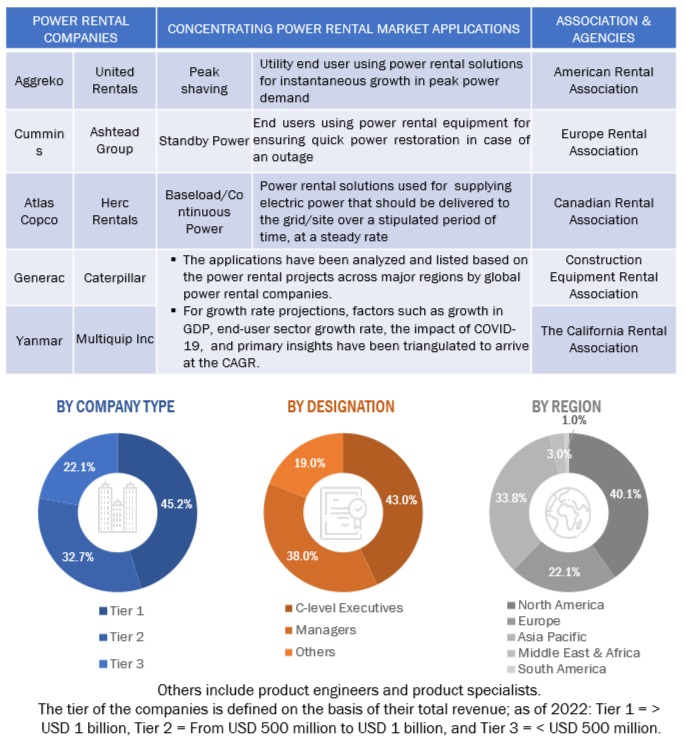
To know about the assumptions considered for the study, download the pdf brochure
Power Rental Market Size Estimation
Both supply side and demand side analysis were used to estimate and validate the total size of the market. These methods were also used extensively to estimate the size of various subsegments in the market. The research methodology used to estimate the market size includes the following:
- Identification of major players in the market across countries. Key players in the power rental market include Aggreko, United Rentals, Ashtead Group, Herc Rentals, Caterpillar, Atlas Copco, and Cummins.
- Determining the revenues and business strategy specifics, such as the inorganic and organic growth strategy details, of major power rental equipment providers.
- The market share of individual power rental segments, namely, equipment, fuel type, application, power rating, rental type, and end user, are determined by consolidating and evaluating the product offerings of major companies.
- In addition, country-level demand for power rental equipment from end users, such as utilities, oil & gas, mining & metals, manufacturing, construction, and IT & data centers, and supportive policy developments across regions during the forecast period has been analyzed. The analysed data then verified through primaries to determine the country-wise and regional landscape.
Global Power Rental Market Size: Supply Side Analysis
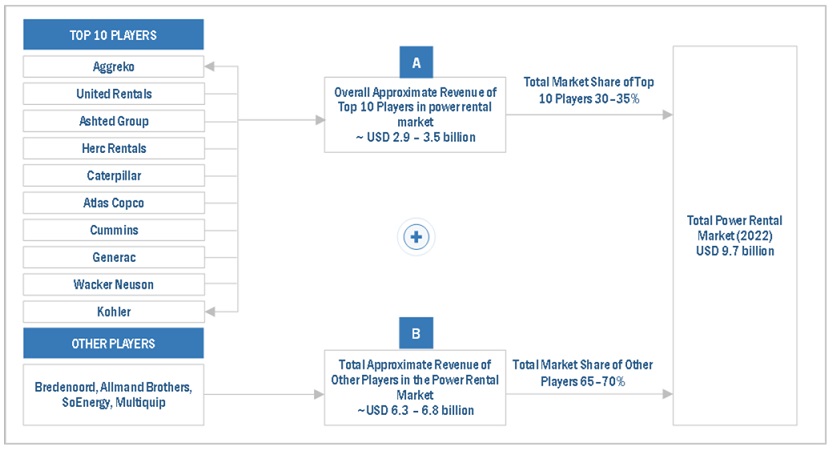
To know about the assumptions considered for the study, Request for Free Sample Report
Global Power Rental Market Size: Demand side Analysis
Data Triangulation
After arriving at the overall market size from the estimation process explained above, the total market has been split into several segments and subsegments. The complete market engineering process is done to arrive at the exact statistics for all the segments and subsegments, also data triangulation and market breakdown processes have been employed, wherever applicable. The data has been triangulated by examining various factors and trends from both the demand- and supply sides. Along with this, the market has been validated through both the top-down and bottom-up approaches.
Market Definition
The power rental market is defined as the revenue generated either through providing equipment on rent such as load banks, generators, fuel tanks, cables, transformers, and power accessories or by renting temporary power plants. Power rental equipment majorly operates on diesel, gas, and other fuels such as gasoline, hybrid fuel, and heavy fuel oil (HFO). This equipment is used for peak shaving, standby power, and base load/continuous load applications by the utilities, oil & gas, events, construction, mining & metals, manufacturing, IT & data centers, corporate & retail, and other end users. Other industries include shipping, agriculture, aerospace and defense, wherein this equipment is majorly used for the generation of backup power.
Key Stakeholders
- Consulting companies in the energy and power sector
- Consulting companies in the oil & gas sector
- Generator raw materials and component manufacturers
- Engine/generator manufacturers, dealers, and suppliers
- Governments and research organizations
- Investment banks
- Petroleum companies (diesel and natural gas suppliers)
- Construction and infrastructure development companies
- Power grid infrastructure companies
- Power plant project developers
- Power rental companies
- Shareholders or investors
Objectives of the Study
- To forecast the market size for five key regions: North America, South America, Europe, Asia Pacific, and Middle East & Africa, along with their key countries.
- To define, describe, analyze, and forecast the size of the global power rental market based on fuel type, power rating, application, equipment, end user, rental type, and region.
- To provide detailed information about key factors such as drivers, restraints, opportunities, and challenges influencing the growth of the market.
- To strategically analyze the subsegments with respect to individual growth trends, prospects, and contributions of each segment to the overall market size
- To strategically analyze the market with respect to individual growth trends, future expansions, and contributions to the market.
- To analyze market opportunities for stakeholders in the market and draw a competitive landscape for market players.
- To analyze competitive developments such as sales contracts, agreements, investments, expansions, new product launches, mergers, partnerships, joint ventures, collaborations, and acquisitions in the market.
- To compare key market players with respect to the market share, product specifications, and applications.
Available Customizations:
With the given market data, MarketsandMarkets offers customizations as per the client’s specific needs. The following customization options are available for this report:
Geographic Analysis
- Further breakdown of region or country-specific analysis
Company Information
- Detailed analyses and profiling of additional market players (up to 5)
Get the Full Power Rental Market Report
Full forecast, segment splits, and company analysis for all Power Rental Market.
- Germany Power Rental Market
- UK Power Rental Market
- Russia Power Rental Market
- France Power Rental Market
- Italy Power Rental Market
- Canada Power Rental Market
- Mexico Power Rental Market
- US Power Rental Market
- China Power Rental Market
- India Power Rental Market
- Australia Power Rental Market
- Japan Power Rental Market
- South Korea Power Rental Market
- Indonesia Power Rental Market
- Brazil Power Rental Market
- Argentina Power Rental Market
- Chile Power Rental Market
- UAE Power Rental Market
- Qatar Power Rental Market
- Nigeria Power Rental Market
- Rest Of Europe Power Rental Market
- South Africa Power Rental Market
- South America Power Rental Market
Need a Tailored Report?
Customize this report to your needs
Get 10% FREE Customization
Customize This Report
