
Rest Of South America Residential Elevators Market (2026-2031)

The Rest Of South America Residential Elevators Market was valued at $674 Million in 2026 and projected to reach to $769.6 Million by 2031, representing a compound annual growth rate of 2.69%. Rest Of South America's residential elevators market demonstrates consistent growth momentum, supported by structural economic improvements and increasing consumer preference for modern residential amenities.


| Market Size in | USD 26.32 MN |
| Market Forecast in | |
| CAGR | |
| Forecast Period | |
| Units Considered | Value (USD MN) |
Rest Of South America Residential Elevators Market Trends and Insights
- This steady expansion in Rest Of South America reflects increasing urbanization, rising middle-class populations, and growing demand for modern residential infrastructure across the region's emerging economies.
- Rest Of South America's market growth is driven by construction activity in multi-family residential developments and retrofitting initiatives in aging building stock. The residential elevators sector in Rest Of South America is characterized by moderate but consistent demand, supported by infrastructure investments and urban renewal projects.
- Rest Of South America's market dynamics are influenced by local economic conditions, building codes, and the availability of financing for residential construction.
- Between 2026 and 2031, Rest Of South America is expected to see incremental adoption of energy-efficient and smart elevator technologies, aligning with broader regional sustainability trends and modernization efforts in the residential real estate sector..
Key Market Statistics
- CAGR (2026-2031) 2.69% CAGR
- Market Size, 2026 ~USD 674 Million
- Forecast, 2031 ~USD 769.6 Million
- Country Rest Of South America
Rest Of South America Residential Elevators Market Overview
Steady Regional Growth :
Rest Of South America's residential elevators market is expanding at 2.69% CAGR, outpacing the global average of 2.5%, driven by urbanization and infrastructure modernization across emerging economies in the region.
Rising Middle-Class Demand :
Growing middle-class populations across Rest Of South America are increasingly investing in modern residential properties with elevator installations, supporting sustained market expansion through 2031.
Urbanization Acceleration :
Rapid urban development in secondary and tertiary cities throughout Rest Of South America is creating new opportunities for residential elevator installations in multi-family housing complexes and high-rise developments.
Market Value Trajectory :
The market is projected to grow from USD 674.0 million in 2026 to USD 769.6 million by 2031, representing approximately USD 95.6 million in incremental value creation over the five-year forecast period.
Rest Of South America Residential Elevators Market Dynamics
- The region's expanding urban centers and rising disposable incomes among middle-class households are driving demand for multi-story residential developments equipped with elevators.
- Infrastructure investments and real estate development initiatives across countries in the region are expected to sustain this positive trajectory through 2031. The market's 2.69% CAGR reflects a balanced growth environment with steady demand from both new construction projects and modernization of existing residential buildings.
- As urbanization continues and building codes increasingly mandate elevator installations in multi-family properties, Rest Of South America is positioned for reliable market expansion.
- Regional economic stability and growing foreign direct investment in real estate development will further support market growth during the forecast period..
Market Ecosystem

RESIDENTIAL ELEVATORS & ESCALATORS MARKET: COMMERCIAL USE CASES ACROSS INDUSTRIES
| COMPANY | USE CASE DESCRIPTION | BENEFITS |
|---|---|---|
 |
Schindler used IoT-enabled remote monitoring to detect a potential elevator issue in a senior residential building before a breakdown occurred, allowing proactive maintenance. | Prevented unplanned elevator downtime. Improved elevator reliability and uptime. Enhanced accessibility for senior residents. Enabled predictive, data-driven maintenance. |
 |
Otis installed SkyRise and Gen2 Premier elevators integrated with the Compass 360 destination management system in the 61-story Collins House residential tower, optimizing vertical transportation within a narrow building footprint. | Maximized space utilization in a slim residential tower. Reduced passenger waiting times through destination dispatch. Improved energy efficiency. Enabled smooth passenger flow with high-capacity elevator operation |
Logos and trademarks shown above are the property of their respective owners. Their use here is for informational and illustrative purposes only.
Related Ecosystem
Equipment Machine And Tooling
- Wastewater Treatment
- Air Cooled Heat Exchangers
- Diaphragm Pumps
- Fiberglass
- HVAC System
- Alfa Laval Corporate AB
- Johnson Controls International plc
- Daikin Industries,Ltd.
- Veolia
- Carrier Global Corporation
Key Takeaways
- Rest Of South America's residential elevators market is valued at USD 674.0 million in 2026 and will reach USD 769.6 million by 2031.
- Rest Of South America exhibits a CAGR of 2.69% over the forecast period, reflecting steady but moderate market expansion.
- Urbanization and multi-family residential construction are primary growth drivers for Rest Of South America's elevator market.
- Rest Of South America is increasingly adopting energy-efficient and smart elevator technologies to meet sustainability and modernization demands.
Residential Elevators Market Report Scope
| Report Metric | Details |
|---|---|
| Base Year | 2026 |
| Fastest Growing Segment | MODERNIZATION (Service) |
| Forecast Period | 2026-2031 |
| Growth Rate | CAGR of 2.5% from 2026 to 2031 |
| Largest Segment | TRACTION ELEVATORS (Elevator Technology) |
| Market Size Base Year (Billions) | ~USD 51.79 (2026) |
| Revenue Forecast (Billions) | ~USD 58.6 (2031) |
| Segments Covered | Elevator Technology, Service |
Rest Of South America Residential Elevators Market Report Segmentation
2 segment dimensions are covered across the global market.
By Elevator Technology
- Hydraulic Elevator
- Hydraulic Elevators
- Machine-Room-Less Traction Elevator
- Machine-Room-Less Traction Elevators
- Traction Elevator
- Traction Elevators
By Service
- Maintenance & Repair
- Modernization
- New Installation
Target Audience
- Elevator Manufacturers : Manufacturers need Rest Of South America-specific market data to assess regional demand, plan production capacity, and develop localized product offerings for the growing residential segment.
- Real Estate Developers : Developers require market insights to understand elevator demand trends, budget for installations in multi-family projects, and align residential offerings with regional consumer preferences.
- Construction & Engineering Firms : Construction companies need regional market forecasts to identify project opportunities, plan resource allocation, and develop expertise in residential elevator installation across Rest Of South America.
- Investment & Private Equity : Investors need market sizing and growth projections for Rest Of South America to evaluate acquisition targets, assess portfolio companies, and identify emerging opportunities in the residential elevator sector.
- Distribution & Supply Chain Partners : Distributors and logistics providers require regional market data to optimize inventory levels, plan warehouse locations, and develop efficient supply chains for elevator components across Rest Of South America.
Reasons to Buy this Report
- Regional Market Sizing : Obtain precise market valuation for Rest Of South America at USD 674.0 million (2026) and USD 769.6 million (2031), enabling accurate budget allocation and revenue forecasting for regional operations.
- Growth Rate Intelligence : Access the region-specific 2.69% CAGR to benchmark performance against global 2.5% growth, identifying Rest Of South America as an outperforming market opportunity for expansion strategies.
- Urbanization Insights : Understand how rapid urbanization and rising middle-class populations in Rest Of South America are creating sustained demand for residential elevator installations across emerging city centers.
- Competitive Positioning : Develop targeted market entry and expansion strategies specific to Rest Of South America's unique economic conditions, infrastructure development patterns, and residential construction trends.
- Investment Decision Support : Make informed capital allocation decisions for manufacturing facilities, distribution networks, and sales operations in Rest Of South America based on reliable five-year market projections.
Frequently asked questions
What is the current market size of residential elevators in Rest Of South America?
Rest Of South America's residential elevators market is estimated at USD 674.0 million in 2026.
What is the projected market size for Rest Of South America by 2031?
Rest Of South America's residential elevators market is forecast to reach USD 769.6 million by 2031.
What is the CAGR for Rest Of South America's residential elevators market?
Rest Of South America's residential elevators market is expected to grow at a CAGR of 2.69% from 2026 to 2031.
What are the main drivers of growth in Rest Of South America's residential elevators market?
Rest Of South America's market growth is primarily driven by urbanization, rising middle-class populations, multi-family residential construction, and building modernization initiatives.
What technology trends are emerging in Rest Of South America's residential elevators sector?
Rest Of South America is seeing increased adoption of energy-efficient elevators and smart technologies that enhance sustainability and user experience in residential buildings.
RESEARCH METHODOLOGY
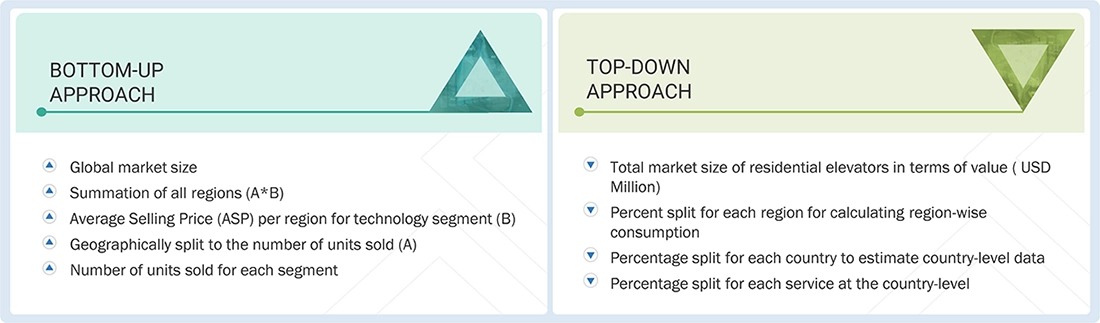
The study involved four major activities to estimate the current size of the global residential elevators market. Exhaustive secondary research was conducted to gather information on the market, the peer product market, and the parent product group market. The next step was to validate these findings, assumptions, and sizes with industry experts across the value chain of residential elevators through primary research. The top-down and bottom-up approaches were employed to estimate the overall size of the residential elevators market. After that, market breakdown and data triangulation procedures were used to determine the size of different segments of the market.
Secondary Research
The market for companies offering residential elevators was arrived at by studying the secondary data available through paid and unpaid sources, analyzing the product portfolios of the major companies in the ecosystem, and rating the companies by their performance and quality. Various secondary sources, such as Business Standard, Bloomberg, World Bank, and Factiva, were referred to identify and collect information for this study on the residential elevators market. In the secondary research process, various secondary sources were referred to identify and collect information related to the study. Secondary sources included annual reports, press releases, investor presentations, residential elevator vendors, forums, certified publications, and white papers. The secondary research was used to obtain critical information on the industry’s value chain, the total pool of key players, market classification, and segmentation from the market and technology-oriented perspectives.
Primary Research
In the primary research process, various primary sources from the supply and demand sides were interviewed to obtain qualitative and quantitative information for this report. The primary sources from the supply side included industry experts, such as Chief Executive Officers (CEOs), Vice Presidents (VPs), marketing directors, technology and innovation directors, and related key executives from several key companies and organizations operating in the residential elevators market. After the complete market engineering (calculations for market statistics, market breakdown, market size estimations, market forecasting, and data triangulation), extensive primary research was conducted to gather information and verify and validate the critical numbers arrived at. Primary research was also conducted to identify the segmentation types, industry trends, competitive landscape of residential elevators offered by various market players, and key market dynamics, such as drivers, restraints, opportunities, challenges, industry trends, and key player strategies. In the complete market engineering process, the top-down and bottom-up approaches and several data triangulation methods were extensively used to perform the market estimation and market forecasting for the overall market segments and subsegments listed in this report. Extensive qualitative and quantitative analysis was performed on the complete market engineering process to list the key information/insights throughout the report.
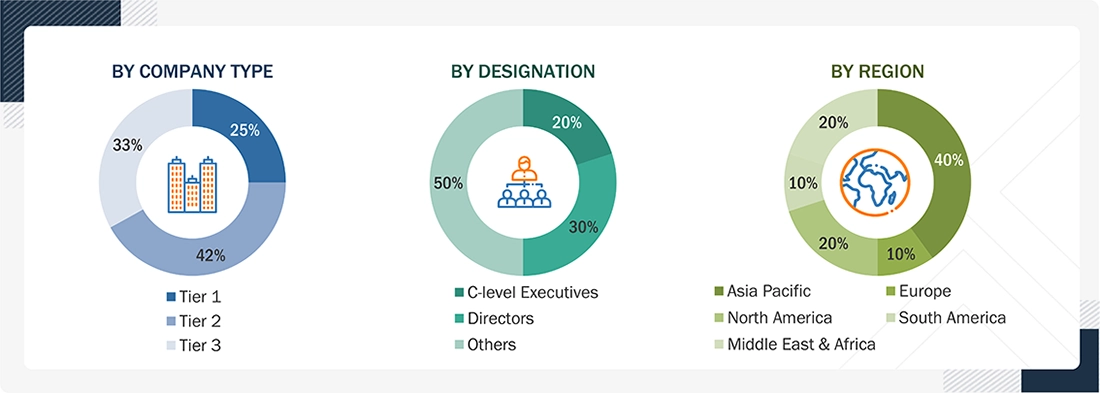
Notes:
Others include Sales, Marketing, and Product Managers.
Tier 1: > USD 1 billion; Tier 2: USD 500 million–1 billion; and Tier 3: < USD 500 million
To know about the assumptions considered for the study, download the pdf brochure
Market Size Estimation
The top-down and bottom-up approaches were used to estimate and validate the size of the global residential elevators market. These approaches were also used extensively to estimate the size of various dependent market segments.
Data Triangulation
After arriving at the overall market size using the market size estimation processes, the market was split into several segments and subsegments. The data triangulation and market breakup procedures were employed, wherever applicable, to complete the overall market engineering process and arrive at the exact statistics of each market segment and subsegment. The data was triangulated by studying various factors and trends from both the demand and supply sides.
Market Definition
Residential elevators are compact vertical transportation systems installed in private homes, villas, duplexes, and residential buildings to provide convenient, safe, and accessible movement between floors. They enhance mobility, improve comfort, support aging-in-place, and increase property value while requiring less space than commercial elevators.
Key Stakeholders
- Raw Material Suppliers and Producers
- Component Manufacturers
- Elevator OEMs
- Elevators Manufacturers
- Traders and Distributors of Elevators
- Installation & Engineering Contractors
- Maintenance & Service Providers
- End Users
- NGOs, Governments, Research Organizations, Investment Banks, Venture Capitalists, and Private Equity Firms
- Technology & Software Providers
Report Objectives
- To define, describe, and forecast the size of the global residential elevators market based on elevator technology, service, and region in terms of value and volume
- To provide detailed information on the significant drivers, restraints, opportunities, and challenges influencing the market
- To analyze and forecast the market based on elevator technology and service
- To strategically analyze micro markets concerning individual growth trends, prospects, and their contribution to the market
- To assess the growth opportunities in the market for stakeholders and provide details on the competitive landscape for market leaders
- To forecast the market size of segments for North America, Europe, Asia Pacific, South America, and the Middle East & Africa
- To strategically profile key players and comprehensively analyze their market shares and core competencies
- To analyze competitive developments, such as expansions, product launches, partnerships, and acquisitions in the residential elevators market
- To provide the impact of AI on the residential elevators market
Available customizations:
With the given market data, MarketsandMarkets offers customizations according to client-specific needs.
The following customization options are available for the residential elevators report:
Product Analysis
- A product matrix that gives a detailed comparison of the product portfolio of each company.
Regional Analysis
- A further breakdown of the residential elevators market for additional countries.
Company Information
- Detailed analysis and profiling of additional market players (up to five)
Get the Full Residential Elevators Market Report
Full forecast, segment splits, and company analysis for all Residential Elevators Market.
- China Residential Elevators Market
- Japan Residential Elevators Market
- India Residential Elevators Market
- South Korea Residential Elevators Market
- Canada Residential Elevators Market
- Mexico Residential Elevators Market
- US Residential Elevators Market
- Brazil Residential Elevators Market
- Argentina Residential Elevators Market
- Germany Residential Elevators Market
- France Residential Elevators Market
- UK Residential Elevators Market
- Italy Residential Elevators Market
- Spain Residential Elevators Market
- Rest Of Europe Residential Elevators Market
- Rest Of Asia Pacific Residential Elevators Market
- GCC Countries Residential Elevators Market
- -Rest Of GCC Countries Residential Elevators Market
Need a Tailored Report?
Customize this report to your needs
Get 10% FREE Customization
Customize This Report
