



Elevators & Escalators Market
Report Code
BC 4488
Published in
Jun, 2026, By MarketsandMarkets™
Elevators and Escalators Market by Type (Elevators, Escalators, Moving Walkways), Service (New Installation, Maintenance & Repair), Elevator Technology (Traction, Machine-room-less, Hydraulic), End-use Industry, and Region - Global Forecast to 2031

USD 114.88 BN
MARKET SIZE, 2031

CAGR 2.9%
(2026-2031)

300
REPORT PAGES

370
MARKET TABLES
OVERVIEW
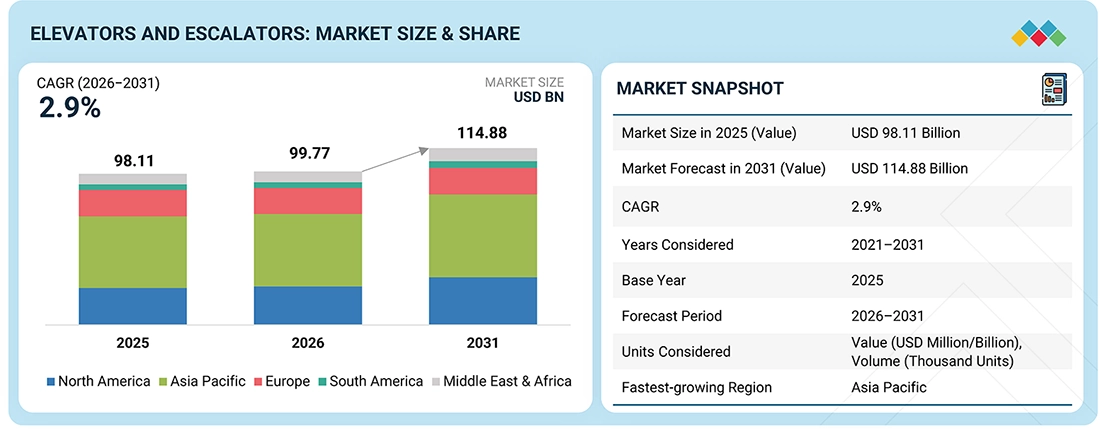
Source: Secondary Research, Interviews with Experts, MarketsandMarkets Analysis
The elevators and escalators market is projected to grow from USD 99.77 billion in 2026 to USD 114.88 billion by 2031, at a CAGR of 2.9% during the forecast period. The elevators and escalators market is anticipated to experience substantial growth during the forecast period due to rapid urbanization and smart city projects worldwide. As the number of residential, commercial, and mixed-use buildings, as well as high-rise buildings, grows, there is an increasing need for efficient vertical transportation. Furthermore, a surge in investments in infrastructure such as airports, metros, railway stations, hospitals, and shopping malls is helping the market grow.
KEY TAKEAWAYS
-
By RegionAsia Pacific's elevators and escalators market dominated, with a share of 47.2% in 2025.
-
By TypeThe escalators segment is expected to register the highest CAGR of 3.0% from 2026 to 2031, in terms of value.
-
By Elevator TechnologyThe traction elevators segment is expected to be the leading segment, in terms of value.
-
By ServiceThe new installation segment is expected to dominate the market in terms of value.
-
By End-use IndustryResidential is expected to be the leading segment in terms of value.
-
Competitive Landscape - Key PlayersSchindler, Otis Worldwide Corporation, KONE Corporation, Hitachi Ltd., TK Elevator, and Mitsubishi Electric Corporation were identified as star players in the elevators and escalators market, as they have focused on extensive product portfolios, strong global presence, and continuous technological advancements.
-
Competitive Landscape- StartupsShenyang Yuanda Intellectual Industry Group Co., Ltd., ORONA, EITA Elevator, Glarie Elevator, and TRIO Elevators Co (India) Private Limited, among others, have distinguished themselves among startups and SMEs. These companies are gaining traction through competitive pricing, customized solutions, and investments in innovative technologies.
Modernization and replacement of older elevator and escalator systems, along with the development of smart, energy-efficient, and IoT (Internet of Things) technologies, are further driving market growth. Furthermore, new legislation regarding safety and the increased accessibility for elderly and handicapped users is driving the use of new elevator and escalator technologies.
TRENDS & DISRUPTIONS IMPACTING CUSTOMERS' CUSTOMERS
Some of the major trends influencing the elevators and escalators market are smart and connected systems, energy-efficient technologies, predictive maintenance solutions, and touchless systems. The innovations are improving efficiency, safety, and the user experience in the operation. The market, however, may experience ups and downs due to volatile raw material prices, supply chain disruptions, labor shortages, and economic uncertainties, which can affect construction work and infrastructure investment.
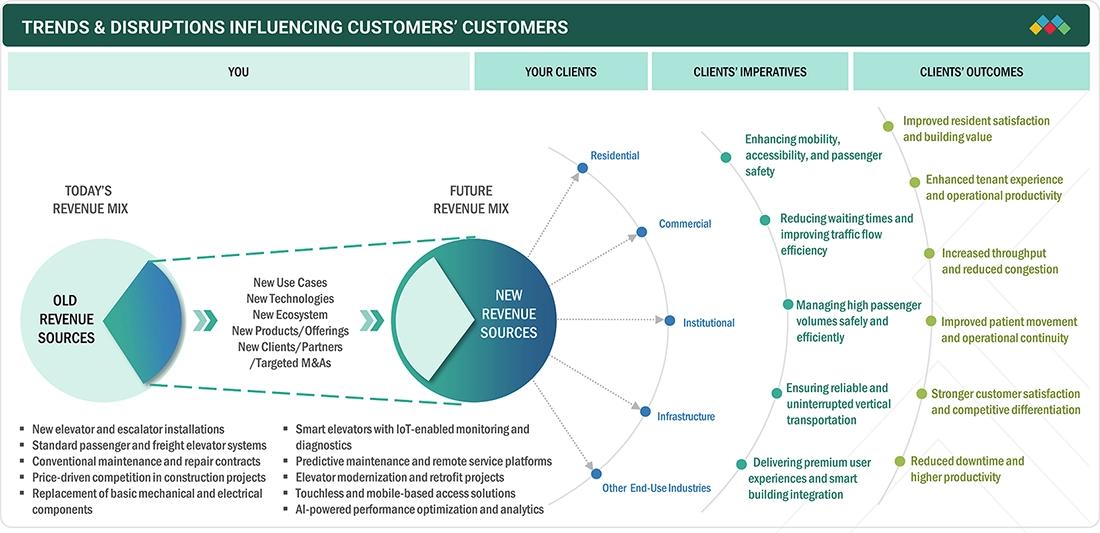
Source: Secondary Research, Interviews with Experts, MarketsandMarkets Analysis
MARKET DYNAMICS

Drivers
Impact
Level
Level
-
Increasing focus on energy efficiency in buildings

-
Healthcare infrastructure expansion and aging demographics


RESTRAINTS
Impact
Level
Level
-
High maintenance cost

-
Uncertainty and risk regarding global economy


OPPORTUNITIES
Impact
Level
Level
-
Technological advancements and innovation

-
Adoption of green building codes and energy-efficient products


CHALLENGES
Impact
Level
Level
-
Compliance with standards and regulations

Source: Secondary Research, Interviews with Experts, MarketsandMarkets Analysis
Driver: Increasing focus on energy efficiency in buildings
Advanced elevator and escalator systems are required as buildings become more energy-efficient and carbon-reducing. Governments and organizations around the world are encouraging green building standards and sustainability rules that promote energy-saving technologies. Therefore, manufacturers are launching smart elevators with regenerative drives, smart controls, and predictive maintenance to minimize energy consumption and enhance operational efficiency. Moreover, the utilization of environmentally friendly materials like low-carbon steel has been contributing to reduce the environmental footprint of vertical transportation equipment. This innovation is helping to move towards greener and sustainable buildings, which is fueling the growth of the elevators and escalators market.
Restraint: High maintenance cost
To operate safely and reliably and meet strict safety regulations, elevators and escalators require regular inspections, preventive maintenance, testing, and component replacement. Periodic upgrades are needed for key components like motors, control systems, cables, brakes, and sensors, which adds to the overall cost of ownership. From a safety perspective, issues arising from mechanical failure and obsolescence of infrastructure and equipment also require ongoing investment in maintenance and modernization. The challenge is especially critical for older buildings, in which substantial retrofit work may be needed to meet current safety, accessibility, and energy-efficiency requirements. These high maintenance, modernization and regulatory cost requirements can thus prevent timely upgrading, particularly in cost-competitive and developing markets, limiting market development.
Opportunity:Technological advancements and innovation
The integration of smart technologies, artificial intelligence (AI), and Internet of Things (IoT) connectivity, along with predictive maintenance capabilities, is becoming a key focus for manufacturers to achieve better operational efficiency, safety, and passenger satisfaction. As more high-rise buildings and skyscrapers are being constructed, the demand for high-speed elevators to move passengers between different levels has increased. Digital technologies, including cloud-based monitoring and digital thread solutions, help to track performance in real time and provide proactive maintenance, minimizing downtime and operating costs. Further, new features such as double-deck elevators, energy-efficient systems and intelligent traffic management solutions are enhancing building efficiency and space usage. The growing implementation of smart city initiatives and urban infrastructure projects should drive market growth in the long term as advanced elevator and escalator technologies gain wider acceptance.
Challenge:Compliance with standards and regulations
Standards and regulations pose a challenge for the elevators and escalators market; manufacturers and building owners must comply with strict safety, quality, and operational requirements. Comprehensive standards governing the design, installation, inspection, maintenance, and modernization of elevators and escalators have been established by regulatory bodies such as the American Society of Mechanical Engineers (ASME) and other safety organizations. Ongoing adherence to such rules is critical for passenger safety and for avoiding accidents, but it can also lead to higher development, testing, and operational costs. In addition, as smart technologies and IoT solutions become more ubiquitous and increasingly connected to elevator networks, the need for cybersecurity measures such as IEC 62443, which provides protection against unauthorized access and cyber threats, becomes increasingly relevant.
ELEVATORS & ESCALATORS MARKET: COMMERCIAL USE CASES ACROSS INDUSTRIES
| COMPANY | USE CASE DESCRIPTION | BENEFITS |
|---|---|---|
 |
Mitsubishi Electric installed 18 elevators in Ruby, Mumbai's tallest office building (40 stories), engineered to meet LEED green building standards. The system controls elevator speeds, loads, and waiting times, and ensures comfort for high-rise office users. | The destination allocation system improved morning rush-hour transport performance by about 15%, while efficient operations reduced waiting times, lowered energy consumption, and enhanced security. |
 |
Japanese Daisho Group chose exclusive custom elevator solutions in 180 Brisbane buildings: 15 KONE MiniSpace, 4 KONE MonoSpace elevators, linked to a KONE Destination Control System, LED identifiers, E-Link monitoring, and Care Maintenance for premium office functionality. | Achievement of 6 Star Greenstar Office rating, making 180 Brisbane the first building in the city with this top-tier environmental accreditation. |
Logos and trademarks shown above are the property of their respective owners. Their use here is for informational and illustrative purposes only.
MARKET ECOSYSTEM
The players in the elevators and escalators market include raw material suppliers, component manufacturers, system integrators, elevator and escalator manufacturers, distributors, installation service providers, and maintenance units. Key stakeholders engage in the design, manufacture, installation, and maintenance of vertical transportation systems for residential, commercial, and industrial use.
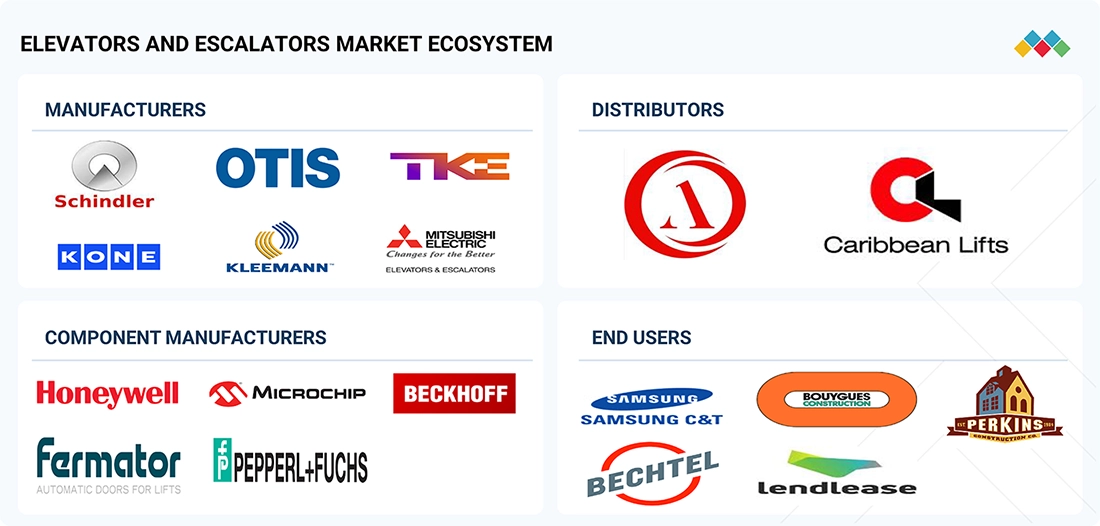
Logos and trademarks shown above are the property of their respective owners. Their use here is for informational and illustrative purposes only.
MARKET SEGMENTS
Source: Secondary Research, Interviews with Experts, MarketsandMarkets Analysis
Elevators and Escalators Market, By Type
Elevators accounted for the largest share of the elevators and escalators market in 2025, because they are used in residential, commercial, institutional, and industrial buildings. As high-rise buildings, such as apartments, office towers, hotels, hospitals, and mixed-use structures, have become more common, the demand for elevators as a vital vertical transportation option has risen dramatically. Moreover, elevators are more accessible and convenient than escalators, making them more suitable for various purposes. The growing modernization and maintenance operations further support the dominance of the elevator segment in the market.
Elevators and Escalators Market, By Elevator Technology
In 2025, traction elevators accounted for the largest segment of the elevators and escalators market because of their efficiency, speed, and suitability in mid and high-rise buildings. These elevators are also driven by ropes and counterweights, using less energy and incurring lower operating costs than hydraulic elevators. They offer superior ride quality, load capacity, and continuous operation, which are suitable for residential, commercial, and infrastructure use. Moreover, the performance and market penetration of traction elevators have been further enhanced by developments such as machine-room-less (MRL) elevators, regenerative drives, and smart control systems.
Elevators and Escalators Market, By Service
In 2025, new installations accounted for the largest share of the elevators and escalators market, owing to the rapid expansion of the residential, commercial, and infrastructure construction industries worldwide. The increasing urbanization and the growing number of high-rise buildings are driving demand for newly installed vertical transportation systems. The growth of this segment is also driven by the significant investments made in smart cities, airports, metro stations, shopping malls, and offices. Also, there is a lot of building work in the developing economies, and therefore a good chance for new installations.
Elevators and Escalators Market, By End-use Industry
Residential accounted for the largest share of the elevators and escalators market in 2025. As demand for modern housing increases, especially in developing countries, the installation of elevators is becoming more common to improve convenience, mobility, and accessibility. Government support for affordable housing projects is also playing a significant role in market growth, alongside smart city projects. Moreover, the rising number of housing units reflects the residential end-use segment, the largest market segment, driven by an aging population and growing emphasis on accessibility in residential buildings.
REGION
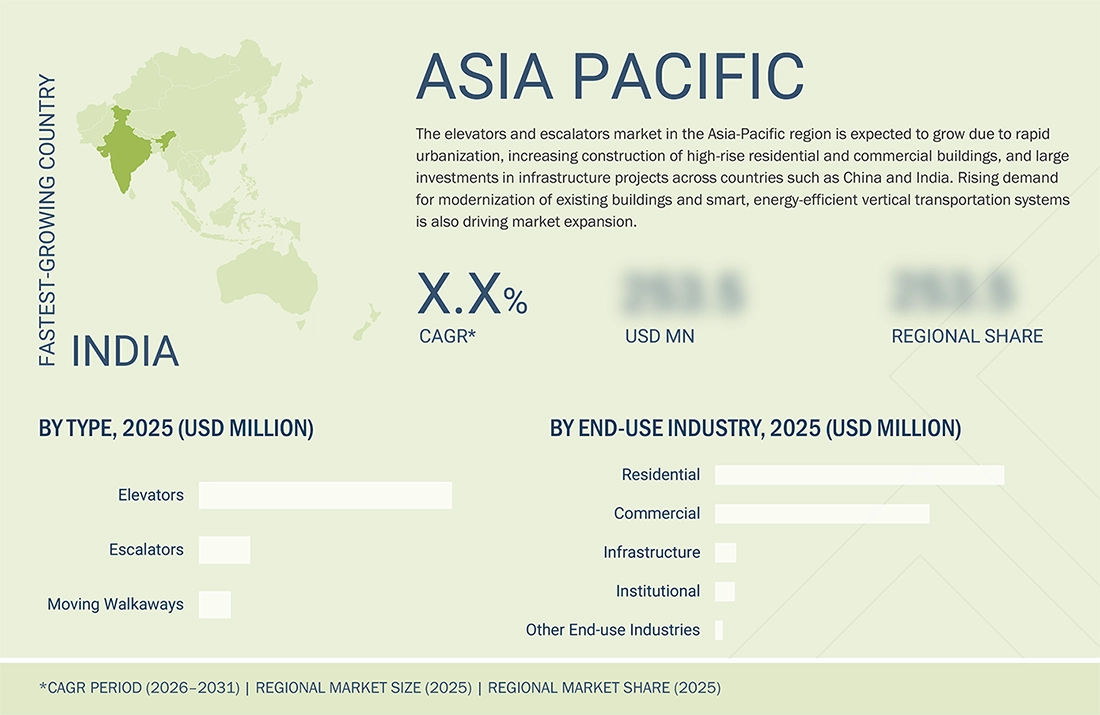
Asia Pacific is leading region in the global elevators and escalators market
By region, Asia Pacific is the leading region in the elevators and escalators market, driven by rapid urbanization and growing populations in countries such as China, India, and Japan, as well as heavy infrastructure development across the region. Vertical transportation systems are being used to support strong demand for the construction of high-rise residential and commercial buildings, as well as large-scale smart city and transportation projects. In addition, the market is being bolstered by the increasing capital expenditure on airports, shopping complexes, metros, and mixed-use developments.
ELEVATORS & ESCALATORS MARKET: COMPANY EVALUATION MATRIX
In the elevators and escalators market matrix, Otis Worldwide Corporation (Star) leads due to its strong global presence, extensive product portfolio, and advanced technological capabilities. Hyundai Elevator Co., Ltd. (Emerging Leader) is gaining visibility due to expanding international footprint, growing investment in smart elevator technologies, and increasing adoption of its solutions in developing markets.
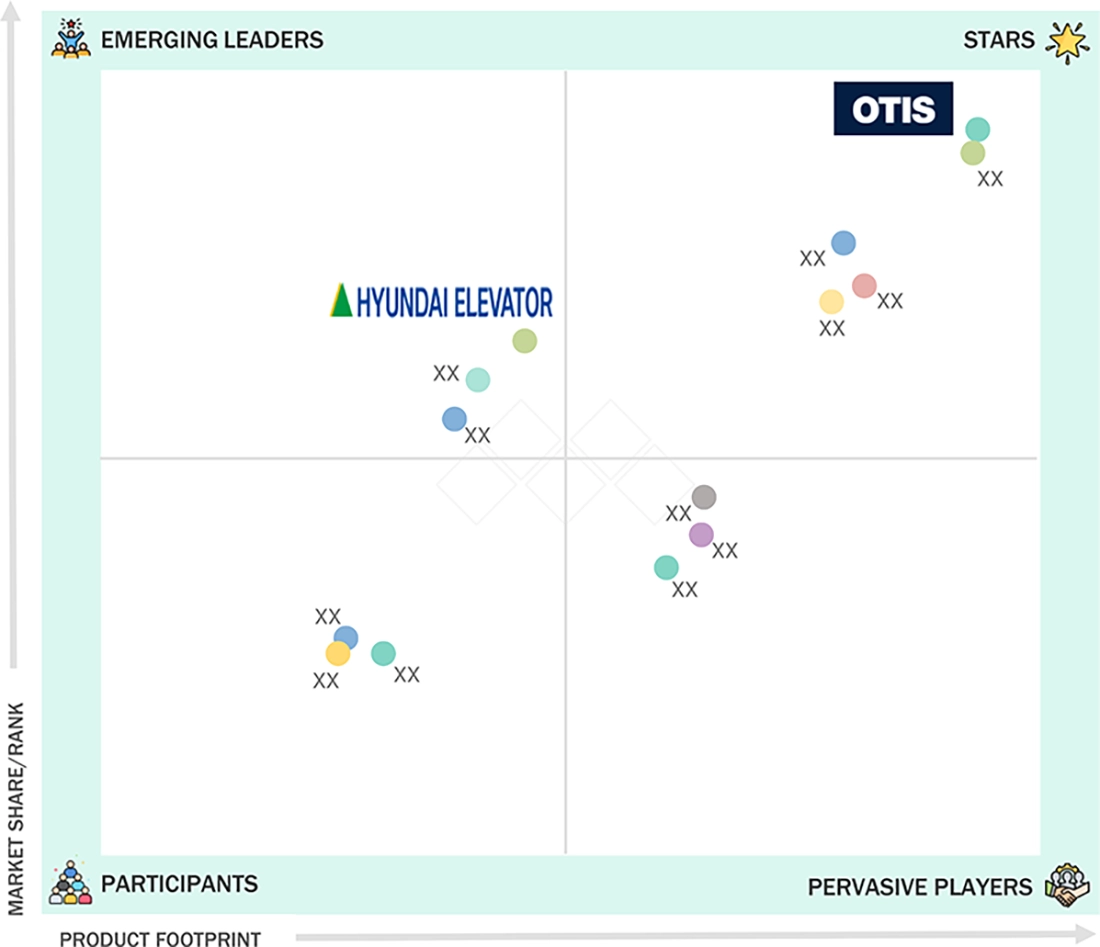
Source: Secondary Research, Interviews with Experts, MarketsandMarkets Analysis
KEY MARKET PLAYERS
- Otis Worldwide Corporation (US)
- Schindler (Switzerland)
- KONE Corporation (Finland)
- Hitachi Ltd. (Japan)
- Hyundai Elevator Co., Ltd. (South Korea)
- FUJITEC CO., LTD. (Japan)
- Toshiba Elevators and Building Systems Corporation (Canada)
- Mitsubishi Electric Corporation (Japan)
- TK Elevator (Germany)
- SJEC Corporation (China)
- Kleemann (Greece)
- Sigma Elevators (India)
- WeMaintain (France)
- Escon Elevators (India)
- ORONA (Spain)
MARKET SCOPE
| REPORT METRIC | DETAILS |
|---|---|
| Market Size in 2025 (Value) | USD 98.11 Billion |
| Market Size in 2026 (Value) | USD 99.77 Billion |
| Market Forecast in 2031 (Value) | USD 114.88 Billion |
| CAGR | 2.9% |
| Years Considered | 2021–2031 |
| Base Year | 2025 |
| Forecast Period | 2026–2031 |
| Units Considered | Value (USD Million/Billion), Volume (Thousand Units) |
| Report Coverage | Revenue forecast, company ranking, competitive landscape, growth factors, and trends |
| Segments Covered |
|
| Regions Covered | North America, Europe, Asia Pacific, South America, and Middle East & Africa |
WHAT IS IN IT FOR YOU: ELEVATORS & ESCALATORS MARKET REPORT CONTENT GUIDE
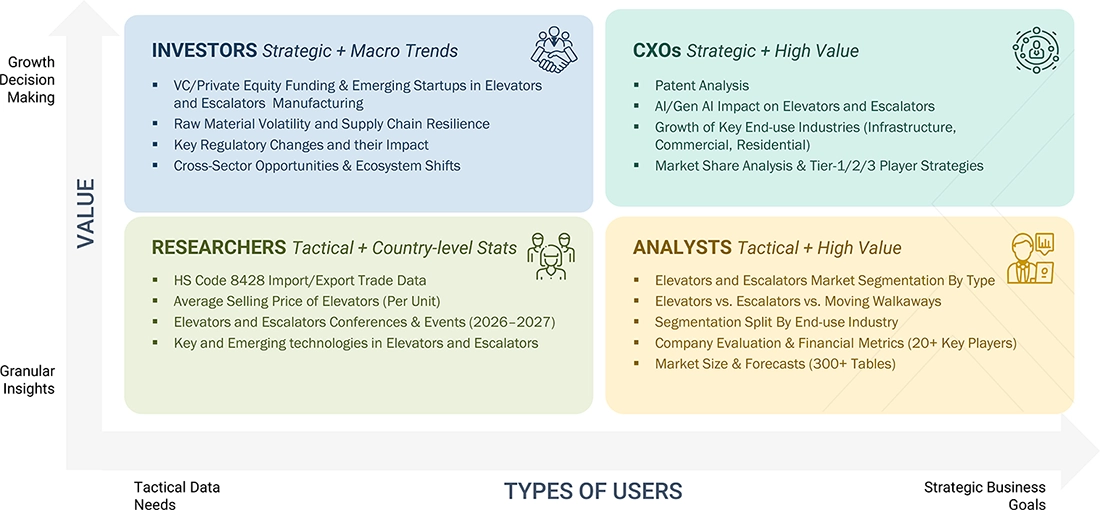
DELIVERED CUSTOMIZATIONS
We have successfully delivered the following deep-dive customizations:
| CLIENT REQUEST | CUSTOMIZATION DELIVERED | VALUE ADDS |
|---|---|---|
| North America-based Elevators and Escalators Market | Detailed company profiles of elevators and escalators market competitors (financials, product portfolios), type (elevators and escalators, and moving walkaways), and end-use industry (residential, commercial, infrastructure, institutional, and other end-use industries) | Identified & profiled 20+ elevator and escalator producers across North America Mapped demand trends across high-growth segments (residential, commercial, infrastructure, institutional, and other end-use industries) |
| Asia Pacific-based Elevators and Escalators Market | Detailed company profiles of elevators and escalators market competitors (financials, product portfolios), type (elevators and escalators, and moving walkaways), and end-use industry (residential, commercial, infrastructure, institutional, and other end-use industries) | Identified & profiled 20+ elevator and escalator producers across Asia Pacific Mapped demand trends across high-growth segments (residential, commercial, infrastructure, institutional, and other end-use industries) |
RECENT DEVELOPMENTS
- 4/1/2026 12:00:00 AM : Otis Worldwide Corporation launched Otis Robust, a new range of heavy-duty elevators designed to meet the growing demand for multi-story data centers and other mission-critical infrastructure, including airports, hospitals, and industrial facilities that require continuous operation in demanding environments.
- 4/1/2026 12:00:00 AM : Otis Worldwide Corporation and WeMaintain announced the completion of an agreement under which Otis will acquire a majority stake in WeMaintain, a rapidly growing technology-driven service provider in the elevator and escalator industry. The acquisition highlights Otis’ ongoing commitment to strengthening its service capabilities and advancing service-related technologies to deliver enhanced solutions and customer experiences.
- 9/1/2025 12:00:00 AM : Schindler signed a Master Services and Supplies Agreement (MSSA) with Accor to provide elevator and escalator installation, modernization, maintenance, and servicing solutions across Accor properties. The agreement covers nine strategic Asian markets, including Cambodia, Hong Kong, Indonesia, Macau, Malaysia, the Philippines, Singapore, Thailand, and Vietnam. The partnership is focused on enhancing guest experiences through innovative technologies and customized service solutions.
Table of Contents
 Exclusive indicates content/data unique to MarketsandMarkets and not available with any competitors.
TITLE
PAGE NO
1
INTRODUCTION
31
2
EXECUTIVE SUMMARY
35
3
PREMIUM INSIGHTS
40
4
MARKET OVERVIEW
Surge in smart, energy-efficient solutions fuels growth amid aging infrastructure and global economic uncertainties.
44
4.1
INTRODUCTION
4.2
MARKET DYNAMICS
4.2.1
DRIVERS
4.2.1.1
INCREASING FOCUS ON ENERGY EFFICIENCY IN BUILDINGS
4.2.1.2
HEALTHCARE INFRASTRUCTURE EXPANSION AND AGING DEMOGRAPHICS
4.2.1.3
INCREASING INVESTMENTS IN SMART CITIES AND INFRASTRUCTURE DEVELOPMENT
4.2.2
RESTRAINTS
4.2.2.1
HIGH MAINTENANCE COST
4.2.2.2
UNCERTAINTY AND RISK REGARDING GLOBAL ECONOMY
4.2.3
OPPORTUNITIES
4.2.3.1
TECHNOLOGICAL ADVANCEMENTS AND INNOVATION
4.2.3.2
ADOPTION OF GREEN BUILDING CODES AND ENERGY-EFFICIENT PRODUCTS
4.2.4
CHALLENGES
4.2.4.1
COMPLIANCE WITH STANDARDS AND REGULATIONS
4.3
UNMET NEEDS AND WHITE SPACES
4.3.1
UNMET NEEDS IN ELEVATORS AND ESCALATORS MARKET
4.3.1.1
GROWING NEED FOR SMART AND PREDICTIVE MAINTENANCE SOLUTIONS
4.3.1.2
NEED FOR COST-EFFECTIVE MODERNIZATION OF AGING ELEVATOR INFRASTRUCTURE
4.3.1.3
LACK OF ACCESSIBILITY-FOCUSED VERTICAL MOBILITY SOLUTIONS IN EXISTING BUILDINGS
4.3.1.4
GROWING DEMAND FOR ENERGY-EFFICIENT AND SUSTAINABLE ELEVATOR SYSTEMS
4.3.2
WHITE SPACE OPPORTUNITIES
4.3.2.1
EXPANSION INTO HIGH-GROWTH EMERGING ECONOMIES
4.3.2.2
GROWTH OPPORTUNITIES IN SMART AND ENERGY-EFFICIENT ELEVATOR SOLUTIONS
4.3.2.3
INCREASING MODERNIZATION AND MAINTENANCE DEMAND IN AGING INFRASTRUCTURE
4.4
INTERCONNECTED MARKETS AND CROSS-SECTOR OPPORTUNITIES
4.4.1
INTERCONNECTED MARKETS
4.4.2
CROSS-SECTOR OPPORTUNITIES
4.5
STRATEGIC MOVES BY TIER 1/2/3 PLAYERS
4.5.1
TIER 1 PLAYERS: GLOBAL LEADERS DRIVING EXPANSION AND PRODUCT INNOVATION
4.5.1.1
OTIS WORLDWIDE CORPORATION ACQUIRES WEMAINTAIN TO STRENGTHEN DIGITAL SERVICE CAPABILITIES
4.5.1.2
SCHINDLER SIGNS MASTER SERVICES AND SUPPLIES AGREEMENT WITH ACCOR TO EXPAND SERVICE FOOTPRINT ACROSS ASIA
4.5.1.3
KONE CORPORATION AND TKE AGREE TO MERGE OPERATIONS THROUGH VERTICAL TOPCO TRANSACTION
5
INDUSTRY TRENDS
Analyze how competitive forces and pricing trends reshape the elevator and escalator market landscape.
57
5.1
PORTER’S FIVE FORCES ANALYSIS
5.1.1
THREAT OF NEW ENTRANTS
5.1.2
THREAT OF SUBSTITUTES
5.1.3
BARGAINING POWER OF SUPPLIERS
5.1.4
BARGAINING POWER OF BUYERS
5.1.5
INTENSITY OF COMPETITIVE RIVALRY
5.2
MACROECONOMIC OUTLOOK
5.2.1
INTRODUCTION
5.2.2
GDP TRENDS AND FORECASTS
5.3
VALUE CHAIN ANALYSIS
5.4
ECOSYSTEM ANALYSIS
5.5
PRICING ANALYSIS
5.5.1
AVERAGE SELLING PRICE RANGE OF ELEVATORS AND ESCALATORS, BY TYPE
5.5.2
RESIDENTIAL ELEVATORS (AVERAGE PRICE RANGE)
5.5.3
FACTORS AFFECTING PRICE OF COMMERCIAL ELEVATORS
5.6
TRADE ANALYSIS
5.6.1
EXPORT SCENARIO (HS CODE 8428)
5.6.2
IMPORT SCENARIO (HS CODE 8428)
5.7
KEY CONFERENCES AND EVENTS, 2026–2027
5.8
TRENDS/DISRUPTIONS IMPACTING CUSTOMER BUSINESS
5.9
INVESTMENT AND FUNDING SCENARIO
5.10
CASE STUDY ANALYSIS
5.10.1
HONEYWELL: CORPORATE OFFICE RENOVATIONS
5.10.2
KONE CORPORATION: 180 BRISBANE COMMERCIAL OFFICES, AUSTRALIA
5.11
IMPACT OF US TARIFFS—ELEVATORS AND ESCALATORS MARKET
5.11.1
INTRODUCTION
5.11.2
KEY TARIFF RATES
5.11.3
PRICE IMPACT ANALYSIS
5.11.4
IMPACT ON KEY COUNTRIES/REGIONS
5.11.4.1
US
5.11.4.2
EUROPE
5.11.4.3
ASIA PACIFIC
5.11.5
IMPACT ON END-USE INDUSTRIES
6
STRATEGIC DISRUPTION THROUGH TECHNOLOGY, PATENTS, DIGITAL, AND AI ADOPTIONS
Harness AI and IoT for pioneering smart, touchless, and adaptive elevator ecosystems.
75
6.1
KEY EMERGING TECHNOLOGIES
6.1.1
INTUITIVE ELEVATOR TECHNOLOGY
6.1.2
CABLE-FREE SMART ELEVATORS
6.2
COMPLEMENTARY TECHNOLOGIES
6.2.1
TOUCHLESS INTERFACE
6.2.2
INTERNET OF THINGS (IOT) AND 5G TECHNOLOGY
6.3
ADJACENT TECHNOLOGIES
6.3.1
AI FOR TRAFFIC MANAGEMENT
6.3.2
AUGMENTED REALITY FOR MAINTENANCE
6.4
TECHNOLOGY/PRODUCT ROADMAP
6.4.1
SHORT-TERM (2025–2027) |SMART CONNECTIVITY AND OPERATIONAL EFFICIENCY PHASE
6.4.2
MID-TERM (2027–2030) | SMART MOBILITY AND DIGITAL ECOSYSTEM EXPANSION
6.4.3
LONG-TERM (2030–2035+) |FULLY CIRCULAR, INTELLIGENT, AND ADAPTIVE PACKAGING SYSTEMS
6.5
PATENT ANALYSIS
6.5.1
INTRODUCTION
6.5.2
METHODOLOGY
6.5.3
ELEVATORS AND ESCALATORS MARKET, PATENT ANALYSIS, 2016–2025
6.6
FUTURE APPLICATIONS
6.6.1
SMART AND INTELLIGENT VERTICAL MOBILITY SYSTEMS
6.7
IMPACT OF AI/GEN AI ON ELEVATORS AND ESCALATORS MARKET
6.7.1
TOP USE CASES AND MARKET POTENTIAL
6.7.2
BEST PRACTICES IN ELEVATORS AND ESCALATORS
6.7.3
CASE STUDIES OF AI IMPLEMENTATION IN ELEVATORS AND ESCALATORS MARKET
6.7.4
INTERCONNECTED ADJACENT ECOSYSTEM AND IMPACT ON MARKET PLAYERS
6.7.5
CLIENTS' READINESS TO ADOPT GENERATIVE AI IN ELEVATORS AND ESCALATORS MARKET
6.8
SUCCESS STORIES AND REAL-WORLD APPLICATIONS
6.8.1
FUJITEC: ADVANCED ELEVATOR AND ESCALATOR SOLUTIONS FOR MODERN COMMERCIAL DEVELOPMENTS
6.8.2
TK ELEVATOR: MODERNIZING VERTICAL MOBILITY AT BAYSHORE HOTEL, DALIAN, CHINA
6.8.3
OTIS: ADVANCED VERTICAL MOBILITY SOLUTIONS FOR MAJOR SPORTS STADIUMS AND ARENAS
6.8.4
SCHINDLER: WUSHAN GODDESS ESCALATOR – WORLD'S LONGEST OUTDOOR ESCALATOR SYSTEM
7
SUSTAINABILITY AND REGULATORY LANDSCAPE
Navigate complex global regulations to enhance sustainability and compliance in elevator technologies.
92
7.1
REGIONAL REGULATIONS AND COMPLIANCE
7.1.1
REGULATORY BODIES, GOVERNMENT AGENCIES, AND OTHER ORGANIZATIONS
7.1.2
INDUSTRY STANDARDS
7.2
SUSTAINABILITY INITIATIVES
7.2.1
KONE STRENGTHENS SUSTAINABILITY LEADERSHIP THROUGH CLIMATE ACTION AND ENERGY-EFFICIENT ELEVATOR TECHNOLOGIES
7.2.2
CARBON IMPACT AND ECO-APPLICATIONS OF ELEVATORS AND ESCALATORS
7.2.2.1
CARBON IMPACT REDUCTION
7.2.2.2
ECO-APPLICATIONS
7.2.3
KONE ADVANCES SUSTAINABILITY THROUGH ENERGY-EFFICIENT ELEVATOR AND ESCALATOR TECHNOLOGIES
7.3
SUSTAINABILITY IMPACT AND REGULATORY POLICY INITIATIVES
7.3.1
REGULATORY COMPLIANCE AND MODERNIZATION IN INDIA
7.3.2
REGULATORY SPOTLIGHT: BUREAU OF INDIAN STANDARDS (BIS)
7.3.3
TK ELEVATOR SUPPORTS SAFE AND COMPLIANT ELEVATOR MODERNIZATION IN INDIA
7.4
CERTIFICATIONS, LABELING, ECO-STANDARDS
8
CUSTOMER LANDSCAPE & BUYER BEHAVIOR
Identify key stakeholders and unmet needs to unlock market profitability and revenue potential.
105
8.1
DECISION-MAKING PROCESS
8.2
KEY STAKEHOLDERS INVOLVED IN BUYING PROCESS AND EVALUATION CRITERIA
8.2.1
KEY STAKEHOLDERS IN BUYING PROCESS
8.2.2
BUYING CRITERIA
8.3
ADOPTION BARRIERS & INTERNAL CHALLENGES
8.4
UNMET NEEDS FROM VARIOUS END-USE INDUSTRIES
8.5
MARKET PROFITABILITY
8.5.1
REVENUE POTENTIAL
8.5.2
COST DYNAMICS
8.6
MARGIN OPPORTUNITIES, BY END-USE INDUSTRY
9
ELEVATORS AND ESCALATORS MARKET, BY TYPE
Market Size & Growth Rate Forecast Analysis to 2031 in USD Million and Units | 4 Data Tables
113
9.1
INTRODUCTION
9.2
ELEVATORS
9.2.1
DEVELOPMENT OF NEW RESIDENTIAL AND COMMERCIAL PROJECTS
9.2.2
PASSENGER ELEVATORS
9.2.2.1
BED ELEVATORS
9.2.2.2
SERVICE ELEVATORS
9.2.2.3
OBSERVATION ELEVATORS
9.2.2.4
RESIDENTIAL ELEVATORS
9.2.3
FREIGHT ELEVATORS
9.2.3.1
DUMBWAITERS
9.2.3.2
VEHICLE ELEVATORS
9.2.4
OTHER ELEVATOR TYPES
9.3
ESCALATORS
9.3.1
RISING URBANIZATION AND COMMERCIAL DEVELOPMENT
9.4
MOVING WALKWAYS
9.4.1
INCREASING NUMBER OF AIRPORTS AND SHOPPING MALLS
10
ELEVATORS AND ESCALATORS MARKET, BY ELEVATOR TECHNOLOGY
Market Size & Growth Rate Forecast Analysis to 2031 in USD Million and Units | 4 Data Tables
119
10.1
INTRODUCTION
10.2
TRACTION ELEVATORS
10.2.1
LIGHTWEIGHT PROPERTY TO DRIVE MARKET
10.3
MACHINE-ROOM-LESS TRACTION ELEVATORS
10.3.1
COST-EFFECTIVENESS AND SUPERIOR PERFORMANCE OF TECHNOLOGY TO DRIVE MARKET
10.4
HYDRAULIC ELEVATORS
10.4.1
TECHNICAL SPECIALTIES OF TECHNOLOGY TO DRIVE MARKET
11
ELEVATORS AND ESCALATORS MARKET, BY SERVICE
Market Size & Growth Rate Forecast Analysis to 2031 in USD Million and Units | 4 Data Tables
124
11.1
INTRODUCTION
11.2
NEW INSTALLATION
11.2.1
RISING CONSTRUCTION ACTIVITIES TO DRIVE MARKET
11.3
MAINTENANCE & REPAIR
11.3.1
GROWING CONCERNS REGARDING AGING ELEVATORS TO DRIVE MARKET
11.4
MODERNIZATION
11.4.1
NEED TO REPLACE AGING AND OBSOLETE SYSTEMS TO DRIVE MARKET
12
ELEVATORS AND ESCALATORS MARKET, BY END-USE INDUSTRY
Market Size & Growth Rate Forecast Analysis to 2031 in USD Million and Units | 4 Data Tables
128
12.1
INTRODUCTION
12.2
RESIDENTIAL
12.2.1
GROWTH IN HIGH-RISE RESIDENTIAL BUILDING CONSTRUCTION TO DRIVE MARKET
12.3
COMMERCIAL
12.3.1
NEED TO OPTIMIZE TRAFFIC FLOW IN ELEVATORS IN COMMERCIAL SPACES TO DRIVE MARKET
12.4
INSTITUTIONAL
12.4.1
RISING DEMAND FOR NEW INSTITUTIONS TO DRIVE MARKET
12.5
INFRASTRUCTURE
12.5.1
RAPID URBANIZATION TO DRIVE MARKET
12.6
OTHER END-USE INDUSTRIES
13
ELEVATORS AND ESCALATORS MARKET, BY REGION
Comprehensive coverage of 8 Regions with country-level deep-dive of 16 Countries | 240 Data Tables.
134
13.1
INTRODUCTION
13.2
ASIA PACIFIC
13.2.1
CHINA
13.2.1.1
LARGE-SCALE URBAN RENEWAL AND RESIDENTIAL COMMUNITY RENOVATION PROGRAMS
13.2.2
JAPAN
13.2.2.1
RISING INVESTMENTS IN EARTHQUAKE-RESISTANT AND DISASTER-RESILIENT VERTICAL TRANSPORTATION SYSTEMS
13.2.3
INDIA
13.2.3.1
RAPID URBANIZATION AND EXPANSION OF RESIDENTIAL REAL ESTATE
13.2.4
SOUTH KOREA
13.2.4.1
MODERNIZATION OF AGING BUILDINGS
13.2.5
REST OF ASIA PACIFIC
13.3
NORTH AMERICA
13.3.1
US
13.3.1.1
INCREASE IN INFRASTRUCTURE DEVELOPMENT PROJECTS
13.3.2
CANADA
13.3.2.1
GROWTH OF AGING POPULATION TO DRIVE MARKET
13.3.3
MEXICO
13.3.3.1
BOOMING TOURISM INDUSTRY TO SUPPORT MARKET GROWTH
13.4
EUROPE
13.4.1
GERMANY
13.4.1.1
EMPHASIS ON MODERNIZATION, INFRASTRUCTURE DEVELOPMENT, AND STRINGENT SAFETY STANDARDS
13.4.2
FRANCE
13.4.2.1
REGULATORY FRAMEWORKS AND ARCHITECTURAL NEEDS TO DRIVE DEMAND
13.4.3
UK
13.4.3.1
DEVELOPMENT OF SMART CITIES AND NEW TECHNOLOGIES
13.4.4
ITALY
13.4.4.1
TOURISM AND HOSPITALITY SECTOR EXPANSION
13.4.5
SPAIN
13.4.5.1
GOVERNMENT REGULATIONS AND SAFETY STANDARDS GOVERNING CONSTRUCTION AND REAL ESTATE SECTORS
13.4.6
REST OF EUROPE
13.5
MIDDLE EAST & AFRICA
13.5.1
GCC COUNTRIES
13.5.1.1
SAUDI ARABIA
13.5.1.1.1
VISION 2030 MEGA PROJECTS TO DRIVE MARKET
13.5.1.2
UAE
13.5.1.2.1
INDUSTRIAL GROWTH AND RISE IN TOURISM
13.5.1.3
REST OF GCC COUNTRIES
13.5.2
REST OF MIDDLE EAST & AFRICA
13.6
SOUTH AMERICA
13.6.1
BRAZIL
13.6.1.1
RAPID URBANIZATION AND VERTICAL HOUSING DEVELOPMENT
13.6.2
ARGENTINA
13.6.2.1
INCREASE IN ENERGY-EFFICIENT BUILDING RENOVATIONS
13.6.3
REST OF SOUTH AMERICA
14
COMPETITIVE LANDSCAPE
Uncover strategic moves and market positions shaping dominant and emerging players' competitive edges.
228
14.1
OVERVIEW
14.2
KEY PLAYERS’ STRATEGIES/RIGHT TO WIN, 2021–2026
14.3
REVENUE ANALYSIS, 2021–2025
14.4
MARKET SHARE ANALYSIS, 2025
14.5
COMPANY VALUATION AND FINANCIAL METRICS
14.6
BRAND/PRODUCT COMPARISON
14.7
COMPANY EVALUATION MATRIX: KEY PLAYERS, 2025
14.7.1
STARS
14.7.2
EMERGING LEADERS
14.7.3
PERVASIVE PLAYERS
14.7.4
PARTICIPANTS
14.7.5
COMPANY FOOTPRINT: KEY PLAYERS, 2025
14.7.5.1
COMPANY FOOTPRINT
14.7.5.2
REGION FOOTPRINT
14.7.5.3
TYPE FOOTPRINT
14.7.5.4
ELEVATOR TECHNOLOGY FOOTPRINT
14.7.5.5
SERVICE FOOTPRINT
14.7.5.6
END-USE INDUSTRY FOOTPRINT
14.8
COMPANY EVALUATION MATRIX: STARTUPS/SMES, 2025
14.8.1
PROGRESSIVE COMPANIES
14.8.2
RESPONSIVE COMPANIES
14.8.3
DYNAMIC COMPANIES
14.8.4
STARTING BLOCKS
14.8.5
COMPETITIVE BENCHMARKING: STARTUPS/SMES, 2025
14.8.5.1
DETAILED LIST OF KEY STARTUPS/SMES
14.8.6
COMPETITIVE BENCHMARKING OF KEY STARTUPS/SMES
14.9
COMPETITIVE SCENARIO
14.9.1
PRODUCT LAUNCHES/DEVELOPMENTS
14.9.2
DEALS
14.9.3
EXPANSIONS
14.9.4
OTHER DEVELOPMENTS
15
COMPANY PROFILES
In-depth Company Profiles of Leading Market Players with detailed Business Overview, Product and Service Portfolio, Recent Developments, and Unique Analyst Perspective (MnM View)
264
15.1
KEY PLAYERS
15.1.1
OTIS WORLDWIDE CORPORATION
15.1.1.1
BUSINESS OVERVIEW
15.1.1.2
PRODUCTS/SOLUTIONS/SERVICES OFFERED
15.1.1.3
RECENT DEVELOPMENTS
15.1.1.3.1
PRODUCT LAUNCHES
15.1.1.3.2
DEALS
15.1.1.3.3
EXPANSIONS
15.1.1.3.4
OTHERS
15.1.1.4
MNM VIEW
15.1.1.4.1
KEY STRENGTHS
15.1.1.4.2
STRATEGIC CHOICES
15.1.1.4.3
WEAKNESSES AND COMPETITIVE THREATS
15.1.2
SCHINDLER
15.1.3
KONE CORPORATION
15.1.4
HITACHI, LTD.
15.1.5
HYUNDAI ELEVATOR CO., LTD.
15.1.6
FUJITEC CO., LTD.
15.1.7
TOSHIBA ELEVATORS AND BUILDING SYSTEMS CORPORATION
15.1.8
MITSUBISHI ELECTRIC CORPORATION
15.1.9
TK ELEVATOR
15.1.10
SJEC CORPORATION
15.2
OTHER PLAYERS
15.2.1
KLEEMANN
15.2.2
SIGMA ELEVATORS
15.2.3
WEMAINTAIN
15.2.4
ESCON ELEVATORS
15.2.5
SHENYANG YUANDA INTELLECTUAL INDUSTRY GROUP CO., LTD.
15.2.6
ORONA
15.2.7
EITA ELEVATOR
15.2.8
GLARIE ELEVATOR
15.2.9
AARON INDUSTRIES LTD.
15.2.10
LEO ELEVATORS
15.2.11
TRIO ELEVATORS CO (INDIA) PRIVATE LIMITED
15.2.12
STANNAH GROUP
15.2.13
CIBES LIFT
15.2.14
WALTON GROUP
15.2.15
EXPEDITE AUTOMATION LLP
15.2.16
LIFT AI VENTURES INC.
16
RESEARCH METHODOLOGY
334
16.1
RESEARCH DATA
16.1.1
SECONDARY DATA
16.1.1.1
KEY DATA FROM SECONDARY SOURCES
16.1.2
PRIMARY DATA
16.1.2.1
KEY DATA FROM PRIMARY SOURCES
16.2
MARKET SIZE ESTIMATION
16.3
DATA TRIANGULATION
16.4
RESEARCH ASSUMPTIONS
16.5
RISK ASSESSMENT
16.6
GROWTH RATE ASSUMPTIONS
17
APPENDIX
341
17.1
KNOWLEDGESTORE: MARKETSANDMARKETS’ SUBSCRIPTION PORTAL
17.2
CUSTOMIZATION OPTIONS
17.3
RELATED REPORTS
17.4
AUTHOR DETAILS
LIST OF TABLES
TABLE 1
ELEVATORS AND ESCALATORS MARKET: PORTER’S FIVE FORCES ANALYSIS
TABLE 2
GLOBAL GDP GROWTH PROJECTION, BY REGION, 2021–2028 (USD TRILLION)
TABLE 3
ELEVATORS AND ESCALATORS MARKET: ROLES OF COMPANIES IN ECOSYSTEM
TABLE 4
AVERAGE SELLING PRICE OF ELEVATORS, BY TYPE (PER UNIT)
TABLE 5
EXPORT DATA FOR HS CODE 8428-COMPLIANT PRODUCTS, BY COUNTRY, 2021–2025 (USD MILLION)
TABLE 6
IMPORT DATA FOR HS CODE 8428-COMPLIANT PRODUCTS, BY COUNTRY, 2021–2025 (USD MILLION)
TABLE 7
ELEVATORS AND ESCALATORS MARKET: DETAILED LIST OF CONFERENCES AND EVENTS, 2026–2027
TABLE 8
ELEVATORS AND ESCALATORS MARKET: LIST OF KEY PATENTS, 2025
TABLE 9
TOP USE CASES AND MARKET POTENTIAL
TABLE 10
BEST PRACTICES: COMPANIES IMPLEMENTING USE CASES
TABLE 11
ELEVATORS AND ESCALATORS MARKET: CASE STUDIES RELATED TO GEN AI IMPLEMENTATION
TABLE 12
NORTH AMERICA: REGULATORY BODIES, GOVERNMENT AGENCIES, AND OTHER ORGANIZATIONS
TABLE 13
EUROPE: REGULATORY BODIES, GOVERNMENT AGENCIES, AND OTHER ORGANIZATIONS
TABLE 14
ASIA PACIFIC: REGULATORY BODIES, GOVERNMENT AGENCIES, AND OTHER ORGANIZATIONS
TABLE 15
ROW: REGULATORY BODIES, GOVERNMENT AGENCIES, AND OTHER ORGANIZATIONS
TABLE 16
GLOBAL INDUSTRY STANDARDS IN ELEVATORS AND ESCALATORS MARKET
TABLE 17
CERTIFICATIONS, LABELING, ECO-STANDARDS IN ELEVATORS AND ESCALATORS MARKET
TABLE 18
INFLUENCE OF STAKEHOLDERS ON BUYING PROCESS, BY END-USE INDUSTRY (%)
TABLE 19
KEY BUYING CRITERIA, BY END-USE INDUSTRY
TABLE 20
UNMET NEEDS IN ELEVATORS AND ESCALATORS MARKET, BY END-USE INDUSTRY
TABLE 21
ELEVATORS AND ESCALATORS MARKET, BY TYPE, 2021–2023 (USD MILLION)
TABLE 22
ELEVATORS AND ESCALATORS MARKET, BY TYPE, 2024–2031 (USD MILLION)
TABLE 23
ELEVATORS AND ESCALATORS MARKET, BY TYPE, 2021–2023 (THOUSAND UNITS)
TABLE 24
ELEVATORS AND ESCALATORS MARKET, BY TYPE, 2024–2031 (THOUSAND UNITS)
TABLE 25
ELEVATORS AND ESCALATORS MARKET, BY ELEVATOR TECHNOLOGY, 2021–2023 (USD MILLION)
TABLE 26
ELEVATORS AND ESCALATORS MARKET, BY ELEVATOR TECHNOLOGY, 2024–2031 (USD MILLION)
TABLE 27
ELEVATORS AND ESCALATORS MARKET, BY ELEVATOR TECHNOLOGY, 2021–2023 (THOUSAND UNITS)
TABLE 28
ELEVATORS AND ESCALATORS MARKET, BY ELEVATOR TECHNOLOGY, 2024–2031 (THOUSAND UNITS)
TABLE 29
ELEVATORS AND ESCALATORS MARKET, BY SERVICE, 2021–2023 (USD MILLION)
TABLE 30
ELEVATORS AND ESCALATORS MARKET, BY SERVICE, 2024–2031 (USD MILLION)
TABLE 31
ELEVATORS AND ESCALATORS MARKET, BY SERVICE, 2021–2023 (THOUSAND UNITS)
TABLE 32
ELEVATORS AND ESCALATORS MARKET, BY SERVICE, 2024–2031 (THOUSAND UNITS)
TABLE 33
ELEVATORS AND ESCALATORS MARKET, BY END-USE INDUSTRY, 2021–2023 (USD MILLION)
TABLE 34
ELEVATORS AND ESCALATORS MARKET, BY END-USE INDUSTRY, 2024–2031 (USD MILLION)
TABLE 35
ELEVATORS AND ESCALATORS MARKET, BY END-USE INDUSTRY, 2021–2023 (THOUSAND UNITS)
TABLE 36
ELEVATORS AND ESCALATORS MARKET, BY END-USE INDUSTRY, 2024–2031 (THOUSAND UNITS)
TABLE 37
ELEVATORS AND ESCALATORS MARKET, BY REGION, 2021–2023 (USD MILLION)
TABLE 38
ELEVATORS AND ESCALATORS MARKET, BY REGION, 2024–2031 (USD MILLION)
TABLE 39
ELEVATORS AND ESCALATORS MARKET, BY REGION, 2021–2023 (THOUSAND UNITS)
TABLE 40
ELEVATORS AND ESCALATORS MARKET, BY REGION, 2024–2031 (THOUSAND UNITS)
TABLE 41
ASIA PACIFIC: ELEVATORS AND ESCALATORS MARKET, BY COUNTRY, 2021–2023 (USD MILLION)
TABLE 42
ASIA PACIFIC: ELEVATORS AND ESCALATORS MARKET, BY COUNTRY, 2024–2031 (USD MILLION)
TABLE 43
ASIA PACIFIC: ELEVATORS AND ESCALATORS MARKET, BY COUNTRY, 2021–2023 (THOUSAND UNITS)
TABLE 44
ASIA PACIFIC: ELEVATORS AND ESCALATORS MARKET, BY COUNTRY, 2024–2031 (THOUSAND UNITS)
TABLE 45
ASIA PACIFIC: ELEVATORS AND ESCALATORS MARKET, BY TYPE, 2021–2023 (USD MILLION)
TABLE 46
ASIA PACIFIC: ELEVATORS AND ESCALATORS MARKET, BY TYPE, 2024–2031 (USD MILLION)
TABLE 47
ASIA PACIFIC: ELEVATORS AND ESCALATORS MARKET, BY TYPE, 2021–2023 (THOUSAND UNITS)
TABLE 48
ASIA PACIFIC: ELEVATORS AND ESCALATORS MARKET, BY TYPE, 2024–2031 (THOUSAND UNITS)
TABLE 49
ASIA PACIFIC: ELEVATORS AND ESCALATORS MARKET, BY END-USE INDUSTRY, 2021–2023 (USD MILLION)
TABLE 50
ASIA PACIFIC: ELEVATORS AND ESCALATORS MARKET, BY END-USE INDUSTRY, 2024–2031 (USD MILLION)
TABLE 51
ASIA PACIFIC: ELEVATORS AND ESCALATORS MARKET, BY END-USE INDUSTRY, 2021–2023 (THOUSAND UNITS)
TABLE 52
ASIA PACIFIC: ELEVATORS AND ESCALATORS MARKET, BY END-USE INDUSTRY, 2024–2031 (THOUSAND UNITS)
TABLE 53
CHINA: ELEVATORS AND ESCALATORS MARKET, BY TYPE, 2021–2023 (USD MILLION)
TABLE 54
CHINA: ELEVATORS AND ESCALATORS MARKET, BY TYPE, 2024–2031 (USD MILLION)
TABLE 55
CHINA: ELEVATORS AND ESCALATORS MARKET, BY TYPE, 2021–2023 (THOUSAND UNITS)
TABLE 56
CHINA: ELEVATORS AND ESCALATORS MARKET, BY TYPE, 2024–2031 (THOUSAND UNITS)
TABLE 57
CHINA: ELEVATORS AND ESCALATORS MARKET, BY END-USE INDUSTRY, 2021–2023 (USD MILLION)
TABLE 58
CHINA: ELEVATORS AND ESCALATORS MARKET, BY END-USE INDUSTRY, 2024–2031 (USD MILLION)
TABLE 59
CHINA: ELEVATORS AND ESCALATORS MARKET, BY END-USE INDUSTRY, 2021–2023 (THOUSAND UNITS)
TABLE 60
CHINA: ELEVATORS AND ESCALATORS MARKET, BY END-USE INDUSTRY, 2024–2031 (THOUSAND UNITS)
TABLE 61
JAPAN: ELEVATORS AND ESCALATORS MARKET, BY TYPE, 2021–2023 (USD MILLION)
TABLE 62
JAPAN: ELEVATORS AND ESCALATORS MARKET, BY TYPE, 2024–2031 (USD MILLION)
TABLE 63
JAPAN: ELEVATORS AND ESCALATORS MARKET, BY TYPE, 2021–2023 (THOUSAND UNITS)
TABLE 64
JAPAN: ELEVATORS AND ESCALATORS MARKET, BY TYPE, 2024–2031 (THOUSAND UNITS)
TABLE 65
JAPAN: ELEVATORS AND ESCALATORS MARKET, BY END-USE INDUSTRY, 2021–2023 (USD MILLION)
TABLE 66
JAPAN: ELEVATORS AND ESCALATORS MARKET, BY END-USE INDUSTRY, 2024–2031 (USD MILLION)
TABLE 67
JAPAN: ELEVATORS AND ESCALATORS MARKET, BY END-USE INDUSTRY, 2021–2023 (THOUSAND UNITS)
TABLE 68
JAPAN: ELEVATORS AND ESCALATORS MARKET, BY END-USE INDUSTRY, 2024–2031 (THOUSAND UNITS)
TABLE 69
INDIA: ELEVATORS AND ESCALATORS MARKET, BY TYPE, 2021–2023 (USD MILLION)
TABLE 70
INDIA: ELEVATORS AND ESCALATORS MARKET, BY TYPE, 2024–2031 (USD MILLION)
TABLE 71
INDIA: ELEVATORS AND ESCALATORS MARKET, BY TYPE, 2021–2023 (THOUSAND UNITS)
TABLE 72
INDIA: ELEVATORS AND ESCALATORS MARKET, BY TYPE, 2024–2031 (THOUSAND UNITS)
TABLE 73
INDIA: ELEVATORS AND ESCALATORS MARKET, BY END-USE INDUSTRY, 2021–2023 (USD MILLION)
TABLE 74
INDIA: ELEVATORS AND ESCALATORS MARKET, BY END-USE INDUSTRY, 2024–2031 (USD MILLION)
TABLE 75
INDIA: ELEVATORS AND ESCALATORS MARKET, BY END-USE INDUSTRY, 2021–2023 (THOUSAND UNITS)
TABLE 76
INDIA: ELEVATORS AND ESCALATORS MARKET, BY END-USE INDUSTRY, 2024–2031 (THOUSAND UNITS)
TABLE 77
SOUTH KOREA: ELEVATORS AND ESCALATORS MARKET, BY TYPE, 2021–2023 (USD MILLION)
TABLE 78
SOUTH KOREA: ELEVATORS AND ESCALATORS MARKET, BY TYPE, 2024–2031 (USD MILLION)
TABLE 79
SOUTH KOREA: ELEVATORS AND ESCALATORS MARKET, BY TYPE, 2021–2023 (THOUSAND UNITS)
TABLE 80
SOUTH KOREA: ELEVATORS AND ESCALATORS MARKET, BY TYPE, 2024–2031 (THOUSAND UNITS)
TABLE 81
SOUTH KOREA: ELEVATORS AND ESCALATORS MARKET, BY END-USE INDUSTRY, 2021–2023 (USD MILLION)
TABLE 82
SOUTH KOREA: ELEVATORS AND ESCALATORS MARKET, BY END-USE INDUSTRY, 2024–2031 (USD MILLION)
TABLE 83
SOUTH KOREA: ELEVATORS AND ESCALATORS MARKET, BY END-USE INDUSTRY, 2021–2023 (THOUSAND UNITS)
TABLE 84
SOUTH KOREA: ELEVATORS AND ESCALATORS MARKET, BY END-USE INDUSTRY, 2024–2031 (THOUSAND UNITS)
TABLE 85
REST OF ASIA PACIFIC: ELEVATORS AND ESCALATORS MARKET, BY TYPE, 2021–2023 (USD MILLION)
TABLE 86
REST OF ASIA PACIFIC: ELEVATORS AND ESCALATORS MARKET, BY TYPE, 2024–2031 (USD MILLION)
TABLE 87
REST OF ASIA PACIFIC: ELEVATORS AND ESCALATORS MARKET, BY TYPE, 2021–2023 (THOUSAND UNITS)
TABLE 88
REST OF ASIA PACIFIC: ELEVATORS AND ESCALATORS MARKET, BY TYPE, 2024–2031 (THOUSAND UNITS)
TABLE 89
REST OF ASIA PACIFIC: ELEVATORS AND ESCALATORS MARKET, BY END-USE INDUSTRY, 2021–2023 (USD MILLION)
TABLE 90
REST OF ASIA PACIFIC: ELEVATORS AND ESCALATORS MARKET, BY END-USE INDUSTRY, 2024–2031 (USD MILLION)
TABLE 91
REST OF ASIA PACIFIC: ELEVATORS AND ESCALATORS MARKET, BY END-USE INDUSTRY, 2021–2023 (THOUSAND UNITS)
TABLE 92
REST OF ASIA PACIFIC: ELEVATORS AND ESCALATORS MARKET, BY END-USE INDUSTRY, 2024–2031 (THOUSAND UNITS)
TABLE 93
NORTH AMERICA: ELEVATORS AND ESCALATORS MARKET, BY COUNTRY, 2021–2023 (USD MILLION)
TABLE 94
NORTH AMERICA: ELEVATORS AND ESCALATORS MARKET, BY COUNTRY, 2024–2031 (USD MILLION)
TABLE 95
NORTH AMERICA: ELEVATORS AND ESCALATORS MARKET, BY COUNTRY, 2021–2023 (THOUSAND UNITS)
TABLE 96
NORTH AMERICA: ELEVATORS AND ESCALATORS MARKET, BY COUNTRY, 2024–2031 (THOUSAND UNITS)
TABLE 97
NORTH AMERICA: ELEVATORS AND ESCALATORS MARKET, BY TYPE, 2021–2023 (USD MILLION)
TABLE 98
NORTH AMERICA: ELEVATORS AND ESCALATORS MARKET, BY TYPE, 2024–2031 (USD MILLION)
TABLE 99
NORTH AMERICA: ELEVATORS AND ESCALATORS MARKET, BY TYPE, 2021–2023 (THOUSAND UNITS)
TABLE 100
NORTH AMERICA: ELEVATORS AND ESCALATORS MARKET, BY TYPE, 2024–2031 (THOUSAND UNITS)
TABLE 101
NORTH AMERICA: ELEVATORS AND ESCALATORS MARKET, BY END-USE INDUSTRY, 2021–2023 (USD MILLION)
TABLE 102
NORTH AMERICA: ELEVATORS AND ESCALATORS MARKET, BY END-USE INDUSTRY, 2024–2031 (USD MILLION)
TABLE 103
NORTH AMERICA: ELEVATORS AND ESCALATORS MARKET, BY END-USE INDUSTRY, 2021–2023 (THOUSAND UNITS)
TABLE 104
NORTH AMERICA: ELEVATORS AND ESCALATORS MARKET, BY END-USE INDUSTRY, 2024–2031 (THOUSAND UNITS)
TABLE 105
US: ELEVATORS AND ESCALATORS MARKET, BY TYPE, 2021–2023 (USD MILLION)
TABLE 106
US: ELEVATORS AND ESCALATORS MARKET, BY TYPE, 2024–2031 (USD MILLION)
TABLE 107
US: ELEVATORS AND ESCALATORS MARKET, BY TYPE, 2021–2023 (THOUSAND UNITS)
TABLE 108
US: ELEVATORS AND ESCALATORS MARKET, BY TYPE, 2024–2031 (THOUSAND UNITS)
TABLE 109
US: ELEVATORS AND ESCALATORS MARKET, BY END-USE INDUSTRY, 2021–2023 (USD MILLION)
TABLE 110
US: ELEVATORS AND ESCALATORS MARKET, BY END-USE INDUSTRY, 2024–2031 (USD MILLION)
TABLE 111
US: ELEVATORS AND ESCALATORS MARKET, BY END-USE INDUSTRY, 2021–2023 (THOUSAND UNITS)
TABLE 112
US: ELEVATORS AND ESCALATORS MARKET, BY END-USE INDUSTRY, 2024–2031 (THOUSAND UNITS)
TABLE 113
CANADA: ELEVATORS AND ESCALATORS MARKET, BY TYPE, 2021–2023 (USD MILLION)
TABLE 114
CANADA: ELEVATORS AND ESCALATORS MARKET, BY TYPE, 2024–2031 (USD MILLION)
TABLE 115
CANADA: ELEVATORS AND ESCALATORS MARKET, BY TYPE, 2021–2023 (THOUSAND UNITS)
TABLE 116
CANADA: ELEVATORS AND ESCALATORS MARKET, BY TYPE, 2024–2031 (THOUSAND UNITS)
TABLE 117
CANADA: ELEVATORS AND ESCALATORS MARKET, BY END-USE INDUSTRY, 2021–2023 (USD MILLION)
TABLE 118
CANADA: ELEVATORS AND ESCALATORS MARKET, BY END-USE INDUSTRY, 2024–2031 (USD MILLION)
TABLE 119
CANADA: ELEVATORS AND ESCALATORS MARKET, BY END-USE INDUSTRY, 2021–2023 (THOUSAND UNITS)
TABLE 120
CANADA: ELEVATORS AND ESCALATORS MARKET, BY END-USE INDUSTRY, 2024–2031 (THOUSAND UNITS)
TABLE 121
MEXICO: ELEVATORS AND ESCALATORS MARKET, BY TYPE, 2021–2023 (USD MILLION)
TABLE 122
MEXICO: ELEVATORS AND ESCALATORS MARKET, BY TYPE, 2024–2031 (USD MILLION)
TABLE 123
MEXICO: ELEVATORS AND ESCALATORS MARKET, BY TYPE, 2021–2023 (THOUSAND UNITS)
TABLE 124
MEXICO: ELEVATORS AND ESCALATORS MARKET, BY TYPE, 2024–2031 (THOUSAND UNITS)
TABLE 125
MEXICO: ELEVATORS AND ESCALATORS MARKET, BY END-USE INDUSTRY, 2021–2023 (USD MILLION)
TABLE 126
MEXICO: ELEVATORS AND ESCALATORS MARKET, BY END-USE INDUSTRY, 2024–2031 (USD MILLION)
TABLE 127
MEXICO: ELEVATORS AND ESCALATORS MARKET, BY END-USE INDUSTRY, 2021–2023 (THOUSAND UNITS)
TABLE 128
MEXICO: ELEVATORS AND ESCALATORS MARKET, BY END-USE INDUSTRY, 2024–2031 (THOUSAND UNITS)
TABLE 129
EUROPE: ELEVATORS AND ESCALATORS MARKET, BY COUNTRY, 2021–2023 (USD MILLION)
TABLE 130
EUROPE: ELEVATORS AND ESCALATORS MARKET, BY COUNTRY, 2024–2031 (USD MILLION)
TABLE 131
EUROPE: ELEVATORS AND ESCALATORS MARKET, BY COUNTRY, 2021–2023 (THOUSAND UNITS)
TABLE 132
EUROPE: ELEVATORS AND ESCALATORS MARKET, BY COUNTRY, 2024–2031 (THOUSAND UNITS)
TABLE 133
EUROPE: ELEVATORS AND ESCALATORS MARKET, BY TYPE, 2021–2023 (USD MILLION)
TABLE 134
EUROPE: ELEVATORS AND ESCALATORS MARKET, BY TYPE, 2024–2031 (USD MILLION)
TABLE 135
EUROPE: ELEVATORS AND ESCALATORS MARKET, BY TYPE, 2021–2023 (THOUSAND UNITS)
TABLE 136
EUROPE: ELEVATORS AND ESCALATORS MARKET, BY TYPE, 2024–2031 (THOUSAND UNITS)
TABLE 137
EUROPE: ELEVATORS AND ESCALATORS MARKET, BY END-USE INDUSTRY, 2021–2023 (USD MILLION)
TABLE 138
EUROPE: ELEVATORS AND ESCALATORS MARKET, BY END-USE INDUSTRY, 2024–2031 (USD MILLION)
TABLE 139
EUROPE: ELEVATORS AND ESCALATORS MARKET, BY END-USE INDUSTRY, 2021–2023 (THOUSAND UNITS)
TABLE 140
EUROPE: ELEVATORS AND ESCALATORS MARKET, BY END-USE INDUSTRY, 2024–2031 (THOUSAND UNITS)
TABLE 141
GERMANY: ELEVATORS AND ESCALATORS MARKET, BY TYPE, 2021–2023 (USD MILLION)
TABLE 142
GERMANY: ELEVATORS AND ESCALATORS MARKET, BY TYPE, 2024–2031 (USD MILLION)
TABLE 143
GERMANY: ELEVATORS AND ESCALATORS MARKET, BY TYPE, 2021–2023 (THOUSAND UNITS)
TABLE 144
GERMANY: ELEVATORS AND ESCALATORS MARKET, BY TYPE, 2024–2031 (THOUSAND UNITS)
TABLE 145
GERMANY: ELEVATORS AND ESCALATORS MARKET, BY END-USE INDUSTRY, 2021–2023 (USD MILLION)
TABLE 146
GERMANY: ELEVATORS AND ESCALATORS MARKET, BY END-USE INDUSTRY, 2024–2031 (USD MILLION)
TABLE 147
GERMANY: ELEVATORS AND ESCALATORS MARKET, BY END-USE INDUSTRY, 2021–2023 (THOUSAND UNITS)
TABLE 148
GERMANY: ELEVATORS AND ESCALATORS MARKET, BY END-USE INDUSTRY, 2024–2031 (THOUSAND UNITS)
TABLE 149
FRANCE: ELEVATORS AND ESCALATORS MARKET, BY TYPE, 2021–2023 (USD MILLION)
TABLE 150
FRANCE: ELEVATORS AND ESCALATORS MARKET, BY TYPE, 2024–2031 (USD MILLION)
TABLE 151
FRANCE: ELEVATORS AND ESCALATORS MARKET, BY TYPE, 2021–2023 (THOUSAND UNITS)
TABLE 152
FRANCE: ELEVATORS AND ESCALATORS MARKET, BY TYPE, 2024–2031 (THOUSAND UNITS)
TABLE 153
FRANCE: ELEVATORS AND ESCALATORS MARKET, BY END-USE INDUSTRY, 2021–2023 (USD MILLION)
TABLE 154
FRANCE: ELEVATORS AND ESCALATORS MARKET, BY END-USE INDUSTRY, 2024–2031 (USD MILLION)
TABLE 155
FRANCE: ELEVATORS AND ESCALATORS MARKET, BY END-USE INDUSTRY, 2021–2023 (THOUSAND UNITS)
TABLE 156
FRANCE: ELEVATORS AND ESCALATORS MARKET, BY END-USE INDUSTRY, 2024–2031 (THOUSAND UNITS)
TABLE 157
UK: ELEVATORS AND ESCALATORS MARKET, BY TYPE, 2021–2023 (USD MILLION)
TABLE 158
UK: ELEVATORS AND ESCALATORS MARKET, BY TYPE, 2024–2031 (USD MILLION)
TABLE 159
UK: ELEVATORS AND ESCALATORS MARKET, BY TYPE, 2021–2023 (THOUSAND UNITS)
TABLE 160
UK: ELEVATORS AND ESCALATORS MARKET, BY TYPE, 2024–2031 (THOUSAND UNITS)
TABLE 161
UK: ELEVATORS AND ESCALATORS MARKET, BY END-USE INDUSTRY, 2021–2023 (USD MILLION)
TABLE 162
UK: ELEVATORS AND ESCALATORS MARKET, BY END-USE INDUSTRY, 2024–2031 (USD MILLION)
TABLE 163
UK: ELEVATORS AND ESCALATORS MARKET, BY END-USE INDUSTRY, 2021–2023 (THOUSAND UNITS)
TABLE 164
UK: ELEVATORS AND ESCALATORS MARKET, BY END-USE INDUSTRY, 2024–2031 (THOUSAND UNITS)
TABLE 165
ITALY: ELEVATORS AND ESCALATORS MARKET, BY TYPE, 2021–2023 (USD MILLION)
TABLE 166
ITALY: ELEVATORS AND ESCALATORS MARKET, BY TYPE, 2024–2031 (USD MILLION)
TABLE 167
ITALY: ELEVATORS AND ESCALATORS MARKET, BY TYPE, 2021–2023 (THOUSAND UNITS)
TABLE 168
ITALY: ELEVATORS AND ESCALATORS MARKET, BY TYPE, 2024–2031 (THOUSAND UNITS)
TABLE 169
ITALY: ELEVATORS AND ESCALATORS MARKET, BY END-USE INDUSTRY, 2021–2023 (USD MILLION)
TABLE 170
ITALY: ELEVATORS AND ESCALATORS MARKET, BY END-USE INDUSTRY, 2024–2031 (USD MILLION)
TABLE 171
ITALY: ELEVATORS AND ESCALATORS MARKET, BY END-USE INDUSTRY, 2021–2023 (THOUSAND UNITS)
TABLE 172
ITALY: ELEVATORS AND ESCALATORS MARKET, BY END-USE INDUSTRY, 2024–2031 (THOUSAND UNITS)
TABLE 173
SPAIN: ELEVATORS AND ESCALATORS MARKET, BY TYPE, 2021–2023 (USD MILLION)
TABLE 174
SPAIN: ELEVATORS AND ESCALATORS MARKET, BY TYPE, 2024–2031 (USD MILLION)
TABLE 175
SPAIN: ELEVATORS AND ESCALATORS MARKET, BY TYPE, 2021–2023 (THOUSAND UNITS)
TABLE 176
SPAIN: ELEVATORS AND ESCALATORS MARKET, BY TYPE, 2024–2031 (THOUSAND UNITS)
TABLE 177
SPAIN: ELEVATORS AND ESCALATORS MARKET, BY END-USE INDUSTRY, 2021–2023 (USD MILLION)
TABLE 178
SPAIN: ELEVATORS AND ESCALATORS MARKET, BY END-USE INDUSTRY, 2024–2031 (USD MILLION)
TABLE 179
SPAIN: ELEVATORS AND ESCALATORS MARKET, BY END-USE INDUSTRY, 2021–2023 (THOUSAND UNITS)
TABLE 180
SPAIN: ELEVATORS AND ESCALATORS MARKET, BY END-USE INDUSTRY, 2024–2031 (THOUSAND UNITS)
TABLE 181
REST OF EUROPE: ELEVATORS AND ESCALATORS MARKET, BY TYPE, 2021–2023 (USD MILLION)
TABLE 182
REST OF EUROPE: ELEVATORS AND ESCALATORS MARKET, BY TYPE, 2024–2031 (USD MILLION)
TABLE 183
REST OF EUROPE: ELEVATORS AND ESCALATORS MARKET, BY TYPE, 2021–2023 (THOUSAND UNITS)
TABLE 184
REST OF EUROPE: ELEVATORS AND ESCALATORS MARKET, BY TYPE, 2024–2031 (THOUSAND UNITS)
TABLE 185
REST OF EUROPE: ELEVATORS AND ESCALATORS MARKET, BY END-USE INDUSTRY, 2021–2023 (USD MILLION)
TABLE 186
REST OF EUROPE: ELEVATORS AND ESCALATORS MARKET, BY END-USE INDUSTRY, 2024–2031 (USD MILLION)
TABLE 187
REST OF EUROPE: ELEVATORS AND ESCALATORS MARKET, BY END-USE INDUSTRY, 2021–2023 (THOUSAND UNITS)
TABLE 188
REST OF EUROPE: ELEVATORS AND ESCALATORS MARKET, BY END-USE INDUSTRY, 2024–2031 (THOUSAND UNITS)
TABLE 189
MIDDLE EAST & AFRICA: ELEVATORS AND ESCALATORS MARKET, BY COUNTRY, 2021–2023 (USD MILLION)
TABLE 190
MIDDLE EAST & AFRICA: ELEVATORS AND ESCALATORS MARKET, BY COUNTRY, 2024–2031 (USD MILLION)
TABLE 191
MIDDLE EAST & AFRICA: ELEVATORS AND ESCALATORS MARKET, BY COUNTRY, 2021–2023 (THOUSAND UNITS)
TABLE 192
MIDDLE EAST & AFRICA: ELEVATORS AND ESCALATORS MARKET, BY COUNTRY, 2024–2031 (THOUSAND UNITS)
TABLE 193
MIDDLE EAST & AFRICA: ELEVATORS AND ESCALATORS MARKET, BY TYPE, 2021–2023 (USD MILLION)
TABLE 194
MIDDLE EAST & AFRICA: ELEVATORS AND ESCALATORS MARKET, BY TYPE, 2024–2031 (USD MILLION)
TABLE 195
MIDDLE EAST & AFRICA: ELEVATORS AND ESCALATORS MARKET, BY TYPE, 2021–2023 (THOUSAND UNITS)
TABLE 196
MIDDLE EAST & AFRICA: ELEVATORS AND ESCALATORS MARKET, BY TYPE, 2024–2031 (THOUSAND UNITS)
TABLE 197
MIDDLE EAST & AFRICA: ELEVATORS AND ESCALATORS MARKET, BY END-USE INDUSTRY, 2021–2023 (USD MILLION)
TABLE 198
MIDDLE EAST & AFRICA: ELEVATORS AND ESCALATORS MARKET, BY END-USE INDUSTRY, 2024–2031 (USD MILLION)
TABLE 199
MIDDLE EAST & AFRICA: ELEVATORS AND ESCALATORS MARKET, BY END-USE INDUSTRY, 2021–2023 (THOUSAND UNITS)
TABLE 200
MIDDLE EAST & AFRICA: ELEVATORS AND ESCALATORS MARKET, BY END-USE INDUSTRY, 2024–2031 (THOUSAND UNITS)
TABLE 201
GCC COUNTRIES: ELEVATORS AND ESCALATORS MARKET, BY TYPE, 2021–2023 (USD MILLION)
TABLE 202
GCC COUNTRIES: ELEVATORS AND ESCALATORS MARKET, BY TYPE, 2024–2031 (USD MILLION)
TABLE 203
GCC COUNTRIES: ELEVATORS AND ESCALATORS MARKET, BY TYPE, 2021–2023 (THOUSAND UNITS)
TABLE 204
GCC COUNTRIES: ELEVATORS AND ESCALATORS MARKET, BY TYPE, 2024–2031 (THOUSAND UNITS)
TABLE 205
GCC COUNTRIES: ELEVATORS AND ESCALATORS MARKET, BY END-USE INDUSTRY, 2021–2023 (USD MILLION)
TABLE 206
GCC COUNTRIES: ELEVATORS AND ESCALATORS MARKET, BY END-USE INDUSTRY, 2024–2031 (USD MILLION)
TABLE 207
GCC COUNTRIES: ELEVATORS AND ESCALATORS MARKET, BY END-USE INDUSTRY, 2021–2023 (THOUSAND UNITS)
TABLE 208
GCC COUNTRIES: ELEVATORS AND ESCALATORS MARKET, BY END-USE INDUSTRY, 2024–2031 (THOUSAND UNITS)
TABLE 209
SAUDI ARABIA: ELEVATORS AND ESCALATORS MARKET, BY TYPE, 2021–2023 (USD MILLION)
TABLE 210
SAUDI ARABIA: ELEVATORS AND ESCALATORS MARKET, BY TYPE, 2024–2031 (USD MILLION)
TABLE 211
SAUDI ARABIA: ELEVATORS AND ESCALATORS MARKET, BY TYPE, 2021–2023 (THOUSAND UNITS)
TABLE 212
SAUDI ARABIA: ELEVATORS AND ESCALATORS MARKET, BY TYPE, 2024–2031 (THOUSAND UNITS)
TABLE 213
SAUDI ARABIA: ELEVATORS AND ESCALATORS MARKET, BY END-USE INDUSTRY, 2021–2023 (USD MILLION)
TABLE 214
SAUDI ARABIA: ELEVATORS AND ESCALATORS MARKET, BY END-USE INDUSTRY, 2024–2031 (USD MILLION)
TABLE 215
SAUDI ARABIA: ELEVATORS AND ESCALATORS MARKET, BY END-USE INDUSTRY, 2021–2023 (THOUSAND UNITS)
TABLE 216
SAUDI ARABIA: ELEVATORS AND ESCALATORS MARKET, BY END-USE INDUSTRY, 2024–2031 (THOUSAND UNITS)
TABLE 217
UAE: ELEVATORS AND ESCALATORS MARKET, BY TYPE, 2021–2023 (USD MILLION)
TABLE 218
UAE: ELEVATORS AND ESCALATORS MARKET, BY TYPE, 2024–2031 (USD MILLION)
TABLE 219
UAE: ELEVATORS AND ESCALATORS MARKET, BY TYPE, 2021–2023 (THOUSAND UNITS)
TABLE 220
UAE: ELEVATORS AND ESCALATORS MARKET, BY TYPE, 2024–2031 (THOUSAND UNITS)
TABLE 221
UAE: ELEVATORS AND ESCALATORS MARKET, BY END-USE INDUSTRY, 2021–2023 (USD MILLION)
TABLE 222
UAE: ELEVATORS AND ESCALATORS MARKET, BY END-USE INDUSTRY, 2024–2031 (USD MILLION)
TABLE 223
UAE: ELEVATORS AND ESCALATORS MARKET, BY END-USE INDUSTRY, 2021–2023 (THOUSAND UNITS)
TABLE 224
UAE: ELEVATORS AND ESCALATORS MARKET, BY END-USE INDUSTRY, 2024–2031 (THOUSAND UNITS)
TABLE 225
REST OF GCC COUNTRIES: ELEVATORS AND ESCALATORS MARKET, BY TYPE, 2021–2023 (USD MILLION)
TABLE 226
REST OF GCC COUNTRIES: ELEVATORS AND ESCALATORS MARKET, BY TYPE, 2024–2031 (USD MILLION)
TABLE 227
REST OF GCC COUNTRIES: ELEVATORS AND ESCALATORS MARKET, BY TYPE, 2021–2023 (THOUSAND UNITS)
TABLE 228
REST OF GCC COUNTRIES: ELEVATORS AND ESCALATORS MARKET, BY TYPE, 2024–2031 (THOUSAND UNITS)
TABLE 229
REST OF GCC COUNTRIES: ELEVATORS AND ESCALATORS MARKET, BY END-USE INDUSTRY, 2021–2023 (USD MILLION)
TABLE 230
REST OF GCC COUNTRIES: ELEVATORS AND ESCALATORS MARKET, BY END-USE INDUSTRY, 2024–2031 (USD MILLION)
TABLE 231
REST OF GCC COUNTRIES: ELEVATORS AND ESCALATORS MARKET, BY END-USE INDUSTRY, 2021–2023 (THOUSAND UNITS)
TABLE 232
REST OF GCC COUNTRIES: ELEVATORS AND ESCALATORS MARKET, BY END-USE INDUSTRY, 2024–2031 (THOUSAND UNITS)
TABLE 233
REST OF MIDDLE EAST & AFRICA: ELEVATORS AND ESCALATORS MARKET, BY TYPE, 2021–2023 (USD MILLION)
TABLE 234
REST OF MIDDLE EAST & AFRICA: ELEVATORS AND ESCALATORS MARKET, BY TYPE, 2024–2031 (USD MILLION)
TABLE 235
REST OF MIDDLE EAST & AFRICA: ELEVATORS AND ESCALATORS MARKET, BY TYPE, 2021–2023 (THOUSAND UNITS)
TABLE 236
REST OF MIDDLE EAST & AFRICA: ELEVATORS AND ESCALATORS MARKET, BY TYPE, 2024–2031 (THOUSAND UNITS)
TABLE 237
REST OF MIDDLE EAST & AFRICA: ELEVATORS AND ESCALATORS MARKET, BY END-USE INDUSTRY, 2021–2023 (USD MILLION)
TABLE 238
REST OF MIDDLE EAST & AFRICA: ELEVATORS AND ESCALATORS MARKET, BY END-USE INDUSTRY, 2024–2031 (USD MILLION)
TABLE 239
REST OF MIDDLE EAST & AFRICA: ELEVATORS AND ESCALATORS MARKET, BY END-USE INDUSTRY, 2021–2023 (THOUSAND UNITS)
TABLE 240
REST OF MIDDLE EAST & AFRICA: ELEVATORS AND ESCALATORS MARKET, BY END-USE INDUSTRY, 2024–2031 (THOUSAND UNITS)
TABLE 241
SOUTH AMERICA: ELEVATORS AND ESCALATORS MARKET, BY COUNTRY, 2021–2023 (USD MILLION)
TABLE 242
SOUTH AMERICA: ELEVATORS AND ESCALATORS MARKET, BY COUNTRY, 2024–2031 (USD MILLION)
TABLE 243
SOUTH AMERICA: ELEVATORS AND ESCALATORS MARKET, BY COUNTRY, 2021–2023 (THOUSAND UNITS)
TABLE 244
SOUTH AMERICA: ELEVATORS AND ESCALATORS MARKET, BY COUNTRY, 2024–2031 (THOUSAND UNITS)
TABLE 245
SOUTH AMERICA: ELEVATORS AND ESCALATORS MARKET, BY TYPE, 2021–2023 (USD MILLION)
TABLE 246
SOUTH AMERICA: ELEVATORS AND ESCALATORS MARKET, BY TYPE, 2024–2031 (USD MILLION)
TABLE 247
SOUTH AMERICA: ELEVATORS AND ESCALATORS MARKET, BY TYPE, 2021–2023 (THOUSAND UNITS)
TABLE 248
SOUTH AMERICA: ELEVATORS AND ESCALATORS MARKET, BY TYPE, 2024–2031 (THOUSAND UNITS)
TABLE 249
SOUTH AMERICA: ELEVATORS AND ESCALATORS MARKET, BY END-USE INDUSTRY, 2021–2023 (USD MILLION)
TABLE 250
SOUTH AMERICA: ELEVATORS AND ESCALATORS MARKET, BY END-USE INDUSTRY, 2024–2031 (USD MILLION)
TABLE 251
SOUTH AMERICA: ELEVATORS AND ESCALATORS MARKET, BY END-USE INDUSTRY, 2021–2023 (THOUSAND UNITS)
TABLE 252
SOUTH AMERICA: ELEVATORS AND ESCALATORS MARKET, BY END-USE INDUSTRY, 2024–2031 (THOUSAND UNITS)
TABLE 253
BRAZIL: ELEVATORS AND ESCALATORS MARKET, BY TYPE, 2021–2023 (USD MILLION)
TABLE 254
BRAZIL: ELEVATORS AND ESCALATORS MARKET, BY TYPE, 2024–2031 (USD MILLION)
TABLE 255
BRAZIL: ELEVATORS AND ESCALATORS MARKET, BY TYPE, 2021–2023 (THOUSAND UNITS)
TABLE 256
BRAZIL: ELEVATORS AND ESCALATORS MARKET, BY TYPE, 2024–2031 (THOUSAND UNITS)
TABLE 257
BRAZIL: ELEVATORS AND ESCALATORS MARKET, BY END-USE INDUSTRY, 2021–2023 (USD MILLION)
TABLE 258
BRAZIL: ELEVATORS AND ESCALATORS MARKET, BY END-USE INDUSTRY, 2024–2031 (USD MILLION)
TABLE 259
BRAZIL: ELEVATORS AND ESCALATORS MARKET, BY END-USE INDUSTRY, 2021–2023 (THOUSAND UNITS)
TABLE 260
BRAZIL: ELEVATORS AND ESCALATORS MARKET, BY END-USE INDUSTRY, 2024–2031 (THOUSAND UNITS)
TABLE 261
ARGENTINA: ELEVATORS AND ESCALATORS MARKET, BY TYPE, 2021–2023 (USD MILLION)
TABLE 262
ARGENTINA: ELEVATORS AND ESCALATORS MARKET, BY TYPE, 2024–2031 (USD MILLION)
TABLE 263
ARGENTINA: ELEVATORS AND ESCALATORS MARKET, BY TYPE, 2021–2023 (THOUSAND UNITS)
TABLE 264
ARGENTINA: ELEVATORS AND ESCALATORS MARKET, BY TYPE, 2024–2031 (THOUSAND UNITS)
TABLE 265
ARGENTINA: ELEVATORS AND ESCALATORS MARKET, BY END-USE INDUSTRY, 2021–2023 (USD MILLION)
TABLE 266
ARGENTINA: ELEVATORS AND ESCALATORS MARKET, BY END-USE INDUSTRY, 2024–2031 (USD MILLION)
TABLE 267
ARGENTINA: ELEVATORS AND ESCALATORS MARKET, BY END-USE INDUSTRY, 2021–2023 (THOUSAND UNITS)
TABLE 268
ARGENTINA: ELEVATORS AND ESCALATORS MARKET, BY END-USE INDUSTRY, 2024–2031 (THOUSAND UNITS)
TABLE 269
REST OF SOUTH AMERICA: ELEVATORS AND ESCALATORS MARKET, BY TYPE, 2021–2023 (USD MILLION)
TABLE 270
REST OF SOUTH AMERICA: ELEVATORS AND ESCALATORS MARKET, BY TYPE, 2024–2031 (USD MILLION)
TABLE 271
REST OF SOUTH AMERICA: ELEVATORS AND ESCALATORS MARKET, BY TYPE, 2021–2023 (THOUSAND UNITS)
TABLE 272
REST OF SOUTH AMERICA: ELEVATORS AND ESCALATORS MARKET, BY TYPE, 2024–2031 (THOUSAND UNITS)
TABLE 273
REST OF SOUTH AMERICA: ELEVATORS AND ESCALATORS MARKET, BY END-USE INDUSTRY, 2021–2023 (USD MILLION)
TABLE 274
REST OF SOUTH AMERICA: ELEVATORS AND ESCALATORS MARKET, BY END-USE INDUSTRY, 2024–2031 (USD MILLION)
TABLE 275
REST OF SOUTH AMERICA: ELEVATORS AND ESCALATORS MARKET, BY END-USE INDUSTRY, 2021–2023 (THOUSAND UNITS)
TABLE 276
REST OF SOUTH AMERICA: ELEVATORS AND ESCALATORS MARKET, BY END-USE INDUSTRY, 2024–2031 (THOUSAND UNITS)
TABLE 277
KEY PLAYER STRATEGIES/RIGHT TO WIN, 2021–2026
TABLE 278
ELEVATORS AND ESCALATORS MARKET: DEGREE OF COMPETITION
TABLE 279
REGION FOOTPRINT
TABLE 280
TYPE FOOTPRINT
TABLE 281
ELEVATOR TECHNOLOGY FOOTPRINT
TABLE 282
SERVICE FOOTPRINT
TABLE 283
END-USE INDUSTRY FOOTPRINT
TABLE 284
ELEVATORS AND ESCALATORS MARKET: DETAILED LIST OF KEY STARTUPS/SMES
TABLE 285
ELEVATORS AND ESCALATORS MARKET: COMPETITIVE BENCHMARKING OF KEY STARTUPS/SMES (1/2)
TABLE 286
ELEVATORS AND ESCALATORS MARKET: COMPETITIVE BENCHMARKING OF KEY STARTUPS/SMES (2/2)
TABLE 287
ELEVATORS AND ESCALATORS MARKET: PRODUCT LAUNCHES, 2021–2026
TABLE 288
ELEVATORS AND ESCALATORS MARKET: DEALS, 2021–2026
TABLE 289
ELEVATORS AND ESCALATORS MARKET: EXPANSIONS, 2021–2026
TABLE 290
ELEVATORS AND ESCALATORS MARKET: OTHER DEVELOPMENTS, 2021–2026
TABLE 291
OTIS WORLDWIDE CORPORATION: COMPANY OVERVIEW
TABLE 292
OTIS WORLDWIDE CORPORATION: PRODUCTS/SOLUTIONS/SERVICES OFFERED
TABLE 293
OTIS WORLDWIDE CORPORATION: PRODUCT LAUNCHES
TABLE 294
OTIS WORLDWIDE CORPORATION: DEALS
TABLE 295
OTIS WORLDWIDE CORPORATION: EXPANSIONS
TABLE 296
OTIS WORLDWIDE CORPORATION: OTHERS
TABLE 297
SCHINDLER: COMPANY OVERVIEW
TABLE 298
SCHINDLER: PRODUCTS/SOLUTIONS/SERVICES OFFERED
TABLE 299
SCHINDLER: PRODUCT LAUNCHES
TABLE 300
SCHINDLER: DEALS
TABLE 301
SCHINDLER: OTHERS
TABLE 302
KONE CORPORATION: COMPANY OVERVIEW
TABLE 303
KONE CORPORATION: PRODUCTS/SOLUTIONS/SERVICES OFFERED
TABLE 304
KONE CORPORATION: DEALS
TABLE 305
KONE CORPORATION: EXPANSIONS
TABLE 306
KONE CORPORATION: OTHERS
TABLE 307
HITACHI, LTD.: COMPANY OVERVIEW
TABLE 308
HITACHI, LTD.: PRODUCTS/SOLUTIONS/SERVICES OFFERED
TABLE 309
HITACHI, LTD.: PRODUCT LAUNCHES
TABLE 310
HITACHI, LTD.: DEALS
TABLE 311
HITACHI, LTD.: EXPANSIONS
TABLE 312
HITACHI, LTD.: OTHERS
TABLE 313
HYUNDAI ELEVATOR CO., LTD.: COMPANY OVERVIEW
TABLE 314
HYUNDAI ELEVATOR CO., LTD.: PRODUCTS/SOLUTIONS/SERVICES OFFERED
TABLE 315
HYUNDAI ELEVATOR CO., LTD.: PRODUCT LAUNCHES
TABLE 316
HYUNDAI ELEVATOR CO., LTD.: DEALS
TABLE 317
HYUNDAI ELEVATOR CO., LTD.: EXPANSIONS
TABLE 318
HYUNDAI ELEVATOR CO., LTD.: OTHERS
TABLE 319
FUJITEC CO., LTD.: COMPANY OVERVIEW
TABLE 320
FUJITEC CO., LTD.: PRODUCTS/SOLUTIONS/SERVICES OFFERED
TABLE 321
FUJITEC CO., LTD.: PRODUCT LAUNCHES
TABLE 322
FUJITEC CO., LTD.: EXPANSIONS
TABLE 323
FUJITEC CO., LTD.: OTHERS
TABLE 324
TOSHIBA ELEVATORS AND BUILDING SYSTEMS CORPORATION: COMPANY OVERVIEW
TABLE 325
TOSHIBA ELEVATORS AND BUILDING SYSTEMS CORPORATION: PRODUCTS/SOLUTIONS/SERVICES OFFERED
TABLE 326
TOSHIBA ELEVATORS AND BUILDING SYSTEMS CORPORATION: DEALS
TABLE 327
TOSHIBA ELEVATORS AND BUILDING SYSTEMS CORPORATION: OTHERS
TABLE 328
MITSUBISHI ELECTRIC CORPORATION: COMPANY OVERVIEW
TABLE 329
MITSUBISHI ELECTRIC CORPORATION: PRODUCTS/SOLUTIONS/ SERVICES OFFERED
TABLE 330
MITSUBISHI ELECTRIC CORPORATION: PRODUCT LAUNCHES
TABLE 331
MITSUBISHI ELECTRIC CORPORATION: DEALS
TABLE 332
MITSUBISHI ELECTRIC CORPORATION: OTHERS
TABLE 333
TK ELEVATOR: COMPANY OVERVIEW
TABLE 334
TK ELEVATOR: PRODUCTS/SOLUTIONS/SERVICES OFFERED
TABLE 335
TK ELEVATOR: PRODUCT LAUNCHES
TABLE 336
TK ELEVATOR: DEALS
TABLE 337
TK ELEVATOR: EXPANSIONS
TABLE 338
TK ELEVATOR: OTHERS
TABLE 339
SJEC CORPORATION: COMPANY OVERVIEW
TABLE 340
SJEC CORPORATION: PRODUCTS/SOLUTIONS/SERVICES OFFERED
TABLE 341
KLEEMANN: COMPANY OVERVIEW
TABLE 342
SIGMA ELEVATORS: COMPANY OVERVIEW
TABLE 343
WEMAINTAIN: COMPANY OVERVIEW
TABLE 344
ESCON ELEVATORS: COMPANY OVERVIEW
TABLE 345
SHENYANG YUANDA INTELLECTUAL INDUSTRY GROUP CO., LTD.: COMPANY OVERVIEW
TABLE 346
ORONA: COMPANY OVERVIEW
TABLE 347
EITA ELEVATOR: COMPANY OVERVIEW
TABLE 348
GLARIE ELEVATOR: COMPANY OVERVIEW
TABLE 349
AARON INDUSTRIES LTD.: COMPANY OVERVIEW
TABLE 350
LEO ELEVATORS: COMPANY OVERVIEW
TABLE 351
TRIO ELEVATORS CO (INDIA) PRIVATE LIMITED: COMPANY OVERVIEW
TABLE 352
STANNAH GROUP: COMPANY OVERVIEW
TABLE 353
CIBES LIFT: COMPANY OVERVIEW
TABLE 354
WALTON GROUP: COMPANY OVERVIEW
TABLE 355
EXPEDITE AUTOMATION LLP: COMPANY OVERVIEW
TABLE 356
LIFT AI VENTURES INC.: COMPANY OVERVIEW
LIST OF FIGURES
FIGURE 1
ELEVATORS AND ESCALATORS: MARKET SEGMENTATION AND REGIONAL SCOPE
FIGURE 2
KEY INSIGHTS AND MARKET HIGHLIGHTS
FIGURE 3
GLOBAL ELEVATORS AND ESCALATORS MARKET, 2021–2031
FIGURE 4
MAJOR STRATEGIES ADOPTED BY KEY PLAYERS IN ELEVATORS AND ESCALATORS MARKET (2021–2026)
FIGURE 5
DISRUPTIVE TRENDS IMPACTING GROWTH OF ELEVATORS AND ESCALATORS MARKET
FIGURE 6
HIGH-GROWTH SEGMENTS AND EMERGING FRONTIERS IN ELEVATORS & ESCALATORS MARKET, 2026–2031
FIGURE 7
ASIA PACIFIC ACCOUNTED FOR LARGEST MARKET SHARE IN 2025
FIGURE 8
INCREASING INVESTMENTS IN SMART BUILDINGS AND MODERNIZATION PROJECTS ACCELERATING ELEVATORS & ESCALATORS MARKET EXPANSION
FIGURE 9
ASIA PACIFIC ACCOUNTED FOR LARGEST MARKET SHARE IN 2025
FIGURE 10
TRACTION ELEVATORS DOMINATED ELEVATORS AND ESCALATORS MARKET IN 2025
FIGURE 11
MAINTENANCE & REPAIR ACCOUNTED FOR LARGEST SHARE OF ELEVATORS AND ESCALATORS MARKET IN 2025
FIGURE 12
RESIDENTIAL SEGMENT DOMINATED ELEVATORS AND ESCALATORS MARKET IN 2025
FIGURE 13
US TO REGISTER HIGHEST CAGR DURING FORECAST PERIOD
FIGURE 14
ELEVATORS AND ESCALATORS MARKET: DRIVERS, RESTRAINTS, OPPORTUNITIES, AND CHALLENGES
FIGURE 15
ENERGY CONSUMPTION: RESIDENTIAL, COMMERCIAL, AND INDUSTRIAL SECTORS, 1950–2025
FIGURE 16
GLOBAL AGING POPULATION (% INCREASE), 1970–2024
FIGURE 17
ELEVATORS AND ESCALATORS MARKET: PORTER’S FIVE FORCES ANALYSIS
FIGURE 18
ELEVATORS AND ESCALATORS MARKET: VALUE CHAIN ANALYSIS
FIGURE 19
ELEVATORS AND ESCALATORS MARKET: ECOSYSTEM ANALYSIS
FIGURE 20
EXPORT SCENARIO FOR HS CODE 8428-COMPLIANT PRODUCTS, BY COUNTRY, 2021–2025
FIGURE 21
IMPORT SCENARIO FOR HS CODE 8428-COMPLIANT PRODUCTS, BY COUNTRY, 2021–2025
FIGURE 22
TRENDS/DISRUPTIONS IMPACTING CUSTOMER BUSINESS
FIGURE 23
INVESTMENT AND FUNDING SCENARIO, 2019–2025
FIGURE 24
LIST OF MAJOR PATENTS FOR ELEVATORS AND ESCALATORS, 2016–2025
FIGURE 25
MAJOR PATENTS APPLIED AND GRANTED RELATED TO ELEVATORS AND ESCALATORS, BY COUNTRY/REGION, 2016–2025
FIGURE 26
ELEVATORS AND ESCALATORS MARKET: DECISION-MAKING FACTORS
FIGURE 27
INFLUENCE OF STAKEHOLDERS ON BUYING PROCESS, BY END-USE INDUSTRY
FIGURE 28
KEY BUYING CRITERIA, BY END-USE INDUSTRY
FIGURE 29
ADOPTION BARRIERS & INTERNAL CHALLENGES
FIGURE 30
ELEVATORS TO BE LEADING SEGMENT DURING FORECAST PERIOD
FIGURE 31
TRACTION ELEVATORS PROJECTED TO BE LARGEST SEGMENT DURING FORECAST PERIOD
FIGURE 32
NEW INSTALLATION TO BE LARGEST SERVICE SEGMENT DURING FORECAST PERIOD
FIGURE 33
RESIDENTIAL TO BE LEADING END-USE INDUSTRY OF ELEVATORS AND ESCALATORS MARKET DURING FORECAST PERIOD
FIGURE 34
ASIA PACIFIC TO ACCOUNT FOR LARGEST SHARE OF ELEVATORS AND ESCALATORS MARKET DURING FORECAST PERIOD
FIGURE 35
ASIA PACIFIC: ELEVATORS AND ESCALATORS MARKET SNAPSHOT
FIGURE 36
NORTH AMERICA: ELEVATORS AND ESCALATORS MARKET SNAPSHOT
FIGURE 37
REVENUE ANALYSIS OF KEY PLAYERS, 2021–2025
FIGURE 38
MARKET SHARE ANALYSIS OF KEY PLAYERS, 2025
FIGURE 39
COMPANY VALUATION
FIGURE 40
FINANCIAL MATRIX (EV/EBITDA)
FIGURE 41
YEAR-TO-DATE PRICE AND FIVE-YEAR STOCK BETA
FIGURE 42
BRAND/PRODUCT COMPARISON
FIGURE 43
ELEVATORS AND ESCALATORS MARKET: COMPANY EVALUATION MATRIX (KEY PLAYERS), 2025
FIGURE 44
COMPANY FOOTPRINT
FIGURE 45
ELEVATORS AND ESCALATORS MARKET: COMPANY EVALUATION MATRIX (STARTUPS/SMES), 2025
FIGURE 46
OTIS WORLDWIDE CORPORATION: COMPANY SNAPSHOT
FIGURE 47
SCHINDLER: COMPANY SNAPSHOT
FIGURE 48
KONE CORPORATION: COMPANY SNAPSHOT
FIGURE 49
HITACHI, LTD.: COMPANY SNAPSHOT
FIGURE 50
HYUNDAI ELEVATOR CO., LTD.: COMPANY SNAPSHOT
FIGURE 51
FUJITEC CO., LTD.: COMPANY SNAPSHOT
FIGURE 52
MITSUBISHI ELECTRIC CORPORATION: COMPANY SNAPSHOT
FIGURE 53
ELEVATORS AND ESCALATORS MARKET: RESEARCH DESIGN
FIGURE 54
STAKEHOLDERS INVOLVED AND BREAKDOWN OF PRIMARY INTERVIEWS
FIGURE 55
MARKET SIZE ESTIMATION: BOTTOM-UP APPROACH
FIGURE 56
MARKET SIZE ESTIMATION: TOP-DOWN APPROACH
FIGURE 57
MARKET SIZE ESTIMATION: SUPPLY-SIDE
FIGURE 58
ELEVATORS AND ESCALATORS MARKET: DATA TRIANGULATION
Methodology
The study involved four major activities to estimate the current size of the global elevators and escalators market. Exhaustive secondary research was conducted to gather information on the market, the peer product market, and the parent product group market. The next step was to validate these findings, assumptions, and sizes with industry experts across the elevator and escalator value chain through primary research. The top-down and bottom-up approaches were employed to estimate the overall size of the elevators and escalators market. After that, market breakdown and data triangulation procedures were used to determine the size of different segments of the market.
Secondary Research
The market for companies offering elevators and escalators is derived from secondary data available through paid and unpaid sources, by analyzing the product portfolios of the major companies in the ecosystem, and by rating the companies based on their performance and quality. For this study, various secondary sources, such as Business Standard, Bloomberg, the World Bank, and Factiva, were referred to identify and collect information on the elevators and escalators market. In the secondary research process, various secondary sources were referred to identify and collect information related to the study. Secondary sources included annual reports, press releases, and investor presentations from elevator and escalator vendors, forums, certified publications, and whitepapers. Secondary research was used to obtain critical information on the industry’s value chain, the pool of key players, market classification, and segmentation from market- and technology-oriented perspectives.
Primary Research
In the primary research process, various primary sources from the supply and demand sides were interviewed to obtain qualitative and quantitative information for this report. The primary sources from the supply side included industry experts, such as chief executive officers (CEOs), vice presidents (VPs), marketing directors, technology and innovation directors, and related key executives from several key companies and organizations operating in the elevators and escalators market. After the complete market engineering (calculations for market statistics, market breakdown, market size estimations, market forecasting, and data triangulation), extensive primary research was conducted to gather information and verify and validate the critical numbers arrived at.
Primary research was also conducted to identify segmentation types, industry trends, the competitive landscape of elevators and escalators offered by various market players, and key market dynamics, including drivers, restraints, opportunities, challenges, trends, and key player strategies. In the complete market engineering process, top-down and bottom-up approaches, along with several data triangulation methods, were extensively used to perform market estimation and forecasting across the overall market segments and subsegments listed in this report. Extensive qualitative and quantitative analysis was performed on the complete market engineering process to list the key information/insights throughout the report.
The following is the breakdown of primary respondents:
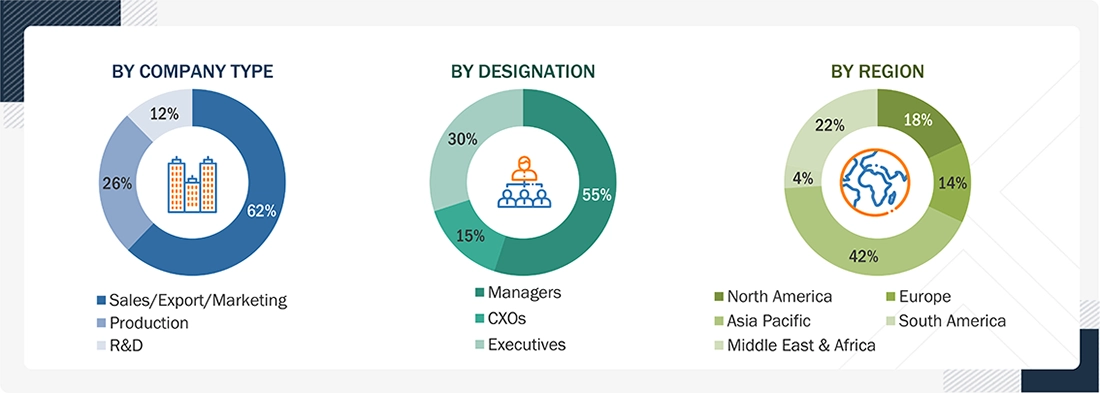
To know about the assumptions considered for the study, download the pdf brochure
Market Size Estimation
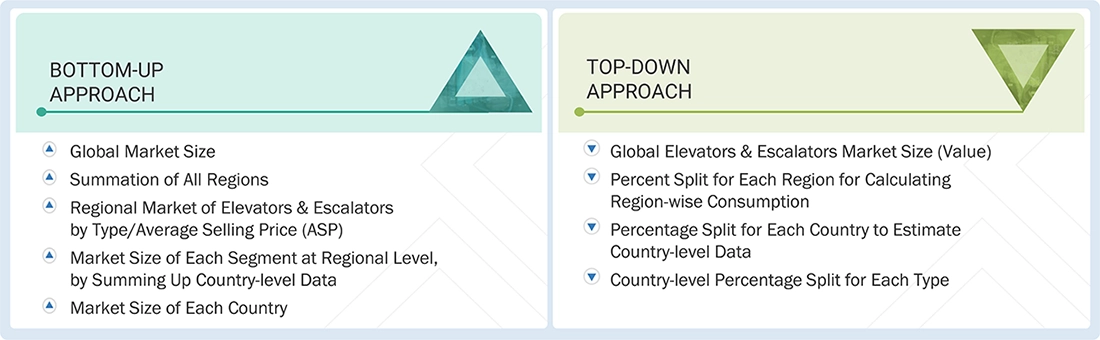
The top-down and bottom-up approaches were used to estimate and validate the size of the global elevators and escalators market. These approaches were also used extensively to estimate the size of various dependent market segments. The research methodology used to estimate the market size included the following:
Elevators & Escalators Market : Top-Down and Bottom-Up Approach
Data Triangulation
After arriving at the overall market size using the market size estimation processes, the market was split into several segments and subsegments. The data triangulation and market breakup procedures were employed, where applicable, to complete the overall market engineering process and derive the exact statistics for each market segment and subsegment. The data was triangulated by studying various factors and trends from the demand and supply sides.
Market Definition
An elevator, also known as a lift, is a technological solution for vertical transportation, facilitating the movement of individuals or goods between different levels of a building, a vessel, or other structures. Typically powered by electric motors, elevators employ either traction cables or counterweight systems, such as hoists or hydraulic pumps with cylindrical pistons (e.g., jacks). In contrast, an escalator is a vertical transportation system that uses a continuously moving staircase. Operating on the principle of a conveyor transport device, an escalator comprises a motor-driven chain of interconnected steps that ascend or descend on tracks, ensuring that the step treads remain in a horizontal position.
Key Stakeholders
- Raw Material Suppliers and Producers
- Component Manufacturers
- Elevator and Escalator OEMs
- Elevator and Escalator Manufacturers
- Traders and Distributors of Elevators and Escalators
- Installation & Engineering Contractors
- Maintenance & Service Providers
- End Users
- NGOs, Governments, Research Organizations, Investment Banks, Venture Capitalists, and Private Equity Firms
- Technology & Software Providers
Report Objectives
- To define, describe, and forecast the size of the global elevators and escalators market, by type, elevator technology, service, and end-use industry, in terms of value and volume
- To forecast the market size of segments for North America, Europe, Asia Pacific, South America, and the Middle East & Africa, along with their respective countries, in terms of value and volume
- To provide detailed information on the significant drivers, restraints, opportunities, and challenges influencing the market
- To strategically analyze micromarkets concerning individual growth trends, prospects, and their contribution to the market
- To assess the growth opportunities in the market for stakeholders and provide details on the competitive landscape for market leaders
- To strategically profile key players and comprehensively analyze their market shares and core competencies
- To analyze competitive developments, such as product launches, agreements, collaborations, partnerships, acquisitions, contracts, and expansions in the elevators and escalators market
- To provide the impact of AI/Gen AI on the market
- To provide the macroeconomic outlook for each region covered under the study, and the impact of the 2025 US tariff on the market
Available customizations:
With the given market data, MarketsandMarkets offers customizations according to client-specific needs.
The following customization options are available for the elevators and escalators report:
Product Analysis
-
A product matrix that gives a detailed comparison of the product portfolio of each company
Regional Analysis
-
A further breakdown of the elevators and escalators market for additional countries
Company Information
-
Detailed analysis and profiling of additional market players (up to five)
Key Questions Addressed by the Report
What are the major drivers for the elevators and escalators market?
Increasing construction of high-rise buildings equipped with smart vertical transportation systems, driven by rapid urbanization and the need to reduce energy consumption.
What are the major challenges in the elevators and escalators market?
Adherence to standards and regulations.
What are the restraining factors in the elevators and escalators market?
Uncertainty regarding the global economy and high maintenance costs.
What is the key opportunity in the elevators and escalators market?
Implementation of green building codes, energy-efficient products, and innovative technologies driving demand for smart elevators.
What are the end-use industries where elevator and escalator components are used?
Residential, commercial, institutional, and infrastructure industries.
Fact checked
Personalize This Research
- Triangulate with your Own Data
- Get Data as per your Format and Definition
- Gain a Deeper Dive on a Specific Application, Geography, Customer or Competitor
- Any level of Personalization
Let Us Help You
- What are the Known and Unknown Adjacencies Impacting the Elevators and Escalators Market
- What will your New Revenue Sources be?
- Who will be your Top Customer; what will make them switch?
- Defend your Market Share or Win Competitors
- Get a Scorecard for Target Partners

Custom Market Research Services
We Will Customise The Research For You, In Case The Report Listed Above Does Not Meet With Your Requirements
Get 10% Free CustomisationTESTIMONIALS

We at Nissan Chemicals Corporation have been clients of MarketsandMarkets for more than a year now. We recently consulted MarketsandMarkets for a study, the team at MarketsandMarkets was extremely professional and organized. The business insights were very detailed and aligned well with our expectations that really helped us formulate the Business Plans and device new strategies for development themes. MarketsandMarkets offers a unique combination of expertise and dedicated engagement model. Their research findings have helped us in designing our Pricing Strategy which will make it easier for us to predict the future sales and profits for the next ten years. We look forward to working with MarketsandMarkets in the future.
VP of Strategy & New Business Development
Leading Specialty Chemical Company
The MarketsandMarkets Engagement Model, composed of both the Knowledge Store and advisory custom research, has greatly helped us in understanding our markets and making strategic decisions. The Knowledge Store is a fast way to allow everyone in our organization to understand more about most any market they are interested in. The ability to then get custom research done and get answers to specific strategic questions and market insight has been spectacular. The Markets and Markets team feel more like colleagues than vendors and their services have helped us change our culture where statements of things like growth opportunities and competitive position are always backed by industry research.

Rich Gibson,
Director, Corporate Strategy
Milliken & Company,
Leading Industrial Manufacturer of specialty chemical, floor covering, performance and protective textile materials, and healthcaremilliken.com
MarketsandMarkets is a trusted resource that helps us to better understand markets that are near-adjacencies-whether its technology, value chain or geography. Their Knowledge Store platform provides a dashboard of markets and their characteristics which is easy to use and saves us time.
Adam Shaw,
Market Development and Strategy Manager
AdvanSix Inc. USA,
An American Leader in Chemicalswww.advansix.com
The Knowledge Store from MarketsandMarkets is a valuable tool which has helped my team acquire greater insight in to the end markets that our business serves. This has enabled us to help our company build stronger strategies throughout our planning process.
TOSHIO KINOSHITA
Senior Chif Consultion Research & Consulting Division
Mitsubishi Chemical Research Corporation,
Leading Manufacturer of Chemical Productswww.mitsubishichem-res.co.jp/en/

We recently engaged with MarketsandMarkets for a study, the team not only clearly understood our business objectives but was also extremely professional in the way they handled the entire project. The study was efficiently conducted in a phase-wise manner, and the engagement model furnished us with high-quality business insights that far exceeded our expectations at each phase. We were especially happy that MarketsandMarkets could provide us with both, an English as well as a Japanese version of the study. A special thanks to the Analyst Team and Client Services Team, whose fluency in Japanese enhanced our comfort level, as we could converse with them in our preferred language.
Independent entrepreneurs
Arrow Precision
We approached MarketsandMarkets for study on Proppants Market, and their work exceeded our expectations. The study conducted was comprehensive and enabled us to view the market through the various dimensions. In addition, the team was extraordinarily responsive throughout the process and resolved our queries on time. I strongly recommend MarketsandMarkets and will certainly consider them for additional market assessments we will need in the future.
Global engineering company, Japan
Deputy Manager,
Strategic Planning OfficeThe high-quality insights shared by the MarketsandMarkets team helped us understand the pharmaceutical plant designers in a specific geography. It also captured the risks that we may likely face in communicating with our potential partners. The study would enable us identify partners, which would impact our future growth.
- China Elevators and Escalators Market
- Japan Elevators and Escalators Market
- India Elevators and Escalators Market
- South Korea Elevators and Escalators Market
- Canada Elevators and Escalators Market
- Mexico Elevators and Escalators Market
- US Elevators and Escalators Market
- Germany Elevators and Escalators Market
- France Elevators and Escalators Market
- UK Elevators and Escalators Market
- Italy Elevators and Escalators Market
- Spain Elevators and Escalators Market
- Saudi Arabia Elevators and Escalators Market
- UAE Elevators and Escalators Market
- Brazil Elevators and Escalators Market
- Argentina Elevators and Escalators Market
- South America Elevators and Escalators Market
- Rest Of Europe Elevators and Escalators Market
- Rest Of Asia Pacific Elevators and Escalators Market
- GCC Countries Elevators and Escalators Market






Growth opportunities and latent adjacency in Elevators and Escalators Market