
India Risk Analytics Market (2025-2030)

The India Risk Analytics Market was valued at $1262.9 Million in 2025 and projected to reach to $2641.6 Million by 2030, representing a compound annual growth rate of 15.9%. India's risk analytics market is poised for exceptional growth driven by regulatory pressures, digital transformation initiatives, and increasing enterprise awareness of risk management.


| Market Size in | USD 26.32 MN |
| Market Forecast in | |
| CAGR | |
| Forecast Period | |
| Units Considered | Value (USD MN) |
India Risk Analytics Market Trends and Insights
- This represents a compound annual growth rate of 15.9%, significantly outpacing global market expansion.
- India's rapid digital transformation, increasing regulatory compliance requirements, and growing adoption of advanced analytics solutions across financial services, insurance, and enterprise sectors are driving this accelerated market penetration. The Indian risk analytics landscape is characterized by heightened demand from banking and financial institutions seeking to strengthen fraud detection, credit risk assessment, and operational resilience frameworks.
- India's expanding middle class, rising fintech innovation, and government-led digital initiatives are creating substantial opportunities for risk analytics vendors.
- Between 2025 and 2030, India is expected to emerge as a critical growth engine within the Asia Pacific region, with enterprises increasingly investing in AI-powered risk management platforms to navigate complex regulatory environments and competitive pressures. India's market trajectory reflects the country's transition toward data-driven decision-making and enterprise risk management maturity.
- The forecast period through 2030 will witness accelerated adoption of cloud-based risk analytics solutions, integration of machine learning capabilities, and expansion into emerging verticals including healthcare, retail, and manufacturing sectors across India..
Key Market Statistics
- CAGR (2025-2030) 15.9% CAGR
- Market Size, 2025 ~USD 1262.9 Million
- Forecast, 2030 ~USD 2641.6 Million
- Country India
India Risk Analytics Market Overview
Exceptional Growth Trajectory :
India's risk analytics market is expanding at 15.9% CAGR, nearly 64% faster than the global average of 9.7%, reflecting strong domestic demand and accelerating digital adoption across enterprises.
Regulatory Compliance Surge :
Stringent regulatory frameworks including RBI guidelines, SEBI mandates, and data protection laws are driving Indian organizations to invest heavily in risk analytics solutions for compliance and governance.
Digital Transformation Catalyst :
India's rapid digital transformation across banking, fintech, insurance, and manufacturing sectors is creating unprecedented demand for advanced analytics capabilities to manage operational and financial risks.
Market Valuation Expansion :
The market is projected to more than double from USD 1,262.9 million in 2025 to USD 2,641.6 million by 2030, representing a USD 1,378.7 million incremental opportunity over five years.
India Risk Analytics Market Dynamics
- Financial institutions, particularly banks and insurance companies, are prioritizing risk analytics investments to comply with evolving regulations and enhance decision-making capabilities.
- The proliferation of fintech startups and digital payment platforms is further accelerating adoption of sophisticated risk management tools. Looking ahead, India's risk analytics market will benefit from cloud adoption, AI-powered analytics solutions, and growing cybersecurity concerns.
- Government initiatives promoting digital India and financial inclusion will expand the addressable market across tier-2 and tier-3 cities.
- Organizations increasingly recognize risk analytics as a competitive differentiator, positioning India as a high-growth market with sustained momentum through 2030..
Market Ecosystem
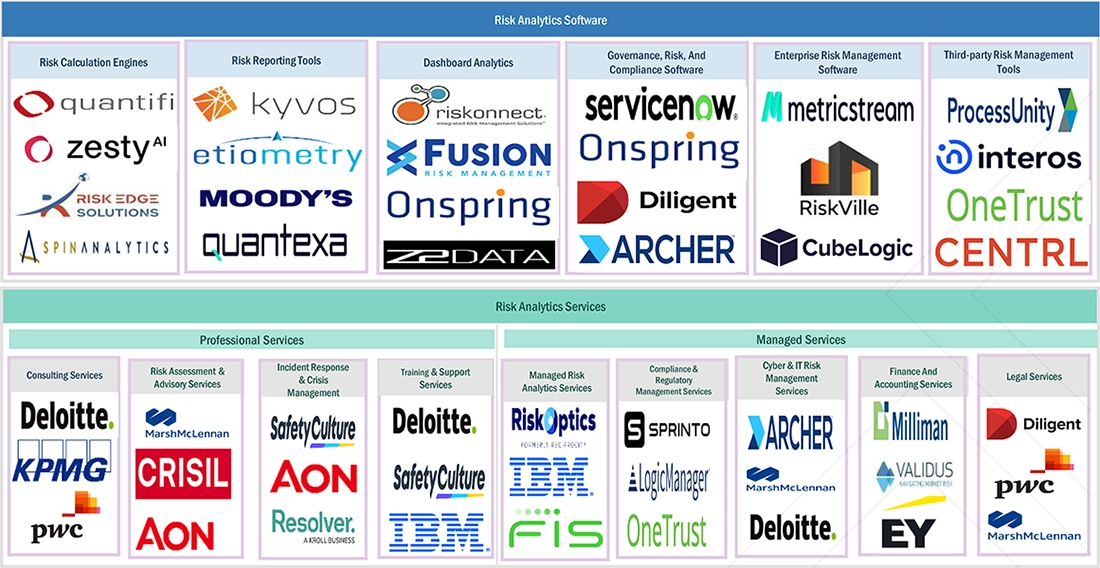
RISK ANALYTICS MARKET: COMMERCIAL USE CASES ACROSS INDUSTRIES
| COMPANY | USE CASE DESCRIPTION | BENEFITS |
|---|---|---|
 |
Askari Bank adopted SAS Governance and Compliance Manager to consolidate risk and compliance activities, automate workflows, improve reporting, and provide greater visibility into enterprise-wide risks. | Improved data consistency and transparency, reduced manual reporting and errors, established clearer accountability through audit trails, and enabled faster risk monitoring through dashboards. |
 |
Bradesco implemented FICO Platform and developed its SAFER fraud and compliance platform to monitor instant payment transactions, detect suspicious activities in real time, and automate fraud-related decisions. | Reduced fraud-related customer friction by 89%, reduced transaction rejections by 25%, increased real-time account openings by 11%, and supported processing of nearly one billion PIX transactions monthly. |
 |
HSBC deployed SAS Fraud Management to detect and manage fraudulent credit and debit card transactions in real time across its global network, covering transactions in the US, Europe, and Asia. | Significantly reduced the incidence of fraud across tens of millions of debit and credit card accounts, exceeding the bank’s stated fraud-reduction objectives. |
 |
AXA Tianping used Verisk’s data and automated risk assessment capabilities to improve insurance underwriting, identify relevant risk factors, and reduce manual intervention in policy assessment. | Achieved a reported 30% increase in sales while maintaining a stable loss ratio, reduced manual underwriting reviews, and enabled faster application processing. |
Logos and trademarks shown above are the property of their respective owners. Their use here is for informational and illustrative purposes only.
Related Ecosystem
Banking
- Image Sensors
- Machine Learning
- Natural Language Processing (NLP)
- Platform as A Service (PaaS)
- Predictive Analytics
- ROLAND BERGER
- Oracle Corporation
- FINASTRA
- SAP SE
- International Business Machines Corporation
Insurance
- Cloud Security
- Security Analytics
- Battery Electric Vehicle (BEV)
- Big Data Analytics
- Black Box
- International Business Machines Corporation
- MICROSOFT CORPORATION
- ROLAND BERGER
- SAP SE
- Oracle Corporation
Analytics
- Natural Language Processing (NLP)
- Machine Learning
- Supply Chain Management
- Predictive Analytics
- Image Sensors
- International Business Machines Corporation
- MICROSOFT CORPORATION
- Oracle Corporation
- SAP SE
Key Takeaways
- India's risk analytics market will grow from USD 1,262.9M (2025) to USD 2,641.6M (2030) at a 15.9% CAGR, outpacing global growth rates.
- Banking, financial services, and insurance sectors in India are primary drivers of risk analytics adoption and investment.
- India's regulatory environment, fintech ecosystem, and digital transformation initiatives are accelerating enterprise risk management adoption.
- Cloud-based and AI-powered risk analytics solutions are expected to dominate India's market expansion through 2030.
Risk Analytics Market Report Scope
| Report Metric | Details |
|---|---|
| Base Year | 2025 |
| Fastest Growing Segment | MANAGED RISK ANALYTICS SERVICES (Managed Service) |
| Forecast Period | 2025–2030 |
| Growth Rate | CAGR of 9.7% from 2025 to 2030 |
| Largest Segment | SERVICES (Offering) |
| Market Size Base Year (Billions) | ~USD 32.32 (2025) |
| Revenue Forecast (Billions) | ~USD 51.34 (2030) |
| Segments Covered | Offering, Software Type, Deployment Mode, Service Type, Professional Service, Managed Service, Risk Type, Vertical, Type |
India Risk Analytics Market Report Segmentation
9 segment dimensions are covered across the global market.
By Offering
- Services
- Software
By Software Type
- Dashboard Analytics
- Enterprise Risk Management Software
- Governance, Risk, And Compliance Software
- Risk Calculation Engines
- Risk Reporting Tools
- Third-Party Risk Management Tools
By Deployment Mode
- Cloud
- On-Premises
By Service Type
- Managed
- Professional
By Professional Service
- Consulting Services
- Incident Response & Crisis Management
- Risk Assessment & Advisory Services
- Training & Support Services
By Managed Service
- Compliance & Regulatory Management Services
- Cyber & It Risk Management Services
- Finance & Accounting Services
- Legal Services
- Managed Risk Analytics Services
By Risk Type
- Environment, Health & Safety Risks
- Financial Risks
- Operational Risks
- Regulatory & Compliance Risks
- Strategic Risks
- Technology Risks
By Vertical
- Bfsi
- Construction & Real Estate
- Energy & Utilities
- Government & Defense
- Healthcare & Life Sciences
- Manufacturing
- Media & Entertainment
- Mining
- Retail & E-Commerce
- Technology & Software Providers
- Telecommunications
- Transportation & Logistics
By Type
- Dashboard Analytics
- Enterprise Risk Management Software
- Governance, Risk, And Compliance Software
- Risk Calculation Engines
- Risk Reporting Tools
- Third-Party Risk Management Tools
Target Audience
- Financial Services Executives : Banks, insurance companies, and fintech leaders need India market intelligence to prioritize risk analytics investments, comply with RBI/SEBI mandates, and enhance competitive positioning in a rapidly evolving landscape.
- Risk Analytics Solution Providers : Software vendors and consulting firms require India-specific market data to validate expansion strategies, identify growth segments, and benchmark competitive positioning in this high-growth market.
- Enterprise Risk Officers : CROs and risk management heads across Indian enterprises need market insights to justify technology investments, understand peer adoption trends, and align risk strategies with regulatory requirements.
- Investment & Strategy Teams : Private equity, venture capital, and corporate strategy teams evaluating India opportunities need market sizing and growth projections to assess investment viability and portfolio company potential.
- Technology & Digital Leaders : CTOs and digital transformation officers require India market data to prioritize risk analytics in digital roadmaps, allocate cloud and AI budgets, and drive organizational risk resilience initiatives.
Key Companies in the India Risk Analytics Market
| Company | HQ | Ownership | Strongest segments |
|---|---|---|---|
| FIRST DATA CORPORATION | United States | Private Company | Merchant acquiring & omnichannel acceptance,Issuer processing & card services,Network, value-added, and data services, |
| NUCLEUS SOFTWARE | India | Public Company | FinnOne Neo (Lending Platform),FinnAxia (Transaction Banking),Digital Payments & PaySe, |
| TRANSUNION | United States | Public Company | Credit reporting and scores (business and consumer),Analytics, scoring models, and consulting,Fraud, identity verification, and authentication, |
| EXPERIAN PLC | Ireland | Public Company | Business-to-Business Credit & Risk Data,Decisioning Software & AI Analytics,Fraud, Identity & Affordability Solutions, |
| EQUIFAX INC | United States | Public Company | Workforce Solutions (verification + employer services),U.S. Information Solutions (consumer/commercial bureau, fraud, decisioning),International Information Services, |
| AMERICAN INTERNATIONAL GROUP, INC | United States | Public Company | North America Commercial,International Commercial,Global Personal, |
| BLACKROCK, INC. | United States | Public Company | ETFs (iShares),Institutional Index & Beta Mandates,Active Fixed Income & Equities, |
| EXL | United States | Public Company | Insurance digital operations and platforms,Healthcare and life sciences services,Banking, capital markets, and diversified industries, |
| MSCI INC. | United States | Public Company | Index,Analytics,Sustainability and Climate, |
| IBM | United States | Public Company | Software (Hybrid Cloud & AI Platforms),Consulting (Strategy, Technology, Managed Services),Infrastructure (Servers, Storage, Lifecycle Services), |
| AON | Ireland | Public Company | Commercial Risk Solutions (P&C broking and specialty),Reinsurance Solutions,Health & Benefits, |
| WILLIS TOWERS WATSON PLC | United Kingdom | Public Company | Health, Wellbeing and Group Benefits Advisory & Broking,Retirement, Pension and Savings Consulting and Administration,Risk & Broking (Property, Casualty, Specialty, Affinity), |
| ACCENTURE | Ireland | Public Company | Strategy & Consulting,Technology (systems integration, software engineering, cloud, data & AI, security, infrastructure),Operations (BPO and managed services across F&A, procurement, supply chain, HR, CX), |
| VERISK ANALYTICS | United States | Public Company | Underwriting forms, rules, and loss costs,Underwriting data and analytics,Catastrophe modelling and risk solutions, |
FIRST DATA CORPORATION
First Data Corporation is a private company founded in 1992 in the United States with 19,000 employees.
NUCLEUS SOFTWARE
Nucleus Software is a public company founded in 1986 in India with 1,917 employees.
TRANSUNION
TransUnion is a public company founded in 1968 in the United States with 13,500 employees.
EXPERIAN PLC
Experian PLC is a public company founded in 1826 in Ireland with 25,200 employees.
EQUIFAX INC
Equifax Inc is a public company founded in 1899 in the United States with 15,000 employees.
AMERICAN INTERNATIONAL GROUP, INC
American International Group, Inc is a public company founded in 1919 in the United States with 22,100 employees.
BLACKROCK, INC.
BlackRock, Inc. is a public company founded in 1988 in the United States.
EXL
EXL is a public company founded in 1999 in the United States with 65,000 employees.
MSCI INC.
MSCI Inc. is a public company founded in 1998 in the United States with 6,327 employees.
IBM
IBM is a public company founded in 1911 in the United States with 264,300 employees.
AON
Aon is a public company founded in 1982 in Ireland.
WILLIS TOWERS WATSON PLC
Willis Towers Watson PLC is a public company founded in 1828 in the United Kingdom with 48,100 employees.
ACCENTURE
Accenture is a public company founded in 1951 in Ireland with 799,000 employees.
VERISK ANALYTICS
Verisk Analytics is a public company founded in 1971 in the United States with 8,000 employees.
Reasons to Buy this Report
- India-Specific Market Sizing : Accurate valuation data for India's risk analytics market with precise 2025 baseline (USD 1,262.9M) and 2030 forecast (USD 2,641.6M), enabling precise budget allocation and ROI projections for India-focused strategies.
- Competitive Growth Intelligence : Understand India's 15.9% CAGR advantage over global 9.7% growth, identifying why India outperforms and how to capitalize on this high-growth market opportunity ahead of competitors.
- Regulatory Landscape Insights : Comprehensive analysis of India-specific compliance drivers including RBI, SEBI, and data protection regulations shaping market demand, helping organizations align solutions with local requirements.
- Sector-Specific Opportunity Mapping : Detailed breakdown of India's banking, fintech, insurance, and manufacturing sectors driving risk analytics adoption, enabling targeted go-to-market strategies for maximum penetration.
- Strategic Investment Validation : Data-backed evidence of India's market potential supporting investment decisions, partnership strategies, and resource allocation for organizations entering or expanding in the Indian risk analytics ecosystem.
Frequently asked questions
What is the projected size of India's risk analytics market by 2030?
India's risk analytics market is projected to reach USD 2,641.6 million by 2030, growing from USD 1,262.9 million in 2025.
What is the CAGR for India's risk analytics market?
India's risk analytics market is expected to grow at a compound annual growth rate of 15.9% between 2025 and 2030.
Which industries are driving risk analytics adoption in India?
Banking and financial services, insurance, fintech, and enterprise sectors are the primary drivers of risk analytics adoption in India.
What technologies are shaping India's risk analytics market?
Cloud-based platforms, artificial intelligence, machine learning, and advanced data analytics are key technologies transforming India's risk analytics landscape.
Why is India's risk analytics market growing faster than the global average?
India's rapid digital transformation, stringent regulatory requirements, fintech innovation, and increasing enterprise focus on data-driven risk management are driving above-average market growth.
RESEARCH METHODOLOGY
The research study for the risk analytics market involved extensive secondary sources, directories, journals, and paid databases. Primary sources were mainly industry experts from the core and related industries, preferred risk analytics providers, third-party service providers, consulting service providers, end users, and other commercial enterprises. In-depth interviews with primary respondents, including key industry participants and subject matter experts, were conducted to obtain and verify critical qualitative and quantitative information and assess the market’s prospects.
Secondary Research
In the secondary research process, various sources were referred to identify and collect information for the study. The secondary sources included annual reports, press releases, investor presentations of companies, white papers, journals, certified publications, and articles from recognized authors, directories, and databases. The data was also collected from other secondary sources, such as AI conferences and related magazines. Additionally, the risk analytics spending of various countries was extracted from respective sources. Secondary research was used to obtain key information about the industry’s value chain and supply chain to identify key players by solution, service, market classification, and segmentation according to the offerings of major players and industry trends related to solutions, applications, verticals, and regions, and key developments from both market- and technology-oriented perspectives.
Primary Research
In the primary research process, various primary sources from both the supply and demand sides were interviewed to obtain qualitative and quantitative information on the market. The primary sources from the supply side included various industry experts, including Chief Experience Officers (CXOs); Vice Presidents (VPs); directors from business development, marketing, and risk analytics expertise; related key executives from risk analytics solution vendors, SIs, managed service providers, industry associations; and key opinion leaders.
Primary interviews were conducted to gather insights, such as market statistics, revenue data collected from solutions and services, market breakdowns, market size estimations, market forecasts, and data triangulation. Primary research also helped understand various trends related to technologies, applications, data types, service types, software types, verticals, and regions. Stakeholders from the demand side, such as Chief Information Officers (CIOs), Chief Technology Officers (CTOs), Chief Strategy Officers (CSOs), and end users of risk analytics solutions, were interviewed to understand the buyer’s perspective on suppliers, products, service providers, and their current usage of risk analytics, which would impact the overall risk analytics market.
The Breakdown of Primary Research:
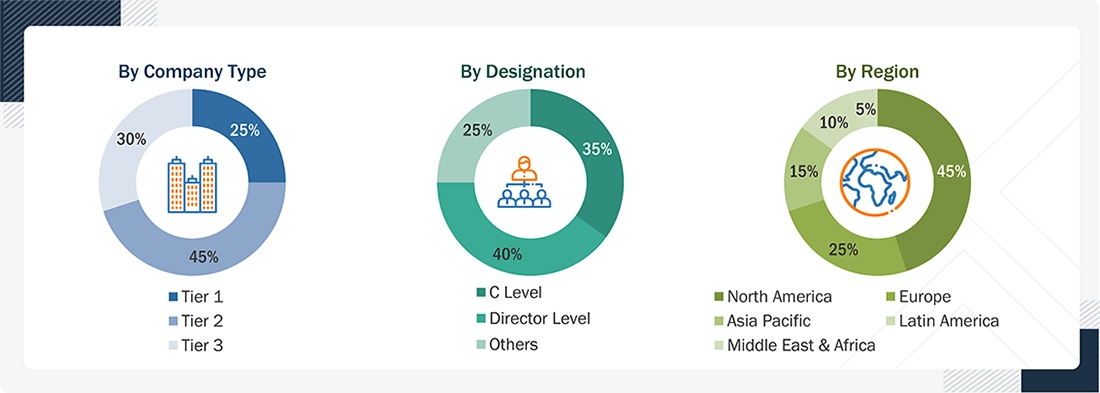
Note: Tier 1 companies account for annual revenue of >USD 10 billion; Tier 2 companies’ revenue ranges between USD 1 and 10 billion; and Tier 3 companies’ revenue ranges between USD 500 million–USD 1 billion
Source: MarketsandMarkets Analysis
To know about the assumptions considered for the study, download the pdf brochure
Market Size Estimation
Multiple approaches were adopted to estimate and forecast the risk analytics market. The first approach involves estimating the market size by summing companies’ revenue generated by selling solutions and services.
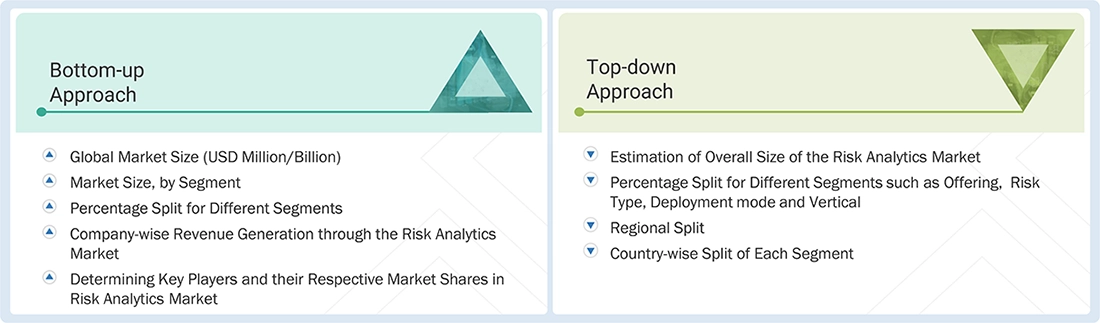
Market Size Estimation Methodology - Top-down approach
In the top-down approach, an exhaustive list of all the vendors offering solutions and services in the risk analytics market was prepared. The revenue contribution of the market vendors was estimated through annual reports, press releases, funding, investor presentations, paid databases, and primary interviews. Each vendor's offerings were evaluated based on the breadth of solutions according to software type, service type, technology, data type, and vertical. The aggregate of all the companies’ revenue was extrapolated to reach the overall market size. Each subsegment was studied and analyzed for its global market size and regional penetration. The markets were triangulated through both primary and secondary research. The primary procedure included extensive interviews for key insights from industry leaders, such as CIOs, CEOs, VPs, directors, and marketing executives. The market numbers were further triangulated with the existing MarketsandMarkets repository for validation.
Market Size Estimation Methodology - Bottom-up approach
In the bottom-up approach, the adoption rate of risk analytics solutions and services among different end users in key countries, with respect to their regions contributing the most to the market share, was identified. For cross-validation, the adoption of risk analytics solutions among industries, along with different use cases with respect to their regions, was identified and extrapolated. Use cases identified in different regions were given weightage for the market size calculation.
Based on the market numbers, the regional split was determined by primary and secondary sources. The procedure included the analysis of the risk analytics market’s regional penetration. Based on secondary research, the regional spending on Information and Communications Technology (ICT), socio-economic analysis of each country, strategic vendor analysis of major risk analytics providers, and organic and inorganic business development activities of regional and global players were estimated. With the data triangulation procedure and data validation through primary interviews, the exact values of the overall risk analytics market size and segments’ size were determined and confirmed using the study.
Risk Analytics Market: Top-Down and Bottom-Up Approach
Data Triangulation
The market was split into several segments and subsegments after arriving at the overall market size using the market size estimation processes as explained above. To complete the overall market engineering process and arrive at the exact statistics of each market segment and subsegment, data triangulation and market breakup procedures were employed, wherever applicable. The overall market size was then used in the top-down procedure to estimate the size of other individual markets via percentage splits of the market segmentation.
Market Definition
The risk analytics market comprises digital solutions that enable insurers to manage core processes such as policy administration, underwriting, claims management, and customer engagement. These platforms use cloud computing, automation, and data analytics to improve operational efficiency, enhance customer experiences, and support product innovation. They serve insurers, brokers, and third-party service providers, enabling seamless ecosystem integration and regulatory compliance.
Key Stakeholders
- Risk analytics software providers
- Risk analytics service providers
- Third-party administrators
- Business analysts
- Cloud service providers
- Consulting service providers
- Enterprise end-users
- Distributors and value-added resellers (VARs)
- Government agencies
- Independent Software Vendors (ISVs)
- Managed service providers
- Market research and consulting firms
- Support & maintenance service providers
- System Integrators (SIs)/Migration service providers
- Technology providers
Report Objectives
- To define, describe, and forecast the risk analytics market by offering, deployment mode, risk type, and vertical
- To provide detailed information related to major factors (drivers, restraints, opportunities, and industry-specific challenges) influencing the market growth
- To analyze the micro markets with respect to individual growth trends, prospects, and their contribution to the total market
- To analyze the opportunities in the market for stakeholders by identifying the high-growth segments of the risk analytics market
- To analyze opportunities in the market and provide details of the competitive landscape for stakeholders and market leaders
- To forecast the market size of segments for five main regions: North America, Europe, Asia Pacific, Middle East & Africa, and Latin America
- To profile the key players and comprehensively analyze their market ranking and core competencies
- To analyze competitive developments, such as partnerships, product launches, and mergers & acquisitions, in the risk analytics market
Available customizations:
Using the provided market data, MarketsandMarkets offers customizations tailored to the company’s specific needs. The following customization options are available for the report.
Product Analysis
- Product comparative analysis, which gives a detailed comparison of innovative products being offered by prominent vendors
Geographic Analysis
- Further breakdown of additional European countries by offering, deployment mode, risk type, and vertical
- Further breakdown of additional Asia Pacific countries by offering, deployment mode, risk type, and vertical
- Further breakdown of additional Middle Eastern & African countries by offering, deployment mode, risk type, and vertical
- Further breakdown of additional Latin American countries by offering, deployment mode, risk type, and vertical
Company Information
-
Detailed analysis and profiling of additional market players (up to five)
Get the Full Risk Analytics Market Report
Full forecast, segment splits, and company analysis for all Risk Analytics Market.
- US Risk Analytics Market
- Canada Risk Analytics Market
- UK Risk Analytics Market
- Germany Risk Analytics Market
- France Risk Analytics Market
- Italy Risk Analytics Market
- Spain Risk Analytics Market
- China Risk Analytics Market
- Japan Risk Analytics Market
- South Korea Risk Analytics Market
- Brazil Risk Analytics Market
- Mexico Risk Analytics Market
- Argentina Risk Analytics Market
Need a Tailored Report?
Customize this report to your needs
Get 10% FREE Customization
Customize This Report
