
US Roofing Membranes Market (2026-2031)

The US Roofing Membranes Market was valued at $5217.1 Million in 2026 and projected to reach to $6496.7 Million by 2031, representing a compound annual growth rate of 4.5%. The US roofing membranes market is poised for steady growth through 2031, driven by sustained construction activity and infrastructure renewal projects.


| Market Size in | USD 26.32 MN |
| Market Forecast in | |
| CAGR | |
| Forecast Period | |
| Units Considered | Value (USD MN) |
US Roofing Membranes Market Trends and Insights
- The US market benefits from robust construction activity, aging infrastructure requiring replacement, and increasing adoption of energy-efficient roofing solutions across residential and commercial segments.
- Demand in the US is driven by stringent building codes, climate resilience concerns, and the shift toward sustainable building materials that enhance thermal performance and durability. In the US, the roofing membranes market is characterized by steady expansion fueled by renovation cycles in the commercial real estate sector and growing residential construction.
- The US market reflects strong competition among established manufacturers and emerging players offering advanced membrane technologies.
- Between 2026 and 2031, the US is expected to maintain moderate growth momentum as contractors and building owners prioritize cost-effective, long-lasting roofing solutions that meet evolving environmental standards..
Key Market Statistics
- CAGR (2026-2031) 4.5% CAGR
- Market Size, 2026 ~USD 5217.1 Million
- Forecast, 2031 ~USD 6496.7 Million
- Country US
US Roofing Membranes Market Overview
Market Size & Growth :
The US roofing membranes market is valued at $5,217.1 million in 2026 and is projected to reach $6,496.7 million by 2031, growing at a CAGR of 4.5% during the forecast period.
Construction Activity Driver :
Robust construction activity across residential and commercial sectors in the US is fueling demand for roofing membranes, supported by infrastructure modernization initiatives and new building projects.
Infrastructure Replacement Demand :
Aging roofing infrastructure across the US presents significant replacement opportunities, as property owners prioritize maintenance and upgrades to extend building lifespan and improve performance.
Energy Efficiency Adoption :
Increasing adoption of energy-efficient roofing solutions in the US market reflects growing environmental awareness and regulatory compliance requirements for sustainable building practices.
US Roofing Membranes Market Dynamics
- Commercial property owners and residential developers are increasingly investing in advanced membrane technologies to improve energy efficiency and reduce operational costs.
- Regulatory pressures for sustainable building materials and climate resilience are accelerating the transition toward high-performance roofing solutions. The market will benefit from technological innovations in membrane durability and installation efficiency, alongside growing consumer awareness of long-term cost savings.
- Regional variations in construction cycles and climate conditions will influence demand patterns, with particular strength expected in regions experiencing significant commercial development and residential expansion..
Market Ecosystem

ROOFING MEMBRANES MARKET: COMMERCIAL USE CASES ACROSS INDUSTRIES
| COMPANY | USE CASE DESCRIPTION | BENEFITS |
|---|---|---|
 |
Fluid-applied roofing membranes for complex rooftop geometries, terraces, and rooftop mechanical areas | Provides seamless waterproofing | Adapts to irregular surfaces | Speeds up installation timelines |
 |
Polyurethane and bituminous roofing systems for schools, government buildings, and healthcare campuses | Reduces heat island effect | Improves indoor comfort | Meets green building certification standards |
 |
Roofing and below-grade waterproofing for commercial buildings, including green roofs and terraces | Improves energy efficiency | Supports sustainability | Ensures leak protection | Lowers lifecycle costs |
 |
Single-ply membranes for industrial and commercial roofing like warehouses and data centers | Enhances weather resistance | Improves energy efficiency | Reduces costs | Ensures long-term durability |
Logos and trademarks shown above are the property of their respective owners. Their use here is for informational and illustrative purposes only.
Related Ecosystem
Membranes
- Reverse Osmosis
- Acetone
- Bioremediation
- Cartridge Filters
- Granular Activated Carbon
- Veolia
- Toray Industries, Inc.
- PALL CORPORATION
- DuPont de Nemours, Inc.
- Pentair plc
Key Takeaways
- The US roofing membranes market is valued at $5,217.1 million in 2026 and will reach $6,496.7 million by 2031 at a 4.5% CAGR.
- The US market is driven by aging infrastructure, commercial renovation cycles, and demand for energy-efficient roofing solutions.
- Stringent building codes and climate resilience requirements are accelerating adoption of advanced membrane technologies in the US.
- The US market shows steady growth potential through 2031 as sustainable and durable roofing materials gain market share.
Roofing Membranes Market Report Scope
| Report Metric | Details |
|---|---|
| Base Year | 2026 |
| Fastest Growing Segment | OTHER ROOF TYPES (Roof Type) |
| Forecast Period | 2026–2031 |
| Growth Rate | CAGR of 5.7% from 2026 to 2031 |
| Largest Segment | WATERPROOFING MEMBRANE (Function) |
| Market Size Base Year (Billions) | ~USD 30.15 (2026) |
| Revenue Forecast (Billions) | ~USD 39.78 (2031) |
| Segments Covered | Roof Type, Membrane Type, End Use, Function |
US Roofing Membranes Market Report Segmentation
4 segment dimensions are covered across the global market.
By Roof Type
- Flat Roof
- Low-Slope Roof
- Other Roof Types
- Steep-Slope Roof
By Membrane Type
- Bituminous Membrane
- Liquid Applied Membrane
- Synthetic Membrane
- –Acrylic Liquid Applied Membrane
- –App Modified Bitumen Membrane
- –Epdm Membrane
- –Other Liquid Applied Membranes
- –Other Synthetic Membranes
- –Polyurea Liquid Applied Membrane
- –Polyurethane Liquid Applied Membrane
- –Pvc Membrane
- –Sbs Modified Bitumen Membrane
- –Self-Adhesive Bitumen Membrane
- –Tpo Membrane
By End Use
- Commercial
- Industrial
- Institutional/Public Infrastructure
- Residential
By Function
- Air Barrier Membrane
- Reflective/Cool Roof Membrane
- Root-Resistant Membrane
- Vapor Barrier Membrane
- Waterproofing Membrane
Target Audience
- Roofing Manufacturers : US-based and international roofing membrane manufacturers need market intelligence to optimize production capacity, identify growth opportunities, and develop products aligned with American market demands.
- Construction & Real Estate Developers : Commercial and residential developers require market insights to make informed decisions on roofing material selection, budget forecasting, and supplier partnerships for US construction projects.
- Distributors & Suppliers : Roofing material distributors and suppliers need US market data to forecast demand, manage inventory, identify emerging trends, and strengthen relationships with contractors and builders.
- Investment & Private Equity Firms : Investors evaluating opportunities in the US roofing sector require comprehensive market analysis to assess growth potential, competitive positioning, and acquisition targets in the membranes segment.
- Contractors & Installation Specialists : Roofing contractors and installation companies need market forecasts to plan service expansion, understand material availability, and align offerings with evolving customer preferences in the US market.
Key Companies in the US Roofing Membranes Market
| Company | HQ | Ownership | Strongest segments |
|---|---|---|---|
| SIKA AG | Switzerland | Public Company | Synthetic roofing membranes,Liquid applied membranes,Bituminous membranes, |
| JOHNS MANVILLE | United States | Private Company | Bituminous membranes,Synthetic membranes,Liquid Applied membranes, |
| CARLISLE COMPANIES INC. | United States | Public Company | Synthetic roofing membranes (EPDM, TPO, PVC),Bituminous membranes,Liquid applied membranes and roof coatings, |
| ORIENTAL YUHONG | China | Public Company | Bituminous roofing membranes,Synthetic roofing membranes,Liquid applied roofing membranes, |
| ELEVATE | United States | Private Company | Bituminous membranes,Synthetic membranes,Liquid applied membranes, |
| KINGSPAN GROUP | Ireland | Public Company | Synthetic membranes,Liquid applied membranes,Bituminous membranes, |
| OWENS CORNING | United States | Public Company | Bituminous membranes,Synthetic membranes,Liquid Applied membranes, |
SIKA AG
Sika AG is a Swiss multinational public company founded in 1910 that specializes in construction chemicals and materials. With approximately 30,629 employees, the company operates globally in the building and construction sectors.
JOHNS MANVILLE
Johns Manville is a United States-based private company founded in 1858 with 9,740 employees. The company manufactures building materials and insulation products.
CARLISLE COMPANIES INC.
Carlisle Companies Inc. is a United States-based public company founded in 1917 with 5,900 employees. The company operates across multiple industrial and commercial segments including construction materials.
ORIENTAL YUHONG
Oriental Yuhong is a Chinese public company founded in 1995 with 10,318 employees. The company specializes in waterproofing and building materials.
ELEVATE
Elevate is a United States-based private company founded in 2006 with 15 employees. The company operates in the construction or building materials sector.
KINGSPAN GROUP
Kingspan Group is an Ireland-based public company founded in 1965 with 27,526 employees. The company is a global leader in high-performance insulation and building envelope solutions.
OWENS CORNING
Owens Corning is a United States-based public company founded in 1938 with 25,000 employees. The company manufactures insulation, roofing, and fiberglass composite materials.
Reasons to Buy this Report
- Accurate US Market Sizing : Obtain precise market valuation data specific to the United States, with detailed 2026-2031 forecasts to support strategic planning and investment decisions in the US roofing sector.
- Regional Growth Drivers Analysis : Understand the unique factors driving US market growth, including construction activity, infrastructure replacement cycles, and energy efficiency mandates specific to American markets.
- Competitive Landscape Intelligence : Gain insights into US-specific competitive dynamics, market consolidation trends, and key player strategies tailored to the American roofing membranes industry.
- Segment Performance Breakdown : Access detailed performance metrics for residential and commercial segments within the US market, enabling targeted business development and product positioning strategies.
- Regulatory & Compliance Insights : Stay informed on US-specific building codes, energy efficiency standards, and environmental regulations impacting roofing membrane adoption and market opportunities.
Frequently asked questions
What is the current size of the US roofing membranes market?
The US roofing membranes market is estimated at $5,217.1 million in 2026 and is expected to grow to $6,496.7 million by 2031.
What is the projected growth rate for the US roofing membranes market?
The US roofing membranes market is projected to grow at a compound annual growth rate (CAGR) of 4.5% from 2026 to 2031.
What factors are driving growth in the US roofing membranes market?
Key drivers in the US include aging infrastructure requiring replacement, commercial renovation cycles, stringent building codes, climate resilience concerns, and increasing demand for energy-efficient and sustainable roofing solutions.
Which segments dominate the US roofing membranes market?
The US market is segmented across residential and commercial applications, with commercial real estate renovation cycles and new construction projects representing significant demand drivers.
What are the main challenges in the US roofing membranes market?
Challenges in the US include price volatility of raw materials, intense competition among manufacturers, and the need for continuous innovation to meet evolving environmental and performance standards.
RESEARCH METHODOLOGY
The study involved four major activities to estimate the current size of the global roofing membranes market. Exhaustive secondary research was carried out to collect information on the market, the peer product market, and the parent product group market. The next step was to validate these findings, assumptions, and sizes with the industry experts across the value chain of roofing membrane through primary research. The top-down and bottom-up approaches were employed to estimate the overall market size. After that, market breakdown and data triangulation procedures were used to determine the size of different segments and sub-segments of the market.
Secondary Research
The market size for companies offering roofing membrane is arrived at by secondary data available through paid and unpaid sources, analyzing the product portfolios of the major companies in the ecosystem, and rating the companies by their performance and quality. Various secondary sources, such as Business Standard, Bloomberg, World Bank, and Factiva, were referred to identify and collect information for this study on the roofing membranes market. In the secondary research process, various secondary sources were referred to identify and collect information related to the study. Secondary sources included annual reports, press releases, and investor presentations of door vendors, forums, certified publications, and whitepapers. The secondary research was used to obtain critical information on the industry’s value chain, the total pool of key players, market classification, and segmentation from the market and technology-oriented perspectives.
Primary Research
In the primary research process, various primary sources from the supply and demand sides were interviewed to obtain qualitative and quantitative information for this report. The primary sources from the supply side included industry experts, such as chief executive officers (CEOs), vice presidents (VPs), marketing directors, technology and innovation directors, and related key executives from several key companies and organizations operating in the roofing membranes market. After the complete market engineering (calculations for market statistics, market breakdown, market size estimations, market forecasting, and data triangulation), extensive primary research was conducted to gather information and verify and validate the critical numbers arrived at. Primary research was also conducted to identify the segmentation types, industry trends, competitive landscape of roofing membranes offered by various market players, and key market dynamics, such as drivers, restraints, opportunities, challenges, industry trends, and key player strategies. In the complete market engineering process, the top-down and bottom-up approaches and several data triangulation methods were extensively used to perform the market estimation and market forecasting for the overall market segments and subsegments listed in this report. Extensive qualitative and quantitative analysis was performed on the complete market engineering process to list the key information/insights throughout the report.
The following is the breakdown of primary respondents:
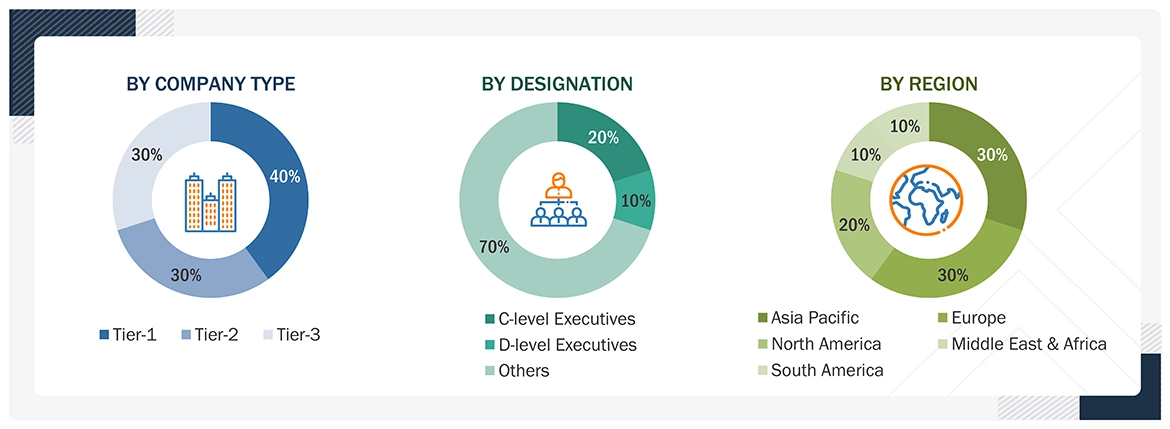
Notes: Other designations include sales, marketing, and product managers.
Tier 1: >USD 1 Billion; Tier 2: USD 500 million–1 Billion; and Tier 3: <USD 500 million.
To know about the assumptions considered for the study, download the pdf brochure
Market Size Estimation
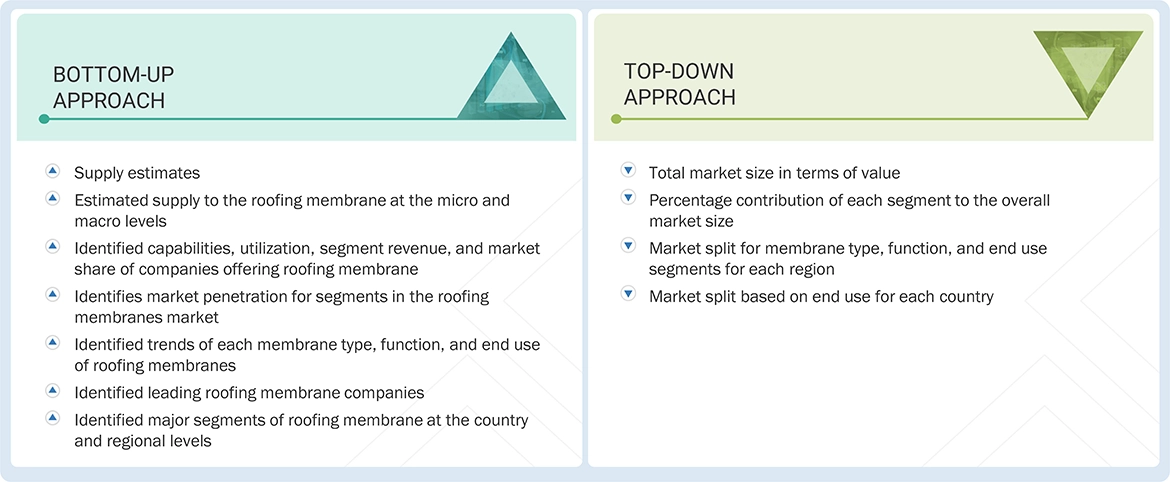
The top-down and bottom-up approaches were used to estimate and validate the size of the global roofing membranes market. These approaches were also used extensively to estimate the size of various dependent market segments. The research methodology used to estimate the market size included the following:
Roofing Membranes Market : Top-Down and Bottom-Up Approach
Data Triangulation
After arriving at the overall market size using the market size estimation processes, the market was split into several segments and subsegments. The data triangulation and market breakup procedures were employed, wherever applicable, to complete the overall market engineering process and arrive at the exact statistics of each market segment and subsegment. The data was triangulated by studying various factors and trends from both the demand and supply sides.
Market Definition
Roofing membrane consists of high-performance waterproofing materials applied to building roofs to prevent water infiltration, weathering, UV degradation, and thermal stress. They are manufactured with synthetic or bituminous polymers that have high flexibility, elasticity, thermal stability, and UV stability for the protection of building structures. Manufacturing methods involve precise and controlled mixing, blending, and extrusion processes to result in continuous, stable membranes with long service life. Roofing membrane manufacturers use bituminous membranes (SBS and APP modified membranes), synthetic single-ply membranes (PVC, TPO, EPDM), and liquid waterproofing systems as critical raw materials. Roofing membrane used in new construction or renovations is vital in flat and low-slope roof applications for conditions of high traffic, snow loading, and tropical storms. Roofing membranes are used in different end-use industries, including residential, commercial, institutional, and infrastructure. These applications include roof covering, waterproofing, insulation board, and safety barriers.
Key Stakeholders
- Roofing membrane manufacturers
- Raw material suppliers
- Contractors and installation service providers
- Construction companies and infrastructure developers
- Architects, consultants, and structural engineers
- Industry associations and regulatory bodies
- End users
Report Objectives
- To describe and forecast the size of the global roofing membranes market, based on membrane type, function, end use, and region in terms of value.
- To provide detailed information on the significant drivers, restraints, opportunities, and challenges influencing the market
- To strategically analyze micro-markets concerning individual growth trends, prospects, and their contribution to the market
- To assess the growth opportunities in the market for stakeholders and provide details on the competitive landscape for market leaders
- To forecast the market size of segments and subsegments for North America, Europe, Asia Pacific, South America, and the Middle East & Africa, in terms of value
- To strategically profile key players and comprehensively analyze their market shares and core competencies
- To analyze competitive developments, such as product launches, acquisitions, expansions, partnerships, and agreements, in the roofing membranes market
- To provide the impact of AI/Gen AI on the market
Available customizations:
With the given market data, MarketsandMarkets offers customizations according to client-specific needs.
The following customization options are available for the roofing membranes market report:
Product Analysis
- A product matrix that gives a detailed comparison of the product portfolio of each company
Regional Analysis
- A further breakdown of the roofing membranes market for additional countries
Company Information
- Detailed analysis and profiling of additional market players (up to five)
Get the Full Roofing Membranes Market Report
Full forecast, segment splits, and company analysis for all Roofing Membranes Market.
- China Roofing Membranes Market
- Rest Of Europe Roofing Membranes Market
- Rest Of Asia Pacific Roofing Membranes Market
- Japan Roofing Membranes Market
- India Roofing Membranes Market
- South Korea Roofing Membranes Market
- Germany Roofing Membranes Market
- UK Roofing Membranes Market
- France Roofing Membranes Market
- Italy Roofing Membranes Market
- Spain Roofing Membranes Market
- Canada Roofing Membranes Market
- Mexico Roofing Membranes Market
- Saudi Arabia Roofing Membranes Market
- South Africa Roofing Membranes Market
- Brazil Roofing Membranes Market
- Argentina Roofing Membranes Market
- South America Roofing Membranes Market
Need a Tailored Report?
Customize this report to your needs
Get 10% FREE Customization
Customize This Report
