
US Rubber Track Market (2025-2030)

The US Rubber Track Market was valued at $274832 Million in 2025 and projected to reach to $384918 Million by 2030, representing a compound annual growth rate of 4.9%. The US rubber track market is poised for steady expansion through 2030, supported by continued infrastructure development, agricultural sector modernization, and military equipment upgrades.


| Market Size in | USD 26.32 MN |
| Market Forecast in | |
| CAGR | |
| Forecast Period | |
| Units Considered | Value (USD MN) |
US Rubber Track Market Trends and Insights
- The US market benefits from strong demand across construction, agriculture, and military applications, where rubber tracks provide superior traction and reduced ground pressure compared to traditional tires.
- In 2025, the US dominates North American rubber track consumption, driven by infrastructure development and equipment modernization across the construction and forestry sectors. Growth in the US rubber track market through 2030 is supported by increasing adoption of tracked vehicles in challenging terrain environments and rising investments in agricultural mechanization.
- The US market's expansion reflects broader trends in equipment durability and operational efficiency, with manufacturers focusing on advanced rubber compounds and reinforced designs.
- By 2030, the US is expected to maintain its leadership position in the Americas, with sustained demand from both original equipment manufacturers and aftermarket replacement segments..
Key Market Statistics
- CAGR (2025-2030) 4.9% CAGR
- Market Size, 2025 ~USD 274832 Million
- Forecast, 2030 ~USD 384918 Million
- Country US
US Rubber Track Market Overview
Market Valuation :
The US rubber track market is valued at $274.8 billion in 2025, with projected growth to $384.9 billion by 2030, driven by robust demand across construction, agriculture, and military sectors.
Growth Trajectory :
The US market is experiencing a 4.9% CAGR through 2030, outpacing global growth rates in certain segments due to strong infrastructure investment and agricultural modernization initiatives across the country.
Key Application Drivers :
Construction equipment, agricultural machinery, and military vehicles dominate US demand, with rubber tracks offering superior traction, reduced ground pressure, and enhanced operational efficiency compared to traditional tire solutions.
Competitive Landscape :
The US market features established manufacturers and regional suppliers competing on innovation, durability, and cost-effectiveness, with increasing focus on sustainable materials and advanced track technologies.
US Rubber Track Market Dynamics
- Rising demand for heavy equipment in construction projects and the adoption of advanced machinery in farming operations will sustain market growth.
- Additionally, the shift toward equipment that minimizes environmental impact and reduces soil compaction is driving preference for rubber tracks over conventional solutions.
- Market players are investing in R&D to develop lighter, more durable, and cost-effective track systems tailored to US customer requirements..
Market Ecosystem
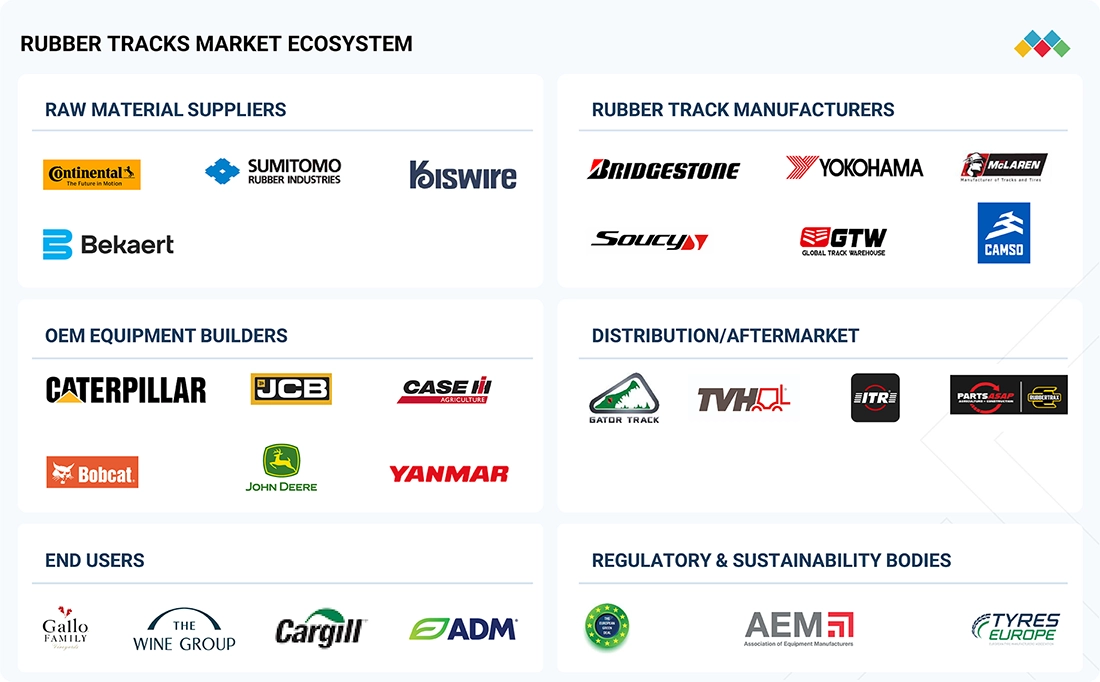
rubber-track-market: COMMERCIAL USE CASES ACROSS INDUSTRIES
| COMPANY | USE CASE DESCRIPTION | BENEFITS |
|---|---|---|
 |
Caterpillar’s 259D3 CTL uses heavy-duty rubber tracks designed for high-cycle rental environments and diverse terrain demands. | Longer wear life, superior ride comfort, and reduced slippage—helping rental companies improve equipment uptime and utilization |
 |
Bobcat equips compact track loaders like the T66 and T76—with rubber tracks optimized for mixed-terrain construction, landscaping, and urban utility work. | Low ground disturbance for turf/asphalt, reduced vibration for operators, and higher stability in grading and digging applications—ideal for city and residential projects |
 |
Kubota’s agricultural and compact equipment lineup (e.g., KX080-4 excavator and KVT85 tractor) uses rubber tracks for improved traction on soft soil and wet-field operations. | Better flotation in rice paddies, improved fuel efficiency, and reduced soil compaction for high-value crop farming |
Logos and trademarks shown above are the property of their respective owners. Their use here is for informational and illustrative purposes only.
Related Ecosystem
On Highway Off Highway Vehicles
- Internal Combustion Engine (ICE)
- Agricultural Tractors
- Crawler Excavator
- Battery Electric Vehicle (BEV)
- Excavators
- Visteon Corporation
- Deere & Company
- AB VOLVO PENTA
- Honda Motor Co., Ltd.
- Komatsu Ltd.
Key Takeaways
- The US rubber track market is valued at $274.8 billion in 2025 and will reach $384.9 billion by 2030, growing at a 4.9% CAGR.
- The US market is driven by strong demand from construction, agriculture, and military sectors requiring superior traction and reduced ground pressure.
- The US benefits from infrastructure investments and equipment modernization, supporting sustained growth through 2030.
- The US maintains leadership in the Americas with both OEM and aftermarket replacement demand fueling market expansion.
Rubber Track Market Report Scope
| Report Metric | Details |
|---|---|
| Base Year | 2025 |
| Fastest Growing Segment | OTHER EQUIPMENT TYPES (Equipment Type) |
| Forecast Period | 2025–2030 |
| Growth Rate | CAGR of 6.6% from 2025 to 2030 |
| Largest Segment | OE (Sales Channel) |
| Market Size Base Year (Billions) | ~USD 1.04 (2025) |
| Revenue Forecast (Billions) | ~USD 1.43 (2030) |
| Segments Covered | Application, Equipment Type, Sales Channel, Tread Pattern, Track Type |
US Rubber Track Market Report Segmentation
5 segment dimensions are covered across the global market.
By Application
- Agriculture & Harvesters
- Construction & Mining
By Equipment Type
- Agriculture Tractors
- Combine Harvesters
- Compact Track Loaders/Multi-Terrain Loaders
- Compact Track/Multi-Terrain Loaders
- Mini-Excavators
- Other Equipment Types
By Sales Channel
- Aftermarket
- Oe
By Tread Pattern
- Block-Pattern
- C-Pattern
- Multi-Bar
- Straight-Bar
- Zig-Zag
By Track Type
- Continuous Wire Strand
- Overlapping/Non-Continuous Wire Strand
Target Audience
- Equipment Manufacturers : Construction and agricultural equipment manufacturers need US market data to optimize rubber track sourcing, understand customer preferences, and align production with regional demand forecasts.
- Rubber Track Suppliers : Domestic and international suppliers require detailed US market intelligence to identify growth segments, assess competitive positioning, and develop targeted sales strategies for regional expansion.
- Investment & Private Equity Firms : Investors evaluating opportunities in the automotive and transportation sector need comprehensive US market analysis to assess growth potential, valuation benchmarks, and risk factors.
- Government & Military Procurement : Defense and infrastructure agencies require market insights to understand supplier capabilities, pricing trends, and technology innovations in rubber track solutions for military and public projects.
- Logistics & Fleet Operators : Companies managing heavy equipment fleets need US market data to make informed purchasing decisions, evaluate total cost of ownership, and optimize equipment performance across operations.
Key Companies in the US Rubber Track Market
| Company | HQ | Ownership | Strongest segments |
|---|---|---|---|
| BRIDGESTONE CORPORATION | Japan | ||
| YOKOHAMA TWS | Italy | Subsidiary | Agricultural tires,Construction and earthmoving tires,Material-handling and industrial tires, |
| GRIZZLY RUBBER TRACKS | Skid steer and compact track loader rubber tracks,Mini-excavator rubber tracks,Other rubber undercarriage components and accessories, | ||
| JIAXING TAITE RUBBER CO., LTD. | China | Automotive rubber components (seals, gaskets, bushings),Industrial and machinery rubber parts,Consumer and appliance rubber components, | |
| RIO RUBBER TRACK | Mini-excavator rubber tracks,Compact track loader and skid steer tracks,Agricultural rubber tracks, |
BRIDGESTONE CORPORATION
Bridgestone Corporation is a Japan-based company operating in the tire and rubber products industry.
YOKOHAMA TWS
Yokohama TWS is a subsidiary company established in 2023 and based in Italy.
GRIZZLY RUBBER TRACKS
Insufficient information provided to generate a business description.
JIAXING TAITE RUBBER CO., LTD.
Jiaxing Taite Rubber Co., Ltd. is a company based in China.
RIO RUBBER TRACK
Insufficient information provided to generate a business description.
Reasons to Buy this Report
- Market Size & Growth Data : Access precise valuation figures for the US market ($274.8B in 2025) and detailed forecasts through 2030, enabling accurate financial planning and investment decisions for stakeholders.
- Segment-Specific Insights : Understand demand patterns across US construction, agriculture, and military applications with granular analysis of which sectors drive growth and profitability in the rubber track industry.
- Competitive Intelligence : Identify key players, market share distribution, and competitive strategies specific to the US market to benchmark performance and identify partnership or acquisition opportunities.
- Regional Trend Analysis : Gain insights into US-specific trends including infrastructure spending, agricultural modernization, and military procurement cycles that directly impact rubber track demand and pricing.
- Strategic Planning Support : Leverage comprehensive US market data to develop targeted go-to-market strategies, product development roadmaps, and expansion plans aligned with regional growth opportunities.
Frequently asked questions
What is the current size of the US rubber track market in 2025?
The US rubber track market is valued at approximately $274.8 billion in 2025, making it a significant segment within the broader automotive and transportation industry.
What is the projected size of the US rubber track market by 2030?
The US rubber track market is projected to reach $384.9 billion by 2030, representing growth of approximately $110.1 billion over the five-year forecast period.
What is the growth rate of the US rubber track market?
The US rubber track market is expected to grow at a compound annual growth rate of 4.9% from 2025 to 2030.
Which industries drive demand for rubber tracks in the US?
The US rubber track market is primarily driven by construction, agriculture, forestry, and military applications, where tracked vehicles offer superior performance in challenging terrain.
What factors support growth in the US rubber track market through 2030?
Growth in the US market is supported by infrastructure investments, agricultural mechanization, equipment modernization, and increasing adoption of tracked vehicles for operational efficiency and durability.
RESEARCH METHODOLOGY
The research study involved the use of various secondary sources, such as company annual reports/presentations, industry association publications, directories, technical handbooks, World Economic Outlook, trade websites, technical articles, and databases. These sources were used to identify and collect information for an extensive study of the rubber tracks market. Primary sources included experts from related industries, OEMs, and suppliers, who were interviewed to obtain and verify critical information and assess prospects and market estimations.
Secondary Research
Secondary sources included the rubber track industry association, internal databases, corporate filings (such as annual reports, investor presentations, and financial statements), and data from trade and business. Secondary data was collected and analyzed to determine the overall market size, further validated by primary research.
Primary Research
Extensive primary research was conducted after understanding the rubber tracks market scenario through secondary research. Several primary interviews were conducted with market experts from demand (OEMs) and supply (Manufacturers and distributors) sides across four major regions: The Americas, Europe, Asia Pacific, and the Middle East & Africa). 80% of primary interviews were conducted with rubber track manufacturers and 20% of the primary interviews were conducted with off-highway OEMs (Manufacturers of mini-excavators, compact track loaders, agricultural tractors & combine harvesters).
Primary data was collected through questionnaires, e-mails, and telephonic interviews. In the canvassing of primaries, various organizational departments, such as sales, operations, and administration, were covered to provide a holistic viewpoint in the report. After interacting with industry experts, brief sessions were conducted with highly experienced independent consultants to validate the findings from the primaries. This and insights by in-house subject-matter experts led to the conclusions described in the remainder of this report.
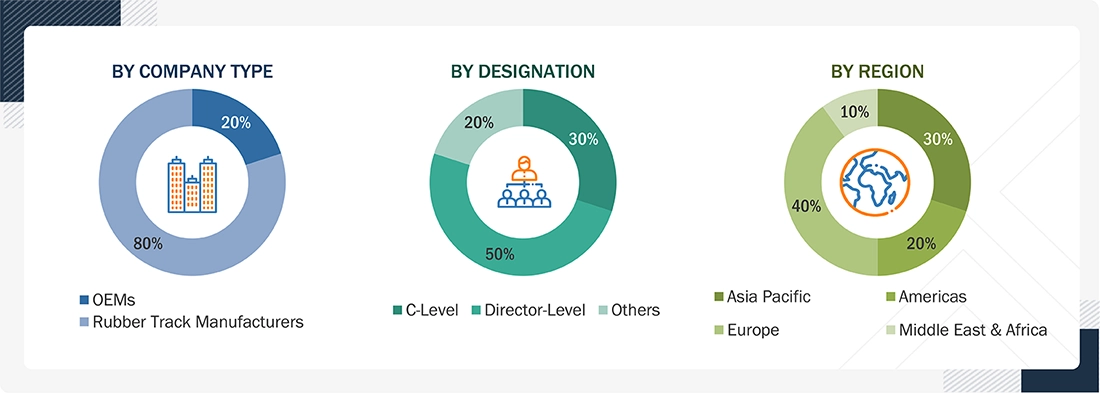
Note: Others include Sales Managers, Operational Heads, and Supply Chain Heads/Managers.
Source: Secondary Research, Primary Interviews, and MarketsandMarkets Analysis
To know about the assumptions considered for the study, download the pdf brochure
Market Size Estimation
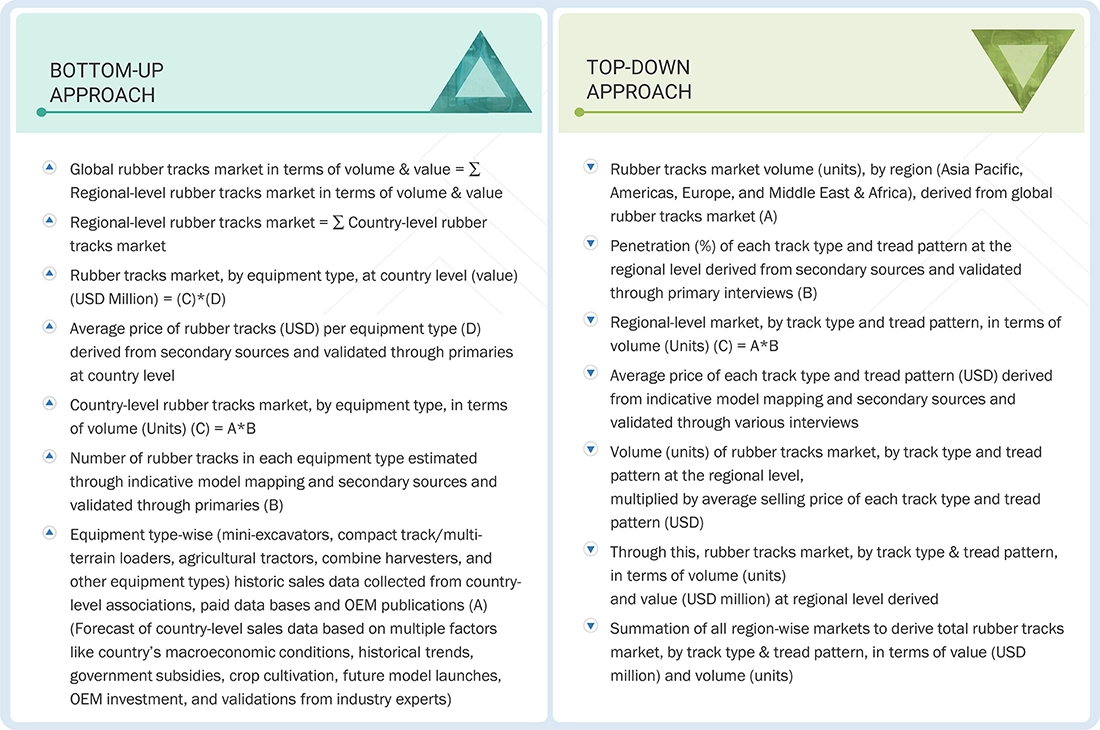
- The bottom-up approach was used to derive the market size based on volume and value. This was followed by primary interviews and feature mapping on a regional basis from the MarketsandMarkets repository.
- The market size was validated through in-depth interviews with industry experts, excerpts available in the discussion guide in the appendix, and secondary research. The report-writing phase began after arriving at the final numbers for the market size.
Bottom-Up Approach
The bottom-up approach was used to estimate and validate the size of the global rubber tracks market. The country-wise historic sales data, by equipment type (Mini-excavators, compact track/multi-terrain loaders, agricultural tractors, combine harvesters, and other equipment types), within the construction, mining, and agriculture industries, was sourced from country/regional level associations, paid databases, OEM publications, and other secondary sources. These sales were forecast based on macroeconomic indicators, industry growth, GDP trends, and government initiatives per region.
The number of rubber tracks in equipment (Mini-excavators, compact track/multi-terrain loaders, agricultural tractors, combine harvesters, and other equipment types) was identified through an indicative model mapping and secondary sources and validated through primary interviews. The number of rubber tracks used per equipment type was then multiplied by country-level sales of the respective equipment type to arrive at the country-level volume market (units) of rubber tracks by equipment type.
In the next step, the country-level rubber tracks’ average OE price (AOP) was estimated for each equipment type through supplier and dealer websites and validated through primary interviews. Each country’s rubber tracks ASP, by equipment type, has been derived from secondary sources and validated through primary sources. The volume of rubber tracks (by equipment type) was multiplied by this average OE price (AOP) to get the country-level market by equipment type in terms of value (USD million).
The rubber tracks market has been projected based on various parameters, such as analysis of historical data; market trends; and growth of drivers, such as increasing off-highway equipment sales, an increase in infrastructural development activities, and growing aftermarket sales. The forecast is based on equipment sales and is dependent on economic conditions and market demand. Also, with increased infrastructure and agricultural activities, the working hours for equipment have increased. Factors like future infrastructure projects, investments, and farm mechanization rate have been studied while estimating the aftermarket demand.
Factors such as technological advancements in rubber track materials, emerging market opportunities, and competitive landscape assessments have also been considered to arrive at the country-wise forecast for the rubber tracks.
The summation of the volume and value of the country-level market in respective regions has given the regional market size. Further summation of regional markets has helped derive the global market volume and value for rubber tracks by equipment type. The findings have been verified with various industry participants at each level.
Top-Down Approach
The top-down approach was used to estimate and validate the market, by track type (Overlapping/non-continuous and continuous), pattern type (Block-pattern, C-pattern, straight-bar, multi-bar, zig-zag, and others), application (agriculture & harvesters and construction & mining), and by sales channel (OE and aftermarket) in terms of volume and value. The rubber tracks market volume (units) and value (USD million) by region (Asia Pacific, Europe, the Americas, and Middle East & Africa) have been derived from the bottom-up approach, as mentioned earlier. The penetration of each track type (Overlapping/non-continuous and continuous) and tread pattern (Block-pattern, C-pattern, straight-bar, multi-bar, zig-zag, and others) at the regional level has been derived from an indicative model mapping and secondary sources and further validated through various interviews.
The penetration of each tread pattern (Block-pattern, C-pattern, straight-bar, multi-bar, zig-zag, and others) and track type (Overlapping/non-continuous and continuous) has been multiplied by the regional rubber tracks market to get the rubber tracks market in terms of volume (units) and value (USD million), by track type and pattern type for each region. All region-wise markets have been summed up to derive the total rubber tracks market volume (units) and value (USD million) by track type.
Rubber Track Market : Top-Down and Bottom-Up Approach
Data Triangulation
After arriving at the overall size of the rubber tracks market through the methodology mentioned above, the market was split into several segments and subsegments. The data triangulation and market breakdown procedures were employed, wherever applicable, to complete the overall market engineering process and arrive at the exact data of the market by volume and value for the key segments and subsegments. The extrapolated market data was triangulated by studying various macro indicators and regional trends from the supply and demand sides.
Market Definition
A rubber track is a continuous loop track composed of layered rubber and embedded steel cords that fit around the undercarriage of tracked vehicles. It delivers traction and stability on various terrains while minimizing ground disturbance compared to metal tracks. Rubber tracks combine flexibility with strength, which makes them essential for machinery operating in agriculture, construction, and landscaping environments.
Key Stakeholders
- Rubber track manufacturers
- Off-highway vehicle manufacturers
- Aftermarket distributors and dealers
- Undercarriage system & drivetrain suppliers
- Rental companies
- Recycling/End-of-life ecosystem
- Country-level associations
Report Objectives
-
To define, describe, and forecast the global rubber tracks market, in terms of value and volume, based on the categories given below:
- By application (Construction/mining, agriculture & harvesters) at the regional level
- By equipment type (Agriculture tractors, compact track/multi-terrain loaders, mini-excavators, combine harvester, and other equipment types) at the regional level
- By tread pattern (Block-pattern, C-pattern, straight-bar, multi-bar, zig-zag, and others) at the regional level
- By track type (Overlapping/non-continuous wire strand and continuous wire strand) at the regional level
- By channel (OE and aftermarket) at the regional level
- Country-level analysis (Asia Pacific, Europe, Americas, and Middle East & Africa) of equipment type segments
- To understand the dynamics (drivers, restraints, opportunities, and challenges) of the market
- To understand the rubber track pads’ market size, forecast, and trends
- To strategically analyze trade analysis, pricing analysis, case study analysis, patent analysis, technology analysis, regulatory analysis, key conferences and events, trends/disruptions impacting buyers, and the investment and funding case scenario
- To analyze the competitive landscape of the global players in the market, along with their market share/ranking
- To analyze the strategic partnership & OEMs’ tie-ups at the regional level
- To understand the dynamics of competitors and distinguish them into stars, emerging leaders, pervasive players, and participants according to the strength of their product portfolio and business strategies
- To analyze a detailed listing of OEMs and their brands, OEM-wise technical specifications, mergers & acquisitions, partnerships, collaborations, expansions, and product launches/developments, company evaluation matrix, competitive scenario, company valuation and financial metrics, and brand and product comparison sections
Customization Options
Along with the market data, MarketsandMarkets offers customizations per company-specific needs.
The following customization options are available for the report:
- Rubber Tacks Market, By Track Type, At The Country Level
- Rubber Tracks Market, By Tread Pattern, At The Country Level
Get the Full Rubber Track Market Report
Full forecast, segment splits, and company analysis for all Rubber Track Market.
- Rest Of Europe Rubber Track Market
- Germany Rubber Track Market
- France Rubber Track Market
- UK Rubber Track Market
- Italy Rubber Track Market
- Spain Rubber Track Market
- Russia Rubber Track Market
- China Rubber Track Market
- Japan Rubber Track Market
- India Rubber Track Market
- Indonesia Rubber Track Market
- Canada Rubber Track Market
- Mexico Rubber Track Market
- Brazil Rubber Track Market
- South Africa Rubber Track Market
- Saudi Arabia Rubber Track Market
- UAE Rubber Track Market
Need a Tailored Report?
Customize this report to your needs
Get 10% FREE Customization
Customize This Report
