
Asia Pacific Self-Sovereign Identity (SSI) Market (2024-2029)

The Asia Pacific Self-Sovereign Identity (SSI) Market was valued at $464.6 Million in 2024 and projected to reach to $13431.9 Million by 2029, representing a compound annual growth rate of 96.0%. Asia Pacific's SSI market is poised for unprecedented expansion, driven by rapid digitalization, government blockchain initiatives, and increasing demand for decentralized identity solutions across financial services, healthcare, and government sectors.


| Market Size in | USD 26.32 MN |
| Market Forecast in | |
| CAGR | |
| Forecast Period | |
| Units Considered | Value (USD MN) |
Asia Pacific Self-Sovereign Identity (SSI) Market Trends and Insights
- Asia Pacific's 96.0% compound annual growth rate significantly outpaces global expansion, driven by rapid digital transformation across the region's diverse economies.
- This acceleration reflects Asia Pacific's strategic investments in blockchain infrastructure, regulatory frameworks supporting digital identity, and widespread adoption among both enterprises and governments seeking decentralized identity solutions. Asia Pacific's dominance in the SSI market is underpinned by several regional factors unique to the geography.
- The region's large unbanked and underbanked populations in emerging markets create substantial demand for self-sovereign identity solutions that bypass traditional intermediaries.
- Asia Pacific's technology-forward regulatory environment, particularly in Singapore, South Korea, and Australia, has catalyzed innovation and enterprise deployment.
- Additionally, Asia Pacific's concentration of blockchain developers and fintech talent accelerates solution maturation and market penetration across financial services, healthcare, and government sectors. By 2029, Asia Pacific is positioned to capture a disproportionate share of global SSI value creation.
- The region's competitive advantages-including cost-effective development, regulatory clarity in key markets, and early-mover adoption by major economies-ensure sustained momentum.
- Asia Pacific organizations are increasingly leveraging SSI for cross-border payments, supply chain verification, and citizen identity programs, establishing the region as the global epicenter of self-sovereign identity innovation and deployment..
Key Market Statistics
- CAGR (2024-2029) 96.0% CAGR
- Market Size, 2024 ~USD 464.6 Million
- Forecast, 2029 ~USD 13431.9 Million
- Geography Asia Pacific
Asia Pacific Self-Sovereign Identity (SSI) Market Overview
Explosive Growth Trajectory :
Asia Pacific's SSI market is projected to grow from $464.6 million in 2024 to $13,431.9 million by 2029, representing a remarkable 96% CAGR that significantly exceeds the global average of 90.5%.
Regional Leadership Position :
Asia Pacific is establishing itself as a critical hub for SSI adoption, driven by massive digital transformation initiatives across emerging and developed economies in the region.
Strategic Digital Investment :
Governments and enterprises across Asia Pacific are prioritizing self-sovereign identity solutions to enhance digital infrastructure, financial inclusion, and cybersecurity frameworks.
Market Diversification :
The region encompasses diverse economies with varying SSI maturity levels, creating multiple growth opportunities from early-stage adoption markets to advanced implementation hubs.
Asia Pacific Self-Sovereign Identity (SSI) Market Dynamics
- The region's diverse economic landscape—spanning developed nations like Japan and Singapore alongside high-growth markets like India and China—creates a dynamic ecosystem for SSI innovation and deployment. Key growth catalysts include regulatory frameworks supporting digital identity, rising cybersecurity concerns, and enterprise adoption of blockchain technologies.
- With a 96% CAGR through 2029, Asia Pacific is positioned to become the global leader in SSI implementation, attracting significant venture capital and technology partnerships that will accelerate market maturation and commercial viability..
Market Ecosystem
Related Ecosystem
Application Security
- Cloud Security
- Security Analytics
- Network Testing
- Security Testing
- Web Application Security
- REDINGTON
- International Business Machines Corporation
- MICROSOFT CORPORATION
- Cisco Systems, Inc.
- PALO ALTO NETWORKS, INC
Cyber Security
- Cloud Security
- Biometric Systems
- Data Loss Prevention (DLP)
- Multi-Factor Authentication
- Security Analytics
- REDINGTON
- International Business Machines Corporation
- Cisco Systems, Inc.
- MITSUI BUSSAN SECURE DIRECTIONS INC
- MICROSOFT CORPORATION
Endpoint Security
- Cloud Security
- Security Analytics
- Multi-Factor Authentication
- Biometric Security and Authentication System
- Critical Communication Network
- REDINGTON
- International Business Machines Corporation
- MICROSOFT CORPORATION
- Cisco Systems, Inc.
- PALO ALTO NETWORKS, INC
Key Takeaways
- Asia Pacific's SSI market will grow from $464.6M (2024) to $13.4B (2029), representing a 96.0% CAGR that outpaces global growth.
- Asia Pacific's large unbanked populations and regulatory clarity in key markets drive accelerated enterprise and government adoption of decentralized identity solutions.
- Asia Pacific's concentration of blockchain talent and fintech innovation positions the region as the global leader in SSI deployment across financial services, healthcare, and government.
- By 2029, Asia Pacific will capture a disproportionate share of global SSI value, driven by cross-border payments, supply chain verification, and national identity programs.
Self-Sovereign Identity (SSI) Market Report Scope
| Report Metric | Details |
|---|---|
| Base Year | 2024 |
| Fastest Growing Segment | HEALTHCARE (Vertical) |
| Forecast Period | 2024-2029 |
| Growth Rate | CAGR of 90.5% from 2024 to 2029 |
| Largest Segment | SOLUTIONS (Offering) |
| Market Size Base Year (Billions) | ~USD 1.88 (2024) |
| Revenue Forecast (Billions) | ~USD 47.1 (2029) |
| Segments Covered | Offering, Identity Type, Network, Organization Size, Vertical, End User |
Asia Pacific Self-Sovereign Identity (SSI) Market Report Segmentation
6 segment dimensions are covered across the global market.
By Offering
- Services
- Software
- Solutions
By Identity Type
- Biometrics
- Non-Biometrics
By Network
- Permissioned
- Permissionless
By Organization Size
- Large Enterprises
- Smes
By Vertical
- Bfsi
- Government
- Healthcare
- It & Ites
- Media & Entertainment
- Other Verticals
- Real Estate & Construction
- Retail & E-Commerce
- Telecom
- Travel & Hospitality
By End User
- Enterprise
- Individual
Target Audience
- Technology Vendors & Solution Providers : Develop market-specific product strategies and go-to-market plans tailored to Asia Pacific's unique regulatory environment, customer preferences, and competitive dynamics.
- Financial Services & Banking Institutions : Evaluate SSI adoption opportunities to enhance customer onboarding, KYC/AML compliance, and digital banking services across Asia Pacific markets.
- Government & Regulatory Bodies : Benchmark digital identity initiatives against regional peers and understand best practices for implementing national SSI frameworks and digital governance solutions.
- Investment & Private Equity Firms : Identify high-potential SSI startups, technology platforms, and service providers in Asia Pacific for investment, acquisition, and portfolio diversification opportunities.
- Enterprise & Consulting Organizations : Support digital transformation initiatives by understanding Asia Pacific's SSI market maturity, implementation challenges, and ROI potential across industries.
Countries within Asia Pacific - compare and drill down
| Country | 2025 size (native) |
|---|---|
| China | USD 3871.9 Million |
| Japan | USD 2581.2 Million |
| India | USD 1489.4 Million |
| Singapore | USD 2183.2 Million |
| Rest Of Apac | USD 3306.2 Million |
Country market size visualization
Reasons to Buy this Report
- Regional Market Segmentation : Gain detailed insights into Asia Pacific's diverse sub-markets, including country-level analysis of China, Japan, India, Singapore, and Rest of APAC regions with specific growth drivers and adoption patterns.
- Competitive Landscape Intelligence : Understand the competitive positioning of SSI providers, technology vendors, and service integrators operating across Asia Pacific's rapidly evolving market ecosystem.
- Investment & Expansion Strategy : Identify high-growth markets and emerging opportunities within Asia Pacific to inform market entry strategies, partnership development, and resource allocation decisions.
- Regulatory & Policy Insights : Access comprehensive analysis of government initiatives, regulatory frameworks, and policy developments shaping SSI adoption across Asia Pacific nations.
- Technology Adoption Trends : Discover sector-specific SSI implementation trends across financial services, healthcare, government, and enterprise segments unique to Asia Pacific markets.
Frequently asked questions
What is the projected market size of SSI in Asia Pacific by 2029?
Asia Pacific's Self-Sovereign Identity market is projected to reach $13,431.9 million by 2029, growing from $464.6 million in 2024 at a 96.0% CAGR.
Why is Asia Pacific's SSI market growing faster than the global average?
Asia Pacific's 96.0% CAGR exceeds the global 90.5% rate due to the region's large unbanked populations, supportive regulatory frameworks in key markets, and concentration of blockchain development talent.
Which Asia Pacific countries are leading SSI adoption?
Singapore, South Korea, and Australia are leading Asia Pacific SSI adoption due to their technology-forward regulatory environments and early-mover government and enterprise initiatives.
What are the primary use cases for SSI in Asia Pacific?
Asia Pacific organizations are deploying SSI for cross-border payments, supply chain verification, financial services KYC/AML, healthcare records, and national citizen identity programs.
How does Asia Pacific's SSI market compare to other global regions?
Asia Pacific's 96.0% CAGR and projected $13.4B market size by 2029 position it as the fastest-growing and largest SSI market globally, outpacing North America and Europe.
RESEARCH METHODOLOGY
The study involved significant activities in estimating the current market size for the self-sovereign identity market. Exhaustive secondary research was done to collect information on the self-sovereign identity industry. The next step was to validate these findings, assumptions, and sizing with industry experts across the value chain using primary research. Different approaches, such as top-down and bottom-up, were employed to estimate the total market size. After that, the market breakup and data triangulation procedures were used to estimate the market size of the segments and subsegments of the self-sovereign identity market.
Secondary Research
The market for the companies offering self-sovereign identity solutions and services is arrived at by secondary data available through paid and unpaid sources, analyzing the product portfolios of the major companies in the ecosystem, and rating the companies by their performance and quality. Various sources were referred to in the secondary research process to identify and collect information for this study. The secondary sources include annual reports, press releases, investor presentations of companies, white papers, journals, certified publications, and articles from recognized authors, directories, and databases.
In the secondary research process, various secondary sources were referred to identify and collect information related to the study. Secondary sources included annual reports, press releases, and investor presentations of self-sovereign identity vendors, forums, certified publications, and whitepapers. The secondary research was used to obtain critical information on the industry's value chain, the total pool of key players, market classification, and segmentation from the market and technology-oriented perspectives.
Primary Research
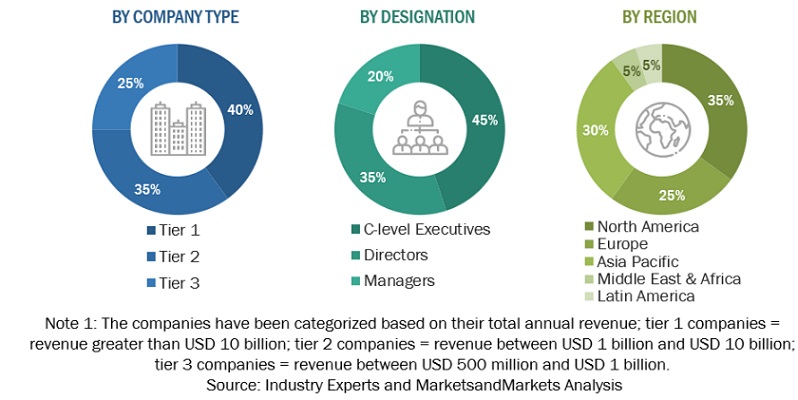
In the primary research process, various supply and demand sources were interviewed to obtain qualitative and quantitative information for this report. The primary sources from the supply side included industry experts, such as Chief Executive Officers (CEOs), Vice Presidents (VPs), marketing directors, technology and innovation directors, and related key executives from various key companies and organizations operating in the self-sovereign identity market.
After the complete market engineering (calculations for market statistics, market breakdown, market size estimations, market forecasting, and data triangulation), extensive primary research was conducted to gather information and verify and validate the critical numbers arrived at. Primary research was also undertaken to identify the segmentation types, industry trends, competitive landscape of self-sovereign identity solutions offered by various market players, and fundamental market dynamics, such as drivers, restraints, opportunities, challenges, industry trends, and key player strategies.
In the complete market engineering process, the top-down and bottom-up approaches and several data triangulation methods were extensively used to perform the market estimation and market forecasting for the overall market segments and subsegments listed in this report. Extensive qualitative and quantitative analysis was performed on the complete market engineering process to list the key information/insights throughout the report.
Following is the breakup of the primary study:
To know about the assumptions considered for the study, download the pdf brochure
Market Size Estimation
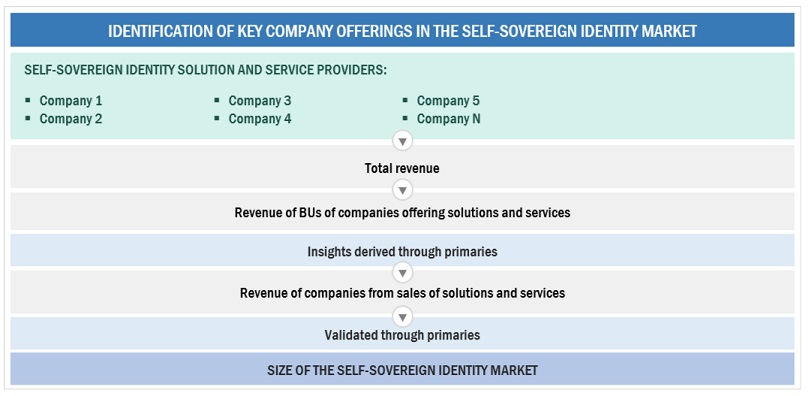
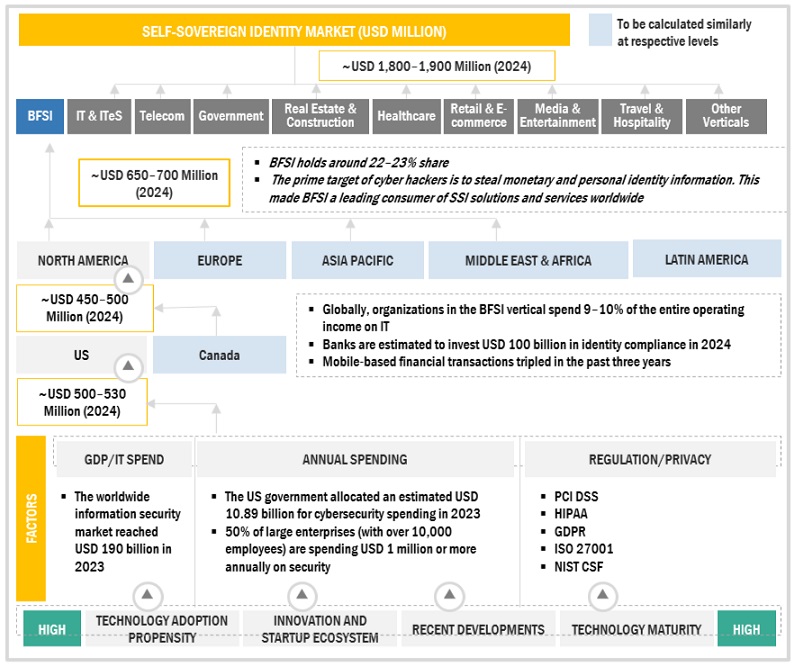
Top-down and bottom-up approaches were used to estimate and validate the size of the global self-sovereign identity market and the size of various other dependent sub-segments in the overall self-sovereign identity market. The research methodology used to estimate the market size includes the following details: critical players in the market were identified through secondary research, and their market shares in the respective regions were determined through primary and secondary research. This entire procedure included the study of the annual and financial reports of the top market players, and extensive interviews were conducted for key insights from the industry leaders, such as CEOs, VPs, directors, and marketing executives.
All percentage splits and breakdowns were determined using secondary sources and verified through primary sources. All possible parameters that affect the market covered in this research study have been accounted for, viewed in extensive detail, verified through primary research, and analyzed to get the final quantitative and qualitative data. This data is consolidated and added to detailed inputs and analysis from MarketsandMarkets.
Infographic Depicting Bottom-Up And Top-Down Approaches
To know about the assumptions considered for the study, Request for Free Sample Report
Data Triangulation
The market was split into several segments and subsegments after arriving at the overall market size using the market size estimation processes explained above. The data triangulation and market breakup procedures were employed, wherever applicable, to complete the overall market engineering process and arrive at the exact statistics of each market segment and subsegment. The data was triangulated by studying various factors and trends from both the demand and supply sides.
Market Definition
Self-sovereign identity (SSI) refers to a digital framework that emphasizes individual ownership and control over one's identity information, free from the oversight of centralized authorities. In an SSI system, individuals manage their identity credentials digitally, enabling them to selectively disclose relevant information to different parties without relying on intermediaries. This approach empowers users to assert their identities with greater autonomy and security, akin to physical interactions.
Key Stakeholders
- Government agencies
- Consulting firms
- Information Technology (IT) security agencies
- Raw material/Component suppliers
- Research organizations and consulting companies
- Government bodies, such as regulating authorities and policymakers
-
Venture capitalists and private equity firms
- Chief technology and data officers
- SSI service professionals
- SSI foundations
- Business analysts
- Information Technology (IT) professionals
- Consultants/Consultancies/Advisory firms
Report Objectives
- To define, describe, and forecast the self-sovereign identity market based on - offering, identity type, network, organization size, vertical, and region.
- To define, describe, and forecast the self-sovereign identity market by – offering, identity type, network, organization size, vertical, and region.
- To forecast the market size of five main regions: North America, Europe, Asia Pacific (APAC), Middle East & Africa (MEA), and Latin America
- To analyze the subsegments of the market concerning individual growth trends, prospects, and contributions to the overall market.
- To provide detailed information on the major factors (drivers, restraints, opportunities, and challenges) influencing the growth of the self-sovereign identity market.
- To analyze opportunities in the market for stakeholders by identifying high-growth segments of the self-sovereign identity market.
- To profile the key players of the self-sovereign identity market and comprehensively analyze their market size and core competencies.
- Track and analyze competitive developments, such as new product launches, mergers and acquisitions, partnerships, agreements, and collaborations in the global self-sovereign identity market.
Customization Options
With the given market data, MarketsandMarkets offers customizations based on company-specific needs. The following customization options are available for the report:
Geographic Analysis
- Further breakup of the Asia Pacific market into countries contributing 75% to the regional market size
- Further breakup of the North American market into countries contributing 100% to the regional market size
- Further breakup of the Latin American market into countries contributing 75% to the regional market size
- Further breakup of the Middle Eastern and African market into countries contributing 75% to the regional market size
- Further breakup of the European market into countries contributing 75% to the regional market size
Company Information
- Detailed analysis and profiling of additional market players (up to 5)
Get the Full Self-Sovereign Identity (SSI) Market Report
Full forecast, segment splits, and company analysis for all Self-Sovereign Identity (SSI) Market.
- Canada Self-Sovereign Identity (SSI) Market
- US Self-Sovereign Identity (SSI) Market
- UK Self-Sovereign Identity (SSI) Market
- Germany Self-Sovereign Identity (SSI) Market
- France Self-Sovereign Identity (SSI) Market
- Italy Self-Sovereign Identity (SSI) Market
- China Self-Sovereign Identity (SSI) Market
- Japan Self-Sovereign Identity (SSI) Market
- India Self-Sovereign Identity (SSI) Market
- Singapore Self-Sovereign Identity (SSI) Market
- UAE Self-Sovereign Identity (SSI) Market
- Brazil Self-Sovereign Identity (SSI) Market
- Mexico Self-Sovereign Identity (SSI) Market
- Rest Of Europe Self-Sovereign Identity (SSI) Market
- Rest Of Apac Self-Sovereign Identity (SSI) Market
- Rest Of Latin America Self-Sovereign Identity (SSI) Market
- Ksa Self-Sovereign Identity (SSI) Market
- Rest Of GCC Countries Self-Sovereign Identity (SSI) Market
Need a Tailored Report?
Customize this report to your needs
Get 10% FREE Customization
Customize This Report
