
US Semiconductor Market for Robots (2025-2030)

The US Semiconductor Market for Robots was valued at $3660.3 Million in 2025 and projected to reach to $12630.8 Million by 2030, representing a compound annual growth rate of 28.1%. The US semiconductor market for robots is positioned for exceptional growth through 2030, fueled by widespread industrial automation adoption and reshoring initiatives.


| Market Size in | USD 26.32 MN |
| Market Forecast in | |
| CAGR | |
| Forecast Period | |
| Units Considered | Value (USD MN) |
US Semiconductor Market for Robots Trends and Insights
- This represents a compound annual growth rate of 28.1%, driven by accelerating automation adoption across manufacturing, logistics, and industrial sectors in the US.
- The US market benefits from strong domestic demand for advanced robotics, significant R&D investments, and a mature technology ecosystem supporting semiconductor innovation. US semiconductor manufacturers and suppliers are capitalizing on the growing need for specialized chips that power robotic vision, processing, and control systems.
- Between 2025 and 2030, the US is expected to maintain its position as a critical hub for both semiconductor production and robotic system integration.
- The market's robust growth trajectory reflects the US economy's shift toward intelligent automation and the strategic importance of domestic semiconductor capabilities for national competitiveness..
Key Market Statistics
- CAGR (2025-2030) 28.1% CAGR
- Market Size, 2025 ~USD 3660.3 Million
- Forecast, 2030 ~USD 12630.8 Million
- Country US
US Semiconductor Market for Robots Overview
Explosive US Market Growth :
The US semiconductor market for robots is projected to grow from $3,660.3 million in 2025 to $12,630.8 million by 2030, representing a robust 28.1% CAGR driven by domestic automation initiatives.
Manufacturing & Logistics Dominance :
US manufacturing and logistics sectors are leading semiconductor adoption for robotics, with automotive, e-commerce fulfillment, and smart factories driving demand for advanced processing chips.
Strong Domestic Innovation Ecosystem :
The US benefits from a mature robotics and semiconductor ecosystem, with major tech hubs in Silicon Valley, Texas, and the Midwest fostering rapid innovation and competitive advantage in robot chip development.
Industrial Automation Acceleration :
Labor shortages and rising operational costs across US industries are accelerating adoption of robotic systems, creating sustained demand for specialized semiconductors powering AI-enabled and autonomous robots.
US Semiconductor Market for Robots Dynamics
- Manufacturing facilities are increasingly deploying advanced robotic systems requiring cutting-edge semiconductor solutions for AI processing, real-time control, and edge computing capabilities.
- The convergence of labor market pressures, supply chain resilience demands, and technological maturity creates a compelling growth environment.
- Additionally, government incentives for domestic semiconductor production and robotics innovation will further accelerate market expansion, positioning the US as a critical hub for robot semiconductor development and deployment..
Market Ecosystem
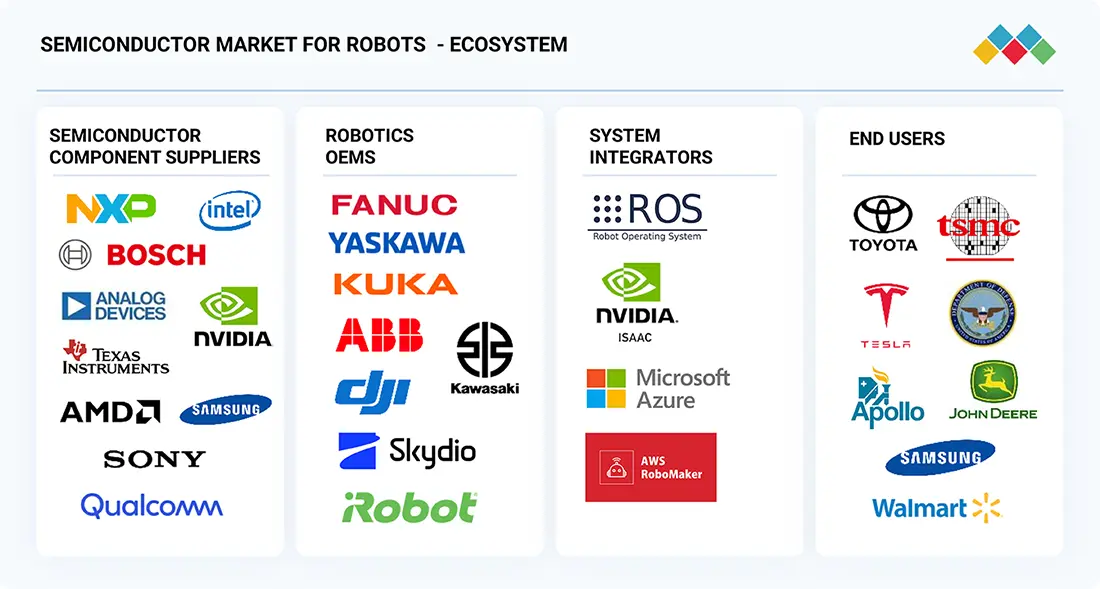
Semiconductor Market: COMMERCIAL USE CASES ACROSS INDUSTRIES
| COMPANY | USE CASE DESCRIPTION | BENEFITS |
|---|---|---|
 |
PMICs and motor driver ICs for robotic actuation systems | Higher power efficiency | Reduced heat generation | Smoother and precise robotic movement |
 |
Secure connectivity ICs and microcontrollers for autonomous mobile robots (AMRs) | Reliable real-time communication | Enhanced safety features | Scalable architecture for robotics |
 |
FPGAs, MCUs for industrial and service robots | Deterministic control | High reliability |Reduced development time |Optimized energy management |
 |
Image sensors for robotic vision systems in logistics and autonomous delivery robots | Superior low-light imaging | Faster object recognition | Improved navigation in dynamic settings |
 |
GPUs enabling autonomous navigation and vision processing in industrial robots | High-speed parallel computing | Real-time decision-making |Improved accuracy in object detection |
Logos and trademarks shown above are the property of their respective owners. Their use here is for informational and illustrative purposes only.
Related Ecosystem
Drones And Robotics
- Sensors
- Articulated Robots
- Cartesian Robots
- Scara Robots
- Actuators
- ABB India Limited
- KUKA AG
- MOMENTIVE PERFORMANCE MATERIALS INC.
- Fanuc Corporation
- STAUBLI INTERNATIONAL AG
Key Takeaways
- The US semiconductor market for robots will grow from $3.66B in 2025 to $12.63B in 2030, representing a 28.1% CAGR.
- US demand for robotic semiconductors is driven by automation in manufacturing, logistics, and industrial applications.
- The US maintains competitive advantages in semiconductor R&D and advanced robotics integration capabilities.
- Strong domestic investment and supply chain resilience position the US as a key growth market through 2030.
Semiconductor Market for Robots Report Scope
| Report Metric | Details |
|---|---|
| Base Year | 2025 |
| Fastest Growing Segment | PROFESSIONAL SERVICE ROBOTS (Robot Type) |
| Forecast Period | 2025-2030 |
| Growth Rate | CAGR of 29.7% from 2025 to 2030 |
| Largest Segment | CONSUMER ELECTRONICS (Vertical) |
| Market Size Base Year (Billions) | ~USD 11.24 (2025) |
| Revenue Forecast (Billions) | ~USD 41.24 (2030) |
| Segments Covered | Component, Type, Robot Type, Vertical |
US Semiconductor Market for Robots Report Segmentation
4 segment dimensions are covered across the global market.
By Component
- Actuation Systems
- Compute
- Connectivity Ics
- Power Management Ics (Pmics)
- Sensors
By Type
- Agricultural Robots
- Articulated
- Cartesian/Gantry
- Cleaning Robots
- Collaborative
- Construction Robots
- Cylindrical/Polar Coordinate
- Delivery Robots
- Encoder
- Entertainment Robots
- Fixed
- Hospitality Robots
- Humanoids
- Image Sensors
- Imu
- Inspection/Monitoring Rovers (Factory/Plant)
- Lidar Sensors
- Medical Exoskeletons
- Mobile
- Pressure Sensors
- Robotic Pet/Companion Robots
- Scara
- Security Robots
- Surgical Robots
- Tactile Sensors
- Temperature Sensors
- Transport Agv
- Ultrasonic Sensors
- Warehouse Amr
By Robot Type
- Drones
- Industrial Robots
- Personal & Household Service Robots
- Professional Service Robots
By Vertical
- Automotive
- Consumer Electronics
- Food & Beverages
- Healthcare & Pharmaceutical
- Industrial
- Logistics & Warehousing
- Other Verticals
Target Audience
- Semiconductor Manufacturers : US-based and international chip makers need detailed market intelligence to develop robot-specific processors, optimize production capacity, and capture market share in the rapidly expanding American robotics sector.
- Robotics & Automation Companies : Robot manufacturers and automation solution providers require US market data to understand semiconductor demand, plan product roadmaps, and identify supply chain opportunities within the domestic market.
- Industrial Equipment OEMs : Manufacturers of industrial machinery and automation systems need insights into US semiconductor trends to integrate advanced chips into their robotic offerings and maintain competitive advantage.
- Investment & Private Equity Firms : Investors evaluating opportunities in US robotics and semiconductor sectors require comprehensive market analysis to identify high-growth companies, assess valuations, and guide portfolio strategy.
- Technology & Strategy Consultants : Consulting firms advising US industrial clients on digital transformation and automation need market data to develop credible strategies, benchmark performance, and justify technology investments.
Reasons to Buy this Report
- Precise US Market Sizing & Forecasts : Access validated market data specific to the US, with detailed projections from 2025-2030 enabling accurate budgeting, investment planning, and competitive positioning in the American robotics semiconductor sector.
- Identify High-Growth US Segments : Understand which US industries (manufacturing, logistics, automotive) are driving semiconductor demand for robots, allowing targeted product development and go-to-market strategies for maximum ROI.
- Competitive Intelligence for US Players : Benchmark against domestic competitors and understand the US market landscape, including regional hubs, key players, and emerging opportunities to strengthen your market position.
- Strategic Investment & M&A Insights : Make informed decisions on US market entry, partnerships, or acquisitions by understanding growth drivers, market dynamics, and investment hotspots within the American robot semiconductor ecosystem.
- Regulatory & Policy Impact Analysis : Gain insights into how US government incentives, reshoring policies, and domestic semiconductor initiatives are shaping market opportunities and long-term growth trajectories.
Frequently asked questions
What is the current size of the US semiconductor market for robots?
The US semiconductor market for robots is valued at $3,660.3 million in 2025 and is projected to grow to $12,630.8 million by 2030.
What is the growth rate of the US semiconductor market for robots?
The US semiconductor market for robots is growing at a compound annual growth rate (CAGR) of 28.1% from 2025 to 2030.
Which industries drive semiconductor demand for robots in the US?
Manufacturing, logistics, industrial automation, and advanced robotics integration sectors are primary drivers of semiconductor demand in the US market.
Why is the US semiconductor market for robots growing so rapidly?
The US market is driven by accelerating automation adoption, significant R&D investments, domestic manufacturing initiatives, and the strategic importance of semiconductor self-sufficiency.
What factors support the US semiconductor market for robots through 2030?
Strong domestic demand, mature technology ecosystems, competitive manufacturing capabilities, and government support for semiconductor production sustain growth in the US market.
RESEARCH METHODOLOGY
The research process for this technical, market-oriented, and commercial study of the semiconductor market for robots included the systematic gathering, recording, and analysis of data about companies operating in the market. It involved the extensive use of secondary sources, directories, and databases (Factiva, Oanda, and OneSource) to identify and collect relevant information. In-depth interviews were conducted with various primary respondents, including experts from core and related industries and preferred manufacturers, to obtain and verify critical qualitative and quantitative information as well as to assess the growth prospects of the market. Key players in the semiconductor market for robots were identified through secondary research, and their market rankings were determined through primary and secondary research. This included studying annual reports of top players and interviewing key industry experts, such as CEOs, directors, and marketing executives.
Secondary Research
In the secondary research process, various secondary sources were used to identify and collect information for this study. These include annual reports, press releases, and investor presentations of companies, whitepapers, certified publications, and articles from recognized associations and government publishing sources. Research reports from a few consortiums and councils were also consulted to structure qualitative content. Secondary sources included corporate filings (such as annual reports, investor presentations, and financial statements); trade, business, and professional associations; white papers; Journals and certified publications; articles by recognized authors; gold-standard and silver-standard websites; directories; and databases. Data was also collected from secondary sources, such as the International Trade Centre (ITC) and the International Monetary Fund (IMF).
List of key secondary sources
|
Source |
Web Link |
|
Semiconductor Industry Association |
www.semiconductors.org |
|
Global Semiconductor Alliance |
www.gsaglobal.org |
|
European Semiconductor Industry Association |
www.eusemiconductors.eu |
|
The Taiwan Semiconductor Industry Association |
www.tsia.org |
|
International Federation of Robotics (IFR) |
www.ifr.org/ |
|
Association for Advancing Automation (A3) |
https://www.automate.org/robotics |
|
IEEE Robotics and Automation Society |
www.ieee-ras.org |
|
euRobotics |
www.eu-robotics.net/ |
|
Robotics Business Review (RBR) |
www.roboticsbusinessreview.com |
|
International Federation of Robotics (IFR) |
www.ifr.org/ |
Primary Research
Extensive primary research was accomplished after understanding and analyzing the semiconductor market for robots scenario through secondary research. Several primary interviews were conducted with key opinion leaders from both demand- and supply-side vendors across four major regions—North America, Europe, Asia Pacific, and RoW. Approximately 30% of the primary interviews were conducted with the demand side, and 70% with the supply side. Primary data was collected through questionnaires, emails, and telephonic interviews. Various departments within organizations, such as sales, operations, and administration, were contacted to provide a holistic viewpoint in the report.
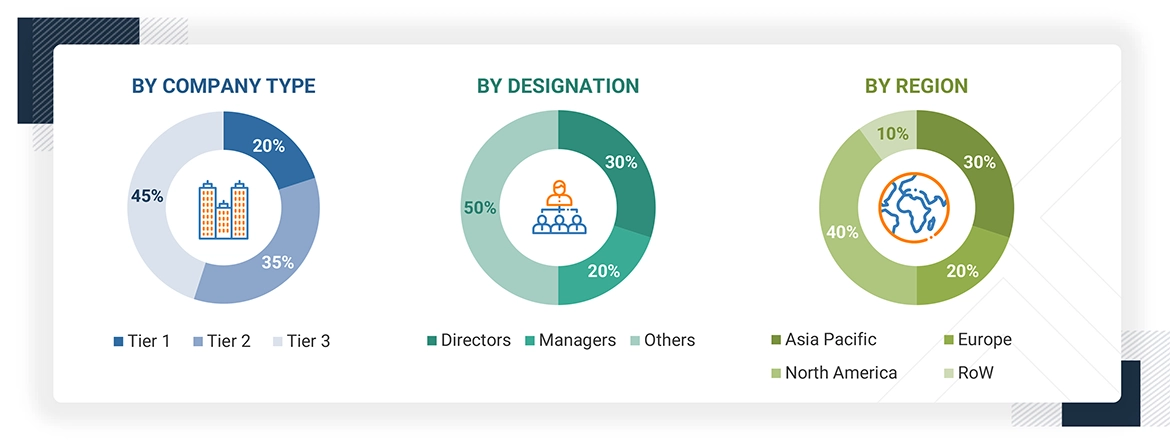
Notes: Other designations include technology heads, media analysts, sales managers, marketing managers, and product managers.
The three tiers of the companies are based on their total revenues as of 2024; Tier 1: >USD 1 billion, Tier 2: USD 500 million–1 billion, and Tier 3: USD 500 million.
To know about the assumptions considered for the study, download the pdf brochure
Market Size Estimation
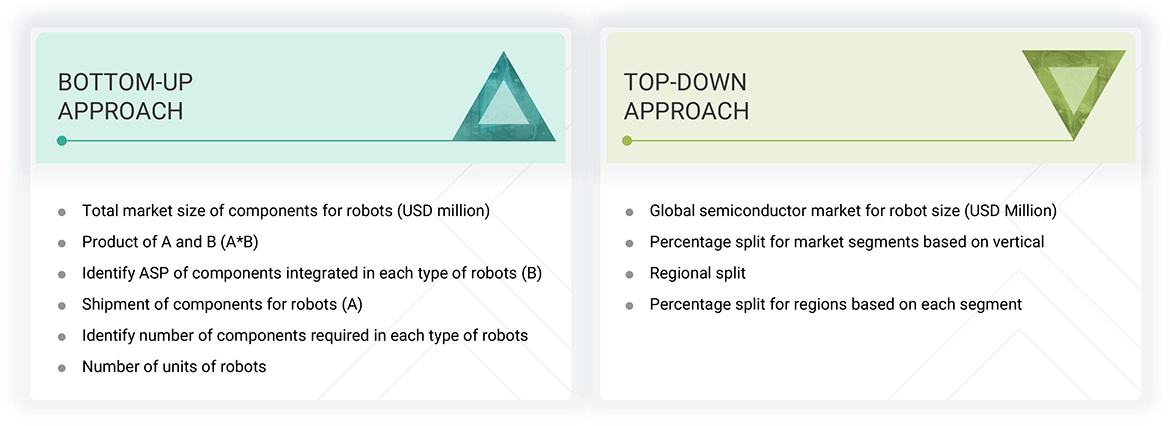
In the complete market engineering process, top-down and bottom-up approaches and several data triangulation methods have been used to perform the market size estimation and forecasting for the overall market segments and subsegments listed in this report. Extensive qualitative and quantitative analyses have been performed on the complete market engineering process to list key information/insights throughout the report. The following table explains the process flow of the market size estimation.
The key players in the market were identified through secondary research, and their rankings in the respective regions were determined through primary and secondary research. This entire procedure involved the study of the annual and financial reports of top players and interviews with industry experts such as chief executive officers, vice presidents, directors, and marketing executives for quantitative and qualitative key insights. All percentage shares, splits, and breakdowns were determined using secondary sources and verified through primary sources. All parameters that affect the markets covered in this research study were accounted for, viewed in extensive detail, verified through primary research, and analyzed to obtain the final quantitative and qualitative data. This data was consolidated, supplemented with detailed inputs and analysis from MarketsandMarkets, and presented in this report.
Bottom-Up Approach
- Shipments of various robot types (industrial robots, professional service robots, personal & household service robots, and drones) were identified through primary and secondary research.
- The number of semiconductor components integrated into each robot type was mapped across compute, memory, sensors, connectivity ICs, PMICs, and others.
- Robot shipments were multiplied by the average number of components per robot to calculate component shipment volumes.
- Component shipment volumes were multiplied by the average selling price (ASP) of each component category to derive the global number.
- The process was repeated for all robot categories, including articulated robots, humanoids, drones, cleaning robots, delivery robots, and others.
- The global semiconductor market size for robots was derived by summing revenues across all robot types and component segments.
- CAGR was estimated based on robotics penetration rate, industry adoption trends, and demand-supply dynamics for semiconductors.
- All estimates were validated through discussions with key stakeholders (semiconductor vendors, robotics OEMs, and domain experts) and cross-checked with company reports, press releases, and industry databases.
Top-Down Approach
- Focusing on the top-line investment and spending being made across various industry ecosystems
- Building and developing the information related to revenue generated through key semiconductor products used in robotic systems
- Carrying out multiple on-field discussions with key opinion leaders (KOLs) across each major company involved in the development of semiconductors for robots
- Estimating the vertical split using secondary sources, based on factors such as the robot type and the semiconductor component mix (compute, sensors, memory, connectivity, power management, actuation, and analog/mixed-signal)
- Estimating the regional split using secondary sources, based on various factors such as the number of players in a specific country and region, robot adoption maturity, and types of semiconductor products demanded
Semiconductor Market for Robot : Top-Down and Bottom-Up Approach
Data Triangulation
After arriving at the overall size of the semiconductor market for robots through the process explained above, the overall market has been split into several segments. Data triangulation procedures have been employed to complete the overall market engineering process and arrive at the exact statistics for all the segments, wherever applicable. The data has been triangulated by studying various factors and trends from both the demand and supply sides. The market has also been validated using both the top-down and bottom-up approaches.
Market Definition
The semiconductor market for robots encompasses the range of electronic components specifically designed or adapted to enable robotic systems across industrial, healthcare, automotive, food & beverages, logistics & warehousing, and consumer applications. This market includes processors, sensors, memory, power management ICs, connectivity ICs, actuation systems, and other analog/mixed-signal ICs that power, control, and connect robots. Driven by advancements in AI, automation, and edge computing, these semiconductors provide the computational performance, energy efficiency, precision control, and environmental adaptability required for robots to perform complex, autonomous, and collaborative tasks.
Key Stakeholders
- Government and Defense Agencies
- Investors and Financial Institutions
- Semiconductor Manufacturers
- Robotics OEMs
- System Integrators
- Regulatory Bodies
Report Objectives
- To define, describe, segment, and forecast the size of the semiconductor market for robots, in terms of component, robot type, vertical, and region
- To forecast the size of the market segments for four major regions: North America, Europe, Asia Pacific, and RoW
- To give detailed information regarding drivers, restraints, opportunities, and challenges influencing the growth of the market
- To provide value chain analysis, ecosystem analysis, case study analysis, patent analysis, trade analysis, technology analysis, pricing analysis, key conferences and events, key stakeholders and buying criteria, Porter's five forces analysis, investment and funding scenario, and regulations pertaining to the market
- To strategically analyze micromarkets with regard to individual growth trends, prospects, and contributions to the total market
- To analyze opportunities for stakeholders by identifying high-growth segments of the market
- To strategically profile the key players, comprehensively analyze their market positions in terms of ranking and core competencies, and provide a competitive market landscape
- To analyze strategic approaches, such as product launches, acquisitions, agreements, and partnerships, in the semiconductor market for robots
Available Customizations
With the given market data, MarketsandMarkets offers customizations according to the company's specific needs. The following customization options are available for the report:
Company Information:
- Detailed analysis and profiling of additional market players (up to 7)
Get the Full Semiconductor Market for Robots Report
Full forecast, segment splits, and company analysis for all Semiconductor Market for Robots.
- Canada Semiconductor Market for Robots
- Mexico Semiconductor Market for Robots
- Germany Semiconductor Market for Robots
- UK Semiconductor Market for Robots
- France Semiconductor Market for Robots
- Italy Semiconductor Market for Robots
- Rest Of Europe Semiconductor Market for Robots
- China Semiconductor Market for Robots
- Japan Semiconductor Market for Robots
- South Korea Semiconductor Market for Robots
- India Semiconductor Market for Robots
- Rest Of Asia Pacific Semiconductor Market for Robots
Need a Tailored Report?
Customize this report to your needs
Get 10% FREE Customization
Customize This Report
