
Spain Smart Warehousing Market (2025-2030)

The Spain Smart Warehousing Market was valued at $975.3 Million in 2025 and projected to reach to $1408.6 Million by 2030, representing a compound annual growth rate of CAGR 7.6%. Spain's smart warehousing market is poised for sustained growth as logistics companies invest in automation and digital transformation to meet evolving supply chain demands.


| Market Size in | USD 26.32 MN |
| Market Forecast in | |
| CAGR | |
| Forecast Period | |
| Units Considered | Value (USD MN) |
Spain Smart Warehousing Market Trends and Insights
- This expansion reflects Spain's increasing adoption of automation, IoT integration, and data analytics technologies within its logistics and supply chain infrastructure.
- Spain is positioning itself as a key logistics hub in Southern Europe, driving demand for intelligent warehouse solutions that enhance operational efficiency and reduce costs. The Spanish smart warehousing sector is benefiting from rising e-commerce activity, labor cost pressures, and regulatory emphasis on supply chain transparency.
- Spain's strategic location and robust manufacturing base are catalyzing investments in advanced warehouse management systems and robotics.
- Between 2025 and 2030, Spain is expected to see accelerated digital transformation across its distribution centers, with particular growth in automated storage and retrieval systems, real-time inventory tracking, and AI-powered demand forecasting. Spain's market growth trajectory aligns with broader European digitalization trends, though at a slightly slower pace than the global average of 8.3% CAGR.
- The country's competitive advantages in logistics infrastructure and increasing venture capital interest in supply chain tech are expected to sustain momentum through 2030..
Key Market Statistics
- CAGR (2025-2030) CAGR 7.6%
- Market Size, 2025 ~USD 975.3 Million
- Forecast, 2030 ~USD 1408.6 Million
- Country Spain
Spain Smart Warehousing Market Overview
Market Valuation Growth :
Spain's smart warehousing market is valued at USD 975.3 million in 2025, with projections reaching USD 1,408.6 million by 2030, demonstrating robust expansion in the Iberian logistics sector.
Strong CAGR Performance :
The Spanish market is growing at a 7.6% CAGR through 2030, slightly below the global average of 8.3%, indicating steady but measured adoption of smart warehousing technologies across the region.
Technology Integration Focus :
Spain is increasingly adopting automation, IoT integration, and data analytics technologies to modernize its logistics and supply chain infrastructure, positioning itself as a regional innovation hub.
Strategic Supply Chain Positioning :
As a key European logistics gateway, Spain is leveraging smart warehousing to enhance operational efficiency and competitiveness in cross-border trade and Mediterranean distribution networks.
Spain Smart Warehousing Market Dynamics
- The 7.6% CAGR reflects increasing adoption among Spanish enterprises seeking to optimize warehouse operations, reduce costs, and improve inventory management through IoT and analytics solutions. The market's expansion is driven by Spain's strategic position in European trade, growing e-commerce penetration, and government initiatives supporting industrial digitalization.
- By 2030, the market is expected to reach USD 1,408.6 million, with continued investment in smart technologies positioning Spain as a competitive logistics hub within the EU and Mediterranean regions..
Market Ecosystem
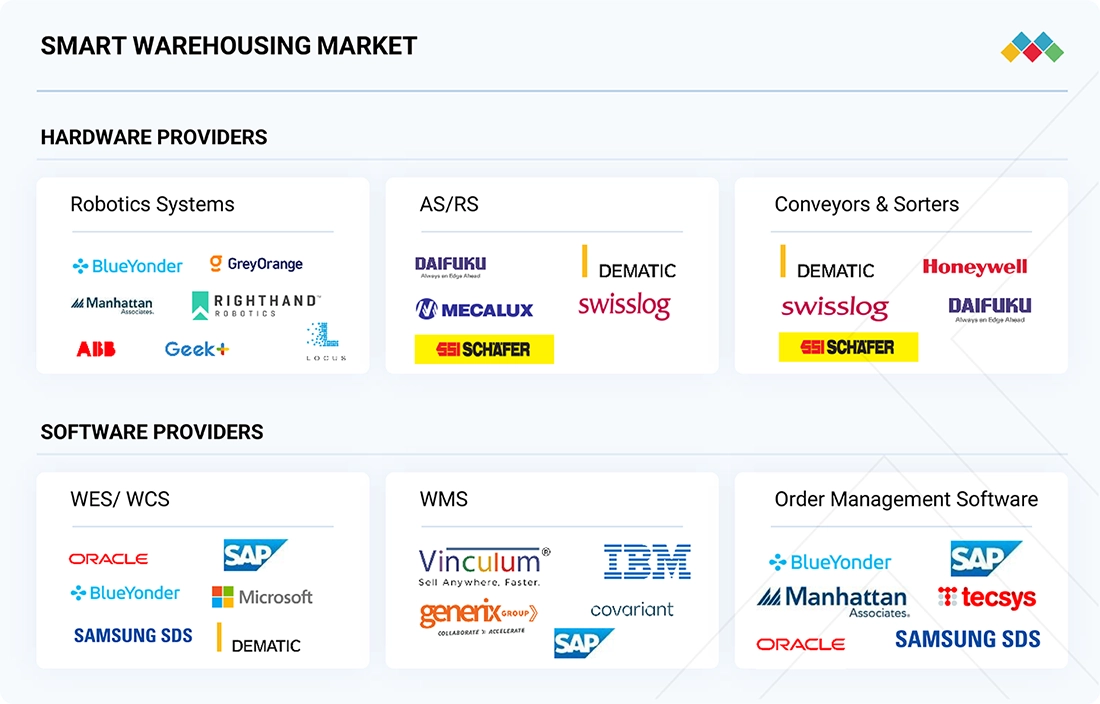
Smart Warehousing Market: COMMERCIAL USE CASES ACROSS INDUSTRIES
| COMPANY | USE CASE DESCRIPTION | BENEFITS |
|---|---|---|
 |
Costa Logistics implemented Manhattan Associates’ WMS to digitize cold chain operations, integrate warehouse and transport systems, and improve efficiency, visibility, and scalability across its nationwide fresh produce distribution centers. | Improved pick accuracy and throughput, enhanced visibility across the cold chain, faster response to peak-season demand without additional labor, and scalable integration with future automation technologies. |
 |
Nagel Group adopted PSIwms from PSI Group, using AI-driven logistics software to optimize storage, picking, and route planning across temperature-controlled warehouses, ensuring real-time adaptability to fluctuating demand. | Increased operational efficiency and transparency, reduced picking times, enabled dynamic capacity management for demand fluctuations, and lowered operational costs while improving customer service levels. |
 |
Endries International deployed Infor WMS on AWS to automate warehouse workflows, integrate ERP systems, and enhance visibility, accuracy, and scalability for global vendor-managed inventory and order fulfillment. | Achieved a 40% boost in warehouse productivity, improved inventory accuracy and fulfillment speed, enhanced scalability to meet customer demand, and strengthened service reliability across global OEM supply chains. |
Logos and trademarks shown above are the property of their respective owners. Their use here is for informational and illustrative purposes only.
Related Ecosystem
Digitalization And Iot
- Sensors
- Remote Monitoring
- Supply Chain Management
- Passenger Information System (PIS)
- Platform as A Service (PaaS)
- International Business Machines Corporation
- Cisco Systems, Inc.
- MICROSOFT CORPORATION
- Oracle Corporation
- HUAWEI TECHNOLOGIES CO LTD
Key Takeaways
- Spain's smart warehousing market will grow from USD 975.3 million in 2025 to USD 1,408.6 million by 2030 at a 7.6% CAGR.
- Spain is leveraging its position as a Southern European logistics hub to drive adoption of automation and IoT-enabled warehouse solutions.
- E-commerce expansion and labor cost pressures are primary catalysts accelerating smart warehousing investments across Spain.
- Spain's growth rate of 7.6% trails the global average of 8.3%, reflecting a more measured but steady digital transformation pace.
Smart Warehousing Market Report Scope
| Report Metric | Details |
|---|---|
| Base Year | 2025 |
| Fastest Growing Segment | LAW (Business Function) |
| Forecast Period | 2025–2030 |
| Growth Rate | CAGR of 8.3% from 2025 to 2030 |
| Largest Segment | LARGE ENTERPRISES (Organization) |
| Market Size Base Year (Billions) | ~USD 31.16 (2025) |
| Revenue Forecast (Billions) | ~USD 46.42 (2030) |
| Segments Covered | Offering, Automated Systems, Robotic Systems, Software, Deployment Mode, Services, Professional Services, Warehouse Size, Technology, Vertical, Transportation And Logistics, Logistics Type, Enterprise Type, Organization, Business Function |
Spain Smart Warehousing Market Report Segmentation
15 segment dimensions are covered across the global market.
By Offering
- Automated Systems
- Automation Software
- Hardware
- Services
- Software
- V Automated Systems
By Automated Systems
- Automatic Identification & Data Collection
- Conveyors & Sorters
- Robotic Systems
- Storage Software
By Robotic Systems
- Automated Guided Vehicles (Agv)
- Autonomous Mobile Robots (Amrs)
- Palletizing & Depalletizing Systems
- Robotic Picking Systems
By Software
- Order Management Software
- Transport Management Systems
- Warehouse Management Systems
By Deployment Mode
- Cloud
- On-Premises
By Services
- Managed Services
- Professional Services
By Professional Services
- Support And Maintenance
- System Integration And Implementation
- Training And Consulting
By Warehouse Size
- Large
- Medium
- Small
By Technology
- AI
- AI & Analytics
- Big Data
- Big Data & Analytics
- Blockchain
- Computer Vision
- Context Awareness
- IoT
- IoT Platforms
- Machine Learning
- Natural Language Processing
- Robotic Process Automation (Rpa)
- Robotics & Automation
By Vertical
- Automotive, Transportation, And Logistics
- Bfsi
- Energy And Utilities
- Food And Beverages
- Government And Defense
- Healthcare And Life Sciences
- It/Ites
- Manufacturing
- Other Verticals
- Retail And Ecommerce
- Telecommunications
- Transportation And Logistics
By Transportation And Logistics
- 3Pl
- Freight Forwarders
- Last-Mile Delivery Providers
By Logistics Type
- Inbound Logistics
- Outbound Logistics
- Reverse Logistics
By Enterprise Type
- Automotive
- Food & Beverages
- Healthcare & Pharmaceuticals
- Manufacturing
- Metal & Machinery
- Other Enterprise Types
- Retail & E-Commerce
- Third-Party Logistics (3Pl)
By Organization
- Large Enterprises
- Small And Medium-Sized Enterprise
By Business Function
- Finance
- Human Resource
- Law
- Marketing And Sales
- Other Business Functions
- Security
Target Audience
- Logistics & Warehouse Operators : Spanish warehouse and logistics companies need this data to benchmark operations, justify automation investments, and understand market growth trajectories to remain competitive in modernizing their facilities.
- Technology Solution Providers : IoT, automation, and software vendors targeting Spain require market sizing and growth forecasts to identify sales opportunities, allocate resources, and develop Spain-specific product strategies.
- Supply Chain Consultants : Management and supply chain consulting firms advising Spanish enterprises need validated market data to support recommendations for digital transformation and smart warehousing implementations.
- Investment & Private Equity Firms : Investors evaluating opportunities in Spanish logistics and supply chain technology require market projections and growth metrics to assess portfolio companies and identify acquisition targets.
- Government & Policy Makers : Spanish government agencies and industrial development organizations need market intelligence to inform digitalization policies, funding programs, and strategic initiatives supporting logistics sector modernization.
Key Companies in the Spain Smart Warehousing Market
| Company | HQ | Ownership | Strongest segments |
|---|---|---|---|
| BLUJAY SOLUTIONS | United Kingdom | Private Company | Transportation Management Systems (TMS),Warehouse Management Systems (WMS),Order Management, |
| MANHATTAN ASSOCIATES | United States | Public Company | Warehouse Management Systems (WMS, including Manhattan Active Warehouse Management and Manhattan SCALE),Order Management & Omni-channel (Manhattan Active Omni, store inventory and fulfillment, POS, customer engagement),Transportation Management Systems (TMS), |
| KöRBER | Germany | Private Company | Warehouse Management Systems (WMS),Automation (Conveyors, Sorters, Palletizing & Depalletizing, AS/RS Integration),Robotics & Mobile (AGVs, AMRs, Robotics & Automation), |
| ORACLE | United States | Public Company | WMS,TMS,Order Management, |
| SAP | Germany | Public Company | Warehouse Management Systems (WMS),Transportation Management Systems (TMS),Order Management, |
| SAMSUNG SDS | Korea, South | Public Company | Warehouse Management Systems (WMS),Transportation Management Systems (TMS),Order Management, |
| REPLY | Italy | Public Company | WMS,Order Management,TMS, |
| INFOR | United States | Private Company | Warehouse Management Systems (WMS),Transportation Management Systems (TMS),Order Management, |
| IBM | United States | Public Company | WMS,TMS,Order Management, |
| TECSYS | United States | Public Company | Warehouse Management Systems (WMS),Retail & Healthcare Order Management,Healthcare Supply Chain Platforms, |
| GENERIX GROUP | France | Private Company | Warehouse Management Systems (WMS),Transport Management Systems (TMS),Order Management & B2B Integration, |
| ABB | Switzerland | Public Company | Palletizing & Depalletizing Systems,Conveyors & Sorters,Robotics & Automation (Cross-cutting), |
BLUJAY SOLUTIONS
Blujay Solutions is a United Kingdom-based private company established in 1972 with 600 employees. The company provides supply chain and logistics software solutions to businesses globally.
MANHATTAN ASSOCIATES
Manhattan Associates is a United States-based public company founded in 1990 with 4,390 employees. The company develops and delivers supply chain, omnichannel commerce, and logistics software solutions.
KöRBER
Körber is a German private company founded in 1946 with 10,665 employees. The company provides software, automation, and services for supply chain management and logistics operations.
ORACLE
Oracle is a United States-based public company founded in 1977 with 141,000 employees. The company is a leading provider of database software, cloud computing solutions, and enterprise applications.
SAP
SAP is a German public company founded in 1972 with 111,038 employees. The company develops enterprise resource planning (ERP) software and cloud solutions for businesses worldwide.
SAMSUNG SDS
Samsung SDS is a South Korean public company founded in 1985 with 11,332 employees. The company provides IT services, supply chain management, and logistics solutions.
REPLY
Reply is an Italian public company founded in 1995 with 17,297 employees. The company offers consulting, system integration, and digital services including supply chain solutions.
INFOR
Infor is a United States-based private company founded in 1993 with 5,200 employees. The company develops enterprise software solutions including supply chain and logistics management systems.
IBM
IBM is a United States-based public company founded in 1911 with 264,300 employees. The company provides cloud computing, artificial intelligence, and enterprise software and services.
TECSYS
Tecsys is a United States-based public company founded in 1983 with 655 employees. The company develops supply chain management and warehouse management software solutions.
GENERIX GROUP
Generix Group is a France-based private company founded in 1990 with 787 employees. The company provides supply chain visibility and collaboration software solutions.
ABB
ABB is a Switzerland-based public company founded in 1883 with 111,900 employees. The company provides robotics, power, and automation technologies for industrial and utility customers.
Reasons to Buy this Report
- Market Size & Growth Validation : Obtain precise valuation data for Spain's smart warehousing market (USD 975.3M in 2025) with 5-year forecasts, enabling accurate investment planning and competitive benchmarking in the Spanish logistics sector.
- Regional Expansion Strategy : Understand Spain-specific adoption trends in automation, IoT, and data analytics to develop targeted market entry or expansion strategies within the Iberian Peninsula and Mediterranean distribution networks.
- Competitive Intelligence : Analyze Spain's 7.6% CAGR performance relative to global trends (8.3%) to identify market gaps, competitive advantages, and opportunities for differentiation in the Spanish smart warehousing landscape.
- Investment Decision Support : Access detailed market projections through 2030 to support capital allocation decisions, partnership evaluations, and technology investments specific to Spain's logistics and supply chain modernization initiatives.
- Stakeholder Alignment : Leverage Spain-focused market data to align internal teams, justify budgets, and communicate growth opportunities to executives, investors, and board members interested in European logistics expansion.
Frequently asked questions
What is the current size of Spain's smart warehousing market?
Spain's smart warehousing market is valued at USD 975.3 million in 2025 and is expected to reach USD 1,408.6 million by 2030.
What is the projected growth rate for Spain's smart warehousing market?
Spain's smart warehousing market is projected to grow at a compound annual growth rate (CAGR) of 7.6% from 2025 to 2030.
What are the main drivers of smart warehousing adoption in Spain?
Key drivers include rising e-commerce activity, labor cost pressures, supply chain transparency regulations, and Spain's strategic position as a Southern European logistics hub.
How does Spain's smart warehousing growth compare to global trends?
Spain's 7.6% CAGR is slightly below the global average of 8.3%, indicating a more measured but consistent pace of digital transformation in the warehousing sector.
Which technologies are driving Spain's smart warehousing market?
Key technologies include automated storage and retrieval systems, IoT integration, real-time inventory tracking, AI-powered demand forecasting, and advanced warehouse management systems.
RESEARCH METHODOLOGY
This research study on the smart warehousing market involved extensive secondary sources, directories, IEEE Communication-Efficient: Algorithms and Systems, International Journal of Innovation and Technology Management, and paid databases. Primary sources were mainly industry experts from the core and related industries, preferred smart warehousing solution providers, third-party service providers, consulting service providers, hardware providers, end users, and other commercial enterprises. In-depth interviews with primary respondents, including key industry participants and subject matter experts, were conducted to obtain and verify critical qualitative and quantitative information and assess the market’s prospects.
Secondary Research
In the secondary research process, various sources were referred to identify and collect information for this study. Secondary sources included annual reports, press releases, and investor presentations of companies; white papers, journals, and certified publications; and articles from recognized authors, directories, and databases. The data was also collected from other secondary sources, such as journals, government websites, blogs, and vendors’ websites. Additionally, the smart warehousing spending of various countries was extracted from the respective sources.
Primary Research
In the primary research process, various sources from the supply and demand sides were interviewed to obtain qualitative and quantitative information on the market. The primary sources from the supply side included various industry experts, such as Chief Experience Officers (CXOs), Vice Presidents (VPs), and directors specializing in business development, marketing, and smart warehousing providers. It also included key executives from smart warehousing solution vendors, system integrators (SIs), professional service providers, hardware providers, industry associations, and other key opinion leaders.
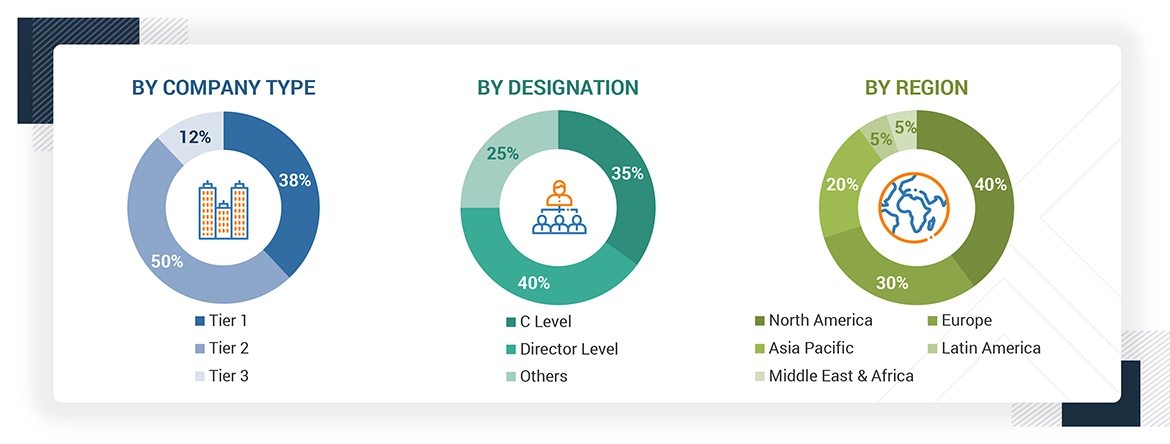
Note: Tier 1 companies’ revenues are more than USD 10 billion; tier 2 companies’ revenues range between
USD 1 and 10 billion; and tier 3 companies’ revenues range between USD 500 million and USD 1 billion. Other designations include
sales managers, marketing managers, and product managers.
Source: Industry Experts
To know about the assumptions considered for the study, download the pdf brochure
Market Size Estimation
Multiple approaches were adopted to estimate and forecast the smart warehousing market. The first approach involved estimating the market size by companies’ revenue generated through the sale of smart warehousing products.
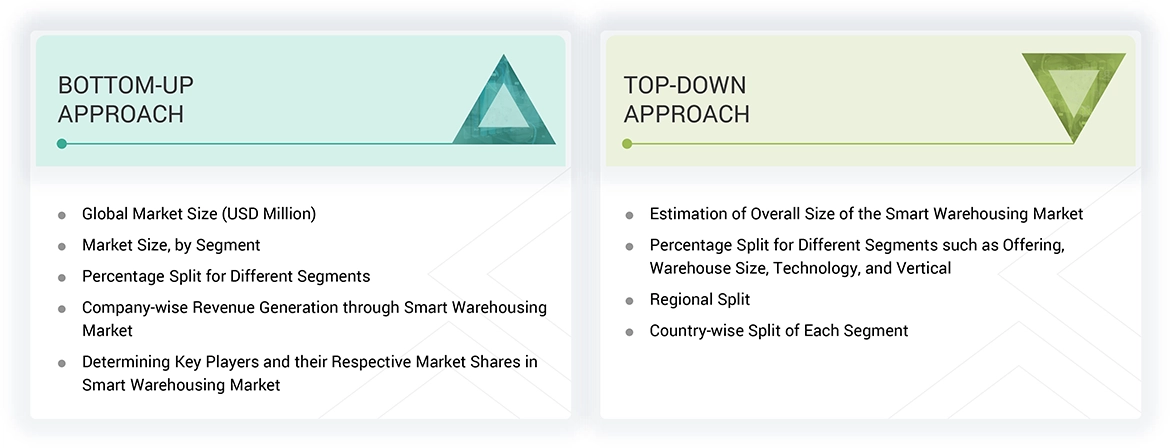
Market Size Estimation Methodology- Top-down approach
In the top-down approach, an exhaustive list of all the vendors offering products in the smart warehousing market was prepared. The revenue contribution of the market vendors was estimated through annual reports, press releases, funding, investor presentations, paid databases, and primary interviews. Each vendor’s offerings were evaluated based on software, services, hardware, warehouse size offered, technology, vertical, and region. The markets were triangulated through primary and secondary research. The primary procedure included extensive interviews for key insights from industry leaders, such as CIOs, CEOs, VPs, directors, and marketing executives. The market numbers were further triangulated with the existing MarketsandMarkets’ repository for validation.
Market Size Estimation Methodology-Bottom-up approach
In the bottom-up approach, the adoption rate of smart warehousing products among different verticals in key countries, concerning their regions contributing the most to the market share, was identified. For cross-validation, the adoption of smart warehousing products among enterprises, along with different use cases with respect to their regions, was identified and extrapolated. Weightage was given to use cases identified in different regions for the market size calculation.
Based on the market numbers, the regional split was determined by primary and secondary sources. The procedure included an analysis of the smart warehousing market’s regional penetration. Based on secondary research, the regional spending on Information and Communications Technology (ICT), socio-economic analysis of each country, strategic vendor analysis of major smart warehousing providers, and organic and inorganic business development activities of regional and global players were estimated.
Smart Warehousing Market : Top-Down and Bottom-Up Approach
Data Triangulation
The market was split into several segments and subsegments after arriving at the overall market size using the market size estimation processes as explained above. To complete the overall market engineering process and arrive at the exact statistics of each market segment and subsegment, data triangulation and market breakup procedures were employed, wherever applicable. The overall market size was then used in the top-down procedure to estimate the size of other individual markets via percentage splits of the market segmentation.
Market Definition
The smart warehousing market refers to the software, hardware, and services ecosystem that enables automated, data-driven warehouse operations. It leverages AI, IoT, robotics, and cloud computing technologies to optimize inventory management, improve operational efficiency, and enhance real-time visibility across supply chain functions.
Stakeholders
- Smart warehousing vendors
- Smart warehousing service vendors
- Managed service providers
- Support and maintenance service providers
- System integrators (SIs)/migration service providers
- Value-added resellers (VARs) and distributors
- Distributors and value-added resellers (VARs)
- Independent software vendors (ISV)
- Third-party providers
- Technology providers
Report Objectives
- To define, describe, and forecast the smart warehousing market by offering, warehouse size, technology, and vertical
- To provide detailed information related to major factors (drivers, restraints, opportunities, and industry-specific challenges) influencing market growth
- To analyze the micro markets with respect to individual growth trends, prospects, and their contribution to the total market
- To analyze the opportunities in the market for stakeholders by identifying the high-growth segments of the smart warehousing market
- To analyze opportunities in the market and provide details of the competitive landscape for stakeholders and market leaders
- To forecast the market size of segments for the five main regions: North America, Europe, Asia Pacific, the Middle East & Africa, and Latin America
- To profile the key players and comprehensively analyze their market ranking and core competencies
- To analyze competitive developments, such as partnerships, product launches, and mergers and acquisitions, in the smart warehousing market
Available Customizations
With the given market data, MarketsandMarkets offers customizations to meet the company’s specific needs. The following customization options are available for the report:
Product Analysis
- The product matrix provides a detailed comparison of each company's product portfolio.
Geographic Analysis as per Feasibility
- Further breakup of the North American smart warehousing market
- Further breakup of the European smart warehousing market
- Further breakup of the Asia Pacific smart warehousing market
- Further breakup of the Middle East & Africa smart warehousing market
- Further breakup of the Latin American smart warehousing market
Company Information
- Detailed analysis and profiling of additional market players (up to five)
Get the Full Smart Warehousing Market Report
Full forecast, segment splits, and company analysis for all Smart Warehousing Market.
- Indonesia Smart Warehousing Market
- Malaysia Smart Warehousing Market
- Rest Of Asean Smart Warehousing Market
- Singapore Smart Warehousing Market
- Rest Of Me Smart Warehousing Market
- Rest Of Latin America Smart Warehousing Market
- US Smart Warehousing Market
- Canada Smart Warehousing Market
- UK Smart Warehousing Market
- Germany Smart Warehousing Market
- France Smart Warehousing Market
- Italy Smart Warehousing Market
- China Smart Warehousing Market
- Japan Smart Warehousing Market
- India Smart Warehousing Market
- South Korea Smart Warehousing Market
- Saudi Arabia Smart Warehousing Market
- UAE Smart Warehousing Market
- Qatar Smart Warehousing Market
- Turkey Smart Warehousing Market
- Brazil Smart Warehousing Market
- Mexico Smart Warehousing Market
- Argentina Smart Warehousing Market
- Rest Of Europe Smart Warehousing Market
- Anz Smart Warehousing Market
- Asean Smart Warehousing Market
Need a Tailored Report?
Customize this report to your needs
Get 10% FREE Customization
Customize This Report
