
Japan Sodium Perborate Market (2025-2030)

The Japan Sodium Perborate Market was valued at $5.54 Million in 2025 and projected to reach to $6.01 Million by 2030, representing a compound annual growth rate of CAGR 1.6%. Japan's sodium perborate market is characterized by stability and maturity, with growth constrained by market saturation and established consumption patterns.


| Market Size in | USD 26.32 MN |
| Market Forecast in | |
| CAGR | |
| Forecast Period | |
| Units Considered | Value (USD MN) |
Japan Sodium Perborate Market Trends and Insights
- Japan maintains a mature and stable market for sodium perborate, driven by established demand in cleaning products, bleaching applications, and industrial uses.
- The modest growth trajectory reflects Japan's saturated domestic market and the country's focus on sustainable and eco-friendly alternatives to traditional peroxide-based bleaching agents. During the 2025–2030 forecast period, Japan's sodium perborate market will be shaped by regulatory pressures favoring greener chemistry and the country's advanced manufacturing standards.
- Japan's chemical industry continues to innovate in formulation efficiency, allowing manufacturers to optimize sodium perborate use while reducing overall consumption volumes.
- Consumer preference for environmentally responsible products and Japan's stringent environmental regulations will influence market dynamics, with incremental growth driven by niche applications in specialty cleaning and industrial sectors rather than mass-market expansion..
Key Market Statistics
- CAGR (2025-2030) CAGR 1.6%
- Market Size, 2025 ~USD 5.54 Million
- Forecast, 2030 ~USD 6.01 Million
- Country Japan
Japan Sodium Perborate Market Overview
Mature Market Stability :
Japan's sodium perborate market demonstrates steady performance with a CAGR of 1.6% from 2025 to 2030, reflecting a mature and well-established market with consistent demand patterns across cleaning and industrial sectors.
Modest Growth Trajectory :
Market size is projected to grow from USD 5.54 million in 2025 to USD 6.01 million by 2030, indicating incremental expansion driven by replacement demand and niche industrial applications rather than breakthrough growth.
Established Application Base :
Japan's sodium perborate demand is anchored in cleaning products, bleaching applications, and industrial uses, with strong penetration in domestic manufacturing and consumer goods sectors that have reached saturation.
Below-Global Growth Rate :
Japan's 1.6% CAGR significantly lags the global market growth of 3.7%, reflecting the country's saturated domestic market and limited new application development compared to emerging regions.
Japan Sodium Perborate Market Dynamics
- The modest 1.6% CAGR reflects limited expansion opportunities in traditional segments, though steady demand from cleaning product manufacturers and industrial bleaching applications provides a stable revenue base.
- The market is expected to benefit from incremental improvements in product formulations and niche applications in specialty cleaning and textile industries. Looking ahead, Japan's sodium perborate market will likely experience consolidation among suppliers and increased focus on sustainability and eco-friendly formulations.
- While growth remains subdued compared to global trends, the market's resilience is supported by Japan's strong manufacturing base and quality-conscious consumer preferences.
- Strategic opportunities may emerge in premium product segments and specialized industrial applications targeting export markets..
Market Ecosystem
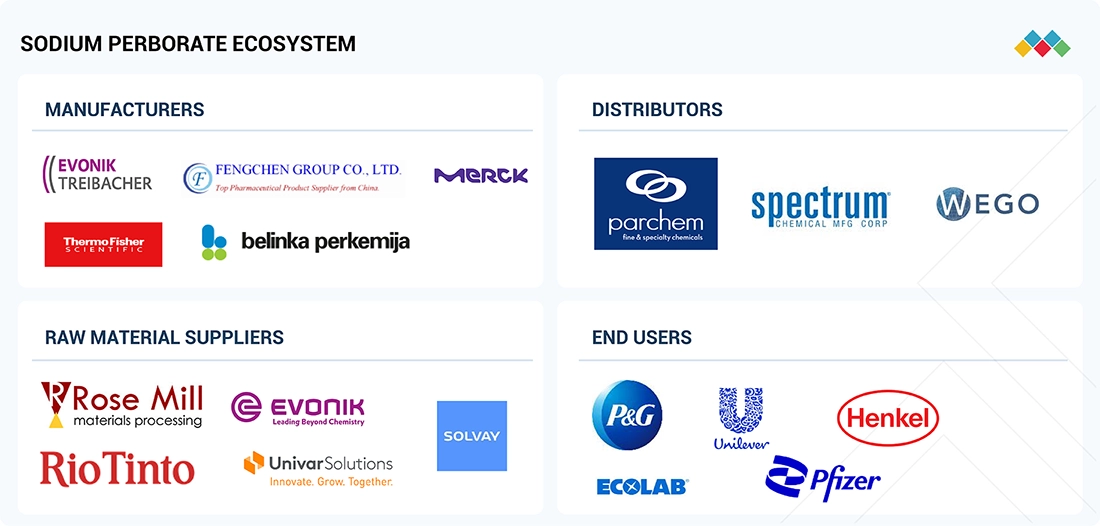
Sodium Perborate Market: COMMERCIAL USE CASES ACROSS INDUSTRIES
| COMPANY | USE CASE DESCRIPTION | BENEFITS |
|---|---|---|
 |
Henkel utilizes sodium perborate in Persil laundry detergents to enhance stain removal and whitening effects. | Sodium perborate releases hydrogen peroxide upon contact with water, providing effective bleaching at lower temperatures and reducing the need for chlorine-based bleaches. |
 |
Evonik employs sodium perborate in home cleaning products, including all-purpose cleaners and dishwashing detergents. | It serves as a sustainable bleaching agent, effectively removing stains and odors while being gentle on surfaces. |
 |
A case report described the treatment of a darkened primary tooth in a 4-year-old child using the walking bleach technique with sodium perborate. | Achieved significant esthetic improvement without adverse clinical or radiographic effects over a one-year follow-up period. |
 |
Sodium perborate tetrahydrate – Used in laboratory and industrial cleaning products, including the Extran line of cleaning agents. | Oxidative stain removal; efficient surface cleaning; reliable for lab and industrial environments |
Logos and trademarks shown above are the property of their respective owners. Their use here is for informational and illustrative purposes only.
Related Ecosystem
Bulk Chemicals And Inorganics
- Corrosion Inhibitors
- Glycol Ethers
- Acetic Acid
- Acetone
- Ammonium Nitrate
- Basf se
- DOW CHEMICAL COMPANY
- Exxon Mobil Corporation
- AZELIS HOLDINGS SA
- Sinopec limited
Speciality Chemicals
- Corrosion Inhibitors
- Polyetheretherketone (PEEK)
- Acrylonitrile Butadiene Styrene (ABS)
- Epoxy Resin
- Polycarbonate
- Basf se
- DOW CHEMICAL COMPANY
- Evonik industries ag
- Clariant ag.
- Solvay sa
Key Takeaways
- Japan's sodium perborate market is valued at USD 5.54 million in 2025 and will reach USD 6.01 million by 2030, reflecting a conservative 1.6% CAGR.
- Japan's mature market is characterized by stable demand in cleaning, bleaching, and industrial applications with limited room for volume expansion.
- Regulatory emphasis on sustainability and eco-friendly chemistry is driving Japan's shift toward alternative bleaching technologies and formulation optimization.
- Growth in Japan will be incremental and concentrated in specialty and high-value applications rather than mass-market segments through 2030.
Sodium Perborate Market Report Scope
| Report Metric | Details |
|---|---|
| Base Year | 2025 |
| Fastest Growing Segment | HOUSEHOLD & INDUSTRIAL CLEANING (End-Use Industry) |
| Forecast Period | 2025–2030 |
| Growth Rate | CAGR of 3.7% from 2025 to 2030 |
| Largest Segment | HOUSEHOLD & INDUSTRIAL CLEANING (End-Use Industry) |
| Market Size Base Year (Billions) | ~USD 0.15 (2025) |
| Revenue Forecast (Billions) | ~USD 0.18 (2030) |
| Segments Covered | Type, End-Use Industry |
Japan Sodium Perborate Market Report Segmentation
2 segment dimensions are covered across the global market.
By Type
- Sodium Perborate Monohydrate
- Sodium Perborate Tetrahydrate
By End-Use Industry
- Healthcare & Pharmaceutical
- Healthcare & Pharmaceuticals
- Household & Industrial Cleaning
- Other End-Use Industries
- Personal Care & Cosmetics
- Pulp & Paper
- Textile
JAPAN: SODIUM PERBORATE MARKET, BY END-USE INDUSTRY, 2023–2030
| Segment | 2023 | 2024 | 2025 | 2026 | 2028 | 2029 | 2030 | CAGR (%) |
|---|---|---|---|---|---|---|---|---|
| HEALTHCARE & PHARMACEUTICAL | 0.93 | 0.94 | 0.96 | 0.97 | 1 | 1.02 | 1.04 | 1.6 |
| HOUSEHOLD & INDUSTRIAL CLEANING | 2.67 | 2.72 | 2.77 | 2.82 | 2.92 | 2.97 | 3.02 | 1.8 |
| OTHER END-USE INDUSTRIES | 0.26 | 0.26 | 0.26 | 0.27 | 0.28 | 0.28 | 0.28 | 1.4 |
| PERSONAL CARE & COSMETICS | 0.89 | 0.9 | 0.92 | 0.93 | 0.96 | 0.97 | 0.99 | 1.5 |
| PULP & PAPER | 0.32 | 0.32 | 0.33 | 0.33 | 0.34 | 0.34 | 0.34 | 1.1 |
| TEXTILE | 0.3 | 0.31 | 0.31 | 0.32 | 0.32 | 0.33 | 0.33 | 1.3 |
| TOTAL | 5.37 | 5.46 | 5.54 | 5.63 | 5.82 | 5.91 | 6.01 | 1.6 |
Target Audience
- Chemical Manufacturers : Sodium perborate producers and chemical companies need Japan-specific market data to optimize production capacity, assess competitive positioning, and identify growth opportunities in this mature but stable market.
- Cleaning Product Companies : Manufacturers of cleaning products and detergents require detailed Japan market insights to understand demand trends, formulation preferences, and consumer behavior in this established application segment.
- Industrial Buyers : Textile, paper, and industrial bleaching companies need accurate market forecasts and supply chain data for Japan to secure reliable sodium perborate sourcing and plan procurement strategies.
- Market Investors & Consultants : Investment firms and business consultants analyzing the Japanese chemicals sector need validated market sizing and growth projections to support due diligence, valuation, and strategic advisory services.
- Distribution & Trading Companies : Chemical distributors and trading firms operating in Japan require market intelligence to optimize inventory management, identify supplier partnerships, and forecast demand across customer segments.
Reasons to Buy this Report
- Accurate Market Sizing : Obtain precise valuation of Japan's sodium perborate market at USD 5.54 million (2025) with validated forecast data through 2030, enabling confident budget allocation and investment decisions.
- Competitive Landscape Intelligence : Understand Japan's mature market dynamics, supplier consolidation trends, and competitive positioning to identify partnership opportunities and market entry strategies in this stable segment.
- Growth Opportunity Identification : Discover niche application segments and specialty product opportunities within Japan's 1.6% CAGR market, including premium formulations and industrial bleaching innovations with higher margin potential.
- Strategic Planning Insights : Leverage Japan-specific market outlook and saturation analysis to develop realistic growth strategies, product development roadmaps, and regional expansion plans aligned with local demand patterns.
- Risk Mitigation : Assess market maturity levels and growth constraints specific to Japan to avoid overestimating expansion potential and make informed decisions about resource allocation and market prioritization.
Frequently asked questions
What is the current market size of sodium perborate in Japan?
Japan's sodium perborate market is estimated at USD 5.54 million in 2025.
What is the projected market size for sodium perborate in Japan by 2030?
Japan's sodium perborate market is forecast to reach USD 6.01 million by 2030.
What is the CAGR for sodium perborate in Japan from 2025 to 2030?
Japan's sodium perborate market is expected to grow at a compound annual growth rate of 1.6% during the 2025–2030 forecast period.
What are the primary applications of sodium perborate in Japan?
In Japan, sodium perborate is primarily used in cleaning products, bleaching applications, and various industrial processes.
What factors are limiting growth in Japan's sodium perborate market?
Japan's market maturity, regulatory pressure toward sustainable alternatives, and consumer preference for eco-friendly products are constraining traditional sodium perborate demand growth.
RESEARCH METHODOLOGY
The study comprised four key activities aimed at quantifying the current global sodium perborate market. Initially, an extensive secondary research phase was undertaken to gather data on the market dynamics, related product markets, and the overarching parent product group. Following this, primary research was conducted to validate the findings, assumptions, and market size estimates with industry experts across the sodium perborate value chain. Both top-down and bottom-up methodologies were utilized to derive the overall market size, ensuring a comprehensive perspective. Subsequently, market segmentation analysis and data triangulation techniques were applied to accurately set the sizes of various market segments and sub-segments.
Secondary Research
The market size of the companies offering sodium perborate was arrived at by secondary data available through paid and unpaid sources, analyzing the product portfolios of the major companies in the ecosystem, and rating the companies by their performance and quality. Various secondary sources, such as Business Standard, Bloomberg, World Bank, and Factiva, were referred to identify and collect information for this study on the sodium perborate market. In the secondary research process, various secondary sources were referred to identify and collect information related to the study. Secondary sources included annual reports, press releases, and investor presentations of sodium perborate vendors, forums, certified publications, and whitepapers. The secondary research was used to obtain critical information on the industry’s value chain, the total pool of key players, market classification, and segmentation from the market and technology-oriented perspectives.
Primary Research
In the primary research process, various primary sources from both the supply and demand sides were interviewed to obtain qualitative and quantitative information for this report. The primary sources from the supply side included industry experts, such as Chief Executive Officers (CEOs), Vice Presidents (VPs), marketing directors, technology and innovation directors, and related key executives from several key companies and organizations operating in the sodium perborate market. After the complete market engineering (calculations for market statistics, market breakdown, market size estimations, market forecasting, and data triangulation), extensive primary research was conducted to gather information and verify and validate the critical numbers arrived at. Primary research was also conducted to identify the segmentation types, industry trends, competitive landscape of sodium perborate offered by various market players, and key market dynamics, such as drivers, restraints, opportunities, challenges, industry trends, and key player strategies. In the complete market engineering process, the top-down and bottom-up approaches and several data triangulation methods were extensively used to perform the market estimation and market forecasting for the overall market segments and subsegments listed in this report. Extensive qualitative and quantitative analysis was performed on the complete market engineering process to list the key information/insights throughout the report.
Following is the breakdown of primary respondents:
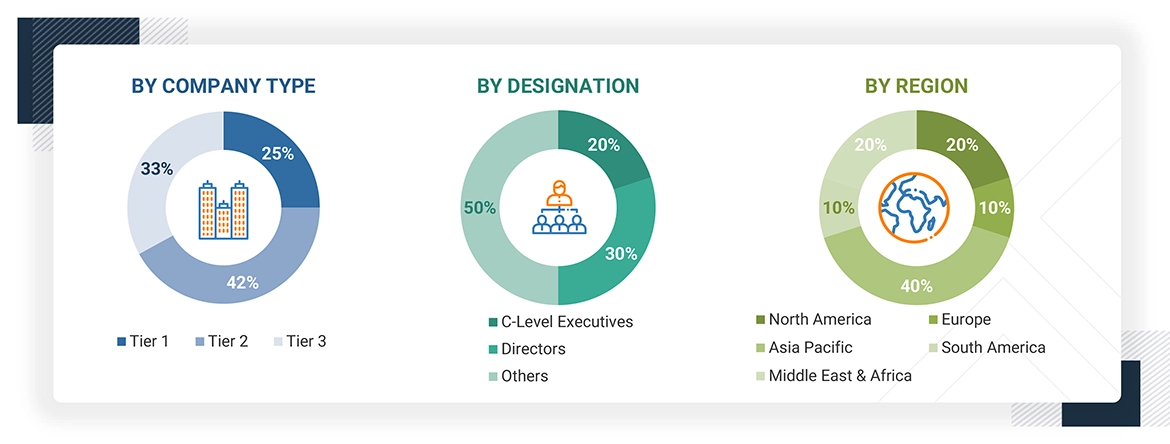
Notes: Other designations include sales, marketing, and product managers.
Tier 1: >USD 1 Billion; Tier 2: USD 500 million–1 Billion; and Tier 3: < USD 500 million.
To know about the assumptions considered for the study, download the pdf brochure
Market Size Estimation
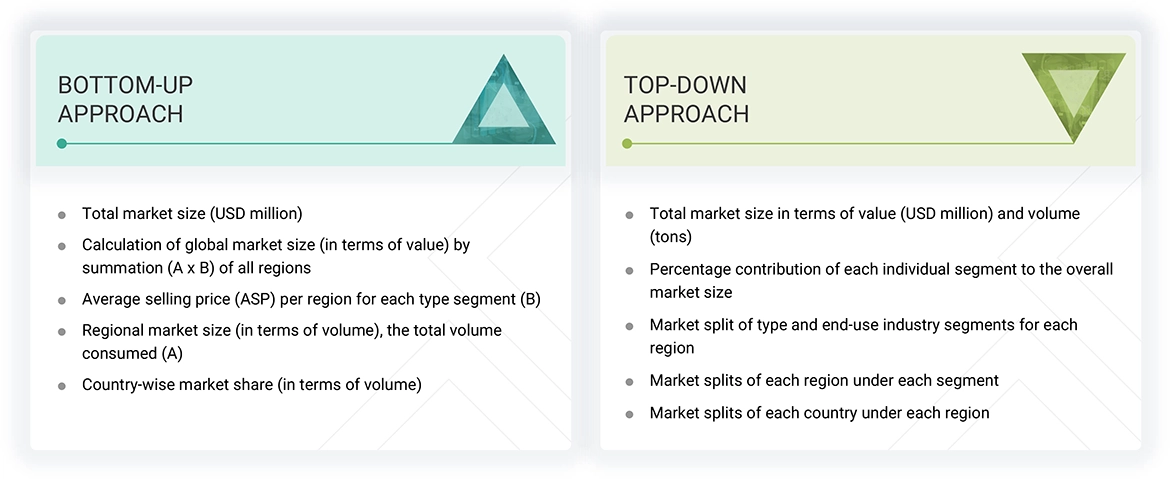
The top-down and bottom-up approaches were used to estimate and validate the size of the global sodium perborate market. These approaches were also used extensively to estimate the size of various dependent market segments.
Data Triangulation
After arriving at the overall market size using the market size estimation processes, the market was split into several segments and subsegments. The data triangulation and market breakup procedures were employed, wherever applicable, to complete the overall market engineering process and arrive at the exact statistics of each market segment and subsegment. The data was triangulated by studying various factors and trends from both the demand and supply sides.
Market Definition
Sodium perborate is a white, odorless, crystalline substance with the formula NaBO3-nH2O (usually present as a monohydrate (n=1) or tetrahydrate (n=4). It is used as a bleaching agent, disinfectant, and oxidizing agent. In an aqueous solution, it decomposes to release hydrogen peroxide, which imparts it with strong cleaning and antimicrobial activity. It is easier to handle and store in its solid state as it is more stable than liquid hydrogen peroxide. As sodium perborate has an oxygen-based bleaching and disinfecting action, it is widely used in laundry detergents, industrial cleaners, mouthwashes, toothpaste, and some cosmetic and pharmaceutical applications.
Stakeholders
- Sodium perborate manufacturers
- Raw material suppliers
- Converters & processors
- Distributors and traders
- Industry associations and regulatory bodies
- End users
Report Objectives
- To define, describe, and forecast the size of the global sodium perborate market based on type, end-use industry, and region in terms of value and volume
- To provide detailed information on the significant drivers, restraints, opportunities, and challenges influencing the market
- To strategically analyze micromarkets concerning individual growth trends, prospects, and their contribution to the market
- To assess the growth opportunities in the market for stakeholders and provide details on the competitive landscape for market leaders
- To forecast the market size of segments and subsegments for North America, Europe, Asia Pacific, South America, and the Middle East & Africa
- To strategically profile key players and comprehensively analyze their market shares and core competencies
- To analyze competitive developments such as acquisitions, expansions, and agreements in the sodium perborate market
- To provide the impact of AI/Gen AI on the market
Get the Full Sodium Perborate Market Report
Full forecast, segment splits, and company analysis for all Sodium Perborate Market.
- China Sodium Perborate Market
- India Sodium Perborate Market
- South Korea Sodium Perborate Market
- Germany Sodium Perborate Market
- UK Sodium Perborate Market
- France Sodium Perborate Market
- Russia Sodium Perborate Market
- Italy Sodium Perborate Market
- Turkey Sodium Perborate Market
- Canada Sodium Perborate Market
- Mexico Sodium Perborate Market
- US Sodium Perborate Market
- South Africa Sodium Perborate Market
- Brazil Sodium Perborate Market
- Argentina Sodium Perborate Market
- Rest Of Europe Sodium Perborate Market
- Rest Of Asia Pacific Sodium Perborate Market
Need a Tailored Report?
Customize this report to your needs
Get 10% FREE Customization
Customize This Report
