
South Korea Subsea Thermal Insulation Materials Market (2025-2030)

The South Korea Subsea Thermal Insulation Materials Market was valued at $0.33 Million in 2025 and projected to reach to $0.39 Million by 2030, representing a compound annual growth rate of 3.1%. South Korea's subsea thermal insulation materials market is poised for steady growth as the nation expands its offshore energy portfolio and deepwater exploration capabilities.


| Market Size in | USD 26.32 MN |
| Market Forecast in | |
| CAGR | |
| Forecast Period | |
| Units Considered | Value (USD MN) |
South Korea Subsea Thermal Insulation Materials Market Trends and Insights
- South Korea's offshore oil and gas infrastructure, combined with deepwater exploration initiatives, drives demand for advanced thermal insulation solutions in subsea applications.
- South Korea's strategic position in the Asia Pacific region and its technological capabilities position it as a growing player in specialized subsea materials. The market in South Korea is characterized by steady expansion driven by investments in subsea pipeline systems and thermal management technologies.
- South Korea's focus on energy security and offshore resource development supports the adoption of high-performance insulation materials.
- Between 2025 and 2030, South Korea is expected to see increased deployment of subsea thermal insulation in both new projects and maintenance operations, reflecting broader regional trends in deepwater infrastructure development..
Key Market Statistics
- CAGR (2025-2030) 3.1% CAGR
- Market Size, 2025 ~USD 0.33 Million
- Forecast, 2030 ~USD 0.39 Million
- Country South Korea
South Korea Subsea Thermal Insulation Materials Market Overview
Market Size & Growth :
South Korea's subsea thermal insulation materials market is valued at $0.33 million in 2025, with projected growth to $0.39 million by 2030, reflecting a steady 3.1% CAGR driven by offshore energy investments.
Deepwater Exploration Drive :
South Korea's strategic deepwater exploration initiatives in the East China Sea and surrounding waters are accelerating demand for advanced thermal insulation solutions to protect subsea infrastructure in extreme conditions.
Offshore Oil & Gas Infrastructure :
Existing and planned offshore oil and gas platforms require reliable thermal insulation materials to maintain operational efficiency, reduce heat loss, and extend equipment lifespan in challenging subsea environments.
Technology & Innovation Focus :
South Korean manufacturers are investing in advanced insulation technologies, including aerogel-based and polymer composite solutions, to meet stringent subsea performance standards and enhance competitive positioning.
South Korea Subsea Thermal Insulation Materials Market Dynamics
- Government support for energy security and technological advancement in subsea engineering will drive adoption of high-performance insulation materials.
- The market's 3.1% CAGR reflects moderate but consistent demand from both existing infrastructure maintenance and new deepwater projects.
- South Korean companies are increasingly focusing on developing cost-effective, durable solutions that meet international subsea standards.
- Strategic partnerships with global energy operators and investment in R&D will position South Korea as a key player in the regional subsea materials market, supporting long-term growth through 2030..
Market Ecosystem
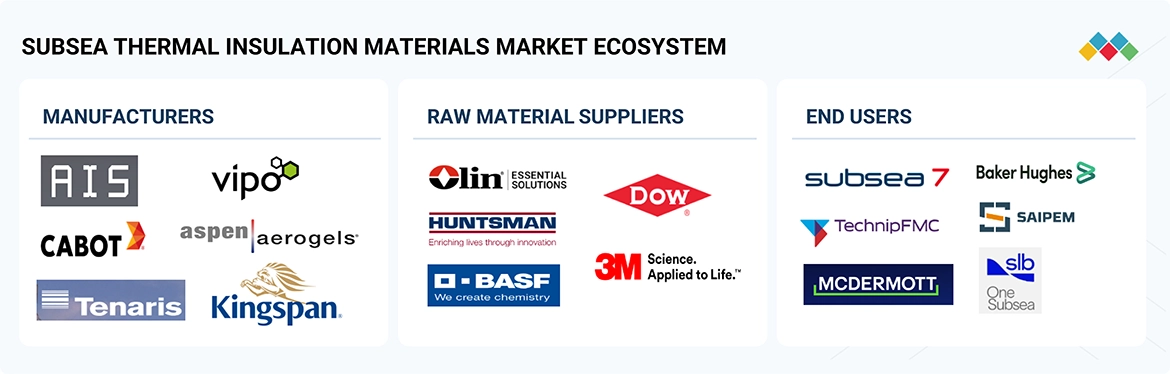
Subsea Thermal Insulation Materials Marke: COMMERCIAL USE CASES ACROSS INDUSTRIES
| COMPANY | USE CASE DESCRIPTION | BENEFITS |
|---|---|---|
 |
AIS provided a turnkey solution combining ContraTherm® C25 with an engineered clamping system for heavy-lift jumper installations in Brazil. | Enabled safe, efficient installation of subsea jumpers while leveraging proven expertise and prior collaboration with the EPC client. |
 |
Local operators in Australia manually applied Vikotherm® R3 subsea thermal insulation on a high-temperature manifold after remote training from Norway. | Achieved fast, safe, and effective on-site insulation with minimal engineering and design effort, despite travel restrictions. |
Logos and trademarks shown above are the property of their respective owners. Their use here is for informational and illustrative purposes only.
Related Ecosystem
Foam And Insulation
- Fiberglass
- Acoustic Insulation
- Elastomeric Foam
- HVAC System
- Flexible Foam
- Basf se
- Saint-gobain
- ARMACELL INTERNATIONAL
- THE WOODBRIDGE GROUP
- Sekisui Chemical Co., Ltd.
Key Takeaways
- South Korea's subsea thermal insulation materials market is valued at $0.33 million in 2025 with a projected value of $0.39 million by 2030.
- South Korea demonstrates a 3.1% CAGR, reflecting steady but moderate growth in subsea infrastructure investments.
- South Korea's offshore energy sector and deepwater exploration activities are primary drivers of thermal insulation material demand.
- South Korea's technological expertise and regional strategic importance support long-term market expansion through 2030.
Subsea Thermal Insulation Materials Market Report Scope
| Report Metric | Details |
|---|---|
| Base Year | 2025 |
| Fastest Growing Segment | EPOXY (Type) |
| Forecast Period | 2025–2030 |
| Growth Rate | CAGR of 4.3% from 2025 to 2030 |
| Largest Segment | GLASS MICROSPHERES (Filler Type) |
| Market Size Base Year (Billions) | ~USD 0.26 (2025) |
| Revenue Forecast (Billions) | ~USD 0.32 (2030) |
| Segments Covered | Type, Filler Type, Application |
South Korea Subsea Thermal Insulation Materials Market Report Segmentation
3 segment dimensions are covered across the global market.
By Type
- Aerogel
- Epdm
- Epoxy
- Other Types
- Polypropylene
- Polyurethane
- Silicone Rubber
By Filler Type
- Glass Microspheres
- Other Filler Types
By Application
- Direct Insulation & Pipe Covers
- Equipment
- Field Joints
- Other Applications
- Pipe-In-Pipe
Target Audience
- Offshore Energy Operators : South Korean and international oil & gas companies operating in Korean waters need market data to source reliable thermal insulation materials and plan subsea infrastructure investments.
- Material Manufacturers & Suppliers : Insulation material producers require South Korea-specific market insights to develop localized products, establish distribution channels, and compete effectively in the regional subsea market.
- Engineering & Subsea Contractors : Subsea engineering firms and installation contractors need detailed market intelligence to specify appropriate insulation materials, manage project costs, and meet client requirements in South Korean deepwater projects.
- Government & Policy Makers : South Korean government agencies and energy policy bodies use market data to guide offshore energy strategy, support domestic industry development, and align subsea infrastructure investments.
- Investment & Consulting Firms : Financial analysts and management consultants require South Korea market forecasts to evaluate investment opportunities, assess industry growth potential, and advise clients on market entry strategies.
Key Companies in the South Korea Subsea Thermal Insulation Materials Market
| Company | HQ | Ownership | Strongest segments |
|---|---|---|---|
| SEKISUI CHEMICAL CO., LTD | Japan | Public Company | Housing, urban infrastructure, and environmental products,High performance plastics and industrial materials,Medical and pharmaceutical solutions, |
| MEXICHEM | Mexico | Public Company | Polymer Solutions (PVC resins, compounds, chlor-alkali derivatives),Building and Infrastructure (plastic piping systems and solutions),Precision Agriculture (irrigation and greenhouse solutions), |
| PETRONAS | Malaysia | Private Company | Crude oil and refined petroleum products,LNG and natural gas,Olefins, polymers, fertilizers, methanol, and basic chemicals, |
| TRINSEO | United States | Public Company | Engineered Materials,Latex Binders,Polymer Solutions, |
| JOHNS MANVILLE | United States | Private Company | Building and mechanical insulation,Commercial roofing systems and roof insulation,Glass fibers and nonwovens (construction, automotive, filtration, specialty), |
| BOREALIS AG | Austria | Private Company | Polyethylene (PE),Polypropylene (PP),Recyclates and Circular Polyolefin Solutions, |
| TASNEE | Saudi Arabia | Public Company | Petrochemicals (PE, PP compounds, acrylics, butanols, SAP),Metallurgy (titanium sponge, slag, pig iron, lead),Downstream Plastics & Films (BOPP, HDPE pipes, agrifilm, pallets, sheets, liners, pails), |
| UPONOR CORPORATION | Finland | Private Company | PEX-a potable plumbing systems (AquaPEX, ProPEX, valves, accessories),Radiant heating and cooling systems (HePEX, controls, manifolds, AquaPort),Wastewater and noise-reducing systems, |
| ASPEN AEROGELS, INC. | United States | Public Company | Thermal Barrier (PyroThin and related EV battery solutions),Pyrogel XTE / HPS (refining and petrochemical insulation),Pyrogel XTF (fire protection), |
| CABOT CORPORATION | United States | Public Company | Reinforcement Materials (tire and industrial rubber carbons, engineered elastomer composites),Specialty Carbons and Masterbatch (inks, coatings, plastics, adhesives, toners, conductive compounds),Fumed Silica and Fumed Alumina (adhesives, sealants, cosmetics, batteries, polishing), |
| AIS | Japan | Public Company | Automatic, CVT, and manual transmissions,eAxle and electrified driveline modules,Brakes, steering, doors, roofs, and body systems, |
| KINGSPAN GROUP | Ireland | Public Company | Insulated panels and building envelopes,Insulation boards and systems,Roofing, waterproofing, and integrated solar, |
| TENARIS S.A. | Luxembourg | Public Company | OCTG (casing, tubing, TenarisHydril premium connections, coiled tubing, sucker rods),Line pipe and pipeline-related services (including coated pipe, subsea applications),Mechanical, structural, and cold-drawn industrial pipes, |
| PERMA-PIPE INTERNATIONAL HOLDINGS, INC. | United States | Public Company | Insulated and jacketed district heating/cooling piping systems,Primary and secondary containment piping for chemicals and hazardous fluids,Pipeline coating and insulation for oil and gas gathering/transmission, |
| DOW | United States | Public Company | Packaging & Specialty Plastics,Industrial Intermediates & Infrastructure,Performance Materials & Coatings, |
SEKISUI CHEMICAL CO., LTD
Sekisui Chemical Co., Ltd. is a Japanese public company founded in 1947 with 26,752 employees. The company operates as a diversified chemical manufacturer serving various industrial sectors.
MEXICHEM
Mexichem is a Mexican public company founded in 1953 with 22,332 employees. The company operates as a diversified chemical and materials manufacturer.
PETRONAS
Petronas is a Malaysian private company established in 1974 with 49,000 employees. The company is a major energy and petrochemical corporation.
TRINSEO
Trinseo is a United States public company founded in 2015 with 2,758 employees. The company manufactures specialty plastics and synthetic rubber products.
JOHNS MANVILLE
Johns Manville is a United States private company founded in 1858 with 9,740 employees. The company manufactures insulation, roofing, and engineered products for building and industrial applications.
BOREALIS AG
Borealis AG is an Austrian private company founded in 1994 with 5,887 employees. The company produces polyolefins and base chemicals for various industrial applications.
TASNEE
Tasnee is a Saudi Arabian public company founded in 1984 with 7,000 employees. The company operates in the petrochemical and industrial sectors.
UPONOR CORPORATION
Uponor Corporation is a Finnish private company founded in 1918 with 3,527 employees. The company manufactures piping systems and building solutions.
ASPEN AEROGELS, INC.
Aspen Aerogels, Inc. is a United States public company founded in 2001 with 854 employees. The company specializes in aerogel insulation and thermal management products.
CABOT CORPORATION
Cabot Corporation is a United States public company founded in 1882 with 4,064 employees. The company manufactures specialty chemicals and performance materials.
AIS
AIS is a Japanese public company founded in 1943 with 113,292 employees. The company operates as a diversified industrial manufacturer.
KINGSPAN GROUP
Kingspan Group is an Irish public company founded in 1965 with 27,526 employees. The company manufactures insulation products and building envelope solutions.
TENARIS S.A.
Tenaris S.A. is a Luxembourg public company founded in 2001 with 26,000 employees. The company manufactures and supplies steel pipe products for the energy sector.
PERMA-PIPE INTERNATIONAL HOLDINGS, INC.
Perma-Pipe International Holdings, Inc. is a United States public company founded in 1909 with 909 employees. The company manufactures insulated piping systems and related products.
DOW
Dow is a United States public company founded in 1897 with 34,600 employees. The company is a global leader in materials science, manufacturing chemicals, plastics, and agricultural products.
Reasons to Buy this Report
- Market-Specific Intelligence : Gain detailed insights into South Korea's unique subsea thermal insulation landscape, including local market dynamics, regulatory environment, and growth drivers specific to Korean offshore operations.
- Competitive Positioning : Understand South Korean manufacturers' capabilities, technology innovations, and market share to identify partnership opportunities and competitive advantages in the regional subsea materials sector.
- Investment & Expansion Strategy : Access forecasted market data through 2030 to inform strategic decisions on facility expansion, product development, and market entry timing in South Korea's growing deepwater sector.
- Supply Chain Optimization : Identify local suppliers, material sourcing opportunities, and supply chain networks specific to South Korea's subsea thermal insulation market to optimize procurement and reduce operational costs.
- Regulatory & Standards Compliance : Stay informed on South Korean maritime regulations, subsea engineering standards, and government policies affecting thermal insulation material specifications and market requirements.
Frequently asked questions
What is the current market size of subsea thermal insulation materials in South Korea?
South Korea's subsea thermal insulation materials market is estimated at $0.33 million in 2025.
What is the projected market size for South Korea by 2030?
South Korea's subsea thermal insulation materials market is projected to reach $0.39 million by 2030.
What is the CAGR for South Korea's subsea thermal insulation materials market?
South Korea's market is expected to grow at a compound annual growth rate of 3.1% from 2025 to 2030.
What drives demand for subsea thermal insulation materials in South Korea?
South Korea's offshore oil and gas infrastructure, deepwater exploration initiatives, and focus on energy security drive demand for advanced thermal insulation solutions.
How does South Korea's market compare to the broader Asia Pacific region?
South Korea represents a growing segment within the Asia Pacific subsea thermal insulation materials market, supported by its technological capabilities and strategic offshore development initiatives.
RESEARCH METHODOLOGY
The analysis comprised four key activities to assess the current scale of the global subsea thermal insulation materials market. Initially, comprehensive secondary research was conducted to gather data on the market, relevant peer products, and the overarching parent product category. Subsequently, these findings and the underlying assumptions and market size estimates were validated through primary research with industry experts throughout the value chain of subsea thermal insulation materials. A combination of top-down and bottom-up methodologies was then applied to quantify the total market size. Finally, market segmentation breakdown and data triangulation techniques were utilized to ascertain the dimensions of various market segments.
Secondary Research
The market size for the companies offering subsea thermal insulation materials was arrived at by secondary data available through paid and unpaid sources, analyzing the product portfolios of the major companies in the ecosystem, and rating the companies by their performance and quality. Various secondary sources, such as Business Standard, Bloomberg, World Bank, and Factiva, were referred to identify and collect information for this study on the subsea thermal insulation materials market. In the secondary research process, various secondary sources were referred to identify and collect information related to the study. Secondary sources included annual reports, press releases, and investor presentations of subsea thermal insulation materials vendors, forums, certified publications, and whitepapers. The secondary research was used to obtain critical information on the industry’s value chain, the total pool of key players, market classification, and segmentation from the market and technology-oriented perspectives.
Primary Research
In the primary research process, various primary sources from both the supply and demand sides were interviewed to obtain qualitative and quantitative information for this report. The primary sources from the supply side included industry experts, such as Chief Executive Officers (CEOs), Vice Presidents (VPs), marketing directors, technology and innovation directors, and related key executives from several key companies and organizations operating in the subsea thermal insulation materials market. After the complete market engineering (calculations for market statistics, market breakdown, market size estimations, market forecasting, and data triangulation), extensive primary research was conducted to gather information and verify and validate the critical numbers arrived at. Primary research was also conducted to identify the segmentation types, industry trends, competitive landscape of subsea thermal insulation materials offered by various market players, and key market dynamics, such as drivers, restraints, opportunities, challenges, industry trends, and key player strategies. In the complete market engineering process, the top-down and bottom-up approaches and several data triangulation methods were extensively used to perform the market estimation and market forecasting for the overall market segments and subsegments listed in this report. Extensive qualitative and quantitative analysis was performed on the complete market engineering process to list the key information/insights throughout the report.
Following is the breakdown of primary respondents:
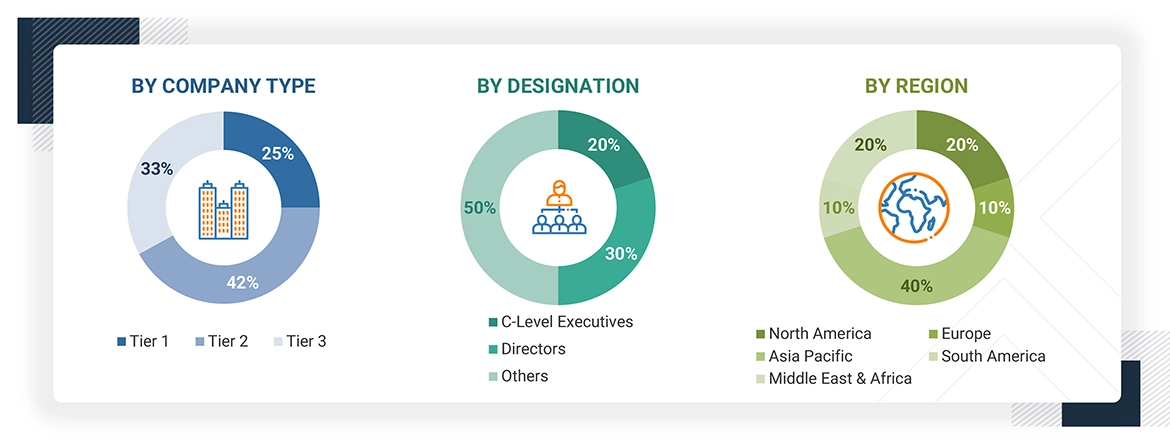
Notes: Other designations include sales, marketing, and product managers.
Tier 1: >USD 1 Billion; Tier 2: USD 500 million–1 Billion; and Tier 3: < USD 500 million.
To know about the assumptions considered for the study, download the pdf brochure
Market Size Estimation
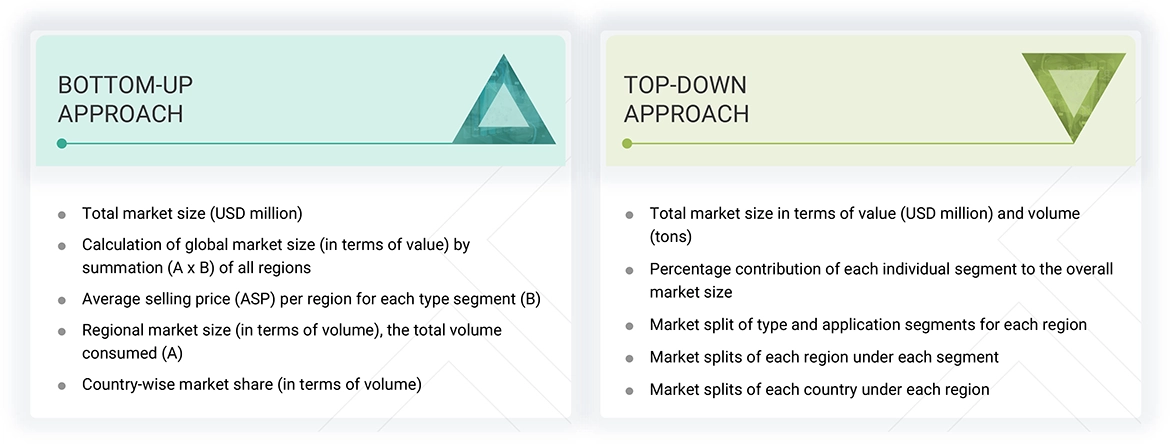
The top-down and bottom-up approaches were used to estimate and validate the size of the global subsea thermal insulation materials market. These approaches were also used extensively to estimate the size of various dependent market segments.
Data Triangulation
After arriving at the overall market size using the market size estimation processes, the market was split into several segments and subsegments. The data triangulation and market breakup procedures were employed, wherever applicable, to complete the overall market engineering process and arrive at the exact statistics of each market segment and subsegment. The data was triangulated by studying various factors and trends from both the demand and supply sides.
Market Definition
Subsea thermal insulation materials are specialized materials designed to insulate subsea pipelines, equipment, and structures in offshore oil & gas operations. These materials prevent wax and hydrate formation during oil and gas transportation. Subsea insulation is typically categorized into wet insulation, which is directly exposed to seawater and requires the use of water-impermeable, durable materials to retain thermal performance, and dry insulation, often implemented through Pipe-in-Pipe (PiP) systems, where an insulated carrier pipe is enclosed within an outer pipe. Polyurethane, polypropylene, silicone rubber, epoxy, and aerogel are the types of subsea thermal insulation materials considered in the report. These materials are used in pipe-in-pipe (PiP), pipe covers and flowlines, equipment, and field joints.
Stakeholders
- Subsea thermal insulation materials manufacturers
- Raw material suppliers
- Distributors
- Industry associations and regulatory bodies
- Polyurethane and polypropylene manufacturers
- Subsea insulation service providers
- Silicone rubber, epoxy, and aerogel manufacturers
- End users
Report Objectives
- To define, describe, and forecast the size of the global subsea thermal insulation materials market based on type, filler type, application, and region in terms of value and volume
- To provide detailed information on the significant drivers, restraints, opportunities, and challenges influencing the market
- To strategically analyze micromarkets concerning individual growth trends, prospects, and their contribution to the market
- To assess the growth opportunities in the market for stakeholders and provide details on the competitive landscape for market leaders
- To forecast the market size of segments for North America, Europe, Asia Pacific, South America, and the Middle East & Africa
- To strategically profile key players and comprehensively analyze their market shares and core competencies
- To analyze competitive developments, such as acquisitions, expansions, and partnerships, in the subsea thermal insulation materials market
- To provide the impact of AI/GenAI on the market
Get the Full Subsea Thermal Insulation Materials Market Report
Full forecast, segment splits, and company analysis for all Subsea Thermal Insulation Materials Market.
- Italy Subsea Thermal Insulation Materials Market
- South Africa Subsea Thermal Insulation Materials Market
- Argentina Subsea Thermal Insulation Materials Market
- Rest Of Asia Pacific Subsea Thermal Insulation Materials Market
- Canada Subsea Thermal Insulation Materials Market
- Mexico Subsea Thermal Insulation Materials Market
- US Subsea Thermal Insulation Materials Market
- China Subsea Thermal Insulation Materials Market
- India Subsea Thermal Insulation Materials Market
- Japan Subsea Thermal Insulation Materials Market
- Russia Subsea Thermal Insulation Materials Market
- Germany Subsea Thermal Insulation Materials Market
- France Subsea Thermal Insulation Materials Market
- UK Subsea Thermal Insulation Materials Market
- Spain Subsea Thermal Insulation Materials Market
Need a Tailored Report?
Customize this report to your needs
Get 10% FREE Customization
Customize This Report
