
India Surgical Instrument Tracking Systems Market (2025-2030)

The India Surgical Instrument Tracking Systems Market was valued at $13.72 Million in 2025 and projected to reach to $26.96 Million by 2030, representing a compound annual growth rate of 14.5%. India's surgical instrument tracking systems market is poised for significant expansion as healthcare providers prioritize operational efficiency and patient safety.


| Market Size in | USD 26.32 MN |
| Market Forecast in | |
| CAGR | |
| Forecast Period | |
| Units Considered | Value (USD MN) |
India Surgical Instrument Tracking Systems Market Trends and Insights
- This expansion reflects India's increasing adoption of advanced healthcare technologies and rising surgical volumes across hospitals and surgical centers.
- India's market growth is driven by heightened focus on surgical safety, infection control compliance, and operational efficiency in healthcare facilities. The 14.5% compound annual growth rate in India underscores the country's commitment to modernizing surgical infrastructure and reducing instrument loss and contamination risks.
- India's healthcare sector is increasingly investing in real-time tracking solutions to enhance patient safety and streamline surgical workflows.
- By 2030, India is expected to emerge as a significant regional market, supported by government healthcare initiatives, rising private hospital investments, and growing awareness of surgical instrument management best practices..
Key Market Statistics
- CAGR (2025-2030) 14.5% CAGR
- Market Size, 2025 ~USD 13.72 Million
- Forecast, 2030 ~USD 26.96 Million
- Country India
India Surgical Instrument Tracking Systems Market Overview
Market Valuation Growth :
India's surgical instrument tracking systems market is valued at USD 13.72 million in 2025, with a projected CAGR of 14.5%, reaching USD 26.96 million by 2030, nearly doubling in size over five years.
Rising Surgical Volumes :
India's expanding healthcare infrastructure and increasing number of surgical procedures across hospitals and surgical centers are driving demand for advanced tracking solutions to manage instrument inventory efficiently.
Surgical Safety Focus :
Enhanced emphasis on surgical safety protocols and infection control measures in Indian healthcare facilities is accelerating adoption of automated tracking systems to prevent instrument loss and ensure sterilization compliance.
Technology Adoption Acceleration :
Indian hospitals and surgical centers are increasingly investing in digital healthcare technologies, including RFID and IoT-based tracking systems, to improve operational efficiency and reduce surgical delays.
India Surgical Instrument Tracking Systems Market Dynamics
- The growing number of surgical procedures, coupled with rising healthcare expenditure and government initiatives to modernize hospital infrastructure, creates substantial opportunities for market growth.
- Indian hospitals are increasingly recognizing the value of automated tracking systems in reducing instrument loss, minimizing surgical delays, and ensuring compliance with sterilization protocols. The market will be further supported by increasing awareness among healthcare administrators about cost savings and efficiency gains from implementing tracking solutions.
- As India's healthcare sector continues to modernize and adopt advanced technologies, surgical instrument tracking systems will become integral to hospital operations, particularly in tier-1 and tier-2 cities where surgical volumes are highest..
Market Ecosystem
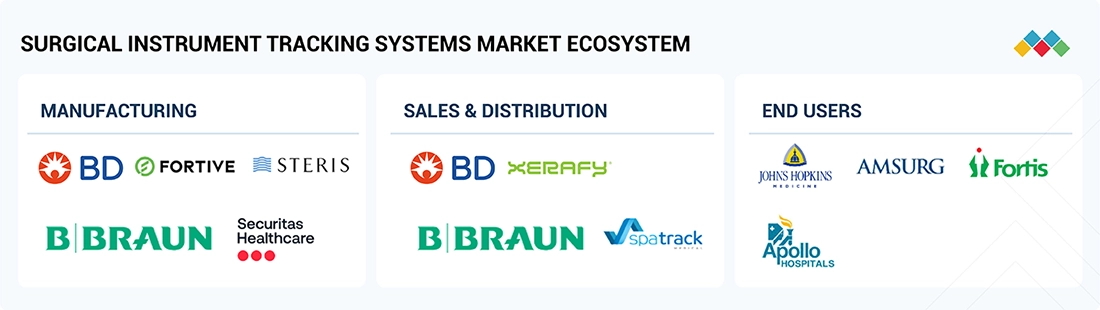
Surgical Instrument Tracking System Market: COMMERCIAL USE CASES ACROSS INDUSTRIES
| COMPANY | USE CASE DESCRIPTION | BENEFITS |
|---|---|---|
 |
Provides integrated surgical instrument tracking platforms enabling RFID/barcode-based identification, sterilization cycle documentation, and real-time inventory management. | Enhances patient safety through full traceability, reduces instrument loss, and improves compliance with sterilization standards |
 |
Offers T-DOC tracking software for complete surgical asset management, covering instrument workflow from sterilization to OR usage. | Improves operational efficiency, reduces turnaround time, ensures accountability, and supports regulatory documentation. |
 |
Provides instrument tracking solutions integrated with hospital IT systems for workflow optimization and inventory visibility | Reduces misplacements, optimizes usage cycles, and lowers costs by improving asset utilization. |
 |
Delivers customized tracking solutions with emphasis on sterilization records, compliance, and external CSSD (Central Sterile Supply Department) services. | Strengthens infection prevention, simplifies audits, and ensures regulatory readiness. |
 |
Offers RFID-enabled surgical instrument tracking with real-time location monitoring and automated data capture. | Minimizes manual errors, enhances visibility across the hospital supply chain, and reduces instrument shrinkage. |
Logos and trademarks shown above are the property of their respective owners. Their use here is for informational and illustrative purposes only.
Related Ecosystem
Medical Devices
- Polymerase Chain Reaction (PCR)
- Magnetic Resonance Imaging (MRI)
- Disposable Autoinjectors
- Pulse Oximeters
- Blood Pressure Monitors
- Medtronic plc
- Abbott Laboratories
- Stryker Corporation
- Becton, Dickinson and Company
- JOHNSON & JOHNSON
Key Takeaways
- India's surgical instrument tracking systems market is valued at USD 13.72 million in 2025 and is forecast to double to USD 26.96 million by 2030.
- India's market is growing at a 14.5% CAGR, driven by increased surgical volumes and heightened focus on patient safety and infection control.
- India's healthcare infrastructure modernization and government healthcare initiatives are accelerating adoption of advanced tracking technologies.
- India's private hospital sector and rising awareness of surgical instrument management best practices are key growth catalysts through 2030.
Surgical Instrument Tracking Systems Market Report Scope
| Report Metric | Details |
|---|---|
| Base Year | 2025 |
| Fastest Growing Segment | RADIO-FREQUENCY IDENTIFICATION (RFID) (Technology) |
| Forecast Period | 2025-2030 |
| Growth Rate | CAGR of 15.2% from 2025 to 2030 |
| Largest Segment | HOSPITALS (End User) |
| Market Size Base Year (Billions) | ~USD 0.37 (2025) |
| Revenue Forecast (Billions) | ~USD 0.75 (2030) |
| Segments Covered | Technology, Component, Type, End User |
India Surgical Instrument Tracking Systems Market Report Segmentation
4 segment dimensions are covered across the global market.
By Technology
- Barcode
- Other Technologies
- Other Technology
- Radio-Frequency Identification (Rfid)
By Component
- Hardware
- Services
- Software
By Type
- Other Hardware Components
- Private Hospitals
- Public Hospitals
- Readers
- Tags
By End User
- Hospitals
- Other End Users
INDIA: SURGICAL INSTRUMENT TRACKING SYSTEMS MARKET, BY END USER, 2025–2030
| Segment | 2025 | 2026 | 2027 | 2028 | 2029 | 2030 | CAGR (%) |
|---|---|---|---|---|---|---|---|
| HOSPITALS | 17.2 | 19.9 | 23.2 | 27.4 | 32.6 | 39.4 | 18 |
| OTHER END USERS | 4 | 4.7 | 5.5 | 6.5 | 7.7 | 9.3 | 18.4 |
| TOTAL | 21.2 | 24.5 | 28.7 | 33.8 | 40.3 | 48.7 | 18.1 |
Target Audience
- Hospital Administrators & Procurement Teams : Need India-specific market data to evaluate surgical instrument tracking solutions, understand ROI potential, benchmark against peer institutions, and make informed procurement decisions aligned with hospital modernization goals.
- Medical Device Manufacturers & Distributors : Require detailed insights into India's market size, growth rates, and adoption trends to develop localized product strategies, identify distribution channels, and plan market entry or expansion initiatives in the Indian healthcare sector.
- Healthcare Technology Investors : Need comprehensive market analysis of India's surgical instrument tracking segment to assess investment opportunities, evaluate market potential, identify promising startups, and make data-driven funding decisions.
- Healthcare Consultants & System Integrators : Require India-focused market intelligence to advise clients on technology adoption, competitive positioning, implementation best practices, and strategic planning for surgical instrument management solutions in Indian hospitals.
- Government & Healthcare Policy Makers : Need market data to understand technology adoption trends, identify infrastructure gaps, develop healthcare modernization policies, and allocate resources effectively to support surgical safety and efficiency initiatives across India.
Reasons to Buy this Report
- Market Size & Growth Trajectory : Comprehensive data on India's surgical instrument tracking market valuation (USD 13.72M in 2025) and robust 14.5% CAGR through 2030, enabling accurate investment and expansion planning for the Indian healthcare sector.
- India-Specific Growth Drivers : Detailed insights into factors unique to India's market, including rising surgical volumes, surgical safety initiatives, infection control mandates, and technology adoption rates across Indian hospitals and surgical centers.
- Competitive Landscape Analysis : Strategic understanding of market dynamics, competitive positioning, and opportunities specific to India's healthcare infrastructure, helping stakeholders identify gaps and differentiation strategies in the Indian market.
- Regional Implementation Insights : Actionable intelligence on adoption patterns across Indian cities and hospital tiers, regulatory requirements, and infrastructure readiness to guide product development and market entry strategies tailored to India.
- Investment & Partnership Opportunities : Identify high-potential segments, emerging players, and collaboration opportunities within India's surgical instrument tracking market to maximize ROI and establish strategic partnerships in this growing healthcare sector.
Frequently asked questions
What is the current size of India's surgical instrument tracking systems market?
India's surgical instrument tracking systems market is valued at USD 13.72 million in 2025 and is expected to grow significantly through the forecast period.
What is the projected market size for India by 2030?
India's surgical instrument tracking systems market is projected to reach USD 26.96 million by 2030, representing a compound annual growth rate of 14.5%.
What factors are driving growth in India's surgical instrument tracking market?
India's market growth is driven by rising surgical volumes, increased focus on patient safety, infection control compliance requirements, operational efficiency demands, and government healthcare modernization initiatives.
Which healthcare facilities in India are adopting surgical instrument tracking systems?
India's adoption spans both public and private hospitals, surgical centers, and specialty clinics, with private healthcare facilities leading in technology implementation.
How does India's market growth compare to global trends?
India's 14.5% CAGR is competitive with global growth rates, reflecting the country's rapid healthcare modernization and increasing investment in surgical safety technologies.
RESEARCH METHODOLOGY
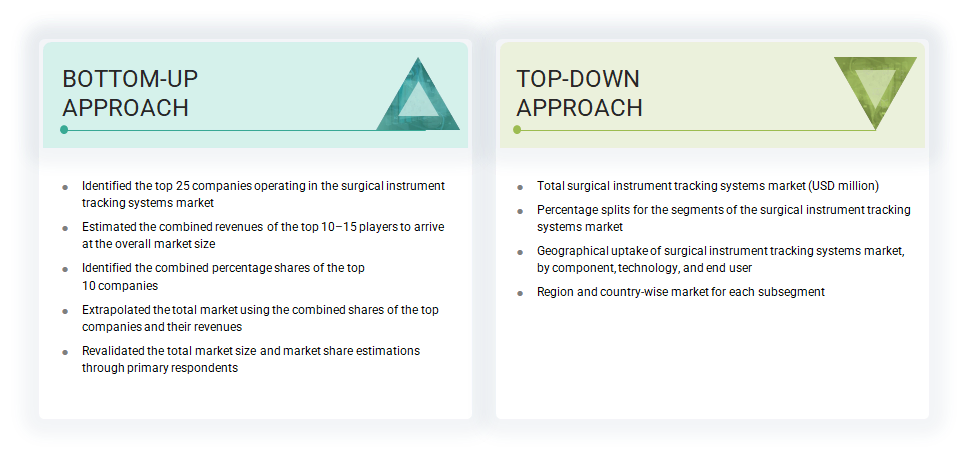
The study involved major activities in estimating the current market size for the surgical instrument tracking systems market. Exhaustive secondary research was done to collect information on the surgical instrument tracking systems industry. The next step was to validate these findings, assumptions, and sizing with industry experts across the value chain using primary research. Different approaches, such as top-down and bottom-up, were employed to estimate the total market size. After that, the market breakup and data triangulation procedures were used to estimate the market size of the segments and subsegments of the surgical instrument tracking systems market.
Secondary Research
The secondary research process involves the widespread use of secondary sources, directories, databases (such as Bloomberg Businessweek, Factiva, and D&B Hoovers), white papers, annual reports, investor presentations, SEC filings of companies and publications from government sources [such as National Institutes of Health (NIH), US FDA, US Census Bureau, World Health Organization (WHO), International Trade Administration (ITA), Global Burden of Disease Study, and Centers for Medicare and Medicaid Services (CMS) were referred to identify and collect information for the global surgical instrument tracking systems market study. It was also used to obtain important information about the key players and market classification & segmentation according to industry trends to the bottom-most level, and key developments related to market and technology perspectives. A database of the key industry leaders was also prepared using secondary research.
Primary Research
In the primary research process, various sources from both the supply and demand sides were interviewed to obtain qualitative and quantitative information for this report. The primary sources from the supply side include industry experts such as CEOs, vice presidents, marketing and sales directors, technology & innovation directors, and related key executives from various key companies and organizations in the surgical instrument tracking systems market. The primary sources from the demand side include ambulatory surgical centers, hospitals, Clinics, and other end users. Primary research was conducted to validate the market segmentation, identify key players, and gather insights on key industry trends & key market dynamics.
A breakdown of the primary respondents is provided below:
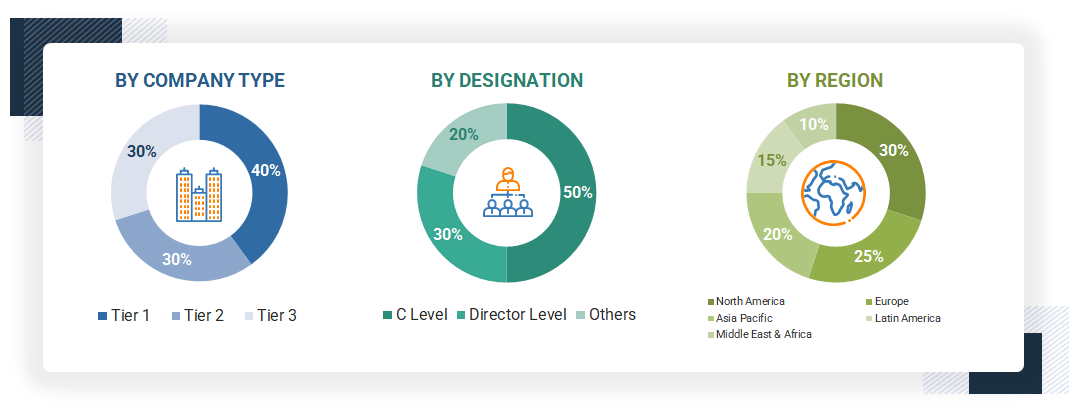
C-level primaries include CEOs, CFOs, COOs, and VPs.
Other designations include sales managers, marketing managers, business development managers, product managers, distributors, and suppliers.
Note: Companies are classified into tiers based on their total revenue. As of 2024, Tier 1 = >USD 10.00 billion, Tier 2 = USD 1.00 billion to USD 10.00 billion, and Tier 3 = < USD 1.00 billion.
Source: MarketsandMarkets Analysis
To know about the assumptions considered for the study, download the pdf brochure
Market Size Estimation
For the global market value, annual revenues were calculated based on the revenue mapping of major product manufacturers and OEMs active in the global surgical instrument tracking systems market. All the major product manufacturers were identified at the global and/or country/regional level. Revenue mapping for the respective business segments/sub-segments was done for the major players. Also, the global surgical instrument tracking systems market was split into various segments and sub-segments based on:
- List of major players operating in the market at the regional and/or country level
- Product mapping of various surgical instrument tracking systems manufacturers at the regional and/or country level
- Mapping of annual revenue generated by listed major players from surgical instrument tracking systems (or the nearest reported business unit/product category)
- Extrapolation of the revenue mapping of the listed major players to derive the global market value of the respective segments/subsegments
- Summation of the market value of all segments/subsegments to arrive at the global surgical instrument tracking systems market
The above-mentioned data was consolidated and added with detailed inputs and analysis from MarketsandMarkets and presented in this report.
Market Size Estimation (Bottom-up approach and Top-down Approach)
Data Triangulation
After arriving at the overall size of the global surgical instrument tracking systems market through the above-mentioned methodology, this market was split into several segments and subsegments. The data triangulation and market breakdown procedures were employed, wherever applicable, to complete the overall market engineering process and arrive at the exact market value data for the key segments and subsegments. The extrapolated market data was triangulated by studying various macro indicators and regional trends from both demand- and supply-side participants.
Market Definition
Surgical instrument tracking systems include barcodes and radiofrequency identification (RFID) tags used to manage surgical instruments in hospitals and other healthcare facilities, such as ambulatory surgery centers and polyclinics. A tracking system reduces the loss of valuable assets and ensures smooth workflows.
Stakeholders
- Instrument Manufacturing Companies
- Healthcare Institutions (Hospitals and Clinics)
- Surgical Instrument Tracking System Providers
- Suppliers And Distributors of Surgical Instruments
- Hospitals, Diagnostic Centers, and Medical Colleges
- Independent Surgeons and Private Offices of Physicians
- Ambulatory Surgery Centers (ASCs)
- Teaching Hospitals and Academic Medical Centers (AMCs)
- Government Bodies/Municipal Corporations
- Original Equipment Manufacturers (OEMs)
- Hardware System Manufacturers
- Medical Device Companies
- Contract Research Organizations (CROs)
- Medical Device Research and Consulting Firms
- Academic and Research Institutes
- Market Research and Consulting Firms
- Venture Capitalists and Investors
- Business Research and Consulting Service Providers
Report Objectives
- To define, describe, segment, and forecast the surgical instrument tracking systems market by component, technology, end user, and region
- To provide detailed information about the factors influencing the market growth (such as drivers, restraints, opportunities, and challenges)
- To analyze micromarkets1 with respect to individual growth trends, prospects, and contributions to the overall surgical instrument tracking systems market
- To analyze market opportunities for stakeholders and provide details of the competitive landscape for key players
- To forecast the size of the surgical instrument tracking systems market in five main regions (along with their respective key countries), namely, North America, Europe, the Asia Pacific, Latin America, and the Middle East & Africa
- To profile the key players in the surgical instrument tracking systems market and comprehensively analyze their core competencies2 and market shares
- To track and analyze competitive developments such as acquisitions, product launches, expansions, collaborations, agreements, partnerships, and R&D activities of the leading players in the surgical instrument tracking systems market
- To benchmark players within the surgical instrument tracking systems market using the Competitive Leadership Mapping framework, which analyzes market players on various parameters within the broad categories of business strategy, market share, and product offerings
Get the Full Surgical Instrument Tracking Systems Market Report
Full forecast, segment splits, and company analysis for all Surgical Instrument Tracking Systems Market.
- US Surgical Instrument Tracking Systems Market
- Canada Surgical Instrument Tracking Systems Market
- Germany Surgical Instrument Tracking Systems Market
- UK Surgical Instrument Tracking Systems Market
- France Surgical Instrument Tracking Systems Market
- Italy Surgical Instrument Tracking Systems Market
- Spain Surgical Instrument Tracking Systems Market
- Japan Surgical Instrument Tracking Systems Market
- China Surgical Instrument Tracking Systems Market
- Australia Surgical Instrument Tracking Systems Market
- South Korea Surgical Instrument Tracking Systems Market
- Brazil Surgical Instrument Tracking Systems Market
- Mexico Surgical Instrument Tracking Systems Market
- Rest Of Europe Surgical Instrument Tracking Systems Market
- Rest Of Asia Pacific Surgical Instrument Tracking Systems Market
- Rest Of Latin America Surgical Instrument Tracking Systems Market
Need a Tailored Report?
Customize this report to your needs
Get 10% FREE Customization
Customize This Report
