
Rest Of Europe Sweeteners Market (2023-2028)

The Rest Of Europe Sweeteners Market was valued at $5143.9 Million in 2023 and projected to reach to $5692.1 Million by 2028, representing a compound annual growth rate of CAGR 2.0%. The Rest Of Europe sweeteners market demonstrates resilient growth trajectory with a 2.0% CAGR through 2028, driven by sustained consumer shift toward healthier sweetening alternatives.


| Market Size in | USD 26.32 MN |
| Market Forecast in | |
| CAGR | |
| Forecast Period | |
| Units Considered | Value (USD MN) |
Rest Of Europe Sweeteners Market Trends and Insights
- Rest Of Europe represents a mature but steady market segment within the broader European sweeteners landscape, characterized by moderate growth driven by shifting consumer preferences toward natural and low-calorie sweetening solutions.
- The region's market dynamics reflect increasing health consciousness and regulatory pressures that continue to reshape product formulations across the food and beverage sector. Rest Of Europe's sweeteners market growth is supported by rising demand for sugar alternatives in both industrial and consumer applications.
- Throughout the forecast period from 2023 to 2028, Rest Of Europe is expected to maintain consistent expansion as manufacturers innovate to meet evolving taste preferences and nutritional requirements.
- The region's market trajectory demonstrates resilience despite competitive pressures, with Rest Of Europe positioning itself as a key contributor to Europe's overall sweeteners consumption patterns..
Key Market Statistics
- CAGR (2023-2028) CAGR 2.0%
- Market Size, 2023 ~USD 5143.9 Million
- Forecast, 2028 ~USD 5692.1 Million
- Country Rest Of Europe
Rest Of Europe Sweeteners Market Overview
Steady Market Growth :
Rest Of Europe sweeteners market valued at USD 5,143.9 million in 2023, projected to reach USD 5,692.1 million by 2028 with a consistent 2.0% CAGR, reflecting stable demand across mature European markets.
Natural Sweetener Shift :
Consumer preference in Rest Of Europe increasingly favors natural and low-calorie sweetening solutions, driving market evolution away from traditional sugar toward stevia, monk fruit, and sugar alcohols.
Mature Market Characteristics :
Rest Of Europe represents a consolidated market segment with established distribution networks, regulatory frameworks, and competitive dynamics distinct from faster-growing European regions.
Health-Conscious Demand :
Growing health awareness among Rest Of Europe consumers fuels demand for reduced-sugar and zero-calorie sweetener products, supporting market expansion despite moderate growth rates.
Rest Of Europe Sweeteners Market Dynamics
- The region's mature market structure provides stability while natural and functional sweetener categories capture increasing market share.
- Regulatory support for reduced-sugar formulations and rising obesity concerns continue to propel demand across food and beverage applications. Key growth drivers include expanding distribution of premium natural sweeteners, innovation in taste-matching technologies, and reformulation initiatives by major food manufacturers.
- Rest Of Europe's established retail infrastructure and consumer education initiatives support steady adoption of alternative sweeteners.
- Market consolidation among regional players and strategic partnerships with ingredient suppliers will shape competitive dynamics through 2028..
Market Ecosystem
Related Ecosystem
Fandb Ingredients
- Dairy Products
- Bakery Products
- Microorganism
- Polydextrose
- Carbohydrates
- AZELIS HOLDINGS SA
- Archer-Daniels-Midland Company
- Kerry Group plc
- Amway
- DSM FIRMMENICH
Key Takeaways
- Rest Of Europe's sweeteners market reached USD 5,143.9 million in 2023 with projected growth to USD 5,692.1 million by 2028.
- Rest Of Europe is experiencing a 2.0% CAGR, reflecting moderate but stable market expansion through the forecast period.
- Rest Of Europe's market growth is driven by increasing consumer demand for natural and low-calorie sweetening alternatives.
- Rest Of Europe maintains a mature market position with steady innovation in product formulations to meet regulatory and health-conscious consumer demands.
Sweeteners Market Report Scope
| Report Metric | Details |
|---|---|
| Base Year | 2023 |
| Fastest Growing Segment | NOVEL SWEETENERS (Product) |
| Forecast Period | 2023-2028 |
| Growth Rate | CAGR of 3.1% from 2023 to 2028 |
| Largest Segment | SUCROSE (Product) |
| Market Size Base Year (Billions) | ~USD 107.39 (2023) |
| Revenue Forecast (Billions) | ~USD 125.1 (2028) |
| Segments Covered | Application, Subapplication, Product, Subtype, Type, Nature, Form, Sales Channel, Indirect, Beverage Application, Food Application |
Rest Of Europe Sweeteners Market Report Segmentation
11 segment dimensions are covered across the global market.
By Application
- Beverages
- Food
- Other Applications
- Personal Care
- Pharmaceuticals
By Subapplication
- Alcoholic Beverages
- Bakery Products
- Carbonated Drinks
- Confectionery Products
- Dairy Products
- Flavored Alcoholic Beverages
- Fruit Drinks & Juices
- Other Beverages
- Other Food Products
- Plant-Based Beverages
- Plant-Based Foods
- Powdered Drinks
- Sweet Spreads
By Product
- Artificial Sweeteners
- High-Fructose Corn Syrup
- Natural Sweeteners
- Novel Sweeteners
- Polyols
- Sucrose
By Subtype
- Ace-K
- Agave Syrup
- Allulose
- Aspartame
- Coconut Sugar
- Cyclamate
- D-Tagatose
- Erythritol
- Honey
- Lucuma Fruit Sugar
- Maltitol
- Mannitol
- Maple Syrup
- Molasses
- Monk Fruit Sugar
- Other Artificial Sweeteners
- Other Natural Sweeteners
- Other Polyols
- Palm Sugar
- Saccharin
- Sorbitol
- Stevia
- Sucralose
- Xylitol
By Type
- Allulose
- D-Tagatose
- Erythritol
- High-Fructose Syrup
- High-Intensity Sweeteners
- Isomalt
- Low-Intensity Sweeteners
- Maltitol
- Sorbitol
- Xylitol
By Nature
- Artificial
- Natural
By Form
- Crystals
- Liquid
- Powder
By Sales Channel
- Direct (B2B)
- Indirect (B2C)
By Indirect
- Convenience Stores
- Hypermarkets/Supermarkets
- Online Retailers
- Other Channels
- Other Indirect Channels
- Specialty Retail Stores
By Beverage Application
- Alcoholic Beverages
- Carbonated Drinks
- Flavored Alcoholic Beverages
- Fruit Drinks & Juices
- Other Beverages
- Plant-Based Beverages
- Powdered Drinks
By Food Application
- Bakery Products
- Confectionery Products
- Dairy Products
- Other Food Products
- Plant-Based Foods
- Sweet Spreads
Target Audience
- Food & Beverage Manufacturers : Rest Of Europe-based and international F&B companies need regional market data to reformulate products, optimize sweetener sourcing, and align with local consumer health trends.
- Sweetener Ingredient Suppliers : Ingredient producers and distributors require Rest Of Europe-specific demand forecasts, competitive positioning, and customer preference insights to drive sales and product innovation.
- Market Entry & Expansion Teams : Companies planning market entry or expansion in Rest Of Europe need detailed regional analysis, growth drivers, and competitive landscape to minimize risk and maximize ROI.
- Investment & Private Equity Firms : Investors evaluating acquisition or partnership opportunities in Rest Of Europe's sweeteners sector require accurate market sizing, growth projections, and profitability indicators.
- Regulatory & Compliance Professionals : Regulatory affairs teams need Rest Of Europe-specific insights on sweetener regulations, labeling requirements, and health claim standards to ensure market compliance.
Reasons to Buy this Report
- Regional Market Specificity : Gain precise insights into Rest Of Europe's distinct market dynamics, consumer preferences, and growth patterns separate from broader European or global market trends.
- Competitive Landscape Analysis : Understand regional competitive positioning, market consolidation trends, and key player strategies specific to Rest Of Europe's mature sweeteners segment.
- Regulatory & Consumer Insights : Access detailed analysis of Rest Of Europe's regulatory environment, health-conscious consumer behavior, and natural sweetener adoption rates driving market evolution.
- Strategic Market Forecasting : Leverage accurate 5-year projections (2023-2028) with 2.0% CAGR data to inform product development, market entry, and investment decisions in Rest Of Europe.
- Category & Application Breakdown : Identify high-growth sweetener categories and end-use applications within Rest Of Europe's food and beverage sector for targeted business expansion.
Frequently asked questions
What is the market size of sweeteners in Rest Of Europe in 2023?
The Rest Of Europe sweeteners market was valued at USD 5,143.9 million in 2023.
What is the projected market size for Rest Of Europe sweeteners by 2028?
Rest Of Europe's sweeteners market is projected to reach USD 5,692.1 million by 2028.
What is the CAGR for Rest Of Europe's sweeteners market?
Rest Of Europe's sweeteners market is expected to grow at a CAGR of 2.0% from 2023 to 2028.
What factors are driving growth in Rest Of Europe's sweeteners market?
Rest Of Europe's market growth is driven by increasing consumer preference for natural and low-calorie sweetening solutions, health consciousness, and regulatory compliance requirements.
How does Rest Of Europe's sweeteners market compare to other European regions?
Rest Of Europe represents a mature market segment within Europe with steady, moderate growth characteristics compared to other regional segments.
RESEARCH METHODOLOGY
The study involved four major activities in estimating the current size of the sweeteners market. Exhaustive secondary research was done to collect information on the market, peer, and parent markets. The next step was to validate these findings, assumptions, and sizing with industry experts across the value chain through primary research. Both top-down and bottom-up approaches were employed to estimate the complete market size. After that, market breakdown and data triangulation were used to estimate the market size of segments and subsegments.
Secondary Research
This research study involved the extensive use of secondary sources—directories and databases such as Bloomberg Businessweek and Factiva—to identify and collect information useful for a technical, market-oriented, and commercial study of the sweeteners market.
In the secondary research process, various sources, such as the International Sugar Organization (ISO), Food and Agriculture Organization (FAO), Food and Drug Administration (FDA), United States Department of Agriculture (USDA), European Food Safety Agency (EFSA), Food Safety and Standards Authority of India (FSSAI), and academic references pertaining to sweeteners were referred to identify and collect information for this study. The secondary sources also include food journals, press releases, investor presentations of companies, white papers, certified publications, articles by recognized authors and regulatory bodies, trade directories, and paid databases.
Secondary research was mainly conducted to obtain critical information about the industry’s supply chain, the total pool of key players, and market classification and segmentation according to the industry trends to the bottom-most level and geographical markets. It was also used to obtain information about the key developments from a market-oriented perspective.
Primary Research
Extensive primary research was conducted after obtaining information regarding the sweeteners market scenario through secondary research. Several primary interviews were conducted with market experts from both the demand and supply sides across major countries of North America, Europe, Asia Pacific, South America, and the Rest of the World. Primary data was collected through questionnaires, emails, and telephonic interviews. The primary sources from the supply side included various industry experts, such as Chief X Officers (CXOs), Vice Presidents (VPs), Directors, from business development, marketing, research, and development teams, and related key executives from distributors, and key opinion leaders. Primary interviews were conducted to gather insights such as market statistics, data on revenue collected from the products and services, market breakdowns, market size estimations, market forecasting, and data triangulation. Primary research also helped in understanding the various trends related to types of sweeteners, products, forms, sales channels, applications, and regions. Stakeholders from the demand side, such as food and beverage companies and health and personal care companies who are using sweeteners were interviewed to understand the buyer’s perspective on the suppliers, products, and their current usage of sweeteners and the outlook of their business which will affect the overall market.
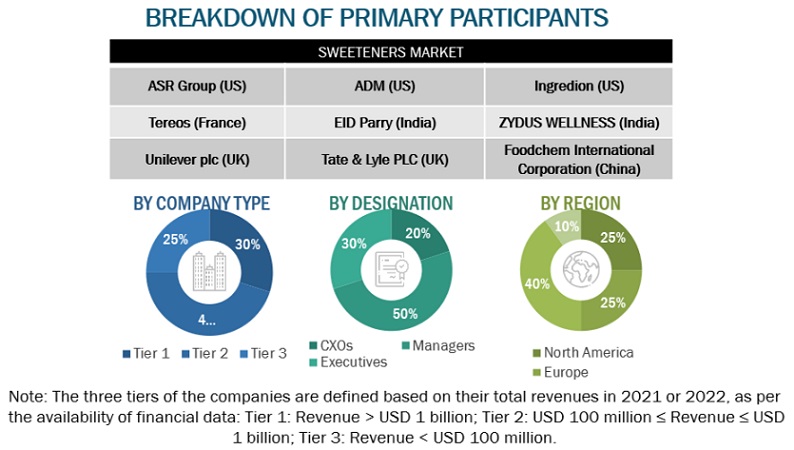
To know about the assumptions considered for the study, download the pdf brochure
Market Size Estimation
Both the top-down and bottom-up approaches were used to estimate and validate the total size of the sweeteners market. These approaches were also used extensively to determine the size of various subsegments in the market for the base year in terms of value. The research methodology used to estimate the market size includes the following details:
- The key players in the industry and the overall markets were identified through extensive secondary research.
- The revenues of the major players were determined through primary and secondary research, which were used as the basis for market sizing and estimation.
- All percentage shares, splits, and breakdowns were determined using secondary sources and verified through primary sources.
- All macroeconomic and microeconomic factors affecting the growth of the sweeteners market were considered while estimating the market size.
- All possible parameters that affect the market covered in this research study were accounted for, viewed in extensive detail, verified through primary research, and analyzed to obtain final quantitative and qualitative data.
Bottom-up Approach (Demand Side):
Through the bottom-up approach, the data extracted from secondary research was utilized to validate the market segment sizes obtained. The approach was employed to arrive at the overall size of the sweeteners market in particular regions, and its share in the market was validated through primary interviews conducted with sweetener manufacturers, suppliers, dealers, and distributors. With the data triangulation procedure and data validation through primary, the overall size of the parent market and each segmental market were determined.
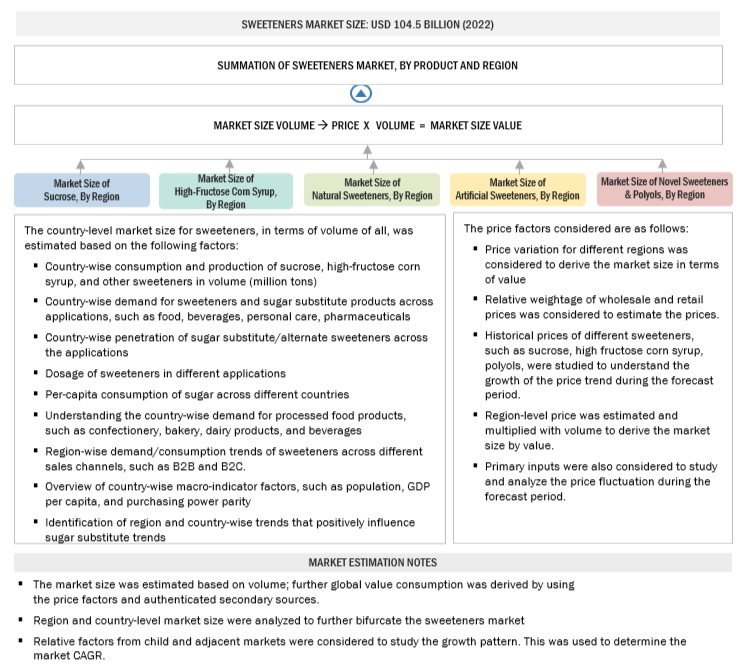
To know about the assumptions considered for the study, Request for Free Sample Report
Top-down Approach:
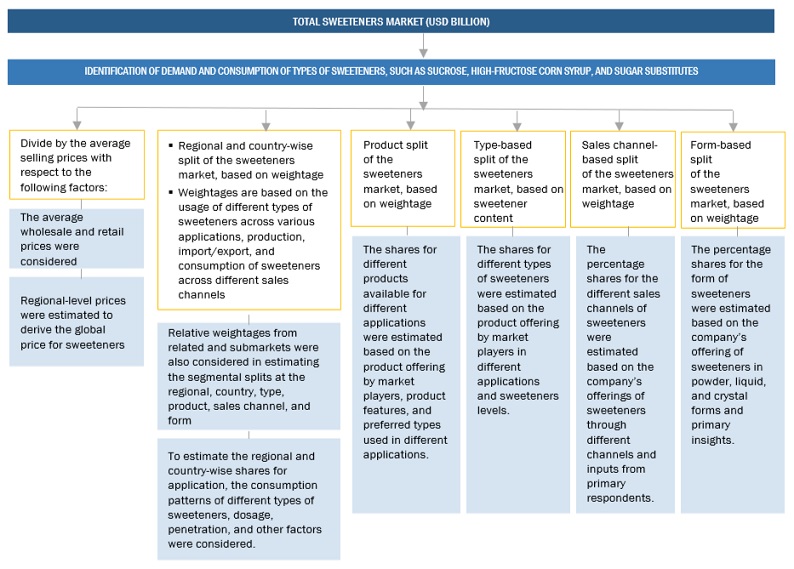
Market Size Estimation (Supply Side):
supply-side analysis was conducted to triangulate the market for sweeteners. The market for sweeteners was analyzed for each product.
- Going at a granular level, the share of sweetener products was analyzed among key players operating in the sweeteners market.
- The other factors considered include the demand for natural sweeteners, adoptions, increase in innovations, new product launches, consumer awareness, pricing trends, the adoption rate, patents registered, and organic & inorganic growth attempts.
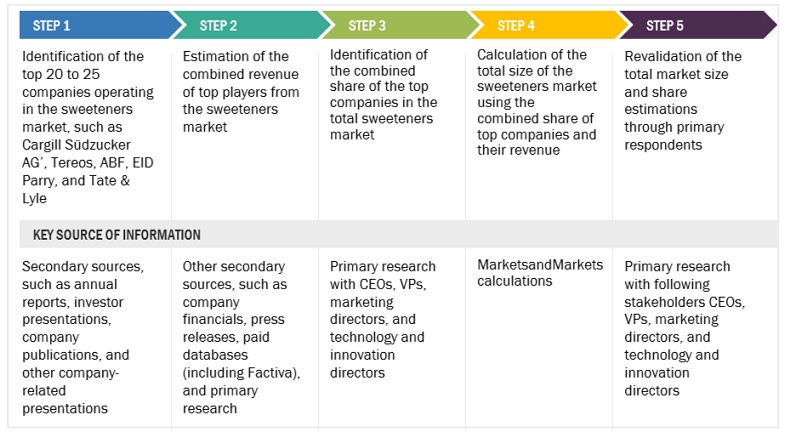
The top-down procedure has been employed to determine the overall size of the sweeteners market from the revenues of key players (companies) and their product share.
- The market share was then estimated for each company to verify the revenue share used earlier in the bottom-up procedure. With the data triangulation procedure and data validation through primaries, the exact values of the overall parent and each individual market have been determined and confirmed in this study.
Data Triangulation
After arriving at the overall market size from the above estimation process, the total market was split into several segments and subsegments. Where applicable, data triangulation and market breakdown procedures were employed to estimate the overall sweetener market and arrive at the exact statistics for all segments and subsegments. The data was triangulated by studying various factors and trends from the demand and supply sides. The market size was also validated using the top-down and bottom-up approaches.
Market Definition
As per the European Food Safety Authority (EFSA), Sweeteners are food additives that are used to impart a sweet taste to foodstuffs. It is an artificial substance that tastes sweet. It is a low-calorie synthetic product used instead of sugar.
Sweeteners are substances employed to add a sweet taste to food, beverages, or other items. They serve as alternatives to natural sugars, providing sweetness without the caloric content associated with conventional sugars. Sweeteners can be categorized into two primary groups: natural sweeteners, sourced from plants or natural origins, and artificial sweeteners, which are chemically manufactured.
Key Stakeholders
- Raw material suppliers
- Regulatory bodies that include the following:
- Food safety agencies, such as the Food and Drug Administration (FDA), European Food Safety Authority (EFSA), US Department of Agriculture (USDA), Food Standards Australia New Zealand (FSANZ), Health Canada – Food Directorate, China National Center for Food Safety Risk Assessment (CFSA), and World Health Organization (WHO)
- Government agencies and NGOs
- End users include the following:
- Food & beverage manufacturers/suppliers
- Health & personal care product manufacturers/suppliers
- Retailers
- Commercial Research & Development (R&D) institutions and financial institutions
- Importers and exporters of sugar substitutes
- Traders, distributors, and suppliers
- Research organizations
- Trade associations and industry bodies
Report Objectives
- To determine and project the size of the sweeteners market, concerning type, product, form, sales channel, application, and region, over five years, ranging from 2023 to 2028
- To identify the attractive opportunities in the market by determining the largest and fastest-growing segments across regions
- To provide detailed information about the key factors influencing the growth of the market (drivers, restraints, opportunities, and industry-specific challenges)
- To analyze the micro-markets concerning individual growth trends, prospects, and their contribution to the total market
- Identifying and profiling the key players in the sweeteners market
-
Providing a comparative analysis of market leaders based on the following:
- Product offerings
- Business strategies
- Strengths and weakness
- Key financials
- Understanding the competitive landscape and identifying the major growth strategies players adopt across the key regions
- Analyzing the value chain and products across key regions and their impact on prominent market players
- Providing insights on key product innovations and investments in the sweeteners market
Available Customizations:
With the given market data, MarketsandMarkets offers customizations according to company-specific scientific needs.
The following customization options are available for the report:
Product Analysis
- Product Matrix, which gives a detailed comparison of the product portfolio of each company.
Geographic Analysis
With the given market data, MarketsandMarkets offers customizations according to company-specific scientific needs.
- Further breakdown of the Rest of Europe into Sweden, Belgium, Switzerland, Ukraine, and other EU and non-EU countries.
- Further breakdown of the Rest of Asia Pacific sweeteners market into key countries
- Further breakdown of the Rest of European sweeteners market into key countries.
Company Information
- Detailed analyses and profiling of additional market players (up to five)
Get the Full Sweeteners Market Report
Full forecast, segment splits, and company analysis for all Sweeteners Market.
- SAUDI ARABIA Sweeteners Market
- US Sweeteners Market
- Rest Of Asia Pacific Sweeteners Market
- Rest Of Latin America Sweeteners Market
- Rest Of Africa Sweeteners Market
- Rest Of The Middle East Sweeteners Market
- CANADA Sweeteners Market
- GERMANY Sweeteners Market
- UK Sweeteners Market
- FRANCE Sweeteners Market
- ITALY Sweeteners Market
- SPAIN Sweeteners Market
- RUSSIA Sweeteners Market
- POLAND Sweeteners Market
- CHINA Sweeteners Market
- INDIA Sweeteners Market
- JAPAN Sweeteners Market
- SOUTH KOREA Sweeteners Market
- INDONESIA Sweeteners Market
- THAILAND Sweeteners Market
- MALAYSIA Sweeteners Market
- MEXICO Sweeteners Market
- BRAZIL Sweeteners Market
- ARGENTINA Sweeteners Market
- SOUTH AFRICA Sweeteners Market
Need a Tailored Report?
Customize this report to your needs
Get 10% FREE Customization
Customize This Report
