
Asia Pacific Thin-Film Photovoltaic Market (2024-2029)

The Asia Pacific Thin-Film Photovoltaic Market was valued at $3774.5 Million in 2024 and projected to reach to $7500.4 Million by 2029, representing a compound annual growth rate of CAGR 14.7%. Asia Pacific's thin-film photovoltaic market is poised for exceptional growth through 2029, driven by escalating energy demand, supportive government policies, and rapid industrialization across emerging economies.


| Market Size in | USD 26.32 MN |
| Market Forecast in | |
| CAGR | |
| Forecast Period | |
| Units Considered | Value (USD MN) |
Asia Pacific Thin-Film Photovoltaic Market Trends and Insights
- In 2024, Asia Pacific's thin-film PV market was valued at $3,774.5 million, driven by increasing government incentives, declining manufacturing costs, and rising energy demand across emerging economies.
- The region is expected to expand significantly, with the market forecast to reach $7,500.4 million by 2029, reflecting a compound annual growth rate of 14.7%. Asia Pacific's leadership in thin-film photovoltaic technology is underpinned by substantial investments in solar infrastructure and manufacturing capacity.
- Countries across Asia Pacific are prioritizing renewable energy targets and grid modernization, creating favorable conditions for thin-film PV deployment.
- The region's competitive manufacturing ecosystem and access to raw materials further strengthen Asia Pacific's position as a key market for thin-film photovoltaic solutions. The forecast period through 2029 will see Asia Pacific continue to capture market share through technological innovation and cost reduction.
- Asia Pacific's commitment to carbon neutrality goals and energy security will sustain demand for thin-film photovoltaic systems, positioning the region as a cornerstone of global renewable energy transition..
Key Market Statistics
- CAGR (2024-2029) CAGR 14.7%
- Market Size, 2024 ~USD 3774.5 Million
- Forecast, 2029 ~USD 7500.4 Million
- Geography Asia Pacific
Asia Pacific Thin-Film Photovoltaic Market Overview
Market Leadership :
Asia Pacific commands the global thin-film photovoltaic market with a 2024 valuation of $3,774.5 million, driven by China's manufacturing dominance and India's rapid renewable energy expansion across the region.
Accelerated Growth Trajectory :
The region is projected to reach $7,500.4 million by 2029, representing a robust 14.7% CAGR, outpacing traditional energy infrastructure investments and positioning Asia Pacific as the renewable energy hub.
Government Support & Incentives :
Favorable policies, subsidies, and renewable energy targets across China, India, Japan, and Australia are catalyzing thin-film PV adoption and attracting significant capital investments in manufacturing and deployment.
Cost Competitiveness :
Declining manufacturing costs in Asia Pacific, coupled with economies of scale and technological advancements, are making thin-film photovoltaics increasingly cost-competitive against conventional energy sources.
Asia Pacific Thin-Film Photovoltaic Market Dynamics
- China's manufacturing prowess combined with India's aggressive renewable energy targets creates a powerful growth dynamic.
- The region benefits from declining production costs, technological innovation, and increasing grid integration capabilities that enhance market penetration. Investment in solar infrastructure, coupled with rising environmental awareness and energy security concerns, will sustain double-digit growth rates.
- Key markets including Japan, Australia, and Southeast Asian nations are expanding their thin-film PV capacity.
- The convergence of favorable regulatory frameworks, competitive pricing, and technological maturity positions Asia Pacific as the global epicenter for thin-film photovoltaic expansion, attracting multinational players and fostering a robust ecosystem of local manufacturers and solution providers..
Market Ecosystem
Related Ecosystem
Electronics System And Components
- Sensors
- Temperature Sensors
- Pressure Sensors
- Actuators
- Image Sensors
- Lenovo
- Samsung
- Texas Instruments Incorporated
- HONEYWELL INTERNATIONAL INC.
- Teledyne Technologies Incorporated
Semiconductor Materials And Components
- Sensors
- Gallium Nitride (GaN)
- Digital Signal Processor (DSP)
- Natural Language Processing (NLP)
- Silicon Carbide
- Texas Instruments Incorporated
- Samsung
- APPLIED MATERIALS, INC.
- Stmicroelectronics
- Lenovo
Energy Storage
- Energy Harvesting
- HVAC System
- Applicant Tracking System
- Battery Electric Vehicle (BEV)
- Carboxymethyl Cellulose (CMC)
- MOMENTIVE PERFORMANCE MATERIALS INC.
- Panasonic Holdings Corporation
- Lg corp
- ABB India Limited
- Byd company ltd.
Key Takeaways
- Asia Pacific's thin-film PV market is valued at $3,774.5 million in 2024 and projected to double to $7,500.4 million by 2029.
- Asia Pacific is experiencing a 14.7% CAGR, driven by government renewable energy targets and declining manufacturing costs.
- Asia Pacific's competitive manufacturing ecosystem and raw material access position it as the global leader in thin-film photovoltaic production.
- Asia Pacific's energy security priorities and carbon neutrality commitments will sustain strong demand through 2029.
Thin-Film Photovoltaic Market Report Scope
| Report Metric | Details |
|---|---|
| Base Year | 2024 |
| Fastest Growing Segment | PEROVSKITE (CATIO3) (Material) |
| Forecast Period | 2024-2029 |
| Growth Rate | CAGR of 15.1% from 2024 to 2029 |
| Largest Segment | RIGID (Type) |
| Market Size Base Year (Billions) | ~USD 6.14 (2024) |
| Revenue Forecast (Billions) | ~USD 12.4 (2029) |
| Segments Covered | Material, End Use, Component, Type |
Asia Pacific Thin-Film Photovoltaic Market Report Segmentation
4 segment dimensions are covered across the global market.
By Material
- Amorphous Silicon (A-Si)
- Cadmium Telluride (Cdte)
- Copper Indium Gallium Selenide (Cigs)
- Organic Photovoltaic (Opv)
- Perovskite (Catio3)
By End Use
- Commercial & Industrial
- Residential
- Utility
By Component
- Balance Of System (Bos)
- Inverter
- Module
By Type
- Flexible
- Rigid
Target Audience
- Solar Manufacturers & Equipment Suppliers : Need regional market sizing, growth forecasts, and competitive dynamics to optimize production capacity, supply chain investments, and market positioning across Asia Pacific's high-growth thin-film PV sector.
- Energy & Utility Companies : Require market intelligence on renewable energy adoption rates, policy incentives, and deployment trends to inform grid modernization strategies and renewable portfolio expansion in Asia Pacific markets.
- Investment & Private Equity Firms : Seek comprehensive market analysis, growth projections, and risk assessments to identify investment opportunities, evaluate portfolio companies, and guide capital deployment in Asia Pacific renewable energy.
- Government & Policy Makers : Need market data and trend analysis to inform renewable energy policy development, incentive structuring, and long-term energy security planning aligned with Asia Pacific's sustainability goals.
- Technology & Research Institutions : Require market insights and forecasts to guide R&D priorities, commercialization strategies, and innovation roadmaps for thin-film photovoltaic technologies targeting Asia Pacific's expanding market.
Countries within Asia Pacific - compare and drill down
| Country | 2025 size (native) |
|---|---|
| China | USD 4156.3 Million |
| Japan | USD 529.4 Million |
| India | USD 673.3 Million |
| Australia | USD 340.7 Million |
| Rest Of Asia Pacific | USD 1800.7 Million |
Country market size visualization
Reasons to Buy this Report
- Regional Market Dominance Insights : Gain comprehensive understanding of Asia Pacific's commanding 50%+ share of global thin-film PV market, including country-level breakdowns and competitive positioning across China, India, Japan, and Australia.
- Growth Opportunity Identification : Identify high-potential markets and segments within Asia Pacific experiencing 14.7% CAGR, enabling strategic investment decisions and market entry planning for the next five-year cycle.
- Policy & Regulatory Landscape : Access detailed analysis of government incentives, renewable energy targets, and regulatory frameworks driving adoption across Asia Pacific nations, critical for compliance and strategic planning.
- Competitive Intelligence : Benchmark against regional competitors, understand manufacturing cost dynamics, and identify emerging players reshaping the Asia Pacific thin-film PV ecosystem and supply chain.
- Investment & Expansion Strategy : Leverage market forecasts and trend analysis to develop data-driven expansion strategies, partnership opportunities, and capital allocation decisions specific to Asia Pacific's renewable energy boom.
Frequently asked questions
What is the current market size of thin-film photovoltaics in Asia Pacific?
Asia Pacific's thin-film photovoltaic market was valued at $3,774.5 million in 2024 and is projected to reach $7,500.4 million by 2029.
What is the expected growth rate for Asia Pacific's thin-film PV market?
Asia Pacific's thin-film photovoltaic market is expected to grow at a compound annual growth rate of 14.7% from 2024 to 2029.
Which countries in Asia Pacific are leading thin-film photovoltaic adoption?
Major markets in Asia Pacific include China, India, Japan, and Southeast Asian nations, which are investing heavily in renewable energy infrastructure and manufacturing capacity.
What factors are driving growth in Asia Pacific's thin-film PV market?
Key drivers include government renewable energy incentives, declining manufacturing costs, rising electricity demand, energy security priorities, and carbon neutrality commitments across the region.
How does Asia Pacific's thin-film PV market compare to other regions?
Asia Pacific represents the largest and fastest-growing thin-film photovoltaic market globally, driven by its manufacturing capacity, raw material access, and aggressive renewable energy targets.
RESEARCH METHODOLOGY
The research process for this study included systematic gathering, recording, and analysis of data about customers and companies operating in the thin-film photovoltaic market. This process involved the extensive use of secondary sources, directories, and databases (Factiva, Oanda, and OneSource) for identifying and collecting valuable information for the comprehensive, technical, market-oriented, and commercial study of the thin-film photovoltaic industry . In-depth interviews were conducted with primary respondents, including experts from core and related industries and preferred manufacturers, to obtain and verify critical qualitative and quantitative information as well as to assess growth prospects. Key players in the thin-film photovoltaic industry were identified through secondary research, and their market rankings were determined through primary and secondary research. This research included studying annual reports of top players and interviewing key industry experts such as CEOs, directors, and marketing executives.
Secondary Research
In the secondary research process, various sources were used to identify and collect information important for this study. These include annual reports, press releases & investor presentations of companies, white papers, technology journals, certified publications, articles by recognized authors, directories, and databases.
Secondary research was mainly used to obtain key information about the industry's supply chain, the total pool of market players, the classification of the market according to industry trends to the bottom-most level, regional markets, and key developments from the market and technology-oriented perspectives.
Primary Research
Primary research was also conducted to identify the segmentation types, key players, competitive landscape, and key market dynamics, such as drivers, restraints, opportunities, challenges, and industry trends, along with key strategies adopted by players operating in the thin-film photovoltaic industry . Extensive qualitative and quantitative analyses were performed on the complete market engineering process to list key information and insights throughout the report.
Extensive primary research has been conducted after acquiring knowledge about the thin-film photovoltaic industry scenarios through secondary research. Several primary interviews have been conducted with experts from both demand (end users) and supply side (thin-film photovoltaic hardware manufacturers/providers) across four major geographic regions: North America, Europe, Asia Pacific, and RoW. Approximately 80% and 20% of the primary interviews were conducted from the supply and demand side, respectively. These primary data have been collected through questionnaires, emails, and telephonic interviews.

To know about the assumptions considered for the study, download the pdf brochure
Market Size Estimation
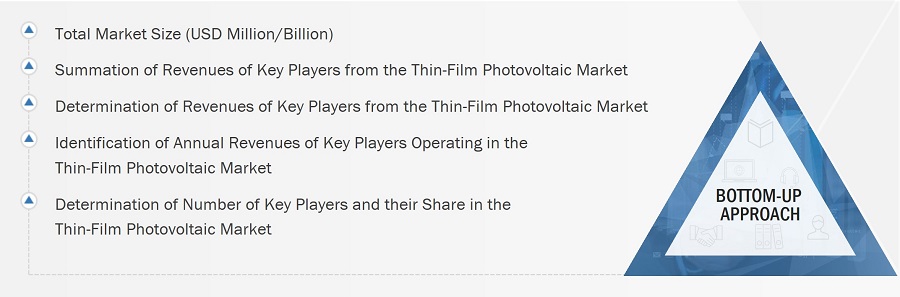
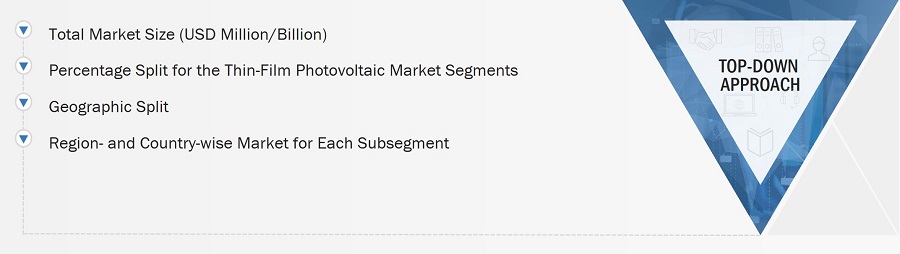
In the complete market engineering process, both top-down and bottom-up approaches were implemented, along with several data triangulation methods, to estimate and validate the size of the thin-film photovoltaic market and various other dependent submarkets. Key players in the market were identified through secondary research, and their market share in the respective regions was determined through primary and secondary research. This entire research methodology included the study of annual and financial reports of the top players, as well as interviews with experts (such as CEOs, VPs, directors, and marketing executives) for key insights (quantitative and qualitative).
All percentage shares, splits, and breakdowns were determined using secondary sources and verified through primary sources. All the possible parameters that affect the markets covered in this research study were accounted for, viewed in detail, verified through primary research, and analyzed to obtain the final quantitative and qualitative data. This data was consolidated and supplemented with detailed inputs and analysis from MarketsandMarkets and presented in this report.
Thin-film photovoltaic Market: Bottom-Up Approach
Thin-film photovoltaic Market: Top-Down Approach
Data Triangulation
After arriving at the overall market size from the market size estimation process, as explained above, the total market has been split into several segments and subsegments. To complete the overall market engineering process and arrive at the exact statistics for all segments and subsegments, market breakdown and data triangulation procedures have been employed, wherever applicable. The data have been triangulated by studying various factors and trends from both the demand and supply sides. Along with this, the market has been validated using top-down and bottom-up approaches.
Market Definition
Thin-film photovoltaic (PV) is a term used to describe a form of solar technology that turns sunlight into electricity using thin semiconductor layers. In contrast to conventional crystalline silicon solar cells constructed from solid silicon blocks, thin-film solar cells are developed by depositing thin layers of semiconductor materials in a substrate. Rapid advancements in emerging thin-film technologies, such as the development of perovskite solar cells, have increased their high efficiency and potential.
The thin-film photovoltaic market continues to evolve and expand, driven by ongoing research and development efforts, cost-reduction initiatives, and increasing demand for solar energy solutions. The market is expected to grow as technology advances and economies of scale continue to improve the efficiency and cost-effectiveness of thin-film PV modules.
Key Stakeholders
- Solar cell manufacturers
- Solar module manufacturers
- Energy companies
- Raw material and manufacturing equipment suppliers
- Solar market technical consultants
- Technology standards organizations, forums, alliances, and associations
- Governments, financial institutions, and investment communities
- Research organizations
- Analysts and strategic business planners
- Venture capitalists, private equity firms, and startups
- Distributors
Report Objectives
- To define, describe, estimate, and forecast the thin-film photovoltaic industry in terms of material, component, end use, type. and region.
- To describe and forecast the thin-film photovoltaic industry , by region, in terms of value. Regional markets covered are North America, Europe, Asia Pacific, and the Rest of the World (RoW)
- To provide detailed information regarding the drivers, restraints, opportunities, and challenges influencing market growth
- To provide a detailed overview of the thin-film photovoltaic industry value chain
- To strategically analyze micro markets with respect to individual growth trends, prospects, and contributions to the total market
- To profile key players and comprehensively analyze their ranking based on their revenues and core competencies along with detailing the competitive landscape.
- To analyze competitive developments, such as expansions, agreements, partnerships, acquisitions, and product launches in the thin-film photovoltaic industry
- To analyze market opportunities for various stakeholders by identifying the high-growth segments of the market
- To benchmark market players using the proprietary company evaluation quadrant, which analyzes them on various parameters.
Available Customizations
With the given market data, MarketsandMarkets offers customizations according to the company’s specific needs. The following customization options are available for the report:
Company Information
- Detailed analysis and profiling of additional market players (up to 5)
Get the Full Thin-Film Photovoltaic Market Report
Full forecast, segment splits, and company analysis for all Thin-Film Photovoltaic Market.
- US Thin-Film Photovoltaic Market
- Canada Thin-Film Photovoltaic Market
- Mexico Thin-Film Photovoltaic Market
- Germany Thin-Film Photovoltaic Market
- UK Thin-Film Photovoltaic Market
- France Thin-Film Photovoltaic Market
- Italy Thin-Film Photovoltaic Market
- Russia Thin-Film Photovoltaic Market
- China Thin-Film Photovoltaic Market
- Japan Thin-Film Photovoltaic Market
- India Thin-Film Photovoltaic Market
- Australia Thin-Film Photovoltaic Market
- Rest Of Europe Thin-Film Photovoltaic Market
- Rest Of Asia Pacific Thin-Film Photovoltaic Market
Need a Tailored Report?
Customize this report to your needs
Get 10% FREE Customization
Customize This Report
