
Brazil Threat Hunting Market (2024-2029)

The Brazil Threat Hunting Market was valued at $57.5 Million in 2024 and projected to reach to $115.1 Million by 2029, representing a compound annual growth rate of 14.9%. Brazil's threat hunting market is positioned for substantial growth as organizations recognize the critical importance of proactive cybersecurity strategies.


| Market Size in | USD 26.32 MN |
| Market Forecast in | |
| CAGR | |
| Forecast Period | |
| Units Considered | Value (USD MN) |
Brazil Threat Hunting Market Trends and Insights
- This expansion reflects Brazil's increasing investment in proactive cybersecurity measures as organizations across the country face escalating threats from sophisticated threat actors.
- Brazil's market growth is driven by regulatory pressures, rising breach incidents, and heightened awareness among enterprises of the need for advanced threat detection capabilities. The Brazilian threat hunting market is characterized by growing adoption among financial institutions, government agencies, and large enterprises seeking to strengthen their security posture.
- Brazil's competitive landscape includes both international security vendors and emerging local players offering specialized threat hunting services.
- By 2029, Brazil is expected to solidify its position as a key market in Latin America, with organizations increasingly allocating budgets to threat hunting platforms and managed services to detect and respond to advanced threats before they cause significant damage..
Key Market Statistics
- CAGR (2024-2029) 14.9% CAGR
- Market Size, 2024 ~USD 57.5 Million
- Forecast, 2029 ~USD 115.1 Million
- Country Brazil
Brazil Threat Hunting Market Overview
Market Valuation Growth :
Brazil's threat hunting market is valued at $57.5 million in 2024 and is projected to reach $115.1 million by 2029, representing a doubling of market size over the five-year forecast period.
Consistent CAGR Performance :
The Brazilian threat hunting market maintains a steady 14.9% CAGR through 2029, aligning with global growth rates and demonstrating strong market momentum driven by increasing cybersecurity investments.
Regulatory and Compliance Drivers :
Brazil's market expansion is fueled by stringent regulatory pressures and compliance requirements, compelling organizations to adopt proactive threat hunting capabilities to meet evolving data protection standards.
Rising Threat Sophistication :
Organizations across Brazil are facing escalating threats from sophisticated threat actors, driving urgent demand for advanced threat hunting solutions to detect and respond to complex cyber threats before they cause damage.
Brazil Threat Hunting Market Dynamics
- The doubling of market value from $57.5 million to $115.1 million reflects increasing awareness among Brazilian enterprises of the need to move beyond reactive security measures.
- Financial institutions, government agencies, and large corporations are prioritizing threat hunting investments to combat sophisticated threat actors targeting the region. The market outlook remains positive as regulatory frameworks continue to tighten and breach incidents underscore the value of threat hunting capabilities.
- Brazilian organizations are increasingly allocating budgets toward managed threat hunting services and internal security operations centers.
- This trend is expected to accelerate as smaller and mid-sized enterprises recognize the competitive advantage of proactive threat detection and response capabilities..
Market Ecosystem
Related Ecosystem
Application Security
- Cloud Security
- Security Analytics
- Network Testing
- Security Testing
- Web Application Security
- REDINGTON
- International Business Machines Corporation
- MICROSOFT CORPORATION
- Cisco Systems, Inc.
- PALO ALTO NETWORKS, INC
Endpoint Security
- Cloud Security
- Security Analytics
- Multi-Factor Authentication
- Biometric Security and Authentication System
- Critical Communication Network
- REDINGTON
- International Business Machines Corporation
- MICROSOFT CORPORATION
- Cisco Systems, Inc.
- PALO ALTO NETWORKS, INC
Network Security
- Cloud Security
- Critical Communication Network
- Surveillance System
- Video Surveillance Systems
- Biometric Security and Authentication System
- REDINGTON
- Cisco Systems, Inc.
- International Business Machines Corporation
- Fortinet, Inc.
- MICROSOFT CORPORATION
Key Takeaways
- Brazil's threat hunting market is valued at $57.5 million in 2024 and is projected to reach $115.1 million by 2029, representing a 14.9% compound annual growth rate.
- Brazil's market growth is driven by regulatory compliance requirements, increasing cyber incidents, and enterprise demand for proactive threat detection and response capabilities.
- Brazil's financial services, government, and large enterprise sectors are leading adopters of threat hunting solutions and managed security services.
- Brazil's competitive environment includes both established global cybersecurity vendors and emerging local providers offering specialized threat hunting expertise and services.
Threat Hunting Market Report Scope
| Report Metric | Details |
|---|---|
| Base Year | 2024 |
| Fastest Growing Segment | NDR (Tool) |
| Forecast Period | 2024-2029 |
| Growth Rate | CAGR of 14.9% from 2024 to 2029 |
| Largest Segment | SOFTWARE (Component) |
| Market Size Base Year (Billions) | ~USD 3.45 (2024) |
| Revenue Forecast (Billions) | ~USD 6.9 (2029) |
| Segments Covered | Offering, Tool, Service, Organization Size, Deployment Mode, Vertical, Component, Target, Application |
Brazil Threat Hunting Market Report Segmentation
9 segment dimensions are covered across the global market.
By Offering
- Services
- Tools
By Tool
- Edr
- Ndr
- Other Tools
- Siem
- Threat Intelligence
- Threat Intelligence Platform
By Service
- Managed Services
- Professional Services
By Organization Size
- Large Enterprises
- Smes
By Deployment Mode
- Cloud
- On-Premises
By Vertical
- Bfsi
- Energy & Utilities
- Energy And Utility
- Finance And Insurance
- Government
- Healthcare
- Healthcare And Social Assistance
- Information
- It & Ites
- It And Ites
- Manufacturing
- Other Verticals
- Retail
- Retail Trade
- Utilities
By Component
- Services
- Software
- Solutions
By Target
- Api Vulnerabilities
- Content Management System Vulnerabilities
- IoT Vulnerabilities
- Other Target Vulnerabilities
- Other Target Vulnerabilities*
By Application
- Log Management And Reporting
- Other Applications
- Security Analytics
- Threat Intelligence
BRAZIL: THREAT HUNTING MARKET, BY VERTICAL, 2024–2029
| Segment | 2024 | 2025 | 2026 | 2027 | 2028 | 2029 | CAGR (%) |
|---|---|---|---|---|---|---|---|
| BFSI | 11.5 | 12.8 | 14.4 | 17.2 | 19.8 | 23.1 | 15 |
| ENERGY & UTILITIES | 7 | 7.8 | 8.7 | 10.4 | 11.9 | 13.8 | 14.8 |
| GOVERNMENT | 10.4 | 11.6 | 12.9 | 15.4 | 17.7 | 20.5 | 14.6 |
| HEALTHCARE | 5.9 | 6.6 | 7.4 | 8.9 | 10.2 | 11.9 | 15.1 |
| IT & ITES | 8.6 | 9.7 | 11 | 13.2 | 15.3 | 17.9 | 15.7 |
| MANUFACTURING | 5.6 | 6.2 | 6.9 | 8.3 | 9.5 | 11 | 14.3 |
| OTHER VERTICALS | 3.6 | 3.9 | 4.3 | 5.1 | 5.8 | 6.7 | 13.4 |
| RETAIL | 5 | 5.6 | 6.3 | 7.6 | 8.8 | 10.3 | 15.5 |
| TOTAL | 57.5 | 64.3 | 71.9 | 86.3 | 98.9 | 115.1 | 14.9 |
Target Audience
- Cybersecurity Solution Providers : Vendors offering threat hunting platforms, managed detection and response (MDR), and security operations services need Brazil-specific market data to identify growth opportunities and develop localized offerings for Brazilian enterprises.
- Enterprise Security Leaders : CISOs and security directors in Brazil require market intelligence to benchmark their threat hunting investments, justify budget allocations to executives, and understand competitive threat hunting capabilities in their region.
- Investment & Private Equity Firms : Investors evaluating cybersecurity companies targeting Brazil need detailed market sizing, growth projections, and regulatory drivers to assess investment opportunities and portfolio company potential in the Brazilian market.
- Managed Security Service Providers (MSSPs) : Brazilian and international MSSPs require market data to understand demand for threat hunting services, identify customer acquisition opportunities, and develop service offerings aligned with regional compliance and threat landscapes.
- Government & Regulatory Bodies : Brazilian government agencies and regulatory bodies need market intelligence to understand cybersecurity capability gaps, inform policy decisions, and assess the effectiveness of compliance frameworks in driving threat hunting adoption.
Reasons to Buy this Report
- Market Size & Growth Validation : Obtain precise market valuation data for Brazil ($57.5M in 2024) and verified forecast projections through 2029, enabling accurate business planning and investment decisions in the Brazilian threat hunting sector.
- Competitive Positioning Intelligence : Understand Brazil-specific market dynamics, regulatory drivers, and threat landscape characteristics to identify competitive advantages and develop targeted go-to-market strategies for Brazilian organizations.
- Investment & Expansion Planning : Leverage detailed Brazil market insights to support investment decisions, resource allocation, and expansion strategies with confidence in market growth trajectories and regional demand drivers.
- Customer Segmentation Insights : Access Brazil-specific audience analysis to identify high-value customer segments, understand their threat hunting needs, and tailor solutions to regional compliance requirements and security priorities.
- Risk Mitigation & Forecasting : Utilize comprehensive Brazil market data to anticipate market trends, assess regulatory impacts, and develop contingency strategies based on region-specific threat actor activities and compliance evolution.
Frequently asked questions
What is the current size of Brazil's threat hunting market?
Brazil's threat hunting market was valued at $57.5 million in 2024 and is expected to grow to $115.1 million by 2029.
What is the growth rate of Brazil's threat hunting market?
Brazil's threat hunting market is growing at a compound annual growth rate (CAGR) of 14.9% from 2024 to 2029.
Which industries are driving threat hunting adoption in Brazil?
Brazil's financial services, government agencies, and large enterprises are the primary drivers of threat hunting market growth due to regulatory requirements and heightened security concerns.
What factors are contributing to Brazil's threat hunting market expansion?
Brazil's market expansion is driven by increasing cyber threats, regulatory compliance mandates, rising breach incidents, and growing organizational awareness of the need for proactive threat detection.
Who are the key players in Brazil's threat hunting market?
Brazil's threat hunting market includes both international cybersecurity vendors and emerging local providers offering specialized threat hunting platforms and managed security services.
RESEARCH METHODOLOGY
The research encompassed various vital activities to determine the current market size of the threat-hunting market. Extensive secondary research was conducted to gather information on the industry. Subsequently, primary research involving industry experts across the value chain validated these findings, assumptions, and estimations. The total market size was estimated using different methodologies, including top-down and bottom-up approaches. Following this, market segmentation and data triangulation techniques were applied to ascertain the market size of individual segments and subsegments within the Threat hunting market.
Secondary Research
During the secondary research phase, various sources were consulted to identify and gather pertinent information for the study. These secondary sources encompassed annual reports, press releases, investor presentations from Threat hunting software and service vendors, online forums, accredited publications, and white papers. This secondary research served as a foundation for acquiring crucial insights into the industry's supply chain, key players, market categorization, segmentation based on prevailing trends down to granular levels, regional markets, and noteworthy developments from both market and technological perspectives. These findings were subsequently corroborated and validated through primary sources. Factors considered in estimating regional market sizes included governmental and technological initiatives, Gross Domestic Product (GDP) growth rates, Information and Communication Technology (ICT) expenditure, recent market developments, and a comprehensive analysis of significant Operational Technology Security solution providers' market standings.
Primary Research
The comprehensive market engineering process employed a combination of top-down and bottom-up approaches, complemented by various data triangulation methods, to accurately estimate and forecast market trends for overall market segments and subsegments outlined in the report. The report systematically compiled and presented vital insights and information through meticulous qualitative and quantitative analyses conducted throughout the market engineering process.
After completing the market engineering process, which encompassed calculations for market statistics, segmentation breakdowns, market size estimations, forecasts, and data triangulation, thorough primary research was undertaken. This primary research gathered, verified, and validated critical numerical data and identified segmentation types, industry trends, and the competitive landscape within the Threat hunting market. Moreover, primary research was instrumental in elucidating fundamental market dynamics, including drivers, restraints, opportunities, challenges, industry trends, and strategic initiatives market players adopt.
Following is the breakup of the primary study:
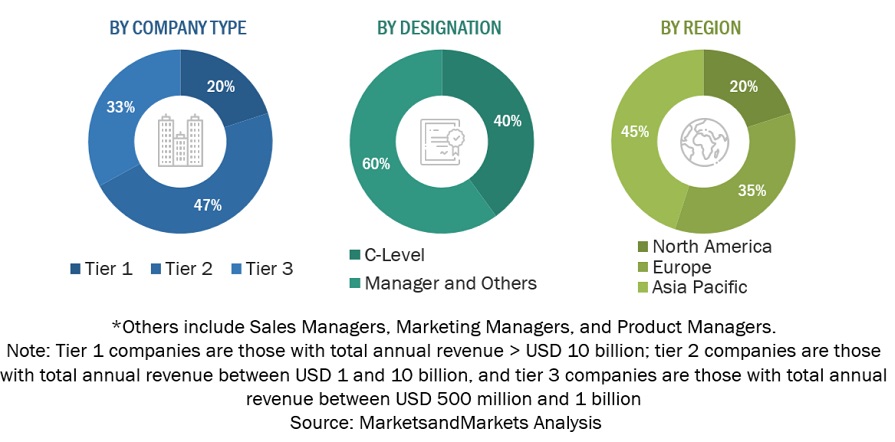
To know about the assumptions considered for the study, download the pdf brochure
Market Size Estimation
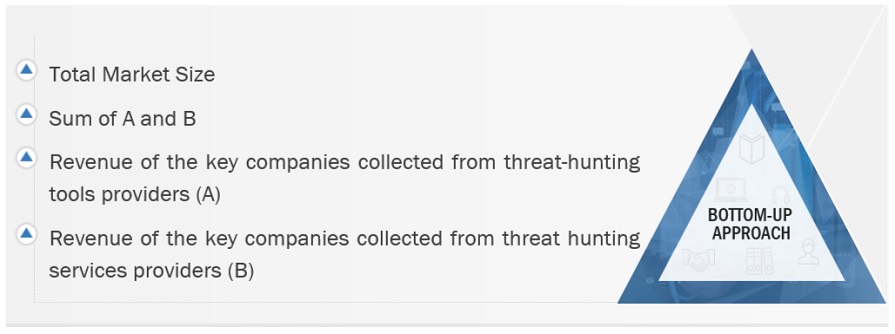
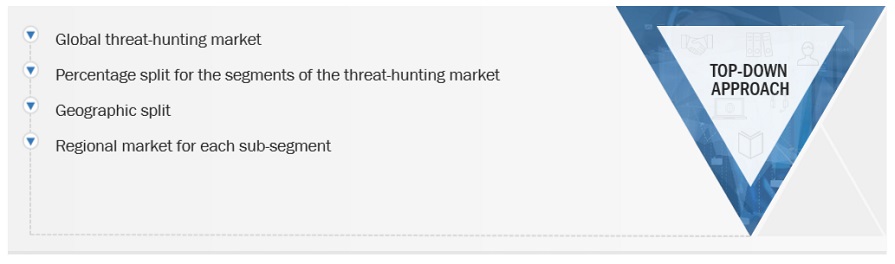
Both top-down and bottom-up approaches were employed to accurately estimate and validate the size of the global Threat hunting market and determine the sizes of various dependent subsegments within the overarching Threat hunting market. The research methodology utilized for estimating market size involved several key steps: Initially, the identification of key players in the market was conducted through comprehensive secondary research. Subsequently, their revenue contributions within respective regions were assessed through a combination of primary and secondary research methods. This process entailed thoroughly examining leading market players' annual and financial reports, supplemented by extensive interviews with industry leaders, including CEOs, VPs, directors, and marketing executives, to gain valuable insights. All percentage splits and segment breakdowns were derived from secondary sources and cross-validated through primary sources to ensure accuracy and reliability.
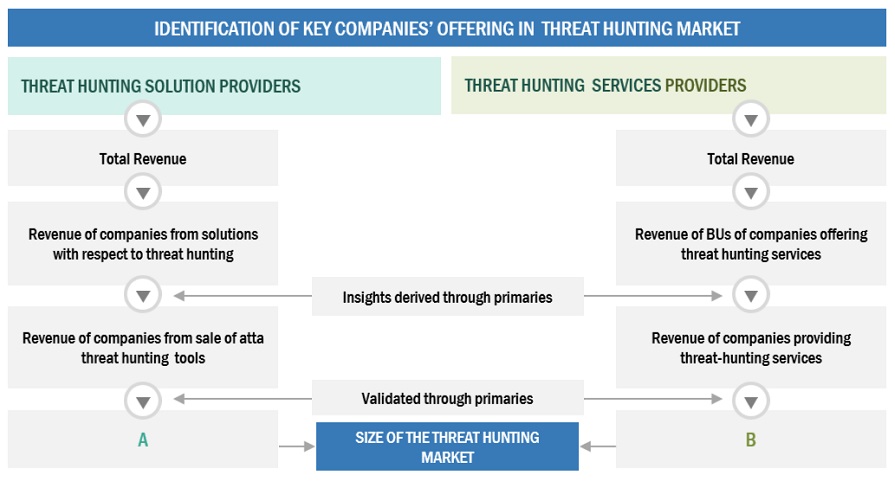
To know about the assumptions considered for the study, Request for Free Sample Report
Infographic Depicting Bottom-Up And Top-Down Approaches
Market Size Estimation Methodology-top-down approach
Data Triangulation
Following the determination of the overall market size using the market above size estimation methodologies, the market was segmented into distinct segments and subsegments. Data triangulation and market segmentation procedures were utilized, as needed, to complete the comprehensive market engineering process and ascertain the precise statistics for each market segment and subsegment. Data triangulation was achieved by analyzing various factors and trends from both the demand and supply sides.
Market Definition
As per IBM, Threat hunting, also known as cyber threat hunting, is a proactive approach to identifying previously unknown or ongoing non-remediated threats within an organization's network.
Cyber or proactive threat hunting seeks out unknown cybersecurity threats to a network. Threat hunting involves searching through endpoints, networks, systems, applications, sources, and datasets to hunt or identify malicious or suspicious activity.
Key Stakeholders
- Chief technology and data officers
- Certified information system auditors
- Business analysts
- Information technology (IT) professionals
- Government agencies
- Small and medium-sized enterprises (SMEs) and large enterprises
- Consultants/consultancies/advisory firms
- Managed and professional service providers
Report Objectives
- To define, describe, and forecast the Threat hunting market based on offering, threat type, organization size, deployment mode, vertical, and region.
- To forecast the market size of five central regions: North America, Europe, Asia Pacific (APAC), Middle East & Africa (MEA), and Latin America.
- To analyze the subsegments of the market concerning individual growth trends, prospects, and contributions to the overall market.
- To provide detailed information related to the primary factors (drivers, restraints, opportunities, and challenges) influencing the growth of market.
- To analyze opportunities in the market for stakeholders by identifying high-growth segments of the market.
- To profile the key players of the market and comprehensively analyze their market size and core competencies.
- Track and analyze competitive developments, such as new product launches, mergers and acquisitions, partnerships, agreements, and collaborations in the global Threat hunting market.
Customization Options
With the given market data, MarketsandMarkets offers customizations based on company-specific needs. The following customization options are available for the report:
Geographic Analysis
- Further breakup of the Asia Pacific market into major countries.
- Further breakup of the North American market into major countries.
- Further breakup of the Latin American market into major countries.
- Further breakup of the Middle East African market into major countries
- Further breakup of the European market into major countries.
Company Information
- Detailed analysis and profiling of additional market players (up to 5)
Get the Full Threat Hunting Market Report
Full forecast, segment splits, and company analysis for all Threat Hunting Market.
- Canada Threat Hunting Market
- US Threat Hunting Market
- UK Threat Hunting Market
- Germany Threat Hunting Market
- France Threat Hunting Market
- Italy Threat Hunting Market
- China Threat Hunting Market
- Japan Threat Hunting Market
- India Threat Hunting Market
- UAE Threat Hunting Market
- South Africa Threat Hunting Market
- Mexico Threat Hunting Market
- Rest Of Europe Threat Hunting Market
- Australia And New Zealand Threat Hunting Market
- Rest Of Asia Pacific Threat Hunting Market
- Rest Of Latin America Threat Hunting Market
- GCC Countries Threat Hunting Market
- Ksa Threat Hunting Market
Need a Tailored Report?
Customize this report to your needs
Get 10% FREE Customization
Customize This Report
