
Rest Of South America Tie Layer Resin Market (2024-2029)

The Rest Of South America Tie Layer Resin Market was valued at $52.8 Million in 2024 and projected to reach to $62.8 Million by 2029, representing a compound annual growth rate of 3.5%. Rest Of South America's tie layer resin market is positioned for steady growth driven by increasing industrialization and rising demand from packaging manufacturers seeking improved adhesive performance.


| Market Size in | USD 26.32 MN |
| Market Forecast in | |
| CAGR | |
| Forecast Period | |
| Units Considered | Value (USD MN) |
Rest Of South America Tie Layer Resin Market Trends and Insights
- Rest Of South America's tie layer resin sector is driven by increasing demand from packaging and adhesive applications across the region's growing industrial base.
- The 3.5% compound annual growth rate reflects Rest Of South America's gradual but consistent market expansion, supported by rising manufacturing activity and infrastructure development initiatives throughout the forecast period. Rest Of South America's tie layer resin market benefits from regional economic recovery and heightened investment in polymer-based solutions for multilayer film production.
- The market in Rest Of South America is characterized by moderate competition and emerging opportunities in flexible packaging segments.
- Between 2024 and 2029, Rest Of South America is expected to see increased adoption of tie layer resins in food packaging and industrial applications, positioning the region as a secondary growth market within the broader South American landscape..
Key Market Statistics
- CAGR (2024-2029) 3.5% CAGR
- Market Size, 2024 ~USD 52.8 Million
- Forecast, 2029 ~USD 62.8 Million
- Country Rest Of South America
Rest Of South America Tie Layer Resin Market Overview
Market Valuation :
Rest Of South America's tie layer resin market is valued at USD 52.8 million in 2024, with steady expansion anticipated through 2029.
Growth Trajectory :
The region demonstrates a 3.5% CAGR, slightly below the global average of 3.6%, indicating moderate but consistent market development in South American economies.
Key Application Drivers :
Packaging and adhesive applications are primary growth catalysts, supported by expanding industrial manufacturing and consumer goods sectors across Rest Of South America.
Forecast Expansion :
Market size is projected to reach USD 62.8 million by 2029, representing approximately USD 10 million in incremental value creation over the five-year period.
Rest Of South America Tie Layer Resin Market Dynamics
- The region's growing middle class and expanding consumer goods sector are fueling demand for high-quality packaging solutions that rely on tie layer resins for enhanced bonding properties.
- Regional manufacturers are increasingly adopting advanced resin technologies to meet international quality standards and compete in export markets. The 3.5% CAGR reflects a maturing market with consistent demand fundamentals rather than explosive growth.
- Investment in local production capacity and strategic partnerships with global resin suppliers are expected to strengthen the region's supply chain.
- Economic stability in key South American markets and infrastructure development initiatives will continue supporting tie layer resin adoption across flexible packaging, rigid containers, and industrial adhesive applications through 2029..
Market Ecosystem
Related Ecosystem
Adhesives And Sealants
- Alkyd Resins
- Polyurethane Resin
- Epoxy Resin
- Polyester Resin
- Polyolefin
- 3M COMPANY
- Henkel ag and co. kgaa
- H.B. Fuller Company
- Sika ag
- DOW CHEMICAL COMPANY
Paints And Coatings
- Polyurethane Resin
- Alkyd Resins
- Epoxy Resin
- Polyester Resin
- Acrylics
- Basf se
- JOTUN
- PPG Industries, Inc.
- DOW CHEMICAL COMPANY
- Akzonobel n.v.
Fandb Logistics Cold Chain And Packaging
- Rigid Packaging
- Acrylics
- Active Packaging
- Dairy Products
- Gravure Process
- Amcor plc
- Basf se
- Essentra plc
- Sonoco Products Company
- AZELIS HOLDINGS SA
Key Takeaways
- Rest Of South America's tie layer resin market is valued at USD 52.8 million in 2024 and will grow to USD 62.8 million by 2029.
- Rest Of South America demonstrates a 3.5% CAGR, reflecting moderate but consistent market expansion driven by packaging sector growth.
- Rest Of South America's market is supported by increasing demand for flexible packaging solutions in food and industrial applications.
- Rest Of South America represents a secondary growth opportunity within South America with emerging competitive dynamics and regional manufacturing expansion.
Tie Layer Resin Market Report Scope
| Report Metric | Details |
|---|---|
| Base Year | 2024 |
| Fastest Growing Segment | PVA (Resin Type) |
| Forecast Period | 2024-2029 |
| Growth Rate | CAGR of 3.6% from 2024 to 2029 |
| Largest Segment | PE (Resin Type) |
| Market Size Base Year (Billions) | ~USD 1.51 (2024) |
| Revenue Forecast (Billions) | ~USD 1.8 (2029) |
| Segments Covered | Base Resin, Type, Application, End-Use Industry, Gcc Countries, Resin Type |
Rest Of South America Tie Layer Resin Market Report Segmentation
6 segment dimensions are covered across the global market.
By Base Resin
- Ethylene Vinyl Acetate (Eva)
- High-Density Polyethylene (Hdpe)
- Linear Low-Density Polyethylene (Lldpe)
- Low-Density Polyethylene (Ldpe)
- Other Base Resins (Sebs, Pet)
- Polypropylene (Pp)
By Type
- Non-Reactive
- Reactive
By Application
- Flexible
- Other Applications
- Rigid
By End-Use Industry
- Automotive
- Food & Beverage
- Other End-Use Industries
- Personal Care & Cosmetics
- Pharmaceutical & Medical
By Gcc Countries
- Rest Of GCC
- Saudi Arabia
- UAE
By Resin Type
- Evoh
- Pa
- Pe
- Pen
- Pet
- Pp
- Pva
- Pvdc
Target Audience
- Regional Resin Manufacturers : South American tie layer resin producers need market-specific data to optimize production capacity, assess competitive positioning, and identify growth opportunities within their regional markets.
- Packaging & Adhesive Companies : Manufacturers in Rest Of South America require detailed market intelligence to source quality tie layer resins, forecast demand, and plan procurement strategies aligned with regional growth.
- Chemical Distributors & Suppliers : Regional distributors need accurate market sizing and application insights to develop sales strategies, manage inventory, and identify high-growth customer segments in South America.
- Investment & Private Equity Firms : Investors evaluating opportunities in South American chemicals and materials sectors require reliable market data to assess growth potential and make informed capital allocation decisions.
- Strategic Business Planners : Corporate strategists and market analysts need Rest Of South America-specific forecasts to develop regional expansion plans, competitive strategies, and long-term business objectives.
Reasons to Buy this Report
- Regional Market Sizing : Obtain precise valuation data specific to Rest Of South America's tie layer resin market, enabling accurate budget allocation and investment decisions for regional operations.
- Growth Opportunity Assessment : Understand the 3.5% CAGR trajectory and USD 10 million market expansion potential to identify entry points and expansion strategies in South American markets.
- Application-Specific Insights : Gain detailed intelligence on packaging and adhesive application segments driving demand in Rest Of South America, supporting product development and marketing strategies.
- Competitive Positioning : Benchmark your regional performance against market growth rates and identify competitive gaps in Rest Of South America's tie layer resin sector.
- Strategic Planning Data : Leverage five-year forecast data through 2029 to develop long-term supply chain, manufacturing, and distribution strategies tailored to Rest Of South America's market dynamics.
Frequently asked questions
What is the current market size of tie layer resin in Rest Of South America?
Rest Of South America's tie layer resin market is estimated at USD 52.8 million in 2024, with verified data from regional market analysis.
What is the projected market size for Rest Of South America by 2029?
Rest Of South America's tie layer resin market is forecasted to reach USD 62.8 million by 2029, representing growth of USD 10 million over the five-year period.
What is the CAGR for Rest Of South America's tie layer resin market?
Rest Of South America's tie layer resin market is expected to grow at a compound annual growth rate of 3.5% from 2024 to 2029.
Which applications drive demand for tie layer resin in Rest Of South America?
Rest Of South America's tie layer resin demand is primarily driven by flexible packaging, food packaging, and industrial adhesive applications across the region's manufacturing sector.
How does Rest Of South America compare to the broader South America market?
Rest Of South America represents a secondary growth market within South America, with a 3.5% CAGR that reflects steady regional expansion supported by emerging manufacturing and packaging opportunities.
RESEARCH METHODOLOGY
The study involved four major activities in estimating the current size of the tie layer resin market. Exhaustive secondary research was done to collect information on the market, peer market, and parent market. The next step was to validate these findings, assumptions, and sizing with industry experts across the value chain through primary research. Both top-down and bottom-up approaches were employed to estimate the complete market size. After that, market breakdown and data triangulation were used to estimate the market size of segments and subsegments.
Secondary Research
Secondary sources referred to for this research study include financial statements of companies offering tie layer resin information from various trade, business, and professional associations. The secondary data was collected and analyzed to arrive at the overall size of the tie layer resin market, which was validated by primary respondents.
Primary Research
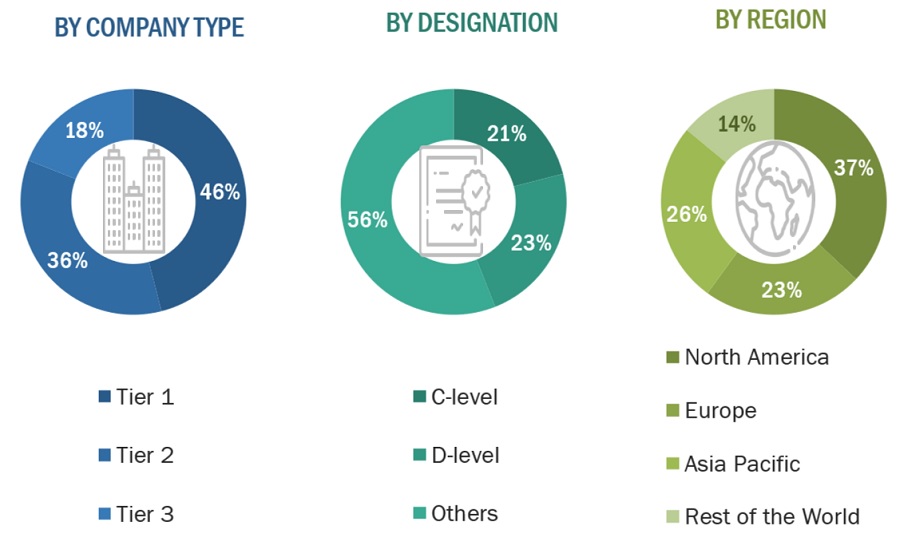
Extensive primary research was conducted after obtaining information regarding the tie layer resin market scenario through secondary research. Several primary interviews were conducted with market experts from both, the demand and supply sides across major countries of North America, Europe, Asia Pacific, Rest of the World. Primary data was collected through questionnaires, emails, and telephonic interview. The primary sources from the supply side included various industry experts, such as Chief X Officers (CXOs), Vice Presidents (VPs), Directors, from business development, marketing, product development/innovation teams, and related key executives from tie layer resin vendors; raw material suppliers; distributors; and key opinion leaders. Primary interviews were conducted to gather insights such as market statistics, data on revenue collected from the products and services, market breakdowns, market size estimations, market forecasting, and data triangulation. Primary research also helped in understanding the various trends related to base resin, type, application, end-use industry, and region. Stakeholders from the demand side, such as CIOs, CTOs, and CSOs, and installation teams of the customer/end users who are using tie layer resin were interviewed to understand the buyer’s perspective on the suppliers, products, component providers, and their current usage of tie layer resin and future outlook of their business which will affect the overall market.
The Breakup of Primary Research:
To know about the assumptions considered for the study, download the pdf brochure
|
COMPANY NAME |
DESIGNATION |
|
The Compound Company |
Director |
|
LyondellBasell Industries Holdings B.V. |
Project Manager |
|
Mitsui Chemicals, Inc. |
Individual Industry Expert |
|
Dow |
Business Development Manager |
Market Size Estimation
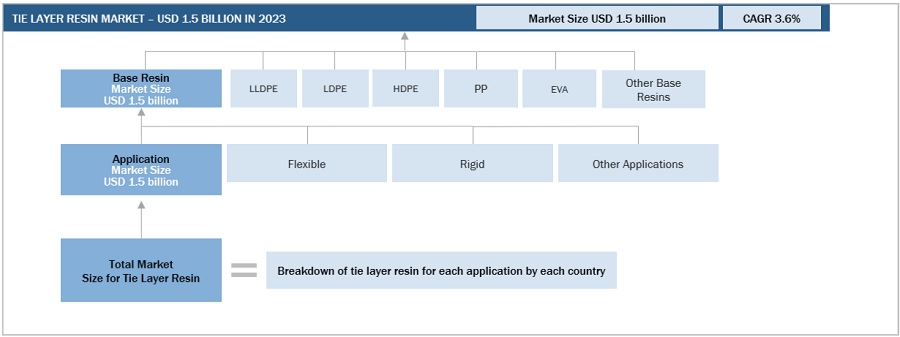
The research methodology used to estimate the size of the tie layer resin market includes the following details. The market sizing of the market was undertaken from the demand side. The market was upsized based on procurement and modernizations in the end-use industries at a regional level. Such procurements provide information on the demand aspects of tie layer resin.
Global Tie Layer Resin Market Size: Bottom-Up Approach
To know about the assumptions considered for the study, Request for Free Sample Report
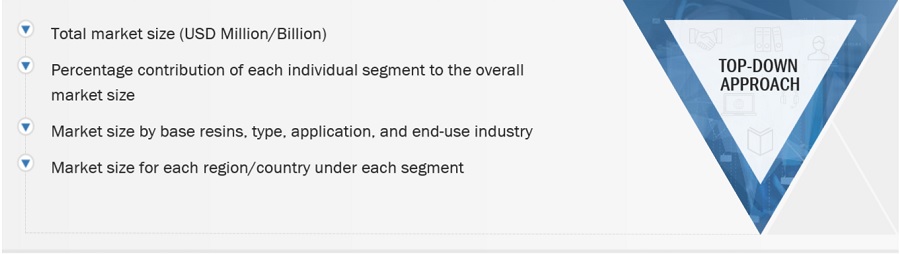
Global Tie Layer Resin Market Size: Top-Down Approach
Data Triangulation
After arriving at the overall size from the market size estimation process explained above, the total market was split into several segments and subsegments. The data triangulation and market breakdown procedures explained below were implemented, wherever applicable, to complete the overall market engineering process and arrive at the exact statistics for various market segments and subsegments. The data was triangulated by studying various factors and trends from the demand and supply sides. Along with this, the market size was validated using both the top-down and bottom-up approaches.
Market Definition
According to the PET Resin Association, “Tie layer resins (TLR) are functionalized polyolefins that are produced by grafting anhydrides or acids to a polyolefin substrate in a post-reactor process. TLR are crucial for bonding dissimilar resins in multi-layer structures. For example, multi-layer packaging structures commonly include a non-polar polyolefin layer and a polar barrier resin layer, such as EVOH. A tie layer allows the polar and non-polar layers to adhere to each other. The most widely used polyolefin base materials for producing tie layer resins are linear low-density polyethylene (LLDPE), low density polyethylene (LDPE), high density polyethylene (HDPE), polypropylene (PP), ethyl vinyl acetate (EVA), and styrene-ethylene-butylene-styrene (SEBS).
Key Stakeholders
- End User
- Raw Material Suppliers
- Senior Management
- Procurement Department
Report Objectives
- To define, describe, segment, and forecast the size of the tie layer resin market based on base resin, type, application, end-use industry and region.
- To forecast the market size of segments with respect to various regions, including North America, Europe, Asia Pacific, Rest of the World, along with major countries in each region
- To identify and analyze key drivers, restraints, opportunities, and challenges influencing the growth of the tie layer resin market
- To analyze technological advancements and product launches in the market
- To strategically analyze micro markets, with respect to their growth trends, prospects, and their contribution to the market
- To identify financial positions, key products, and key developments of leading companies in the market
- To provide a detailed competitive landscape of the market, along with market share analysis
- To provide a comprehensive analysis of business and corporate strategies adopted by the key players in the market
- To strategically profile key players in the market and comprehensively analyze their core competencies
Available Customizations
MarketsandMarkets offers the following customizations for this market report:
- Additional country-level analysis of the tie layer resin market
- Profiling of additional market players (up to 5)
Product Analysis
- Product matrix, which provides a detailed comparison of the product portfolio of each company in the tie layer resin Market
Get the Full Tie Layer Resin Market Report
Full forecast, segment splits, and company analysis for all Tie Layer Resin Market.
- US Tie Layer Resin Market
- Canada Tie Layer Resin Market
- Mexico Tie Layer Resin Market
- Germany Tie Layer Resin Market
- UK Tie Layer Resin Market
- France Tie Layer Resin Market
- Italy Tie Layer Resin Market
- Spain Tie Layer Resin Market
- China Tie Layer Resin Market
- India Tie Layer Resin Market
- Japan Tie Layer Resin Market
- South Korea Tie Layer Resin Market
- Australia Tie Layer Resin Market
- Brazil Tie Layer Resin Market
- Argentina Tie Layer Resin Market
- Colombia Tie Layer Resin Market
- South Africa Tie Layer Resin Market
- Rest Of Europe Tie Layer Resin Market
- Rest Of Asia Pacific Tie Layer Resin Market
- GCC Countries Tie Layer Resin Market
Need a Tailored Report?
Customize this report to your needs
Get 10% FREE Customization
Customize This Report
