
France Timing Devices Market (2024-2029)

The France Timing Devices Market was valued at $144.7 Million in 2024 and projected to reach to $190.8 Million by 2029, representing a compound annual growth rate of 4.7%. France's timing devices market is positioned for steady growth through 2029, supported by the country's advanced manufacturing base and digital transformation initiatives.


| Market Size in | USD 26.32 MN |
| Market Forecast in | |
| CAGR | |
| Forecast Period | |
| Units Considered | Value (USD MN) |
France Timing Devices Market Trends and Insights
- France's market reflects steady demand driven by industrial automation, telecommunications infrastructure, and consumer electronics manufacturing across the country.
- The timing devices sector in France benefits from the nation's strong semiconductor ecosystem and investment in advanced manufacturing technologies. During the 2024-2029 forecast period, France is expected to experience moderate but consistent growth in timing device adoption.
- France's market expansion is supported by increasing digitalization initiatives, automotive electrification, and the rollout of 5G networks requiring precision timing components.
- France's position within the European Union also facilitates cross-border supply chain integration and technology transfer, strengthening the competitive positioning of local and regional timing device manufacturers..
Key Market Statistics
- CAGR (2024-2029) 4.7% CAGR
- Market Size, 2024 ~USD 144.7 Million
- Forecast, 2029 ~USD 190.8 Million
- Country France
France Timing Devices Market Overview
Market Valuation :
France's timing devices market is valued at $144.7 million in 2024, with projected growth to $190.8 million by 2029, representing a steady 4.7% CAGR driven by domestic industrial and consumer electronics demand.
Industrial Automation Growth :
French manufacturing sectors are increasingly adopting precision timing devices for automation applications, particularly in automotive and machinery production, supporting consistent market expansion across industrial verticals.
Telecommunications Infrastructure :
France's robust telecommunications sector and ongoing 5G infrastructure investments create sustained demand for high-precision timing devices in network equipment and communication systems.
Consumer Electronics Manufacturing :
Strong consumer electronics production capabilities in France, including smart devices and IoT applications, drive demand for timing components in both domestic manufacturing and export markets.
France Timing Devices Market Dynamics
- Industrial automation investments and the modernization of telecommunications infrastructure will continue to fuel demand for precision timing solutions.
- The market's 4.7% CAGR reflects France's mature but resilient electronics sector, with particular strength in automotive and industrial applications.
- Government support for Industry 4.0 and digital infrastructure development will further enhance market opportunities, though growth remains moderate compared to global expansion rates..
Market Ecosystem
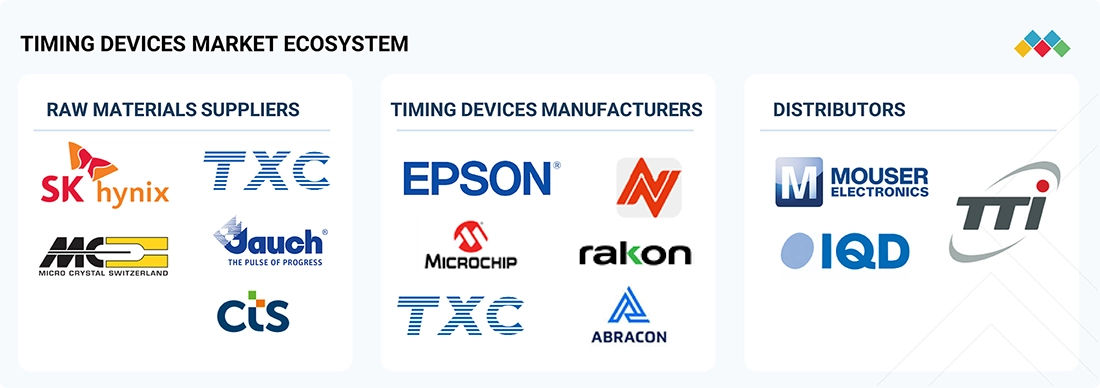
TIMING DEVICES MARKET SIZE, SHARE & GROWTH: COMMERCIAL USE CASES ACROSS INDUSTRIES
| COMPANY | USE CASE DESCRIPTION | BENEFITS |
|---|---|---|
 |
Epson and Rohde & Schwarz, market-leading test & measurement equipment provider, announced their joint development of a modern test procedure for measuring power supply noise rejection to bring clarity and precision to real-world signal integrity design challenges. | Epson and Rohde & Schwarz introduced and demonstrated the procedure and summarized data from Epson's SG3225EEN low noise differential crystal oscillator measured by the R&S FSWP phase noise analyzer from Rohde & Schwarz |
Logos and trademarks shown above are the property of their respective owners. Their use here is for informational and illustrative purposes only.
Related Ecosystem
Semiconductor Materials And Components
- Sensors
- Gallium Nitride (GaN)
- Digital Signal Processor (DSP)
- Natural Language Processing (NLP)
- Silicon Carbide
- Texas Instruments Incorporated
- Samsung
- APPLIED MATERIALS, INC.
- Stmicroelectronics
- Lenovo
Electrical System And Components
- Natural Language Processing (NLP)
- Sensors
- Machine Learning
- Temperature Sensors
- Actuators
- ABB India Limited
- Siemens ag
- SCHNEIDER ELECTRIC SE
- Eaton Corporation plc
- Lenovo
Key Takeaways
- France's timing devices market is valued at $144.7 million in 2024 and will reach $190.8 million by 2029, representing a 4.7% CAGR.
- France's market growth is driven by industrial automation, 5G infrastructure deployment, and automotive electrification initiatives.
- France benefits from a robust semiconductor ecosystem and EU integration, supporting competitive advantage in timing device manufacturing.
- Steady demand in France reflects increasing digitalization across telecommunications, consumer electronics, and industrial sectors.
Timing Devices Market Report Scope
| Report Metric | Details |
|---|---|
| Base Year | 2024 |
| Fastest Growing Segment | ATOMIC CLOCKS (Type) |
| Forecast Period | 2024-2029 |
| Growth Rate | CAGR of 6.4% from 2024 to 2029 |
| Largest Segment | CRYSTAL (Material) |
| Market Size Base Year (Billions) | ~USD 5.23 (2024) |
| Revenue Forecast (Billions) | ~USD 7.13 (2029) |
| Segments Covered | Type, Oscillator Type, Vertical, Circuitry Type, Material |
France Timing Devices Market Report Segmentation
5 segment dimensions are covered across the global market.
By Type
- Atomic Clocks
- Clock Buffers
- Clock Generators
- Jitter Attenuators
- Oscillators
- Resonators
By Oscillator Type
- Ceramic Oscillators
- Crystal Oscillators
- MEMS Oscillators
By Vertical
- Automotive
- Bfsi
- Consumer Electronics
- Enterprise Electronics
- Industrial
- Medical & Healthcare
- Medical And Healthcare
- Military & Aerospace
- Military & Defense
- Telecommunications & Networking
By Circuitry Type
- Dcmo
- Fcxo
- Fsmo
- Ocxo
- Spmo
- Spxo
- Ssmo
- Tcmo
- Tcxo
- Vcmo
- Vcxo
By Material
- Ceramic
- Crystal
- Silicon
Target Audience
- Electronics Manufacturers : French and European electronics manufacturers need France-specific timing device market data to optimize supply chain decisions, identify local suppliers, and plan production capacity for domestic and export markets.
- Industrial Automation Companies : Automation equipment providers targeting French industrial sectors require detailed market insights to understand timing device integration requirements and growth opportunities in manufacturing modernization.
- Semiconductor & Component Suppliers : Timing device manufacturers and semiconductor suppliers need France market analysis to assess demand trends, competitive positioning, and sales potential in this key European market.
- Telecommunications Infrastructure Providers : Telecom equipment manufacturers and network infrastructure companies need France-specific data to forecast timing device demand driven by 5G deployment and infrastructure investments.
- Investment & Strategy Consultants : Business strategists, private equity firms, and management consultants require France market intelligence to support investment decisions, M&A analysis, and growth strategy development in the electronics sector.
Reasons to Buy this Report
- Localized Market Intelligence : Gain France-specific insights into timing device demand patterns, regional manufacturing trends, and country-level growth drivers that differ from broader European market dynamics.
- Industrial Sector Opportunities : Identify high-growth segments within French industrial automation, automotive, and machinery sectors where timing device adoption is accelerating and competitive positioning matters most.
- Telecommunications Investment Tracking : Monitor France's 5G rollout and telecom infrastructure expansion to anticipate timing device requirements and capitalize on network modernization opportunities through 2029.
- Competitive Landscape Analysis : Understand France-specific competitive dynamics, local supplier relationships, and market entry strategies essential for manufacturers targeting this mature but stable European market.
- Strategic Planning & Forecasting : Leverage detailed 5-year projections and CAGR analysis to inform product development, market expansion, and investment decisions specific to the French timing devices sector.
Frequently asked questions
What is the current size of France's timing devices market?
France's timing devices market is valued at $144.7 million in 2024 and is expected to grow to $190.8 million by 2029.
What is the growth rate for timing devices in France?
France's timing devices market is projected to grow at a compound annual growth rate (CAGR) of 4.7% from 2024 to 2029.
What are the main drivers of growth in France's timing devices market?
Key growth drivers in France include industrial automation expansion, 5G network rollout, automotive electrification, and increased digitalization across multiple sectors.
How does France's timing devices market compare to other European markets?
France represents a significant segment of the European timing devices market, with steady growth supported by its strong semiconductor infrastructure and EU integration advantages.
Which industries are the largest consumers of timing devices in France?
The primary consumers of timing devices in France include telecommunications, automotive, consumer electronics, industrial automation, and IoT applications.
RESEARCH METHODOLOGY
The research process for this study included systematic gathering, recording, and analysis of data about customers and companies operating in the timing devices market. This process involved the extensive use of secondary sources, directories, and databases (Factiva, Oanda, and OneSource) for identifying and collecting valuable information for the comprehensive, technical, market-oriented, and commercial study of the timing devices market. In-depth interviews were conducted with primary respondents, including experts from core and related industries and preferred manufacturers, to obtain and verify critical qualitative and quantitative information as well as to assess growth prospects. Key players in the timing devices market were identified through secondary research, and their market rankings were determined through primary and secondary research. This research included studying annual reports of top players and interviewing key industry experts such as CEOs, directors, and marketing executives.
Secondary Research
In the secondary research process, various sources were used to identify and collect information important for this study. These include annual reports, press releases & investor presentations of companies, white papers, technology journals, certified publications, articles by recognized authors, directories, and databases.
Secondary research was mainly used to obtain key information about the industry's value chain, the total pool of market players, the classification of the market according to industry trends to the bottom-most level, regional markets, and key developments from the market and technology-oriented perspectives.
Primary Research
Primary research was also conducted to identify the segmentation types, key players, competitive landscape, and key market dynamics, such as drivers, restraints, opportunities, challenges, and industry trends, along with key strategies adopted by players operating in the timing devices market. Extensive qualitative and quantitative analyses were performed on the complete market engineering process to list key information and insights throughout the report.
Extensive primary research has been conducted after acquiring knowledge about the timing devices market scenario through secondary research. Several primary interviews have been conducted with experts from both demand (vertical, and region) and supply side (type, material) across four major geographic regions: North America, Europe, Asia Pacific, and RoW. Approximately 80% and 20% of the primary interviews were conducted from the supply and demand side, respectively. These primary data have been collected through questionnaires, emails, and telephonic interviews.
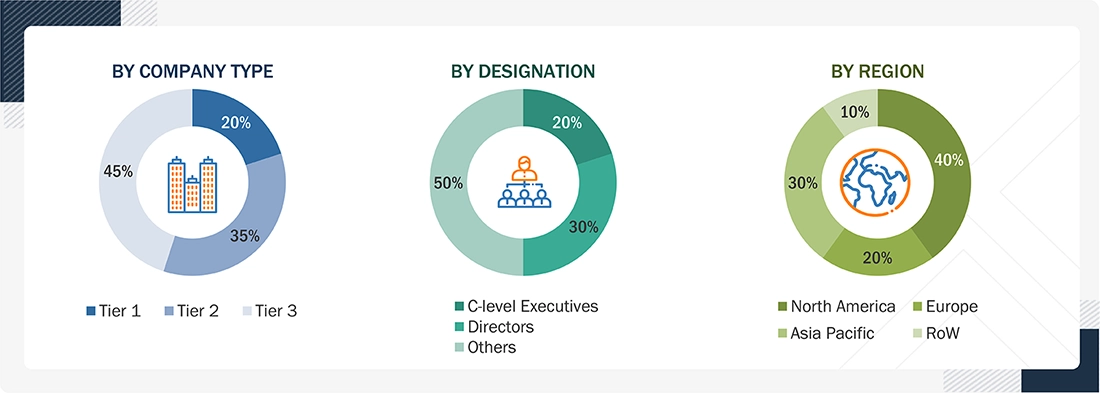
To know about the assumptions considered for the study, download the pdf brochure
Market Size Estimation
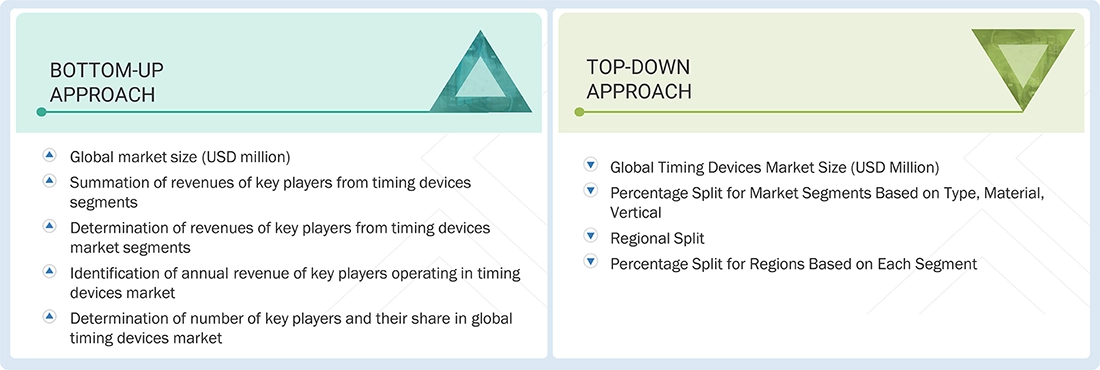
In the complete market engineering process, both top-down and bottom-up approaches were implemented, along with several data triangulation methods, to estimate and validate the size of the timing devices market and various other dependent submarkets. Key players in the market were identified through secondary research, and their market share in the respective regions was determined through primary and secondary research. This entire research methodology included the study of annual and financial reports of the top players, as well as interviews with experts (such as CEOs, VPs, directors, and marketing executives) for key insights (quantitative and qualitative).
All percentage shares, splits, and breakdowns were determined using secondary sources and verified through primary sources. All the possible parameters that affect the markets covered in this research study were accounted for, viewed in detail, verified through primary research, and analyzed to obtain the final quantitative and qualitative data. This data was consolidated and supplemented with detailed inputs and analysis from MarketsandMarkets and presented in this report.
Timing Devices Market: Bottom-Up Approach and Top-Down Approach
Data Triangulation
After arriving at the overall market size from the market size estimation process, as explained above, the total market has been split into several segments and subsegments. To complete the overall market engineering process and arrive at the exact statistics for all segments and subsegments, market breakdown and data triangulation procedures have been employed, wherever applicable. The data have been triangulated by studying various factors and trends from both the demand and supply sides. Along with this, the market has been validated using top-down and bottom-up approaches.
Market Definition
Timing devices are the most important component of any electronic system. Oscillators, resonators, clock generators, clock buffers, and jitter attenuators are among the major timing device types. Electronic circuits operate with reference to a clock signal. The clock signal provides timing cues to the electronic circuits, enabling them to carry out their functions. It provides a timing reference that synchronizes and coordinates the activities of various components within a circuit.
Additionally, the clock signal allows the electronic circuits to coordinate or synchronize with the peripheral controller. A peripheral controller, also known as a peripheral interface controller or simply a peripheral controller unit (PCU), serves the essential purpose of managing and facilitating communication between a microcontroller or microprocessor and various peripheral devices or external components within an electronic circuit.
The timing device generates a reference signal for synchronization that oscillates at a constant cycle. It is essential for ensuring the proper functioning of electronic equipment. In most timing devices, the core element is made of ceramic or crystal.
Key Stakeholders
- Raw material suppliers
- Original equipment manufacturers (OEMs)
- OEM technology solution providers
- Technology, service, and solution providers
- Intellectual property (IP) core and licensing providers
- Suppliers and distributors
- Government and other regulatory bodies
- Forums, alliances, and associations
- Technology investors
- Research institutes and organizations
- Analysts and strategic business planners
- Market research and consulting firms
Report Objectives
- To define, describe, and forecast the timing devices market, in terms of value, by type, material, vertical, and region
- To describe and forecast the timing devices market, by type, in terms of volume
- To forecast the size of the market segments for four major regions—North America, Europe, Asia Pacific, and the Rest of the World (RoW)
- To provide detailed information regarding the major factors influencing the growth of the market (drivers, restraints, opportunities, and challenges)
- To offer an ecosystem analysis, case study analysis, patent analysis, technology analysis, pricing analysis, Porter’s Five Forces analysis, and regulations pertaining to the market
- To give a detailed overview of the value chain of the timing devices market ecosystem
- To strategically analyze micromarkets with respect to individual growth trends, prospects, and contributions to the total market
- To strategically profile the key players and comprehensively analyze their market shares and core competencies
- To analyze the opportunities in the market for stakeholders and describe the competitive landscape of the market
- To study competitive developments such as collaborations, partnerships, product developments, and acquisitions in the market
- To understand the impact of AI on the timing devices market
Available Customizations
With the given market data, MarketsandMarkets offers customizations according to the company’s specific needs. The following customization options are available for the report:
Company Information
- Detailed analysis and profiling of additional market players (up to 5)
Get the Full Timing Devices Market Report
Full forecast, segment splits, and company analysis for all Timing Devices Market.
- US Timing Devices Market
- Canada Timing Devices Market
- Mexico Timing Devices Market
- Germany Timing Devices Market
- UK Timing Devices Market
- Italy Timing Devices Market
- Rest Of Europe Timing Devices Market
- China Timing Devices Market
- Japan Timing Devices Market
- India Timing Devices Market
- South Korea Timing Devices Market
- Rest Of Asia Pacific Timing Devices Market
Need a Tailored Report?
Customize this report to your needs
Get 10% FREE Customization
Customize This Report
