
UAE Track and Trace Solutions Market (2026-2031)

The UAE Track and Trace Solutions Market was valued at $59.7 Million in 2026 and projected to reach to $108.8 Million by 2031, representing a compound annual growth rate of 12.8%. The UAE Track and Trace Solutions Market is poised for sustained growth driven by the healthcare sector's commitment to digital transformation and supply chain modernization.


| Market Size in | USD 26.32 MN |
| Market Forecast in | |
| CAGR | |
| Forecast Period | |
| Units Considered | Value (USD MN) |
UAE Track and Trace Solutions Market Trends and Insights
- The UAE's healthcare sector is increasingly adopting advanced track and trace technologies to enhance supply chain transparency, combat counterfeit pharmaceuticals, and ensure regulatory compliance.
- This growth reflects the UAE's strategic investments in healthcare infrastructure and its commitment to digital transformation across the region. Driving this expansion, the UAE benefits from strong government support, including regulatory frameworks that mandate serialization and traceability for pharmaceutical products.
- The UAE's position as a regional healthcare hub and its adoption of cutting-edge technologies position it as a leader in implementing track and trace solutions.
- Between 2026 and 2031, the UAE market is expected to grow at a compound annual growth rate of 12.8%, outpacing global averages and reflecting the nation's focus on healthcare innovation and supply chain security..
Key Market Statistics
- CAGR (2026-2031) 12.8% CAGR
- Market Size, 2026 ~USD 59.7 Million
- Forecast, 2031 ~USD 108.8 Million
- Country UAE
UAE Track and Trace Solutions Market Overview
Market Valuation Growth :
The UAE Track and Trace Solutions Market is valued at USD 59.7 million in 2026 and is projected to grow to USD 108.8 million by 2031, representing an 82% increase over the five-year forecast period.
Strong CAGR Performance :
The UAE market is expanding at a CAGR of 12.8%, outpacing the global average of 12.4%, indicating accelerated adoption of track and trace technologies within the Emirates' healthcare ecosystem.
Regulatory Compliance Focus :
UAE healthcare providers are prioritizing advanced track and trace solutions to meet stringent regulatory requirements and ensure full supply chain transparency across pharmaceutical distribution networks.
Counterfeit Prevention Priority :
The UAE's healthcare sector is leveraging track and trace technologies to combat counterfeit pharmaceuticals, protecting patient safety and maintaining the integrity of the nation's drug supply chain.
UAE Track and Trace Solutions Market Dynamics
- Government initiatives promoting healthcare innovation, coupled with increasing investments in pharmaceutical infrastructure, are accelerating the adoption of advanced tracking technologies across the Emirates.
- The market's expansion reflects UAE's strategic positioning as a regional healthcare hub and its emphasis on implementing cutting-edge solutions for regulatory compliance and patient safety. Looking ahead, the UAE market will benefit from growing awareness of counterfeit drug risks, rising healthcare expenditure, and the integration of IoT and blockchain technologies into pharmaceutical supply chains.
- Pharmaceutical distributors, healthcare facilities, and regulatory bodies are increasingly recognizing the value of end-to-end visibility in drug distribution.
- This convergence of regulatory pressure, technological advancement, and market maturity positions the UAE as a key growth driver for track and trace solutions in the Middle East region through 2031..
Market Ecosystem
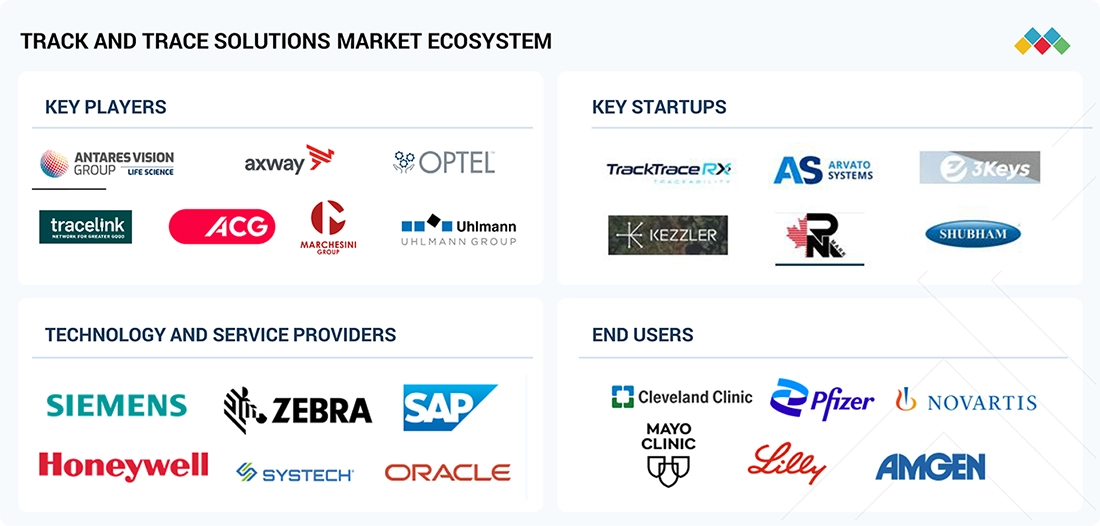
TRACK AND TRACE SOLUTIONS MARKET: COMMERCIAL USE CASES ACROSS INDUSTRIES
| COMPANY | USE CASE DESCRIPTION | BENEFITS |
|---|---|---|
 |
Provides end-to-end serialization, aggregation, and inspection systems for pharmaceutical, cosmetics, and food industries to ensure full product traceability from production to distribution. | Enhances product authentication, prevents counterfeiting, ensures regulatory compliance (e.g., EUFMD, DSCSA), and improves supply chain transparency. |
 |
Delivers secure data integration and API-driven connectivity solutions for track and trace ecosystems, enabling interoperability between partners, regulators, and logistics systems. | Facilitates seamless data exchange, reduces compliance complexity, and improves operational efficiency through real-time visibility. |
 |
Offers modular and scalable track and trace platforms using serialization, aggregation, and sustainability tracking technologies across pharma, food, and healthcare sectors. | Provides full supply chain visibility, enables circular economy traceability, strengthens regulatory compliance, and supports sustainability initiatives. |
 |
Cloud-based Digital Supply Network (DSN) for end-to-end pharmaceutical supply chain traceability, serialization management, and compliance reporting across global markets. | Ensures rapid compliance with evolving global regulations, enhances collaboration among supply chain partners, and reduces counterfeit risks. |
 |
Provides integrated serialization and packaging solutions for pharmaceutical companies, combining track and trace technology with packaging machinery and software. | Streamlines production and packaging, improves product integrity, supports compliance with global serialization mandates, and enhances brand protection. |
Logos and trademarks shown above are the property of their respective owners. Their use here is for informational and illustrative purposes only.
Related Ecosystem
Healthcare Analytics
- Machine Learning
- Natural Language Processing (NLP)
- Blood Pressure Monitors
- Computed Tomography (CT)
- Magnetic Resonance Imaging (MRI)
- Oracle Corporation
- PHILIPS HEALTHCARE
- Siemens healthineers
- Zensar Technologies Limited
- International Business Machines Corporation
Healthcare It
- Computed Tomography (CT)
- Machine Learning
- Magnetic Resonance Imaging (MRI)
- Natural Language Processing (NLP)
- Predictive Analytics
- CERNER CORPORATION
- PHILIPS HEALTHCARE
- Oracle Corporation
- GE HealthCare Technologies Inc.
- Siemens healthineers
Retail Technology
- Supply Chain Management
- Active Tags
- Pallet Aggregation
- 2D Barcodes
- Augmented Reality
- MICROSOFT CORPORATION
- SAP SE
- Zebra Technologies Corporation
- Saison Information Systems Co., Ltd.
- International Business Machines Corporation
Key Takeaways
- The UAE Track and Trace Solutions Market is valued at USD 59.7 million in 2026 and is forecast to reach USD 108.8 million by 2031, representing an 82% increase over the five-year period.
- The UAE's market growth rate of 12.8% CAGR exceeds the global average, driven by regulatory mandates and the nation's commitment to pharmaceutical supply chain security.
- The UAE's position as a regional healthcare hub and digital innovation leader accelerates adoption of track and trace technologies across the healthcare sector.
- Government support and stringent regulatory frameworks in the UAE are key drivers ensuring sustained market expansion through 2031.
Track and Trace Solutions Market Report Scope
| Report Metric | Details |
|---|---|
| Base Year | 2026 |
| Fastest Growing Segment | DISTRIBUTION MONITORING (Warehouse & Distribution Traceability Application) |
| Forecast Period | 2026–2031 |
| Growth Rate | CAGR of 12.4% from 2026 to 2031 |
| Largest Segment | SOFTWARE (Component 2024–2031) |
| Market Size Base Year (Billions) | ~USD 8.21 (2026) |
| Revenue Forecast (Billions) | ~USD 14.73 (2031) |
| Segments Covered | Application 2024–2031, Serialization Application, Aggregation Application, Warehouse & Distribution Traceability Application, Compliance & Reporting Application, Authentication & Brand Protection Application, Component 2024–2031, Software, Hardware, Service |
UAE Track and Trace Solutions Market Report Segmentation
10 segment dimensions are covered across the global market.
By Application 2024–2031
- Aggregation
- Authentication & Brand Protection
- Compliance & Reporting
- Serialization
- Warehouse & Distribution Traceability
By Serialization Application
- Blister Serialization
- Bottle Serialization
- Carton Serialization
By Aggregation Application
- Bundle Aggregation
- Case Aggregation
- Pallet Aggregation
By Warehouse & Distribution Traceability Application
- Distribution Monitoring
- Shipment Traceability
- Warehouse Verification
By Compliance & Reporting Application
- Audit Trail Management
- Epcis Data Exchange
- Regulatory Reporting
By Authentication & Brand Protection Application
- Consumer Verification
- Product Authentication
By Component 2024–2031
- Hardware
- Services
- Software
By Software
- End-To-End Traceability Platforms
- Modular Track & Trace Solutions
By Hardware
- Barcode Scanners & Rfid Infrastructure
- Packaging Line Controllers & Automation Systems
- Printing & Coding Systems
- Vision Inspection & Verification Systems
By Service
- Integration & Deployment
- Managed & Support
- Validation & Consulting
UAE: TRACK AND TRACE SOLUTIONS MARKET, BY END USER, 2024–2031
| Segment | 2024 | 2025 | 2026 | 2027 | 2028 | 2029 | 2030 | 2031 | CAGR (%) |
|---|---|---|---|---|---|---|---|---|---|
| COSMETICS INDUSTRY | 3 | 3.56 | 4.04 | 4.58 | 5.2 | 5.89 | 6.67 | 7.55 | 13.3 |
| FOOD INDUSTRY | 9.82 | 11.68 | 13.33 | 15.2 | 17.32 | 19.73 | 22.45 | 25.54 | 13.9 |
| MEDICAL DEVICE COMPANIES | 5.87 | 6.91 | 7.8 | 8.8 | 9.92 | 11.17 | 12.58 | 14.15 | 12.6 |
| OTHER END USERS | 0.81 | 0.94 | 1.06 | 1.18 | 1.31 | 1.46 | 1.61 | 1.78 | 11 |
| PHARMACEUTICAL & BIOPHARMACEUTICAL COMPANIES | 25.32 | 29.72 | 33.45 | 37.61 | 42.27 | 47.47 | 53.27 | 59.75 | 12.3 |
| TOTAL | 44.82 | 52.82 | 59.67 | 67.37 | 76.02 | 85.71 | 96.58 | 108.76 | 12.8 |
Target Audience
- Pharmaceutical Manufacturers : UAE-based and international pharmaceutical companies need market insights to understand local demand for serialization and track and trace solutions, ensuring compliance with UAE healthcare regulations and protecting brand integrity.
- Healthcare Distributors & Wholesalers : Pharmaceutical distributors operating in the UAE require detailed market data to evaluate technology investments, assess competitive positioning, and implement supply chain transparency solutions across their operations.
- Healthcare Facility Operators : Hospitals, clinics, and healthcare institutions in the UAE need market intelligence to justify technology adoption, understand implementation costs, and evaluate vendors offering track and trace solutions for their facilities.
- Technology Solution Providers : Software vendors, IoT providers, and blockchain companies targeting the UAE healthcare sector require market sizing and growth forecasts to develop products, allocate resources, and plan market entry strategies.
- Regulatory & Government Bodies : UAE healthcare authorities and regulatory agencies benefit from market analysis to inform policy decisions, assess technology adoption rates, and develop frameworks supporting pharmaceutical supply chain transparency initiatives.
Key Companies in the UAE Track and Trace Solutions Market
| Company | HQ | Ownership | Strongest segments |
|---|---|---|---|
| ESSENTRA PLC | United Kingdom | Public Company | Cable management, PCB hardware and electronic components,Fasteners and point-of-sale hardware,Machine and hardware components (handles, feet, workholding, motion), |
| SIEMENS HEALTHINEERS | Germany | Public Company | Imaging,Diagnostics,Varian (Oncology), |
| ANTARES VISION S.P.A. | Italy | Private Company | Pharma and life-science track & trace (serialization, aggregation, software),Pharma and life-science inspection machines and lab equipment,Food and beverage inspection solutions, |
| AXWAY | United States | Public Company | Amplify API Management Platform,B2B Integration,Managed File Transfer, |
| ACG | Bermuda | Public Company | Insurance (commercial P&C and specialty),Reinsurance (property, casualty, marine, aviation, specialty),Mortgage (U.S. and international MI/CRT), |
| SIEMENS | Germany | Public Company | Digital Industries (automation, PLM, simulation),Smart Infrastructure (electrification, buildings, grid),Mobility (rail systems, automation, services), |
| ZEBRA TECHNOLOGIES CORP. | United States | Public Company | Rugged and enterprise mobile computing,Barcode, card, and RFID printers plus supplies,Data capture (scanners, imagers, fixed industrial scanners, machine vision), |
| METTLER-TOLEDO | Switzerland | Public Company | Laboratory instruments and LabX software,Industrial instruments (weighing, product inspection, industrial software),Retail weighing and fresh-goods solutions, |
| IBM | United States | Public Company | Software (Hybrid Cloud and AI Platforms),Consulting,Infrastructure, |
ESSENTRA PLC
Essentra PLC is a public company headquartered in the United Kingdom, founded in 2005, with 2998 employees. The company operates as a diversified industrial business.
SIEMENS HEALTHINEERS
Siemens Healthineers is a public company headquartered in Germany, founded in 1896 with 72,369 employees. The company is a major global provider of healthcare technology and services.
ANTARES VISION S.P.A.
Antares Vision S.P.A. is an Italian private company founded in 2007 with 1200 employees. The company operates as a specialized industrial enterprise.
AXWAY
Axway is a public company based in the United States, founded in 2000 with 4512 employees. The company provides software and integration solutions for enterprise operations.
ACG
ACG is a public company based in Bermuda, founded in 1995 with 8000 employees. The company operates as a diversified industrial and pharmaceutical services enterprise.
SIEMENS
Siemens is a German public company founded in 1847 with 310,312 employees. The company is a global conglomerate providing industrial, energy, and infrastructure solutions.
ZEBRA TECHNOLOGIES CORP.
Zebra Technologies Corp. is a public company based in the United States, founded in 1969 with 10,700 employees. The company provides enterprise mobility and data capture solutions.
METTLER-TOLEDO
Mettler-Toledo is a Swiss public company founded in 1991 with 16,600 employees. The company is a global manufacturer of precision instruments and services for laboratory and industrial applications.
IBM
IBM is a public company based in the United States, founded in 1911 with 264,300 employees. The company is a global technology and consulting enterprise providing hardware, software, and services.
Reasons to Buy this Report
- Market-Specific Growth Data : Access precise valuation figures for the UAE market (USD 59.7M in 2026, USD 108.8M in 2031) with country-specific CAGR of 12.8%, enabling accurate financial forecasting and investment planning tailored to the Emirates.
- Regulatory Landscape Insights : Understand UAE-specific regulatory requirements and compliance mandates driving track and trace adoption, helping stakeholders align solutions with local healthcare authority standards and government initiatives.
- Competitive Positioning Strategy : Identify market opportunities and competitive dynamics unique to the UAE healthcare sector, enabling vendors and service providers to develop targeted go-to-market strategies for the Emirates region.
- Investment Decision Support : Make informed investment and expansion decisions based on UAE market performance metrics, growth trajectory, and sector-specific demand drivers for track and trace technologies in healthcare.
- Supply Chain Optimization : Leverage UAE market intelligence to optimize pharmaceutical supply chain operations, reduce counterfeit risks, and enhance distribution efficiency across the Emirates' healthcare network.
Frequently asked questions
What is the current size of the UAE Track and Trace Solutions Market?
The UAE Track and Trace Solutions Market is valued at USD 59.7 million in 2026 and is expected to grow to USD 108.8 million by 2031.
What is the projected growth rate for the UAE market?
The UAE Track and Trace Solutions Market is projected to grow at a compound annual growth rate (CAGR) of 12.8% from 2026 to 2031.
What are the main drivers of growth in the UAE market?
Key drivers include regulatory mandates for pharmaceutical serialization, the UAE's position as a regional healthcare hub, government support for digital transformation, and increasing focus on combating counterfeit medications.
How does the UAE market compare to global trends?
The UAE's market growth rate of 12.8% CAGR outpaces the global average of 12.4%, reflecting the nation's accelerated adoption of track and trace technologies and strong regulatory environment.
What is the forecast market size for the UAE by 2031?
The UAE Track and Trace Solutions Market is forecast to reach USD 108.8 million by 2031, representing significant expansion from the 2026 baseline of USD 59.7 million.
RESEARCH METHODOLOGY
The study involved five major activities to estimate the current size of the track and trace solutions market. Exhaustive secondary research was done to collect information on the market and its different subsegments. The next step was to validate these findings, assumptions, and sizing with industry experts across the value chain through primary research. Both top-down and bottom-up approaches were employed to estimate the complete market size. Thereafter, market breakdown and data triangulation procedures were used to estimate the market size of the segments and subsegments.
Secondary Research
In the secondary research process, various secondary sources such as annual reports, press releases & investor presentations of companies, white papers, certified publications, articles by recognized authors, gold-standard & silver-standard websites, regulatory bodies, and databases (such as D&B Hoovers, Bloomberg Business, and Factiva) were referred to identify and collect information for the study of the track and trace solutions market. It was also used to obtain important information about the top players, market classification, and segmentation according to industry trends to the bottom-most level, geographic markets, and key developments related to the market. A database of the key industry leaders was also prepared using secondary research.
Primary Research
Extensive primary research was conducted after acquiring basic knowledge about the global track and trace solutions market scenario through secondary research. Several primary interviews were conducted with market experts from both the demand side (Hospital directors, Hospital Vice Presidents, Department heads, and Critical care specialists ) and supply side (such as C-level and D-level executives, technology experts, product managers, marketing and sales managers, among others) across five major regions North America, Europe, the Asia Pacific, Latin America, Middle East, and Africa. This primary data was collected through questionnaires, e-mails, online surveys, personal interviews, and telephonic interviews.
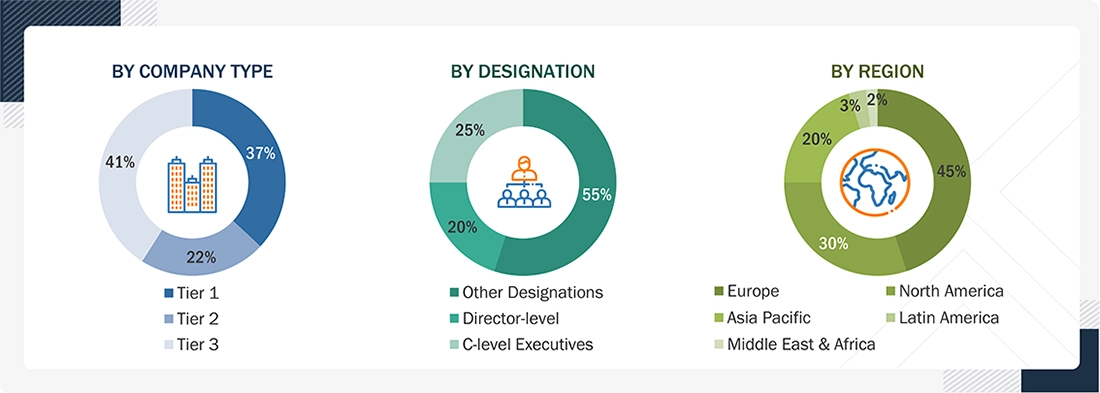
Note 1: Others include sales managers, marketing managers, and product managers.
Note 2: Tiers of companies are defined on the basis of their total revenues in 2025. Tier 1 = >USD 1 billion, Tier 2 = USD 500 million to USD 1 billion, and Tier 3 = <USD 500 million.
To know about the assumptions considered for the study, download the pdf brochure
Market Size Estimation
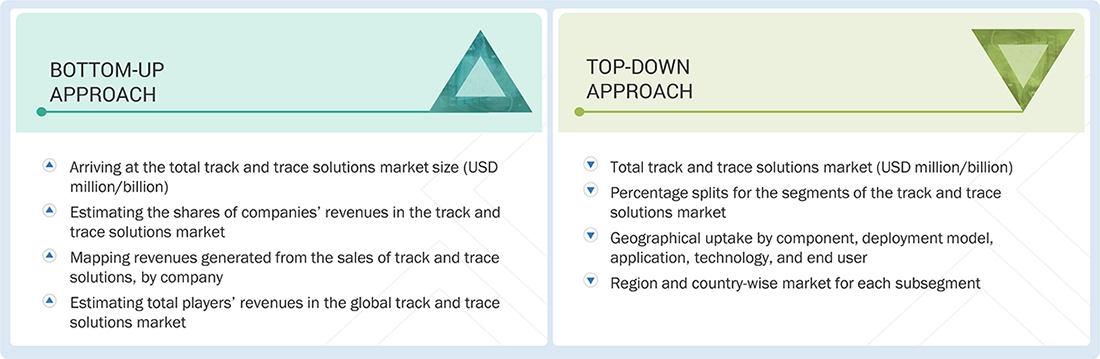
Both top-down and bottom-up approaches were used to estimate and validate the total size of the track and trace solutions market. These methods were also used extensively to estimate the size of various subsegments in the market.
Data Triangulation
After arriving at the overall market size using the market size estimation processes, the market was split into several segments and subsegments. To complete the overall market engineering process and arrive at the exact statistics of each market segment and sub-segment, data triangulation and market breakdown procedures were employed, wherever applicable. The data was triangulated by studying various factors and trends from both the demand and supply sides in the track and trace solutions market.
Market Definition
Track and trace solutions refer to software, hardware, and services used to identify, monitor, and verify products as they move across manufacturing, packaging, warehousing, distribution, and end-user channels. These solutions use serialization, aggregation, barcodes, RFID, NFC, vision inspection, and data exchange platforms to ensure product authenticity, regulatory compliance, supply chain visibility, and faster recall management.
Key Stakeholders
- Pharmaceutical & Biopharmaceutical Companies
- Food & Beverage Manufacturers
- Medical Device Companies
- Cosmetics & Personal Care Companies
- Contract Manufacturing Organizations (CMOs)
- Contract Packaging Organizations (CPOs)
- Packaging Line Equipment Providers
- Serialization & Traceability Software Providers
- Barcode, RFID & NFC Technology Providers
- Vision Inspection & Verification System Providers
- Warehouse, Distribution & Logistics Partners
- Wholesalers, Distributors & Retail Pharmacies
- Regulatory & Compliance Bodies such as FDA, EMA, SFDA, and GS1
- Cloud, Data Integration & EPCIS Platform Providers
- System Integrators, Validation & Consulting Firms
- Brand Protection & Anti-counterfeit Solution Providers
Report Objectives
- To define, describe, and forecast the track and trace solutions market based on component, deployment model, application, technology, end user, and region
- To provide detailed information regarding the major factors (such as drivers, restraints, opportunities, and challenges) influencing market growth
- To strategically analyze micro markets with respect to individual growth trends, prospects, and contributions to the overall track and trace solutions market
- To analyze opportunities in the market for stakeholders and provide details of the competitive landscape for market leaders
- To strategically analyze the market structure profile of the key players of the track and trace solutions market, and comprehensively analyze their core competencies
- To forecast the size of the market segments with respect to five regions: North America, Europe, Asia Pacific, Latin America, and the Middle East & Africa
- To track and analyze competitive developments such as product launches, investments, partnerships, collaborations, acquisitions, expansions, product approval, and alliances in the track and trace solutions market during the forecast period
Available customizations:
With the given market data, MarketsandMarkets offers customizations as per the company’s specific needs. The following customization options are available for the report:
- Product Analysis: Product matrix, which gives a detailed comparison of the product portfolios of each company.
- Geographic Analysis: Further breakdown of Latin America, Europe, and the Middle East & Africa Track and trace solutions into specific countries
Get the Full Track and Trace Solutions Market Report
Full forecast, segment splits, and company analysis for all Track and Trace Solutions Market.
- Canada Track and Trace Solutions Market
- US Track and Trace Solutions Market
- Germany Track and Trace Solutions Market
- France Track and Trace Solutions Market
- UK Track and Trace Solutions Market
- Italy Track and Trace Solutions Market
- Spain Track and Trace Solutions Market
- China Track and Trace Solutions Market
- Japan Track and Trace Solutions Market
- India Track and Trace Solutions Market
- Australia Track and Trace Solutions Market
- South Korea Track and Trace Solutions Market
- Brazil Track and Trace Solutions Market
- Mexico Track and Trace Solutions Market
- Saudi Arabia Track and Trace Solutions Market
- South Africa Track and Trace Solutions Market
Need a Tailored Report?
Customize this report to your needs
Get 10% FREE Customization
Customize This Report
