
GCC Countries Hollow Fiber Ultrafiltration Market (2025-2030)

The GCC Countries Hollow Fiber Ultrafiltration Market was valued at $243 Million in 2025 and projected to reach to $480.5 Million by 2030, representing a compound annual growth rate of 14.6%. The GCC hollow fiber ultrafiltration market is positioned for sustained growth through 2030, driven by the region's critical water security challenges and aggressive infrastructure development.


| Market Size in | USD 26.32 MN |
| Market Forecast in | |
| CAGR | |
| Forecast Period | |
| Units Considered | Value (USD MN) |
GCC Countries Hollow Fiber Ultrafiltration Market Trends and Insights
- GCC Countries' strategic focus on water security, desalination infrastructure, and industrial wastewater treatment is driving significant demand for advanced filtration technologies.
- The region's rapid industrialization and stringent environmental regulations are positioning GCC Countries as a key growth hub for hollow fiber ultrafiltration solutions. GCC Countries' market growth is underpinned by increasing investments in municipal water treatment facilities and rising adoption across oil & gas, petrochemical, and food & beverage sectors.
- The 14.6% compound annual growth rate reflects GCC Countries' commitment to sustainable water management and circular economy initiatives.
- Between 2025 and 2030, GCC Countries is expected to see accelerated deployment of hollow fiber membranes in both greenfield projects and retrofit applications, supported by government incentives and private sector participation..
Key Market Statistics
- CAGR (2025-2030) 14.6% CAGR
- Market Size, 2025 ~USD 243 Million
- Forecast, 2030 ~USD 480.5 Million
- Country GCC Countries
GCC Countries Hollow Fiber Ultrafiltration Market Overview
Water Security Imperative :
GCC Countries face acute water scarcity, driving investments in desalination and advanced filtration. Hollow fiber ultrafiltration technology is critical for pre-treatment in reverse osmosis systems, making it essential infrastructure for the region's water independence strategy.
Rapid Market Growth :
The GCC hollow fiber ultrafiltration market is expanding at 14.6% CAGR, outpacing many global regions. Growth is fueled by increasing desalination capacity, stringent environmental regulations, and industrial expansion across petrochemical and food & beverage sectors.
Industrial Wastewater Treatment Demand :
GCC's booming industrial sector, particularly oil & gas and petrochemicals, generates substantial wastewater requiring advanced treatment. Hollow fiber ultrafiltration systems enable cost-effective recycling and compliance with regional environmental standards.
Strategic Infrastructure Investment :
Government initiatives like Saudi Vision 2030 and UAE's sustainability goals prioritize water infrastructure modernization. These strategic investments create sustained demand for high-performance filtration technologies across desalination plants and industrial facilities.
GCC Countries Hollow Fiber Ultrafiltration Market Dynamics
- Desalination capacity expansion, particularly in Saudi Arabia and UAE, combined with stricter environmental regulations, will accelerate adoption of advanced filtration solutions.
- Industrial diversification initiatives are creating new demand from food processing, pharmaceuticals, and chemical manufacturing sectors. Key growth catalysts include government-backed water security programs, increasing private sector investment in wastewater treatment, and technological advancements in membrane efficiency.
- The market's 14.6% CAGR reflects strong fundamentals, with projected market value reaching USD 480.5 million by 2030.
- Regional players and international manufacturers are expanding operations to capture this high-growth opportunity, supported by favorable regulatory frameworks and substantial capital availability..
Market Ecosystem
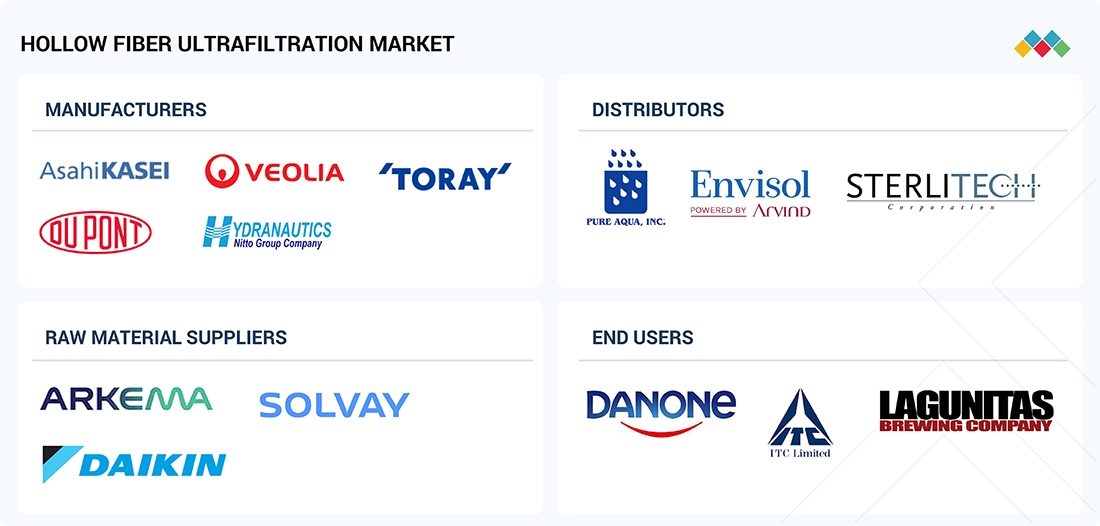
Ultrafiltration Market: COMMERCIAL USE CASES ACROSS INDUSTRIES
| COMPANY | USE CASE DESCRIPTION | BENEFITS |
|---|---|---|
 |
Implements ZeeWeed 500 hollow fiber UF membranes for municipal water treatment, wastewater recycling, and high-quality drinking water production. | Ensures safe, reliable drinking water, expands plant capacity without additional footprint, and meets regulatory standards. |
 |
Uses Microza hollow fiber UF membranes for municipal water treatment, wastewater reuse, and industrial filtration in biopharmaceuticals, food, and chemicals. | Provides high-quality water, reduces chemical use, and enhances sustainability in industrial and municipal applications. |
 |
Employs PVDF hollow fiber UF membrane modules for surface water treatment in municipal drinking water plants. | Delivers clean, safe drinking water, meets stringent water quality standards, and improves operational reliability. |
 |
Deploys IntegraTec PVDF hollow fiber UF modules for tertiary wastewater treatment and aquifer recharge. | Enhances water reuse capabilities, ensures compliance with environmental regulations, and supports sustainable water management. |
|
|
Implements HYDRAsub and HYDRAsub MAX hollow fiber UF modules in municipal and industrial wastewater treatment, including chemical, textile, food & beverage, and palm oil industries. | Offers high permeate quality, low energy consumption, reduces downtime, and provides reliable filtration across diverse industrial applications. |
Logos and trademarks shown above are the property of their respective owners. Their use here is for informational and illustrative purposes only.
Related Ecosystem
Membranes
- Reverse Osmosis
- Acetone
- Acrylonitrile Butadiene Styrene (ABS)
- Bioremediation
- Cartridge Filters
- Veolia
- Toray Industries, Inc.
- PALL CORPORATION
- DuPont de Nemours, Inc.
- Pentair plc
Water Purification
- Corrosion Inhibitors
- Cartridge Filters
- Fiberglass
- Reverse Osmosis
- Acetone
- Veolia
- Kemira oyj
- SOLENIS
- Basf se
- CALGON CARBON CORPORATION
Key Takeaways
- GCC Countries' hollow fiber ultrafiltration market is valued at USD 243.0 million in 2025 and will nearly double to USD 480.5 million by 2030.
- GCC Countries demonstrates a strong 14.6% CAGR, driven by water scarcity concerns and industrial expansion across the region.
- GCC Countries' desalination and wastewater treatment sectors are primary growth catalysts for hollow fiber membrane adoption.
- GCC Countries' regulatory environment and government water security initiatives are accelerating technology deployment through 2030.
Hollow Fiber Ultrafiltration Market Report Scope
| Report Metric | Details |
|---|---|
| Base Year | 2025 |
| Fastest Growing Segment | -FOOD & BEVERAGE (Application) |
| Forecast Period | 2025-2030 |
| Growth Rate | CAGR of 15.2% from 2025 to 2030 |
| Largest Segment | POLYMERIC (Type) |
| Market Size Base Year (Billions) | ~USD 2.39 (2025) |
| Revenue Forecast (Billions) | ~USD 4.85 (2030) |
| Segments Covered | Type, Application |
GCC Countries Hollow Fiber Ultrafiltration Market Report Segmentation
2 segment dimensions are covered across the global market.
By Type
- Ceramic
- Hybrid
- Other Types
- Polymeric
- -Alumina
- -Other Polymeric Types
- -Ps & Pes
- -Pvdf
- -Titania
- -Zirconia
By Application
- Industrial Treatment
- Municipal Treatment
- -Chemical & Petrochemical
- -Desalination
- -Food & Beverage
- -Other Industrial Treatment Applications
- -Pharmaceutical
- -Public Utility Water Treatment
- -Wastewater Reuse
Target Audience
- Water & Desalination Plant Operators : Need detailed market data to evaluate hollow fiber ultrafiltration technology adoption, assess supplier options, and plan capital investments in desalination infrastructure expansion across GCC facilities.
- Industrial Wastewater Treatment Managers : Require GCC-specific insights on filtration technology performance, regulatory compliance requirements, and cost-benefit analysis for implementing advanced treatment systems in petrochemical and manufacturing operations.
- Equipment Manufacturers & Suppliers : Need market sizing, growth forecasts, and competitive intelligence specific to GCC Countries to develop go-to-market strategies, identify distribution partnerships, and allocate R&D resources for regional product customization.
- Investment & Private Equity Firms : Seek comprehensive market analysis of GCC's hollow fiber ultrafiltration sector to evaluate investment opportunities, assess portfolio company growth potential, and identify strategic acquisition targets in the region.
- Government & Policy Decision Makers : Require market intelligence to inform water security policy, infrastructure investment decisions, and environmental regulation development aligned with national sustainability goals and industrial growth objectives.
Reasons to Buy this Report
- Market-Specific Growth Projections : Access precise forecasts for GCC Countries showing 14.6% CAGR through 2030. Understand regional market dynamics distinct from global trends, enabling accurate investment planning and resource allocation for GCC-focused operations.
- Water Security & Desalination Insights : Gain deep understanding of GCC's unique water scarcity drivers and desalination infrastructure expansion plans. Identify opportunities in pre-treatment systems and advanced filtration solutions critical to regional water independence strategies.
- Industrial Sector Opportunity Analysis : Discover demand drivers across GCC's petrochemical, oil & gas, food processing, and pharmaceutical sectors. Understand wastewater treatment requirements and regulatory compliance needs specific to each industry vertical in the region.
- Competitive Landscape & Entry Strategy : Evaluate market positioning for international and regional players in GCC Countries. Identify partnership opportunities, distribution channels, and localization strategies essential for capturing market share in this high-growth region.
- Regulatory & Policy Framework : Understand GCC-specific environmental regulations, government initiatives (Vision 2030, sustainability goals), and infrastructure investment programs. Align product development and market strategies with regional policy priorities and compliance requirements.
Frequently asked questions
What is the current market size of hollow fiber ultrafiltration in GCC Countries?
GCC Countries' hollow fiber ultrafiltration market is valued at USD 243.0 million in 2025, with strong growth momentum expected through the forecast period.
What is the projected market size for GCC Countries by 2030?
GCC Countries' market is forecasted to reach USD 480.5 million by 2030, representing nearly 98% growth over the five-year period.
What is the CAGR for hollow fiber ultrafiltration in GCC Countries?
GCC Countries exhibits a compound annual growth rate of 14.6% from 2025 to 2030, outpacing many global markets.
Which industries are driving demand in GCC Countries?
GCC Countries' demand is primarily driven by desalination, municipal water treatment, oil & gas, petrochemicals, and food & beverage sectors.
Why is GCC Countries a strategic market for hollow fiber ultrafiltration?
GCC Countries faces acute water scarcity, has significant industrial growth, and maintains strong government support for water security infrastructure investments.
RESEARCH METHODOLOGY
The study involved four major activities in estimating the market size of the hollow fiber ultrafiltration market. Exhaustive secondary research was done to collect information on the market, the peer market, and the parent market. The next step was to validate these findings, assumptions, and sizing with industry experts across the value chain through primary research. Both, the top-down and bottom-up approaches were employed to estimate the complete market size. Thereafter, the market breakdown and data triangulation procedures were used to estimate the market size of segments and subsegments.
Secondary Research
In the secondary research process, various secondary sources have been referred to for identifying and collecting information for this study. These secondary sources include annual reports, press releases, investor presentations of companies, white papers, certified publications, trade directories, certified publications, articles from recognized authors, gold standard and silver standard websites, and databases.
Secondary research has been used to obtain key information about the value chain of the industry, the monetary chain of the market, the total pool of key hollow fiber ultrafiltration, market classification, and segmentation according to industry trends to the bottom-most level, and regional markets. It was also used to obtain information about the key developments from a market-oriented perspective.
Primary Research
The hollow fiber ultrafiltration market comprises several stakeholders in the value chain, which include raw material suppliers, manufacturers, and end users. Various primary sources from the supply and demand sides of the hollow fiber ultrafiltration market have been interviewed to obtain qualitative and quantitative information. The primary interviewees from the demand side include key opinion leaders in end-use sectors. The primary sources from the supply side include manufacturers, associations, and institutions involved in the hollow fiber ultrafiltration industry.
Interviews with experts were conducted to gather insights such as market statistics, data of revenue collected from products and services, market breakdowns, market size estimations, market forecasting, and data triangulation. Primary research also helped in understanding the various trends related to type, application, and region. Stakeholders from the demand side, such as CIOs, CTOs, and CSOs, were interviewed to understand the buyer’s perspective on suppliers, products, component providers, and their current usage of hollow fiber ultrafiltration and the future outlook of their business, which will affect the overall market.
The following is a breakdown of the primary respondents:
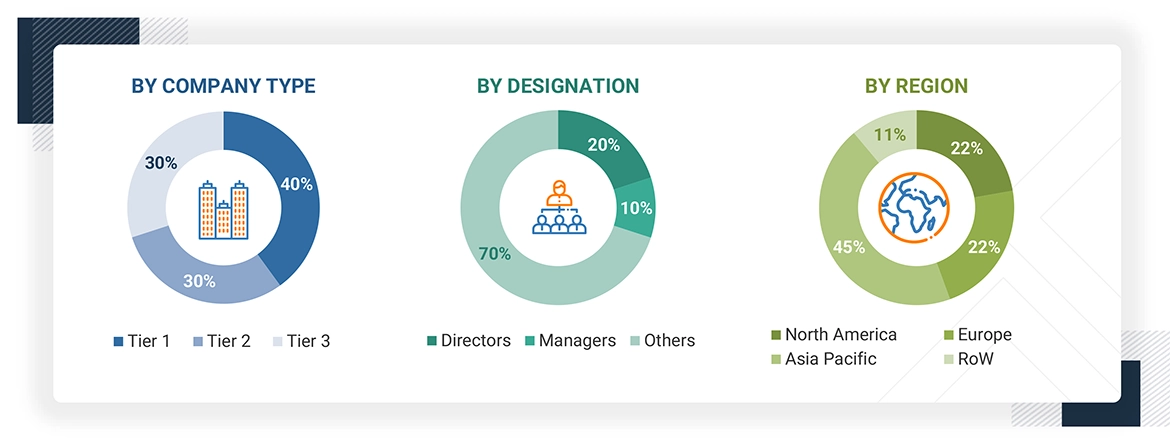
To know about the assumptions considered for the study, download the pdf brochure
Market Size Estimation
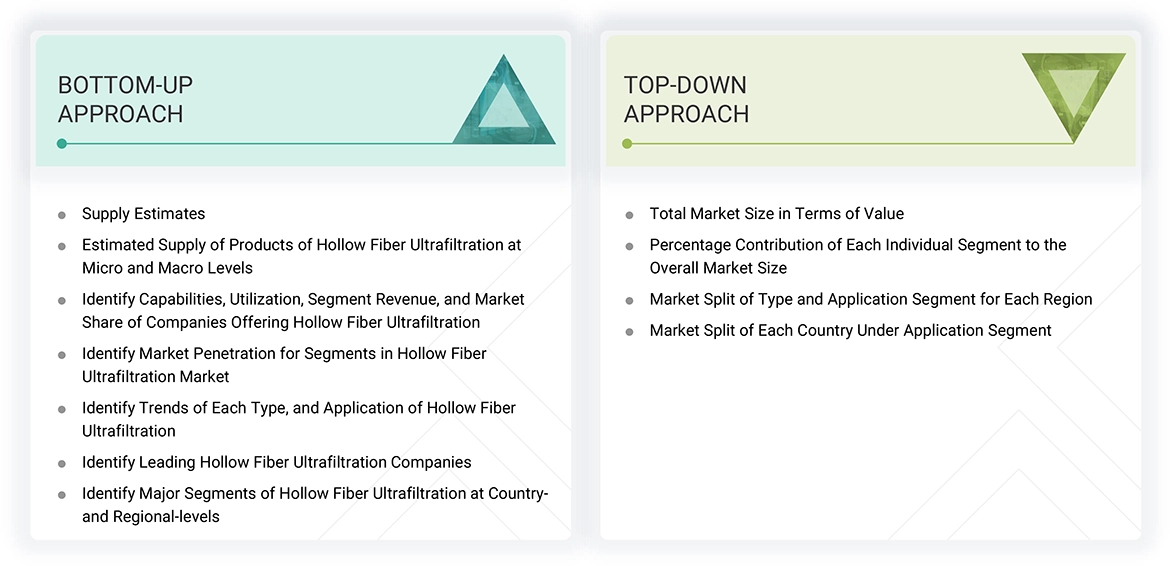
The top-down approach was used to estimate and validate the size of various submarkets for hollow fiber ultrafiltration for each region. The research methodology used to estimate the market size included the following steps:
- The key players in the industry have been identified through extensive secondary research.
- The supply chain of the industry has been determined through primary and secondary research.
- The global market was then segmented into five major regions and validated by industry experts.
- All percentage shares, splits, and breakdowns based on type, application, and region were determined using secondary sources and verified through primary sources.
- All possible parameters that affect the markets covered in this research study were accounted for, viewed in extensive detail, verified through primary research, and analyzed to get the final quantitative and qualitative data. This data was consolidated and added with detailed inputs and analysis and presented in this report.
The market size includes the following:
Data Triangulation
After arriving at the total market size from the estimation process hollow fiber ultrafiltration above, the overall market has been split into several segments and subsegments. To complete the overall market engineering process and arrive at the exact statistics for all the segments and subsegments, the data triangulation and market breakdown procedures have been employed, wherever applicable. The data has been triangulated by studying various factors and trends from both, the demand and supply sides. Along with this, the market size has been validated by using both, the top-down and bottom-up approaches and interviews with experts. Hence, for every data segment, there have been three sources—top-down approach, bottom-up approach, and interviews with experts. The data was assumed correct when the values arrived from the three sources matched.
Market Definition
Hollow fiber is the most widely used ultrafiltration module. It utilizes numerous long porous filaments inside the body. Owing to the shape of the module, the membrane has a large surface area, which allows it to filter large volumes while utilizing minimal space and energy. The filaments inside the body of the module are very narrow in diameter and are flexible. Owing to the small strand diameter, the module has a high packing density. These modules are more likely to break under high strain as they are flexible. The major disadvantages of the module are irreversible fouling and easy breakage. High membrane packing density resulting in high throughput, controlled flow hydraulics, and tangential flow feed limiting membrane fouling are the major advantages of the hollow fiber ultrafiltration module.
Stakeholders
- Hollow Fiber Ultrafiltration Manufacturers
- Hollow Fiber Ultrafiltration Traders, Distributors, and Suppliers
- Raw Type Suppliers
- Government and Private Research Organizations
- Associations and Industrial Bodies
- R&D Institutions
- Environmental Support Agencies
Report Objectives
- To define, describe, and forecast the hollow fiber ultrafiltration market size in terms of value and volume
- To provide detailed information regarding the drivers, restraints, opportunities, and challenges influencing the growth of the hollow fiber ultrafiltration market
- To analyze and forecast the market based on type, application, and region
- To describe and forecast the market with respect to five main regions: North America, Europe, Asia Pacific, South America, and the Middle East & Africa, along with their key countries
- To analyze opportunities for stakeholders by identifying the high-growth segments of the hollow fiber ultrafiltration market
- To strategically analyze the ecosystem, Porter’s Five Forces, technology analysis, tariffs and regulations, patent landscape, trade landscape, key conferences and events, and case studies/use cases pertaining to the market under study
- To strategically analyze micromarkets with respect to individual growth trends, prospects, and contributions to the overall market
- To strategically profile the key players and comprehensively analyze their market positions in terms of their ranking and core competencies, along with detailing the competitive landscape for market leaders
- To analyze competitive developments such as investments & expansions and mergers & acquisitions
Get the Full Hollow Fiber Ultrafiltration Market Report
Full forecast, segment splits, and company analysis for all Hollow Fiber Ultrafiltration Market.
- US Hollow Fiber Ultrafiltration Market
- Canada Hollow Fiber Ultrafiltration Market
- Mexico Hollow Fiber Ultrafiltration Market
- Germany Hollow Fiber Ultrafiltration Market
- France Hollow Fiber Ultrafiltration Market
- Spain Hollow Fiber Ultrafiltration Market
- UK Hollow Fiber Ultrafiltration Market
- Netherlands Hollow Fiber Ultrafiltration Market
- Italy Hollow Fiber Ultrafiltration Market
- China Hollow Fiber Ultrafiltration Market
- Japan Hollow Fiber Ultrafiltration Market
- India Hollow Fiber Ultrafiltration Market
- South Korea Hollow Fiber Ultrafiltration Market
- South Africa Hollow Fiber Ultrafiltration Market
- Brazil Hollow Fiber Ultrafiltration Market
- Argentina Hollow Fiber Ultrafiltration Market
- Rest Of Europe Hollow Fiber Ultrafiltration Market
- Rest Of Asia Pacific Hollow Fiber Ultrafiltration Market
- -Rest Of GCC Countries Hollow Fiber Ultrafiltration Market
- Rest Of South America Hollow Fiber Ultrafiltration Market
Need a Tailored Report?
Customize this report to your needs
Get 10% FREE Customization
Customize This Report
