
Germany Urban Air Mobility (UAM) Market (2026-2031)

The Germany Urban Air Mobility (UAM) Market was valued at $115.9 Million in 2026 and projected to reach to $162.2 Million by 2031, representing a compound annual growth rate of 19.6%. Germany's Urban Air Mobility market is poised for significant expansion, leveraging the country's advanced manufacturing capabilities and strong regulatory framework.


| Market Size in | USD 26.32 MN |
| Market Forecast in | |
| CAGR | |
| Forecast Period | |
| Units Considered | Value (USD MN) |
Germany Urban Air Mobility (UAM) Market Trends and Insights
- Valued at USD 115.9 million in 2026, Germany's UAM market is projected to expand to USD 162.2 million by 2031, reflecting a compound annual growth rate (CAGR) of 19.6%.
- This expansion underscores Germany's commitment to advanced air mobility solutions and its role as a technology leader in the region. The German UAM market benefits from strong regulatory frameworks, established aerospace infrastructure, and significant investment in autonomous flight technologies.
- Germany's dense urban centers and congested transportation networks create compelling use cases for air taxi services, cargo delivery, and emergency medical transport.
- Between 2026 and 2031, Germany is expected to see accelerated adoption of electric vertical takeoff and landing (eVTOL) aircraft and supporting infrastructure development. Germany's market growth is driven by collaboration between government agencies, aerospace manufacturers, and technology startups focused on sustainable urban mobility solutions.
- The country's emphasis on emissions reduction and smart city initiatives further supports UAM market expansion through 2031..
Key Market Statistics
- CAGR (2026-2031) 19.6% CAGR
- Market Size, 2026 ~USD 115.9 Million
- Forecast, 2031 ~USD 162.2 Million
- Country Germany
Germany Urban Air Mobility (UAM) Market Overview
Market Valuation Growth :
Germany's UAM market is valued at USD 115.9 million in 2026 and is projected to reach USD 162.2 million by 2031, demonstrating strong investment momentum in advanced air mobility infrastructure.
Robust CAGR Performance :
With a CAGR of 19.6% from 2026 to 2031, Germany's UAM market growth outpaces many European counterparts, driven by regulatory support and technological innovation in the aerospace sector.
European Technology Leadership :
Germany's established aerospace and defence ecosystem positions it as a critical innovation hub for UAM solutions, attracting major OEMs and technology developers across Europe.
Urban Mobility Integration :
German cities are increasingly adopting UAM frameworks to address congestion and emissions, with infrastructure investments supporting eVTOL operations and air taxi services.
Germany Urban Air Mobility (UAM) Market Dynamics
- The projected growth from USD 115.9 million to USD 162.2 million reflects increasing investments in eVTOL technology, autonomous flight systems, and urban air infrastructure.
- Germany's commitment to sustainable aviation and digital mobility solutions positions it as a key player in Europe's UAM ecosystem. The market outlook is supported by strategic partnerships between German aerospace companies, government initiatives promoting advanced air mobility, and growing demand for innovative transportation solutions in major metropolitan areas.
- With a 19.6% CAGR, Germany is expected to capture significant market share in European UAM operations, driven by technological excellence, regulatory clarity, and substantial capital investments in next-generation air mobility infrastructure..
Market Ecosystem
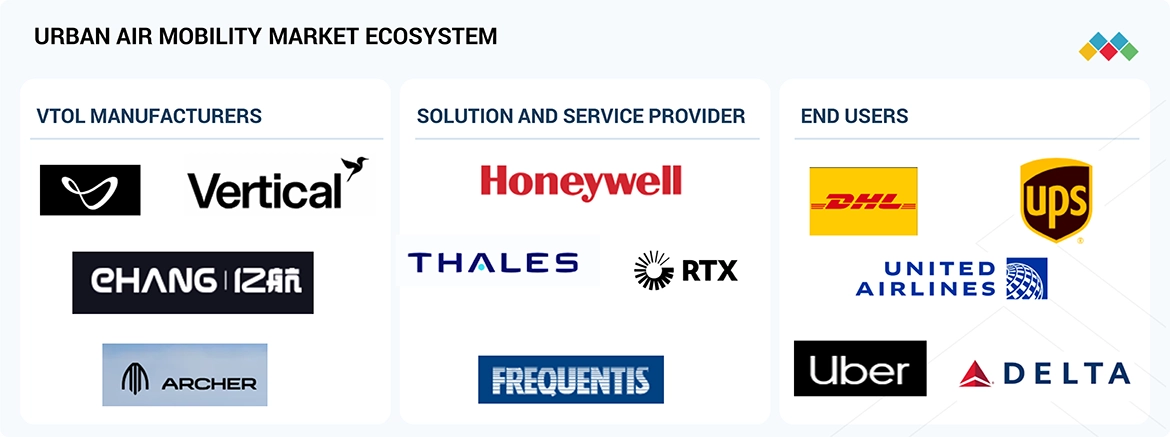
URBAN AIR MOBILITY MARKET SIZE, SHARE, TRENDS, COMPANIES & INDUSTRY: COMMERCIAL USE CASES ACROSS INDUSTRIES
| COMPANY | USE CASE DESCRIPTION | BENEFITS |
|---|---|---|
 |
Development of electric vertical take-off and landing (eVTOL) aircraft for urban passenger transport, including air taxi services and airport connectivity, supported by integrated ecosystem partnerships | Enables fast and efficient urban transport | Reduces travel time and emissions | Supports scalable air taxi operations | Enhances connectivity across urban and regional routes |
 |
Development of autonomous passenger-carrying eVTOL aircraft for urban air mobility, including air taxi services, logistics, and smart city integration | Enables pilotless operations | Reduces operating costs | Improves efficiency in passenger and cargo transport Supports integration with smart city ecosystems |
 |
Design and development of piloted eVTOL aircraft for short-distance urban air mobility, focusing on high-frequency air taxi operations and commercial deployment | Supports rapid urban commuting | Enables high-frequency operations | Improves passenger experience | Accelerates commercialization of air taxi services |
 |
Development and operation of vertiports and supporting ground infrastructure for eVTOL operations, including landing, charging, and passenger handling systems | Enables infrastructure readiness for UAM deployment | Improves operational | Supports safe and seamless flight operations | Enhances scalability of urban air networks |
 |
Development of electric aircraft and charging infrastructure solutions for cargo and passenger transport, supporting logistics and regional mobility use cases | Supports sustainable aviation | Enables efficient cargo and passenger transport | Improves energy efficiency | Accelerates adoption through an integrated charging ecosystem |
Logos and trademarks shown above are the property of their respective owners. Their use here is for informational and illustrative purposes only.
Related Ecosystem
Unmanned Systems
Key Takeaways
- Germany's UAM market is valued at USD 115.9 million in 2026 and is forecast to reach USD 162.2 million by 2031, growing at a 19.6% CAGR.
- Germany's established aerospace infrastructure and regulatory environment position the country as a leading UAM innovation hub in Europe.
- Urban congestion and emissions reduction targets in Germany are driving demand for eVTOL aircraft and air mobility services.
- Germany's collaborative ecosystem of manufacturers, startups, and government agencies is accelerating UAM technology development and commercialization.
Urban Air Mobility (UAM) Market Report Scope
| Report Metric | Details |
|---|---|
| Base Year | 2026 |
| Fastest Growing Segment | AEROSTRUCTURES (Platform System) |
| Forecast Period | 2026–2031 |
| Growth Rate | CAGR of 20.9% from 2026 to 2031 |
| Largest Segment | COMMERCIAL FLEET OPERATORS (End User) |
| Market Size Base Year (Billions) | ~USD 2.95 (2026) |
| Revenue Forecast (Billions) | ~USD 7.62 (2031) |
| Segments Covered | Platform System, Infrastructure, Application, Operation Mode, Range, End User, Platform Architecture |
Germany Urban Air Mobility (UAM) Market Report Segmentation
7 segment dimensions are covered across the global market.
By Platform System
- Aerostructures
- Avionics
- Electrical Systems
- Flight Control & Software
- Interiors
- Propulsion Systems
By Infrastructure
- Atm Integration Systems
- Charging & Energy Systems
- Communication, Navigation, And Surveillance
- Fleet Management Software
- Hangars & Maintenance Facilities
- Utm Systems
- Vertiports/Vertistops
By Application
- Cargo & Logistics
- Medical & Disaster Response
- Passenger Transport
- Private Ownership / Use
- Private Ownership/Use
By Operation Mode
- Fully Autonomous
- Piloted
- Remotely Operated/Semi-Autonomous
By Range
- Long Range (> 200 Km)
- Medium Range (50–200 Km)
- Short Range (< 50 Km)
By End User
- Commercial Fleet Operators
- Institutional/Government
- Private/Individual Users
By Platform Architecture
- Lift + Cruise
- Multirotor
- Tilt-Rotor/Tilt-Wing
GERMANY: URBAN AIR MOBILITY MARKET, BY END USER, 2031–2035
| Segment | 2031 | 2032 | 2033 | 2034 | 2035 | CAGR (%) |
|---|---|---|---|---|---|---|
| COMMERCIAL FLEET OPERATORS | 121.9 | 148 | 177.7 | 211.4 | 248.9 | 19.5 |
| INSTITUTIONAL/GOVERNMENT | 28 | 34 | 40.9 | 48.6 | 57.2 | 19.6 |
| PRIVATE/INDIVIDUAL USERS | 11.1 | 13.5 | 16.2 | 19.2 | 22.7 | 19.6 |
| TOTAL | 161 | 195.5 | 234.8 | 279.2 | 328.8 | 19.5 |
Target Audience
- Aerospace & Defence Companies : OEMs and suppliers need Germany-specific market data to develop localized UAM solutions, identify partnership opportunities, and plan manufacturing and R&D investments.
- Investment & Private Equity Firms : Investors require detailed market sizing, growth forecasts, and competitive analysis for Germany to evaluate UAM venture opportunities and portfolio allocation decisions.
- Urban Mobility & Transportation Planners : City planners and transportation authorities need Germany market insights to design UAM infrastructure, assess feasibility, and integrate air mobility into urban transport networks.
- Technology & Startup Entrepreneurs : Emerging UAM startups need Germany-focused market intelligence to validate business models, identify customer segments, and secure funding from regional investors.
- Government & Policy Makers : Regulatory bodies and government agencies require market data to develop supportive policies, allocate resources, and establish frameworks for safe UAM operations in Germany.
Key Companies in the Germany Urban Air Mobility (UAM) Market
| Company | HQ | Ownership | Strongest segments |
|---|---|---|---|
| EXYN TECHNOLOGIES INC | United States | Public Company | ExynAI autonomy and mapping software (licenses and subscriptions),Exyn Nexys modular 3D mapping solutions (hardware-integrated systems),ExynView and data services (mission planning, visualization, post-processing), |
| SAFRAN GROUP | France | Public Company | Aerospace Propulsion,Aircraft Equipment, Defense and Aerosystems,Aircraft Interiors, |
| LMI AEROSPACE, INC. | United States | Private Company | Aerostructures components and assemblies,Engineering and design services,Defense and non-aerospace structural components, |
| EHANG | China | Public Company | EH216 series (passenger UAM),VT series and logistics UAVs,Falcon B, GD series, and other UAV hardware, |
| ARCHER AVIATION INC. | United States | Public Company | Commercial urban air taxi (eVTOL platform and services),Defense and government applications,Technology licensing and related services, |
| BETA TECHNOLOGIES, INC. | United States | Public Company | ALIA electric aircraft (fixed-wing and eVTOL),Electric propulsion systems and components,Charging systems and infrastructure network, |
| AIRBUS | Netherlands | Public Company | Commercial jet and freighter aircraft (Airbus segment),Helicopters (civil and military, including UAS services),Defence air systems (crewed and uncrewed), |
| TEXTRON INC. | United States | Public Company | Textron Aviation (business, turboprop, piston, trainer, MRO),Bell (military and commercial rotorcraft, tiltrotor, services),Textron Systems (UAS, weapons, marine, armored vehicles), |
| FERROVIAL | Netherlands | Public Company | Highways (Toll Road Concessions),Construction (Public & Private Works),Airports, |
| AéROPORTS DE PARIS | France | Public Company | Aviation,Retail and Services,Real Estate, |
| THALES | France | Public Company | Defence systems, C4ISR, and mission/surveillance,Aerospace, avionics, and air traffic management,Digital identity, cybersecurity, and secure IoT, |
EXYN TECHNOLOGIES INC
EXYN Technologies Inc. is a U.S.-based public company founded in 2014 that employs 42 people. The company operates in the aerospace and technology sector.
SAFRAN GROUP
Safran Group is a French multinational public company founded in 1896 with 103,710 employees. It is a major player in the aerospace, defense, and security industries.
LMI AEROSPACE, INC.
LMI Aerospace, Inc. is a U.S.-based private company founded in 1948 with 1,651 employees. The company operates in the aerospace manufacturing and supply sector.
EHANG
EHang is a Chinese public company founded in 2014 with 829 employees. The company specializes in autonomous aerial vehicle technology and urban air mobility solutions.
ARCHER AVIATION INC.
Archer Aviation Inc. is a U.S.-based public company with 1,160 employees. The company develops electric vertical takeoff and landing aircraft for urban air mobility.
BETA TECHNOLOGIES, INC.
Beta Technologies, Inc. is a U.S.-based public company founded in 2017 with 1,008 employees. The company develops electric aircraft and aviation technology solutions.
AIRBUS
Airbus is a Netherlands-based public company founded in 1998 with 166,876 employees. It is one of the world's leading aircraft manufacturers and aerospace companies.
TEXTRON INC.
Textron Inc. is a U.S.-based public company founded in 1923 with 34,000 employees. The company operates across aerospace, defense, and industrial segments.
FERROVIAL
Ferrovial is a Netherlands-based public company founded in 1952 with 22,464 employees. The company operates in infrastructure, construction, and airport management sectors.
AéROPORTS DE PARIS
Aéroports de Paris is a French public company founded in 1945 with 26,055 employees. The company operates and manages major airports in the Paris region.
THALES
Thales is a French public company founded in 1893 with 82,111 employees. The company is a global leader in aerospace, defense, and security technology solutions.
Reasons to Buy this Report
- Market Size & Growth Projections : Access precise valuation data for Germany's UAM market (USD 115.9M in 2026 to USD 162.2M in 2031) with detailed CAGR analysis to inform investment and expansion strategies.
- Competitive Landscape Intelligence : Understand Germany's position within Europe's UAM ecosystem and identify key players, technology leaders, and emerging competitors shaping the market.
- Regulatory & Infrastructure Insights : Gain detailed knowledge of Germany's regulatory framework, airspace management policies, and urban infrastructure requirements for UAM operations and deployment.
- Investment Opportunity Assessment : Evaluate market entry strategies, funding trends, and partnership opportunities specific to Germany's aerospace and defence sector for UAM ventures.
- Technology & Innovation Trends : Discover emerging technologies, R&D initiatives, and innovation hubs driving Germany's UAM market growth and competitive differentiation.
Frequently asked questions
What is the current size of Germany's UAM market?
Germany's Urban Air Mobility market is valued at USD 115.9 million in 2026 and is expected to grow to USD 162.2 million by 2031.
What is the projected growth rate for Germany's UAM market?
Germany's UAM market is projected to grow at a compound annual growth rate (CAGR) of 19.6% from 2026 to 2031.
What factors are driving UAM market growth in Germany?
Key drivers include Germany's strong regulatory frameworks, dense urban centers, emissions reduction targets, established aerospace infrastructure, and collaborative innovation ecosystem.
Which applications are most promising for Germany's UAM market?
Air taxi services, cargo delivery, emergency medical transport, and urban logistics are among the most promising applications for Germany's UAM market through 2031.
How does Germany's UAM market compare to other European markets?
Germany is positioned as a leading UAM innovation hub in Europe, leveraging its aerospace expertise, regulatory maturity, and investment in autonomous flight technologies.
RESEARCH METHODOLOGY
The study followed four main steps to estimate the size of the urban air mobility market. Secondary research was conducted to gather data on eVTOL aircraft platforms, infrastructure development, airspace management systems, operational models, and end-user adoption across urban and regional environments. These findings were validated through primary interviews with industry stakeholders, including aircraft OEMs (Original Equipment Manufacturers), infrastructure providers, mobility operators, regulators, and technology experts. The research team analyzed pilot programs, certification progress, investment trends, and ecosystem partnerships to assess market demand and growth potential. Market estimates were then segmented by platform system, infrastructure, application, operation mode, range, end users, and platform architecture. Data triangulation was applied to validate the final figures for each segment and subsegment.
Secondary Research
Secondary research was conducted to establish the foundation for this study. Data was gathered from industry reports, eVTOL aircraft manufacturers, infrastructure developers, and urban mobility programs across regions. Company information was reviewed from annual reports, product documentation, press releases, and investor disclosures of UAM stakeholders, including aircraft OEMs (Original Equipment Manufacturers), technology providers, and mobility operators. The study also examined industry publications, white papers, and research on electric propulsion, battery systems, airspace management, and urban mobility integration. Additional insights were obtained from aviation authorities, regulatory bodies, and industry associations to analyze market trends, technological advancements, and regional adoption of UAM solutions.
Primary Research
Primary research was conducted after key insights from secondary analysis were identified. The study team engaged with executives, engineers, infrastructure developers, and technology providers involved in the urban air mobility (UAM) ecosystem. Discussions included eVTOL aircraft OEMs (Original Equipment Manufacturers), mobility service operators, vertiport and infrastructure developers, battery and propulsion system providers, and regulatory authorities across major regions. Interviews were conducted through calls and written correspondence to validate market size estimates, operational requirements, and adoption trends.
These interactions helped refine perspectives on the competitive landscape, technology advancements, certification progress, and deployment strategies. Feedback from industry participants was also used to validate assumptions related to infrastructure readiness, airspace integration, and commercial viability. This process ensured improved data accuracy and strengthened the reliability of market estimates and forecasts.
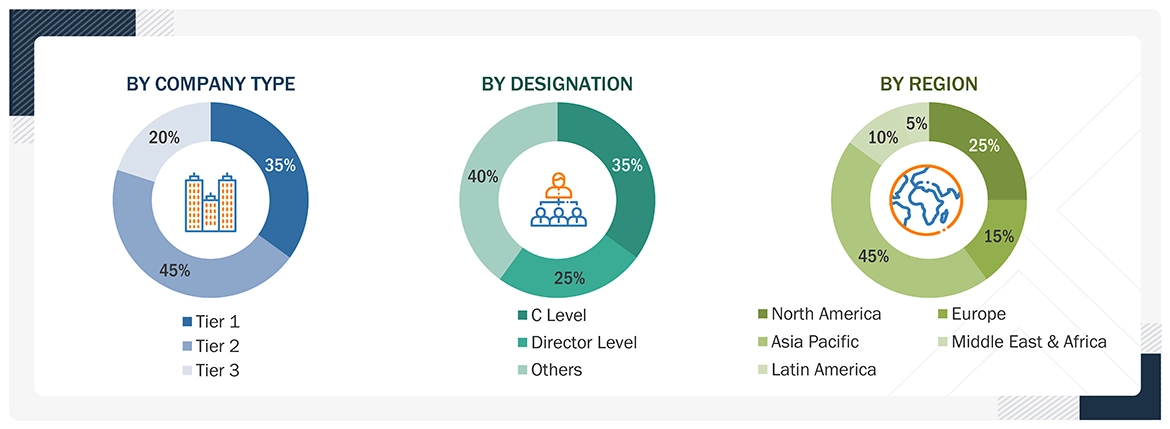
Note: “Others” includes sales, marketing, and product managers.
To know about the assumptions considered for the study, download the pdf brochure
Market Size Estimation
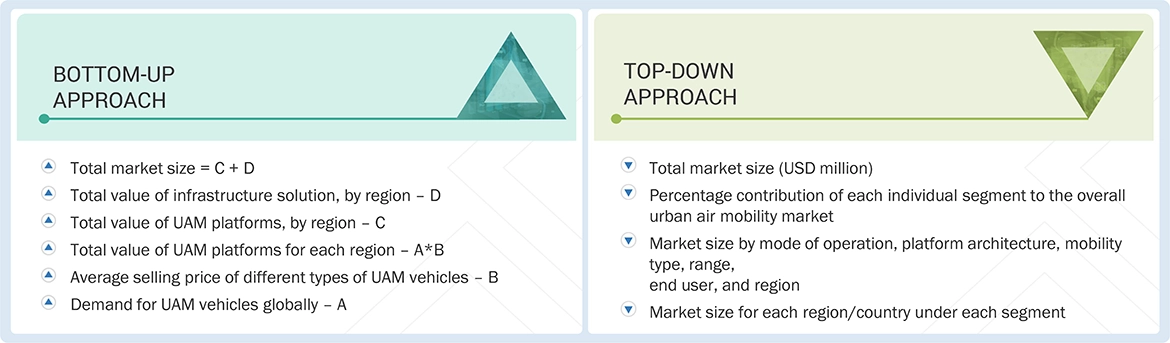
The top-down and bottom-up methods were used to estimate and validate the size of the urban air mobility market. The research process involved several steps to ensure accuracy.
- Key companies active in the market were identified through secondary research. Their market share was evaluated using a combination of primary inputs and published data. This included reviewing annual reports, financial disclosures, certification updates, pilot program developments, and public filings from various organizations. Interviews were also conducted with industry participants such as company executives, program managers, mobility operators, infrastructure providers, and aviation experts. These inputs were used to validate assumptions and refine market size estimates across regions.
- All percentage shares, segment splits, and market breakdowns were first developed using secondary information. These values were then verified through primary discussions with industry participants.
- The analysis evaluated key factors shaping the urban air mobility market. Some of these factors are eVTOL development timelines, certification progress, infrastructure deployment (vertiports and charging networks), technological advancements, and investment trends. Each factor was assessed through primary research and used to develop both quantitative and qualitative market estimates for this report.
The top-down approach has been used to estimate and validate the total size of the high voltage current sensor market.
- Identified top-line investments and spending in the ecosystem and major market developments to consider segment-level splits
- Estimated the overall high voltage current sensor market size, then segmented the global market by allocating shares based on the segments considered
- Distributed the segment-level markets into regions and countries by aligning regional high voltage current sensor activity with economic indicators, high voltage current sensor manufacturing presence, and national development initiatives
Urban Air Mobility (UAM) Market : Top-Down and Bottom-Up Approach
Data Triangulation
After determining the overall market size, the total market was divided into multiple segments and subsegments. The data triangulation and market breakdown procedures described below were carried out, where applicable, to complete the overall market analysis and determine the estimated market figures for the segments and subsegments. The data was triangulated by examining various factors and trends from the demand and supply sides. Additionally, the market size was validated using the top-down and bottom-up approaches.
Market Definition
Urban air mobility refers to an advanced air transportation ecosystem that enables the movement of passengers and cargo within and between urban and suburban areas using electric, hybrid-electric, or next-generation vertical take-off and landing (VTOL) aircraft. These aircraft are designed to operate in low-altitude airspace, offering faster, more efficient, and sustainable alternatives to conventional ground transportation. The UAM ecosystem integrates aircraft technologies, ground infrastructure, airspace management systems, and operational services to ensure safe, efficient, and scalable urban air transport. The development of UAM is driven by advancements in electrification, autonomous systems, digital air traffic management, and increasing urban congestion, with a strong focus on safety, regulatory compliance, and operational efficiency.
Key Stakeholders
- Urban air mobility operators and fleet service providers
- eVTOL aircraft manufacturers and original equipment manufacturers (OEMs)
- Infrastructure developers
- Battery, propulsion system, and energy solution providers
- Avionics, flight control, and software solution providers
- Air Traffic Management (ATM) and Unmanned Traffic Management (UTM) solution providers
- Telecom and connectivity providers
- Maintenance, repair, and overhaul (MRO) service providers
- Government authorities, aviation regulators, and urban planning bodies
- Logistics, emergency service, and public safety operators
- Technology companies
- Research organizations and industry associations
Report Objectives
- To define, describe, and forecast the size of the urban air mobility market based on platform system, infrastructure, application, operation mode, range, end user, and platform architecture
- To forecast the size of market segments with respect to key countries in the following regions: North America, Europe, Asia Pacific, Rest of the World
- To identify and analyze drivers, restraints, opportunities, and challenges influencing the growth of the market
- To identify industry trends, market trends, and technology trends currently prevailing in the market
- To provide an overview of the regulatory landscape with respect to the global urban air mobility market regulations
- To analyze micromarkets with respect to individual growth trends, prospects, and their contribution to the overall market
- To analyze opportunities in the market for stakeholders by identifying key market trends
- To profile key market players and comprehensively analyze their market share and core competencies
- To analyze the degree of competition in the market by identifying growth strategies, such as agreements, acquisitions, partnerships, collaborations, and product launches, adopted by leading market players
- To identify detailed financial positions, key products, and unique selling points of leading market players
Available customizations:
MarketsandMarkets offers the following customizations for this market report:
- Additional country-level analysis of the urban air mobility market
- Profiling of other market players (up to 5)
Product Analysis
- Product matrix, which provides a detailed comparison of the product portfolio of each company in the urban air mobility market
Get the Full Urban Air Mobility (UAM) Market Report
Full forecast, segment splits, and company analysis for all Urban Air Mobility (UAM) Market.
- Canada Urban Air Mobility (UAM) Market
- US Urban Air Mobility (UAM) Market
- UK Urban Air Mobility (UAM) Market
- France Urban Air Mobility (UAM) Market
- Italy Urban Air Mobility (UAM) Market
- Spain Urban Air Mobility (UAM) Market
- China Urban Air Mobility (UAM) Market
- Japan Urban Air Mobility (UAM) Market
- South Korea Urban Air Mobility (UAM) Market
- Singapore Urban Air Mobility (UAM) Market
- Australia Urban Air Mobility (UAM) Market
- Rest Of Europe Urban Air Mobility (UAM) Market
Need a Tailored Report?
Customize this report to your needs
Get 10% FREE Customization
Customize This Report
