
Russia Urea Market (2024-2029)

The Russia Urea Market was valued at $1302.6 Million in 2024 and projected to reach to $1481.9 Million by 2029, representing a compound annual growth rate of CAGR 2.61%. Russia's urea market demonstrates steady growth momentum, supported by consistent demand from its large-scale agricultural operations and industrial chemical applications.


| Market Size in | USD 26.32 MN |
| Market Forecast in | |
| CAGR | |
| Forecast Period | |
| Units Considered | Value (USD MN) |
Russia Urea Market Trends and Insights
- Russia maintains a significant position in the global urea landscape, driven by its substantial agricultural sector and industrial chemical demand.
- The market in Russia reflects steady demand from fertilizer applications, particularly in grain and crop production across its vast agricultural regions. During the forecast period from 2024 to 2029, Russia's urea market is expected to experience moderate but consistent growth.
- Russia's production capacity and export capabilities continue to support market expansion, though geopolitical factors and trade dynamics influence market trajectories.
- The growth rate of 2.61% in Russia is slightly lower than the global average of 3.05%, reflecting regional market maturity and specific economic conditions affecting the country's chemical sector..
Key Market Statistics
- CAGR (2024-2029) CAGR 2.61%
- Market Size, 2024 ~USD 1302.6 Million
- Forecast, 2029 ~USD 1481.9 Million
- Country Russia
Russia Urea Market Overview
Market Valuation :
Russia's urea market was valued at USD 1,302.6 million in 2024, reflecting its substantial role in Eastern European chemical production and agricultural inputs.
Projected Growth :
The market is expected to reach USD 1,481.9 million by 2029, representing a steady CAGR of 2.61% over the forecast period.
Agricultural Demand Driver :
Russia's extensive agricultural sector remains the primary demand driver for urea, with fertilizer applications accounting for the majority of market consumption.
Global Position :
Russia maintains a significant position in the global urea landscape, with growth rates slightly below the global CAGR of 3.05%, indicating stable but measured market expansion.
Russia Urea Market Dynamics
- The 2.61% CAGR reflects a mature market with stable fundamentals, driven by ongoing fertilizer requirements across Russia's vast farming regions and export-oriented production capabilities. Looking ahead to 2029, the market is expected to benefit from modernization of agricultural practices and potential increases in crop production.
- However, growth will be tempered by market saturation and competitive pressures.
- Strategic investments in production efficiency and sustainability practices will be critical for market participants seeking to capture incremental growth opportunities in this established market segment..
Market Ecosystem
Related Ecosystem
Bulk Chemicals And Inorganics
- Corrosion Inhibitors
- Glycol Ethers
- Acetic Acid
- Acetone
- Ammonium Nitrate
- Basf se
- DOW CHEMICAL COMPANY
- Exxon Mobil Corporation
- AZELIS HOLDINGS SA
- Sinopec limited
Resins And Polymers
- Polycarbonate
- Acrylonitrile Butadiene Styrene (ABS)
- Epoxy Resin
- Light Commercial Vehicles (LCVs)
- Polypropylene (PP)
- Basf se
- DOW CHEMICAL COMPANY
- Solvay sa
- Saudi arabia basic industries corporation (sabic)
- DuPont de Nemours, Inc.
Agrochemicals
- Phosphatic Fertilizers
- Potassic Fertilizers
- Fungicides
- Ammonium Nitrate
- Anticoagulant Rodenticides
- AZELIS HOLDINGS SA
- Basf se
- Origin Enterprises plc
- MITSUI AGRO BUSINESS SACO
- SNF HOLDING COMPANY INC.
Key Takeaways
- Russia's urea market is valued at USD 1,302.6 million in 2024 with projected growth to USD 1,481.9 million by 2029.
- Russia's market CAGR of 2.61% reflects moderate growth driven by agricultural demand and industrial applications.
- Russia's urea sector benefits from strong domestic production capacity and established export infrastructure.
- Russia's growth trajectory is influenced by regional economic conditions and evolving global trade dynamics.
Urea Market Report Scope
| Report Metric | Details |
|---|---|
| Base Year | 2024 |
| Fastest Growing Segment | CASALE (Technology) |
| Forecast Period | 2024-2029 |
| Growth Rate | CAGR of 3.05% from 2024 to 2029 |
| Largest Segment | DRY (Form) |
| Market Size Base Year (Billions) | ~USD 80.24 (2024) |
| Revenue Forecast (Billions) | ~USD 93.25 (2029) |
| Segments Covered | Grade, Application, End-Use Industry, Product Type, Technology, Type, Crop Type, Form |
Russia Urea Market Report Segmentation
8 segment dimensions are covered across the global market.
By Grade
- Agriculture Grade
- Feed Grade
- Medical Grade
- Technical Grade
By Application
- Cattle Feed
- Fertilizers
- Food & Feed Additives
- Melamine
- Nitrogenous Fertilizers
- Other Applications
- Pharmaceuticals
- Textile Dyeing
- Water Treatment
By End-Use Industry
- Agriculture
- Automotive
- Chemical
- Medical
- Other End-Use Industries
By Product Type
- Granular Urea
- Other Product Types
- Prilled Urea
By Technology
- Casale
- Niik
- Other Technologies
- Saipem
- Stamicarbon
- Tec
By Type
- Ammonia
- Ammonium Nitrate
- Ammonium Sulfate
- Calcium Ammonium Nitrate
- Liquid
- Other Nitrogenous Fertilizers
- Solid
- Urea
By Crop Type
- Cereals & Grains
- Fruits & Vegetables
- Oilseeds & Pulses
- Others*
By Form
- Dry
- Liquid
RUSSIA: UREA MARKET, BY END-USE INDUSTRY, 2022–2029
| Segment | 2022 | 2023 | 2024 | 2025 | 2026 | 2027 | 2028 | 2029 | CAGR (%) |
|---|---|---|---|---|---|---|---|---|---|
| AGRICULTURE | 1050 | 1077.7 | 1106.1 | 1135.3 | 1165.3 | 1196.1 | 1227.7 | 1260.1 | 2.64 |
| AUTOMOTIVE | 50.9 | 52.2 | 53.6 | 55 | 56.4 | 57.9 | 59.3 | 60.9 | 2.59 |
| CHEMICAL | 87.8 | 90 | 92.2 | 94.5 | 96.8 | 99.2 | 101.6 | 104.2 | 2.47 |
| MEDICAL | 12 | 12.3 | 12.6 | 12.9 | 13.3 | 13.6 | 13.9 | 14.3 | 2.54 |
| OTHER END-USE INDUSTRIES | 36.5 | 37.3 | 38.1 | 38.9 | 39.8 | 40.7 | 41.5 | 42.5 | 2.2 |
| TOTAL | 1237.2 | 1269.5 | 1302.6 | 1336.6 | 1371.6 | 1407.4 | 1444.2 | 1481.9 | 2.61 |
Target Audience
- Chemical Manufacturers : Producers and exporters of urea need Russia-specific market data to optimize production capacity, assess demand trends, and plan distribution strategies in this key market.
- Agricultural Input Suppliers : Fertilizer distributors and agricultural companies require detailed Russia market insights to forecast demand, manage inventory, and develop targeted sales strategies.
- Investment & Private Equity Firms : Investors evaluating opportunities in Russia's chemical sector need accurate market sizing and growth projections to assess investment viability and returns.
- Market Entry Strategists : Companies planning to enter or expand in Russia's urea market require comprehensive local market analysis, competitive positioning data, and growth forecasts.
- Business Analysts & Consultants : Research professionals and consultants need Russia-specific urea market data to support client advisory work, feasibility studies, and strategic recommendations.
Reasons to Buy this Report
- Accurate Market Sizing : Obtain precise valuation data for Russia's urea market with verified figures for 2024 (USD 1,302.6M) and 2029 projections, enabling confident investment and expansion decisions.
- Growth Trajectory Insights : Understand Russia-specific growth dynamics with a 2.61% CAGR analysis, allowing you to benchmark performance against regional trends and identify competitive positioning opportunities.
- Agricultural Sector Intelligence : Gain deep insights into Russia's agricultural demand patterns and fertilizer consumption trends, critical for supply chain planning and market entry strategies.
- Competitive Landscape Analysis : Access Russia-focused market intelligence to identify key competitors, market gaps, and opportunities for differentiation in this established chemical market.
- Strategic Planning Support : Leverage comprehensive Russia market data to develop informed business strategies, pricing models, and long-term growth plans through 2029 and beyond.
Frequently asked questions
What is the current size of Russia's urea market?
Russia's urea market was valued at USD 1,302.6 million in 2024 according to verified market data.
What is the projected size of Russia's urea market by 2029?
Russia's urea market is forecast to reach USD 1,481.9 million by 2029, representing growth from the 2024 baseline.
What is the CAGR for Russia's urea market?
Russia's urea market is expected to grow at a CAGR of 2.61% between 2024 and 2029.
How does Russia's urea market growth compare to global trends?
Russia's CAGR of 2.61% is slightly below the global average CAGR of 3.05%, indicating more moderate regional growth.
What drives demand for urea in Russia?
Russia's urea demand is primarily driven by agricultural fertilizer applications, industrial chemical uses, and strong domestic production capacity supporting both domestic and export markets.
RESEARCH METHODOLOGY
The study involved four major activities for estimating the current size of the global urea market. Exhaustive secondary research was conducted to collect information on the market, the peer product market, and the parent product group market. The next step was to validate these findings, assumptions, and sizes with the industry experts across the value chain of urea through primary research. Both the top-down and bottom-up approaches were employed to estimate the overall size of the urea market. After that, market breakdown and data triangulation procedures were used to determine the size of different segments and sub-segments of the market.
Secondary Research
In the secondary research process, various secondary sources such as Hoovers, Factiva, Bloomberg BusinessWeek, and Dun & Bradstreet were referred, to identify and collect information for this study on the urea market. These secondary sources included annual reports, press releases & investor presentations of companies; white papers; certified publications; articles by recognized authors; regulatory bodies, trade directories, and databases.
Primary Research
The urea market comprises several stakeholders in the supply chain, which include raw material suppliers, processors, end-product manufacturers, buyers, and regulatory organizations. Various primary sources from the supply and demand sides of the markets have been interviewed to obtain qualitative and quantitative information. The primary participants from the demand side include key opinion leaders, executives, vice presidents, and CEOs of companies in the urea market. Primary sources from the supply side include associations and institutions involved in the urea industry, key opinion leaders, and processing players.
Following is the breakdown of primary respondents:
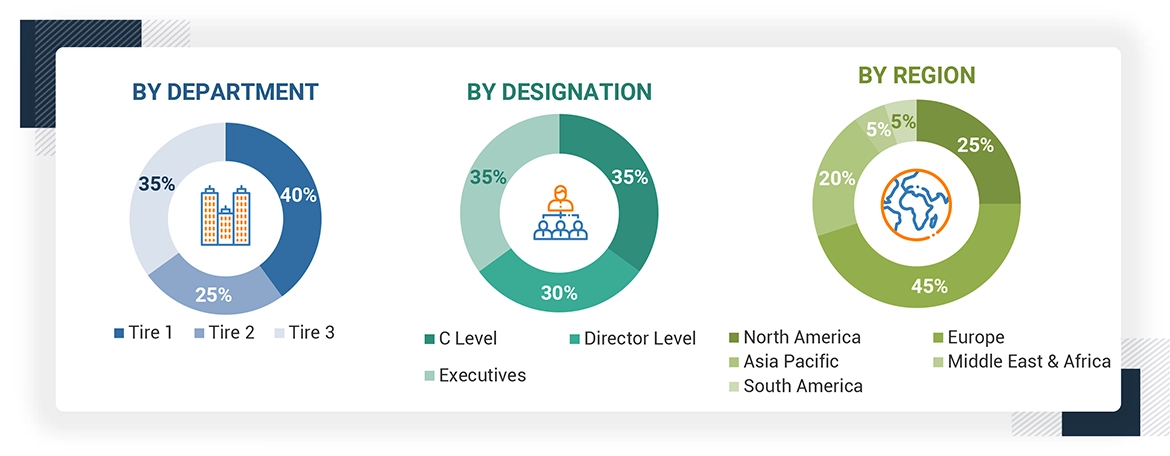
To know about the assumptions considered for the study, download the pdf brochure
Market Size Estimation
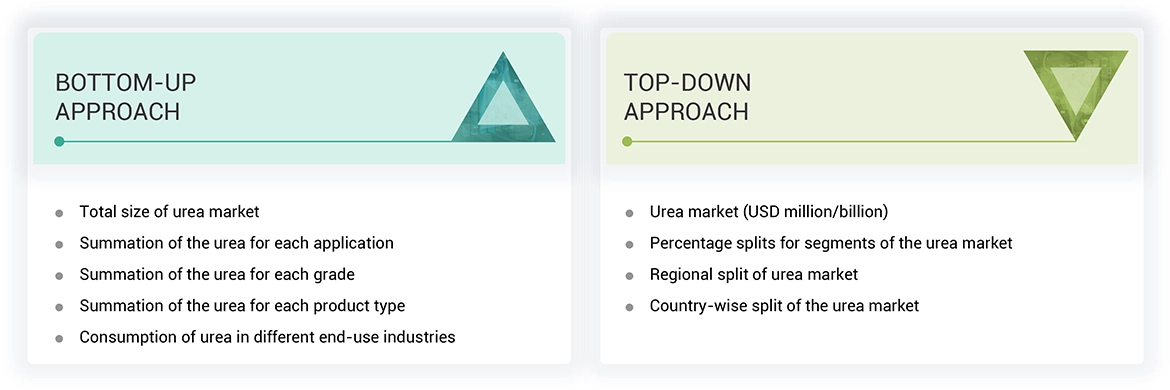
The bottom-up and top-down approaches have been used to estimate the urea market by product type, grade, technology, application, end-use industry, and region. The research methodology used to calculate the market size includes the following steps:
- The key players in the industry and markets were identified through extensive secondary research.
- In terms of value, the industry’s supply chain and market size were determined through primary and secondary research processes.
- All percentage shares, splits, and breakdowns were determined using secondary sources and verified through primary sources.
- All possible parameters that affect the markets covered in this research study were accounted for, viewed in extensive detail, verified through primary research, and analyzed to obtain the final quantitative and qualitative data.
- The research included studying reports, reviews, and newsletters of top market players and extensive interviews with leaders such as directors and marketing executives to obtain opinions.
- The following figure illustrates the overall market size estimation process employed for this study.
Data Triangulation
After arriving at the overall size of the urea market from the estimation process explained above, the total market was split into several segments and sub-segments. The data triangulation and market breakdown procedures were employed, wherever applicable, to complete the overall market engineering process and arrive at the exact statistics for all segments and subsegments. The data was triangulated by studying various factors and trends from both the demand and supply sides. Along with this, the market size was validated using both the top-down and bottom-up approaches.
Market Definition
Urea is an organic compound that exists as a white odorless and tasteless crystalline solid, consisting of carbon, nitrogen, oxygen, and hydrogen. It is highly soluble in water and hence is crucially necessary in the majority of industrial and agricultural sectors all over the world. Urea primarily acts as a fertilizer, which contains high percentages of nitrogen, making it proficiently efficient in transport and application in agriculture. Besides its strategic position in agriculture, urea serves as a raw material for chemical manufacturing, and pharmaceuticals, and through animal feed, it serves as the source of important nutrients. Urea is a critical component of high productivity in agriculture and assists other industrial operations, and it is also substantially applied in environmental applications, like diesel exhaust fluid, to reduce the nitrogen oxide concentration that diesel engines emit, thereby paving its way toward cleaner air standards.
Stakeholders
- Urea manufacturers
- Urea suppliers
- Fertilizer manufacturers
- Pharmaceutical companies
- Chemical industries
- Government agencies
- Raw material suppliers
Report Objectives
- To provide detailed information regarding the key factors influencing the growth of the market (drivers, restraints, opportunities, and challenges)
- To forecast the market size based on product type, grade, technology, application, end-use industry, and region.
- To forecast the market size for the five main regions—North America, Europe, Asia Pacific (APAC), the Middle East & Africa (MEA), and South America—along with their key countries
- To strategically analyze micro markets with respect to individual growth trends, prospects, and contributions to the total market
- To analyze the opportunities in the market for stakeholders and provide details of the competitive landscape for the market leaders
- To strategically profile leading players and comprehensively analyze their key developments such as new product launches, expansions, and acquisitions in the urea market
- To define, describe, and forecast the size of the global urea market in terms of value and volume
- To strategically profile key players and comprehensively analyze their market shares and core competencies.
Get the Full Urea Market Report
Full forecast, segment splits, and company analysis for all Urea Market.
- China Urea Market
- India Urea Market
- Indonesia Urea Market
- Vietnam Urea Market
- Japan Urea Market
- Brazil Urea Market
- Argentina Urea Market
- Canada Urea Market
- Mexico Urea Market
- US Urea Market
- Germany Urea Market
- France Urea Market
- UK Urea Market
- Italy Urea Market
- Ukraine Urea Market
- South Africa Urea Market
- Nigeria Urea Market
- Rest Of Europe Urea Market
- Rest Of Asia Pacific Urea Market
- GCC Countries Urea Market
- Türkiye Urea Market
- -Rest Of GCC Countries Urea Market
- Rest Of South America Urea Market
Need a Tailored Report?
Customize this report to your needs
Get 10% FREE Customization
Customize This Report
