
Canada Variable Frequency Drive Market (2025-2030)

The Canada Variable Frequency Drive Market was valued at $475.9 Million in 2025 and projected to reach to $589 Million by 2030, representing a compound annual growth rate of 4.4%. Canada's Variable Frequency Drive market is positioned for consistent growth through 2030, driven by provincial energy efficiency mandates and industrial modernization initiatives.


| Market Size in | USD 26.32 MN |
| Market Forecast in | |
| CAGR | |
| Forecast Period | |
| Units Considered | Value (USD MN) |
Canada Variable Frequency Drive Market Trends and Insights
- This steady growth reflects Canada's commitment to energy efficiency standards and industrial modernization across manufacturing, water treatment, and HVAC sectors.
- Canada's regulatory environment, including provincial energy codes and federal sustainability initiatives, continues to incentivize the adoption of VFD technology to reduce operational costs and carbon emissions. The Canadian market benefits from strong demand in both industrial and commercial applications, where VFDs optimize motor performance and reduce energy consumption.
- Canada's aging infrastructure and ongoing digital transformation in industrial facilities create sustained opportunities for VFD deployment.
- Between 2025 and 2030, Canada is expected to see increased investment in smart grid technologies and process automation, further supporting market expansion and positioning the country as a key growth market within North America's broader energy efficiency transition..
Key Market Statistics
- CAGR (2025-2030) 4.4% CAGR
- Market Size, 2025 ~USD 475.9 Million
- Forecast, 2030 ~USD 589 Million
- Country Canada
Canada Variable Frequency Drive Market Overview
Market Valuation :
Canada's Variable Frequency Drive market is valued at $475.9 million in 2025, with projections reaching $589.0 million by 2030, representing a steady 4.4% CAGR.
Energy Efficiency Regulations :
Canada's stringent provincial energy efficiency standards and federal sustainability initiatives are driving VFD adoption across industrial and commercial sectors.
Key Application Sectors :
Manufacturing, water treatment facilities, and HVAC systems represent the primary growth drivers for VFD deployment across Canadian industries.
Industrial Modernization Trend :
Canadian manufacturers are increasingly investing in VFD technology to modernize aging infrastructure and reduce operational energy costs in competitive markets.
Canada Variable Frequency Drive Market Dynamics
- The country's focus on reducing carbon emissions and operational costs has accelerated VFD adoption in manufacturing, water utilities, and HVAC applications.
- With a 4.4% CAGR, the market reflects Canada's commitment to sustainable industrial practices and energy conservation. The Canadian market benefits from strong regulatory support, including provincial building codes and federal sustainability programs that incentivize VFD installation.
- Key growth opportunities exist in retrofitting existing industrial facilities, expanding water treatment infrastructure, and upgrading HVAC systems in commercial buildings.
- As energy costs remain a priority for Canadian businesses, VFD technology adoption is expected to accelerate across mid-market and enterprise segments..
Market Ecosystem
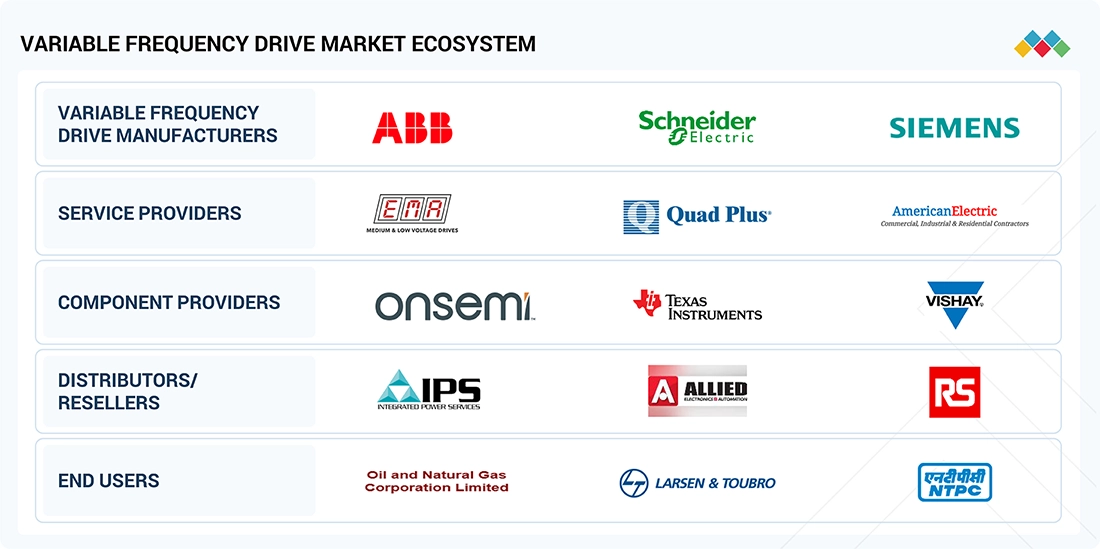
Variable Frequency Drive Market: COMMERCIAL USE CASES ACROSS INDUSTRIES
| COMPANY | USE CASE DESCRIPTION | BENEFITS |
|---|---|---|
 |
DSI Inc. modernizes well-pad motor control infrastructure by replacing aging VFDs using dynamic braking resistors (DBRs) with PowerFlex® 755TR regeneration drives. Drive improvements were needed for reduced energy waste, lower costs, and enhanced sustainability. | By using the VFD, DSI Inc. achieved faster and more efficient well-pad operations. Regenerative drives recycled excess energy, producing projected $3M/month energy savings and accomplished 17% regeneration with 95% reuse of energy. Benefits included lower operational costs, eligibility for carbon credits, better reliability, and improved reporting on pump performance. |
 |
CAESB improves operational reliability and predictability for water and wastewater management through tailored maintenance, refurbished drives, and ultra-low-harmonic (AFE) drive upgrades. The requirement focused on minimizing downtime risk and maintaining full visibility and control of 500+ critical drives operating in harsh conditions. | By using a Danfoss VFD, CAESB achieved reliable, planned maintenance with guaranteed response time. Extended equipment lifetime, reduced risk of downtime, enhanced operational and budgetary control, and improved power quality. The tailored service program and upgraded units gave peace of mind and secured long-term performance of critical water and wastewater infrastructure. |
 |
Enhance energy efficiency and reduce operating costs at the Gliwice ceramics factory by modernizing ventilation, conveyors, and mixers. Required investment in Danfoss VLT® variable frequency drives (VFDs) to allow process-demand-based speed control across multiple systems. | By using a VFD, the Gliwice ceramics factory achieved approximately 30% reduction in annual energy consumption, faster payback (7 months), reduced CO2 emissions, and improved equipment reliability. Enabled process optimization, minimized waste, reduced the need for new equipment, and supported Roca's sustainability and climate neutrality goals. |
Logos and trademarks shown above are the property of their respective owners. Their use here is for informational and illustrative purposes only.
Related Ecosystem
Industrial Equipment
Variable Speed Drives
Key Takeaways
- Canada's VFD market reaches $475.9M in 2025 and is forecast to grow to $589.0M by 2030 at a 4.4% CAGR.
- Energy efficiency regulations and federal sustainability mandates are primary drivers of VFD adoption across Canada's industrial and commercial sectors.
- Canada's manufacturing, water treatment, and HVAC industries represent the largest end-use segments for variable frequency drive technology.
- Digital transformation and smart grid investments in Canada are expected to accelerate VFD deployment through 2030.
Variable Frequency Drive Market Report Scope
| Report Metric | Details |
|---|---|
| Base Year | 2025 |
| Fastest Growing Segment | HIGH POWER DRIVE (Power Rating) |
| Forecast Period | 2025–2030 |
| Growth Rate | CAGR of 5.3% from 2025 to 2030 |
| Largest Segment | AC DRIVE (Type) |
| Market Size Base Year (Billions) | ~USD 24.72 (2025) |
| Revenue Forecast (Billions) | ~USD 32 (2030) |
| Segments Covered | Type, Voltage, Power Rating, Application, End User |
Canada Variable Frequency Drive Market Report Segmentation
5 segment dimensions are covered across the global market.
By Type
- Ac Drive
- Dc Drive
- Servo Drive
By Voltage
- Low Voltage
- Medium Voltage
By Power Rating
- High Power Drive
- Low Power Drive
- Medium Power Drive
- Micro Power Drive
By Application
- Compressors
- Conveyors
- Fans & Blowers
- Other Applications
- Pumps
By End User
- Automotive
- Chemicals & Petrochemicals
- Construction/Infrastructure
- Food & Beverage
- Mining & Metal
- Mining & Metals
- Oil & Gas
- Other End Users
- Power
- Water & Wastewater Treatment
CANADA: VARIABLE FREQUENCY DRIVE MARKET, BY END USER, 2025–2030
| Segment | 2025 | 2026 | 2027 | 2028 | 2029 | 2030 | CAGR (%) |
|---|---|---|---|---|---|---|---|
| AUTOMOTIVE | 39.2 | 41 | 43 | 45 | 47.2 | 49.5 | 4.8 |
| CHEMICALS & PETROCHEMICALS | 60.4 | 63.1 | 65.9 | 68.9 | 72.1 | 75.4 | 4.5 |
| CONSTRUCTION/INFRASTRUCTURE | 36.3 | 37.6 | 39 | 40.4 | 42 | 43.6 | 3.7 |
| FOOD & BEVERAGE | 40.2 | 41.5 | 43 | 44.5 | 46.1 | 47.7 | 3.5 |
| MINING & METAL | 49.3 | 51.3 | 53.5 | 55.8 | 58.2 | 60.7 | 4.2 |
| OIL & GAS | 78 | 81.9 | 85.9 | 90.2 | 94.7 | 99.5 | 5 |
| OTHER END USERS | 41.6 | 42.7 | 43.9 | 45.2 | 46.4 | 47.7 | 2.8 |
| POWER | 101.2 | 106.3 | 111.6 | 117.3 | 123.2 | 129.6 | 5.1 |
| WATER & WASTEWATER TREATMENT | 29.9 | 30.9 | 31.9 | 33 | 34.1 | 35.3 | 3.4 |
| TOTAL | 475.9 | 496.3 | 517.7 | 540.2 | 564 | 589 | 4.4 |
Target Audience
- Industrial Equipment Manufacturers : Manufacturers need Canada-specific market data to develop localized VFD solutions and identify growth opportunities in manufacturing and water treatment sectors.
- Energy & Utilities Companies : Canadian utilities require market insights to understand VFD adoption trends and develop energy efficiency programs aligned with provincial regulations.
- System Integrators & Distributors : Integration partners need detailed market forecasts and sector analysis to optimize inventory, plan expansion, and target high-potential customer segments in Canada.
- Facility & Building Managers : Facility operators require market data to justify VFD investments, understand ROI timelines, and align upgrades with Canadian energy efficiency standards.
- Investment & Strategy Consultants : Consultants advising on Canadian industrial modernization need market-specific data to support client recommendations and identify emerging opportunities.
Key Companies in the Canada Variable Frequency Drive Market
| Company | HQ | Ownership | Strongest segments |
|---|---|---|---|
| EMERSON ELECTRIC CO. | United States |
EMERSON ELECTRIC CO.
Emerson Electric Co. is a global manufacturing and technology company headquartered in the United States that provides innovative solutions in process management, industrial automation, climate technologies, and power systems. The company serves customers across diverse industries including oil and gas, refining, chemicals, power generation, and commercial HVAC.
Reasons to Buy this Report
- Regulatory Compliance Insights : Understand provincial energy efficiency standards and federal sustainability requirements shaping VFD demand across Canadian industrial and commercial sectors.
- Market Sizing & Forecasts : Access precise valuation data for Canada's VFD market ($475.9M in 2025) with detailed 5-year projections to support investment and expansion decisions.
- Sector-Specific Opportunities : Identify high-growth applications in Canadian manufacturing, water treatment, and HVAC sectors with actionable insights for targeted market entry strategies.
- Competitive Landscape Analysis : Gain intelligence on key players, market dynamics, and competitive positioning specific to Canada's VFD market to inform business strategy.
- Growth Driver Assessment : Evaluate industrial modernization trends, energy cost pressures, and sustainability initiatives driving VFD adoption across Canadian enterprises.
Frequently asked questions
What is the current size of Canada's Variable Frequency Drive market?
Canada's VFD market is valued at $475.9 million in 2025 and is expected to reach $589.0 million by 2030.
What is the growth rate of Canada's VFD market?
Canada's Variable Frequency Drive market is growing at a compound annual growth rate (CAGR) of 4.4% from 2025 to 2030.
Which industries drive demand for VFDs in Canada?
Canada's primary VFD end-use sectors include manufacturing, water treatment facilities, HVAC systems, and commercial building automation.
What regulatory factors support VFD adoption in Canada?
Canada's provincial energy codes, federal sustainability initiatives, and carbon reduction targets incentivize industrial and commercial adoption of energy-efficient VFD technology.
How does Canada's VFD market compare to North America?
Canada represents a significant portion of North America's VFD market, with steady growth driven by infrastructure modernization and energy efficiency mandates specific to Canadian provinces.
RESEARCH METHODOLOGY
This research study involves the use of extensive secondary sources, directories, and databases, such as Hoovers, Bloomberg L.P., Factiva, ICIS, and OneSource, to identify and collect information useful for this technical, market-oriented, and commercial study of the global variable frequency drive market. Primary sources are mainly industry experts from core and related industries, preferred suppliers, manufacturers, distributors, service providers, and organizations related to all segments of the value chain of this industry. In-depth interviews were conducted with various primary respondents, including key industry participants, subject matter experts, C-level executives of key market players, and industry consultants, among other experts, to obtain and verify critical qualitative and quantitative information as well as assess growth prospects of the market.
Secondary Research
Secondary sources include annual reports, press releases, and investor presentations of companies; directories and databases, which include D&B, Bloomberg, and Factiva; white papers and articles from recognized authors, and publications and databases from associations, such as International Energy Agency (IEA), US Energy Information Administration (EIA), International Renewable Energy Agency (IRENA), National Electrical Manufacturers Association (NEMA). Secondary research has been used to obtain important information about the key players and market classification & segmentation according to industry trends to the bottom-most level and key developments related to market and technology perspectives. A database of the key industry leaders has also been prepared using secondary research.
Primary Research
In the primary research process, various sources from both the supply and demand sides have been interviewed to obtain and verify qualitative and quantitative information for this report and analyze prospects. Primary sources from the supply side include industry experts such as CEOs, vice presidents, marketing directors, technology and innovation directors, and related executives from various leading companies and organizations operating in the variable frequency drive market. Primary sources from the demand side include experts and key persons.
After the complete market engineering process (which includes calculations of market statistics, market breakdown, market size estimations, market forecasts, and data triangulation), extensive primary research has been conducted to gather information and verify and validate the critical numbers arrived at. Primary research has also been conducted to identify the segmentation, applications, Porter’s Five Forces, key players, competitive landscape, and key market dynamics such as drivers, opportunities, challenges, industry trends, and strategies adopted by key players.
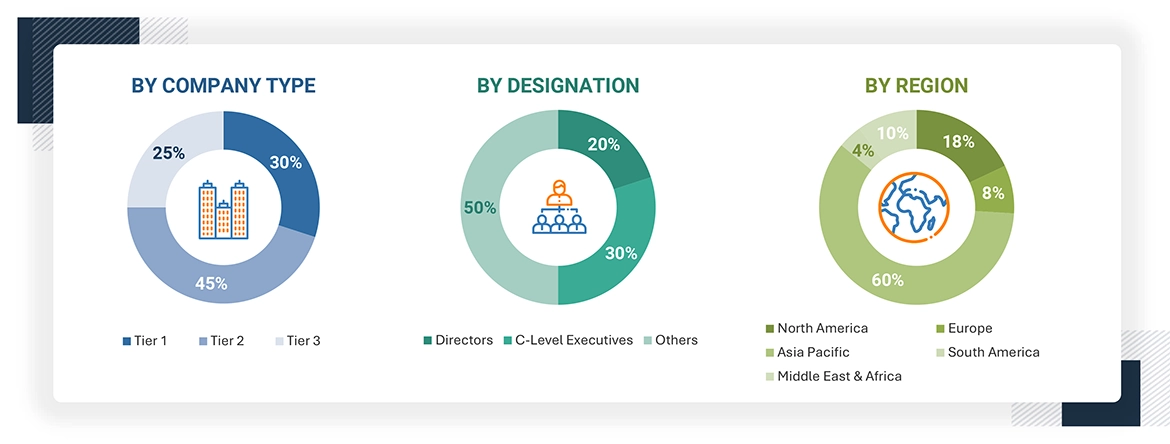
To know about the assumptions considered for the study, download the pdf brochure
Market Size Estimation
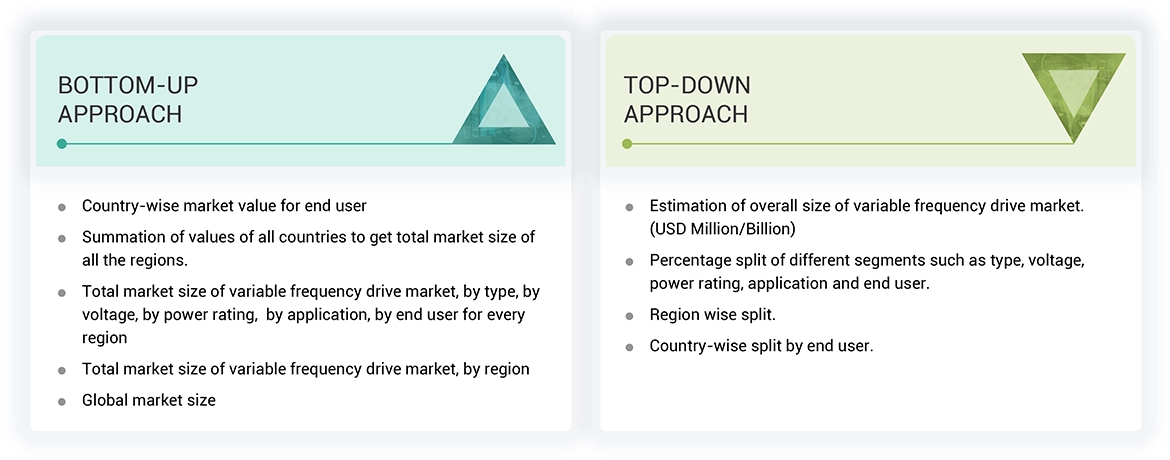
In the complete market engineering process, both top-down and bottom-up approaches have been extensively used along with several data triangulation methods to estimate and forecast the overall market segments listed in this report.
Top-down and bottom-up approaches have been used to estimate and validate the market size of variable frequency drives for various end user in each region. The key players in the market have been identified through secondary research, and their market share in respective regions has been determined through primary and secondary research. This entire procedure includes the study of annual and financial reports of the key market players and extensive interviews for insights from industry leaders such as CEOs, vice presidents, directors, and marketing executives. All percentage shares, splits, and breakdowns have been determined using secondary sources and verified through primary sources.
Variable Frequency Drive Market : Top-Down and Bottom-Up Approach
Data Triangulation
After arriving at the overall market size from the estimation process explained above, the total market has been split into several segments and sub-segments. Data triangulation and market breakdown procedures have been used wherever applicable to complete the overall market engineering process and to arrive at the exact statistics for all segments and sub-segments. The data has been triangulated by studying various factors and trends from both the demand and supply sides. The market has been validated using both the top-down and bottom-up approaches. Then, it was verified through primary interviews. Hence, for every data segment, there are three sources—the top-down approach, the bottom-up approach, and expert interviews. When the values arrived at from the three points matched, the data was assumed to be correct.
Market Definition
A variable frequency drive (VFD) is an electronic motor control device that drives an electric motor by changing the voltage and frequency supplied in the electric motor circuit. VFD works by converting fixed frequency and fixed voltage sine wave power to a variable frequency or variable output voltage, which is used to control the speed of a motor. It is also referred to as variable speed drive, adjustable speed drive, adjustable frequency drive, AC drive, micro drive, and inverter. The primary advantages associated with the use of VFD include less energy consumption and energy cost, controlled performance, extended equipment life, and low maintenance cost. It is mainly used for variable torque applications in various industries, such as oil & gas, water & wastewater treatment, power, paper & pulp, textile, and mining. The market for variable frequency drives is defined as the sum of revenues generated by companies through the sale of variable frequency drives.
Stakeholders
- Government organizations and regulatory agencies
- VFD manufacturing companies
- Automotive, aerospace, marine, and industrial equipment manufacturers
- Research and development institutes
- Environmental and sustainability organizations
- Trade associations and industry forums related to VFD technologies
- Original Equipment Manufacturers (OEMs)
- Component and parts suppliers for VFD
- Consulting companies in energy, automotive, and manufacturing sectors
- Transportation and logistics companies
- Maintenance and repair service providers
Report Objectives
- To describe and forecast the variable frequency drive market in terms of value based on type, voltage, power rating, application, end user, region
- To describe and forecast the variable frequency drive market in terms of volume based on region and power rating segment
- To provide detailed information about the key factors such as drivers, restraints, opportunities, and challenges influencing the growth of the variable frequency drive market
- To strategically analyze the subsegments with respect to individual growth trends, prospects, and contributions of each segment to the overall market size
- To forecast the market size for five key regions: North America, Europe, Asia Pacific, Middle East & Africa, and South America, along with their key countries
- To strategically analyze micromarkets with respect to individual growth trends, prospects, and contributions to the total market
- To study the complete supply chain and allied industry segments and perform a supply chain analysis of the variable frequency drive market’ landscape
- To study market trends, patent analysis, trade analysis, tariff and regulatory landscape, Porter’s five forces analysis, ecosystem mapping, technologies, investment and funding scenario, key stakeholders & buying criteria, case studies pertaining to off variable frequency drive market
- To analyze the opportunities for various stakeholders by identifying the high-growth segments of the variable frequency drivemarket
- To profile the key players and comprehensively analyze their market positions in terms of ranking and core competencies, along with detailing the competitive landscape for the market leaders
- To analyze competitive developments, such as contracts, collaborations, expansions, product launches, investments, and acquisitions, in the variable frequency drivemarket
Note: 1. Micro markets are defined as the further segments and subsegments of the variable frequency drive market included in the report.
2. Core competencies of companies are captured in terms of their key developments and product portfolios, as well as key strategies adopted to sustain their position in the variable frequency drive market.
Available Customizations
MarketsandMarkets offers customizations according to the specific needs of the companies with the given market data.
The following customization options are available for the report:
Product Analysis
- Product matrix, which gives a detailed comparison of the product portfolio of each company
Regional Analysis
- Further breakdown of the VFD market, by country
Company Information
- Detailed analysis and profiling of additional market players (up to five)
Get the Full Variable Frequency Drive Market Report
Full forecast, segment splits, and company analysis for all Variable Frequency Drive Market.
- China Variable Frequency Drive Market
- Japan Variable Frequency Drive Market
- India Variable Frequency Drive Market
- Australia Variable Frequency Drive Market
- Indonesia Variable Frequency Drive Market
- South Korea Variable Frequency Drive Market
- Mexico Variable Frequency Drive Market
- US Variable Frequency Drive Market
- Germany Variable Frequency Drive Market
- Russia Variable Frequency Drive Market
- France Variable Frequency Drive Market
- UK Variable Frequency Drive Market
- Italy Variable Frequency Drive Market
- Spain Variable Frequency Drive Market
- Brazil Variable Frequency Drive Market
- Argentina Variable Frequency Drive Market
- Chile Variable Frequency Drive Market
- Saudi Arabia Variable Frequency Drive Market
- UAE Variable Frequency Drive Market
- South Africa Variable Frequency Drive Market
- Nigeria Variable Frequency Drive Market
- Egypt Variable Frequency Drive Market
- South America Variable Frequency Drive Market
- Rest Of Europe Variable Frequency Drive Market
- Rest Of Asia Pacific Variable Frequency Drive Market
Need a Tailored Report?
Customize this report to your needs
Get 10% FREE Customization
Customize This Report
