
UK Vector Control Market (2024-2029)

The UK Vector Control Market was valued at $1060.6 Million in 2024 and projected to reach to $1460.3 Million by 2029, representing a compound annual growth rate of 6.6%. The UK vector control market is positioned for sustained growth through 2029, driven by intensifying agricultural practices and climate-related pest pressures affecting British farming regions.


| Market Size in | USD 26.32 MN |
| Market Forecast in | |
| CAGR | |
| Forecast Period | |
| Units Considered | Value (USD MN) |
UK Vector Control Market Trends and Insights
- The UK's vector control sector is driven by increasing agricultural intensification, rising pest pressure from climate variability, and regulatory emphasis on sustainable pest management practices.
- The UK market reflects strong demand for integrated pest management solutions across both crop and livestock farming systems..
Key Market Statistics
- CAGR (2024-2029) 6.6% CAGR
- Market Size, 2024 ~USD 1060.6 Million
- Forecast, 2029 ~USD 1460.3 Million
- Country UK
UK Vector Control Market Overview
Market Valuation :
The UK vector control market is valued at USD 1,060.6 million in 2024, with projections reaching USD 1,460.3 million by 2029, demonstrating robust growth potential in the agricultural sector.
Strong Growth Trajectory :
The UK market exhibits a CAGR of 6.6% from 2024-2029, outpacing the global average of 6.2%, indicating accelerating demand for vector control solutions within British agriculture.
Climate-Driven Demand :
Rising pest pressure from climate variability and increased agricultural intensification are primary drivers pushing UK farmers to adopt advanced vector control technologies and sustainable pest management practices.
Regulatory Compliance Focus :
UK regulatory emphasis on sustainable and environmentally responsible pest management is shaping market dynamics, encouraging adoption of integrated pest management and biological control solutions.
UK Vector Control Market Dynamics
- Regulatory frameworks promoting sustainable pest management are accelerating the transition from conventional chemical solutions toward integrated and biological control methods.
- Investment in precision agriculture technologies and data-driven pest monitoring systems is expected to expand market opportunities.
- The UK's commitment to environmental stewardship and food security will continue supporting market expansion, with particular growth in organic farming segments and climate-resilient agricultural practices..
Market Ecosystem
Related Ecosystem
Agrochemicals
- Phosphatic Fertilizers
- Potassic Fertilizers
- Fungicides
- Ammonium Nitrate
- Anticoagulant Rodenticides
- AZELIS HOLDINGS SA
- Basf se
- Origin Enterprises plc
- MITSUI AGRO BUSINESS SACO
- SNF HOLDING COMPANY INC.
Key Takeaways
- The UK vector control market will expand from £1,060.6M (2024) to £1,460.3M (2029) at a 6.6% CAGR.
- UK regulatory frameworks increasingly favor biological and organic vector control methods over synthetic alternatives.
- The UK market is characterized by growing adoption of precision agriculture technologies integrated with vector management.
- Climate change and seasonal variations are intensifying vector pressure across UK agricultural regions.
Vector Control Market Report Scope
| Report Metric | Details |
|---|---|
| Base Year | 2024 |
| Fastest Growing Segment | INTEGRATED VECTOR MANAGEMENT (IVM) (Control Method) |
| Forecast Period | 2024-2029 |
| Growth Rate | CAGR of 6.2% from 2024 to 2029 |
| Largest Segment | INSECTS (Vector Type) |
| Market Size Base Year (Billions) | ~USD 21.16 (2024) |
| Revenue Forecast (Billions) | ~USD 28.58 (2029) |
| Segments Covered | Control Method, End-Use Sector, Mode Of Application, Technology, Type, Vector Type, Pest Type |
UK Vector Control Market Report Segmentation
7 segment dimensions are covered across the global market.
By Control Method
- Biological Control Methods
- Chemical Control Methods
- Comprehensive
- Integrated Vector Management (Ivm)
- Other Control Methods*
- Physical Control Methods
- Targeted
By End-Use Sector
- Commercial
- Industrial
- Residential
By Mode Of Application
- Pellets
- Powder
- Spray
By Technology
- Biological
- Chemical
- Other Technologies
- Physical & Mechanical
By Type
- Anticoagulant
- Bacteria
- Biological
- Botanical
- Bromethalin
- Chemical
- Cholecalciferol
- Cockroaches
- Essential Oils
- Fgar
- Fipronil
- Flies
- Fungi
- Insects & Others
- Larvicides
- Mechanical
- Mice
- Microbial
- Mosquitoes
- Neonicotinoids
- Non-Anticoagulant
- Oleoresins
- Organophosphates
- Other Insects
- Other Rodents
- Predators
- Pyrethroids
- Rats
- Rodents
- Sgar
- Software & Services
- Strychnine
- Traps & Baits
- Ultraviolet Devices
- Zinc Phosphide
By Vector Type
- Insects
- Other Vector Types
- Other Vectors
- Rodents
By Pest Type
- Insect
- Other Pest Types*
- Rodents
- Termites
- Wildlife
Target Audience
- UK Agricultural Producers : Farmers and large-scale agricultural operations need UK-specific vector control market data to optimize pest management investments and select solutions aligned with local climate and regulatory requirements.
- Agrochemical & Biotech Companies : Manufacturers and distributors require detailed UK market analysis to assess growth opportunities, competitive positioning, and demand trends for vector control products in the British market.
- Agricultural Consultants & Advisors : Crop protection specialists and farm management consultants need UK market intelligence to provide evidence-based recommendations on pest management strategies and technology adoption.
- Investment & Private Equity Firms : Investors evaluating opportunities in UK agricultural technology and pest management solutions require market sizing, growth forecasts, and sector dynamics specific to British agriculture.
- Government & Policy Bodies : UK agricultural departments and regulatory agencies need market data to inform policy development, sustainability initiatives, and support programs for integrated pest management adoption.
Reasons to Buy this Report
- UK-Specific Market Sizing : Access precise valuation data for the UK vector control market with detailed forecasts through 2029, enabling accurate budget allocation and investment planning for UK agricultural operations.
- Competitive Landscape Intelligence : Understand UK market dynamics, regulatory requirements, and competitive positioning specific to British agricultural regions to inform product development and market entry strategies.
- Growth Driver Analysis : Identify key growth catalysts unique to the UK including climate impacts, regulatory changes, and agricultural intensification trends affecting pest management demand.
- Segment Opportunity Mapping : Discover high-potential segments within UK vector control including organic farming, precision agriculture, and sustainable solutions aligned with British environmental policies.
- Strategic Decision Support : Leverage UK market insights to guide investment decisions, partnership development, and go-to-market strategies tailored to British agricultural stakeholders and regulatory frameworks.
Frequently asked questions
What is the current size of the UK vector control market?
The UK vector control market is valued at £1,060.6 million in 2024.
What is the projected market size for the UK vector control market by 2029?
The UK vector control market is forecast to reach £1,460.3 million by 2029.
What is the growth rate of the UK vector control market?
The UK vector control market is expected to grow at a compound annual growth rate of 6.6% from 2024 to 2029.
What factors are driving growth in the UK vector control market?
Key drivers include regulatory pressure for sustainable practices, climate-induced pest pressure, agricultural intensification, and adoption of integrated pest management solutions across UK farms.
Which vector control methods are most prevalent in the UK market?
The UK market shows increasing preference for biological controls, organic methods, and precision agriculture-integrated solutions, alongside traditional chemical approaches.
RESEARCH METHODOLOGY
The study involved two major approaches in estimating the current size of the vector control market. Exhaustive secondary research was done to collect information on the market, peer, and parent markets. The next step was to validate these findings, assumptions, and sizing with industry experts across the value chain through primary research. Both top-down and bottom-up approaches were employed to estimate the complete market size. After that, market breakdown and data triangulation were used to estimate the market size of segments and subsegments.
Secondary Research
This research study involved the extensive use of secondary sources—directories and databases such as Bloomberg Businessweek and Factiva—to identify and collect information useful for a technical, market-oriented, and commercial study of the market.
In the secondary research process, various sources such as annual reports, press releases & investor presentations of companies, white papers, food journals, certified publications, articles from recognized authors, directories, and databases were referred to identify and collect information.
Secondary research was mainly used to obtain key information about the industry’s supply chain, the total pool of key players, and market classification and segmentation as per the industry trends to the bottom-most level, regional markets, and key developments from both market- and technology-oriented perspectives.
Primary Research
Extensive primary research was conducted after obtaining information regarding the vector control market scenario through secondary research. Several primary interviews were conducted with market experts from both the demand and supply sides across major countries of North America, Europe, Asia Pacific, South America, and the Rest of the World. Primary data was collected through questionnaires, emails, and telephonic interviews. The primary sources from the supply side included various industry experts, such as Chief X Officers (CXOs), Vice Presidents (VPs), Directors from business development, marketing, research, and development teams, and related key executives from distributors and key opinion leaders. Primary interviews were conducted to gather insights such as market statistics, data on revenue collected from the products and services, market breakdowns, market size estimations, market forecasting, and data triangulation. Primary research also helped in understanding the various trends related to vector control technology, vector type, control method, end-use sector, mode of application, and region. Stakeholders from the demand side, such as livestock rearing flocks, dairy farms, and the poultry industry, were interviewed to understand the buyer’s perspective on the suppliers, products, and their current usage of vector control and the outlook of their business, which will affect the overall market.
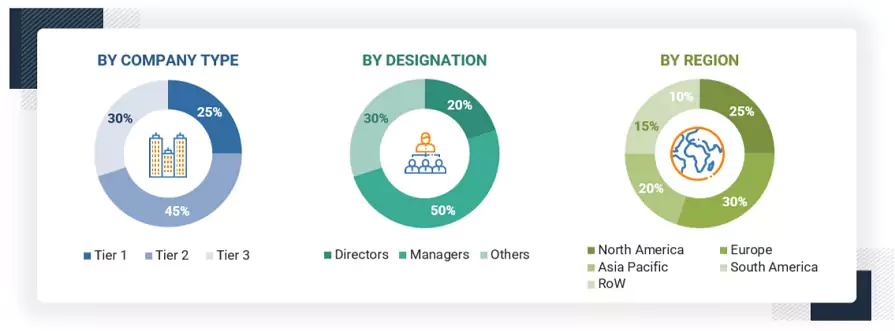
Note: The three tiers of the companies are defined based on their total revenues in 2022 or 2023, as per
the availability of financial data: Tier 1: Revenue > USD 1 billion; Tier 2: USD 100 million = Revenue = USD
1 billion; Tier 3: Revenue < USD 100 million.
To know about the assumptions considered for the study, download the pdf brochure
|
COMPANY NAME |
DESIGNATION |
|
Syngenta Group (Switzerland) |
General Manager |
|
Rentokil Initial Plc (UK) |
Sales Manager |
|
BASF SE (Germany) |
Manager |
|
Environmental Science U.S. LLC (US) |
Sales Manager |
|
Bell Laboratories (US) |
Marketing Manager |
|
Pelgar International (UK) |
Sales Executive |
Market Size Estimation
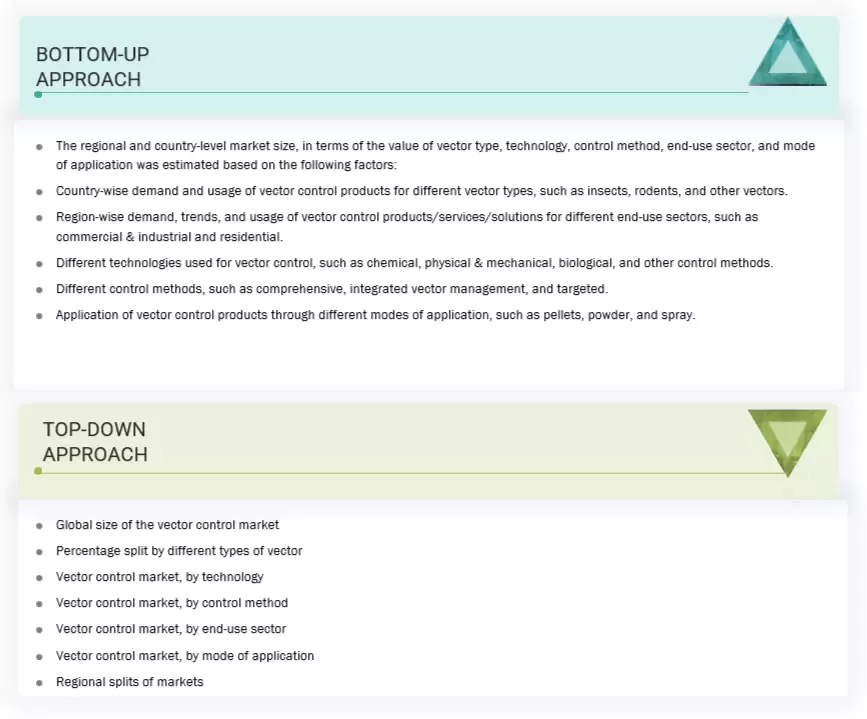
Both the top-down and bottom-up approaches were used to estimate and validate the total size of the vector control market. These approaches were also used extensively to determine the size of various subsegments in the market. The research methodology used to estimate the market size includes the following details:
- The key players in the industry and the overall markets were identified through extensive secondary research.
- All shares, splits, and breakdowns were determined using secondary sources and verified through primary sources.
- All possible parameters that affect the market covered in this research study were accounted for, viewed in extensive detail, verified through primary research, and analyzed to obtain final quantitative and qualitative data.
- The research included the study of reports, reviews, and newsletters of top market players, along with extensive interviews for opinions from leaders, such as CEOs, directors, and marketing executives.
Vector Control Market : Top-Down and Bottom-Up Approach
Data Triangulation
After arriving at the overall market size from the estimation process explained above, the total market was split into several segments and subsegments. The data triangulation and market breakdown procedures were employed, wherever applicable, to estimate the overall vector control market and arrive at the exact statistics for all segments and subsegments. The data was triangulated by studying various factors and trends from the demand and supply sides. The market size was also validated using both the top-down and bottom-up approaches.
Market Definition
According to the World Health Organization (WHO), “Vectors are living organisms that can transmit infectious diseases between humans or from animals to humans. Many of these vectors are bloodsucking insects, which ingest disease-producing microorganisms during a blood meal from an infected host (human or animal) and later inject it into a new host during their subsequent blood meal.
Vector control refers to any steps or methods taken to limit or eradicate vectors that transmit disease pathogens. Integrated Vector Management (IVM) is a rational decision-making process for the optimal use of resources for vector control. The vector control market, for the purpose of this study, considers both, products and services provided in areas apart from on-crop applications, which include commercial, industrial, and residential.
Stakeholders
- Vector control product manufacturers, suppliers, and formulators
- Professional pest control service providers
- Pesticide traders, distributors, importers, exporters, and suppliers
- Public health contractors
- Agricultural warehouse owners and animal & dairy co-operative societies
- Commercial research & development (R&D) organizations and financial institutions
- Pest control associations and industry bodies
- Government health authorities and regulatory bodies such as World Health Organization (WHO), Environmental Protection Agency (EPA), and Pest Management Regulatory Agency (PMRA)
- Associations and industry bodies:
- Food and Agriculture Organization (FAO)
- European Food Safety Authority (EFSA)
- British Pest Control Association (BPCA)
- National Pest Management Association (NPMA)
- National Pest Technicians Association
- Confederation of Europe Pest Management Association (CEPA)
- Organization for Economic Co-operation and Development (OECD)
Report Objectives
- To determine and project the size of the vector control market with respect to the control method, technology, vector type, end-use sector, mode of application, and regions in terms of value over five years, ranging from 2024 to 2029.
- To identify the attractive opportunities in the market by determining the largest and fastest-growing segments across regions
- To provide detailed information about the key factors influencing market growth (drivers, restraints, opportunities, and challenges)
- To analyze the opportunities in the market for stakeholders and provide details of the competitive landscape for market leaders.
- To analyze the micro-markets with respect to individual growth trends, prospects, and their contribution to the total market.
- To identify and profile the key players in the vector control market.
- To understand the competitive landscape and identify the major growth strategies adopted by players across the key regions.
Available Customizations
With the given market data, MarketsandMarkets offers customizations according to company-specific scientific needs.
The following customization options are available for the report:
Product Analysis
- Product Matrix, which gives a detailed comparison of the product portfolio of each company.
Geographic Analysis
With the given market data, MarketsandMarkets offers customizations according to company-specific scientific needs.
- Further breakdown of the Rest of Europe vector control market into key countries.
- Further breakdown of the Rest of Asia Pacific vector control market into key countries.
- Further breakdown of the Rest of South America vector control market into key countries.
Company Information
- Detailed analyses and profiling of additional market players (up to five)
Get the Full Vector Control Market Report
Full forecast, segment splits, and company analysis for all Vector Control Market.
- US Vector Control Market
- Canada Vector Control Market
- Mexico Vector Control Market
- France Vector Control Market
- Germany Vector Control Market
- Spain Vector Control Market
- Italy Vector Control Market
- China Vector Control Market
- India Vector Control Market
- Japan Vector Control Market
- Brazil Vector Control Market
- Argentina Vector Control Market
- Rest Of Europe Vector Control Market
- Rest Of Asia Pacific Vector Control Market
- Rest Of South America Vector Control Market
Need a Tailored Report?
Customize this report to your needs
Get 10% FREE Customization
Customize This Report
