
Rest Of Middle East Video as a Sensor Market (2024-2029)

The Rest Of Middle East Video as a Sensor Market was valued at $702 Million in 2024 and projected to reach to $931.5 Million by 2029, representing a compound annual growth rate of 5.8%. Rest Of Middle East's video as a sensor market is positioned for sustained expansion through 2029, driven by accelerating digital infrastructure investments and increasing adoption across surveillance, automotive, and industrial sectors.


| Market Size in | USD 26.32 MN |
| Market Forecast in | |
| CAGR | |
| Forecast Period | |
| Units Considered | Value (USD MN) |
Rest Of Middle East Video as a Sensor Market Trends and Insights
- Rest Of Middle East is witnessing increased adoption of video sensing technologies across surveillance, automotive, and industrial automation sectors, driven by regional infrastructure investments and digital transformation initiatives.
- The Rest Of Middle East market's 5.8% compound annual growth rate reflects moderate but consistent demand for advanced imaging and sensor integration solutions tailored to regional security and smart city applications. Rest Of Middle East's video as a sensor ecosystem is characterized by growing integration of AI-powered analytics and edge computing capabilities.
- Rest Of Middle East enterprises are increasingly deploying video sensors for real-time monitoring, quality control, and autonomous systems, supported by improving telecommunications infrastructure and rising cybersecurity awareness.
- The forecast period through 2029 indicates Rest Of Middle East will continue to capture regional opportunities in smart surveillance and industrial IoT, though market penetration remains below global averages..
Key Market Statistics
- CAGR (2024-2029) 5.8% CAGR
- Market Size, 2024 ~USD 702 Million
- Forecast, 2029 ~USD 931.5 Million
- Country Rest Of Middle East
Rest Of Middle East Video as a Sensor Market Overview
Market Valuation :
Rest Of Middle East video as a sensor market reached $702.0 million in 2024, with strong projected growth to $931.5 million by 2029, representing a robust 5.8% CAGR driven by regional digitalization efforts.
Surveillance Sector Expansion :
Increased security concerns and smart city initiatives across Rest Of Middle East are accelerating video sensing adoption in surveillance applications, supported by government infrastructure modernization programs.
Automotive & Industrial Growth :
Rest Of Middle East is experiencing rising demand for video sensor technologies in automotive safety systems and industrial automation, fueled by manufacturing sector expansion and safety regulation compliance.
Digital Transformation Catalyst :
Regional digital transformation initiatives and technology investments are creating favorable conditions for video as a sensor market penetration across commercial, industrial, and public sector applications.
Rest Of Middle East Video as a Sensor Market Dynamics
- The region's focus on smart city development and enhanced security measures is creating significant opportunities for video sensing technology deployment.
- Government initiatives supporting technological modernization and private sector investments in automation are expected to maintain steady market momentum.
- The 5.8% CAGR reflects the region's gradual but consistent shift toward advanced sensing solutions, with particular strength in surveillance and industrial applications where video analytics provide critical operational value..
Market Ecosystem
Related Ecosystem
Sensors And Control
- Sensors
- Temperature Sensors
- Image Sensors
- Pressure Sensors
- Flow Sensors
- BAUMER ELECTRIC AG
- HONEYWELL INTERNATIONAL INC.
- Stmicroelectronics
- Lenovo
- Texas Instruments Incorporated
Automotive Advance Technologies
- Battery Electric Vehicle (BEV)
- Light Commercial Vehicles (LCVs)
- Fuel Cell Electric Vehicle (FCEV)
- Hybrid Electric Vehicle (HEV)
- Internal Combustion Engine (ICE)
- BOSCH LIMITED
- Continental ag
- Visteon Corporation
- DENSO Corporation
- ZF FRIEDRICHSHAFEN AG
Industrial Automation
- Sensors
- Image Sensors
- Manufacturing Execution System (MES)
- Actuators
- Flow Sensors
- Siemens ag
- ABB India Limited
- Emerson Electric Co.
- HONEYWELL INTERNATIONAL INC.
- SCHNEIDER ELECTRIC SE
Key Takeaways
- Rest Of Middle East video as a sensor market valued at $702.0M in 2024, growing to $931.5M by 2029 at 5.8% CAGR
- Rest Of Middle East surveillance and smart city applications drive primary demand for video sensing technologies
- Rest Of Middle East market benefits from regional infrastructure modernization and increased industrial automation investments
- Rest Of Middle East adoption lags global benchmarks but shows consistent growth trajectory through 2029
Video as a Sensor Market Report Scope
| Report Metric | Details |
|---|---|
| Base Year | 2024 |
| Fastest Growing Segment | HYPERSPECTRAL IMAGING (Product Type) |
| Forecast Period | 2024-2029 |
| Growth Rate | CAGR of 7.9% from 2024 to 2029 |
| Largest Segment | VIDEO SURVEILLANCE (Product Type) |
| Market Size Base Year (Billions) | ~USD 69.67 (2024) |
| Revenue Forecast (Billions) | ~USD 101.89 (2029) |
| Segments Covered | Offering, Type, Camera Type, Camera Component, Product Type, End User, Application |
Rest Of Middle East Video as a Sensor Market Report Segmentation
7 segment dimensions are covered across the global market.
By Offering
- Hardware
- Services
- Software
By Type
- Accessories
- AI And Machine Learning Algorithms
- Cameras
- Dvrs
- Image Sensor
- Infrared Sensor
- Installation & Maintenance Services
- Integration Software
- Intelligent Video Analytics Software
- Monitors
- Motion Sensor
- Nvrs
- Storage Devices
- Video Management Software
- Vsaas
By Camera Type
- Hyperspectral Imaging Cameras
- Ip Cameras
- Machine Vision Cameras
- Thermal Cameras
By Camera Component
- Camera Sensors
- Other Components
- Processors
By Product Type
- Hyperspectral Imaging
- Machine Vision And Monitoring
- Thermal Imaging
- Video Surveillance
By End User
- Commercial
- Government
- Industrial
- Residential
By Application
- Healthcare
- Manufacturing
- Mapping
- Retail Analytics
- Security & Surveillance
- Traffic Management
Target Audience
- Technology Solution Providers : Video sensor manufacturers and software developers need Rest Of Middle East market data to identify regional demand patterns, customize product offerings, and establish competitive market entry strategies.
- System Integrators & Resellers : Regional system integrators require detailed market insights to assess opportunity sizing, develop customer acquisition strategies, and align service portfolios with emerging surveillance and industrial automation demands.
- Investment & Private Equity Firms : Investors evaluating opportunities in Rest Of Middle East technology sector need market valuation data and growth forecasts to assess portfolio companies, identify acquisition targets, and evaluate regional expansion potential.
- Government & Infrastructure Planners : Public sector decision-makers overseeing smart city and digital transformation initiatives require market intelligence to understand video sensor technology adoption, budget allocation, and procurement planning.
- Enterprise End-Users : Large organizations in Rest Of Middle East across security, automotive, and industrial sectors need market research to benchmark technology investments, evaluate vendor solutions, and plan digital modernization roadmaps.
Reasons to Buy this Report
- Regional Market Sizing : Obtain precise market valuation data specific to Rest Of Middle East, including 2024 baseline ($702M) and 2029 forecast ($931.5M), enabling accurate regional business planning and investment decisions.
- Sector-Specific Insights : Gain detailed understanding of video sensor adoption patterns across surveillance, automotive, and industrial automation sectors within Rest Of Middle East, identifying high-growth application areas.
- Growth Trajectory Analysis : Benchmark Rest Of Middle East's 5.8% CAGR against global 7.9% growth rate to understand regional market dynamics, competitive positioning, and expansion opportunities relative to other markets.
- Infrastructure Investment Trends : Access insights into regional digital transformation initiatives and infrastructure investments driving video sensor adoption, enabling strategic alignment with government and private sector modernization programs.
- Competitive Positioning : Develop targeted go-to-market strategies for Rest Of Middle East by understanding regional adoption drivers, technology preferences, and market maturity levels across key application segments.
Frequently asked questions
What is the current market size of video as a sensor in Rest Of Middle East?
Rest Of Middle East video as a sensor market was valued at $702.0 million in 2024 and is projected to reach $931.5 million by 2029.
What is the expected growth rate for Rest Of Middle East video as a sensor market?
Rest Of Middle East video as a sensor market is expected to grow at a compound annual growth rate (CAGR) of 5.8% from 2024 to 2029.
Which sectors are driving video as a sensor adoption in Rest Of Middle East?
Rest Of Middle East adoption is primarily driven by surveillance, smart city infrastructure, automotive applications, and industrial automation sectors.
How does Rest Of Middle East market compare to global video as a sensor trends?
Rest Of Middle East grows at 5.8% CAGR compared to the global rate of 7.9%, indicating moderate regional adoption relative to worldwide expansion.
What factors support growth in Rest Of Middle East video as a sensor market?
Rest Of Middle East growth is supported by infrastructure modernization, digital transformation initiatives, increased cybersecurity investments, and expanding industrial IoT deployments.
RESEARCH METHODOLOGY
The study involved four major activities for estimating the video as a sensor market size. Exhaustive secondary research has been conducted to collect information relevant to the market, its peer markets, and its child market. Primary research has been undertaken to validate key findings, assumptions, and sizing with industry experts across the value chain of the video as a sensor market. Both top-down and bottom-up approaches have been employed to estimate the complete market size. It has been followed by the market breakdown and data triangulation methods to estimate the size of different segments and subsegments of the market.
Secondary Research
The research methodology used to estimate and forecast the size of the video as a sensor market began with the acquisition of data related to the revenues of key vendors in the market through secondary research. Various secondary sources have been referred to in the secondary research process for identifying and collecting information for this study. Secondary sources include annual reports, press releases, and investor presentations of companies; white papers, journals, certified publications, and articles by recognized authors; websites; directories; and databases. Secondary research has mainly been used to obtain key information about the value chain of the video as a sensor market, key players, market classification, and segmentation according to the industry trends to the bottom-most level, geographic markets, and key developments from both market and technology-oriented perspectives. Secondary data has been collected and analyzed to determine the overall market size, further validated through primary research. Some of the secondary research referred to for this research study involves the Institute of Electrical and Electronics Engineers (IEEE), Federal Communications Commission (FCC), National Institute of Standards and Technology (NIST), American National Standards Institute, Semiconductor Industry Association, Digital Imaging Association, Society for Imaging Sciences and Technology, and Camera & Imaging Products Association (CIPA). Moreover, the study involved extensive use of secondary sources, directories, and databases, such as Hoovers, Bloomberg Businessweek, Factiva, and OneSource, to identify and collect valuable information for a technical, market-oriented, and commercial study of the video as a sensor market. Vendor offerings have been taken into consideration to determine market segmentation.
Primary Research
In the primary research, various primary sources from both the supply and demand sides have been interviewed to obtain the qualitative and quantitative information relevant to this report. Primary sources from the supply side include the key industry participants, subject-matter experts (SMEs), and C-level executives and consultants from various key companies and organizations in the video as a sensor ecosystem. After the complete market engineering (including calculations for the market statistics, the market breakdown, the market size estimations, the market forecasting, and the data triangulation), extensive primary research has been conducted to verify and validate the critical market numbers obtained. Extensive qualitative and quantitative analyses have been performed during the market engineering process to list key information/insights throughout the report. Extensive primary research has been conducted after understanding the video as a sensor market scenario through secondary research. Several primary interviews have been conducted with market experts from the demand and supply-side players across key regions, namely, North America, Europe, Asia Pacific, and the Rest of the World (Middle East, Africa, and South America). Various primary sources from both the supply and demand sides of the market have been interviewed to obtain qualitative and quantitative information. Following is the breakdown of the primary respondents.
Primary data has been collected through questionnaires, emails, and telephonic interviews. In the canvassing of primaries, various departments within organizations, such as sales, operations, and administration, were covered to provide a holistic viewpoint in our report. After interacting with industry experts, brief sessions were conducted with highly experienced independent consultants to reinforce the findings from our primaries. This and the in-house subject matter experts’ opinions have led us to the findings described in the remainder of this report.
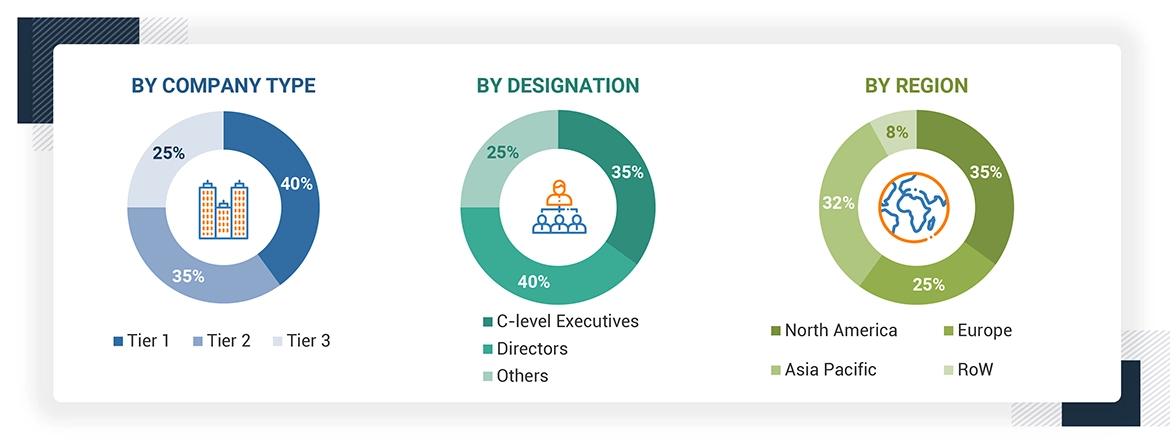
Note: The three tiers of the companies are defined based on their total revenue in 2023: Tier 1 - revenue greater than or equal to USD 1 billion; Tier 2 - revenue between USD 100 million and USD 1 billion; and Tier 3 revenue less than or equal to USD 100 million. Other designations include sales managers, marketing managers, and product managers.
About the assumptions considered for the study, To know download the pdf brochure
Market Size Estimation
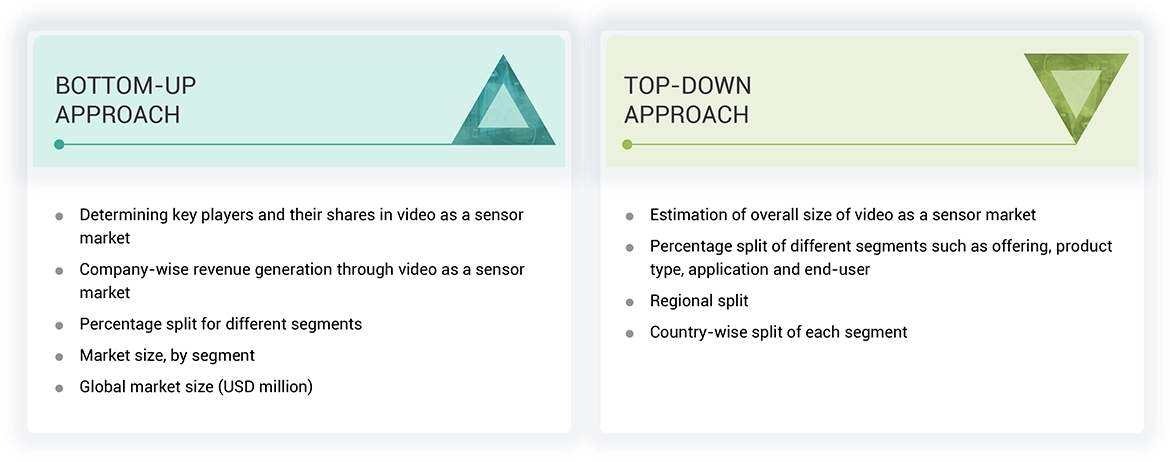
The total size of the video as a sensor market has been estimated and validated using both top-down and bottom-up approaches. Furthermore, these methods have also been used extensively to estimate the size of various subsegments in the market. The research methodology used to estimate the market size is as follows:
- Identifying various entities influencing the value chain of the video as a sensor market
- Identifying major companies, product manufacturers, system integrators, and solutions developers operating in the market
- Estimating segment-level revenue of individual key players operating in the video as a sensor market
- Estimating the size of the video as a sensor market for each industry segment, such as government, commercial, industrial, and residential
- Estimating the size of the video as a sensor market for each region based on the demand for video as a sensor system and solutions
- Tracking the ongoing and upcoming video as a sensor systems product launches to forecast the market size based on these developments and other critical parameters
- Estimating the size of the global video as a sensor market and growth rate at the segment and sub-segment levels
Video as a Sensor Market : Top-Down and Bottom-Up Approach
Data Triangulation
After arriving at the overall size of the video as a sensor market from the market size estimation process explained above, the total market has been split into several segments and subsegments. Data triangulation and market breakdown procedures have been employed, wherever applicable, to complete the overall market engineering process and arrive at the exact statistics for all segments and subsegments of the market. The data has been triangulated by studying various factors and trends from both the demand and supply sides. Along with this, the market size has been validated using both top-down and bottom-up approaches.
Market Definition
Video as a sensor is a technology that integrates video surveillance systems with smart analytics capabilities used for converting visual data into actionable insight. A video as a sensor system consists of the installation of cameras and associated technologies that capture videos that are analyzed in real-time to detect events, track behaviors, and enhance situational awareness in retail, healthcare, transportation, and public safety. Video as a sensor market contains products such as hyperspectral imaging, video surveillance, and machine vision and monitoring. Solutions included in the market include video as a sensor for retail analytics, health care, manufacturing, mapping, security and surveillance, and traffic management.
Key Stakeholders
- Raw material vendors
- Component providers
- Video as a sensor software developers
- Video surveillance as a service (VSaaS) providers
- Video surveillance cameras and other hardware manufacturers
- Original equipment manufacturers (OEMs)
- Video as a sensor system integrators
- Video surveillance service providers
- Technology standards organizations, forums, alliances, and associations
- Governments, financial institutions, and investment communities
- Research organizations
- Analysts and strategic business planners
- Venture capitalists, private equity firms, and startup companies
- Distributors
- End users such as commercial, government, industrial, and residential
Report Objectives
- To define, describe, segment, and forecast the size of the video as a sensor market, by offering, product type, application, and end-user, in terms of value
- To describe and forecast the market size for camera type in terms of volume
- To forecast the market size for various segments with respect to four main regions—North America, Europe, Asia Pacific, and the Rest of the World (RoW)—in terms of value
- To provide detailed information regarding the drivers, restraints, opportunities, and challenges influencing the growth of video as a sensor market
- To study the complete value chain analysis of the video as a sensor market landscape
- To strategically analyze macro and micromarkets1 with respect to growth trends, prospects, and their contributions to the overall market
- To provide a detailed overview of the ecosystem analysis, case study analysis, patent analysis, trade analysis, technology analysis, average selling price (ASP) analysis, AI impact analysis, Porter’s five forces analysis, macroeconomic outlook, and regulations pertaining to the market of the video as a sensor.
- To analyze opportunities in the market for stakeholders and provide a detailed competitive landscape
- To strategically profile key players in the market and comprehensively analyze their market share/ranking and core competencies2
- To analyze competitive developments by players in the video as a sensor market, such as contracts, product launches/developments, expansions, and research and development (R&D) activities
Micromarkets are defined as the further segments and subsegments of the video as a sensor market included in the report.
Core competencies of companies are defined in terms of their key developments and key strategies adopted to sustain their positions in the market.
Available Customizations:
With the given market data, MarketsandMarkets offers customizations according to the company’s specific needs. The following customization options are available for the report:
Company Information
- Detailed analysis and profiling of additional market players based on various blocks of the value chain.
Get the Full Video as a Sensor Market Report
Full forecast, segment splits, and company analysis for all Video as a Sensor Market.
- Canada Video as a Sensor Market
- Mexico Video as a Sensor Market
- US Video as a Sensor Market
- Germany Video as a Sensor Market
- UK Video as a Sensor Market
- France Video as a Sensor Market
- Italy Video as a Sensor Market
- China Video as a Sensor Market
- India Video as a Sensor Market
- Japan Video as a Sensor Market
- South Korea Video as a Sensor Market
- Rest Of Europe Video as a Sensor Market
- Rest Of Asia Pacific Video as a Sensor Market
- Africa Video as a Sensor Market
- Middle East Video as a Sensor Market
- South America Video as a Sensor Market
- GCC Countries Video as a Sensor Market
Need a Tailored Report?
Customize this report to your needs
Get 10% FREE Customization
Customize This Report
