
US Video as a Sensor Market (2024-2029)

The US Video as a Sensor Market was valued at $10761.5 Million in 2024 and projected to reach to $15930.4 Million by 2029, representing a compound annual growth rate of 8.2%. The US Video as a Sensor Market is positioned for sustained growth through 2029, driven by accelerating digital transformation across key verticals.


| Market Size in | USD 26.32 MN |
| Market Forecast in | |
| CAGR | |
| Forecast Period | |
| Units Considered | Value (USD MN) |
US Video as a Sensor Market Trends and Insights
- The US market is driven by increasing adoption of computer vision technologies across automotive, surveillance, and industrial automation sectors.
- In the US, demand for advanced imaging solutions continues to accelerate as enterprises integrate video-based sensing into smart infrastructure and autonomous systems. The US represents a critical hub for video sensor innovation, with significant investments in AI-powered visual analytics and edge computing capabilities.
- By 2029, the US market is expected to capture substantial value as manufacturers scale production and deployment of next-generation sensor technologies.
- The US growth trajectory reflects strong demand from both established technology leaders and emerging startups developing specialized video sensing applications..
Key Market Statistics
- CAGR (2024-2029) 8.2% CAGR
- Market Size, 2024 ~USD 10761.5 Million
- Forecast, 2029 ~USD 15930.4 Million
- Country US
US Video as a Sensor Market Overview
Market Valuation :
The US Video as a Sensor Market is valued at $10,761.5 million in 2024, with strong momentum expected to reach $15,930.4 million by 2029, representing an 8.2% CAGR.
Automotive Sector Leadership :
US automotive manufacturers are rapidly adopting video-as-sensor technology for autonomous vehicles, advanced driver assistance systems (ADAS), and real-time vehicle monitoring, driving significant market expansion.
Surveillance & Security Growth :
Increased investment in US surveillance infrastructure, smart city initiatives, and enterprise security solutions are accelerating demand for advanced video sensing capabilities across public and private sectors.
Industrial Automation Integration :
US manufacturing and logistics companies are deploying video-as-sensor solutions for quality control, predictive maintenance, and supply chain optimization, fueling enterprise adoption rates.
US Video as a Sensor Market Dynamics
- Automotive applications, particularly autonomous vehicle development and ADAS integration, represent the largest growth opportunity, with major OEMs and tech companies investing heavily in computer vision infrastructure.
- Additionally, enterprise adoption of video analytics for surveillance, industrial automation, and smart building management continues to expand as organizations prioritize operational efficiency and security. Government initiatives supporting smart infrastructure and cybersecurity investments further bolster market expansion.
- The competitive landscape is intensifying as semiconductor manufacturers and software providers develop specialized chips and algorithms optimized for video sensing.
- Supply chain resilience and domestic semiconductor production initiatives are expected to strengthen the US market position, while emerging applications in retail analytics and healthcare monitoring present additional growth vectors through 2029..
Market Ecosystem
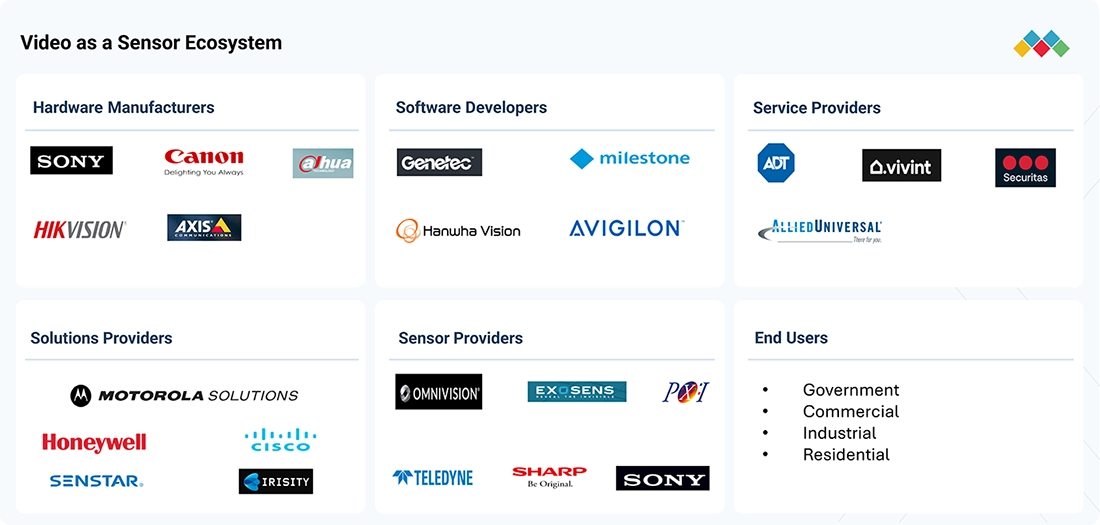
VIDEO AS A SENSOR MARKET SIZE, SHARE AND TRENDS: COMMERCIAL USE CASES ACROSS INDUSTRIES
| COMPANY | USE CASE DESCRIPTION | BENEFITS |
|---|---|---|
 |
Hikvision offers AI-enabled video sensing solutions that combine intelligent cameras, deep-learning algorithms, edge computing, and cloud-based analytics. Its AI technologies enable automatic detection, classification, and analysis of people, vehicles, and objects, while its AIoT architecture integrates video with IoT data for security, traffic management, retail, manufacturing, and smart-city applications. | Enables real-time intelligent detection | Reduces false alarms | Supports automated monitoring | Improves situational awareness and operational efficiency |
 |
Dahua Technology provides AI-based video sensing through its WizMind portfolio, integrating deep-learning algorithms across network cameras, PTZ cameras, NVRs, thermal cameras, and software platforms. Its solutions support human and vehicle detection, video metadata, people counting, ANPR, parking management, PPE detection, and behavioral analysis across transportation, retail, energy, finance, and other verticals. | Enables accurate object and behavior detection | Supports real-time business analytics | Improves traffic and security management | Enables automated decision-making |
 |
Honeywell provides intelligent video surveillance solutions incorporating AI analytics, smart motion detection, people counting, object detection, license plate recognition, vehicle tracking, heat mapping, and occupancy monitoring. Its AI-enabled cameras and video management platforms transform surveillance footage into actionable intelligence for commercial, industrial, critical infrastructure, and perimeter-security applications. | Enhances security and situational awareness | Reduces nuisance alarms | Enables occupancy and behavior monitoring | Improves incident response and facility management |
 |
Bosch integrates AI-driven video analytics directly into its cameras to detect and classify objects, monitor predefined areas, and identify events such as loitering or intrusion. Its Intelligent Insights platform converts video analytics metadata into actionable information such as people counting, occupancy, crowd detection, object counting, and object positioning for security and operational applications. | Enables proactive threat detection | Improves situational awareness | Supports operational efficiency | Converts video data into actionable insights |
 |
Cisco, through its Meraki MV smart camera portfolio, combines onboard processing, AI-powered analytics, cloud management, and video intelligence. Its smart cameras provide person and vehicle detection, people counting, heat maps, object detection, motion and audio analytics, and cloud-based remote management, enabling video to function as a data source for physical security and business intelligence. | Reduces infrastructure complexity | Enables real-time video intelligence | Supports remote monitoring and management | Improves security and data-driven decision-making |
Logos and trademarks shown above are the property of their respective owners. Their use here is for informational and illustrative purposes only.
Related Ecosystem
Sensors And Control
- Sensors
- Temperature Sensors
- Image Sensors
- Pressure Sensors
- Flow Sensors
- BAUMER ELECTRIC AG
- HONEYWELL INTERNATIONAL INC.
- Stmicroelectronics
- Lenovo
- Texas Instruments Incorporated
Automotive Advance Technologies
- Battery Electric Vehicle (BEV)
- Light Commercial Vehicles (LCVs)
- Fuel Cell Electric Vehicle (FCEV)
- Hybrid Electric Vehicle (HEV)
- Internal Combustion Engine (ICE)
- BOSCH LIMITED
- Continental ag
- Visteon Corporation
- DENSO Corporation
- ZF FRIEDRICHSHAFEN AG
Industrial Automation
- Sensors
- Image Sensors
- Manufacturing Execution System (MES)
- Actuators
- Flow Sensors
- Siemens ag
- ABB India Limited
- Emerson Electric Co.
- HONEYWELL INTERNATIONAL INC.
- SCHNEIDER ELECTRIC SE
Key Takeaways
- The US Video as a Sensor Market will grow from $10.76B in 2024 to $15.93B in 2029, representing an 8.2% CAGR.
- The US market is driven by autonomous vehicle development, smart city infrastructure, and industrial IoT applications requiring real-time visual data.
- The US leads in AI-integrated video sensing solutions, with major investments from tech giants and venture-backed startups.
- The US demand for edge computing and on-device video processing is accelerating adoption across enterprise and consumer segments.
Video as a Sensor Market Report Scope
| Report Metric | Details |
|---|---|
| Base Year | 2024 |
| Fastest Growing Segment | HYPERSPECTRAL IMAGING (Product Type) |
| Forecast Period | 2024-2029 |
| Growth Rate | CAGR of 7.9% from 2024 to 2029 |
| Largest Segment | VIDEO SURVEILLANCE (Product Type) |
| Market Size Base Year (Billions) | ~USD 69.67 (2024) |
| Revenue Forecast (Billions) | ~USD 101.89 (2029) |
| Segments Covered | Offering, Type, Camera Type, Camera Component, Product Type, End User, Application |
US Video as a Sensor Market Report Segmentation
7 segment dimensions are covered across the global market.
By Offering
- Hardware
- Services
- Software
By Type
- Accessories
- AI And Machine Learning Algorithms
- Cameras
- Dvrs
- Image Sensor
- Infrared Sensor
- Installation & Maintenance Services
- Integration Software
- Intelligent Video Analytics Software
- Monitors
- Motion Sensor
- Nvrs
- Storage Devices
- Video Management Software
- Vsaas
By Camera Type
- Hyperspectral Imaging Cameras
- Ip Cameras
- Machine Vision Cameras
- Thermal Cameras
By Camera Component
- Camera Sensors
- Other Components
- Processors
By Product Type
- Hyperspectral Imaging
- Machine Vision And Monitoring
- Thermal Imaging
- Video Surveillance
By End User
- Commercial
- Government
- Industrial
- Residential
By Application
- Healthcare
- Manufacturing
- Mapping
- Retail Analytics
- Security & Surveillance
- Traffic Management
Target Audience
- Automotive OEMs & Suppliers : US automotive manufacturers and Tier-1 suppliers need detailed market intelligence on ADAS and autonomous vehicle adoption rates to guide sensor technology selection and supply chain investments.
- Semiconductor & Chip Designers : US semiconductor companies require market sizing and application-specific demand forecasts to prioritize chip architecture development and manufacturing capacity planning for video sensing processors.
- Surveillance & Security Providers : US security solution vendors need comprehensive market data on enterprise and government spending trends to develop competitive offerings and identify high-growth customer segments.
- Industrial Automation Companies : US manufacturing and logistics firms need insights into video-as-sensor adoption in quality control and predictive maintenance to evaluate technology investments and operational efficiency gains.
- Investment & Private Equity Firms : US investors and PE firms require detailed market forecasts and growth drivers to evaluate acquisition targets, fund allocation decisions, and portfolio company valuations in the video sensing sector.
Reasons to Buy this Report
- Strategic Market Sizing : Obtain precise US market valuation ($10.76B in 2024) and 5-year forecasts to benchmark competitive positioning and identify revenue opportunities within the rapidly expanding video-as-sensor segment.
- Sector-Specific Insights : Access detailed analysis of automotive, surveillance, and industrial automation applications specific to the US market, enabling targeted product development and go-to-market strategies for each vertical.
- Growth Driver Analysis : Understand key US market catalysts including autonomous vehicle adoption, smart city investments, and enterprise security spending to prioritize R&D investments and partnership opportunities.
- Competitive Landscape Intelligence : Gain visibility into US market dynamics, emerging competitors, and technology trends to inform strategic planning, M&A decisions, and product roadmap development for sustained competitive advantage.
- Investment Decision Support : Leverage comprehensive US market data and 8.2% CAGR projections to support funding decisions, investor presentations, and capital allocation strategies for video sensing technology initiatives.
Frequently asked questions
What is the current size of the US Video as a Sensor Market?
The US Video as a Sensor Market was valued at $10,761.5 million in 2024 and is expected to reach $15,930.4 million by 2029.
What is the projected growth rate for the US market?
The US Video as a Sensor Market is projected to grow at a compound annual growth rate (CAGR) of 8.2% from 2024 to 2029.
Which industries are driving growth in the US Video as a Sensor Market?
The US market is primarily driven by automotive (autonomous vehicles), surveillance and security, industrial automation, smart cities, and healthcare applications.
What technologies are key to the US market's expansion?
Key technologies in the US market include AI-powered computer vision, edge computing, real-time video analytics, and advanced imaging sensors integrated with machine learning algorithms.
Who are the major players in the US Video as a Sensor Market?
The US market includes established semiconductor companies, camera manufacturers, AI software providers, and specialized startups developing video sensing solutions for various verticals.
RESEARCH METHODOLOGY
The study involved four major activities to estimate the current size of the global Video as a Sensor market. Extensive secondary research was conducted to gather information on the Video as a Sensor ecosystem, including camera manufacturers, video analytics providers, AI and computer vision companies, image sensor and semiconductor companies, component suppliers, distributors, system integrators, technology providers, and end users. This was followed by primary research with industry stakeholders across the value chain, including video surveillance manufacturers, AI analytics providers, technology developers, component suppliers, distributors, OEMs, system integrators, commercial enterprises, industrial companies, transportation operators, and end users, to validate assumptions and market sizing. Both top-down and bottom-up approaches were used to estimate the overall market size. Market breakdowns and data triangulation techniques were then applied to determine the size of individual segments and subsegments by component, technology, deployment, application, end-use industry, and region. Secondary and primary sources were used together to support a comprehensive technical, commercial, and competitive analysis of the global video as a sensor market.
Secondary Research
Secondary research drew on a range of sources to identify and collect information relevant to the Video as a Sensor market. These sources included annual reports, company presentations, press releases, product catalogs, technical datasheets, patents, technical journals, industry publications, company websites, trade directories, and government databases. The research provided key insights into the market’s supply chain, value chain, competitive landscape, and segmentation by component, technology, deployment, application, end-use industry, and region. It also helped assess industry trends, adoption of Video as a Sensor solutions across commercial, industrial, transportation, retail, smart city, critical infrastructure, healthcare, and public safety applications, and advancements in AI-powered cameras, computer vision, edge computing, deep-learning video analytics, IoT-enabled cameras, cloud-based video platforms, and multi-sensor technologies. The collected information was further analyzed to estimate the overall market size and validate market assumptions, which were subsequently refined through primary research with industry experts and key stakeholders.
Primary Research
Extensive primary research was conducted after secondary research provided insight into the current state of the video as a sensor market. Several primary interviews were conducted with experts from the demand and supply sides across four major regions: North America, Europe, Asia Pacific, and RoW. This primary data was collected through questionnaires, emails, and telephone interviews.
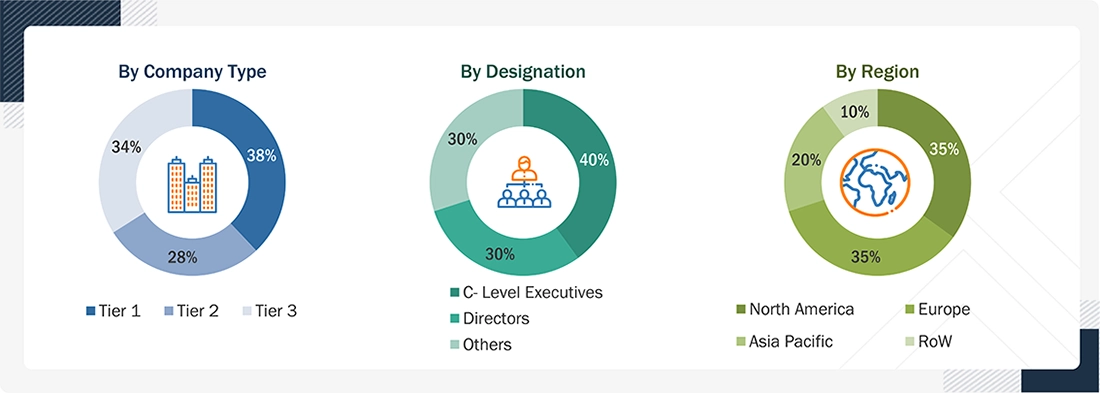
Note: The three tiers of the companies are defined based on their total revenue in 2025: Tier 1 - revenue greater than or equal to USD 1 billion; Tier 2 - revenue between USD 100 million and USD 1 billion; and Tier 3 revenue less than or equal to USD 100 million. Other designations include sales managers, marketing managers, and product managers.
To know about the assumptions considered for the study, download the pdf brochure
Market Size Estimation
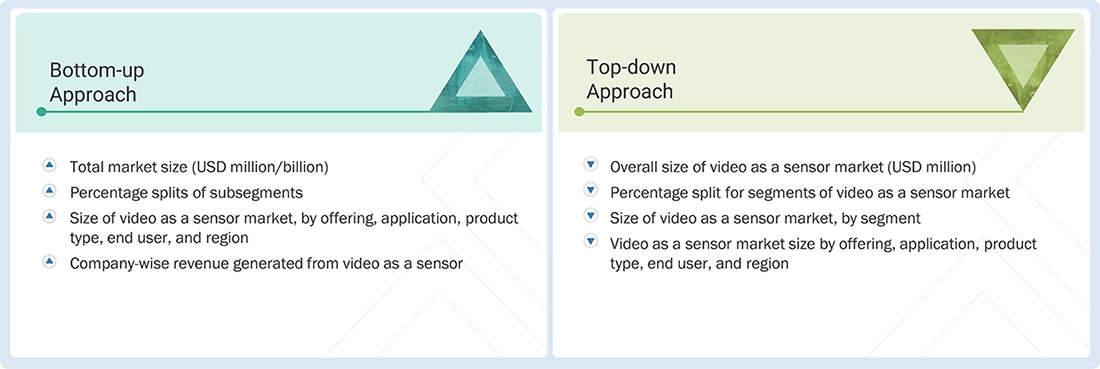
Both top-down and bottom-up approaches were used to estimate and validate the total size of the video as a sensor market. These methods have also been used extensively to estimate the size of various market subsegments. The following research methodology was used to estimate the market size:
- Major players in the video as a sensor market and related markets were identified through extensive secondary research.
- The industry’s value chain and market size in terms of value and volume were determined through primary and secondary research processes.
- All percentage shares, splits, and segment-level breakdowns were determined using secondary sources and verified through primary research and data triangulation.
Data Triangulation
After determining the overall size of the Video as a Sensor market through the market size estimation process, the total market was divided into relevant segments and subsegments. Data triangulation and market breakdown procedures were employed, wherever applicable, to complete the market engineering process and derive statistics for each segment and subsegment. Data was triangulated by evaluating factors and trends from the demand and supply sides, including AI adoption, video analytics capabilities, camera technologies, edge computing, cloud deployment, IoT integration, application requirements, smart-city development, industrial automation, and regional trends. The analysis considered key Video as a Sensor technologies, such as AI-enabled cameras, computer vision, edge-based analytics, cloud-based video platforms, IoT-enabled cameras, and multi-sensor systems, along with applications such as security and surveillance, traffic management, industrial monitoring, retail analytics, smart buildings, and public safety. The market size was also validated using top-down and bottom-up approaches to ensure consistency across the overall market and individual segments.
Market Definition
Video as a sensor refers to using cameras, computer vision, and video analytics to detect, identify, track, and measure people, objects, activities, and environmental conditions, converting visual information into actionable data for monitoring, decision-making, control, or automation. Video-as-a-sensor solutions can incorporate AI-enabled cameras, edge-based video analytics, cloud-based platforms, IoT connectivity, and multi-sensor systems, supporting real-time and historical analysis across diverse applications.
Video as a sensor solutions play a crucial role across commercial facilities, manufacturing and industrial automation, transportation, smart cities, retail, critical infrastructure, healthcare, and public safety. These solutions enable intelligent surveillance, object detection and classification, people and vehicle counting, traffic monitoring, occupancy analysis, behavioral detection, process monitoring, and automated response. Video sensors are commonly integrated into security systems, access control, traffic management systems, industrial equipment, smart building platforms, retail analytics, and city infrastructure. A typical Video as a Sensor system may consist of a camera or imaging device, an image sensor, a processing/AI engine, video analytics software, a connectivity interface, and an associated management or control platform. Its configuration varies according to the sensing technology, analytics requirements, application, and operating environment.
Key Stakeholders
- Raw material vendors
- Component providers
- Video as a sensor software developers
- Video surveillance as a service (VSaaS) provider s
- Video surveillance cameras and other hardware manufacturers
- Original equipment manufacturers (OEMs)
- Video as a sensor system integrators
- Video surveillance service providers
- Technology standards organizations, forums, alliances, and associations
- Governments, financial institutions, and investment communities
- Research organizations
- Analysts and strategic business planners
- Venture capitalists, private equity firms, and startups
- Distributors
- Commercial, government, industrial, and residential end users
Report Objectives
- To define, describe, segment, and forecast the size of the video as a sensor market, by offering, product type, application, and end user, in terms of value
- To describe and forecast the market size for camera type in terms of volume
- To forecast the market size for various segments with respect to four main regions—North America, Europe, Asia Pacific, and the Rest of the World (RoW) in terms of value
- To provide detailed information regarding drivers, restraints, opportunities, and challenges influencing the growth of video as a sensor market
- To study the complete value chain analysis of the video as a sensor market landscape
- To strategically analyze macro and micromarkets with respect to growth trends, prospects, and their contributions to the overall market
- To provide a detailed overview of the ecosystem analysis, case study analysis, patent analysis, trade analysis, technology analysis, average selling price (ASP) analysis, AI impact analysis, Porter’s Five Forces analysis, macroeconomic outlook, and regulations pertaining to the market
- To analyze opportunities in the market for stakeholders and provide a detailed competitive landscape
- To strategically profile key players in the market and comprehensively analyze their market share/ranking and core competencies
- To analyze competitive developments by players in the video as a sensor market, such as contracts, product launches/developments, expansions, and research and development (R&D) activities.
Available customizations:
Based on the provided market data, MarketsandMarkets offers customizations to meet the company’s specific needs. The following customization options are available for the report:
Company Information:
- Detailed analysis and profiling of additional market players (up to 5)
Get the Full Video as a Sensor Market Report
Full forecast, segment splits, and company analysis for all Video as a Sensor Market.
- Canada Video as a Sensor Market
- Mexico Video as a Sensor Market
- Germany Video as a Sensor Market
- UK Video as a Sensor Market
- France Video as a Sensor Market
- Italy Video as a Sensor Market
- China Video as a Sensor Market
- India Video as a Sensor Market
- Japan Video as a Sensor Market
- South Korea Video as a Sensor Market
- Rest Of Europe Video as a Sensor Market
- Rest Of Asia Pacific Video as a Sensor Market
- Africa Video as a Sensor Market
- Middle East Video as a Sensor Market
- South America Video as a Sensor Market
- GCC Countries Video as a Sensor Market
- Rest Of Middle East Video as a Sensor Market
Need a Tailored Report?
Customize this report to your needs
Get 10% FREE Customization
Customize This Report