
India Virtual Extensible LAN (VXLAN) Market (2024-2029)

The India Virtual Extensible LAN (VXLAN) Market was valued at $50.1 Million in 2024 and projected to reach to $133 Million by 2029, representing a compound annual growth rate of 21.6%. India's VXLAN market is poised for substantial growth, expanding from USD 50.1 million in 2024 to USD 133.0 million by 2029.


| Market Size in | USD 26.32 MN |
| Market Forecast in | |
| CAGR | |
| Forecast Period | |
| Units Considered | Value (USD MN) |
India Virtual Extensible LAN (VXLAN) Market Trends and Insights
- India's digital transformation initiatives, coupled with increasing cloud infrastructure investments and data center modernization, are driving widespread adoption of VXLAN technology across enterprises and service providers.
- The surge in virtualization demand and network overlay solutions in India reflects the country's shift toward software-defined networking architectures. India's VXLAN market growth is fueled by rising data center consolidation, multi-cloud strategies, and the need for scalable network solutions among Indian enterprises.
- As organizations in India migrate workloads to hybrid and public cloud environments, VXLAN deployment becomes critical for seamless network segmentation and mobility.
- The forecast period (2024-2029) will witness India strengthening its position as a key adopter of advanced networking technologies, supported by government digitalization programs and increased IT spending across sectors including BFSI, telecommunications, and e-commerce..
Key Market Statistics
- CAGR (2024-2029) 21.6% CAGR
- Market Size, 2024 ~USD 50.1 Million
- Forecast, 2029 ~USD 133 Million
- Country India
India Virtual Extensible LAN (VXLAN) Market Overview
Rapid Market Expansion :
India's VXLAN market is growing at 21.6% CAGR, significantly outpacing the global growth rate of 15%, driven by aggressive digital transformation and cloud adoption across enterprises.
Data Center Modernization :
Indian data centers are increasingly adopting VXLAN technology to enhance network scalability and flexibility, supporting the country's growing cloud infrastructure and edge computing requirements.
Cloud Infrastructure Investment :
Rising investments in cloud services and hybrid IT environments across Indian enterprises are accelerating VXLAN deployment for improved network virtualization and multi-tenancy capabilities.
Digital Transformation Catalyst :
Government digital initiatives and enterprise modernization programs are creating strong demand for VXLAN solutions to support seamless network overlay and data center interconnectivity.
India Virtual Extensible LAN (VXLAN) Market Dynamics
- This robust expansion is fueled by India's position as a global IT hub, increasing adoption of cloud-native architectures, and the need for scalable network solutions across enterprises.
- The country's digital economy initiatives and growing data center infrastructure investments are creating favorable conditions for VXLAN technology adoption. Enterprise organizations in India are increasingly recognizing VXLAN's value in enabling network flexibility, reducing operational complexity, and supporting multi-cloud strategies.
- With rising awareness among IT decision-makers and competitive pricing from regional vendors, the market is expected to witness accelerated adoption across financial services, telecommunications, and e-commerce sectors throughout the forecast period..
Market Ecosystem
Related Ecosystem
Data Centre And Networking
- Software-Defined Networking (SDN)
- Mid-Sized Data Centers
- Small Data Centers
- Remote Monitoring
- Smart Healthcare
- Cisco Systems, Inc.
- HUAWEI TECHNOLOGIES CO LTD
- Hewlett Packard Enterprise Company
- MITSUBISHI ELECTRIC INFORMATION NETWORK CORPORATION
- MITSUBISHI ELECTRIC INFORMATION SYSTEMS CORPORATION
Key Takeaways
- India's VXLAN market is projected to grow from USD 50.1 million (2024) to USD 133.0 million (2029) at a 21.6% CAGR, significantly outpacing global growth.
- Cloud migration and data center modernization initiatives in India are primary drivers accelerating VXLAN adoption among enterprises.
- India's software-defined networking transition and multi-cloud strategies position VXLAN as essential infrastructure for network scalability and flexibility.
- Government digitalization programs and increased IT spending across BFSI, telecom, and e-commerce sectors in India are fueling market expansion through 2029.
Virtual Extensible LAN (VXLAN) Market Report Scope
| Report Metric | Details |
|---|---|
| Base Year | 2024 |
| Fastest Growing Segment | SMES (Organization Size) |
| Forecast Period | 2024-2029 |
| Growth Rate | CAGR of 15% from 2024 to 2029 |
| Largest Segment | ENTERPRISES (End User) |
| Market Size Base Year (Billions) | ~USD 1.59 (2024) |
| Revenue Forecast (Billions) | ~USD 3.2 (2029) |
| Segments Covered | Offering, Hardware, Software, Service, Professional Service, Application, Vertical, Type, Deployment Mode, Organization Size, End User, Sdn Type |
India Virtual Extensible LAN (VXLAN) Market Report Segmentation
12 segment dimensions are covered across the global market.
By Offering
- Hardware
- Sdn Infrastructure
- Services
- Software
- Solutions
By Hardware
- Other Hardware
- Routers
- Switches
By Software
- Network Management & Orchestration Software
- Network Virtualization Software
- Vxlan Testing & Analysis Tools
- Vxlan-Enabled Network Operating Systems
By Service
- Managed Services
- Professional Services
By Professional Service
- Consulting
- Deployment & Integration
- Support & Maintenance
By Application
- Multi-Tenancy
- Network Function Virtualization (Nfv)
- Other Applications
- Sd-Lan
- Sd-Wan
- Security Applications
- Software-Defined Networking (Sdn) Overlays
- Workload Mobility
By Vertical
- Bfsi
- Education
- Energy And Utilities
- Government
- Government & Defense
- Healthcare
- It & Ites
- Ites
- Manufacturing
- Media & Entertainment
- Other Verticals
- Retail
- Retail & E-Commerce
- Telecom
- Telecommunications
- Transportation And Logistics
By Type
- Appliances
- Consulting
- Implementation
- Software
- Training And Support
By Deployment Mode
- Cloud
- On-Premises
By Organization Size
- Large Enterprises
- Smes
By End User
- Cloud Service Providers
- Enterprises
- Service Providers
- Telecommunication Service Providers
- Vertical
By Sdn Type
- Hybrid Sdn
- Open Sdn
- Sdn Via Api
- Sdn Via Overlay
Target Audience
- Enterprise IT Decision-Makers : CIOs and network architects in Indian enterprises need this data to evaluate VXLAN investments, justify budget allocation, and plan network modernization initiatives aligned with digital transformation goals.
- Technology Vendors & Solution Providers : VXLAN solution providers require India-specific market intelligence to develop localized offerings, identify customer segments, and optimize sales strategies for this high-growth market.
- Data Center Operators : Indian data center providers need insights into VXLAN adoption trends to enhance service offerings, plan infrastructure investments, and remain competitive in the modernizing data center landscape.
- Cloud Service Providers : CSPs operating in India require market analysis to understand VXLAN demand drivers, competitive positioning, and customer requirements for cloud-native networking solutions.
- Investment & Strategy Consultants : Consultants advising on India's IT infrastructure investments need comprehensive market data to support strategic recommendations, feasibility studies, and market entry planning for clients.
Reasons to Buy this Report
- India-Specific Market Sizing : Access precise market valuation data for India (USD 50.1M in 2024) with detailed forecasts through 2029, enabling accurate budget allocation and investment planning for Indian operations.
- Competitive Growth Intelligence : Understand India's 21.6% CAGR advantage over global 15% growth, identifying market acceleration drivers and competitive opportunities unique to the Indian enterprise landscape.
- Regional Adoption Insights : Gain deep understanding of VXLAN adoption patterns across Indian data centers, cloud providers, and enterprises to inform product positioning and go-to-market strategies.
- Investment Decision Support : Leverage India-focused market analysis to evaluate expansion opportunities, partnership potential, and resource allocation for capturing growth in this high-velocity market segment.
- Sector-Specific Trends : Identify which Indian industries (BFSI, telecom, e-commerce) are driving VXLAN adoption and understand their specific requirements for targeted solution development and marketing.
Frequently asked questions
What is the current size of India's VXLAN market?
India's VXLAN market was valued at USD 50.1 million in 2024 and is expected to grow to USD 133.0 million by 2029.
What is the projected CAGR for India's VXLAN market?
India's VXLAN market is projected to grow at a compound annual growth rate (CAGR) of 21.6% from 2024 to 2029.
What are the main drivers of VXLAN adoption in India?
Key drivers include cloud migration, data center modernization, multi-cloud strategies, software-defined networking adoption, and increased IT spending across BFSI, telecom, and e-commerce sectors in India.
How does India's VXLAN market growth compare to global trends?
India's VXLAN market CAGR of 21.6% significantly exceeds the global CAGR of 15%, reflecting India's accelerated digital transformation and cloud infrastructure investments.
Which industries in India are driving VXLAN market growth?
BFSI, telecommunications, e-commerce, and government sectors in India are primary drivers, supported by digitalization initiatives and increased virtualization requirements.
RESEARCH METHODOLOGY
The research study involved four major activities in estimating the VXLAN market size. Exhaustive secondary research has been done to collect important information about the market and peer markets. The next step has been to validate these findings and assumptions and size them with the help of primary research with industry experts across the value chain. Both top-down and bottom-up approaches have been used to estimate the market size. Post which the market breakdown and data triangulation have been adopted to estimate the market sizes of segments and sub-segments.
Secondary Research
The market size of the companies offering VXLAN solutions to various end users was arrived at based on the secondary data available through paid and unpaid sources and by analyzing the product portfolios of major companies in the ecosystem and rating the companies based on their performance and quality. In the secondary research process, various sources were referred to identify and collect information for the study. The secondary sources included annual reports, press releases, and investor presentations of companies; white papers, certified publications, and articles from recognized associations and government publishing sources. Several journals and associations, such as the VXLAN associations/forums, IETF, 3GPP, VXLAN policy coalition, and SDxCentral, were also referred to. Secondary research was used to obtain key information about industry insights, the market’s monetary chain, the overall pool of key players, market classification and segmentation according to industry trends to the bottom-most level, regional markets, and key developments from both the market and technology-oriented perspectives.
Secondary research was used to obtain key information about the industry’s supply chain, the total pool of key players, market classification, and segmentation according to the industry trends to the bottom-most level, regional markets, and key developments from both market and technology-oriented perspectives, all of which were further validated by primary sources.
Primary Research
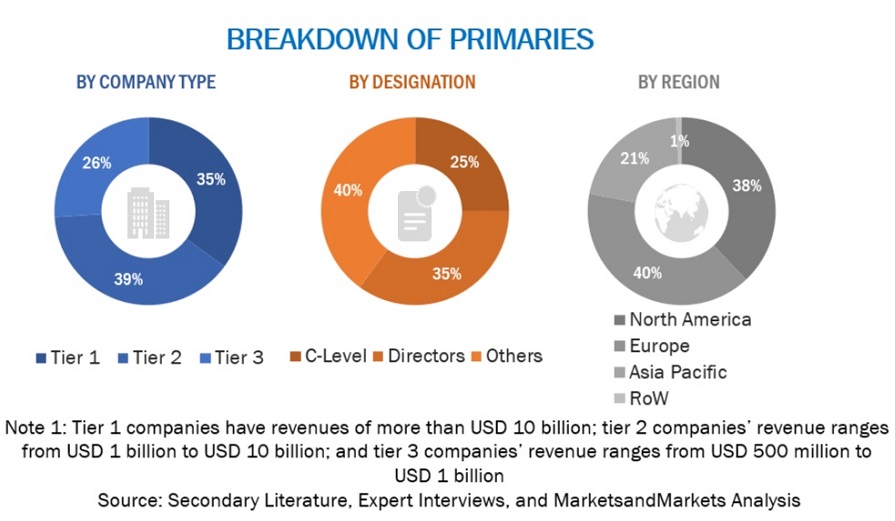
In the primary research process, various sources from the supply and demand sides were interviewed to obtain qualitative and quantitative information for the report. The primary sources from the supply side included Chief Executive Officers (CEOs), Chief Technology Officers (CTOs), Chief Operating Officers (COOs), Vice Presidents (VPs), Managing Directors (MDs), technology and innovation directors, and related key executives from various key companies and organizations operating in the VXLAN market.
Primary interviews were conducted to gather insights, such as market statistics, data on revenue collected from software and services, market breakups, market size estimations, market forecasts, and data triangulation. Stakeholders from the demand side, such as Chief Information Officers (CIOs), Chief Finance Officers (CFOs), Chief Strategy Officers (CSOs), and the installation team of end users who use smart learning, were interviewed to understand buyers’ perspectives on suppliers, products, service providers, and their current usage of VXLAN hardware, solutions and services, which is expected to affect the overall VXLAN market growth.
To know about the assumptions considered for the study, download the pdf brochure
Market Size Estimation
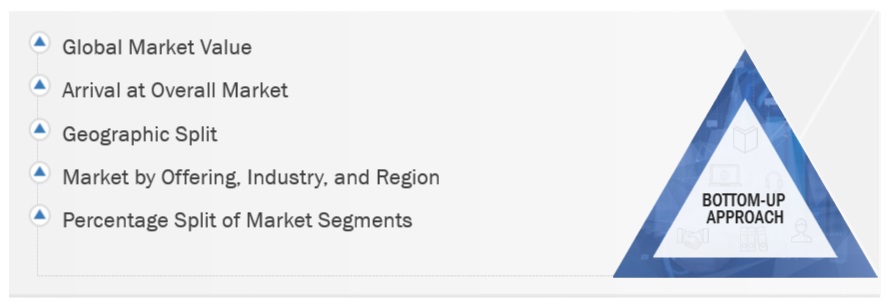
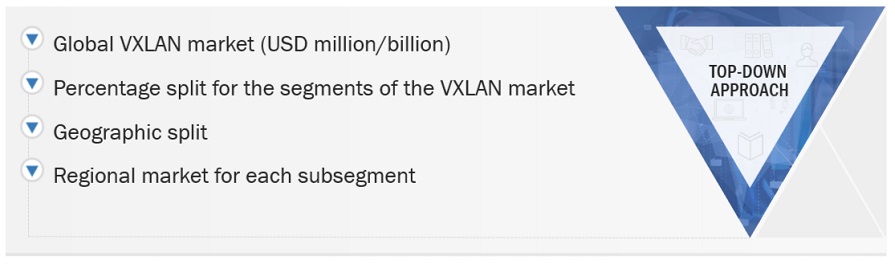
In the market engineering process, the top-down and bottom-up approaches were used along with multiple data triangulation methods to estimate and validate the size of the VXLAN market, as well as other dependent submarkets. The research methodology used to estimate the market sizes includes the following:
- Initially, MarketsandMarkets focuses on top-line investments and spending in the ecosystems. Further, significant developments in the critical market area have been considered.
- Tracking the recent and upcoming developments in the VXLAN market that include investments, R&D activities, product launches, collaborations, mergers and acquisitions, and partnerships, as well as forecasting the market size based on these developments and other critical parameters.
- Conduct multiple discussions with key opinion leaders to learn about the diverse types of authentications and brand protection offerings used and the applications for which they are used to analyze the breakdown of the scope of work carried out by major companies.
- Segmenting the market based on technology types concerning applications wherein the types are to be used and deriving the size of the global application market.
- Segmenting the overall market into various market segments
- Validating the estimates at every level through discussions with key opinion leaders, such as chief executives (CXOs), directors, and operation managers, and finally with the domain experts at MarketsandMarkets
Market Size Estimation Methodology-Bottom-up approach
To know about the assumptions considered for the study, Request for Free Sample Report
Market Size Estimation Methodology-top-down approach
Data Triangulation
After arriving at the overall market size from the above estimation process, the VXLAN market has been split into several segments and sub-segments. To complete the overall market engineering process and arrive at the exact statistics for all segments and sub-segments, data triangulation and market breakdown procedures have been used, wherever applicable. The data has been triangulated by studying various factors and trends from both the demand and supply sides.
The VXLAN market size has been validated using top-down and bottom-up approaches.
Market Definition
VXLAN stands for Virtual eXtensible Local Area Network (VXLAN). VXLAN (Virtual Extensible LAN) is a network virtualization technology designed to address the scalability issues associated with traditional VLANs in large cloud and data center environments. By using MAC-in-UDP encapsulation, VXLAN enables the creation of a Layer 2 overlay network on top of a Layer 3 infrastructure. This allows for the extension of a Layer 2 network across multiple physical locations, making it possible to interconnect and manage large numbers of virtual machines across distributed data centers. VXLAN increases network flexibility and scalability by supporting up to 16 million logical networks, compared to the 4,096 limit of VLANs, and facilitates efficient traffic isolation and segmentation in multitenant environments.
Stakeholders
- Network Server Providers
- Technology Vendors
- Mobile Network Operators (MNOs)
- Independent Software Vendors (ISVs)
- System Integrators (SIs)
- Resellers
- Value-added Resellers (VARs)
- Managed Service Providers (MSPs)
- Compliance Regulatory Authorities
- Government Authorities
- Investment Firms
- VXLAN Alliances/Groups
- Original Design Manufacturers (ODMs)
- Original Equipment Manufacturers (OEMs)
- Enterprises/Businesses
Report Objectives
- To determine and forecast the global VXLAN market by offering (hardware and software, and services), verticals, applications, and region from 2024 to 2029, and analyze the various macroeconomic and microeconomic factors affecting market growth.
- To forecast the size of the market segments concerning five central regions: North America, Europe, Asia Pacific (APAC), Middle East & Africa (MEA), and Latin America.
- To provide detailed information about the major factors (drivers, restraints, opportunities, and challenges) influencing the growth of the VXLAN market.
- Analyze each submarket concerning individual growth trends, prospects, and contributions to the overall VXLAN market.
- To analyze the opportunities in the market for stakeholders by identifying the high-growth segments of the VXLAN market.
- To profile the key market players; provide a comparative analysis based on business overviews, regional presence, product offerings, business strategies, and key financials; and illustrate the market’s competitive landscape.
- Track and analyze competitive developments in the market, such as mergers and acquisitions, product developments, partnerships and collaborations, and Research and Development (R&D) activities.
Available Customizations
With the given market data, MarketsandMarkets offers customizations per the company’s specific needs. The following customization options are available for the report:
Geographic Analysis
- Further break-up of the Asia Pacific market into countries contributing 75% to the regional market size
- Further break-up of the North American market into countries contributing 75% to the regional market size
- Further break-up of the Latin American market into countries contributing 75% to the regional market size
- Further break-up of the Middle East African market into countries contributing 75% to the regional market size
- Further break-up of the European market into countries contributing 75% to the regional market size
Company Information
- Detailed analysis and profiling of additional market players (up to 5)
Get the Full Virtual Extensible LAN (VXLAN) Market Report
Full forecast, segment splits, and company analysis for all Virtual Extensible LAN (VXLAN) Market.
- Canada Virtual Extensible LAN (VXLAN) Market
- US Virtual Extensible LAN (VXLAN) Market
- Germany Virtual Extensible LAN (VXLAN) Market
- China Virtual Extensible LAN (VXLAN) Market
- Brazil Virtual Extensible LAN (VXLAN) Market
- Nordic Countries Virtual Extensible LAN (VXLAN) Market
- Rest Of Europe Virtual Extensible LAN (VXLAN) Market
- UK Virtual Extensible LAN (VXLAN) Market
- Japan Virtual Extensible LAN (VXLAN) Market
- Rest Of Asia Pacific Virtual Extensible LAN (VXLAN) Market
- Mexico Virtual Extensible LAN (VXLAN) Market
- Rest Of Latin America Virtual Extensible LAN (VXLAN) Market
- Ksa Virtual Extensible LAN (VXLAN) Market
- South Africa Virtual Extensible LAN (VXLAN) Market
- UAE Virtual Extensible LAN (VXLAN) Market
Need a Tailored Report?
Customize this report to your needs
Get 10% FREE Customization
Customize This Report
