Graphite Market by Type (Natural, Synthetic), Application (Electrode, Refractory, Foundry, Battery, Friction Products, Lubricants), Purity (High, Low), End-use Industry (Metallurgy, Automotive, Electronics), and Region - Global Forecast to 2031

icon1
USD 37.11 BN
MARKET SIZE, 2031
icon2
CAGR 11.6%
(2026-2031)
icon3
290
REPORT PAGES
icon4
200
MARKET TABLES

OVERVIEW

graphite-market Overview

Source: Secondary Research, Interviews with Experts, MarketsandMarkets Analysis

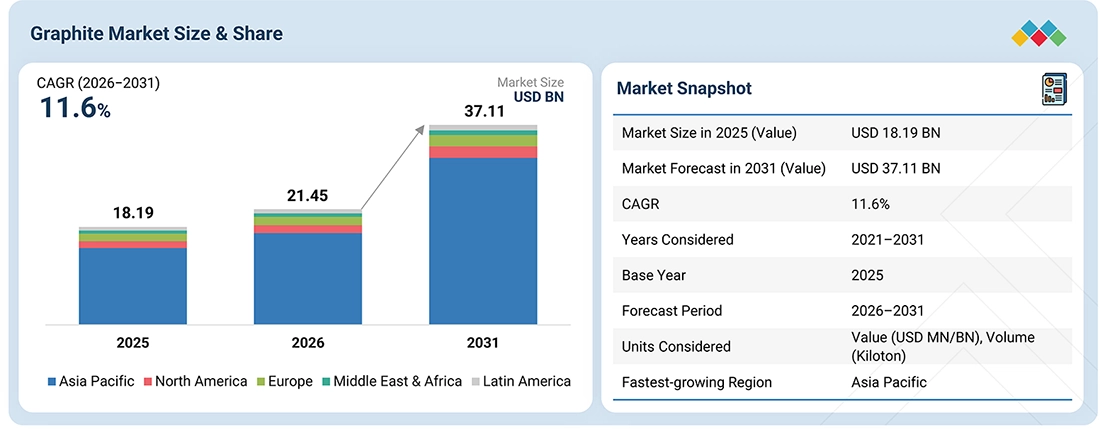
The graphite market is projected to grow from USD 21.45 billion in 2026 to USD 37.11 billion by 2031, at a CAGR of 11.6% during the forecast period. Factors that drive the market include the growing demand for lithium-ion batteries and electric vehicles, increased use of energy storage systems, rising application of graphite electrodes in steel manufacturing, and high demand for synthetic graphite in electronics and other industries.

KEY TAKEAWAYS

  • By Region
    By region, Asia Pacific is projected to grow at a CAGR of 12.7%, in terms of value, during the forecast period.
  • By Type
    By type, the synthetic graphite segment accounted for a 86.3% share, in terms of value, in 2025.
  • By Purity
    By purity, the high purity segment captured the largest share of 73.1%, in terms of volume, in 2025.
  • By Application
    By application, the battery segment is expected to register a CAGR of 14.0% between 2026 and 2031.
  • Competitive Landscape - Key Players
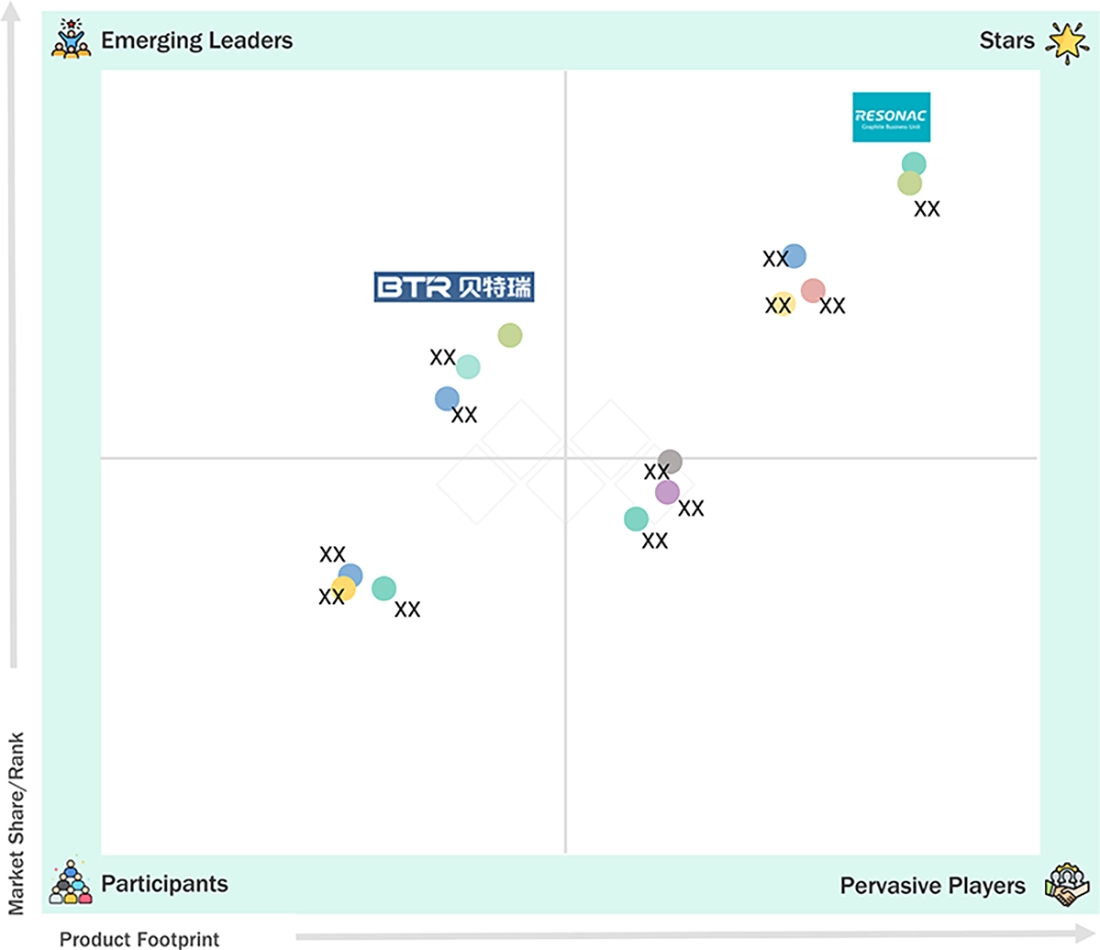
    Shanshan Co (China), SGL Carbon (Germany), Resonac Holdings Corporation (Japan), GrafTech International (US), and Imerys (France) were identified as star players in the graphite market, given their strong market share and product footprint.
  • Competitive Landscape - Startups/SMEs
    Nippon Carbon Co., Ltd. (Japan), POCO (US), and HEG Limited (India), among others, have distinguished themselves as startups and SMEs by securing strong footholds in specialized niche areas, underscoring their potential as emerging market leaders.

The growth opportunities in the graphite market are driven by the increasing investments in lithium-ion battery production, rising use of electric vehicles, growing need for energy storage solutions, and diversified graphite sourcing networks. The innovations that exist and are expected to emerge in the coming years include advanced synthetic graphite technologies, graphite recovery techniques for used lithium-ion batteries, and graphite sourced from waste and low-carbon sources.

TRENDS & DISRUPTIONS IMPACTING CUSTOMERS' CUSTOMERS

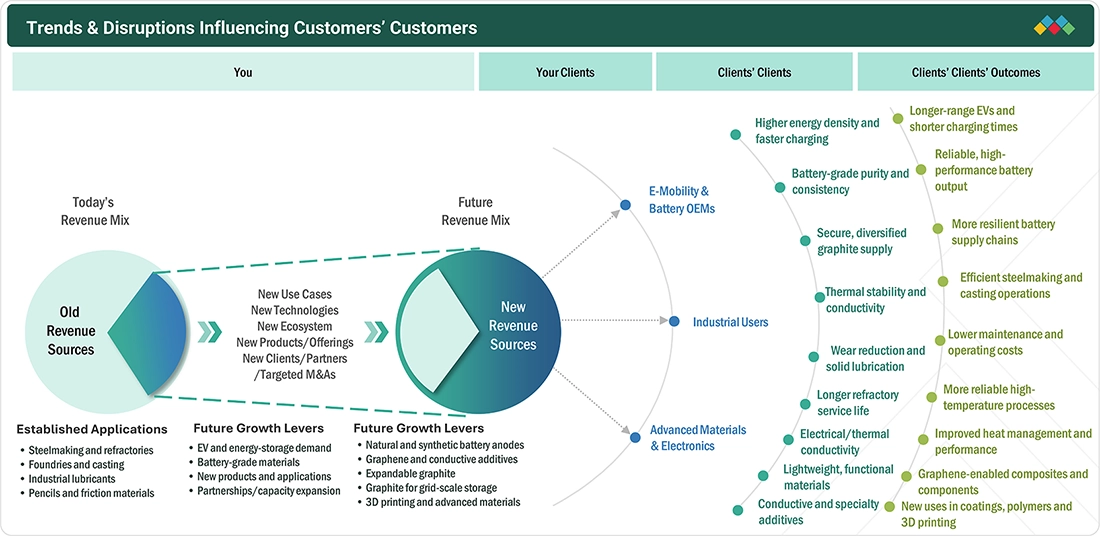
The impact on graphite manufacturers’ revenues stems from changing customer trends and market disruptions. Battery manufacturers, electric vehicle producers, steelmakers, and energy-storage companies are key customers of graphite manufacturers. Shifts in battery technologies, electrification, energy-storage requirements, and industrial applications will influence end-user demand, which will affect demand across customer industries and ultimately shape the revenue growth opportunities for graphite manufacturers.

graphite-market Disruptions

Source: Secondary Research, Interviews with Experts, MarketsandMarkets Analysis

MARKET DYNAMICS

Drivers
Impact
Level
  • Growing electric vehicle sales
  • Booming steel and aluminum industries
RESTRAINTS
Impact
Level
  • Supply chain volatility and resource constraints
  • Environmental concerns
OPPORTUNITIES
Impact
Level
  • Expansion of renewable energy storage technologies
  • Emergence of graphene-based applications
CHALLENGES
Impact
Level
  • Rapid adoption of silicon-based anodes in battery technology
  • Potential substitution of graphite by carbon nanomaterials

Source: Secondary Research, Interviews with Experts, MarketsandMarkets Analysis

Driver: Growing electric vehicle sales

The growing sales of electric vehicles (EVs) have resulted in increased demand for graphite due to its widespread application in lithium-ion battery anodes. As automobile companies boost EV manufacturing to satisfy consumer demands and reduce emissions, the graphite required for battery production has seen increasing demand. The importance of graphite cannot be overlooked, as the material is vital in improving the performance of batteries in energy storage and charging. According to the IEA, electric vehicle sales reached above 17 million units in 2024, registering an increase of more than 25% from 2023. This trend will result in the expansion of battery producers' capacities and consequently higher consumption of graphite. As such, the adoption of electric vehicles is likely to contribute to graphite market growth in the forecast period.

Restraint: Supply chain volatility and resource constraints

The graphite market is subject to a number of risks associated with the volatility of its supply chain and the shortage of processed graphite. Due to the location of major deposits of natural graphite and the processing of battery-grade graphite in China, the industry becomes more exposed to geopolitical risks, potential export bans, and trade policy changes. Such factors might cause supply instability, price fluctuations, and higher costs of graphite procurement for producers. Moreover, increasing mining and establishing processing plants entail heavy expenditures of money and time. Lack of diversity in supply sources might pose problems for battery producers and other end users in terms of acquiring graphite. As a result, risks in the supply chain and constraints in resources might impede the development of the market during the forecast period.

Opportunity: Expansion of renewable energy storage technologies

Graphite will benefit from rapid advances in renewable energy storage technology in the coming years. The growing use of solar energy and wind energy is providing a substantial boost to the market in terms of development. Battery energy storage technology will become increasingly important in order to manage the fluctuations in renewable energy electricity generation, stabilize the grid, and provide for peak electricity demand. Graphite is one of the key components of the anode of lithium-ion batteries, which are used for stationary energy storage. According to the International Energy Agency (IEA), total battery storage additions for 2025 stood at 108 GW, marking a 40% rise when compared to 2024. Such developments will encourage battery makers to produce more batteries and thus require larger amounts of graphite.

Challenge: Rapid adoption of silicon-based anodes in battery technology

The growing emergence of silicon anodes poses an obstacle for the graphite market as battery companies look for materials that provide high energy density and better battery performance. Silicon provides a much higher theoretical lithium storage capacity compared to graphite and therefore is considered the preferable material for next-generation lithium-ion batteries. Investment in silicon anode technology can help decrease the use of graphite in batteries, thereby impacting future demand trends. Nevertheless, high-volume expansion of silicon during charge and discharge processes, together with questions about its stability and durability, prevents the widespread application of silicon in batteries. Therefore, companies have been increasingly considering the usage of silicon graphite composites.

GRAPHITE MARKET SIZE, SHARE & FORECAST 2024-2030: COMMERCIAL USE CASES ACROSS INDUSTRIES

COMPANY USE CASE DESCRIPTION BENEFITS
company logo
Shanshan supplies synthetic graphite, natural graphite, and graphite composite materials used as anode materials in lithium-ion batteries for electric vehicles, consumer electronics, and battery energy storage systems. Supports high energy and power density in lithium-ion batteries, enabling their use in electric vehicles and energy storage systems | Supports battery performance across consumer electronics and other applications requiring reliable energy storage
company logo
SGL Carbon supplies specialty graphite materials, including battery felts, bipolar plates, and expanded graphite products for redox flow batteries, other electrochemical energy storage systems, and battery thermal management applications. Facilitates efficient charging and discharging in energy storage systems | Supports electrical conductivity, corrosion protection, and heat dissipation | Helps improve battery system functionality and thermal management
company logo
Resonac supplies graphite electrodes for electric arc furnaces used in steel production and recycling, as well as artificial graphite anode materials for lithium-ion batteries. Its graphite products also serve non-ferrous metal smelting applications Electrical conductivity and heat resistance required to melt scrap steel efficiently in electric arc furnaces | Supports lithium-ion storage capacity, discharge performance, and battery operation at low temperatures
company logo
GrafTech manufactures UCAR graphite electrodes for electric arc furnace steelmaking, offering multiple grades and sizes for different furnace operating conditions, including high-power and ultra-high-power applications. Conducts high electrical currents | Withstands extreme furnace temperatures, enabling steelmakers to melt scrap metal and produce new steel | GrafTech's electrode solutions and technical services help furnace operators improve productivity, manage electrode consumption, and reduce operating costs
company logo
Imerys supplies natural and synthetic graphite, graphite-based active materials, and conductive carbon additives for lithium-ion batteries. Its product portfolio supports battery anodes and electrode formulations used in electric vehicles and other energy storage applications. Helps enhance battery conductivity, charging performance, and energy storage characteristics | Selected graphite grades improve reversible capacity and low-temperature performance | Conductive additives support electrode stability and help optimize battery performance

Logos and trademarks shown above are the property of their respective owners. Their use here is for informational and illustrative purposes only.

MARKET ECOSYSTEM

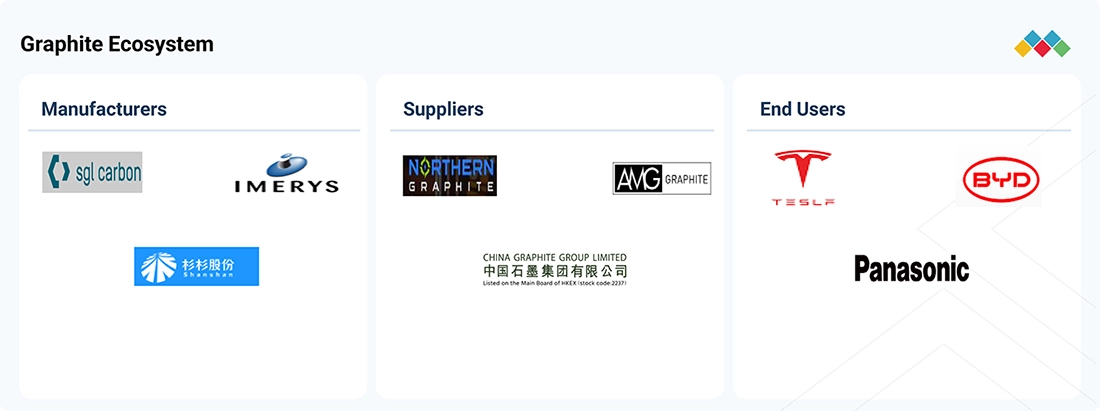
The graphite ecosystem consists of a robust network of manufacturers, raw material suppliers, distributors, and end-use industries. The ecosystem consists of raw material suppliers (e.g., Northern Graphite, Syrah Resources Limited), producers (e.g., SGL Carbon, Imerys), and end users (e.g., Tesla, BYD). Together, this interconnected ecosystem fosters product innovation, ensures stable supply chains, and supports strong market growth.

graphite-market Ecosystem

Logos and trademarks shown above are the property of their respective owners. Their use here is for informational and illustrative purposes only.

MARKET SEGMENTS

graphite-market Segments

Source: Secondary Research, Interviews with Experts, MarketsandMarkets Analysis

Graphite Market, by Type

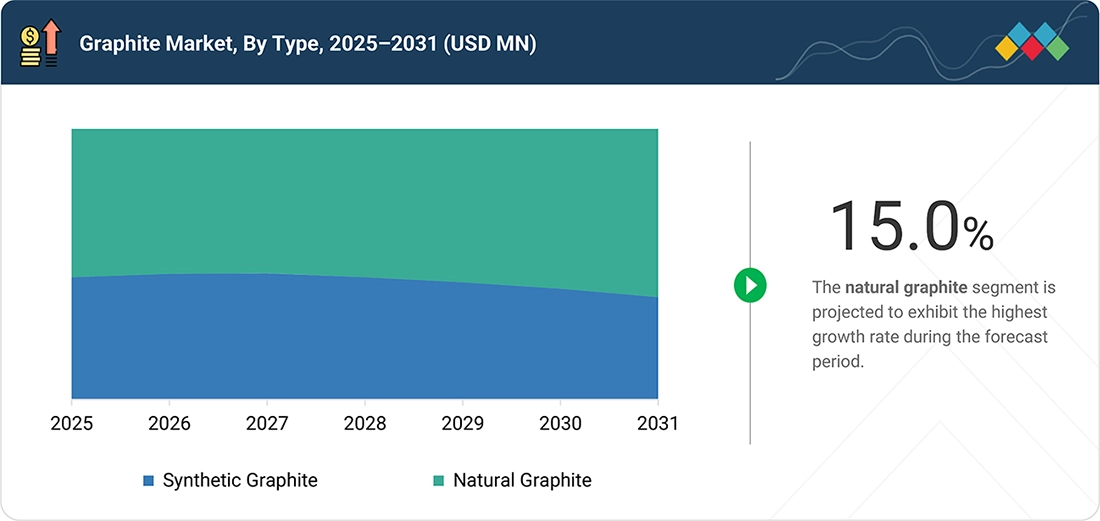
According to the type of graphite, it is anticipated that natural graphite will show the highest growth rate during the forecast period. There are three types of natural graphite, namely flake, amorphous, and vein graphite, all of which have their own special attributes and uses. Flake graphite is used in making batteries, refractories, lubricants, and expandable graphite materials. On the other hand, amorphous graphite is used in foundries, steel, and friction products. Vein graphite has a high carbon content and is used for special purposes. There are four types of synthetic graphite, namely graphite electrodes, carbon fiber, graphite blocks, and graphite powder

Graphite Market, by Purity

On the basis of purity, high purity is likely to witness the highest growth in the coming years. The use of high-purity graphite is associated with applications that have strict requirements for the purity of the material being used and include lithium-ion batteries, electronics, and various industrial applications. Obtaining high purity often requires some additional processing of the material to eliminate ash, metals, and other contaminants. Low-purity graphite is typically used in applications where the purity requirements are less stringent and include such industrial uses as foundry, refractories, lubricants, and other applications.

Graphite Market, by Application

According to the application, it is expected that the battery will be the fastest-growing segment during the forecast period. The main application of graphite electrodes is in electric arc furnaces due to its excellent electrical conductivity and heat resistance properties. In the refractory and foundry industry, graphite is mostly used in crucibles, furnace linings, and molds for handling molten metals. Graphite has an application in batteries, where it acts as the anode in lithium-ion batteries used in electric vehicles and portable electronic gadgets. One of the applications of graphite is as a brake lining and in other friction materials, as well as lubricants that minimize friction and wear.

REGION

Asia Pacific to record highest CAGR in graphite market during forecast period

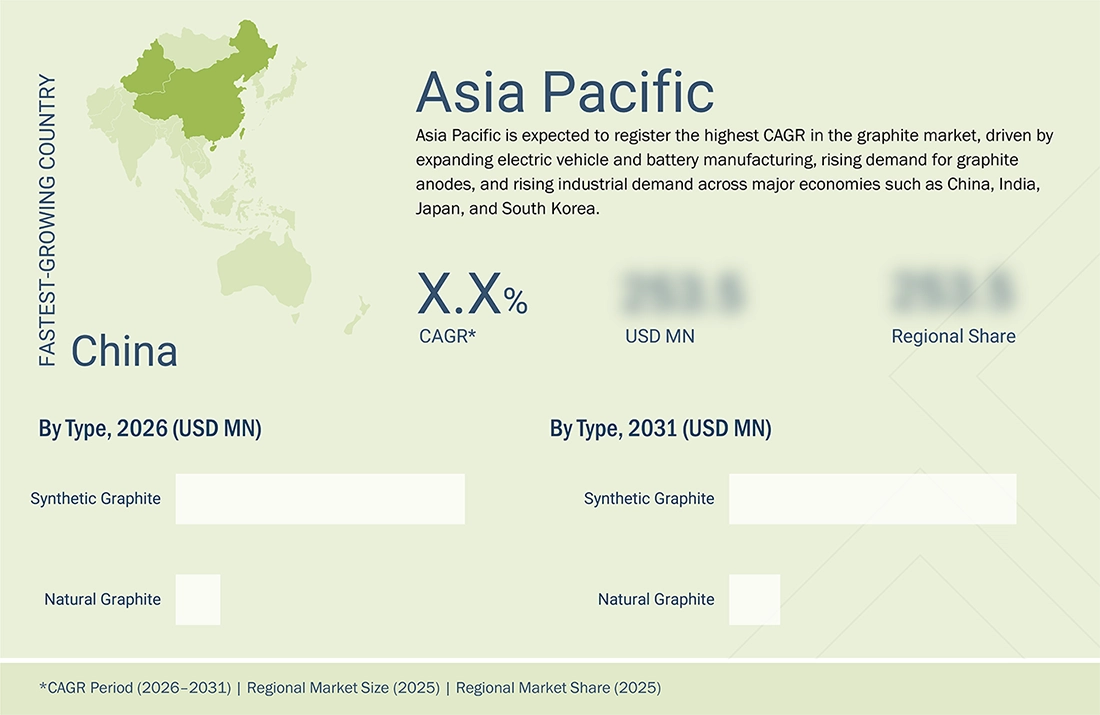
In the forecast period, the CAGR for the graphite market is predicted to be highest in Asia Pacific. The fast-growing pace of electric vehicle manufacturing, investments in lithium-ion battery manufacturing, and renewable energy storage solutions can be attributed to the development of electric vehicle manufacturing in countries such as China, India, Japan, and South Korea. The highly developed battery manufacturing in the region, especially in China, causes high demand for natural and synthetic graphite for anodes in batteries. In addition, high growth rates in the industrial sector, especially in terms of increased steel production and the use of graphite electrodes in the electric arc furnace process, drive demand. Furthermore, the growing development of the electronics industry and the high demand for high-quality graphite products in thermal management and other special applications can be considered another factor of growth in the market.

graphite-market Region

GRAPHITE MARKET SIZE, SHARE & FORECAST 2024-2030: COMPANY EVALUATION MATRIX

Resonac Holdings Corporation (Star) maintains a strong position in the graphite market through its expertise in synthetic graphite and graphite electrodes. Its products support efficient steel production, scrap metal recycling, and industrial applications. BTR New Material Group Co., Ltd. (Emerging Leader) is expanding its presence through natural and artificial graphite anode materials for lithium-ion batteries. Its solutions support improved battery performance and cater to growing demand from electric vehicles and energy storage systems.

graphite-market Evaluation Metrics

Source: Secondary Research, Interviews with Experts, MarketsandMarkets Analysis

KEY MARKET PLAYERS

MARKET SCOPE

REPORT METRIC DETAILS
Market Size in 2025 (Value) USD 18.19 Billion
Market Size in 2026 (Value) USD 21.45 Billion
Market Forecast in 2031 (Value) USD 37.11 Billion
Growth Rate CAGR of 11.6% from 2026-2031
Years Considered 2021-2031
Base Year 2025
Forecast Period 2026-2031
Units Considered Value (USD Million/Billion) and Volume (Kiloton)
Report Coverage Revenue forecast, company ranking, competitive landscape, growth factors, and trends
Segments Covered
  • By Type:
    • Natural Graphite
    • Synthetic Graphite
  • By Application:
    • Electrode
    • Refractory
    • Foundry
    • Battery
    • Friction Product
    • Lubricant
    • Other Applications
  • By Purity:
    • High Purity
    • Low Purity
Regions Covered North America, Asia Pacific, Europe, the Middle East & Africa, and South America

WHAT IS IN IT FOR YOU: GRAPHITE MARKET SIZE, SHARE & FORECAST 2024-2030 REPORT CONTENT GUIDE

graphite-market Content Guide

DELIVERED CUSTOMIZATIONS

We have successfully delivered the following deep-dive customizations:

CLIENT REQUEST CUSTOMIZATION DELIVERED VALUE ADDS
Leading Graphite Manufacturer / Anode Material Producer Competitive profiling of graphite manufacturers based on product portfolio, production capabilities, geographical presence, and strategic developments; benchmarking of natural graphite (flake, amorphous, and vein), synthetic graphite, purity grades, and application-specific products; analysis of product differentiation and technological capabilities Identify high-growth graphite segments; assess competitive positioning and market opportunities; identify product portfolio gaps and potential expansion areas.
Battery Manufacturer / Anode Material Supplier Assessment of graphite requirements for lithium-ion battery anodes; comparison of natural and synthetic graphite based on purity, particle size, electrochemical performance, and cost; evaluation of silicon-graphite blends, supplier capabilities, and battery-grade graphite availability Identify suitable graphite grades and alternative suppliers; evaluate cost-performance trade-offs; assess supply chain risks and opportunities to improve battery performance.
Steel Manufacturer / Electric Arc Furnace Operator Analysis of graphite electrode requirements across steelmaking applications; benchmarking of electrode grades, dimensions, electrical conductivity, performance, and consumption; evaluation of supplier capabilities, pricing trends, and procurement requirements Identify reliable graphite electrode suppliers; assess opportunities to optimize electrode consumption and procurement costs; evaluate supply risks and operational performance.
Refractory, Foundry & Industrial Product Manufacturer Assessment of graphite requirements for refractory materials, crucibles, foundry coatings, friction products, and lubricants; evaluation of graphite purity, carbon content, particle size, thermal stability, and lubrication properties; benchmarking of suitable grades and suppliers. Identify application-specific graphite grades; improve material performance and product durability; evaluate cost-effective sourcing alternatives and opportunities for product development.
Graphite Miner / Raw Material Supplier Global and regional benchmarking of natural graphite resources, mining and processing capabilities, flake grades, synthetic graphite feedstocks, and purification technologies; analysis of raw material pricing, supply chains, processing capacity, and downstream demand trends. Identify potential customers and downstream growth opportunities; evaluate supply-demand gaps and sourcing risks; support long-term supply agreements and expansion into higher-value graphite products.
Battery Energy Storage Developer / Government Critical Minerals Agency Analysis of graphite demand arising from electric vehicle batteries and stationary energy storage systems; assessment of regional battery manufacturing investments, graphite supply concentration, domestic processing capabilities, recycling potential, and critical mineral supply chain developments. Identify emerging regional demand opportunities; assess supply chain diversification and domestic manufacturing opportunities; support strategic sourcing, investment decisions, and long-term supply security.

RECENT DEVELOPMENTS

  • July 2024 : AMG subsidiary Graphit Kropfmühl and BASF signed a groundbreaking agreement on product carbon footprint reduction. Under the agreement, BASF will provide renewable energy certificates for Graphit Kropfmühl's production site based in Hauzenberg, Germany. BASF will use the reduced PCF graphite to manufacture Neopor with a reduced product carbon footprint.
  • June 2024 : Mineral Commodities signed an agreement with Gold Terrace Pty Ltd, its joint venture partner in the Munglinup Graphite Project, to settle a dispute and acquire the remaining 49% interest in Munglinup. The company holds an existing 51% interest in Munglinup. Upon acquiring the remaining 49% interest, it will become the 100% owner of Munglinup
  • March 2023 : SGL Carbon signed a cooperation agreement to Supply Key Graphite Components for Wolfspeed Silicon Carbide Production Facilities. It is a supply agreement. SGL Carbon will be supplying graphite components to the global leader in Silicon Carbide technology, Wolfspeed, for its US production facilities

Table of Contents

checkmarkExclusive indicates content/data unique to MarketsandMarkets and not available with any competitors.

TITLE
PAGE NO
1
INTRODUCTION


15
2
EXECUTIVE SUMMARY


3
PREMIUM INSIGHTS


4
MARKET OVERVIEW
Provides a snapshot of current market scenario, value chain context, and factors impacting competitive intensity.


4.1
INTRODUCTION


4.2
MARKET DYNAMICS


4.2.1
DRIVERS


4.2.2
RESTRAINTS


4.2.3
OPPORTUNITIES


4.2.4
CHALLENGES


4.3
UNMET NEEDS AND WHITE SPACES


4.4
INTERCONNECTED MARKETS AND CROSS-SECTOR OPPORTUNITIES


4.5
STRATEGIC MOVES BY TIER-1/2/3 PLAYERS


5
INDUSTRY TRENDS
Covers the key developments, trend analysis, and actionable insights to support strategic planning and positioning.


5.1
PORTER’S FIVE FORCES ANALYSIS


5.1.1
BARGAINING POWER OF SUPPLIERS


5.1.2
THREAT OF NEW ENTRANTS


5.1.3
THREAT OF SUBSTITUTES


5.1.4
BARGAINING POWER OF BUYERS


5.1.5
INTENSITY OF COMPETITIVE RIVALRY


5.2
GLOBAL MACROECONOMIC OUTLOOK


5.3
VALUE CHAIN ANALYSIS


5.4
ECOSYSTEM ANALYSIS


5.5
PRICING ANALYSIS


5.6
TRADE ANALYSIS


5.6.1
EXPORT SCENARIO


5.6.2
IMPORT SCENARIO


5.7
KEY CONFERENCES & EVENTS, 2026-2027


5.8
TRENDS/DISRUPTIONS IMPACTING CUSTOMER BUSINESS


5.9
INVESTMENT AND FUNDING SCENARIO


5.10
CASE STUDY ANALYSIS


5.11
IMPACT OF US TARIFFS – GRAPHITE MARKET


5.11.1
INTRODUCTION


5.11.2
KEY TARIFF RATES


5.11.3
PRICE IMPACT ANALYSIS


5.11.4
IMPACT ON COUNTRIES/REGIONS


5.11.5
IMPACT ON APPLICATIONS


6
TECHNOLOGICAL ADVANCEMENTS, AI-DRIVEN IMPACT, PATENTS, INNOVATIONS, AND FUTURE APPLICATIONS


6.1
KEY EMERGING TECHNOLOGIES


6.2
COMPLEMENTARY TECHNOLOGIES


6.3
TECHNOLOGY/PRODUCT ROADMAP


6.4
PATENT ANALYSIS


6.5
FUTURE APPLICATIONS


6.6
IMPACT OF GEN AI/AI ON GRAPHITE MARKET


6.6.1
TOP USE CASES AND MARKET POTENTIAL


6.6.2
BEST PRACTICES FOLLOWED BY MANUFACTURERS IN GRAPHITE MARKET


6.6.3
CASE STUDIES RELATED TO AI IMPLEMENTATION IN GRAPHITE MARKET


6.6.4
INTERCONNECTED ECOSYSTEM AND IMPACT ON MARKET PLAYERS


6.6.5
CLIENTS’ READINESS TO ADOPT AI-INTEGRATED GRAPHITE


7
REGULATORY LANDSCAPE AND SUSTAINABILITY INITIATIVES


7.1
REGIONAL REGULATIONS AND COMPLIANCE


7.1.1
REGULATORY BODIES, GOVERNMENT AGENCIES, AND OTHER ORGANIZATIONS


7.1.2
INDUSTRY STANDARDS


7.2
SUSTAINABILITY INITIATIVES


8
CUSTOMER LANDSCAPE AND BUYER BEHAVIOR


8.1
DECISION-MAKING PROCESS


8.2
KEY STAKEHOLDERS INVOLVED IN BUYING PROCESS AND THEIR EVALUATION CRITERIA


8.2.1
KEY STAKEHOLDERS IN BUYING PROCESS


8.2.2
BUYING CRITERIA


8.3
ADOPTION BARRIERS AND INTERNAL CHALLENGES


8.4
UNMET NEEDS OF VARIOUS APPLICATIONS


8.5
MARKET PROFITABILITY


9
END-USE INDUSTRIES OF GRAPHITE


1.1
INTRODUCTION


1.2
METALLURGY


1.3
AUTOMOTIVE


1.4
ELECTRONICS


1.5
OTHER END-USE INDUSTRIES


10
GLOBAL GRAPHITE MARKET, BY TYPE
Market Size, Volume & Forecast – USD Million


10.1
INTRODUCTION


10.2
NATURAL GRAPHITE


10.2.1
FLAKE


10.2.2
AMORPHOUS


10.2.3
VEIN


10.3
SYNTHETIC GRAPHITE


10.3.1
GRAPHITE ELECTRODE


10.3.2
CARBON FIBER


10.3.3
GRAPHITE BLOCK


10.3.4
GRAPHITE POWDER


10.4
OTHER TYPES


11
GLOBAL GRAPHITE MARKET, BY PURITY
Market Size, Volume & Forecast – USD Million


11.1
INTRODUCTION


1.6
HIGH PURITY


1.7
LOW PURITY


12
GLOBAL GRAPHITE MARKET, BY APPLICATION
Market Size, Volume & Forecast – USD Million


1.8
INTRODUCTION


1.9
ELECTRODE


1.10
REFRACTORY


1.11
FOUNDRY


1.12
BATTERY


1.13
FRICTION PRODUCT


1.14
LUBRICANT


1.15
OTHER APPLICATIONS


13
GLOBAL GRAPHITE MARKET, BY REGION
Market Size, Volume & Forecast – USD Million


11.1
INTRODUCTION


11.2
NORTH AMERICA


11.2.1
US


11.2.2
CANADA


11.2.3
MEXICO


11.3
EUROPE


11.3.1
UK


11.3.2
GERMANY


11.3.3
ITALY


11.3.4
FRANCE


11.3.5
SPAIN


11.3.6
REST OF EUROPE


11.4
ASIA PACIFIC


11.4.1
CHINA


11.4.2
JAPAN


11.4.3
INDIA


11.4.4
AUSTRALIA & NEW ZEALAND


11.4.5
SOUTH KOREA


11.4.6
REST OF ASIA PACIFIC


11.5
MIDDLE EAST & AFRICA


11.5.1
GCC


11.5.1.1
UAE


11.5.1.2
SAUDI ARABIA


11.5.1.3
REST OF GCC


11.5.2
SOUTAFRICA


11.5.3
REST OF MIDDLE EAST & AFRICA


11.6
SOUTH AMERICA


11.6.1
BRAZIL


11.6.2
ARGENTINA


11.6.3
CHILE


11.6.4
REST OF SOUTH AMERICA


14
COMPETITIVE LANDSCAPE


11.7
OVERVIEW


11.8
KEY PLAYER COMPETITIVE STRATEGIES/RIGHT TO WIN, 2023–2026


11.9
REVENUE ANALYSIS, 2022–2025


11.10
MARKET SHARE ANALYSIS,


11.11
BRAND COMPARISON


11.12
COMPANY EVALUATION MATRIX: KEY PLAYERS,


11.12.1
STARS


11.12.2
EMERGING LEADERS


11.12.3
PERVASIVE PLAYERS


11.12.4
PARTICIPANTS


11.12.5
COMPANY FOOTPRINT: KEY PLAYERS,


11.12.5.1
COMPANY FOOTPRINT


11.12.5.2
REGION FOOTPRINT


11.12.5.3
TYPE FOOTPRINT


11.12.5.4
PURITY FOOTPRINT


11.12.5.5
APPLICATION FOOTPRINT


11.13
COMPANY EVALUATION MATRIX: STARTUPS/SMES,


11.13.1
PROGRESSIVE COMPANIES


11.13.2
RESPONSIVE COMPANIES


11.13.3
DYNAMIC COMPANIES


11.13.4
STARTING BLOCKS


11.13.5
COMPETITIVE BENCHMARKING: STARTUPS/SMES,


11.13.5.1
DETAILED LIST OF KEY STARTUPS/SMES


11.13.5.2
COMPETITIVE BENCHMARKING OF KEY STARTUPS/SMES


11.14
COMPANY VALUATION AND FINANCIAL METRICS


11.15
COMPETITIVE SCENARIO


11.15.1
PRODUCT LAUNCHES


11.15.2
DEALS


11.15.3
EXPANSIONS


15
COMPANY PROFILES


11.16
KEY PLAYERS


11.16.1
SHANSHAN CO


11.16.1.1
BUSINESS OVERVIEW


11.16.1.2
PRODUCTS/SOLUTIONS/SERVICES OFFERED


11.16.1.3
RECENT DEVELOPMENTS


11.16.1.4
MNM VIEW


11.16.1.4.1
KEY STRENGTHS/RIGHT TO WIN


11.16.1.4.2
STRATEGIC CHOICES


11.16.1.4.3
WEAKNESSES/COMPETITIVE THREATS


11.16.2
RESONAC HOLDINGS CORPORATION


11.16.3
SGL CARBON


11.16.4
GRAFTECH INTERNATIONAL


11.16.5
IMERYS


11.16.6
AMG


11.16.7
BTR NEW MATERIAL GROUP CO., LTD.


11.16.8
TOKAI CARBON CO., LTD.


11.16.9
ASBURY CARBONS


11.16.10
TOYO TANSO CO., LTD.


11.16.11
SYRAH RESOURCES LIMITED


11.16.12
GRAPHITE INDIA LIMITED


11.16.13
MERSEN PROPERTY


11.16.14
GRAFITBERGBAU KAISERSBERG GMBH


11.16.15
NACIONAL DE GRAFITE


11.16.16
MINERAL COMMODITIES LTD.


11.16.17
ECO GRAF


11.17
OTHER PLAYERS


11.17.1
NIPPON CARBON CO., LTD


11.17.2
POCO


11.17.3
HEG LIMITED


11.17.4
TIRUPATHI CARBONS & CHEMICALS PVT LTD


11.17.5
NOVONIX LIMITED


11.17.6
NORTHERN GRAPHITE


11.17.7
TALGA GROUP


11.17.8
HEBEI KUNTIAN NEW ENERGY CO. LTD.


11.17.9
ZENTEK LTD.


11.17.10
PINGDINGSHAN ORIENTAL CARBON CO., LTD


*NOTE: THE ABOVE IS A TENTATIVE LIST OF COMPANIES. WE WILL UPDATE THIS AS THE STUDY PROGRESSES


16
RESEARCH METHODOLOGY


11.18
RESEARCH DATA


11.18.1
SECONDARY DATA


11.18.1.1
LIST OF KEY SECONDARY SOURCES


11.18.1.2
KEY DATA FROM SECONDARY SOURCES


11.18.2
PRIMARY DATA


11.18.2.1
KEY DATA FROM PRIMARY SOURCES


11.18.2.2
LIST OF PRIMARY INTERVIEW PARTICIPANTS


11.18.2.3
BREAKDOWN OF PRIMARY INTERVIEWS


11.18.2.4
KEY INDUSTRY INSIGHTS


11.19
MARKET SIZE ESTIMATION


11.19.1
BOTTOM-UP APPROACH


11.19.2
TOP-DOWN APPROACH


11.19.3
MARKET SIZE CALCULATION FOR BASE NUMBER


11.20
MARKET FORECAST APPROACH


11.20.1
SUPPLY SIDE


11.20.2
DEMAND SIDE


11.21
DATA TRIANGULATION


11.22
FACTOR ANALYSIS


11.23
RESEARCH ASSUMPTIONS


11.24
RESEARCH LIMITATIONS


11.25
RISK ANALYSIS


17
APPENDIX


11.26
DISCUSSION GUIDE


11.27
KNOWLEDGESTORE: MARKETSANDMARKETS’ SUBSCRIPTION PORTAL


11.28
CUSTOMIZATION OPTIONS



11.29
RELATED REPORTS



11.30
AUTHOR DETAILS


Methodology

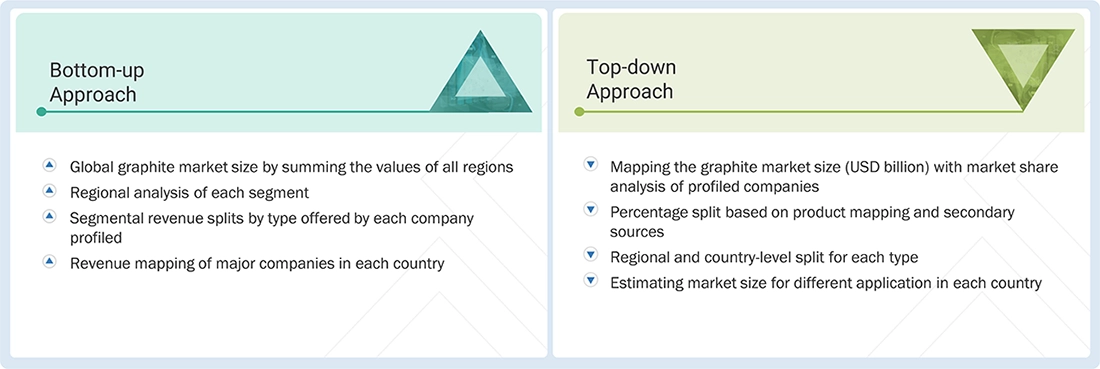
The estimation of the current size of the graphite market involved a four-step methodology. Initially, secondary research included all pertinent information about the market itself, as well as related and parent markets. These results, along with assumptions and metrics, were validated with primary research that involved experts from both the supply and demand sides of the graphite value chain. Total market size was determined through a top-down and bottom-up approach. Finally, the market sizes for various segments and subsegments were found using comprehensive market segmentation and data triangulation techniques.

Secondary Research

The research methodology followed in estimating the current graphite market size consisted of four significant activities. Extensive secondary research was conducted to provide information on the market, peer markets, and parent markets. These findings, assumptions, and metrics were validated through primary research undertaken with experts from the demand side of the graphite value chain. Both top-down and bottom-up approaches were followed for the estimation of the total market size. The complete market segmentation and data triangulation techniques were applied for the final estimation of various segments and subsegments.

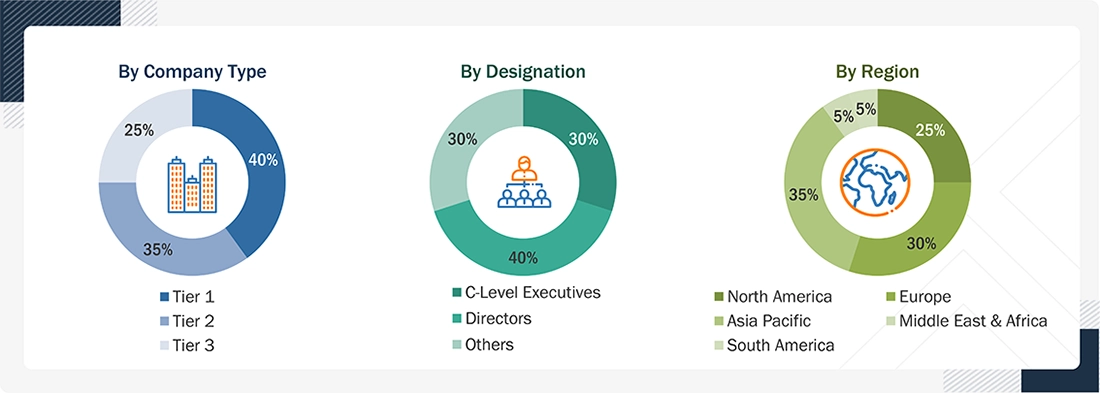
Primary Research

The graphite market comprises several stakeholders in the supply chain, such as graphite producers and Miners, graphite processing and refining companies, manufacturers, distributors and traders, government and regulatory bodies, and end users. The development of EVs,  metallurgy, electronics, textiles, and construction defines the demand side of this market. Interviews were conducted with various primary sources on both the supply and demand sides of the market to gather qualitative and quantitative data.

Graphite Market 
 Size, and Share

To know about the assumptions considered for the study, download the pdf brochure

Market Size Estimation

Top-down and bottom-up approaches were used to estimate and validate the size of the graphite market. These methods were used to determine the market size of various segments

The research methodology used for the market size estimation is as follows:

  • Extensive primary and secondary research was done to identify the key players.
  • The value chain and market size of the graphite market, in terms of value, were determined through primary and secondary research.
  • All percentage shares, splits, and breakdowns were collected through secondary sources and verified through primary sources.
  • All possible parameters that affect the market were covered in this research study and are viewed in extensive detail, verified through primary research, and analyzed to obtain the final quantitative and qualitative data.
  • This research includes the study of reports, reviews, and newsletters of top market players, along with extensive interviews for opinions from key leaders, such as CEOs, directors, and marketing executives.

Graphite Market Size: Bottom-Up & Top-Down Approach

Graphite Market Top Down and Bottom Up Approach

Data Triangulation

After estimating the overall market size using the above estimation, the market was split into various segments and subsegments. Data triangulation, market breakup techniques, and the market engineering process were used to reach the exact market analysis data for each segment and subsegment. Data triangulation and market breakdown procedures were used wherever applicable. The data was triangulated by studying various factors and trends from the demand and supply sides. The market size was also validated using the top-down and bottom-up approaches.

Market Definition

Graphite is a semimetal and possesses good electrical conductivity properties. It is a form of crystalline carbon, in which carbon atoms are densely arranged in parallel-stacked, planar honeycomb lattice sheets. The demand for graphite is directly dependent on the growth of its application industries, including electric vehicles, energy storage devices, refractories, foundry, batteries, friction products, and lubricants. Graphite is used across various end-use industries, such as aerospace & defense, steel, and automotive, since it is lightweight and has excellent strength. Graphite-based composites are used in the manufacturing of automotive parts, such as exterior body parts, hoods, bonnets, test plates, suspension struts, and chassis, among others. There has been a growing demand for graphite, particularly in battery technologies in electric vehicles

Key Stakeholders

  • Graphite Producers and Miners
  • Graphite Processing and Refining Companies
  • Electric Vehicle (EV) Manufacturers
  • Distributors and Traders
  • Research and Development Institutions
  • Regulatory Bodies
  • NGOs, Governments, Investment Banks, Venture Capitalists, and Private Equity Firms
  • Consumers and End Users

Report Objectives

  • To define, describe, and forecast the size of the global graphite market in terms of value and volume
  • To provide detailed information regarding the key factors, such as drivers, restraints, opportunities, and industry-specific challenges, influencing the market growth
  • To analyze and forecast the size of various segments (type, purity, and application) of the market based on five major regions—North America, Europe, Asia Pacific, Middle East & Africa, and South America—along with key countries in each region
  • To analyze recent developments and competitive strategies, such as expansions, new product developments, partnerships, and acquisitions, to draw the market's competitive landscape
  • To strategically profile the key players in the market and comprehensively analyze their core competencies

Available customizations:

With the given market data, MarketsandMarkets offers customizations according to client-specific needs.

The following customization options are available for the report:

  • Additional country-level analysis of the graphite market
  • Profiling of additional market players (up to 5)

Product Analysis

  • Product matrix, which gives a detailed comparison of the product portfolio of each company.


Personalize This Research

  • Triangulate with your Own Data
  • Get Data as per your Format and Definition
  • Gain a Deeper Dive on a Specific Application, Geography, Customer or Competitor
  • Any level of Personalization
Request A Free Customisation

Let Us Help You

  • What are the Known and Unknown Adjacencies Impacting the Graphite Market
  • What will your New Revenue Sources be?
  • Who will be your Top Customer; what will make them switch?
  • Defend your Market Share or Win Competitors
  • Get a Scorecard for Target Partners
Customized Workshop Request

Custom Market Research Services

We Will Customise The Research For You, In Case The Report Listed Above Does Not Meet With Your Requirements

Get 10% Free Customisation

TESTIMONIALS

Growth opportunities and latent adjacency in Graphite Market

THIS REPORT TELLS YOU

How big the Graphite market is, and who leads it.

GROWTHIQ TELLS YOU NEW

Where your company should play next, and who is taking your share.

Get your company's view of this market. Free snapshot.

DMCA.com Protection Status
popup img