Heat Pump Market

Heat Pump Market by Technology (Air-to-Air, Air-to-Water, Water Source, Geothermal, Hybrid, PVT), Refrigerant (R410A, R407C, R744, R290, R717), Type (Reversible, Non-reversible), Rated Capacity, End User, Application, and Region - Global Forecast to 2031




OVERVIEW
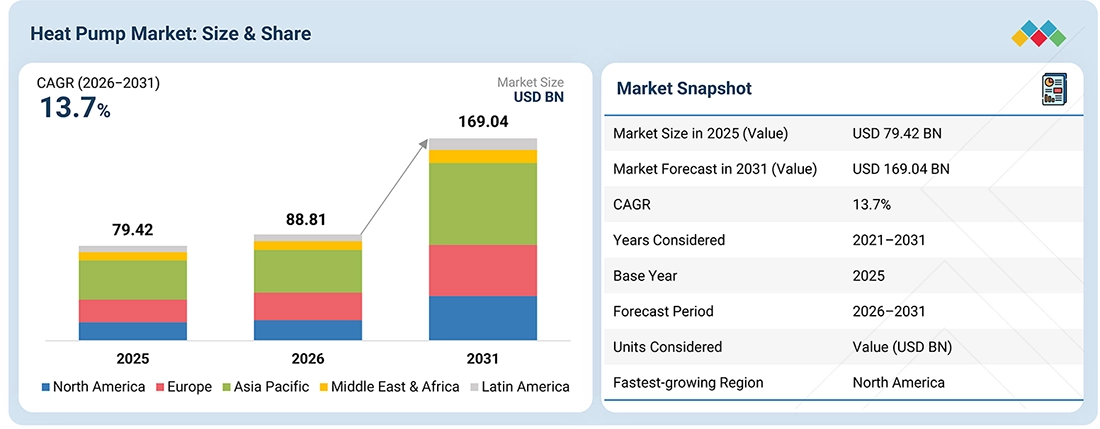
The global heat pump market is projected to grow from USD 88.81 billion in 2026 to USD 169.04 billion by 2031, at a CAGR of 13.7%, driven by the increasing adoption of energy-efficient heating and cooling solutions, growing efforts toward building decarbonization, and supportive government incentives for low-carbon heating technologies. Rising demand for air-source, ground-source, and water-source heat pumps across residential, commercial, and industrial applications is accelerating market growth. Furthermore, advancements in inverter-driven compressors, high-efficiency systems, smart controls, and high-temperature heat pump technologies are expanding the application scope of heat pumps, enabling lower energy consumption, reduced carbon emissions, and greater integration with renewable energy systems.
Source: Secondary Research, Interviews with Experts, MarketsandMarkets Analysis
Heat Pump Market Size and Forecast:
- Market Size (2025): USD 79.42 Billion
- Market Size (2026): USD 88.81 Billion
- Market Forecast (2031): USD 169.04 Billion
- Growth Rate: CAGR of 13.7% from 2026 to 2031
- Base Year: 2025
- Forecast Period: 2026–2031
Key growth drivers
- Increasing adoption of energy-efficient heating and cooling solutions
- Electrification of space and water heating is increasing demand for heat pumps targets
- Decarbonization policies and restrictions on fossil-fuel heating are accelerating adoption
- Heat pump water heaters are expanding the addressable market
- Low-GWP refrigerants are creating opportunities
KEY TAKEAWAYS
-
BY REGIONThe North America heat pump market is expected to register the highest CAGR of 17.0% during the forecast period.
-
BY TYPEBy type, the reversible heat pumps segment is expected to register the highest CAGR of 15.9% during the forecast period.
-
BY TECHNOLOGYBy technology, the ground-source (Geothermal) heat pumps segment is expected to register the highest CAGR of 15.9% during the forecast period.
-
BY REFRIGERANTBy refrigerant, R20 segment is expected to register the highest CAGR of 25.2% during the forecast period.
-
BY RATED CAPACITYBy rated capacity, the upto 10 kW segment is expected to register the highest CAGR during the forecast period.
-
BY APPLICATIONBy application, the heating and cooling segment is projected to register the highest CAGR during the forecast period.
-
BY END USERBy end user, the commercial segment is projected to register the highest CAGR during the forecast period.
-
COMPETITIVE LANDSCAPE - KEY PLAYERSDaikin Industries (Japan), Mitsubishi Electric (Japan), Carrier Global (US), Trane Technologies (Ireland), Bosch Thermotechnology (Germany), Panasonic Holdings (Japan), Johnson Controls (Ireland), and NIBE Industrier (Sweden) have been identified as the leading players in the global heat pump market. These companies are strengthening their market positions through high-efficiency heat pump technologies, expanded air-source and ground-source product portfolios, investments in low-GWP refrigerants, advanced inverter technologies, and strategic expansion of manufacturing and distribution networks across key regional markets.
-
COMPETITIVE LANDSCAPE - STARTUPS/SMESEvo Energy Technology (Australia), NammaSwadeshi (India), and EcoTech Solutions (India) emerged as notable startups in heat pump market due to its strategic, large-scale investments and project development in low carbon refrigerants.
The heat pump market is projected to grow significantly from 2026 to 2031. The market is driven by the increasing adoption of energy-efficient heating and cooling solutions, growing efforts toward building decarbonization, and supportive government incentives for low-carbon heating technologies. Rising demand for air-source, ground-source, and water-source heat pumps across residential, commercial, and industrial applications is accelerating market growth. Furthermore, advancements in inverter-driven compressors, high-efficiency systems, smart controls, and high-temperature heat pump technologies are expanding the application scope of heat pumps, enabling lower energy consumption, reduced carbon emissions, and greater integration with renewable energy systems.
TRENDS & DISRUPTIONS IMPACTING CUSTOMERS' CUSTOMERS
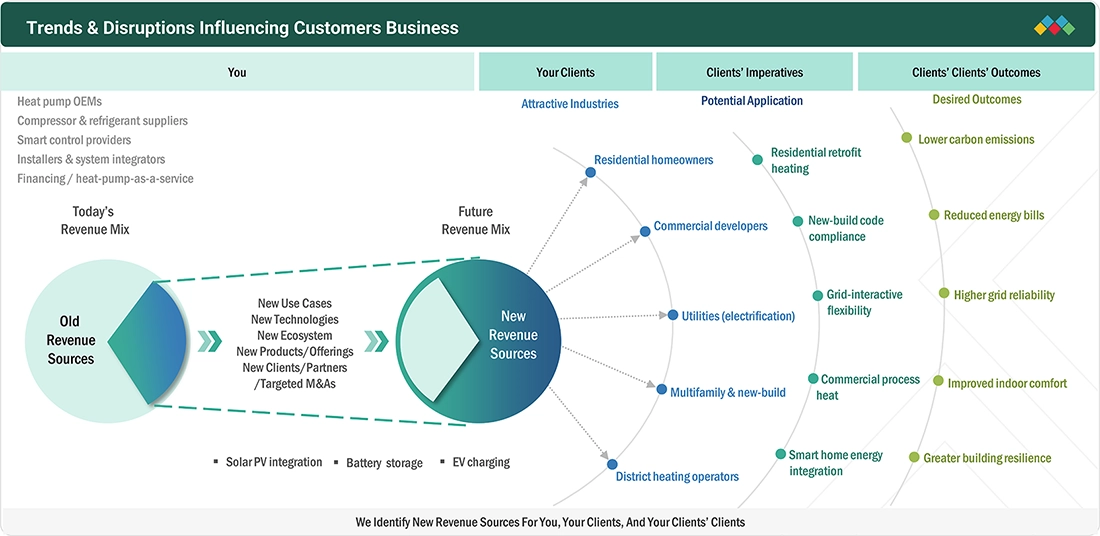
The heat pump market is estimated to register a CAGR of 13.7% during the forecast period. Daikin Industries, Ltd., Mitsubishi Electric Corporation, Midea Group Co., Ltd., Carrier Global Corporation, Robert Bosch GmbH (Bosch Home Comfort Group), Panasonic Holdings Corporation, LG Electronics Inc., Vaillant GmbH (Vaillant Group), and Trane Technologies plc are expanding portfolios across residential, commercial, and industrial applications through new product platforms, localized manufacturing, technology development, and strategic expansion.
Source: Secondary Research, Interviews with Experts, MarketsandMarkets Analysis
MARKET DYNAMICS

Level
-
Electrification of space and water heating is increasing demand for heat pumps

-
Decarbonization policies and restrictions on fossil-fuel heating are accelerating adoption


Level
-
High upfront equipment and installation costs limit adoption

-
Unfavorable electricity-to-gas price ratios can weaken operating-cost economics


Level
-
Heat pump water heaters are expanding the addressable market

-
Low-GWP refrigerants are creating opportunities for new-generation heat pump platforms


Level
-
Policy uncertainty can cause significant swings in heat pump demand

-
Refrigerant transition requires product redesign and compliance investments

Source: Secondary Research, Interviews with Experts, MarketsandMarkets Analysis
Electrification of space and water heating is increasing demand for heat pumps
The shift from fossil-fuel-based heating toward electricity is expanding demand for heat pumps across residential and commercial buildings. Heat pumps can provide space heating, cooling, and hot water while using substantially less electricity than conventional resistance heating. The IEA estimates that global heat pump sales reached more than 130 million units in 2024, with growth supported by electrification policies and rising demand for efficient heating technologies. Adoption is particularly strong where electric systems are replacing natural gas heating. Increasing deployment of heat-pump water heaters, air-to-water systems, and cold-climate heat pumps is further broadening the addressable market across developed and emerging economies.
High upfront equipment and installation costs limit adoption
Heat pumps typically require higher initial investment than conventional gas or oil heating systems, particularly where installation involves electrical upgrades, new radiators, insulation improvements, or replacement of existing heating infrastructure. The IEA indicates that air-to-water heat pumps can cost around 2–4 times more than gas boilers in major heating markets. Ground-source systems can require even higher investment because of drilling or ground-loop installation. Although lower energy consumption can reduce operating costs over the system lifetime, the initial capital requirement remains a significant barrier for price-sensitive households and commercial users, particularly in markets with limited subsidies or financing support.
Heat-pump water heaters are expanding the addressable market
Heat pump water heaters are creating an additional growth avenue beyond space heating by replacing conventional electric resistance and fossil fuel water heating systems. Their higher efficiency enables users to produce hot water with substantially less electricity than resistance-based systems. The technology is gaining traction in markets such as the US, Europe, Japan, and Australia, supported by building-efficiency requirements and electrification incentives. The US Department of Energy has also strengthened efficiency requirements for residential water heaters, supporting the transition toward higher-efficiency technologies. Manufacturers are responding with larger-capacity, integrated, and smart heat pump water heater platforms, expanding opportunities across residential buildings, hotels, commercial facilities, and multifamily housing.
Policy uncertainty can cause significant swings in heat-pump demand
Heat pump adoption remains highly sensitive to government incentives, energy prices, building regulations, and heating-system policies. Changes in subsidy levels or eligibility can significantly affect purchase economics and create fluctuations in annual installations. Europe experienced a notable decline in heat pump sales in 2024, following strong growth during the previous two years, as high electricity prices, reduced incentives, and weaker construction activity affected consumer economics. Similar variations can occur across other markets when governments modify rebates, tax credits, or fossil-fuel heating policies. This uncertainty makes demand forecasting more difficult for manufacturers and can influence production planning, capacity investments, and distributor inventories.
HEAT PUMP MARKET: COMMERCIAL USE CASES ACROSS INDUSTRIES
| COMPANY | USE CASE DESCRIPTION | BENEFITS |
|---|---|---|
 |
Carrier supplied a 2 MW high-temperature heat-pump system to a major bank estate in Glasgow, Scotland. The system combines five AquaSnap air-source heat pumps with four AquaForce water-source heat pumps to deliver 85°C hot water for district heating. | It enables high-temperature heating for an existing commercial estate, demonstrating heat pump applicability in retrofit and district heating environments. The system uses R-32 and R-1234ze low-GWP refrigerants, supporting the transition toward lower-emission heating technologies. |
 |
Mitsubishi Electric supplied Ecodan air-to-water heat pumps to 154 new homes in County Wicklow, Ireland, with each home equipped with a 6 kW system for space heating and domestic hot water. The company worked with the developer and installer on system design, heat-loss calculations, sizing, and commissioning. | It demonstrates Mitsubishi Electric's ability to integrate heat pumps at large residential-development scale, while standardized equipment, design support, and maintenance registration simplify deployment across multiple homes. |
Logos and trademarks shown above are the property of their respective owners. Their use here is for informational and illustrative purposes only.
MARKET ECOSYSTEM
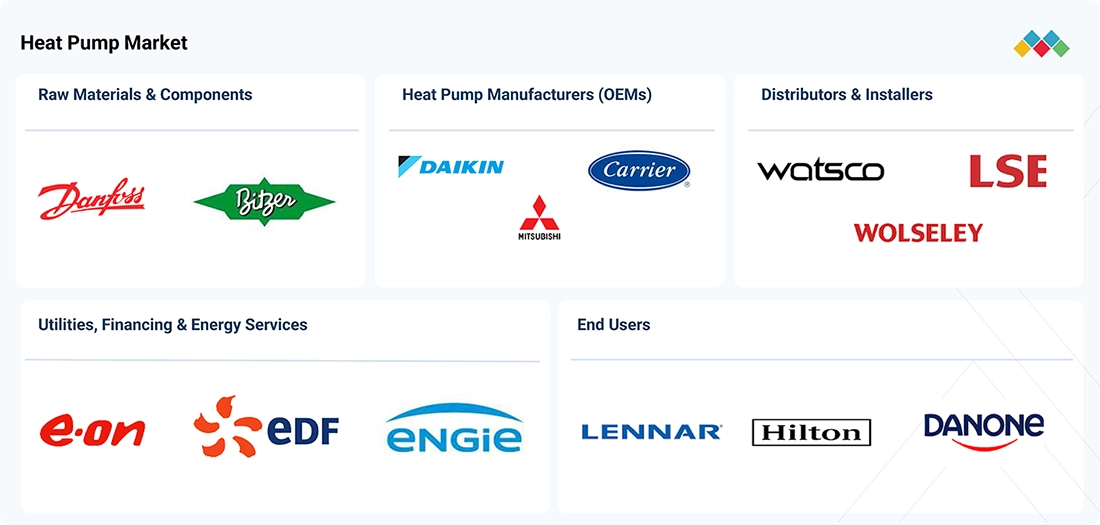
The heat pump market operates through a collaborative ecosystem comprising equipment manufacturers, component and refrigerant suppliers, installers and system integrators, financing/service providers, and end users. Manufacturers such as Daikin, Mitsubishi Electric, Panasonic, Vaillant Group, Bosch Home Comfort, Stiebel Eltron, NIBE Group, Ariston Holding, Midea Building Technologies, Carrier Global, and A.O. Smith design and produce heat pump units and controls, while compressor and refrigerant suppliers enable the low-GWP technology transition. Installers and system integrators deploy and commission these systems across residential, commercial, and industrial buildings, with newer entrants like Aira bundling financing and smart optimization software into the installation itself. Homeowners, commercial developers, utilities, and district heating operators drive adoption to improve energy efficiency, reduce carbon emissions, and support building electrification goals.
Logos and trademarks shown above are the property of their respective owners. Their use here is for informational and illustrative purposes only.
MARKET SEGMENTS
Source: Secondary Research, Interviews with Experts, MarketsandMarkets Analysis
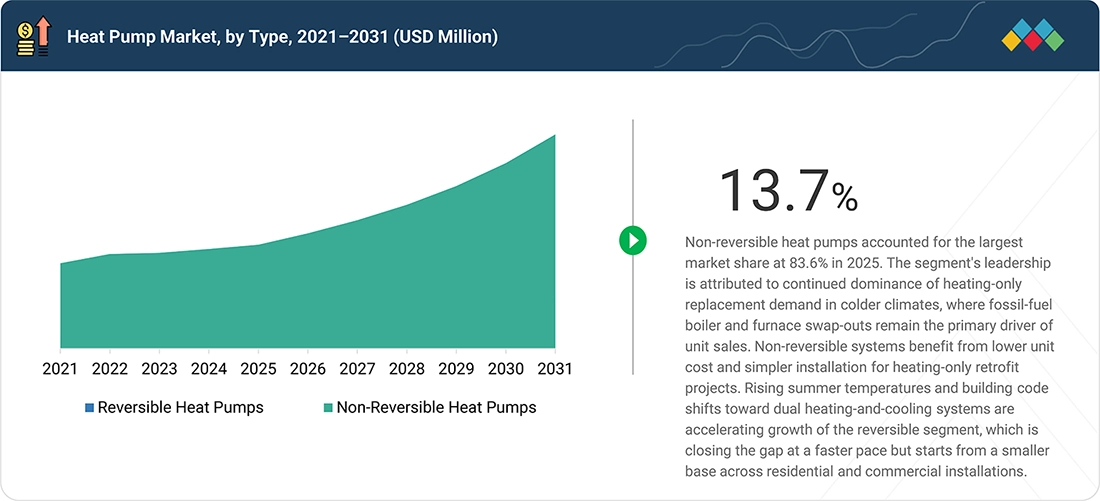
The reversible heat pumps segment is projected to register the highest CAGR during the forecast period.
The reversible heat pumps segment is projected to register the highest CAGR during the forecast period. Reversible units deliver both heating and cooling from a single system, making them the preferred choice as building codes increasingly mandate electrified space conditioning rather than heating alone. Rising summer temperatures across Europe and North America are pushing homeowners and developers who previously needed heating-only replacement to opt for reversible systems instead, since the incremental cost over non-reversible units is small relative to the added cooling functionality. This dual-purpose value proposition is accelerating adoption faster than heating-only replacement cycles alone would support.
The air-to-water heat pumps segment is expected to register the highest CAGR during the forecast period.
The air-to-water heat pumps segment is expected to register the highest CAGR during the forecast period, driven by their compatibility with existing hydronic infrastructure (radiators, underfloor heating) already installed across Europe and parts of Asia. This allows installers to replace a boiler with a heat pump without ripping out the building's existing heat distribution system, significantly lowering retrofit cost and disruption compared to air-to-air alternatives. Rising demand for combined space heating-plus-hot water systems from a single unit is further accelerating adoption of this technology segment over standalone air-to-air or water-source alternatives.
R290 (Propane) is projected to register the highest CAGR during the forecast period.
R290 (Propane) is projected to register the highest CAGR during the forecast period. As the EU's F-Gas phase-down restricts high-GWP refrigerants like R410A and R407C, manufacturers are rapidly redesigning product lines around R290's near-zero global warming potential and strong thermodynamic efficiency at high flow temperatures. Regulatory deadlines are compressing the adoption timeline industry-wide, with major OEMs including Vaillant, Daikin, and NIBE already shifting the majority of their residential heat pump range to R290 platforms, making it the fastest-growing refrigerant category by a wide margin.
The above 30 kW segment is expected to register the highest CAGR during the forecast period.
The above 30 kW segment is expected to register the highest CAGR during the forecast period, driven by accelerating commercial, industrial, and district-heating deployment. As utilities and municipalities pursue large-scale decarbonization of district heating networks (such as wastewater- and air-source district systems replacing coal or gas plants), and as commercial developers increasingly specify heat pumps as standard in new construction, demand for high-capacity units is scaling faster than the historically dominant residential-scale capacity bands.
The heating and cooling (combined) segment is projected to register the highest CAGR during the forecast period.
The heating and cooling (combined) segment is projected to register the highest CAGR during the forecast period. Combined heating and cooling application is increasingly favored over heating-only or water heating-only use cases as building owners seek a single electrified system that addresses both winter heating replacement and rising cooling demand from warmer summers, reducing the need for separate HVAC equipment and simplifying both installation and total cost of ownership.
The commercial segment is expected to register the highest CAGR during the forecast period.
The commercial segment is expected to register the highest CAGR during the forecast period, driven by code-driven specifications in new construction and corporate net-zero commitments. Survey data shows commercial real estate developers specifying heat pumps as standard in new construction above 5,000 square meters, rising sharply as building codes (such as California's 2025 Building Energy Code) mandate heat pump priority — pulling commercial demand growth ahead of the residential segment, which continues to grow but faces headwinds from the recent expiration of US federal residential tax incentives.
REGION
North America is expected to account for the largest market share during the forecast period.
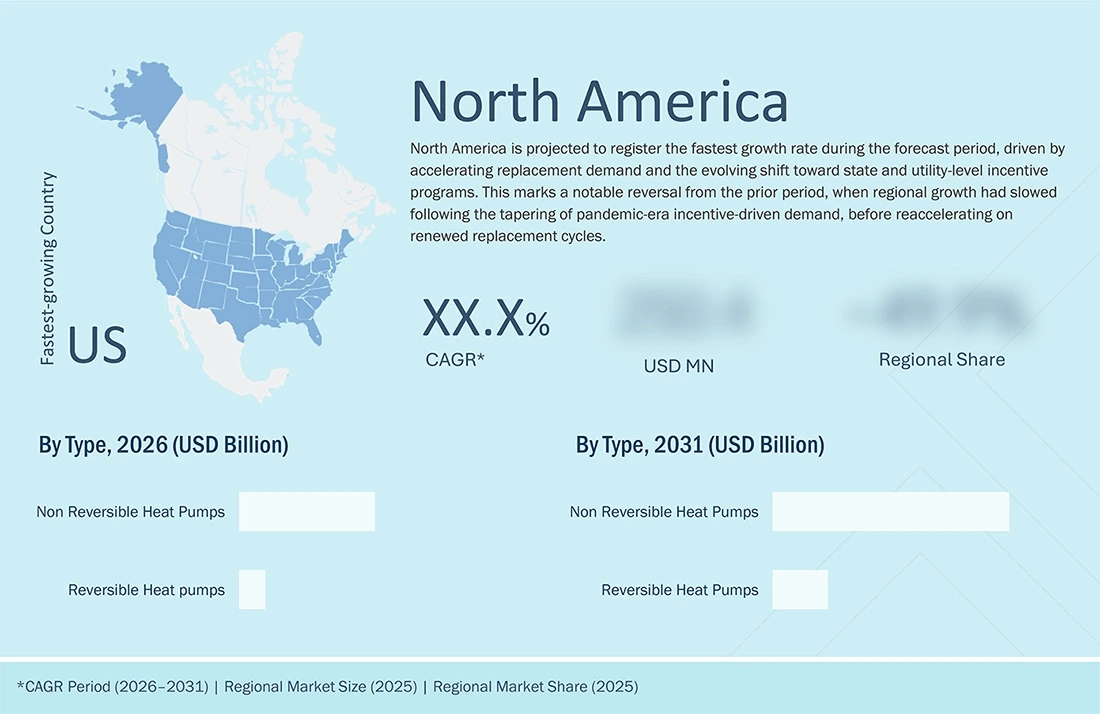
North America is projected to register the fastest growth rate during the forecast period, driven by accelerating replacement demand and the evolving shift toward state and utility-level incentive programs. This marks a notable reversal from the prior period, when regional growth had slowed following the tapering of pandemic-era incentive-driven demand, before reaccelerating on renewed replacement cycles. Continued electrification of residential and commercial heating, rising cold-climate heat pump adoption, and the rollout of state and utility rebate programs - filling the gap left by the expired federal 25C tax credit - are expected to sustain North America's position as the fastest-growing region, even as Asia Pacific remains the largest market.
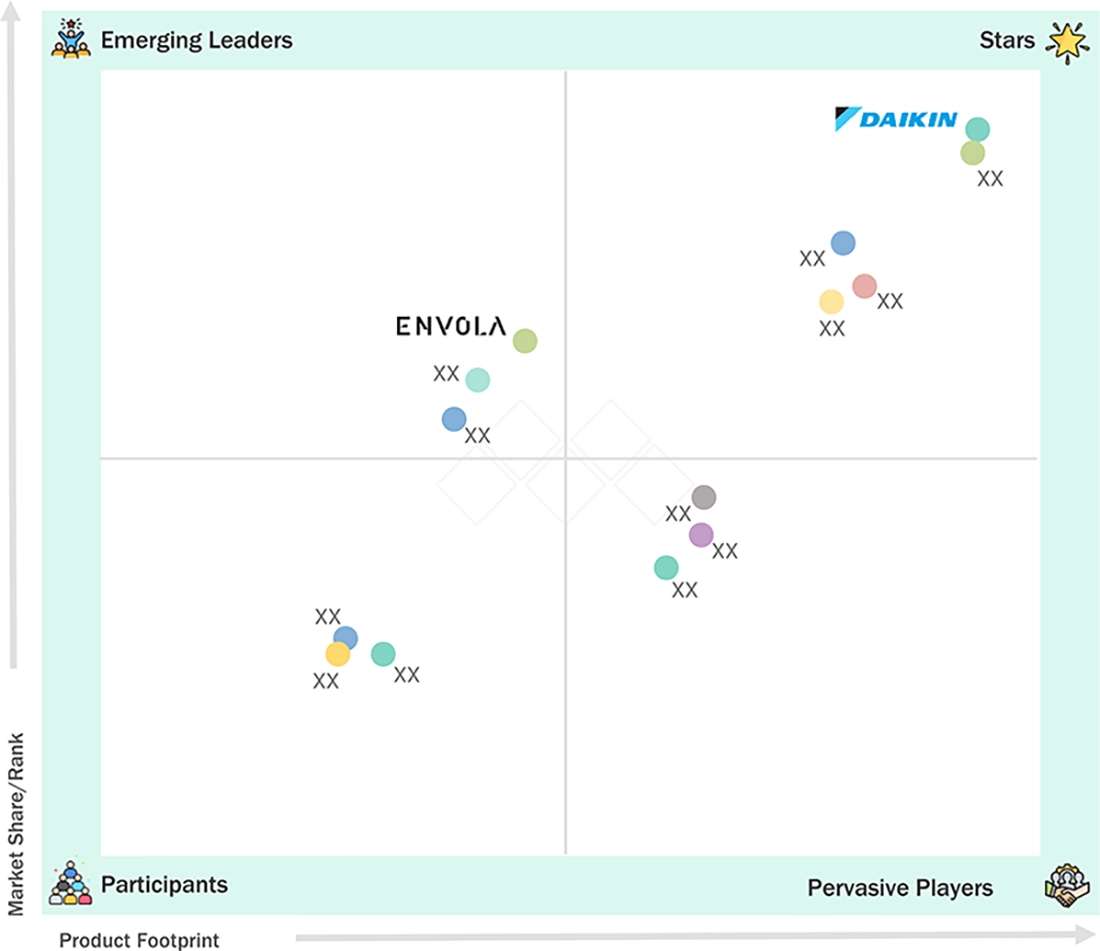
HEAT PUMP MARKET: COMPANY EVALUATION MATRIX
The heat pump market is moderately consolidated, led by Daikin Industries, Ltd., Mitsubishi Electric Corporation, Midea Group Co., Ltd., Carrier Global Corporation, and Robert Bosch GmbH (Bosch Home Comfort Group), supported by broad product portfolios and strong global distribution networks. Daikin Industries has the strongest overall position, supported by broad technology coverage and significant international presence, while Mitsubishi Electric Corporation and Midea Group Co. have strong positions across air-source and air-to-water systems. Carrier Global Corporation and Robert Bosch GmbH (Bosch Home Comfort Group) benefit from established HVAC and heating portfolios, with strong residential and commercial market coverage.
Source: Secondary Research, Interviews with Experts, MarketsandMarkets Analysis
KEY MARKET PLAYERS
- Samsung
- Panasonic Holdings Corporation
- Denso corporation
- Midea Group
- Mitsubishi Electric Corporation
- LG Electronics
- Daikin Industries, Ltd.
- Johnson Controls
- Carrier
- Trane Technologies plc
- GEA Group Aktiengesellschaft
- Bosh thermotechnology corp
- Fujitsu General
- Lennox International Inc.
- RHEEM Manufacturing
- NIBE Energy Systems Limited
MARKET SCOPE
| REPORT METRIC | DETAILS |
|---|---|
| Market Size in 2025 (Value) | USD 79.42 Billion |
| Market Size in 2026 (Value) | USD 88.81 Billion |
| Market Forecast in 2031 (Value) | USD 169.04 Billion |
| Growth Rate | CAGR of 13.7% from 2026-2031 |
| Years Considered | 2021–2031 |
| Base Year | 2025 |
| Forecast Period | 2026–2031 |
| Units Considered | Value (USD Million)/Billion |
| Report Coverage | Market size and forecast, company profiling, competitive landscape, market dynamics (drivers, restraints, opportunities, and challenges), technology trends, ecosystem analysis, commercial use cases, and regional analysis |
| Segments Covered |
|
| Regions Covered | North America, Latin America, Europe , Asia Pacific, Middle East & Africa |
WHAT IS IN IT FOR YOU: HEAT PUMP MARKET REPORT CONTENT GUIDE
DELIVERED CUSTOMIZATIONS
We have successfully delivered the following deep-dive customizations:
| CLIENT REQUEST | CUSTOMIZATION DELIVERED | VALUE ADDS |
|---|---|---|
| Regulation study in Europe | Comprehensive assessment of key European regulations impacting the heat pump market, including F-gas Regulation, energy efficiency/building regulations, refrigerant restrictions, phase-down timelines, and their implications for heat pump adoption | Helps identify regulatory-driven market opportunities, technology shifts, and refrigerant transition trends across Europe. For example, EU F-gas rules are accelerating the shift toward low-GWP refrigerants such as R-290, R-744, and R-32. (Climate Action). |
| Cross-segmentation of refrigerant by end user (Scenario-based analysis) | Developed a scenario-based cross-segmentation of refrigerants across residential, commercial, and industrial end users to assess potential refrigerant adoption patterns under different regulatory and technology scenarios | Provides a deeper view of how refrigerant preferences may evolve across end users and helps assess potential shifts from high-GWP refrigerants toward low-GWP/natural refrigerants based on application, capacity, and regulatory requirements. |
RECENT DEVELOPMENTS
- May 2026 : NIBE Group agreed to acquire Italian heating equipment manufacturer Beltrami Felice, strengthening NIBE Element's technological capabilities and product offering in the commercial heating segment. The company, employing 50 people with annual turnover of roughly €9 million, will be consolidated into NIBE's business area by July 2026, extending NIBE's footprint in industrial and residential heat transfer equipment amid rising European heat pump subsidy demand.
- May 2026 : Daikin debuted redesigned VRV Emerion commercial heat pump systems, reducing installation and commissioning times while expanding heating and cooling operation ranges and simplifying maintenance. The company also continued its role in California's Heat Pump Partnership, expanding workforce training centers and distribution locations, and partnering with utilities to accelerate inverter-based heat pump adoption toward the state's goal of 6 million installations by 2030.
- April 2026 : LG Electronics secured HVAC and heat pump supply contracts for large apartment developments in Eindhoven and Ridderkerk, Netherlands, marking a case of heat pump systems being specified at the development-planning stage for multi-unit residential stock across Europe.
- June 2026 : Google signed a multiyear contract with Transaera, an MIT-rooted startup, for next-generation heat pump technology aimed at reducing energy costs and emissions, reflecting growing corporate procurement interest in advanced heat pump systems beyond traditional HVAC buyers.
Table of Contents
 Exclusive indicates content/data unique to MarketsandMarkets and not available with any competitors.
Methodology
The research process for this technical, market-oriented, and commercial study of the heat pump market involved systematic collection, validation, and analysis of information related to heat pump technologies, heating applications, refrigerant developments, energy-efficiency requirements, and electrification initiatives. Extensive secondary research was conducted using annual reports, investor presentations, technical papers, regulatory publications, industry databases, company websites, and financial reports to identify key market participants, technology trends, market developments, and competitive strategies. The findings were further validated through primary interviews with executives from heat pump manufacturers, HVAC system providers, distributors, installers, energy companies, and industry experts to assess market estimates, technology adoption, customer requirements, and competitive positioning. Key market players and their market positions were established through a combination of secondary research and primary validation involving senior executives, business development managers, product specialists, and technical experts across the heat pump ecosystem.
Secondary Research
In the secondary research process, various secondary sources were referred to for identifying and collecting information relevant to the study. Secondary sources included annual reports, investor presentations, press releases, company websites, technical papers, industry journals, regulatory publications, and recognized market databases. Publications and datasets from organizations such as the International Energy Agency (IEA), European Heat Pump Association (EHPA), U.S. Department of Energy (DOE), National Renewable Energy Laboratory (NREL), U.S. Energy Information Administration (EIA), European Commission, and International Energy Agency Heat Pump Monitor were reviewed to understand heat pump deployment, energy-efficiency trends, policy developments, refrigerant transition, and technology adoption. Secondary research was primarily conducted to obtain information on the heat pump value chain, key market participants, technology developments, refrigerant trends, product portfolios, market drivers and restraints, regional adoption patterns, application trends, end-user demand, and recent industry developments
Primary Research
During the primary research phase, manufacturers, distributors, installers, HVAC contractors, building owners, and industry experts were interviewed to obtain qualitative and quantitative insights on the heat pump market. Interviews were conducted to validate market estimates, technology adoption, pricing, installation trends, regional demand, competitive positioning, and customer buying criteria. A combination of top-down and bottom-up approaches, supported by data triangulation, was used to estimate and forecast the market across all segments and subsegments. Primary interviews also helped assess adoption drivers and barriers, replacement demand, retrofit requirements, installer availability, refrigerant transition, and emerging technologies. The findings were further validated against company disclosures, government statistics, and industry sources such as the IEA and EHPA to refine market estimates, segment shares, regional forecasts, and competitive assessments.
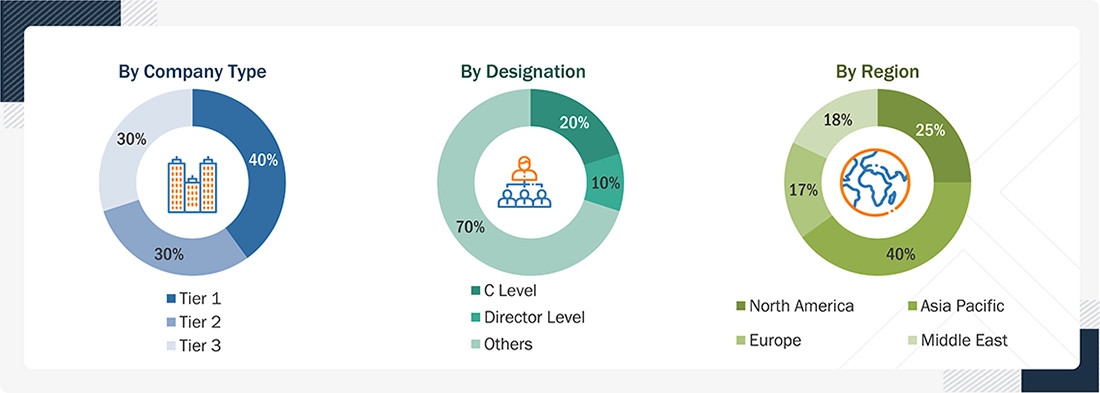
Note: Others include sales managers, engineers, and regional managers.
Tier 1 Company Revenue > USD 5 billion, Tier 2 Company Revenue between USD 1 and USD 5 billion, and Tier 3 Company Revenue < USD 1 billion.
To know about the assumptions considered for the study, download the pdf brochure
Market Size Estimation
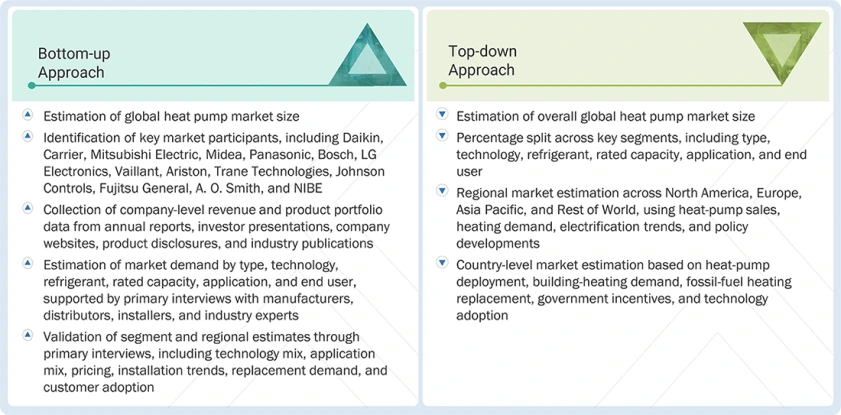
Bottom-up Approach
- Estimating the heat pump market size across type, technology, refrigerant, rated capacity, application, and end user segments by analyzing revenue generated from heat pump systems and consolidating segment-level estimates to derive the overall market size.
- Mapping leading market participants, including DAIKIN INDUSTRIES, Ltd., Carrier, Mitsubishi Electric Corporation, Midea Group, Panasonic Holdings Corporation, Bosch Thermotechnology Corp, LG Electronics Inc., Vaillant Group International GmbH, Ariston Holding N.V., Trane Technologies plc, Johnson Controls, Fujitsu, A. O. Smith Corporation, NIBE Industrier AB, and other regional and specialized manufacturers.
- Collecting segment-wise revenue and product portfolio information from annual reports, investor presentations, company websites, product catalogs, press releases, regulatory filings, and other publicly available disclosures.
- Estimating demand across major applications, including heating and heating & cooling, with further assessment of water heating and district & space heating, based on heat-pump installations, product sales, replacement demand, construction activity, and electrification trends.
- Estimating market demand across major technologies, including air-to-air, air-to-water, water-source, ground-source, hybrid, and PVT heat pumps, using manufacturer product portfolios, technology deployment data, and regional adoption trends.
Incorporating qualitative factors, including electrification policies, fossil-fuel heating restrictions, energy prices, low-GWP refrigerant regulations, energy-efficiency standards, retrofit activity, technology advancements, and installer availability, into the market forecasting model.
Top-down Approach
- Estimating the overall global heat pump market by analyzing global heating equipment demand, building sector electrification, heat pump deployment, energy-efficiency investments, and replacement of conventional fossil fuel heating systems.
- Allocating the market across type (Reversible and Non-reversible), technology (Air-to-Air, Air-to-Water, Water-Source, Ground-Source, Hybrid, and PVT), refrigerant, rated capacity, application, and end user (Residential, Commercial, and Industrial) using regional adoption patterns, technology penetration, manufacturer portfolios, and industry data.
- Distributing market estimates across North America, Europe, Asia Pacific, and Rest of the World based on regional heat-pump sales, installed base, building-heating demand, policy support, and technology adoption.
- Validating the final market estimates through primary interviews with manufacturers and channel participants to validate regional sales trends, installer activity, pricing, technology preferences, and replacement demand, followed by data triangulation to ensure consistency and accuracy.
Heat Pump Market : Top-Down and Bottom-Up Approach
Data Triangulation
The process of determining the overall market size involved the methodologies described earlier, followed by segmenting the market into multiple segments and subsegments. To finalize the comprehensive market analysis and obtain precise statistics for each market segment and subsegment, data triangulation and market breakdown procedures were applied, wherever appropriate. Data triangulation was accomplished by examining factors and trends from both the demand and supply sides of the heat pump ecosystem, including heat pump sales and installations, technology adoption, manufacturer revenues and product portfolios, heating-system replacement demand, policy developments, refrigerant regulations, energy prices, and regional market dynamics.
Market Definition
A heat pump is an electrically powered device that transfers heat from one location to another. It operates using a refrigerant that circulates through four key components - an evaporator, condenser, compressor, and expansion device - to enable heat exchange. This process allows the heat pump to provide heating in winter and cooling in summer. Rather than generating heat, a heat pump moves it, making it a highly energy-efficient alternative to traditional furnaces and air conditioning systems, suitable for use in all climate zones.
The heat pump market encompasses the total revenue generated globally from the sale of various heat pump technologies, including air-to-air, air-to-water, water-source, ground-source (geothermal), hybrid, and photovoltaic-thermal systems. These heat pumps are available in multiple rated capacities, such as up to 10 kW, 10–20 kW, 20–30 kW, and above 30 kW, to suit diverse application needs. The primary end-user segments for these systems are the residential, commercial, and industrial sectors.
Key Stakeholders
- Heat pump manufacturers and OEMs
- Heat pump component and compressor manufacturers
- HVAC equipment manufacturers and system integrators
- Installation, maintenance, and after-sales service providers
- Government agencies and regulatory authorities
- Research institutions and industry associations
- Utility companies and energy service providers (ESCOs)
- Technology standards organizations, industry forums, alliances, and trade associations
- Institutional investors and private equity firms
- Building developers, EPC contractors, and infrastructure companies
Report Objectives
- To define, describe, segment, and forecast the heat pump market by technology, type, refrigerant, rated capacity, end user, and application, in terms of value
- To forecast the market sizes for six major regions, namely North America, Europe, Asia Pacific, Latin America, the Middle East, and Africa, along with their key countries, in terms of value
- To forecast the heat pump market by technology and region, in terms of volume
- To provide detailed information regarding key drivers, restraints, opportunities, and challenges influencing the growth of the heat pump market
- To provide the supply chain analysis, trends/disruptions impacting customer business, ecosystem analysis, regulatory landscape, patent analysis, case study analysis, technology analysis, key conferences & events, the impact of AI/Gen AI, macroeconomic outlook, pricing analysis, Porter’s five forces analysis, and regulatory analysis, the impact of 2025 US tariff on the market
- To analyze opportunities for stakeholders in the heat pump market and draw a competitive landscape of the market
- To benchmark market players using the company evaluation matrix, which analyzes market players on broad categories of business and product strategies adopted by them
- To compare key market players for the market share, product specifications, and applications
- To strategically profile key players and comprehensively analyze their market ranking and core competencies.
- To analyze competitive developments, such as contracts, agreements, partnerships, and expansions in the heat pump market
Available customizations:
With the given market data, MarketsandMarkets offers customizations based on the company’s specific needs. The following customization options are available for the report:
Product Analysis
- Product Matrix, which provides a detailed comparison of the product portfolio of each company
Company Information
-
Detailed analyses and profiling of additional market players (up to 5)
Key Questions Addressed by the Report
What is the size of the heat pump market??
The size of the heat pump market in 2025 was USD 83.27 billion.
What are the major drivers for the heat pump market?
Government subsidies, tax credits, and rebates for the installation of heat pumps are incentivizing consumers to adopt this technology.
Which region is expected to be the biggest market for heat pump during the forecast period?
Asia Pacific is expected to dominate the heat pump market between 2025 and 2030, followed by Europe and North America.
Which is the largest segment, by type, in the heat pump market during the forecast period?
The non-reversible segment is estimated to account for the largest market share during the forecast period, owing to the relatively mature and cost-effective technology.
Which is the largest segment, by application, in the heat pump market during the forecast period?
Heating is estimated to account for the largest market share during the forecast period.


Personalize This Research
- Triangulate with your Own Data
- Get Data as per your Format and Definition
- Gain a Deeper Dive on a Specific Application, Geography, Customer or Competitor
- Any level of Personalization
Let Us Help You
- What are the Known and Unknown Adjacencies Impacting the Heat Pump Market
- What will your New Revenue Sources be?
- Who will be your Top Customer; what will make them switch?
- Defend your Market Share or Win Competitors
- Get a Scorecard for Target Partners

Custom Market Research Services
We Will Customise The Research For You, In Case The Report Listed Above Does Not Meet With Your Requirements
Get 10% Free CustomisationTESTIMONIALS

Kimberly Murphy
GLOBAL MARKETING DIRECTOR
Bently Nevada,
Leading Condition Monitoring & Asset Protectionwww.bakerhughesds.com/bently-nevada

MarketsandMarkets™ showed consistent rigor for success and relentlessly worked with Bently Nevada stakeholders to positively impact go-to-market strategy. Their proactiveness and flexibility has been instrumental in achieving the objectives to grow our sales pipeline in key industrial markets.

DARRICK HUEBER
Business Development Leader
Nexus Controls LLC,
Leading Manufacturer of Automation System & Electrical Panelswww.bakerhughesds.com/nexus-controls

We partnered with MarketsandMarkets to expand our business further by tapping into new industrial segments. It was critical for us to gather crucial business insights about specific markets to achieve this goal. MarketsandMarkets engagement model and client services helped us provide those insights, it was really impressive and valuable for my business. The team was extremely flexible and helpful.

Mike Schoff
Global Industrial Commercial Strategy Leader
Nexus Controls LLC
Leading Manufacturer of Automation System & Electrical Panelswww.bakerhughesds.com/nexus-controls
We consulted MarketsandMarkets for potential Partner Identification. Overall, it was a good experience. The insights provided through interviews conducted by the team helped us put together the questionnaire required for discussion with the selected partners. Their ability to provide insights through interviews with customers in a timely manner was quite impressive.
- China Heat Pump Market
- India Heat Pump Market
- Japan Heat Pump Market
- South Korea Heat Pump Market
- Australia Heat Pump Market
- France Heat Pump Market
- Italy Heat Pump Market
- Germany Heat Pump Market
- UK Heat Pump Market
- Spain Heat Pump Market
- Canada Heat Pump Market
- US Heat Pump Market
- Saudi Arabia Heat Pump Market
- UAE Heat Pump Market
- South Africa Heat Pump Market
- Brazil Heat Pump Market
- Mexico Heat Pump Market
- Rest Of Europe Heat Pump Market
- Rest Of Asia Pacific Heat Pump Market
- Rest Of Latin America Heat Pump Market
- GCC Countries Heat Pump Market
- Rest Of The GCC Countries Heat Pump Market
Growth opportunities and latent adjacency in Heat Pump Market




William
May, 2022
We want to know the competitive scenario for the Heat Pump Market? and the Top vendors in the Heat Pump Industry for the Forecast period 2022 to 2026..