Higher Education Learning Management System Market

Higher Education Learning Management System Market by Offering (Solutions, Services), Application (Course & Curriculum Management, Student Engagement & Retention, Learning Analytics & Performance Tracking, Others) – Global Forecast to 2032




OVERVIEW
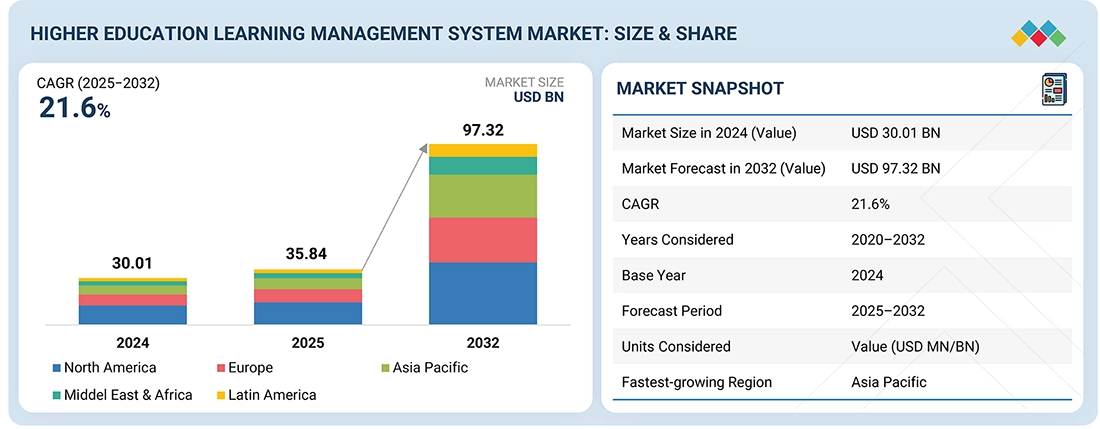
Source: Secondary Research, Interviews with Experts, MarketsandMarkets Analysis
The higher education learning management system market is expected to reach USD 97.32 billion by 2032, from USD 35.84 billion in 2025, with a CAGR of 21.6%. The market is growing as universities and colleges adopt digital teaching methods. Schools are utilizing learning management systems to handle courses, assignments, exams, and academic communication all in one platform. The rise of online and hybrid programs has driven higher demand for organized and dependable learning tools. Cloud-based and mobile management solutions make academic content more accessible to students and faculty.
KEY TAKEAWAYS
-
BY REGIONNorth America held the largest market share of 35% in 2025.
-
BY OFFERINGThe solutions segment was valued at USD 25.06 billion in 2025.
-
BY APPLICATIONThe student engagement & retention segment is expected to grow at the highest CAGR of 16.0% during the forecast period.
-
BY DELIVERY MODEThe blended learning segment is expected to record a CAGR of 19.9% during the forecast period.
-
BY USER TYPEUniversities are expected to lead the market during the forecast period.
-
COMPETITIVE LANDSCAPECornerstone OnDemand, Anthology, Moodle, D2L Corporation, and IBM are strengthening their presence through product enhancements, partnerships, technology upgrades, and platform expansion. These companies focus on improving AI-based learning features, personalization, analytics, mobile access, and compliance support to meet the rising need for efficient digital learning. Their strong portfolios help organizations manage large-scale training, support continuous learning, and improve workforce and student performance across different sectors.
-
COMPETITIVE LANDSCAPETovuti LMS, SkyPrep, Talent LMS, Acorn LMS, and LearnWorlds are gaining market attention with flexible, easy-to-use, and cost-effective learning management system platforms. These companies focus on simple deployment, user-friendly design, strong customization, and quick integration to support small and mid-sized businesses, training providers, and institutions. Their solutions help organizations modernize learning, improve engagement, and meet specific training needs.
Universities are using higher education learning management system platforms to increase student involvement in studies in a more organized way. Schools and universities are also increasingly relying on learning management systems for online and blended learning. Cloud and mobile-based platforms are making learning easy to access from anywhere. AI features are helping personalize learning and improve outcomes. Overall, higher education learning management system is moving from a support tool to a core part of learning and workforce development.
TRENDS & DISRUPTIONS IMPACTING CUSTOMERS' CUSTOMERS
The higher education learning management system market is being shaped by the shift toward digital learning and the broader use of AI in training. Universities are adopting smarter platforms that personalize learning, monitor progress, and offer real-time guidance. The rise of remote and hybrid learning has heightened the demand for dependable online learning systems. Mobile learning and short learning modules are becoming more common, as users seek simple and flexible learning options. Cloud-based learning management system platforms are replacing older systems because they are easier to use and scale.
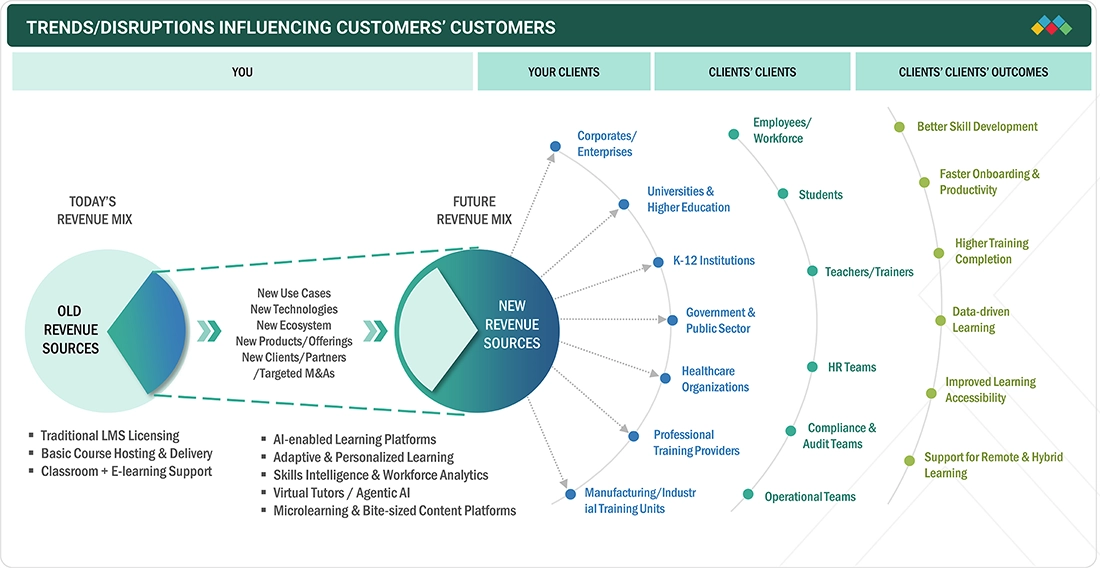
Source: Secondary Research, Interviews with Experts, MarketsandMarkets Analysis
MARKET DYNAMICS

Level
-
Compliance with federal regulations for distance learning

-
Elevated adoption of WCAG-compliant learning management platforms due to accessibility mandates


Level
-
Student data privacy concerns

-
Delayed standardization due to faculty course migration


Level
-
Rise of micro-credential programs

-
Faster EdTech expansion with LTI-based open ecosystems


Level
-
High integration risk associated with managing multi-vendor academic tools

-
Ensuring academic integrity in large-scale online assessments

Source: Secondary Research, Interviews with Experts, MarketsandMarkets Analysis
Driver: Compliance with federal regulations for distance learning
Federal regulations for distance learning are expected to increase the demand for higher education learning management systems, as institutions seek systems that enable faculty to monitor student engagement and participation in online learning environments. A regulatory requirement exists to maintain a paper trail indicating that the student remains actively involved in academics, participates in course offerings, and demonstrates progress toward a learning goal. The learning management system addresses this need by maintaining user logs, course completion, discussion responses, and assessment scores in a single system of record. This helps with accreditation reporting, prepares organizations for audits, and encourages growth in the learning management system market as higher education institutions increasingly adopt distance education.
Restraint: Delayed standardization due to faculty course migration
The faculty-led course migration effort is expected to be a major obstacle in the higher education learning management system market. Moving existing courses into standardized digital formats is challenging for institutions, as many faculty members have depended on teaching materials, customized workflows, and department-specific tools for quite some time. These tools often take considerable time and effort to redesign within a single learning management system. Migration typically requires restructuring content, updating assessments, and learning new system features-all of which increase workload and slow down adoption. As a result, most institutions delay full standardization with the learning management system, limiting platform use and thereby slowing the implementation of learning management systems across higher education.
Opportunity: Rise of micro-credential programs
Micro-credential programs are driving higher demand for learning management system badge integration. As universities introduce short, skill-focused certificates alongside degree programs, the ability to issue and manage digital badges is poised to be a key opportunity in the higher education learning management system market. These programs rely on a learning management system to issue, manage, and track digital badges that verify learners have achieved the required outcomes. Badge-enabled learning management system platforms allow institutions to support continuous learning, enhance graduate job readiness, and connect academic achievements with current workforce needs. As micro-credentials gain wider acceptance among employers and students, there is increasing demand for learning management platforms that feature built-in credentialing capabilities.
Challenge: High integration risk associated with managing multi-vendor academic tools
Vendor management of multiple educational tools can increase the risk of integrating learning management systems and is likely to remain a major challenge in the higher education learning management system market, as various tools from different vendors are used for assessment, video learning, analysis, and student engagement. This adds to the complexity of managing the learning system since multiple tools must be integrated into a single platform.
HIGHER EDUCATION LEARNING MANAGEMENT SYSTEM MARKET: COMMERCIAL USE CASES ACROSS INDUSTRIES
| COMPANY | USE CASE DESCRIPTION | BENEFITS |
|---|---|---|
 |
Arizona State University faced the challenge of managing its large number of online courses while maintaining consistent engagement for students in each course. To better facilitate engagement across its growing online programs, the university chose Canvas by Instructure as its main learning management system for courses, assessments, and faculty and student interactions. | The learning management system helped ASU expand online learning, provided instructors with a clearer view of student engagement, and enabled more flexible course design. The update improved course reporting, boosted faculty adoption, and maintained consistent delivery across thousands of online and hybrid courses. |
 |
The University of London offers distance learning programs for students in many countries and time zones. As enrollment increased, legacy systems became difficult to manage academic content, run assessments, and track student participation at scale. The university adopted Moodle as its learning management system to centralize course administration and support online learners worldwide. | Moodle facilitated standardized course delivery, enhanced assessment management, and supported multilingual learning environments. The platform increased student access, improved participation tracking, and ensured compliance with academic quality standards. |
 |
Purdue University needed an updated learning management system to support both on-campus and online programs and to enhance digital tools and resources for faculty. The university adopted Brightspace by D2L to improve course setup, make assessment processes more efficient, and monitor student engagement. | Brightspace enhanced course consistency, enabled advanced learning analytics, and supported personalized learning experiences. The learning management system strengthened academic reporting and assisted faculty in managing large and diverse student groups more effectively. |
Logos and trademarks shown above are the property of their respective owners. Their use here is for informational and illustrative purposes only.
MARKET ECOSYSTEM
The higher education learning management system landscape involves platform providers, content creators, integration partners, technology suppliers, and end users such as enterprises, schools, and training providers. In this setup, platform providers deliver the core learning system, while content partners develop courses, assessments, and other training materials. Technology partners offer support for AI, analytics, mobile access, and cloud hosting to enhance overall system performance. System integrators assist organizations in deploying a learning management system, customizing it to their internal needs, and integrating it with HR, ERP, and other enterprise systems. Students and instructors are the primary end users, and their daily use of the platform and feedback influence adoption and future improvements.
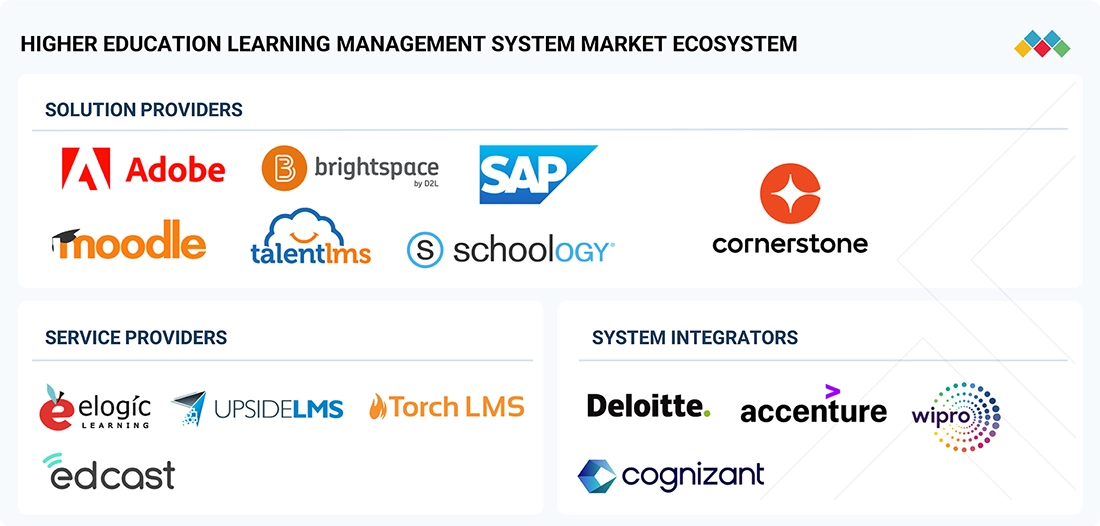
Logos and trademarks shown above are the property of their respective owners. Their use here is for informational and illustrative purposes only.
MARKET SEGMENTS
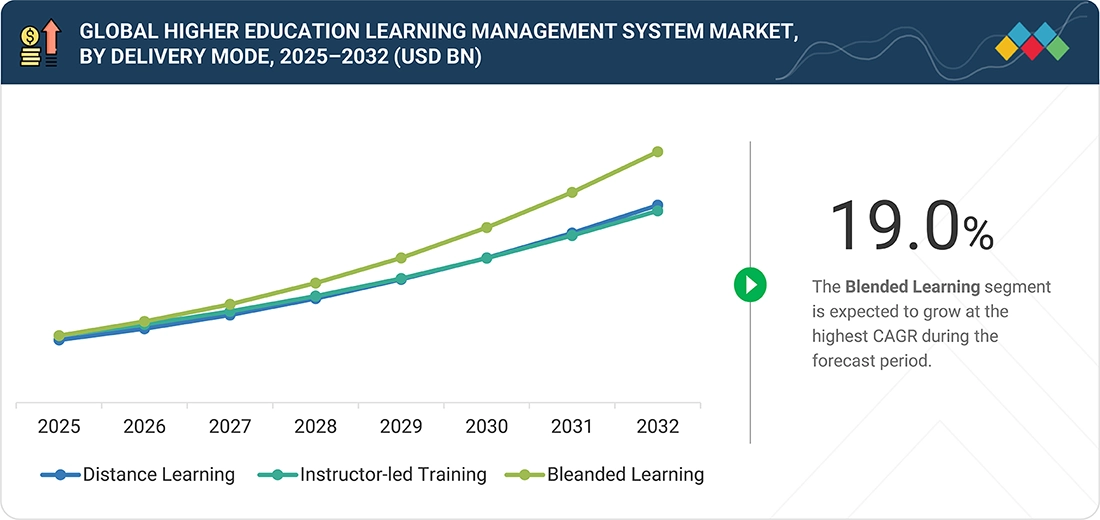
Source: Secondary Research, Interviews with Experts, MarketsandMarkets Analysis
Higher Education Learning Management System Market, By Offering
The solutions segment holds a larger market share because most universities focus their spending on the main platform used to deliver courses, run assessments, manage grading, and support student engagement. Institutions need a single, centrally managed system that supports both online and in-person instruction, meets compliance requirements, and maintains accurate, up-to-date academic records. A learning management system typically includes analytics, content management, and faculty collaboration tools in a single platform, reducing the need to rely on multiple systems. Growing enrollment in online programs is driving demand for learning management platforms that can scale, meet security needs, and cover core features, keeping the solutions segment in the lead in higher education.
Higher Education Learning Management System Market, By Delivery Mode
The blended learning segment is expected to grow at the fastest rate as universities combine online instruction with in-person classes. Many institutions use learning management system platforms to manage lecture materials, assignments, assessments, and class discussions, supporting in-person sessions. This approach facilitates learning outside the classroom while maintaining clear academic expectations and regular faculty-student interaction. Blended learning provides universities with a practical way to run courses with large enrollments, keep students more engaged in class activities, and offer more flexible attendance options when schedules or access limit in-person participation.
Higher Education Learning Management System Market, By Deployment
The cloud segment is expected to hold the largest market share because most students prefer cloud-based platforms that are easy to deploy, cost-effective, and require less IT management. These platforms do not need heavy hardware investment and allow users to access learning from anywhere. They are also highly scalable, enabling organizations to easily accommodate growing numbers of learners. Regular updates, improved storage, and stronger security features further boost their adoption.
Higher Education Learning Management System Market, By Application
The student engagement & retention segment is expected to record the highest CAGR as universities focus more on meeting compliance standards and reducing student dropout rates. Currently, many institutions utilize learning management systems to log student activity, monitor progress, and identify students in need of early support. Online tools such as forums, progress alerts, and performance dashboards enable educators to track student progress in real time and respond quickly to provide assistance when students hit key milestones.
Higher Education Learning Management System Market, By User Type
The universities segment is expected to exhibit the fastest growth as universities adopt digital learning platforms to support classroom instruction, remote teaching, and tracking student progress. Universities rely on learning management system platforms to organize lesson plans, share assignments, run assessments, and support communication with parents through one system. As blended and remote learning expand, schools have become more dependent on digital systems. Cloud-based learning management system platforms are often a practical choice for schools with limited IT staff, since setup and ongoing maintenance are handled by the provider rather than being managed on-site.
REGION
China to be the fastest-growing country in the Higher Education Learning Management System Market during the forecast period
Asia Pacific is expected to be the fastest-growing region in the higher education learning management system market as universities and colleges across the region increase adoption of online learning platforms. The adoption of higher education learning management systems is driven by higher spending on education technology, growth in online degree programs, and increased demand for flexible learning options. Many institutions rely on learning management platforms to manage large student groups, ensure consistent course delivery, and track performance to improve academic results. Government initiatives supporting digital education and cross-border learning are also boosting demand.

HIGHER EDUCATION LEARNING MANAGEMENT SYSTEM MARKET: COMPANY EVALUATION MATRIX
Cornerstone OnDemand (Star) maintains a strong position with a large market presence and a comprehensive learning platform. Its strengths include AI-enabled learning, robust compliance support, advanced analytics, and the ability to manage large and diverse workforces. Meanwhile, Infor (Emerging Leader) is gaining momentum with its expanding learning management system capabilities, focusing on scalable learning, easy integration, and support for industry-specific training needs. With increasing adoption among enterprises seeking flexible and efficient learning solutions, the company is emerging as a key growth player in the higher education learning management system market.
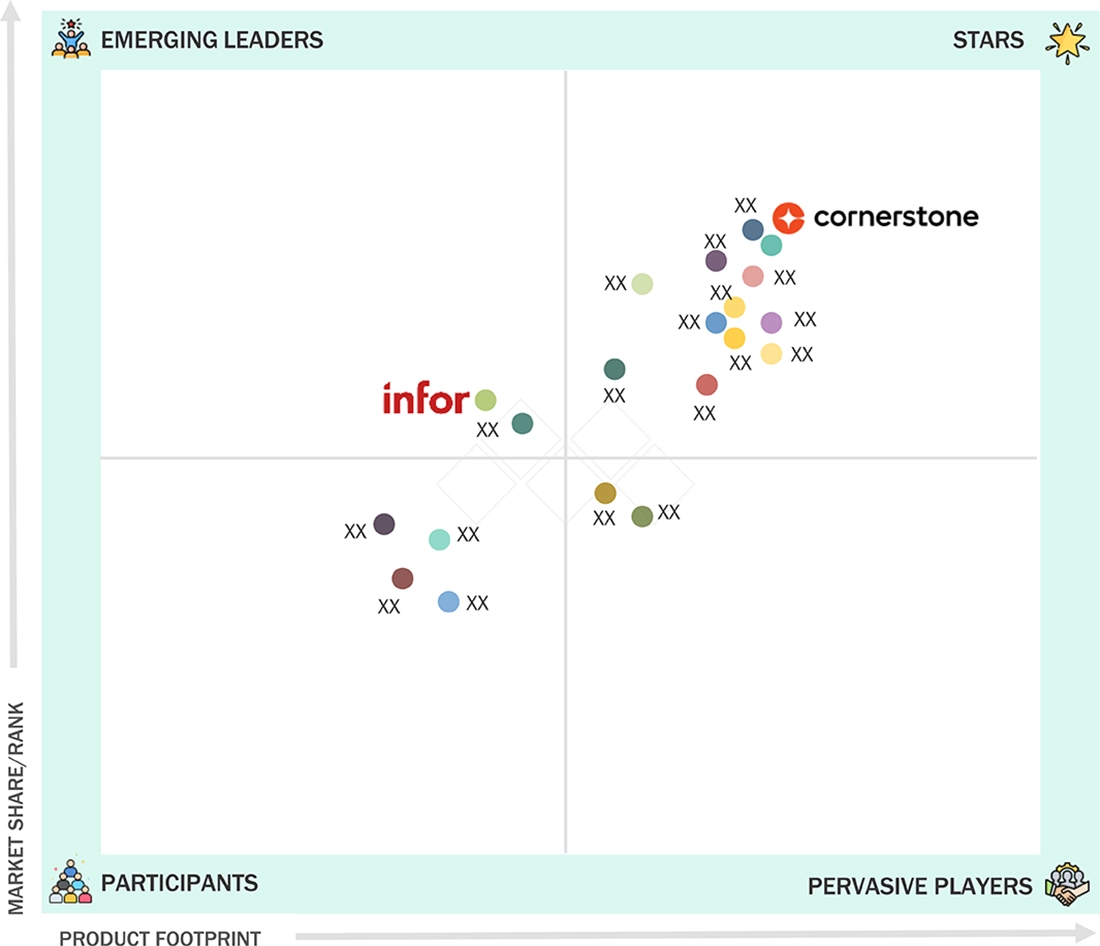
Source: Secondary Research, Interviews with Experts, MarketsandMarkets Analysis
KEY MARKET PLAYERS
- Cornerstone Ondemand
- Anthology
- Moodle
- D2L Corporation
- IBM
- PowerSchool
- Instructure
- Infor
- Adobe
- LTG
- Oracle
- SAP
- Docebo
- Simpltrain
- Learning Pool
- Absorb learning management system
- CrossKnowledge
- BIZllibrary
- Ispring
- Blue Sky Elearn
- Trakstar
- DigitalChalk
MARKET SCOPE
| REPORT METRIC | DETAILS |
|---|---|
| Market Size in 2024 (Value) | USD 30.01 BN |
| Market Forecast in 2032 (value) | USD 97.32 BN |
| Growth Rate | 21.6% |
| Years Considered | 2020–2032 |
| Base Year | 2024 |
| Forecast Period | 2025–2032 |
| Units Considered | Value (USD MN/BN) |
| Report Coverage | Revenue forecast, company ranking, competitive landscape, growth factors, and trends. |
| Segments Covered |
|
| Region Covered | North America, Europe, Asia Pacific, Middle East & Africa, Latin America |
WHAT IS IN IT FOR YOU: HIGHER EDUCATION LEARNING MANAGEMENT SYSTEM MARKET REPORT CONTENT GUIDE
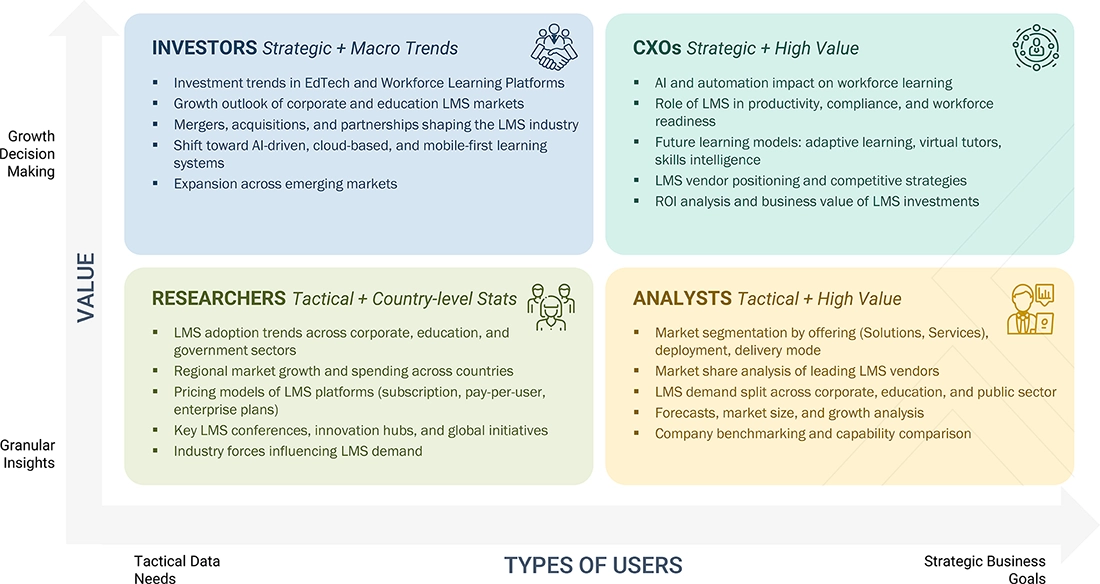
DELIVERED CUSTOMIZATIONS
We have successfully delivered the following deep-dive customizations:
| CLIENT REQUEST | CUSTOMIZATION DELIVERED | VALUE ADDS |
|---|---|---|
| learning management system Solution Provider | Global learning management system demand mapping across key regions, analysis of enterprise, education and government learning management system usage, study of AI-enabled learning, mobile learning and cloud-based learning management system trends, competitive benchmarking of leading learning management system vendors | Helps identify high-growth markets, supports better product strategy, improves go-to-market planning, guides platform enhancement |
| Education Institution / University | Regional digital learning readiness assessment, roadmap for hybrid and online learning adoption, best practices for learning management system deployment and integration, evaluation of student engagement tools and learning outcomes | Better digital learning planning, improved student engagement, stronger learning management system implementation strategy, better platform selection decisions |
| Corporate / Enterprise | Corporate learning management system use case analysis, mapping of training, upskilling and compliance needs, cost-benefit analysis for learning management system implementation, comparison of learning management system platforms for corporate learning | Better workforce training planning, stronger compliance management, lower risk in learning management system investments, improved employee skill development |
RECENT DEVELOPMENTS
- July 2025 : D2L announced Createspace, a new tool within D2L Brightspace designed to make course creation and collaboration easier for educators. It allows instructors to create, edit, and manage content in one place before publishing it to learners. The company also introduced several platform enhancements, including better assessment tools, larger group capacity, improved parent visibility, stronger employee learning support, and accessibility features.
- May 2025 : Cornerstone announced new partnerships and product innovations at Cornerstone Spark in Las Vegas to help organizations prepare for a future workforce that includes both humans and AI agents. The company introduced collaborations with Microsoft and Salesforce to bring AI-driven workforce tools directly into everyday work platforms. It also revealed upcoming upgrades in skills intelligence, AI capabilities, immersive learning, and a new mobile app to support frontline workers.
- May 2024 : Anthology announced a partnership with Obrizum to bring advanced AI-powered adaptive learning to Blackboard users worldwide. The partnership delivered more personalized learning, better analytics, and improved support for both students and educators. By using Obrizum’s AI technology, Anthology enhanced course development, engagement levels, and learning outcomes.
Table of Contents
 Exclusive indicates content/data unique to MarketsandMarkets and not available with any competitors.
Methodology
The study involved four major activities in estimating the Higher Education Learning Management System Market. We performed extensive secondary research to collect information on the market, the competitive market, and the parent market. The next step was to validate these findings, assumptions, and sizing with industry experts across the value chain through primary research. Both top-down and bottom-up approaches were employed to estimate the complete market size. After that, we used the market breakup and data triangulation procedures to estimate the market size of the various segments in the Higher Education Learning Management System Market.
Secondary Research
This research study used extensive secondary sources, directories, and databases, such as D&B Hoovers, DiscoverOrg, Factiva, vendor data sheets, product demos, Cloud Computing Association (CCA), Vendor Surveys, Asia Cloud Computing Association, and The Software Alliance. We used these sources to identify and collect valuable information for this technical, market-oriented, and commercial Higher Education Learning Management System Market.
Primary Research
Primary sources were several industry experts from the core and related industries, preferred software providers, hardware manufacturers, distributors, service providers, technology developers, alliances, and organizations related to all segments of the industry's value chain. In-depth interviews were conducted with primary respondents, including key industry participants, subject-matter experts, C-level executives of key market players, and industry consultants, to obtain and verify critical qualitative and quantitative information and assess the market's prospects.
We conducted primary interviews to gather insights, such as market statistics, the latest trends disrupting the market, new use cases implemented, data on revenue collected from products and services, market breakups, market size estimations, market forecasts, and data triangulation. Primary research also helped understand various technology trends, segmentation types, industry trends, and regions. Demand-side stakeholders, such as Chief Information Officers (CIOs), Chief Technology Officers (CTOs), and Chief Security Officers (CSOs); the installation teams of governments/end users using LMS solutions & services; and digital initiatives project teams, were interviewed to understand the buyer's perspective on suppliers, products, service providers, and their current use of services, which would affect the overall Higher Education Learning Management System Market.
Market Size Estimation
We used top-down and bottom-up approaches to estimate and forecast the LMS and other dependent submarkets. We deployed a bottom-up procedure to arrive at the overall market size using the revenues and offerings of key companies in the market. With data triangulation methods and validation through primary interviews, this study determined and confirmed the exact value of the overall parent market size. We used the overall market size in the top-down procedure to estimate the size of other individual markets via percentage splits of the market segments.
The research methodology used to estimate the market size included the following details:
- We identified key players in the market through secondary research. We then determined their revenue contributions in the respective countries through primary and secondary research.
- This procedure included studying top market players' annual and financial reports and extensive interviews for key insights from industry leaders, such as Chief Executive Officers (CEOs), VPs, directors, and marketing executives.
- All percentage splits and breakups were determined using secondary sources and verified through primary sources.
All the possible parameters that affect the market covered in this research study have been accounted for, viewed in extensive detail, verified through primary research, and analyzed to get the final quantitative and qualitative data. This data is consolidated and added with detailed inputs and analysis from MarketsandMarkets.
Data Triangulation
After arriving at the overall market size, the market was split into several segments and subsegments—using the market size estimation processes as explained above. Where applicable, data triangulation and market breakup procedures were employed to complete the overall market engineering process and determine each market segment's and subsegment's exact statistics. The data was triangulated by studying several factors and trends from the Higher Education Learning Management System Market's demand and supply sides.
Market Definition
Learning Management System (LMS) is a software application or web-based platform designed to facilitate the administration, documentation, tracking, and delivery of educational courses or training programs. It is commonly used in educational institutions, corporations, and organizations to manage and organize learning materials and activities. With the help of these solutions, companies and institutions can provide specialized training to their employees and students in the most interactive manner.
Key Stakeholders
- IT Service Providers
- LMS Vendors
- Learning Service Providers
- Software Providers
- E-learning Course Providers
- System Integrators
- System Administrators
- Internet Service Providers (ISPs)
- Corporate Trainers
- Compliance Regulatory Authorities
- Cloud Service Providers (CSPs)
- Government Authorities
Report Objectives
- To define, describe, and forecast the Higher Education Learning Management System Market based on offerings, delivery modes, organization sizes, deployment types, application areas, user types, and regions
- To forecast the market size of the five major regional segments: North America, Europe, Asia Pacific, Middle East & Africa, and Latin America in the Higher Education Learning Management System Market
- To strategically analyze the Higher Education Learning Management System market subsegments concerning individual growth trends, prospects, and contributions to the total market
- To provide detailed information related to the significant factors influencing the growth of the Higher Education Learning Management System market (drivers, restraints, opportunities, and challenges)
- To strategically analyze the macro and micromarkets concerning growth trends, prospects, and their contributions to the overall Higher Education Learning Management System market
- To analyze the industry trends, patents and innovations, and pricing data related to the Higher Education Learning Management System Market
- To analyze the opportunities in the Higher Education Learning Management System market for stakeholders and provide details of the competitive landscape for major players.
- To profile the key players in the Higher Education Learning Management System market and comprehensively analyze their market share/ranking and core competencies across segments and subsegments.
- To track and analyze the competitive developments, such as mergers and acquisitions, product developments, and partnerships and collaborations in the Higher Education Learning Management System market.
Available Customizations
With the given market data, MarketsandMarkets offers customizations per the company's specific needs. The following customization options are available for the report:
Product Analysis
- The product matrix provides a detailed comparison of the product portfolio of each company.
Geographic Analysis
- Further breakup of the Asia Pacific Higher Education Learning Management System market into countries contributing 75% to the regional market size
- Further breakup of the North American Higher Education Learning Management System market into countries contributing 75% to the regional market size
- Further breakup of the Latin American Higher Education Learning Management System market into countries contributing 75% to the regional market size
- Further breakup of the Middle Eastern & African Higher Education Learning Management System market into countries contributing 75% to the regional market size
- Further breakup of the European Higher Education Learning Management System market into countries contributing 75% to the regional market size
Company Information
- Detailed analysis and profiling of additional market players (up to 5).
Key Questions Addressed by the Report
What is the projected size of the Higher Education Learning Management System Market by 2032?
The Higher Education Learning Management System market is projected to grow from USD 35.84 billion in 2025 to USD 97.32 billion by 2032, at a CAGR of 21.6% during the forecast period.
Which institution type is expected to witness the fastest growth in the Higher Education Learning Management System Market?
Universities are expected to witness the fastest growth as they increasingly adopt digital learning platforms to support classroom instruction, remote learning, assessments, and student performance tracking.
Which region is expected to grow the fastest in the Higher Education Learning Management System Market?
Asia Pacific is projected to be the fastest-growing region due to rising investments in education technology, expanding online degree programs, and government initiatives supporting digital education.
What is driving the growth of the Higher Education Learning Management System Market?
The market is driven by the growing adoption of online and hybrid learning models, increasing demand for centralized academic management, and the need to improve student engagement and learning outcomes.
Why are higher education institutions investing in learning management systems?
Higher education institutions are investing in learning management systems to streamline course delivery, manage assessments, monitor student progress, and support scalable digital learning environments.
Which trend is shaping the Higher Education Learning Management System Market?
The increasing adoption of AI-enabled learning platforms and cloud-based learning management systems is a key trend shaping the market by enabling personalized learning experiences and improving academic administration.


Personalize This Research
- Triangulate with your Own Data
- Get Data as per your Format and Definition
- Gain a Deeper Dive on a Specific Application, Geography, Customer or Competitor
- Any level of Personalization
Let Us Help You
- What are the Known and Unknown Adjacencies Impacting the Higher Education Learning Management System Market
- What will your New Revenue Sources be?
- Who will be your Top Customer; what will make them switch?
- Defend your Market Share or Win Competitors
- Get a Scorecard for Target Partners

Custom Market Research Services
We Will Customise The Research For You, In Case The Report Listed Above Does Not Meet With Your Requirements
Get 10% Free CustomisationTESTIMONIALS






Growth opportunities and latent adjacency in Higher Education Learning Management System Market