IoT Platform Market

IoT Platforms Market By Platforms (Device Management, Application Enablement, Connectivity Management, IoT Advanced Analytics), Focus Areas (Smart Manufacturing, Smart Transportation/Mobility, Smart Healthcare) - Global Forecast to 2030




OVERVIEW
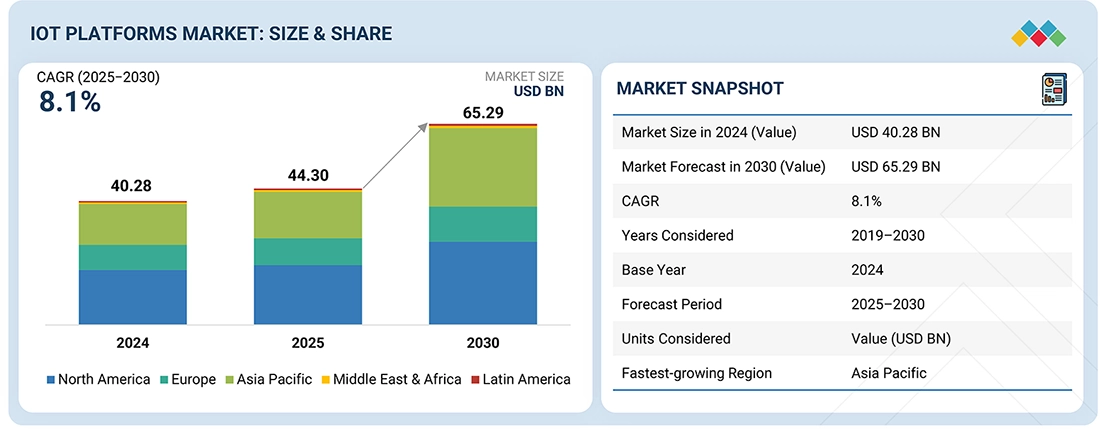
Source: Secondary Research, Interviews with Experts, MarketsandMarkets Analysis
The IoT platform market is projected to reach USD 65.29 billion by 2030, up from USD 44.30 billion in 2025, at a CAGR of 8.1% from 2025 to 2030. The IoT platform market is moving toward hybrid cloud solutions that process data both in the cloud and locally on the device for faster results. Leading platforms now use built-in AI to help companies move beyond merely "seeing" their data to actually predicting when a machine will fail. This shift is helping businesses save significantly on maintenance costs and enabling them to launch new connected products much faster than before.
KEY TAKEAWAYS
-
By RegionThe Asia Pacific region is expected to be the fastest-growing, at a CAGR of 11.0% during the forecast period.
-
By OfferingBy offering, the services segment is expected to register the highest CAGR of 8.5%.
-
By ApplicationBy application, the asset management segment held the largest market share of 23.1% in 2025.
-
By Focus AreaBy focus areas, the smart manufacturing segment is projected to dominate the market.
-
Competitive Landscape - Key PlayersCompanies such as Cisco, AWS, Microsoft, Oracle, and PTC were identified as some of the star players in the IoT Market (global), given their strong market share and product footprint.
-
Competitive Landscape - Startups/SMEsCompanies such as Particle, Clearblade, Emnify, and Losant, among others, have distinguished themselves among startups and SMEs by securing strong footholds in specialized niche areas, underscoring their potential as emerging market leaders.
IoT platforms are becoming the "brain" of IoT, focusing on security-by-design and seamless connectivity across different types of hardware. Most providers now offer outcome-based services, where customers pay for guaranteed results, such as "total uptime," rather than just the software itself. This evolution is making it easier for smaller companies to adopt IoT, as platforms now handle the complex task of keeping thousands of devices secure and updated automatically.
TRENDS & DISRUPTIONS IMPACTING CUSTOMERS' CUSTOMERS
The impact on consumers' business emerges from customer trends or disruptions. Hotbets are clients of manufacturing (IIoT), utilities, smart cities, healthcare devices, retail & logistics, automotive/transportation, agriculture and commercial buildings all buying managed IoT platforms, connectivity, edge compute and device-security services. Disruptions include fragmentation of standards/interoperability, rising device security & privacy regulation, supplier & silicon constraints, vendor consolidation and emergence of vertical-specific platform players and real-time analytics.
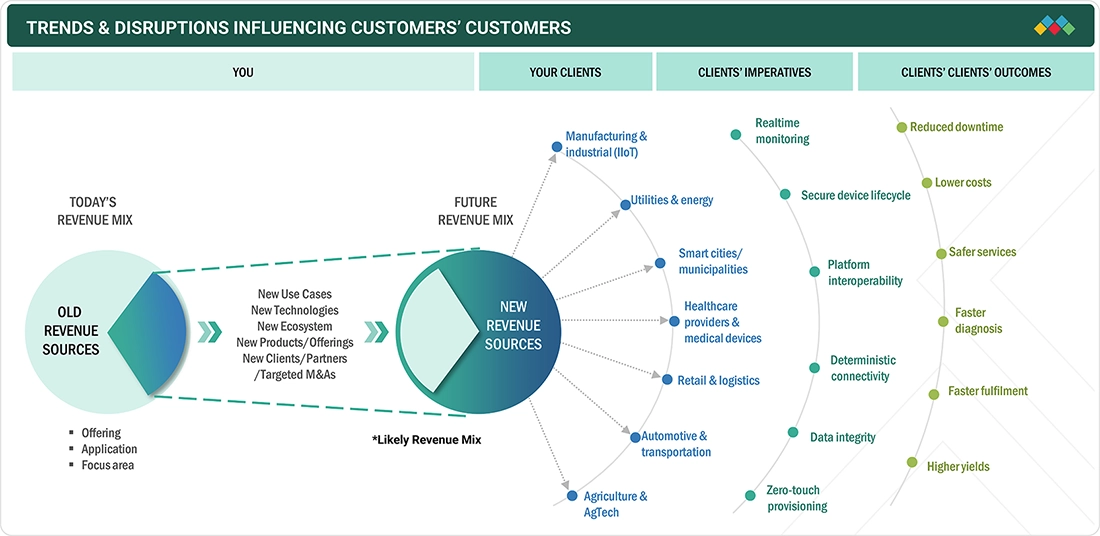
Source: Secondary Research, Interviews with Experts, MarketsandMarkets Analysis
MARKET DYNAMICS

Level
-
Rising demand for digital twin technology increases need for sophisticated virtual modeling

-
Integration of generative AI and autonomous agents


Level
-
Technical fragmentation to limit seamless communication

-
Complexity of international data privacy laws


Level
-
Growth of hybrid edge-to-cloud architectures

-
Shift toward vertical-specific IoT platforms to create tailored solutions


Level
-
Legacy system integration

-
IoT skills shortage

Source: Secondary Research, Interviews with Experts, MarketsandMarkets Analysis
Driver: Rising demand for digital twin technology increases need for sophisticated virtual modeling
Organizations are increasingly using platforms to create "Digital Twins"—virtual replicas of physical assets such as factories or power grids—to simulate changes before they occur. This trend pushes platform vendors to include advanced 3D modeling and real-time synchronization tools that can predict equipment failures with extreme accuracy. By using these virtual models, businesses can reduce physical testing costs and optimize operations in a risk-free digital environment. This trend is turning IoT platforms into essential "operating systems" for modern industrial management.
Restraint: Technical fragmentation to limit seamless communication
With hundreds of IoT platforms available, there is no single "universal language," which often leads to "vendor lock-in," where a company’s data is trapped in one system. This lack of interoperability makes it incredibly difficult and expensive for a business to switch providers or connect two platforms. This fragmentation forces companies to spend extra money on "bridge" software just to make their systems talk to each other. Until the industry agrees on common standards, many businesses will remain hesitant to commit to large-scale, multi-platform projects.
Opportunity: Growth of hybrid edge-to-cloud architectures
Modern platforms now have the opportunity to split the "thinking" between the cloud and the device itself, known as edge-to-cloud orchestration. By processing urgent data locally (at the "edge") and sending only the most important summaries to the cloud, platforms can save companies up to 40% on internet and storage costs. This hybrid approach allows for faster responses in critical situations, like stopping a machine before it breaks, while still keeping a full record in the cloud for long-term study. Platforms that can seamlessly manage this "split-brain" architecture are seeing a massive surge in interest from industrial and medical users.
Challenge: Legacy system integration
Most factories and utilities still rely on machines that are decades old and were never designed to connect to the internet. Bridging the gap between these aging mechanical systems and modern, high-tech IoT platforms is a major technical challenge that often requires costly custom hardware and "translators." Many projects are delayed because the old machines speak "languages" that modern software doesn't understand. This makes the physical setup of an IoT platform far more difficult than simply installing the software.
IOT PLATFORM MARKET: COMMERCIAL USE CASES ACROSS INDUSTRIES
| COMPANY | USE CASE DESCRIPTION | BENEFITS |
|---|---|---|
 |
Fleet telemetry ingestion and analytics via IoT FleetWise for vehicles | Predictive maintenance, route optimization, faster diagnostics, lower fleet downtime |
 |
Azure IoT Hub and Digital Twins for factory automation | Reduced downtime, optimized throughput, real-time operational visibility and control |
 |
Maximo-integrated IoT for enterprise asset performance management | Centralized asset intelligence, extended equipment life, fewer failures |
 |
Oracle IoT Cloud for supply-chain tracking and real-time monitoring | Improved traceability, faster recalls, inventory accuracy, supply-chain resilience |
 |
Industrial digital-twin platform for factories, energy and assets | Optimized plant operations, energy savings, predictive maintenance, and performance analytics |
Logos and trademarks shown above are the property of their respective owners. Their use here is for informational and illustrative purposes only.
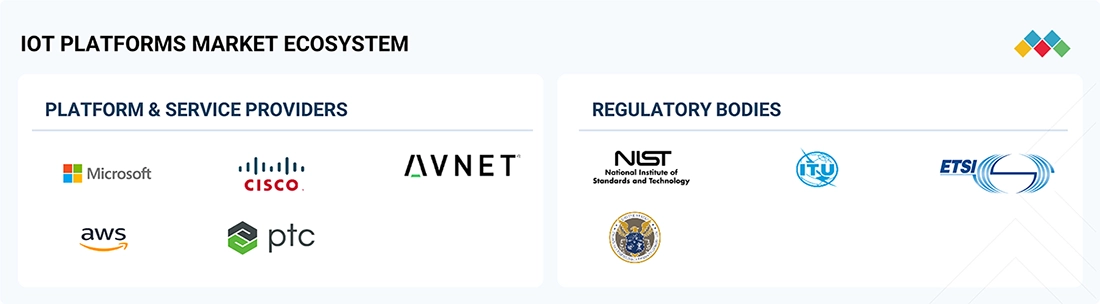
MARKET ECOSYSTEM
The IoT platform ecosystem is divided into two categories: platform and service providers (Microsoft, Cisco, Avnet, AWS, PTC) deliver cloud platforms, device management, edge orchestration, digital twin services, analytics, and partner marketplaces that form the core cloud-to-edge backbone; regulatory bodies (NIST, ITU, ETSI, and national regulators) provide security frameworks, interoperability standards, spectrum and certification rules, and compliance guidelines.
Logos and trademarks shown above are the property of their respective owners. Their use here is for informational and illustrative purposes only.
MARKET SEGMENTS
Source: Secondary Research, Interviews with Experts, MarketsandMarkets Analysis
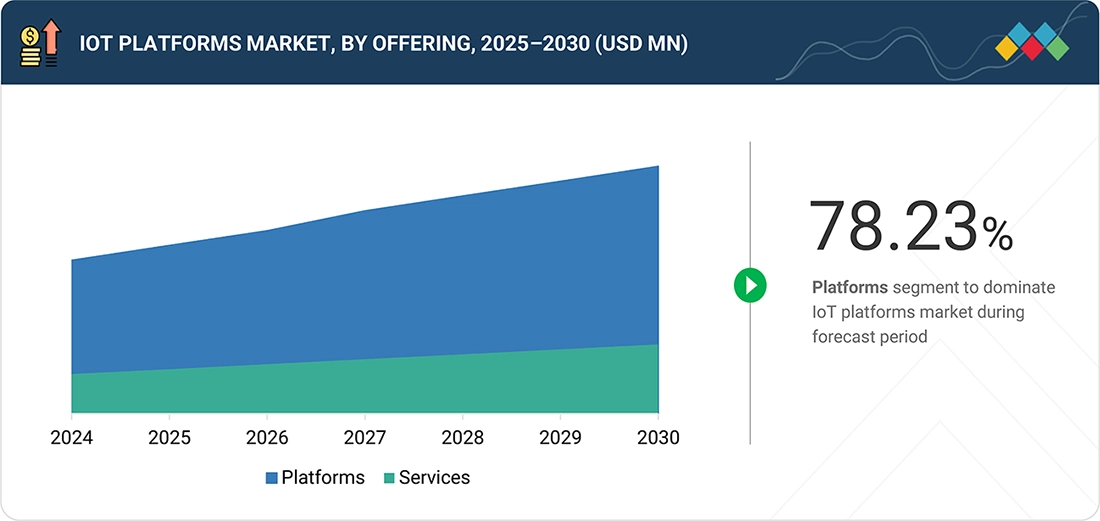
IoT Platforms Market, By Offering
The platform segment remains the largest part of the IoT platforms market. It serves as a critical middleware layer that connects physical hardware to actionable digital insights. Application enablement and device management layers lead this segment. They help businesses expand their connected systems with minimal custom coding. The shift toward hybrid and cloud-native architectures has accelerated. These architectures provide the infrastructure needed to handle massive data streams from billions of global endpoints. Major providers are increasingly incorporating analytics and edge-to-cloud orchestration into these platforms to lower total ownership costs. As a result, the platform layer continues to lead in revenue and serves as the key foundation for all enterprise-level digital transformations.
IoT Platforms Market, By Application
The emergency and incident management segment is a high-priority application driven by the urgent need for real-time situational awareness in public safety. These platforms integrate diverse sensor data—ranging from smoke detectors and seismic sensors to AI-powered surveillance cameras—to provide a unified view of unfolding crises. By automating alerts and coordinating responses across multiple agencies, IoT-enabled systems have significantly reduced emergency response times in both urban and rural environments. The growing frequency of natural disasters and the expansion of smart city initiatives are further fueling demand for these resilient, low-latency communication networks. This segment relies heavily on secure, interoperable software that ensures mission-critical data reaches first responders without delay.
IoT Platforms Market, By Focus Area
Smart manufacturing stands as the largest focus area for the IoT platforms market, accounting for over a quarter of total industry deployments as factories embrace the full potential of Industry 4.0. IoT platforms in this sector are primarily utilized for predictive maintenance and real-time asset tracking, allowing manufacturers to prevent costly equipment failures before they occur. The integration of digital twins and AI-driven process optimization has enabled unprecedented levels of operational efficiency and production customization. Driven by the need to combat labor shortages and rising energy costs, manufacturers are investing heavily in these platforms to gain end-to-end visibility across their supply chains. As a result, the industrial sector continues to outpace all other focus areas in terms of IoT investment and realized business value.
REGION
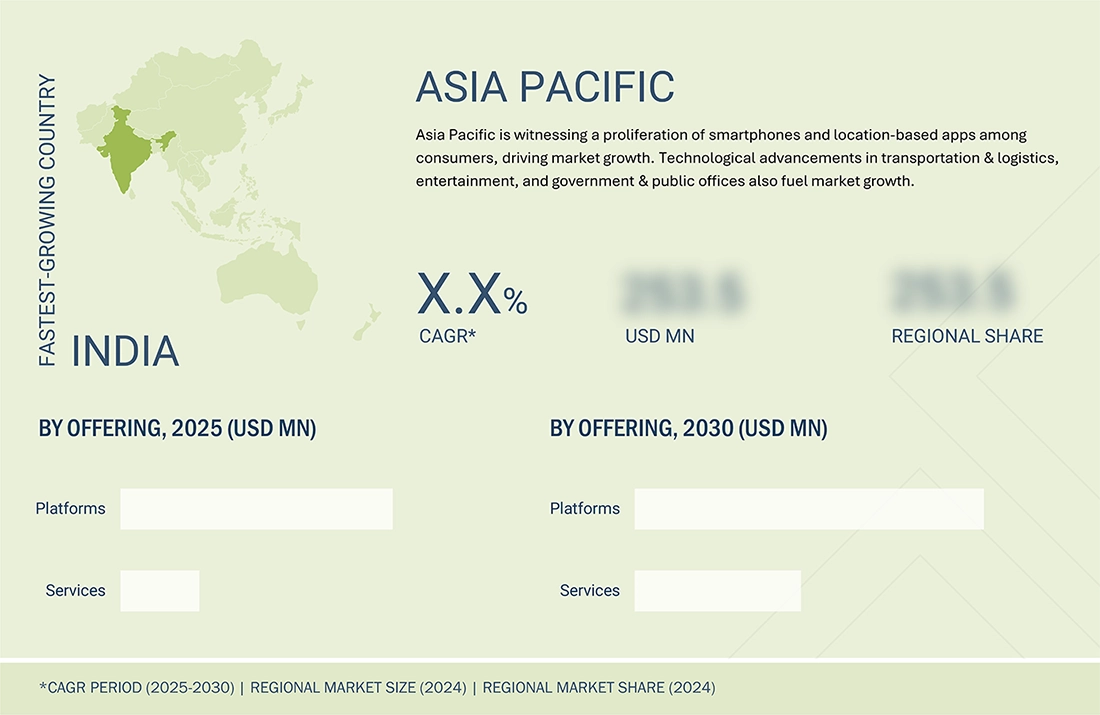
Asia Pacific to be the fastest-growing region in the global IoT platforms market during the forecast period
The Asia Pacific region is the fastest-growing market for IoT platforms, driven by extensive digital transformation and high-speed 5G deployments across China, India, and Japan. Governments in the region are aggressively funding smart infrastructure and industrial automation projects to bolster economic competitiveness. This rapid growth is supported by a robust ecosystem of local hardware manufacturers and a surge in cloud-native platform adoption among small and medium-sized enterprises. Furthermore, the growing need for real-time data analytics in densely populated urban centers is pushing enterprises toward scalable, intelligent middleware. As a result, Asia Pacific is not only a global manufacturing hub but also the leading engine for software-driven IoT innovation.
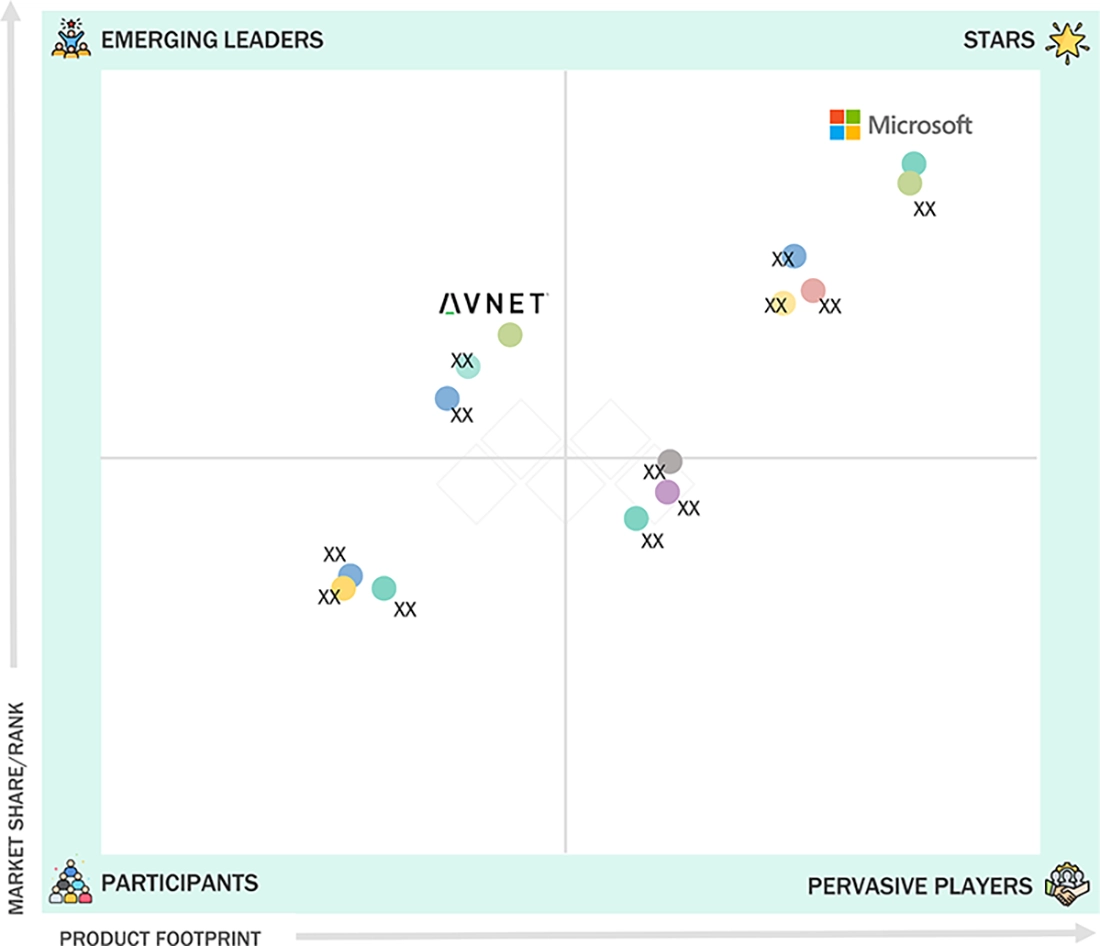
IOT PLATFORM MARKET: COMPANY EVALUATION MATRIX
In the IoT platforms market matrix, Microsoft (Star) leads with a strong market share and an extensive product footprint, driven by its customized solutions tailored to customers' requirements and growth strategies that consistently deliver advanced technology. Avnet (Emerging Leader) is gaining visibility with innovative solutions to meet future IoT demands. While Microsoft dominates through scale and a diverse portfolio, Avnet shows significant potential to move toward the leaders’ quadrant as IoT demand continues to rise.
Source: Secondary Research, Interviews with Experts, MarketsandMarkets Analysis
KEY MARKET PLAYERS
- Microsoft (US)
- AWS (US)
- Cisco (US)
- Oracle (US)
- PTC (US)
- SAP (Germany)
- IBM (US)
- Avnet (US)
- Google (US)
- Software AG (Germany)
- Hitachi (Japan)
- Telit Cinterion (US)
- Clearblade (US)
- HQSoftware (Estonia)
- emnify (Germany)
MARKET SCOPE
| REPORT METRIC | DETAILS |
|---|---|
| Market Size in 2024 (Value) | USD 40.28 Billion |
| Market Forecast in 2030 (Value) | USD 65.29 Billion |
| Growth Rate | CAGR of 8.1% from 2025 to 2030 |
| Years Considered | 2019-2030 |
| Base Year | 2024 |
| Forecast Period | 2025-2030 |
| Units Considered | Value (USD Million/Billion) |
| Report Coverage | Revenue forecast, company ranking, competitive landscape, growth factors, and trends |
| Segments Covered |
|
| Regions Covered | North America, Europe, Asia Pacific, Middle East & Africa, Latin America |
WHAT IS IN IT FOR YOU: IOT PLATFORM MARKET REPORT CONTENT GUIDE
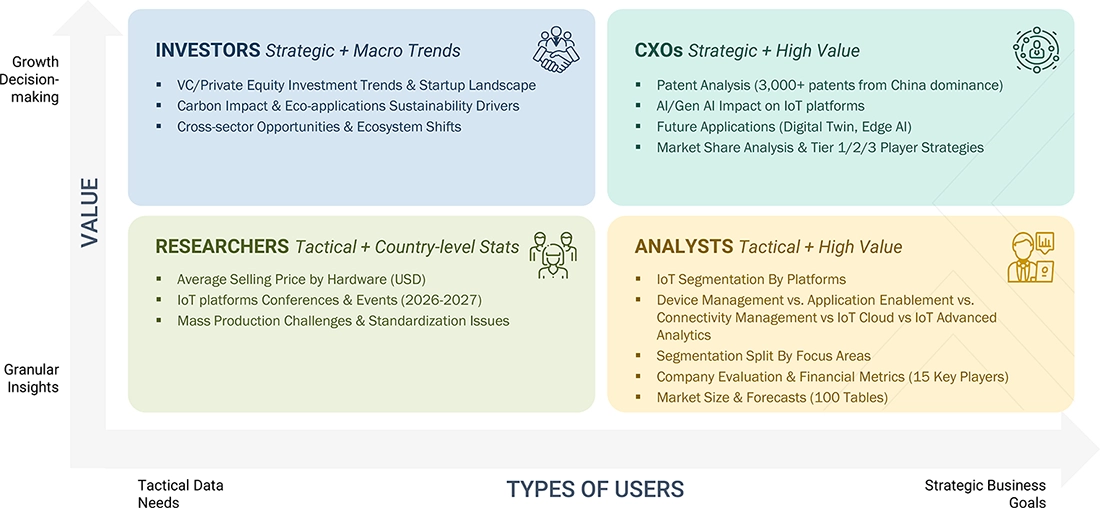
DELIVERED CUSTOMIZATIONS
We have successfully delivered the following deep-dive customizations:
| CLIENT REQUEST | CUSTOMIZATION DELIVERED | VALUE ADDS |
|---|---|---|
| Leading Solution Provider (Asia Pacific) | Product Analysis: Product Matrix, which gives a detailed comparison of the product portfolio of each company | Enhanced understanding of competitive positioning and product offerings |
| Leading Service Provider (US) | Company Information: Detailed analysis and profiling of additional market players (up to 5) | Deeper insights into market dynamics and potential strategic partnerships |
RECENT DEVELOPMENTS
- November 2025 : TPG agreed to acquire PTC's ThingWorx IoT and Kepware connectivity businesses, injecting capital for expanded industrial IoT growth worldwide.
- September 2025 : Siemens relaunched MindSphere as an Open Industry Cloud platform, supporting scalable IoT data management for global manufacturing users.
- June 2025 : AWS launched IoT RoboRunner for robotics orchestration alongside IoT ExpressLink modules and Private 5G service to enhance global industrial IoT edge deployments.
Table of Contents
 Exclusive indicates content/data unique to MarketsandMarkets and not available with any competitors.
Key Questions Addressed by the Report
What is the projected size of the global IoT Platform market by 2030?
The global IoT Platform market is projected to grow from USD 44.30 billion in 2025 to USD 65.29 billion by 2030, registering a CAGR of 8.1% during the forecast period (2025–2030). The market is expanding as organizations increasingly adopt AI-enabled, hybrid cloud IoT platforms to improve operational efficiency, predictive maintenance, and connected product development.
What is driving the growth of the IoT Platform Market?
The IoT Platform Market is growing due to increasing enterprise adoption of connected devices, demand for real-time data analytics, cloud-based IoT deployments, and the need for secure device management across industries.
Which industries are the primary adopters of IoT platforms?
Major adopters of IoT platforms include manufacturing, healthcare, transportation and logistics, retail, energy and utilities, and smart city projects, where connected devices improve operational efficiency and decision-making.
Which region is expected to lead the IoT Platform Market?
North America is expected to hold a significant share of the IoT Platform Market due to early technology adoption, strong cloud infrastructure, and the presence of leading IoT solution providers, while Asia Pacific is projected to experience the fastest growth.
What are the key trends shaping the IoT Platform Market?
Key trends include AI-enabled IoT platforms, edge computing integration, low-code/no-code IoT application development, enhanced cybersecurity capabilities, digital twin adoption, and increasing deployment of 5G-enabled IoT solutions.
Who are the major companies in the IoT Platform Market?
According to the MarketsandMarkets report, leading players in the IoT Platform Market include IBM, Microsoft, Amazon Web Services (AWS), Google, Oracle, Cisco, PTC, Siemens, SAP, and Bosch, focusing on platform innovation, cloud integration, and industry-specific IoT solutions.


Personalize This Research
- Triangulate with your Own Data
- Get Data as per your Format and Definition
- Gain a Deeper Dive on a Specific Application, Geography, Customer or Competitor
- Any level of Personalization
Let Us Help You
- What are the Known and Unknown Adjacencies Impacting the IoT Platforms Market
- What will your New Revenue Sources be?
- Who will be your Top Customer; what will make them switch?
- Defend your Market Share or Win Competitors
- Get a Scorecard for Target Partners

Custom Market Research Services
We Will Customise The Research For You, In Case The Report Listed Above Does Not Meet With Your Requirements
Get 10% Free CustomisationTESTIMONIALS






Growth opportunities and latent adjacency in IoT Platforms Market