Latin America Managed Services Market Size & Share, Latest Trends - 2030

Latin America Managed Services Market by Service Type (Managed IT Infrastructure & Data Center Services, Network Services, Security Services, Communication & Collaboration Services, Mobility Services), Organization Size, Vertical – Forecast to 2030




OVERVIEW
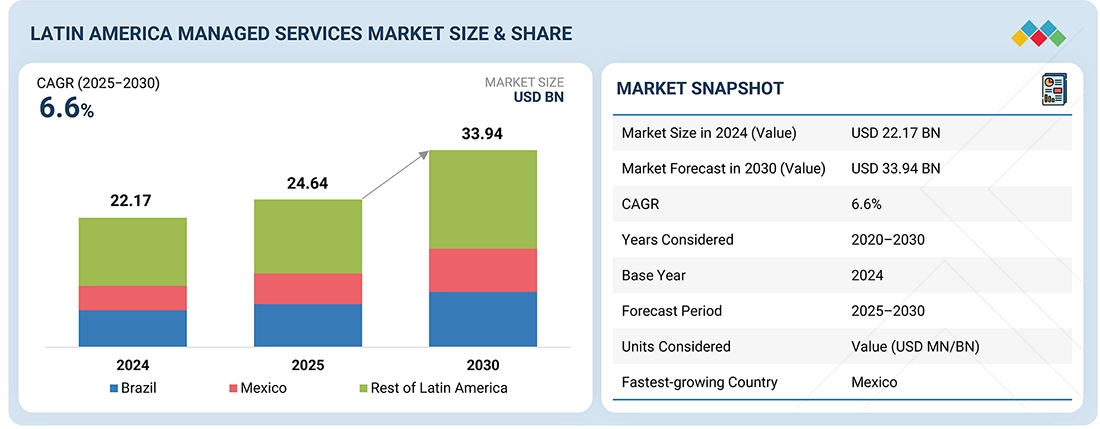
Source: Secondary Research, Interviews with Experts, MarketsandMarkets Analysis
The Latin America managed services market is projected to grow from USD 24.64 billion in 2025 to USD 33.94 billion by 2030, at a 6.6% CAGR. Growth is supported by rising cloud complexity and stronger security needs across enterprises adopting hybrid and multicloud operating model environments.
KEY TAKEAWAYS
-
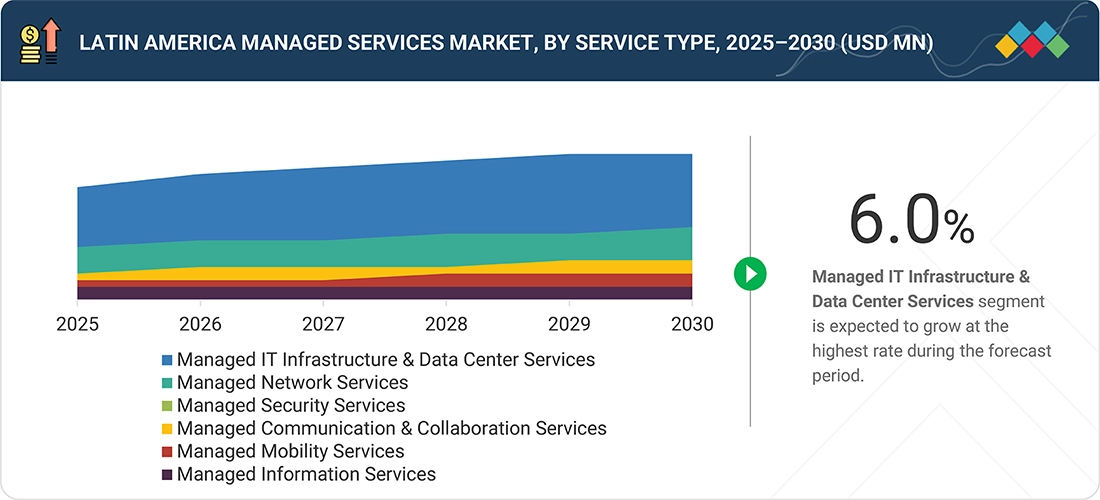
By Service TypeManaged security services segment is the fastest-growing service type in Latin America, with a projected 12.0% CAGR.
-
By Managed Security ServiceManaged detection and response segment is expected to record a CAGR of 20.8% during the forecast period.
-
By Managed Network ServiceManaged network security is fastest-growing network service segment in Latin America, projected at 8.4% CAGR.
-
By Managed IT Infrastructure & Data Center ServiceServer management is the fastest-growing segment in Latin America, driven by migration.
-
By Managed Communication & Collaboration ServiceManaged VOIP is the fastest-growing segment in the Latin America managed services market.
-
By Managed Mobility ServiceUnified endpoint management services segment is the fastest-growing in Latin America as remote work increases.
-
By Managed Information ServiceManaged information services represent the fastest-growing area in the Latin America as enterprises automate workflows.
-
By Deployment ModeCloud-based managed services are fastest-growing deployment model in Latin America, supported by cloud ecosystems.
-
By Organization SizeSMEs are the fastest-growing customer segment in Latin America as outsourcing enables cost control.
-
By VerticalHealthcare & life sciences segment is the fastest-growing vertical in Latin America due to digital health expansion.
-
Competitive Landscape – Large ProvidersIBM, Microsoft, and Accenture lead Latin America managed services market through global delivery scale, automation depth, and enterprise trust.
-
Competitive Landscape – Emerging ProvidersStefanini Group and KIO gain Latin America market traction by offering agile delivery, rapid onboarding, and cost-efficient managed service models.
The Latin America Managed Services Market grows steadily as enterprises prioritize cloud optimization, AI-driven automation, and advanced cybersecurity. Organizations increasingly outsource IT management to reduce operational complexity, enhance uptime, support hybrid work environments, and accelerate digital transformation across highly competitive, innovation-led industries and large distributed enterprise networks.
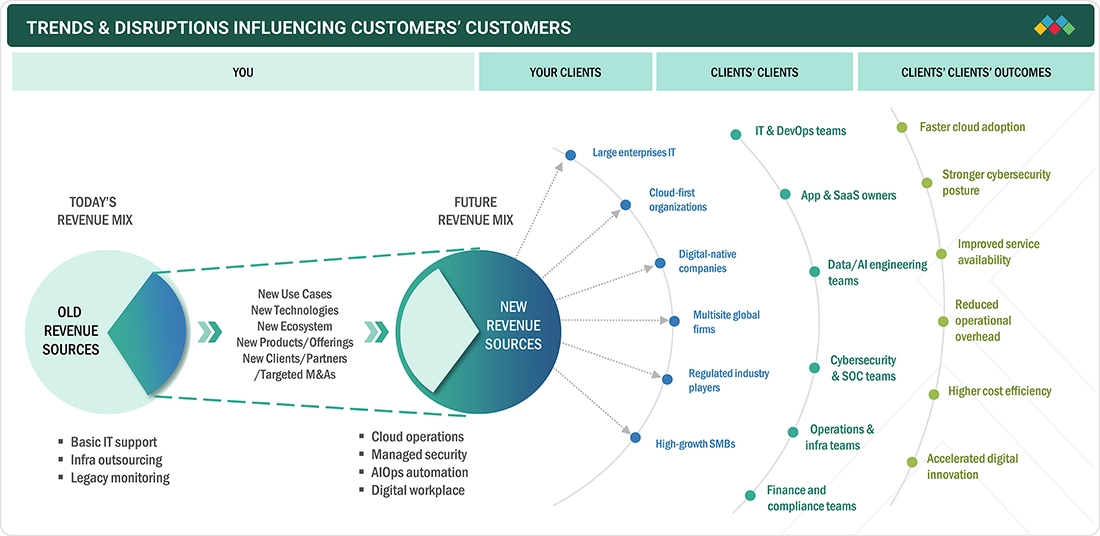
TRENDS & DISRUPTIONS IMPACTING CUSTOMERS' CUSTOMERS
The Latin America managed services market is reshaped by enterprise cloud modernization and AI-driven automation adoption across large distributed organizations. Enterprises increasingly select specialized partners to manage cybersecurity exposure support hybrid cloud operations deliver compliance assurance and control costs within multivendor environments.
Source: Secondary Research, Interviews with Experts, MarketsandMarkets Analysis
MARKET DYNAMICS

Level
-
Increasing need to minimize downtime and ensure business continuity

-
Growing emphasis on cybersecurity and stronger data protection investments


Level
-
Shortage of IT expertise

-
Slow internal decision-making


Level
-
Rising demand for MSP-led compliance and regulatory alignment

-
High adoption of multicloud operations requiring unified management


Level
-
Complex cloud migration and legacy IT integration requirements

-
Ongoing integration and maintenance issues across legacy infrastructure

Source: Secondary Research, Interviews with Experts, MarketsandMarkets Analysis
Driver: Increasing need to minimize downtime and ensure business continuity
Large enterprises in the Latin America managed services market are increasingly prioritizing uninterrupted digital operations across hybrid and multicloud environments. Managed service providers address this need by offering proactive monitoring and automated recovery capabilities that reduce downtime risk and protect enterprise revenue.
Restraint: Shortage of IT expertise
The Latin America managed services market continues to face shortages of skilled cloud security and automation professionals across industries. This talent gap is expected to raise delivery costs and slow deployment timelines for advanced managed services within complex enterprise IT environments.
Opportunity: Rising demand for MSP-led compliance and regulatory alignment
Regulatory pressure across healthcare, financial services, and critical infrastructure is intensifying within the Latin America managed services market. Managed service providers are increasingly engaged to deliver centralized governance, continuous monitoring, and audit readiness that lower compliance risk across distributed enterprise systems.
Challenge: Complex cloud migration and legacy IT integration requirements
Enterprises in the Latin America managed services market continue operating legacy systems alongside modern cloud platforms at scale. Migration programs are expected to require architectural redesign and stronger data alignment, which increases execution risk, raises costs, and slows large modernization initiatives.
LATIN AMERICA MANAGED SERVICES MARKET: COMMERCIAL USE CASES ACROSS INDUSTRIES
| COMPANY | USE CASE DESCRIPTION | BENEFITS |
|---|---|---|
 |
DNB partnered with Ericsson to use the AI-based Ericsson Operations Engine to manage six nationwide 5G networks. The solution simplified operations, automated network management, and supported reliable SLA delivery during rapid 5G rollout. | 99.8% network uptime | 500% reduction in alarm counts within six months | 90% faster complaint resolution through automation | New business outcomes enabled through predictive and intent-based operations |
 |
WaFd Bank partnered with AWS Managed Services to move core systems from on-premises infrastructure to the cloud. The engagement automated routine tasks and supported large-scale migration while limiting disruption across more than 200 branches. | 80% workload migration within one year | Lower operational overhead through automation | IT teams freed to focus on innovation | Improved development of customer-facing banking applications |
 |
O-I Glass collaborated with DXC Technology to deploy the DXC Uptime Experience Platform to modernize global IT operations. AI-driven automation and self-service tools improved system reliability and strengthened IT service consistency for more than 20,000 employees. | Enhanced system reliability and reduced downtime | Faster incident resolution | 35% reduction in IT costs | Improved employee experience using AI digital assistants |
Logos and trademarks shown above are the property of their respective owners. Their use here is for informational and illustrative purposes only.
MARKET ECOSYSTEM
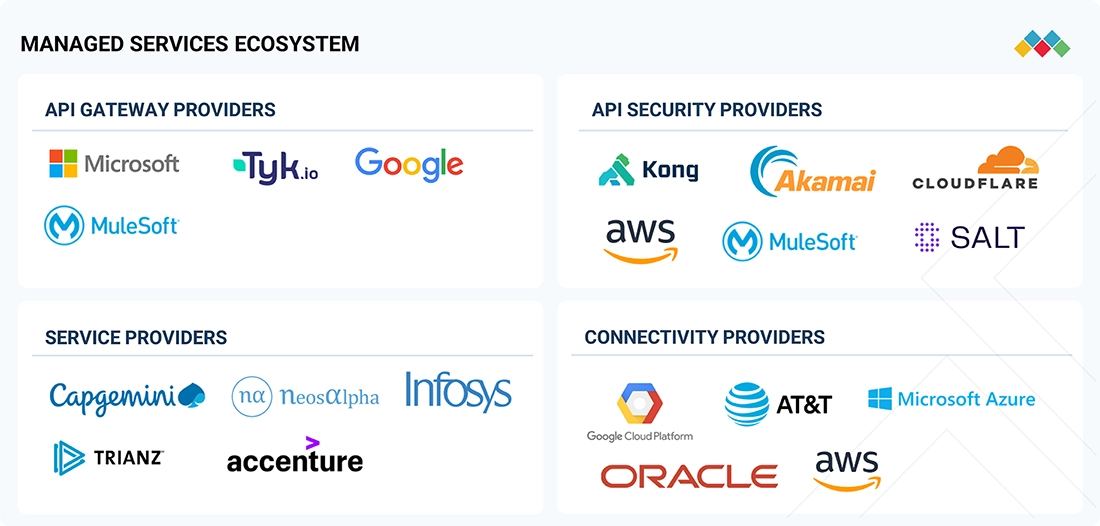
The Latin America managed services ecosystem includes API gateway providers, API security providers, service providers, and connectivity providers, supporting hybrid integration. The combined ecosystem layers enable secure data exchange strengthen governance and ensure resilient service delivery across distributed enterprise digital environments.
Logos and trademarks shown above are the property of their respective owners. Their use here is for informational and illustrative purposes only.
MARKET SEGMENTS
Source: Secondary Research, Interviews with Experts, MarketsandMarkets Analysis
By Service Type
Managed IT infrastructure and data center services segment is holding the largest share in Latin America. Enterprises are moving more workloads to the cloud and updating older systems, which increases the need for outsourced infrastructure management and day-to-day operational support.
By Managed Security Service
Managed detection and response segment is the leading security service in Latin America as cyber threats continue to increase. Enterprises rely on continuous monitoring and automated response to keep critical systems and sensitive data secure.
By Managed Network Service
Managed IP and VPN services segment is the largest network services segment in Latin America. Organizations depend on secure private connectivity to support distributed operations and ensure reliable access to cloud environments.
By Managed Communication & Collaboration Service
Managed UCaaS dominates communication services in Latin America due to sustained hybrid work adoption. Enterprises prefer cloud-based voice and collaboration platforms that offer reliability and centralized management.
By Managed Mobility Service
Unified endpoint management is the largest mobility service category in Latin America. The segment is driven by increasing device usage and stronger requirements for security, visibility, and regulatory compliance.
By Managed Information Service
Business process management leads information services adoption in Latin America. Enterprises use BPM to automate workflows and improve efficiency across customer-facing and internal business functions.
By Deployment Mode
Cloud-based delivery is the most widely used deployment model in Latin America. Enterprises favor cloud services for scalability, flexibility, and reduced operational complexity.
By Organization Size
Large enterprises account for most managed services adoption in Latin America. Complex IT environments and higher technology budgets support long-term outsourcing strategies.
By Vertical
BFSI is the largest industry adopting managed services in Latin America. Demand is driven by cybersecurity priorities, cloud modernization initiatives, and strict regulatory requirements.
REGION
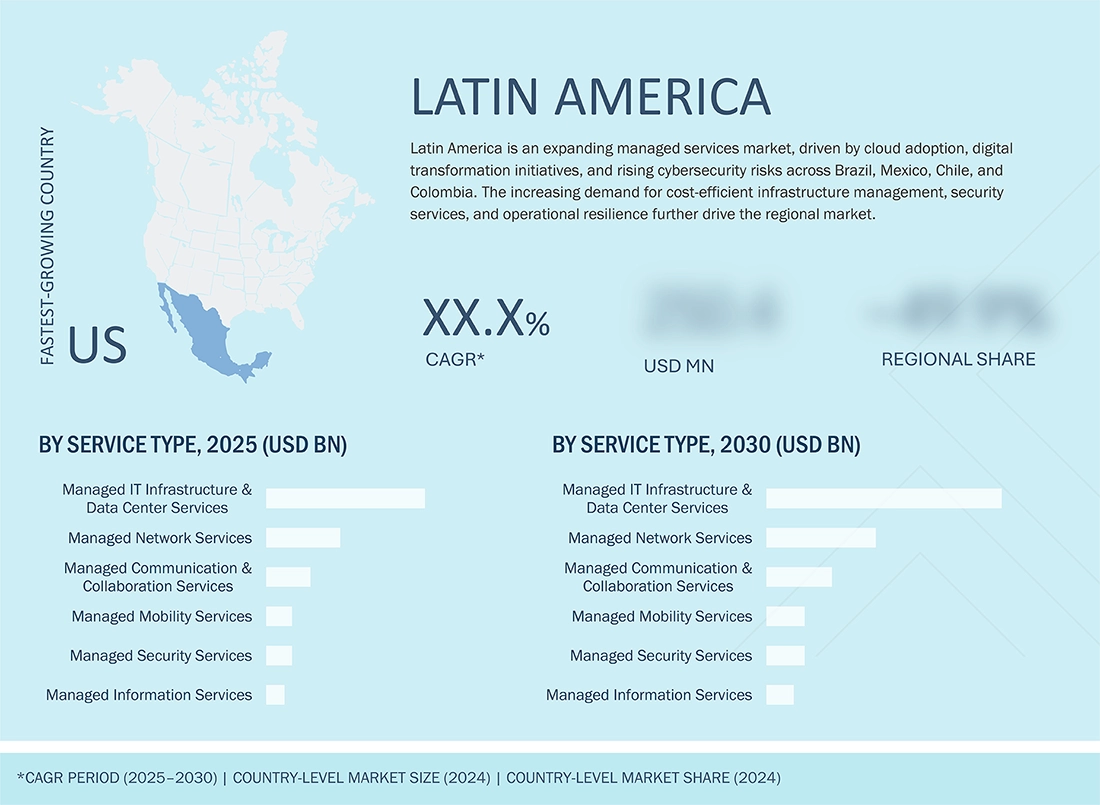
Mexico to be fastest-growing country in Latin America managed services market during forecast period
The Mexico managed services market is expected to witness the fastest growth rate during the forecast period. This market is projected to be driven by accelerating cloud adoption and rising cybersecurity requirements among enterprises adopting hybrid and multicloud operating models.
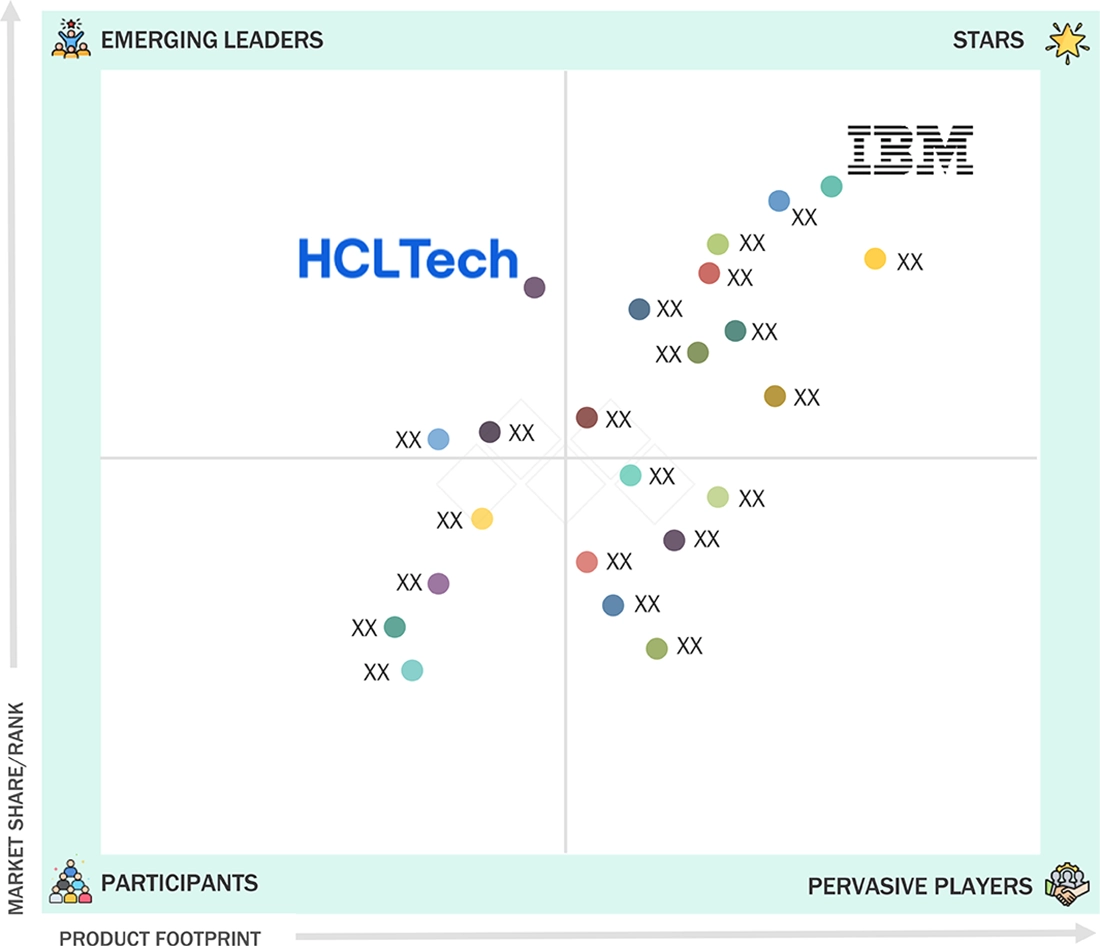
LATIN AMERICA MANAGED SERVICES MARKET: COMPANY EVALUATION MATRIX
The Company Evaluation Matrix places IBM in the Stars quadrant because of its strong market presence and mature service portfolio. HCLTech appears in the Emerging Leaders quadrant as its capabilities and service reach continue to expand. Other vendors fall across Participants and Pervasive Players, reflecting differences in scale, innovation readiness, and outsourcing depth.
Source: Secondary Research, Interviews with Experts, MarketsandMarkets Analysis
KEY MARKET PLAYERS
- IBM (US)
- Microsoft (US)
- Cisco (US)
- Google (US)
- DXC Technology (US)
- Stefanini Group (Brazil)
- TIVIT (Brazil)
- Sonda (Chile)
- Softtek (Mexico)
- KIO (Mexico)
- Tata Consultancy Services (India)
- HCL Technologies (India)
- Wipro (India)
- Fujitsu (Japan)
- NTT Data (Japan)
MARKET SCOPE
| REPORT METRIC | DETAILS |
|---|---|
| Market Size in 2024 (Value) | USD 22.17 Billion |
| Market Forecast in 2030 (Value) | USD 33.94 Billion |
| Growth Rate | CAGR of 6.6% from 2025–2030 |
| Years Considered | 2020–2030 |
| Base Year | 2024 |
| Forecast Period | 2025–2030 |
| Units Considered | Value (USD Billion) |
| Report Coverage | Revenue forecast, company ranking, competitive landscape, vendor positioning, segment-wise analysis, regional trends, technological developments, key commercial use cases, and growth factors |
| Segments Covered |
|
| Countries Covered | Brazil, Mexico, and Rest of Latin America |
WHAT IS IN IT FOR YOU: LATIN AMERICA MANAGED SERVICES MARKET REPORT CONTENT GUIDE
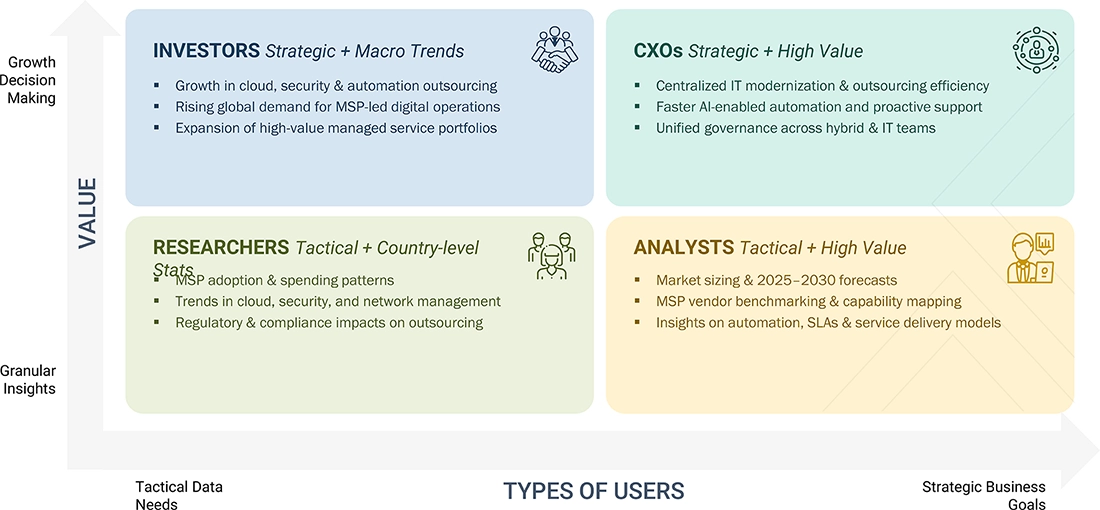
DELIVERED CUSTOMIZATIONS
We have successfully delivered the following deep-dive customizations:
| CLIENT REQUEST | CUSTOMIZATION DELIVERED | VALUE ADDS |
|---|---|---|
| Global Enterprise (IT, BFSI, Retail, Manufacturing) |
|
|
| Telecom Operator (Network Modernization & 5G Rollout) |
|
|
| Cloud & Data Center Provider (Hybrid Cloud Services) |
|
|
RECENT DEVELOPMENTS
- November 2025 : Kyndryl to acquire Solvinity, a provider of secure managed cloud platforms and services. The acquisition will make Kyndryls cloud services better by combining what they already do with what Solvinity does. Both companies collaborate to ensure that critical workloads are up-to-date, secure, and automated. These workloads must adhere to numerous rules and regulations. The goal of Kyndryl and Solvinity is to help these workloads run smoothly and securely. Kyndryl and Solvinity will achieve this by using their skills and experience to modernize and protect these workloads.
- August 2025 : Capgemini entered an agreement to acquire Cloud4C, a provider specializing in automation-focused managed services for hybrid and sovereign cloud environments. This move reinforces Capgemini’s position in cloud managed services by expanding its AI-ready capabilities, low-code platforms, and industry-specific frameworks. The expanded portfolio supports complex cloud migrations, day-to-day operations, security management, and business continuity programs.
- August 2025 : Vodafone Idea collaborated with IBM to enhance its computer systems with intelligence. They are launching an AI Innovation Hub, streamlining their development process. This will help Vodafone Idea work smoothly, make its services more stable, and complete tasks more efficiently. The company aims to utilize automation and artificial intelligence to understand customer needs and enhance their overall satisfaction. Vodafone Idea and IBM are collaborating to enhance Vodafone Idea's services with the aid of intelligence.
- August 2025 : NTT DATA and Google Cloud established a global partnership focused on accelerating agentic AI adoption and broader cloud modernization efforts. Under the partnership, NTT DATA is responsible for delivering end-to-end AI and cloud solutions on Google Cloud, covering design, deployment, hosting, and ongoing management. The offering includes sovereign and distributed cloud models and is supported by dedicated Google Cloud resources and a large pool of certified specialists.
Table of Contents
 Exclusive indicates content/data unique to MarketsandMarkets and not available with any competitors.
Methodology
The study comprised four main activities to estimate the Latin America Managed Services Market size. We conducted significant secondary research to gather data on the market, the competing market, and the parent market. The following stage involved conducting primary research to confirm these conclusions and hypotheses and sizing with industry experts throughout the value chain. The overall market size was evaluated using a blend of top-down and bottom-up approach methodologies. After that, we estimated the market sizes of the various Latin America Managed Services Market segments using the market breakup and data triangulation techniques.
Secondary Research
We determined the size of companies offering managed services based on secondary data from paid and unpaid sources. We also analyzed major companies' product portfolios and rated them based on their performance and quality.
In the secondary research process, various sources were referred to identify and collect information for this study. Secondary sources included annual reports, press releases, and investor presentations of companies; white papers, journals, and certified publications; and articles from recognized authors, directories, and databases. The data was also collected from other secondary sources, such as journals, government websites, blogs, and vendors' websites. Additionally, the spending of various countries on the Latin America Managed Services Market was extracted from the respective sources. We used secondary research to obtain the critical information related to the industry's value chain and supply chain to identify the key players based on platform, services, market classification, and segmentation according to components of the major players, industry trends related to components, users, and regions, and the key developments from both market- and technology-oriented perspectives.
Primary Research
In the primary research process, we interviewed various primary sources from the supply and demand sides of the Latin America Managed Services Market to obtain qualitative and quantitative information. The primary sources from the supply side included industry experts, such as Chief Executive Officers (CEOs), Vice Presidents (VPs), marketing directors, technology and innovation directors, and related key executives from vendors providing offerings, associated service providers, and is operating in the targeted countries. All possible parameters that affect the market covered in this research study have been accounted for, viewed in extensive detail, verified through primary research, and analyzed to arrive at the final quantitative and qualitative data.
After the complete market engineering process (including calculations for market statistics, market breakup, market size estimations, market forecasting, and data triangulation), we conducted extensive primary research to gather information and verify and validate the critical numbers arrived at. The primary research also helped identify and validate the segmentation, industry trends, key players, competitive landscape, and market dynamics, such as drivers, restraints, opportunities, challenges, and key strategies. In the complete market engineering process, the bottom-up approach and several data triangulation methods were extensively used to perform market estimation and market forecasting for the overall market segments and subsegments listed in this report. We conducted an extensive qualitative and quantitative analysis of the complete market engineering process to list the key information/insights throughout the report.
To know about the assumptions considered for the study, download the pdf brochure
Market Size Estimation
The Latin America Managed Services Market and related submarkets were estimated and forecasted using top-down and bottom-up methodologies. We used the bottom-up method to determine the market's overall size, using the revenues and product offerings of the major market players. This research ascertained and validated the precise value of the total parent market size through data triangulation techniques and primary interview validation. Next, using percentage splits of the market segments, we utilized the overall market size in the top-down approach to estimate the size of other individual markets.
The research methodology used to estimate the market size included the following:
- We used primary and secondary research to determine the revenue contributions of the major market participants in each country after secondary research helped identify them.
- Throughout the process, we obtained critical insights by conducting in-depth interviews with industry professionals, including directors, CEOs, VPs, and marketing executives, and by reading the annual and financial reports of the top firms in the market.
- We used primary sources to verify all percentage splits and breakups, which we calculated using secondary sources.
Data Triangulation
Once the overall market size was determined, we divided the market into segments and subsegments using the previously described market size estimation procedures. When required, market breakdown and data triangulation procedures were employed to complete the market engineering process and specify the exact figures for every market segment and subsegment. The data was triangulated by examining several variables and patterns from government entities' supply and demand sides.
Market Definition
Considering the views of various sources and associations, MarketsandMarkets defines Managed Services as the practice of outsourcing the responsibility for proactively maintaining and managing a range of business functions or IT infrastructure. Managed services allow organizations to offload specific tasks, such as network management, security, and system maintenance, to a third-party provider, a Managed Service Provider (MSP). MSPs assume ongoing responsibility for managing and improving the outsourced services while ensuring they align with an organization's goals, often operating under a subscription model.
Stakeholders
- Global Managed Services Providers
- Cloud Service Providers (CSPs)
- Independent Software Vendors (ISVs)
- System Integrators
- Value-Added Resellers (VARs)
- Managed Service Providers (MSPs)
- Chief Financial Officers (CFOs)
- Information Technology (IT) Directors
- Small and Medium-sized Enterprises (SMEs)
- IT Strategy Consultants
- Managed Services Consulting Vendors
- Technology Partners
- Research Organizations
- Enterprise Users
- Technology Providers
Report Objectives
- To define, describe, and forecast the Latin America Managed Services Market based on service type, managed security services, managed network services, managed IT infrastructure & data center services, managed communication & collaboration services, managed mobility services, managed information services, deployment type, organization size, vertical, and region.
- To strategically analyze the market subsegments to individual growth trends, prospects, and contributions to the total market
- To provide detailed information related to the significant factors influencing the growth of the market (drivers, restraints, opportunities, and challenges)
- To strategically analyze macro and micro markets concerning growth trends, prospects, and their contributions to the overall market
- To analyze industry trends, patents and innovations, and pricing data related to the Latin America Managed Services Market
- To analyze the opportunities in the market for stakeholders and provide details of the competitive landscape for prominent players
- To profile key players in the market and comprehensively analyze their market share/ranking and core competencies.
- To track and analyze competitive developments, such as mergers & acquisitions, product developments, and partnerships & collaborations in the market.
Available Customizations
MarketsandMarkets provides customizations based on the company's unique requirements using market data. The following customization options are available for the report:
Product Analysis
- The product matrix provides a detailed comparison of each company's portfolio.
Company Information
- Detailed analysis and profiling of five additional market players
Key Questions Addressed by the Report
What is the current size of the Latin America Managed Services Market?
The Latin America Managed Services Market is projected to grow from USD 24.64 billion in 2025 to USD 33.94 billion by 2030 at a CAGR of 6.6%.
What is driving growth in the Latin America Managed Services Market?
Market growth is driven by increasing hybrid and multi-cloud adoption, rising cybersecurity concerns, and demand for cost-efficient IT operations.
Which managed service segment is growing the fastest in Latin America?
Managed security services are the fastest-growing segment, expected to register a CAGR of 12.0% during the forecast period.
Which countries lead the Latin America Managed Services Market?
Brazil, Mexico, and Chile are the leading markets due to stronger digital infrastructure and enterprise cloud adoption.
Who are the leading players in the Latin America Managed Services Market?
Key players include IBM, Accenture, DXC Technology, Fujitsu, NTT Data, Stefanini Group, TIVIT, SONDA, Softtek, and KIO Networks.
What are the key investment opportunities in the Latin America Managed Services Market?
High-growth investment areas include managed detection and response (MDR), cloud security, server management, and managed VoIP services.


Personalize This Research
- Triangulate with your Own Data
- Get Data as per your Format and Definition
- Gain a Deeper Dive on a Specific Application, Geography, Customer or Competitor
- Any level of Personalization
Let Us Help You
- What are the Known and Unknown Adjacencies Impacting the Latin America Managed Services Market
- What will your New Revenue Sources be?
- Who will be your Top Customer; what will make them switch?
- Defend your Market Share or Win Competitors
- Get a Scorecard for Target Partners

Custom Market Research Services
We Will Customise The Research For You, In Case The Report Listed Above Does Not Meet With Your Requirements
Get 10% Free Customisation





Growth opportunities and latent adjacency in Latin America Managed Services Market