Automotive Sensors Market Size, Share & Trends

Automotive Sensors Market Size, Share & Trends by Sales Channel (OEM, Aftermarket), Type (Temperature, Pressure, Oxygen, Position, Speed, Inertial, Image, Level, Chemical, Lidar, Current Sensors), Vehicle Type (Passenger Car, LCV, HCV), Application - Global Forecast to 2032




Automotive Sensors Market Overview
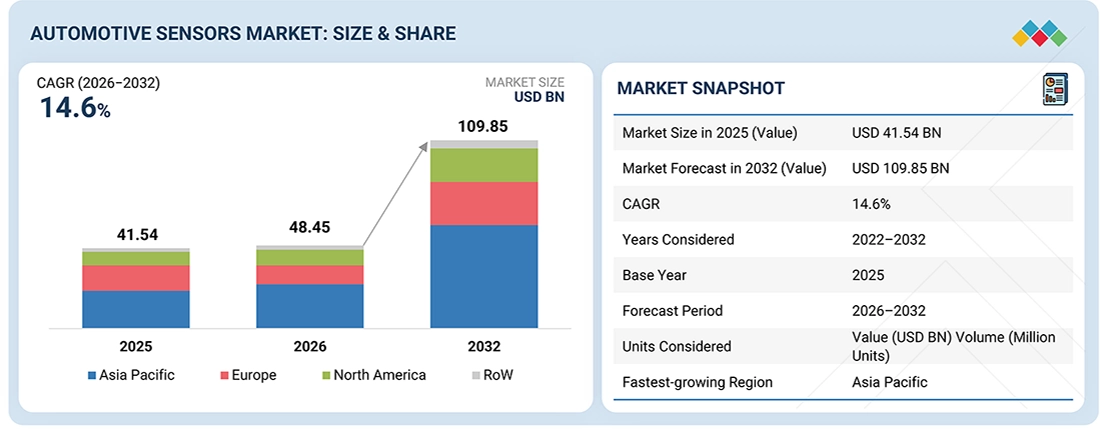
According to Marketsandmarkets, the automotive sensors market size is estimated to grow from USD 48.45 billion in 2026 to USD 109.85 billion by 2032, at a CAGR of 14.6%. The automotive sensor market is driven by the growing adoption of safety and driver-assistance features, rising electric vehicle production, and advancements in connected and autonomous mobility. Regulatory initiatives aimed at improving vehicle safety, reducing emissions, and enhancing fuel efficiency are further supporting sensor adoption across automotive applications.
Report Scope
| REPORT METRIC | DETAILS |
|---|---|
| Market Size in 2025 (Value) | USD 41.54 Billion |
| Market Forecast in 2026 (Value) | USD 48.45 Billion |
| Market Forecast in 2032 (Value) | USD 109.85 Billion |
| CAGR | CAGR of 14.6% from 2026-2032 |
| Years Considered | 2022–2032 |
| Base Year | 2025 |
| Forecast Period | 2026–2032 |
| Units Considered | Value (USD Billion), Volume (Million Units) |
| Report Coverage | Revenue Forecast, Company Ranking, Competitive Landscape, Growth Factors, and Trends |
| Top Companies |
|
| Growth Driver |
|
| Segments Covered |
|
| Regions Covered | North America, Europe, Asia Pacific and Rest of the World (RoW) |
KEY TAKEAWAYS
-
BY REGIONThe Asia Pacific region is anticipated to record the highest CAGR of 15.1% in the automotive sensors market during the forecast period.
-
BY SENSOR TYPEThe position sensors segment accounted for the largest market share of 21.6% of the global market, by sensor type, in 2025.
-
BY VEHICLE TYPEThe passenger cars segment is expected to register the highest CAGR in the automotive sensors market, by vehicle type, during the forecast period.
-
BY APPLICATIONPowertrain Systems captured the largest market share of 27.6% in 2025.
-
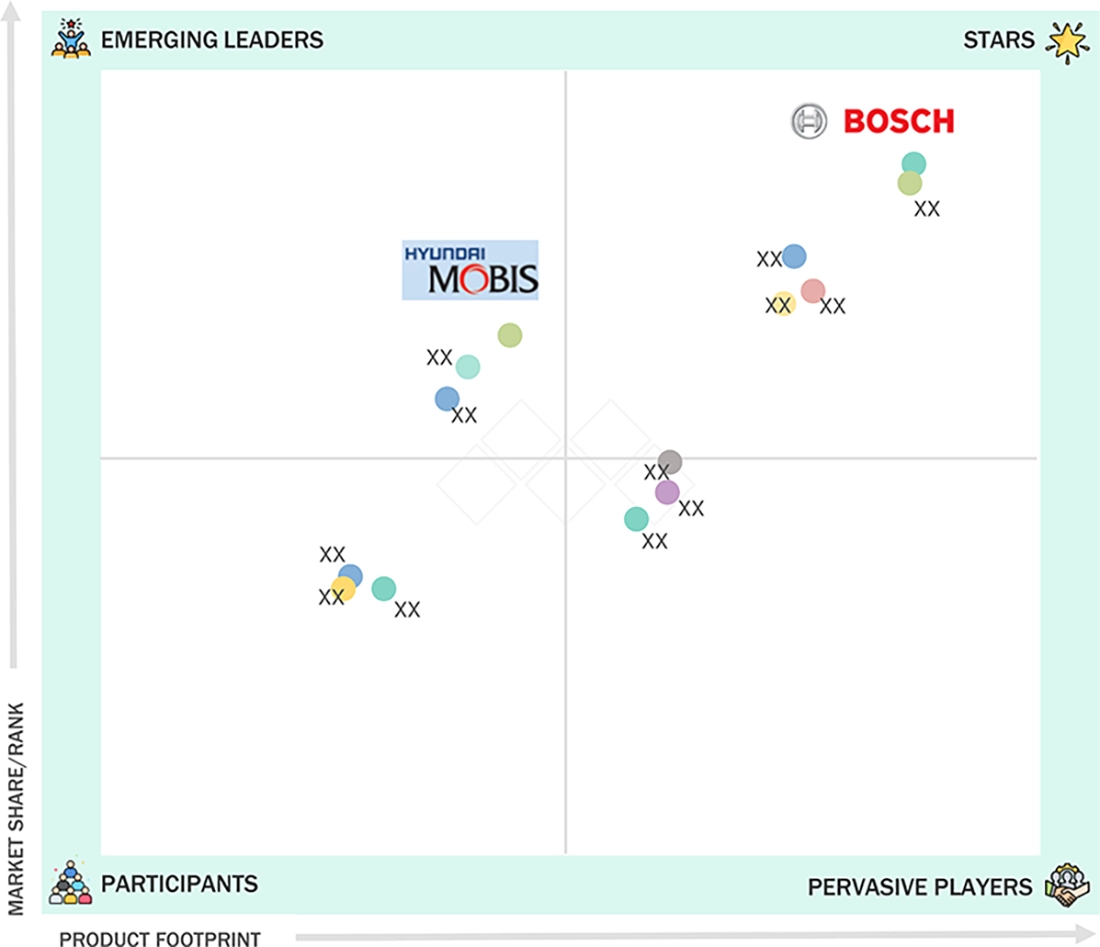
COMPETITIVE LANDSCAPE (KEY PLAYERS)Robert Bosch GmbH, DENSO Corporation, Aptiv PLC, and Valeo SA (France) were identified as star players in the automotive sensors market due to their active involvement in advancing ADAS, lidar, radar, image sensing, and connected vehicle technologies.
-
COMPETITIVE LANDSCAPE (STARTUPS/SMES)TracSense, Revvo, and COMPREDICT are some startups and SMEs focused on smart sensing, predictive analytics, and software-defined vehicle technologies to improve vehicle intelligence, safety, and maintenance capabilities.
The automotive sensors market share is primarily supported by the increasing penetration of safety and driver-assistance technologies, the rapid shift toward vehicle electrification, and the development of connected and autonomous vehicles. In addition, regulatory mandates related to passenger safety, environmental compliance, and fuel economy are encouraging automakers to incorporate a higher number of sensors across vehicle systems.
Source: Secondary Research, Interviews with Experts, MarketsandMarkets Analysis
TRENDS & DISRUPTIONS IMPACTING CUSTOMERS' CUSTOMERS
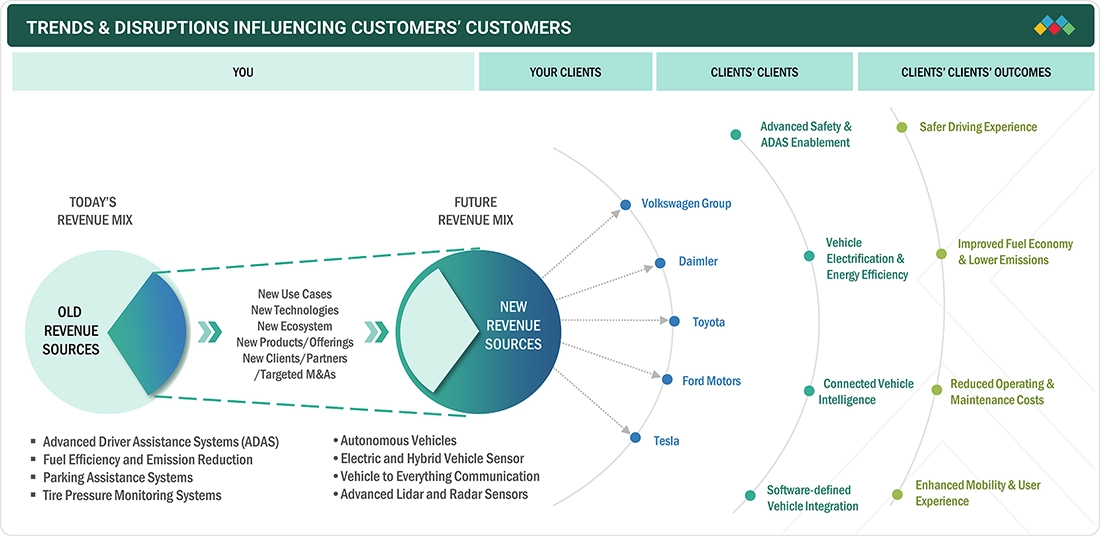
The automotive sensors market trends is undergoing a significant transformation as revenue generation shifts from conventional sensing applications toward advanced solutions supporting vehicle electrification, connectivity, and autonomous driving. Historically, market revenues were largely derived from powertrain, temperature, pressure, and emission-monitoring sensors used in internal combustion engine vehicles. However, the increasing adoption of ADAS, electric vehicles, and connected vehicle technologies is creating new revenue streams centered on lidar, radar, image sensors, battery management sensors, and occupant monitoring systems. To capitalize on these opportunities, sensor manufacturers are expanding their technological capabilities and strengthening relationships with leading automotive OEMs such as Toyota, Volkswagen, Hyundai, Tesla, and BYD. These customers are increasingly focused on vehicle safety, electrification, software-defined architectures, and autonomous driving capabilities, driving demand for sophisticated sensing solutions. As a result, innovation in AI-enabled sensor fusion, solid-state lidar, 4D imaging radar, and edge computing technologies is becoming a key competitive differentiator. Ultimately, these advancements are expected to deliver tangible benefits to end users, including enhanced safety, improved vehicle efficiency, greater connectivity, lower operating costs, and higher levels of vehicle automation. Consequently, the market's future growth trajectory will be shaped by the industry's transition toward intelligent, connected, and increasingly autonomous mobility ecosystems.
Source: Secondary Research, Interviews with Experts, MarketsandMarkets Analysis
MARKET DYNAMICS

Level
-
Significant demand for multi-sensor ADAS architectures fueled by safety mandates and autonomous driving trend

-
High adoption of cutting-edge electronics and software to enhance vehicle and passenger safety


Level
-
Shortage of aftermarket service professionals in emerging economies

-
High cost of lidar automotive sensors


Level
-
Rapid expansion of autonomous and connected vehicles

-
Rising demand for automotive aftermarket services


Level
-
Safety and security threats in autonomous vehicles

-
Reliance on associated technologies to ensure functional accuracy

Source: Secondary Research, Interviews with Experts, MarketsandMarkets Analysis
Driver: Significant demand for multi-sensor ADAS architectures fueled by safety mandates and autonomous driving trend
Vehicles are becoming increasingly complex due to the integration of electronics and software, driving the need for enhanced safety, security, and comfort. Automotive security, particularly vehicle authentication, is crucial to prevent counterfeiting and ensure secure data communication. Governments and OEMs are concerned about improving infotainment system safety due to rising consumer demand for advanced technologies. Electrical control systems are now essential in vehicles, enhancing safety and providing real-time insights into vehicle performance. Automotive semiconductor vendors are poised to benefit from rising demand for MCUs, sensors, and memory modules, as OEMs focus on automation, electrification, and digital connectivity. This consumer demand propels growth in the automotive sensor market. Safety features like ABS and airbags are mandated in Asia, while Europe and North America focus on deploying driver-assistance systems in commercial vehicles. Major manufacturers, such as Volkswagen and Ford, are standardizing safety features and investing in advanced technologies to remain competitive, increasing the demand for automotive sensors.
Restraint: Shortage of aftermarket service professionals in emerging economies
The automotive sensor business is heavily reliant on OEMs, lacking a robust aftermarket. Most technical specifications for sensors come from vehicle manufacturers or tier 1 suppliers, posing challenges for new companies seeking to innovate. They face costly and time-consuming testing and compliance with safety regulations before market entry. The absence of standardized interfaces complicates integration, as automakers prefer established solutions for reliability. This conservative approach leads to a slow pace of innovation, resulting in a small retrofit market for new sensors like radar and lidar. While the aftermarket is somewhat developed in North America and Europe, it remains underdeveloped in emerging economies in Asia Pacific.
Opportunity: Rapid expansion of autonomous and connected vehicles
The rise of autonomous, connected, and software-defined vehicles (SDVs) presents a major opportunity for automotive sensor manufacturers. These vehicles require a variety of sensors—such as radar, lidar, cameras, and ultrasonic sensors—for functions like object detection, navigation, and collision avoidance. Additionally, the growth of vehicle-to-everything (V2X) communication increases the demand for sensors that provide real-time data on vehicle position and road conditions. As automakers focus on vehicle automation and connectivity, the need for advanced, high-performance sensors is expected to grow significantly.
Challenge: Safety and security threats in autonomous vehicles
In recent years, autonomous cars have gained traction, but several fatal incidents involving Level 3 to Level 5 vehicles highlight safety concerns due to limited human interaction. The EU Agency for Cybersecurity (ENISA) and the Joint Research Centre (JRC) reported significant cybersecurity risks, including vulnerability to adversarial machine learning attacks, such as evasion or poisoning attacks that can manipulate vehicle systems. For example, Tesla vehicles have been tricked into accelerating rapidly by altered speed limit signs. Moreover, factors like adverse weather, poor road infrastructure, and unexpected obstacles challenge autonomous systems' perception and decision-making. To address these issues, integrating sensors—cameras, lidar, and radar—must be carefully calibrated. As advanced sensors become more common, it’s crucial for manufacturers to prioritize their accuracy and reliability, and implement security-by-design approaches to ensure the safety of AI technology on the roads.
AUTOMOTIVE SENSORS MARKET SIZE, SHARE AND GROWTH ANALYSIS: COMMERCIAL USE CASES ACROSS INDUSTRIES
| COMPANY | USE CASE DESCRIPTION | BENEFITS |
|---|---|---|
 |
Bosch expanded its collaboration with Qualcomm to develop advanced ADAS and automated driving solutions by integrating radar, camera, ultrasonic, and AI-enabled sensing technologies into next-generation vehicle platforms. | Improved vehicle perception and decision-making capabilities | Enhanced safety performance | Accelerated ADAS deployment | Supported higher levels of vehicle automation |
 |
DENSO strengthened its electrification portfolio through the development of advanced sensing and control solutions for battery management, thermal management, and vehicle energy optimization in electric vehicles. | Enhanced battery efficiency | Improved vehicle range and reliability | Optimized energy consumption | Supported electric vehicle adoption |
 |
Valeo advanced its LiDAR and sensor fusion capabilities to support ADAS and autonomous driving applications, enabling more accurate detection of vehicles, pedestrians, and road obstacles. | Improved sensing accuracy and environmental perception | Enhanced vehicle safety | Enabled advanced autonomous driving functions | Strengthened OEM competitiveness through differentiated safety features |
Logos and trademarks shown above are the property of their respective owners. Their use here is for informational and illustrative purposes only.
MARKET ECOSYSTEM
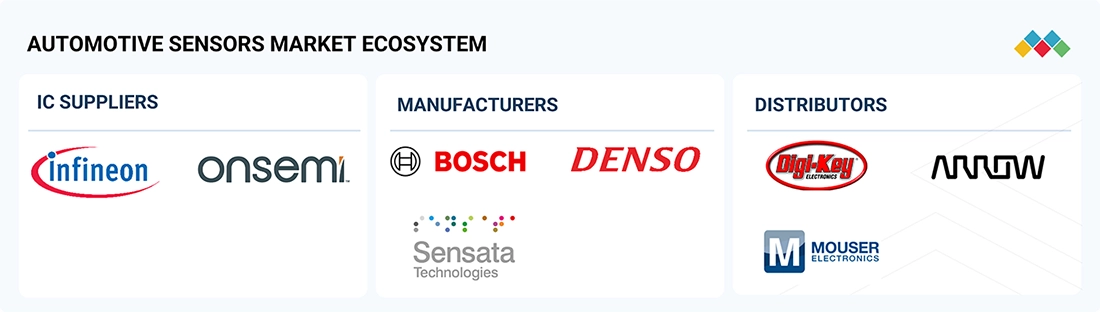
The automotive sensor market ecosystem comprises semiconductor suppliers, sensor manufacturers, and distribution partners that collectively support the development, production, and commercialization of sensing solutions. Semiconductor companies such as Infineon Technologies AG and onsemi provide critical components, including microcontrollers, signal-processing ICs, power management devices, and sensing chips that form the foundation of automotive sensor systems. Sensor manufacturers such as Robert Bosch GmbH, DENSO Corporation, and Sensata Technologies leverage these semiconductor technologies to design and manufacture advanced pressure, temperature, position, inertial, radar, and battery management sensors for applications spanning ADAS, vehicle electrification, safety, and powertrain systems. Supporting the supply chain, distributors such as DigiKey and Mouser Electronics facilitate market access by ensuring efficient component sourcing, inventory management, and global distribution. The close collaboration among these ecosystem participants accelerates innovation, strengthens supply chain resilience, reduces time-to-market, and enables the large-scale deployment of next-generation automotive sensing technologies.
Logos and trademarks shown above are the property of their respective owners. Their use here is for informational and illustrative purposes only.
MARKET SEGMENTS
Source: Secondary Research, Interviews with Experts, MarketsandMarkets Analysis
Automotive Sensors Market, By Sensor Type
Lidar sensors are expected to experience the highest CAGR from 2026 to 2032, driven by their crucial role in ADAS and the shift towards autonomous driving. Unlike traditional sensors, lidar offers precise 3D environmental mapping, enhancing object detection and situational awareness. The growth in vehicle autonomy levels and demand for improved safety standards are increasing lidar adoption across various vehicle segments. Advances in solid-state lidar technology are further boosting performance while reducing size, power consumption, and cost, promoting commercial viability. Additionally, ongoing investments by automotive manufacturers in autonomous solutions and stringent regulatory safety requirements are set to support the growth of the lidar segment in the coming years.
Automotive Sensors Market, By Vehicle Type
Passenger cars are expected to be the fastest-growing segment during the forecast period, driven by strong global production and the integration of advanced technologies like ADAS, next-gen infotainment, and emissions controls. Increasing consumer demands for better performance, safety, and driving experiences, along with stringent regulations for fuel efficiency and emissions, are pushing automotive manufacturers to adopt more complex electronic systems. The convergence of electrification, connectivity, and autonomous driving is set to sustain high demand, reinforcing the growth of passenger cars in the global automotive market.
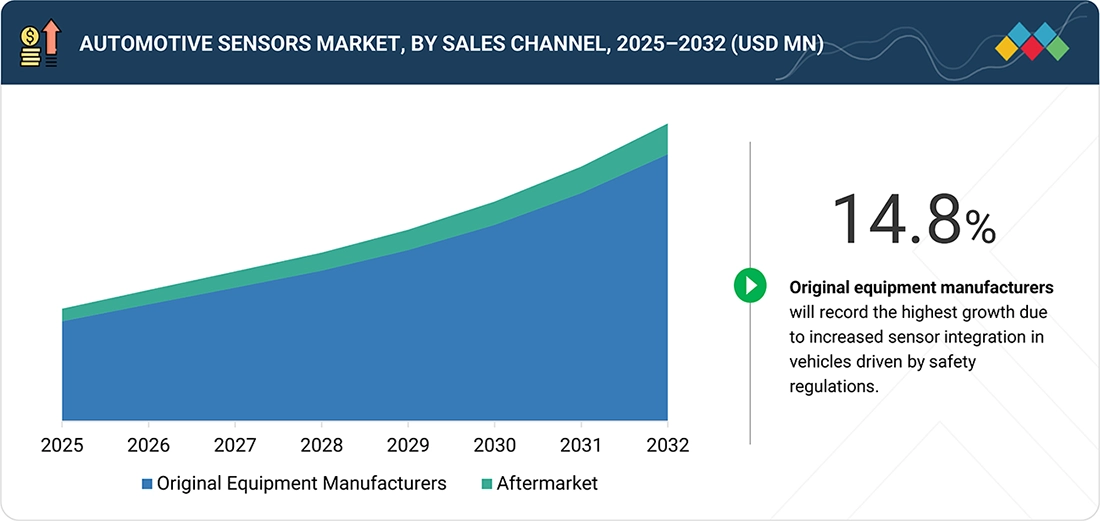
Automotive Sensors Market, By Sales Channel
Original equipment manufacturers (OEMs) are expected to exhibit the highest CAGR in the automotive sensors market due to the increasing integration of sensors in vehicle manufacturing. Modern vehicles use various sensors in ADAS, powertrain, safety, body electronics, and electrification systems, making OEMs the main procurement channel for sensor suppliers. Factors such as stringent safety and emission regulations, along with the rise of connected and autonomous vehicle technologies, are motivating automakers to install more factory sensors. The aftermarket segment is smaller, as sensors have long lifespans and are typically replaced only when needed. Therefore, the growth in vehicle production and sensor content per vehicle reinforces the dominance of the OEM sales channel.
Automotive Sensors Market, By Application
Powertrain systems accounted for a prominent market share in 2025, in terms of value, due to the critical role of sensor-powered powertrain systems in improving vehicle performance, fuel efficiency, and emission control parameters. These systems rely heavily on sensors for monitoring and controlling engine functions, transmission, fuel injection, and exhaust processes. Increasing demand for stricter emission compliance, improved fuel economy, and enhanced drivetrain efficiency has further driven the adoption of sensors such as pressure, temperature, position, and oxygen sensors across powertrain applications
REGION
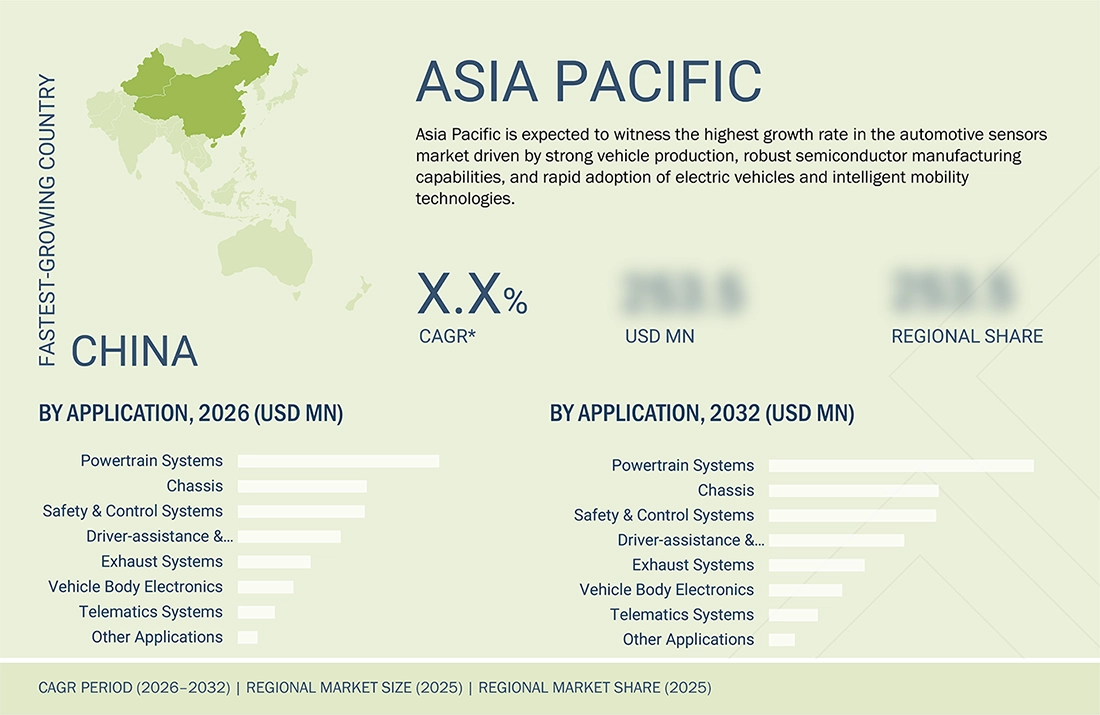
Asia Pacific to be fastest-growing region in automotive sensors market during forecast period
Asia Pacific is expected to register the highest CAGR in the automotive sensors market during the forecast period, underpinned by robust vehicle production volumes, advanced semiconductor manufacturing capabilities, and accelerating EV and intelligent mobility adoption across China, Japan, South Korea, and India. China leads regional demand through large-scale NEV production and connected vehicle infrastructure investments, while Japan and South Korea leverage established automotive ecosystems to advance ADAS, lidar, and radar technologies. India is emerging as a high-growth market, driven by automotive electronics localization, government incentives (PLI, FAME), and rising ADAS penetration in mid-range segments. The region's expanding semiconductor fabrication capacity and growing demand for safety, connectivity, and electrification features are expected to create significant growth opportunities for sensor manufacturers throughout the forecast period.
AUTOMOTIVE SENSORS MARKET SIZE, SHARE AND GROWTH ANALYSIS: COMPANY EVALUATION MATRIX
Bosch GmbH is a Star Player in the automotive sensors market due to its strong global presence, broad sensor portfolio, technological leadership, and deep relationships with automotive OEMs. Meanwhile, Hyundai Mobis is an Emerging Leader, driven by its growing investments in ADAS, autonomous driving, and electrification technologies, along with its expanding sensor capabilities and increasing global market presence.
Source: Secondary Research, Interviews with Experts, MarketsandMarkets Analysis
KEY MARKET PLAYERS
- Robert Bosch GmbH (Germany)
- DENSO Corporation (Japan)
- Aptiv PLC (Ireland)
- Valeo SA (France)
- Sensata Technologies Holding plc (US)
- Niterra (NGK Spark Plug) (Japan)
- AUMOVIO SE (Germany)
- ZF Friedrichshafen AG (Germany)
- Hyundai Mobis (South Korea)
WHAT IS IN IT FOR YOU: AUTOMOTIVE SENSORS MARKET SIZE, SHARE AND GROWTH ANALYSIS REPORT CONTENT GUIDE
DELIVERED CUSTOMIZATIONS
We have successfully delivered the following deep-dive customizations:
| CLIENT REQUEST | CUSTOMIZATION DELIVERED | VALUE ADDS |
|---|---|---|
| Automotive OEM | Competitive benchmarking of sensor fusion architectures, ADAS feature integration roadmaps, supplier sourcing strategies, and autonomous driving sensor stack evaluation |
|
| Tier 1 Automotive Supplier | Application-specific analysis for LiDAR, radar, camera, and ultrasonic sensor deployment across passenger vehicles, commercial vehicles, and two-wheelers |
|
| Semiconductor & Sensor IC Manufacturer | Semiconductor & Sensor IC Manufacturer | Assessment of automotive-grade sensor IC demand trends, MEMS sensor adoption, signal processing requirements, and AEC-Q100 qualification benchmarking |
| EV & Connected Vehicle Company | EV & Connected Vehicle Company | Evaluation of sensor requirements for battery management systems (BMS), thermal management, autonomous parking, and V2X communication platforms |
| Industrial & Fleet Operator | Industrial & Fleet Operator | Analysis of sensor deployment trends in fleet telematics, predictive maintenance, driver monitoring systems (DMS), and commercial vehicle safety compliance |
RECENT DEVELOPMENTS
- June 2026: Niterra launched an advanced pressure-sensor glow plug under its NGK Ignition Parts brand, integrating a piezo sensor directly into the glow-plug element to measure cylinder combustion pressure in real time. The Y1078PS pressure sensor glow plug enables active combustion management by dynamically adjusting its glow profile according to engine operating conditions and is designed to help diesel engines meet stringent Euro 7 emissions requirements. The development directly expands Niterra’s automotive sensor technology portfolio.
- June 2026: AUMOVIO SE highlighted its sensor technologies as part of its autonomous-driving solutions for commercial vehicles, including radar and camera sensors integrated into a modular hardware kit developed with Aurora for autonomous trucking. The system is being developed for scalable, mass-production deployment and is intended to support autonomous commercial vehicles on U.S. highways from 2027. The development directly demonstrates the integration of automotive sensing technologies into next-generation autonomous-vehicle architectures.
- June 2026: ZF Friedrichshafen AG demonstrated its latest safety and motion systems for software-defined, AI-driven commercial vehicles, including a scalable 360-degree safety ecosystem integrating radar and camera sensor systems. The technologies are designed to provide comprehensive environmental perception for advanced driver-assistance and autonomous-driving functions while supporting software-defined vehicle architectures. The development directly advances ZF’s automotive sensor and perception capabilities for commercial vehicles.
- June 2026: Robert Bosch GmbH highlighted its automotive sensing portfolio and the role of inertial, radar, camera and ultrasonic sensors in its ADAS strategy, following its reported €10 billion in 2025 orders for intelligent driver-assistance systems. Bosch's latest radar generation combines an in-house system-on-chip with enhanced computing for AI-based perception, while its inertial sensors provide vehicle-position and motion data when camera or GPS signals are unavailable. The development reinforces Bosch’s integrated automotive sensor platform for assisted and automated driving.
- May 2026: Aptiv PLC secured a production award from Volvo Cars for its Gen 8 radar platform, with deployment in future Volvo vehicles beginning in 2028. The radar provides enhanced perception capabilities for safety and driver-assistance functions and forms part of Aptiv’s intelligent-perception portfolio for software-defined vehicles. The award represents a direct commercial deployment of next-generation automotive radar sensing technology.
Table of Contents
 Exclusive indicates content/data unique to MarketsandMarkets and not available with any competitors.
Methodology
The research process for this technical, market-oriented, and commercial study of the automotive sensors market included the systematic gathering, recording, and analysis of data about companies operating in the market. It involved the extensive use of secondary sources, directories, and databases (Factiva and Oanda) to identify and collect relevant information. In-depth interviews were conducted with various primary respondents, including experts from core and related industries and preferred manufacturers, to obtain and verify critical qualitative and quantitative information as well as to assess the growth prospects of the market. Key players in the automotive sensors market were identified through secondary research, and their market rankings were determined through primary and secondary research. This included studying annual reports of top players and interviewing key industry experts, such as CEOs, directors, and marketing executives.
Secondary Research
In the secondary research process, various secondary sources were referred to for identifying and collecting information relevant to this study. Secondary sources include annual reports, press releases, and investor presentations of companies; white papers, certified publications, and articles from recognized authors; directories; and databases. Secondary research has been mainly conducted to obtain key information about the supply chain and value chain of the industry; a total pool of key players; segmentation of the market according to the industry trends, geographic markets, and key developments from market- and technology-oriented perspectives.
Primary Research
In the primary research process, primary sources from the supply and demand sides were interviewed to obtain qualitative and quantitative information for this report. Primary sources from the supply side include experts, such as CEOs, vice presidents, marketing directors, technology and innovation directors, subject-matter experts, consultants, and related key executives from major companies and organizations operating in the automotive sensors market.
After the complete market engineering process (market statistics calculations, market breakdown, market size estimations, market forecasting, and data triangulation), extensive primary research was conducted to gather information and verify and validate the critical market numbers.
Several primary interviews were conducted with experts from the demand and supply sides across four major regions—North America, Europe, Asia Pacific, and RoW. This primary data was collected through questionnaires, emails, and telephonic interviews.
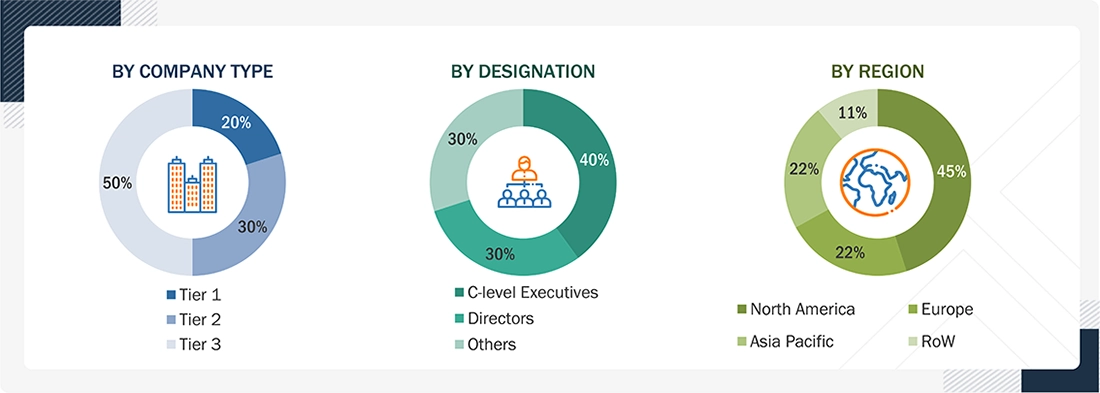
Note: Other designations include product managers, sales managers, and marketing managers.
Three tiers of companies have been defined based on their total revenue as of 2025: tier 3: revenue less than USD 500 million; tier 2: revenue between USD 500 million and USD 1 billion; and tier 1: revenue more than USD 1 billion.
RoW includes South America, Africa, and the Middle East.
To know about the assumptions considered for the study, download the pdf brochure
Market Size Estimation
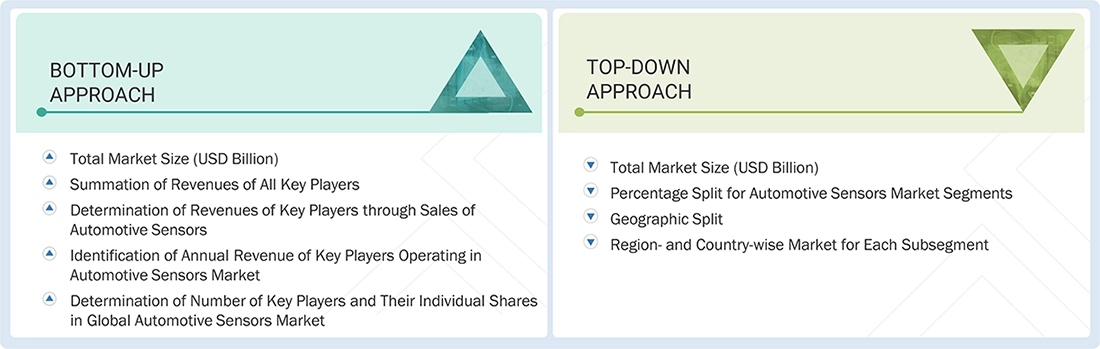
In the complete market engineering process, top-down and bottom-up approaches and several data triangulation methods were used to estimate and forecast the overall market segments and subsegments listed in this report. Key players in the market were identified through secondary research, and their market shares in the respective regions were determined through primary and secondary research. This entire procedure included the study of annual and financial reports of the top market players and extensive interviews for key insights (quantitative and qualitative) with industry experts (CEOs, VPs, directors, and marketing executives).
All percentage shares, splits, and breakdowns were determined using secondary sources and verified through primary sources. All the parameters affecting the markets covered in this research study were accounted for, viewed in detail, verified through primary research, and analyzed to obtain the final quantitative and qualitative data. This data was consolidated and supplemented with detailed inputs and analysis from MarketsandMarkets and presented in this report.
BOTTOM-UP APPROACH
- Companies offering automotive sensors were identified, and their offerings were mapped based on their applications and regional footprint.
- The global automotive sensors market size was derived through the data sanity method. The revenues of automotive sensor providers were analyzed through annual reports and press releases and summed up to derive the overall market size.
- For each company, a percentage was assigned to the overall revenue to derive the revenues from automotive sensors.
- Each company’s percentage was assigned after analyzing various factors, including its product offerings, geographic presence, R&D expenditures and initiatives, and recent developments/strategies adopted for growth in the automotive sensors market.
- For the CAGR, the market trend analysis of automotive sensors was carried out by understanding the industry penetration rate and the demand and supply of automotive sensors for different applications.
- Estimates at every level were verified and cross-checked by discussing them with key opinion leaders, including sales heads, directors, operations managers, and market domain experts of MarketsandMarkets.
- Various paid and unpaid information sources, such as annual reports, press releases, white papers, and databases, were studied.
TOP-DOWN APPROACH
- Focusing initially on the top-line investments and expenditures being made in the ecosystem of automotive sensors, further splitting into sensor types, vehicle types, applications, and listing key developments in key market areas
- Identifying all major players in the automotive sensors market and their penetration in various applications through secondary research, as well as verifying with a brief discussion with industry experts
- Analyzing revenues, product mix, geographic presence, and key applications for which all identified players serve automotive sensors to estimate and arrive at the percentage splits for all key segments
- Discussing these splits with the industry experts to validate the information and identify key growth pockets across all key segments
- Breaking down the total market based on verified splits and key growth pockets across all segments
Data Triangulation
After arriving at the overall market size, the market was split into several segments and subsegments using the market size estimation processes as explained above. Data triangulation and market breakdown procedures were employed to complete the entire market engineering process and determine each market segment's and subsegment's exact statistics. The data was triangulated by studying various factors and trends from the demand and supply sides in the automotive sensors market.
Market Definition
Automotive sensors are electronic devices that detect, measure, and convert physical or chemical parameters into electrical signals for vehicle control systems. These sensors act as the sensory organs of a vehicle, continuously monitoring parameters such as pressure, temperature, speed, position, acceleration, fluid levels, oxygen concentration, and nitrogen oxide (NOx) emissions. The collected data is transmitted to electronic control units (ECUs), which process the information and initiate appropriate control actions to optimize vehicle performance, safety, efficiency, and passenger comfort.
Automotive sensors play a critical role in a wide range of vehicle systems, including powertrain, chassis, body electronics, safety, advanced driver assistance systems (ADAS), infotainment, and electrification platforms. With the increasing adoption of connected, electric, and autonomous vehicles, sensor technologies have become essential for enabling real-time monitoring, intelligent decision-making, regulatory compliance, and enhanced driving experiences. As vehicle electronics continue to evolve, automakers are integrating a greater number of sensors to improve vehicle control, safety, fuel efficiency, and overall operational reliability.
Key Stakeholders
- Raw material suppliers
- Original equipment manufacturers (OEMs)
- Technology solution providers
- Research institutes
- Market research and consulting firms
- Governments and financial institutions
- Analysts and strategic business planners
Report Objectives
- To describe and forecast the automotive sensors market by sensor type, sales channel, vehicle type, application, and region, in terms of value
- To describe and forecast the market for various segments across four main regions, namely, North America, Europe, Asia Pacific, and the RoW, in terms of value
- To describe and forecast the market for sensor types, in terms of volume
- To strategically analyze micromarkets1 about individual growth trends, prospects, and their contribution to the market
- To provide detailed information regarding the drivers, restraints, opportunities, and challenges influencing market growth
- To analyze opportunities for stakeholders by identifying high-growth segments in the market
- To provide a detailed overview of the automotive sensor value chain
- To strategically profile the key players in the automotive sensors market and comprehensively analyze their market shares and core competencies
- To analyze competitive developments such as partnerships, acquisitions, expansions, collaborations, and product launches, along with R&D activities in the automotive sensors market
- To provide interconnected markets and cross-sector opportunities, strategic moves by tier 1/2/3 players, ecosystem analysis, case study analysis, patent analysis, technology analysis, impact of AI/Gen AI, key conferences and events, Porter’s five forces analysis, and regulations pertaining to the market under study
Available customizations:
With the given market data, MarketsandMarkets offers customizations according to the company’s specific needs. The following customization options are available for the report:
COMPANY INFORMATION
- Detailed analysis and profiling of additional market players (up to five)
Key Questions Addressed by the Report
What is the current size of the Automotive Sensors Market?
The global automotive sensors market is valued at USD 48.45 billion in 2026 and is projected to reach USD 109.85 billion by 2032, growing at a CAGR of 14.6% during the forecast period.
What factors are driving the growth of the Automotive Sensors Market?
Major growth drivers include increasing adoption of ADAS, rising production of electric vehicles (EVs), advancements in connected and autonomous vehicles, stringent vehicle safety regulations, emission standards, and growing demand for intelligent mobility solutions.
What are the latest trends shaping the Automotive Sensors Market?
Key trends include AI-enabled sensor fusion, solid-state LiDAR, 4D imaging radar, software-defined vehicles, driver monitoring systems, smart sensing technologies, and increasing integration of sensors in EV powertrains and autonomous driving platforms.
Which companies are the leading players in the Automotive Sensors Market?
Major companies include Robert Bosch GmbH, DENSO Corporation, Aptiv PLC, Valeo SA, Sensata Technologies, ZF Friedrichshafen AG, Hyundai Mobis, Niterra (NGK Spark Plug), and AUMOVIO SE.
Which region dominates the Automotive Sensors Market?
Asia Pacific is expected to record the highest growth due to strong automotive manufacturing, expanding EV production, semiconductor capabilities, and government initiatives supporting intelligent mobility across China, Japan, South Korea, and India.
Which sensor segment holds the largest market share?
Position sensors accounted for the largest market share, representing approximately 21.6% of the global automotive sensors market by sensor type, owing to their extensive use in powertrain, steering, braking, and ADAS applications.
Which application segment generates the highest revenue in the Automotive Sensors Market?
Powertrain systems held the largest market share, accounting for approximately 27.6% in 2025. Demand is driven by engine management, emission control, fuel efficiency improvements, and electrified powertrain technologies.
Which vehicle type is expected to witness the fastest growth?
The passenger car segment is projected to grow at the highest CAGR due to increasing integration of ADAS, vehicle connectivity, electrification technologies, and stricter global safety regulations.
What does the MarketsandMarkets Automotive Sensors report cover?
The report provides detailed analysis by sensor type, application, vehicle type, sales channel, regional outlook, competitive landscape, market trends, value chain, pricing analysis, trade analysis, Porter's Five Forces, ecosystem analysis, forecasts through 2032, and strategic company profiles.
What opportunities exist in the Automotive Sensors Market over the forecast period?
Significant opportunities are expected from autonomous driving, vehicle electrification, software-defined vehicles, intelligent cockpit systems, predictive maintenance, cybersecurity-enabled sensors, V2X communication, and increasing OEM investments in AI-powered sensing technologies.


Personalize This Research
- Triangulate with your Own Data
- Get Data as per your Format and Definition
- Gain a Deeper Dive on a Specific Application, Geography, Customer or Competitor
- Any level of Personalization
Let Us Help You
- What are the Known and Unknown Adjacencies Impacting the Automotive Sensors Market
- What will your New Revenue Sources be?
- Who will be your Top Customer; what will make them switch?
- Defend your Market Share or Win Competitors
- Get a Scorecard for Target Partners

Custom Market Research Services
We Will Customise The Research For You, In Case The Report Listed Above Does Not Meet With Your Requirements
Get 10% Free CustomisationTESTIMONIALS

Tetsuya Ohhira
Business Development Manager-Technology Business
Nikon Corporation,
Leading Japanese MNC specializing in optics and imaging productswww.nikon.com
MarketsandMarkets™ response
is quick. Their attitude is flexible and positive. Analyst Insights are globally considered and
significant. Client Services quickly respond to our inquiry and demand. Their wide range of global
surveys help us make our strategic plan.
We hope Knowledge Store will be easier to search
for a report.
VP - Marketing & Business Development
Leading Provider of Process Control Solutions
We engaged with MarketsandMarkets on a study to perform an analysis and recommend a Go-To-Market strategy for metrology and process control in the semiconductor market. The study was tailored to our targets and needs with well-defined milestones. Our overall experience with the MarketsandMarkets team was very good throughout the project in all aspects including the analysis methodologies used, the quality and depth of primary and secondary data sets, the professionalism and flexibility of the team and the ability to meet the target schedule and milestones. We want to thank MarketsandMarkets team for a job well done.
- US Automotive Sensors Market
- Canada Automotive Sensors Market
- Mexico Automotive Sensors Market
- Germany Automotive Sensors Market
- UK Automotive Sensors Market
- France Automotive Sensors Market
- Italy Automotive Sensors Market
- Rest Of Europe Automotive Sensors Market
- China Automotive Sensors Market
- Japan Automotive Sensors Market
- India Automotive Sensors Market
- South Korea Automotive Sensors Market
- Rest Of Asia Pacific Automotive Sensors Market
Growth opportunities and latent adjacency in Automotive Sensors Market






TK
Jun, 2014
I'd be grateful if I have sample pages on (2.1.1. Automotive Sensor Market Value, By Application) and (2.1.2 Automotive Sensor Market Value, By Product Type).
Charles
Apr, 2026
How are ADAS, autonomous driving, and LiDAR technologies impacting revenue growth across automotive sensor segments?.
Ryan
Apr, 2026
How are EV adoption and autonomous vehicle development influencing revenue growth in automotive sensor demand?.
roger
Aug, 2014
Dear Sir/Madam...I am a journalist in the process of finalizing an article for the October issue of Electronic Products Magazine (US) on automotive sensors. I would appreciate receiving your forecast for automotive sensors from 2012 to 2020 with the CAGR noted. .
Rajratna
Oct, 2016
Interested in temperature, climate, oxygen, air quality, humidity sensor cluster trends and future technology roadmap..
Moritz
Jun, 2019
Hello! I would like to have a sample of this market research report. My company is looking for a high quality market report on automotive sensors. .
josh
Jan, 2017
I know this market well, I want to see if this would be helpful to me. For instance I would be interested in the view of wheel speed sensors or steering angle sensors..
Angie
Apr, 2013
Need information on sensors for auto market, with focus on emissions and fuel econ. Has this report been updated to capture the regulation changes / delays by North America and Europe that occurred late 2018? .
Robert
Feb, 2017
We are reviewing where to take our auto sensors business. In particular, we're interested in purchasing a company that can manufacture a full array of automotive sensors. Should we purchase someone with these capabilities or partner with them on the development and marketing of these sensors? Need as much data (up to date). As this is a document using 2016 data, an updated one would be appreciated. .
Robert
Feb, 2017
Interested in ME sheet of the report only. .
Milagros
Apr, 2019
Hi! I'm working on my thesis for my MBA and since it's about the business plan for a company in the US which produces electronic sensors for cars, having access to your report would be very useful. Could you please, share the report with me? .
Peter
Aug, 2015
I am looking at: automotive sensor market continuous technological advancements, supportive government and environment regulations, increasing vehicle production, and customer preferences. I am trying to understand end market trends, opportunities for TAM expansion, etc. .
Steffi
Mar, 2014
Need information on market share analysis of major players..
Markus
Oct, 2017
Hello, I am trying to estimate the effect of electrical autonomous cars would have on the sensor market. To do that I am trying to estimate the cost of different sensors used in cars today. .
Jigar
Aug, 2019
We are working as automotive interiors. To give new user experience we are adding new features related smart surface. As a part of study and market trend we are analyzing automotive sensors..
suzana
Apr, 2015
I work in a company that produces polyamide compounds for automotive industry. I was interested on this report to check opportunities for polyamide in this market. I wonder if the report contains technical requirements (corrosion resistance, strength, etc.) or what are the CTQ's for this market..
Robert
Apr, 2017
Interested in knowing the recent market trend and upcoming technologies..
Hany
Feb, 2016
Special interested in commercial vehicles (trucks and heavy duty), development trends, sensors price erosion and sensors supply chain analysis..