Military Mass Notification System Market

Military Mass Notification System Market by Software (Public Warning & Emergency, Operational & IT Alerting), Hardware (Fire Alarm and Public Address Systems), Application (Outdoor Warning Systems, Public Health Notifications) – Global Forecast to 2030




OVERVIEW
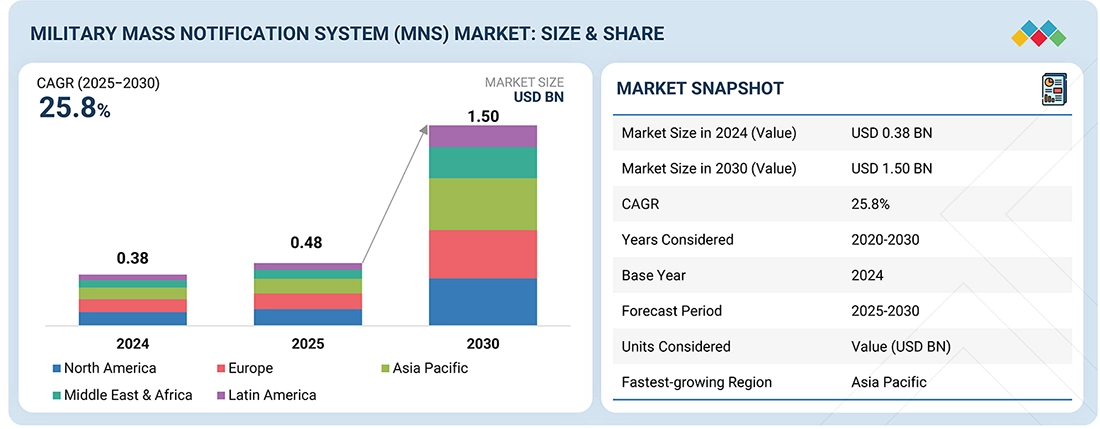
Source: Secondary Research, Interviews with Experts, MarketsandMarkets Analysis
The military mass notification system (MNS) market is projected to grow from USD 0.48 billion 2025 to USD 1.50 billion by 2030, expanding at a remarkable CAGR of 25.8%. The market is driven by defense modernization efforts and rising focus on force protection and operational readiness. Armed forces are deploying MNS platforms to ensure rapid, secure communication during base emergencies, security threats, cyber incidents, and natural disasters. Demand is supported by strict safety and continuity-of-operations requirements, along with the need for systems that integrate with command-and-control, physical security, and secure networks. Buyers increasingly favor reliable, multi-channel solutions that function in constrained or high-risk operational environments.
KEY TAKEAWAYS
-
BY OFFERINGBy offering, the public address systems hardware segment is likely to hold the largest market share of 24.6% in 2025.
-
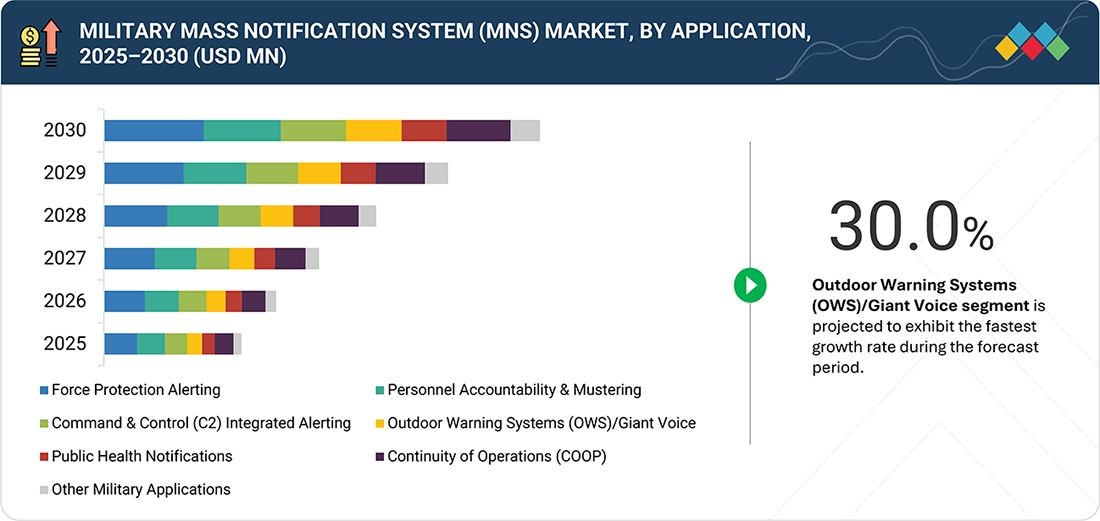
BY APPLICATIONThe outdoor warning systems (OWS)/giant voices application is expected to showcase the highest growth rate of 30.0% during the forecast period.
-
BY COMMUNICATION TYPEThe text-based communication segment is anticipated to hold the largest share of the military mass notification system (MNS) market in 2025.
-
BY REGIONNorth America is expected to hold a market shareof 28.06% in 2025.
-
BY COMPETITIVE LANDSCAPE - KEY PLAYERSEverbridge, Honeywell, and Motorola Solutions are identified as some of the leading players in the Military America Mass Notification market, given their strong market share and product footprint.
-
BY COMPETITIVE LANDSCAPE - STARTUPSExon, and Everon among others, have distinguished themselves among other players by securing strong footholds in specialized niche areas, underscoring their potential as emerging leaders.
The military mass notification system (MNS) market is influenced by evolving threat environments, infrastructure upgrades, and tighter coordination across defense installations. Military organizations require systems that function during network outages and support secure, role-based communication. Growing use of joint bases and allied operations is increasing demand for interoperable solutions. Training requirements and regular emergency drills are also reinforcing the need for dependable notification systems across fixed and temporary military facilities.
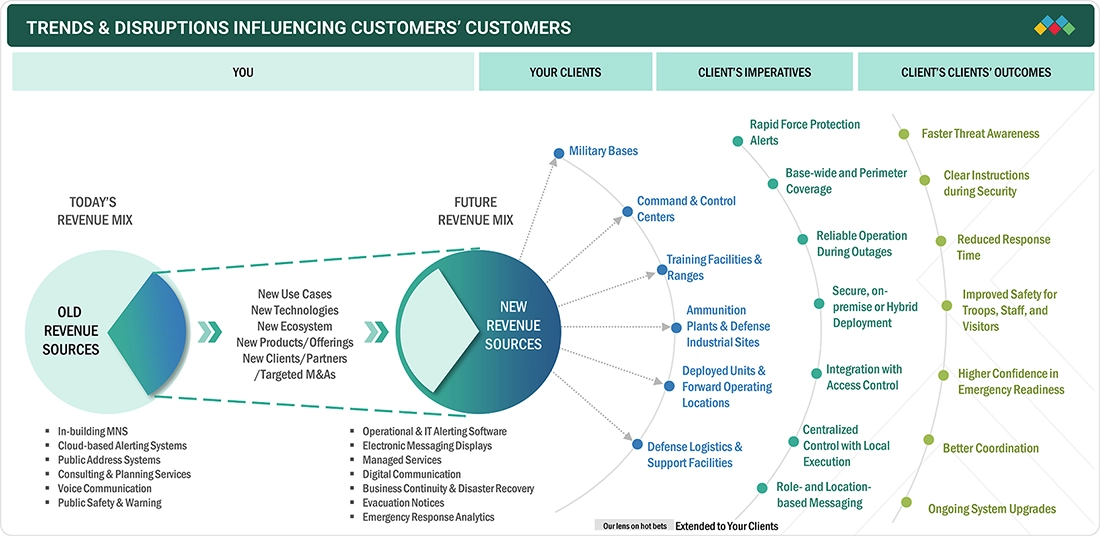
TRENDS & DISRUPTIONS IMPACTING CUSTOMERS' CUSTOMERS
The military mass notification system (MNS) market is undergoing a shift from hardware-focused deployments and one-time system purchases toward software-led platforms and ongoing service models. Earlier revenue was largely driven by on-premise alerting hardware and limited base-level installations. Future opportunities are emerging from secure software platforms, system upgrades and long-term support deals. The transition allows vendors to offer continuous updates and compliance support. Military clients benefit from improved system reliability and scalability, while downstream users gain more faster, consistent access to critical alerts across multiple operational environments.
Source: Secondary Research, Interviews with Experts, MarketsandMarkets Analysis
MARKET DYNAMICS

Level
-
Defense modernization and base digitization initiatives

-
Joint and allied operations creating need for interoperable communication systems


Level
-
Resistance to replacing existing infrastructure slowing adoption of newer platforms

-
Extended approval and procurement timelines delaying vendor revenue realization


Level
-
Integration of MNS platforms with command-and-control and security systems

-
Modernization of Aging Military Infrastructure


Level
-
Operating in contested and degraded environments

-
Security and certification standards raising barriers for new and smaller vendors

Source: Secondary Research, Interviews with Experts, MarketsandMarkets Analysis
Driver: Defense modernization and base digitization initiatives
Defense modernization programs are accelerating the adoption of digital communication systems across military setups. Armed forces are upgrading outdated infrastructure to improve situational awareness, reactive coordination, and personnel safety. MNS are increasingly viewed as core digital asset that support base wide operations, as well as preparedness. The trend is creating sustained demand for scalable and integrated MNS platforms.
Restraint: Resistance to replacing existing infrastructure slowing adoption of newer platforms
Numerous military sites still rely on legacy alerting and public address systems that barely continue to function. Changing the systems altogether involves large capital and disruptions to operations. Decision makers delay these upgrades to avoid downtime and the need for retraining. This slows adoption of updated platforms, especially at sites with limited budgets or has a lower threat level.
Opportunity: Integration of MNS platforms with command-and-control and security systems
Integrating MNS platforms with command-and-control systems, access control, and surveillance tools presents a strong growth opportunity. When systems are connected, threats can be identified faster and responses can be better coordinated. Vendors that offer smooth integration can deliver more value to military customers. This supports centralized control and improves communication during complex or fast-moving security situations.
Challenge: Operating in contested and degraded environments
Military MNS platforms must remain operational under conditions of limited or unavailable network connectivity. Cyber threats, physical damage, and temporary outages are common in military environments, requiring systems to incorporate robust backup mechanisms and secure message delivery. Addressing these requirements increases system design complexity and places greater emphasis on reliability, particularly in challenging operating conditions.
MILITARY MASS NOTIFICATION SYSTEM MARKET: COMMERCIAL USE CASES ACROSS INDUSTRIES
| COMPANY | USE CASE DESCRIPTION | BENEFITS |
|---|---|---|
 |
Fort Hood Military Base faced issues in coordinating emergency messages across a large and complex site. The base needed a solution that could work with existing fire alarm. Mircom provided an integrated mass notification and voice evacuation system. The solution was designed to support alerts during security incidents, emergencies, and operational disruptions. | After deployment, messages reached indoor and outdoor areas more quickly and with better clarity | Use of existing infrastructure helped reduce maintenance needs and operational effort | Command teams gained clearer control over message delivery | Personnel received direct, easy-to-understand instructions, which improved safety and emergency response |
 |
Lake City Army Ammunition Plant needed a reliable alerting system for a high-risk industrial and military environment. The facility required fast communication during severe weather, security events, and operational incidents. Alertus implemented a mass notification solution using both indoor and outdoor alerting devices. These devices were managed through a centralized control system to ensure timely and consistent messaging. | The new system increased the speed and coverage of emergency messages across the facility | Automated alerts and centralized management reduced reliance on manual actions | Personnel received timely, location-specific information, improving awareness and response | The solution also supported safety compliance and increased confidence in emergency communications |
Logos and trademarks shown above are the property of their respective owners. Their use here is for informational and illustrative purposes only.
MARKET ECOSYSTEM
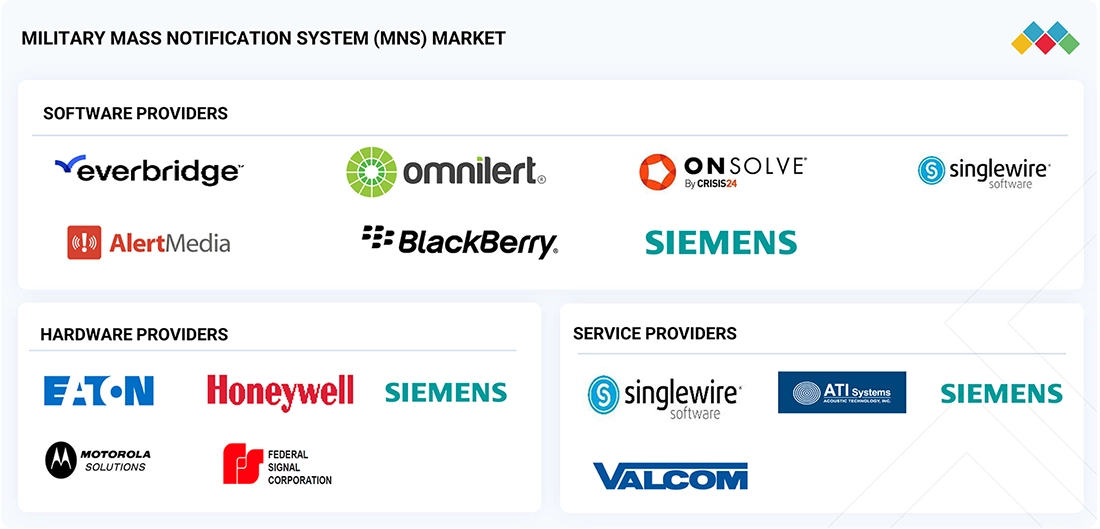
The military mass notification system (MNS) ecosystem consists of software providers, hardware providers, and service providers. Vendors compete by offering secure systems, strong reliability, and the ability to connect with command-and-control and security platforms. Demand is driven by base upgrades, force protection needs, and continuity planning. Flexible deployment options, including modular and hybrid setups, help support both individual bases and large defense networks.
Logos and trademarks shown above are the property of their respective owners. Their use here is for informational and illustrative purposes only.
MARKET SEGMENTS
Source: Secondary Research, Interviews with Experts, MarketsandMarkets Analysis
Military Mass Notification System Market, By Offering
Military organizations worldwide are moving toward software-led MNS platforms that support secure and repeatable deployments across bases and operational areas. These systems make it easier to manage alerts from a central location, apply updates, and connect with other security systems. While hardware such as sirens and speakers remains important, market growth is increasingly tied to software, upgrades, and support services. Vendors offering hybrid and on-site deployment options are better suited to meet security and reliability needs.
Military Mass Notification System Market, By Communication Channel
Digital communication modes are becoming important as military alerting expands beyond sirens and high-pitch voice systems. Secure mobile alerts, desktop messages, and visual displays are being used to improve reach and clarity. Using multiple channels adds backup during outages and allows messages to be targeted by role or location. Military buyers prefer systems that reduce reliance on public networks and work reliably across fixed and deployed environments.
Military Mass Notification System Market, By Application
Force protection alerting is positioned to account for the largest market share. These applications play a direct role in protecting personnel, assets, and facilities. They support fast warnings for perimeter breaches, active threats, and other security events. Demand is supported by stronger focus on base security, real-time awareness, and coordinated response. Integration with surveillance and access control systems makes force protection alerting a core requirement.
REGION
North America to hold largest share of military mass notification system (MNS) market
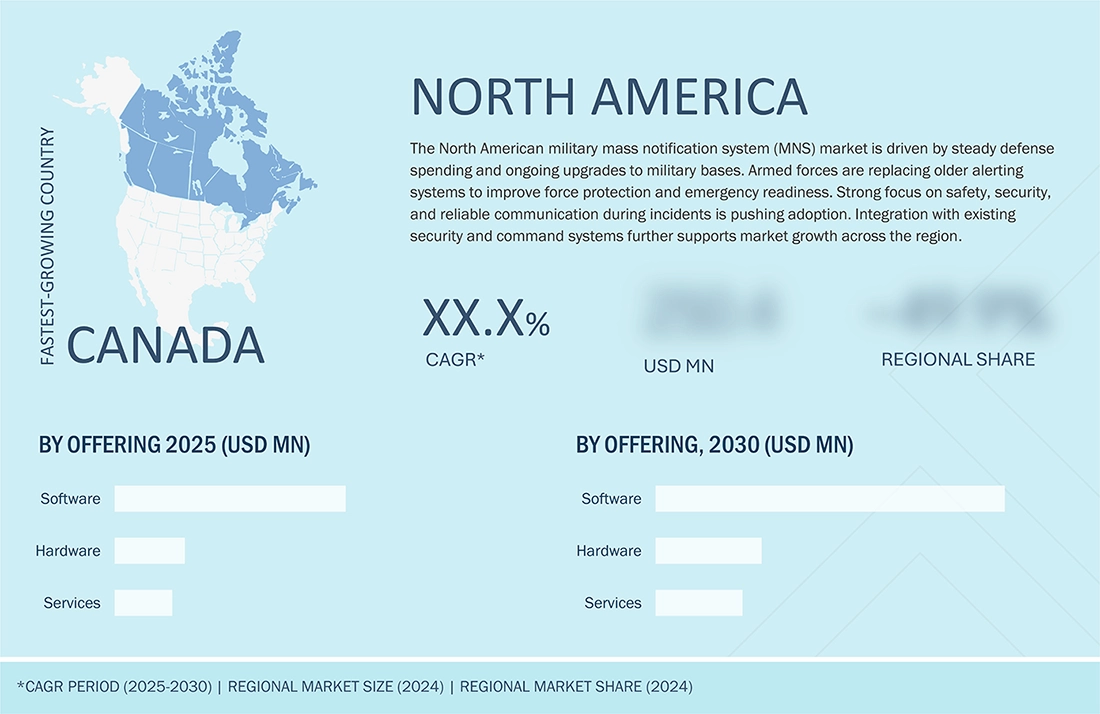
North America is expected to account for the largest share of the military mass notification system (MNS) market. In the US, steady defense spending and a large number of military bases continue to support demand. Ongoing upgrades to both domestic and foreign facilities are also contributing to growth. Strong focus on personnel safety, base security, and continuity of operations keeps investment levels stable. In Canada, adoption is mainly driven by base security improvements and closer alignment with allied defense communication practices. Together, these factors strengthen the region’s overall market position.
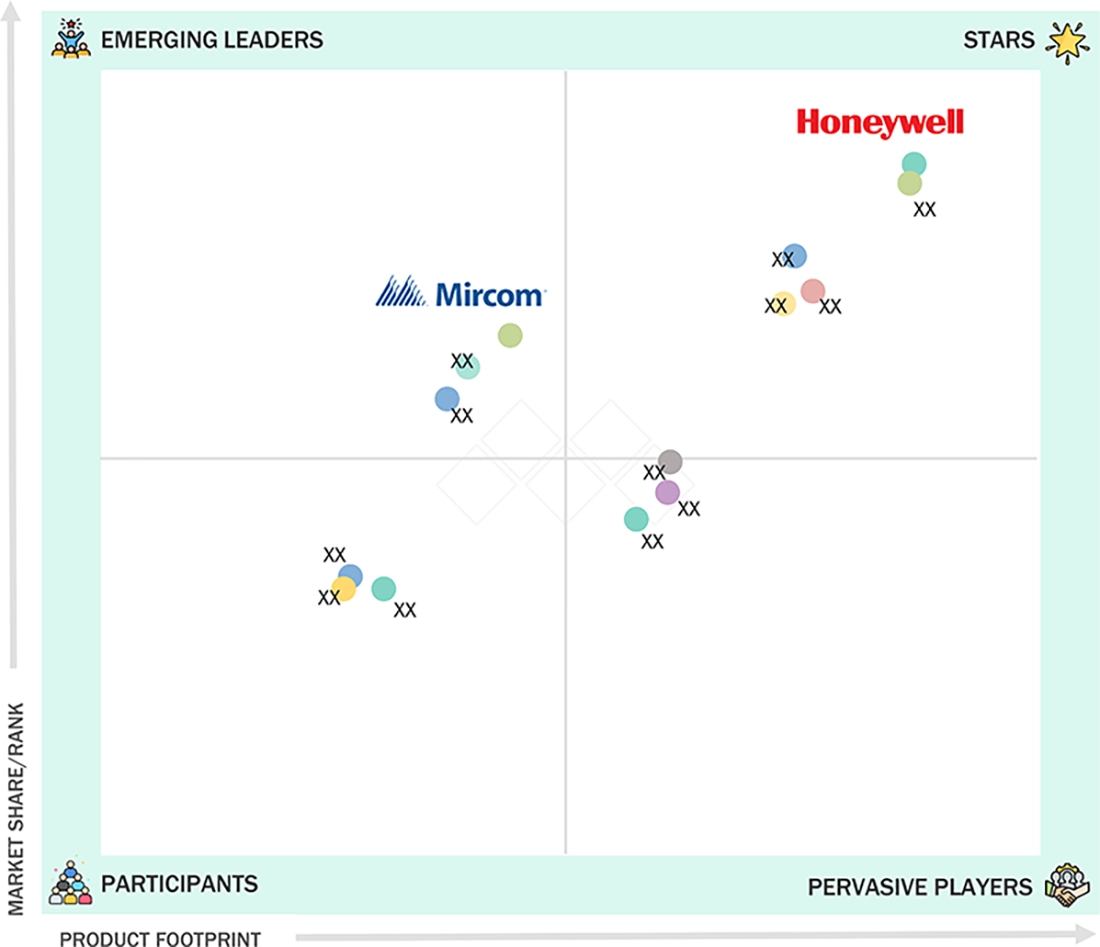
MILITARY MASS NOTIFICATION SYSTEM MARKET: COMPANY EVALUATION MATRIX
Honeywell is positioned as a star player due to its broad product portfolio, strong integration capabilities, and deep presence across military installations. Mircom is an emerging leader, supported by proven deployments in military bases and critical facilities. Mircom can move toward the Stars quadrant by expanding its software platform, strengthening digital and mobile alerting, and increasing focus on long-term service and integration-led contracts for large defense customers.
Source: Secondary Research, Interviews with Experts, MarketsandMarkets Analysis
KEY MARKET PLAYERS
- Everbridge (US)
- Honeywell (US)
- Motorola Solutions (US)
- Blackberry (Canada)
- Singlewire Software (US)
- AlertMedia (US)
- Alertus Technologies (US)
- Mircom (Canada)
- American Signal Corporation (US)
- ATI Systems (US)
- Valcom (US)
- Omnilert (US)
- Federal Signal Corporation (US)
- Crisis24 (Canada)
- SnapComms (New Zealand)
- Siemens AG (Germany)
MARKET SCOPE
| REPORT METRIC | DETAILS |
|---|---|
| Market Size in 2024 (Value) | USD 0.38 Billion |
| Market Size in 2030 | USD 1.50 Billion |
| Growth Rate | CAGR of 25.8% during 2025-2030 |
| Years Considered | 2020-2030 |
| Base Year | 2024 |
| Forecast Period | 2025-2030 |
| Units Considered | Value (USD Billion) |
| Report Coverage | Revenue Forecast, Company Ranking, Competitive Landscape, Growth Factors, and Trends |
| Segments Covered |
|
| Region Covered | North America, Europe, Asia Pacific, Middle East & Africa, Latin America |
WHAT IS IN IT FOR YOU: MILITARY MASS NOTIFICATION SYSTEM MARKET REPORT CONTENT GUIDE
DELIVERED CUSTOMIZATIONS
We have successfully delivered the following deep-dive customizations:
| CLIENT REQUEST | CUSTOMIZATION DELIVERED | VALUE ADDS |
|---|---|---|
| Defense Organization with Multiple Military Installations | A customized assessment of military mass notification systems was conducted for both domestic & overseas bases. The study focused on how vendors are supporting secure alert delivery in military environments. It reviewed on-site and hybrid deployment options, system backup requirements, and the ability to work with existing command and security systems. The assessment also examined how well solutions meet military safety and continuity guidelines. | The assessment helped the client narrow down vendors that matched their security and reliability needs. It lowered implementation risk by identifying solutions that were ready to integrate and easy to deploy across different sites. The engagement supported better vendor selection and improved confidence in long-term system performance across military installations. |
| Armed Forces Training and Logistics Command | A customized MNS evaluation was conducted for training centers and logistics hubs operating in high-occupancy environments. The engagement assessed multi-channel alerting, role-based messaging, system scalability, and support for routine drills and emergency exercises. Vendor capabilities were benchmarked against operational readiness and lifecycle support requirements. | The customization enabled standardized emergency communication across training and logistics sites. It improved alert reach and response coordination during drills and incidents. The analysis supported selection of platforms that balanced operational needs with cost efficiency and long-term support expectations. |
RECENT DEVELOPMENTS
- May 2025 : Motorola Solutions acquired Silvus Technologies, a defense-focused radio and MANET provider, to strengthen its position in secure and resilient military communications. The deal expands Motorola’s capabilities in high-bandwidth, mobile, and contested environments, which are critical for military alerting, situational awareness, and field-level coordination.
- September 2025 : Motorola Solutions partnered with Nokia to develop next-generation tactical communications, combining broadband, private LTE, and mission-critical technologies. The collaboration aims to support defense and public safety users with more reliable, secure, and interoperable communication networks, improving real-time information sharing during military and emergency operations.
- April 2025 : A UK government defense contract was awarded for emergency communication and notification-related services, supporting military and public sector preparedness requirements. The engagement reflects continued investment in systems that enable rapid alert dissemination, coordination, and compliance with safety and continuity standards.
- July 2025 : A US federal purchase order was issued to support military communication and alerting infrastructure, reinforcing demand for reliable notification and response systems at defense installations. Such contracts highlight ongoing upgrades to base-level safety, operational readiness, and emergency communication capabilities.
Table of Contents
 Exclusive indicates content/data unique to MarketsandMarkets and not available with any competitors.
Methodology
The research methodology for the Mass Notification System market report involved the use of extensive secondary sources and directories, as well as various reputed open-source databases, to identify and collect useful information for this technical and market-oriented study. In-depth interviews were conducted with various primary respondents, including software by type; software by integration; by deployment mode; verticals; high-level executives of multiple companies offering mass notification system software, hardware & services; and industry consultants to obtain and verify critical qualitative and quantitative information and assess the market prospects and industry trends.
Secondary Research
During the secondary research process, various secondary sources were consulted to identify and collect information for the study. The secondary sources included annual reports; press releases and investor presentations of companies; white papers, certified publications.
The secondary research was utilized to gather key information about the industry’s value chain, the market’s monetary chain, the overall pool of key players, market classification and segmentation based on industry trends, and regional markets, as well as key developments from both market- and technology-oriented perspectives.
Primary Research
In the primary research process, a diverse range of stakeholders from both the supply and demand sides of the Mass notification system ecosystem were interviewed to gather qualitative and quantitative insights specific to this market. From the supply side, key industry experts, such as chief executive officers (CEOs), vice presidents (VPs), marketing directors, technology & innovation directors, as well as technical leads from vendors offering Mass notification system hardware, software & services, were consulted. Additionally, system integrators, service providers, and IT service firms that implement and support the Mass notification system solutions were included in the study. On the demand side, input from IT decision-makers, infrastructure managers, and business heads of prominent industry verticals was collected to understand the user perspectives and adoption challenges within targeted industries.
The primary research ensured that all crucial parameters affecting the Mass notification system market, from technological advancements and evolving use cases to regulatory and compliance needs, were considered. Each factor was thoroughly analyzed, verified through primary research, and evaluated to obtain precise quantitative and qualitative data for this market.
Once the initial phase of market engineering was completed, including detailed calculations for market statistics, segment-specific growth forecasts, and data triangulation, a second round of primary research was conducted. This step was crucial for refining and validating critical data points, such as Mass notification system offerings (hardware, software & services), industry adoption trends, the competitive landscape, and key market dynamics like demand drivers (Growing need for real-time, multi-channel emergency communication across organizations, Regulatory and industry-mandated requirements for emergency preparedness), challenges Balancing ease of access with strong security posture across devices and external users, Managing cross-channel consistency, false alarms, and governance across large distributed organizations), and opportunities (Advanced content lifecycle automation, intelligent sync, and metadata-driven governance, Expansion into AI-driven alert automation, multilingual messaging, and behavioral response analytics) and restraints (Balancing ease of access with strong security posture across devices and external users, Managing cross-channel consistency, false alarms, and governance across large distributed organizations).
In the comprehensive market engineering process, the top-down and bottom-up approaches, along with several data triangulation methods, were extensively employed to perform market estimation and forecasting for the overall market segments and subsegments listed in this report. Extensive qualitative and quantitative analysis was performed on the complete market engineering process to record the critical information/insights throughout the report.
Market Size Estimation
The top-down and bottom-up approaches were employed to estimate and forecast the Mass Notification System market, as well as its dependent submarkets. This multi-layered analysis was further reinforced through data triangulation, which incorporated primary and secondary research inputs. The market figures were also validated against the existing MarketsandMarkets repository for accuracy.
Military Mass Notification System Market : Top-Down and Bottom-Up Approach
Data Triangulation
The market was divided into several segments and subsegments after determining the overall market size using the market size estimation processes described above. To complete the overall market engineering process and determine the exact statistics for each market segment and subsegment, data triangulation and market segmentation procedures were employed, wherever applicable. The overall market size was then used in the top-down approach to estimate the size of other individual markets by applying percentage splits to the market segmentation.
Market Definition
According to Everbridge, a mass notification system is a vital solution that enables the prompt and precise delivery of notifications to individuals or groups, irrespective of their location. It is a comprehensive platform, swiftly disseminating emergency messages through various communication channels like voice calls, SMS, push notifications, desktop alerts, and social media. By utilizing visual intelligence and user-friendly interfaces, a mass notification system ensures that the right message reaches the intended recipients during critical events, regardless of their devices or physical whereabouts. This system plays a pivotal role in protecting people, securing operations, and safeguarding the reputation of organizations by facilitating timely and accurate communication.
Key Stakeholders
- Mass Notification System Vendors
- Mass Notification Software Vendors
- Managed Service Providers
- Support and Maintenance Service Providers
- System Integrators (SIs)/Migration Service Providers
- Distributors and Value-added Resellers (VARs)
- Independent Software Vendors (ISVs)
- Cloud Service Providers
- Technology Providers
Report Objectives
- To define, describe, and predict the mass notification system market by offering (software, hardware, and services), communication channel, facility type, application, vertical, and region
- To provide detailed information related to major factors (drivers, restraints, opportunities, and industry-specific challenges) influencing market growth
- To analyze opportunities in the market and provide details of the competitive landscape for stakeholders and market leaders
- To forecast the market size of segments with respect to five main regions: North America, Europe, Asia Pacific, Middle East & Africa, and Latin America
- To analyze each submarket with respect to individual growth trends, prospects, and contributions to the overall mass notification system market
- To analyze competitive developments, such as partnerships, new product launches, mergers & acquisitions, in the mass notification system market
- To analyze the competitive developments, such as partnerships, product launches, mergers and acquisitions, in the Mass notification system market
- To analyze the impact of macroeconomic factors on the Mass Notification System market across all regions
Available Customizations
With the given market data, MarketsandMarkets offers customizations based on the company’s specific needs. The following customization options are available for the report.
Product Analysis
- Product comparative analysis, which gives a detailed comparison of innovative products being offered by prominent vendors
Geographic analysis
- Further breakup of additional European countries by offering, communication channel, facility type, application and vertical
- Further breakup of additional Asia Pacific countries by offering, communication channel, facility type, application and vertical
- Further breakup of additional Middle East & African countries by offering, communication channel, facility type, application and vertical
- Further breakup of additional Latin American countries by offering, communication channel, facility type, application and vertical
Company information
- Detailed analysis and profiling of additional market players (up to five)
Key Questions Addressed by the Report
What is the current size of the Military Mass Notification System market?
The global Military Mass Notification System market is estimated at USD 0.48 billion in 2025 and is projected to reach USD 1.50 billion by 2030, reflecting strong demand for secure emergency communication solutions across defense organizations.
What is driving the growth of the Military Mass Notification System market?
The market is driven by increasing defense modernization programs, rising geopolitical tensions, growing focus on force protection, and the need for real-time, secure communication during emergencies, cyber incidents, and military operations.
Which applications are expected to dominate the Military Mass Notification System market?
Force protection alerting is expected to hold a significant market share due to its critical role in notifying military personnel about security threats, perimeter breaches, and emergency situations, enabling faster response and improved operational readiness.
Which communication technologies are widely used in Military Mass Notification Systems?
Military Mass Notification Systems use multiple communication channels, including secure mobile alerts, desktop notifications, public address systems, fire alarm systems, digital signage, sirens, and voice messaging to ensure rapid and reliable information delivery during critical events.
What is the expected CAGR of the Military Mass Notification System market?
The Military Mass Notification System market is projected to grow at a CAGR of 25.8% from 2025 to 2030, driven by increasing investments in advanced defense communication infrastructure and integrated emergency response systems.


Personalize This Research
- Triangulate with your Own Data
- Get Data as per your Format and Definition
- Gain a Deeper Dive on a Specific Application, Geography, Customer or Competitor
- Any level of Personalization
Let Us Help You
- What are the Known and Unknown Adjacencies Impacting the Military Mass Notification System Market
- What will your New Revenue Sources be?
- Who will be your Top Customer; what will make them switch?
- Defend your Market Share or Win Competitors
- Get a Scorecard for Target Partners

Custom Market Research Services
We Will Customise The Research For You, In Case The Report Listed Above Does Not Meet With Your Requirements
Get 10% Free CustomisationTESTIMONIALS






Growth opportunities and latent adjacency in Military Mass Notification System Market