



More Electric Aircraft Market Size, Share & Trends
Report Code
AS 2769
Published in
Sep, 2026, By MarketsandMarkets™
More Electric Aircraft Market Size, Share and Trends by Platform (Fixed Wing, Rotary Wing), System (Propulsion, Aircraft), Application (Power Generation, Power Distribution, Power Conversion, Energy Storage), Component, End User, and Region - Global Forecast to 2031

USD 8.66 BN
MARKET SIZE, 2031

CAGR 7.8%
(2026-2031)

300
REPORT PAGES

200
MARKET TABLES
MORE ELECTRIC AIRCRAFT MARKET SIZE, SHARE & TRENDS
According to Marketsandmarkets, The global More Electric Aircraft Market size was valued at USD 5.95 billion in 2026 and is projected to reach USD 8.66 billion by 2031 growing at a CAGR of 7.8% from 2026 to 2031. The market is gaining momentum as aircraft manufacturers increase the electrification of onboard systems and airlines and defense operators focus on improving fuel efficiency, reducing aircraft weight, and lowering maintenance requirements. Demand is further supported by rising adoption of electric actuation, advanced power generation systems, high-voltage electrical architectures, power electronics, and electrically driven pumps and environmental control systems. Advancements in starter-generators, SiC-based power electronics, solid-state power distribution, and integrated power management technologies are also strengthening More Electric Aircraft capabilities across commercial, military, and rotary-wing platforms.
MARKET SNAPSHOT TABLE
| REPORT METRIC | DETAILS |
|---|---|
| Market Size in 2025 | USD 5.51 Billion |
| Market Size in 2026 | USD 5.95 Billion |
| Market Forecast in 2031 | USD 8.66 Billion |
| Growth Rate | 7.8% |
| Years Considered | 2021–2031 |
| Base Year | 2025 |
| Forecast Period | 2026–2031 |
| Units Considered | Value (USD Million/Billion) |
| Report Coverage | Revenue Forecast, Company Ranking, Competitive Landscape, Growth Factors, and Trends |
| Segments Covered |
|
| Regions Covered | North America, Europe, Asia Pacific, Middle East & Africa, and Latin America |
KEY TAKEAWAYS
-
By RegionThe Middle East & Africa is projected to have the highest CAGR of 9.9% during the forecast period.
-
By PlatformBy platform, rotary-wing aircraft is expected to record the highest CAGR of 13.3% during the forecast period
-
By SystemBy system, aircraft systems are expected to account for the dominant share of 70.1% in 2026.
-
By ComponentBy component, engines are expected to record the strongest growth rate of 10.4% during the forecast period.
-
By ApplicationBy application, power generation is expected to account for a significant share of the more electric aircraft market.
-
By End UserBy end user, civil aviation is expected to account for the largest market share during the forecast period.
-
Competitive Landscape - Key CompaniesMajor more electric aircraft manufacturers are expanding through aircraft electrification programs, OEM integration contracts, technology development, and next-generation aircraft platforms. Companies such as Safran SA, Honeywell Aerospace, RTX Corporation, GE Aerospace, Parker Hannifin Corporation, BAE Systems, Liebherr, AMETEK, Moog, Eaton, Thales, Curtiss-Wright, and Crane Aerospace & Electronics are strengthening their positions through advanced electrical power generation, electric actuation, power conversion, intelligent distribution, and integrated power management technologies.
-
Competitive Landscape - Startups/SMEsSpecialized aerospace technology companies such as Glenair, H3X Technologies, KGS Electronics, and Lynxeo are gaining relevance through high-power-density electric machines, advanced power electronics, energy-storage systems, and integrated electrification technologies targeted at next-generation regional, hybrid-electric, and more-electric aircraft platforms.
The More Electric Aircraft Industry is being supported by increasing aircraft production, rising electrification of onboard systems, and growing requirements for improved fuel efficiency, reduced aircraft weight, and lower maintenance costs. Demand is increasing for electric actuation, advanced power generation, high-voltage electrical architectures, power electronics, and intelligent power distribution systems that progressively replace or reduce conventional hydraulic, pneumatic, and mechanical functions.
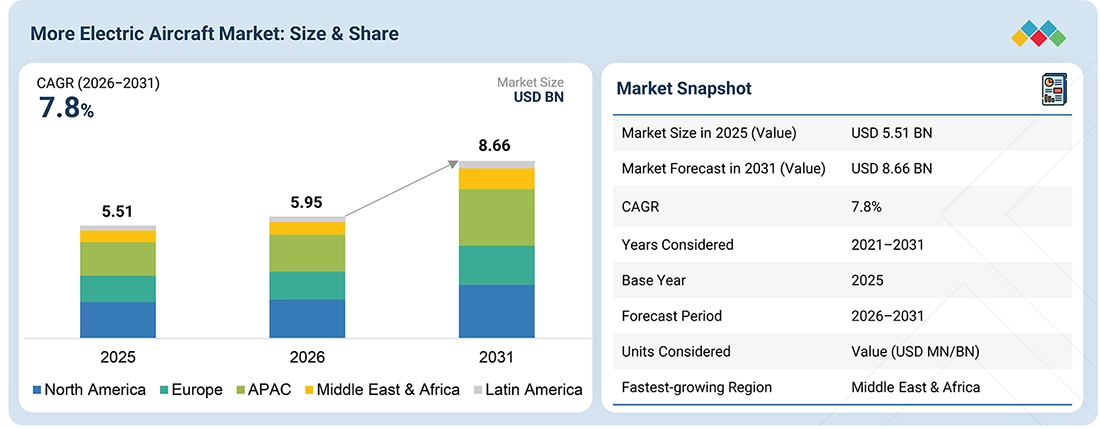
Source: Secondary Research, Interviews with Experts, MarketsandMarkets Analysis
TRENDS & DISRUPTIONS IMPACTING CUSTOMERS' CUSTOMERS
The more electric aircraft market dynamics are shifting from conventional hydraulic, pneumatic, and mechanically driven aircraft systems toward electrically intensive architectures capable of supporting higher onboard power requirements and improved aircraft efficiency. Future demand will be increasingly molded by high-voltage electrical distribution, advanced power electronics, electric actuation, high-power starter-generators, solid-state power distribution, intelligent power management, and integrated thermal management. Aircraft OEMs, airlines, defense forces, system integrators, and component manufacturers are looking for electrical solutions that provide lower aircraft weight, reduced fuel consumption, improved reliability, and lower maintenance requirements. SiC-based power electronics, electromechanical and electro-hydrostatic actuators, electrically driven pumps, high-power-density generators, advanced energy-storage systems, and digitally controlled distribution networks are among the key technological trends. Increased production of new-generation commercial aircraft, modernization of military fleets, and growing development of hybrid-electric and highly electrified aircraft are likely to enhance the role of electrical systems across the aerospace ecosystem.
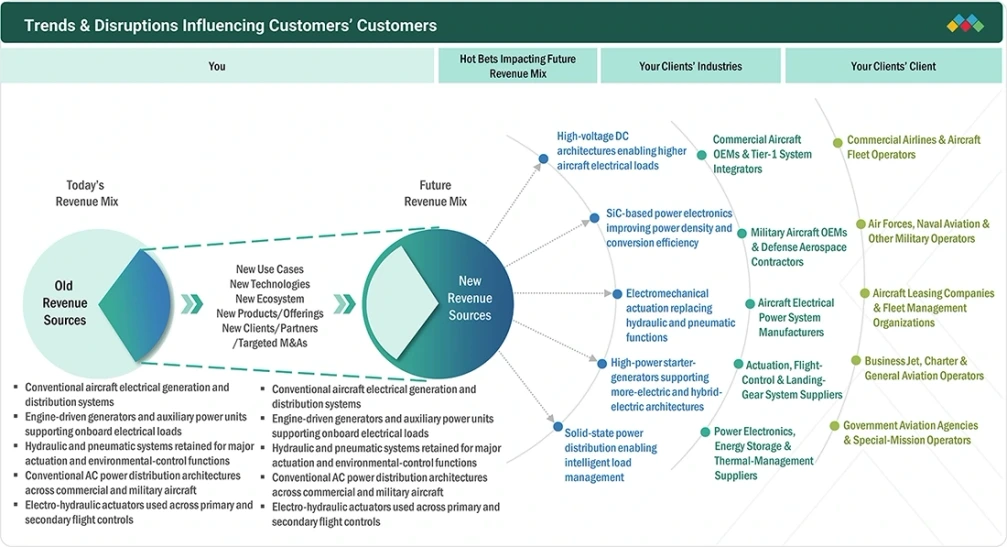
Source: Secondary Research, Interviews with Experts, MarketsandMarkets Analysis
MARKET DYNAMICS

Drivers
Impact
Level
Level
-
Development of high-density battery solutions for more electric aircraft

-
Increasing use of electric technology to optimize aircraft performance


RESTRAINTS
Impact
Level
Level
-
High capital requirements and longer clearance periods

-
Potential for overheating of electrical systems


OPPORTUNITIES
Impact
Level
Level
-
Introduction of alternative power sources for electric power generation

-
Advancements in power electronic components


CHALLENGES
Impact
Level
Level
-
Requirement for reliable cable systems

-
Significant increase in maximum take-off weight

Source: Secondary Research, Interviews with Experts, MarketsandMarkets Analysis
Driver: Development of high-density battery solutions for more electric aircraft
Advances in high-energy-density batteries are supporting greater electrification of onboard systems by improving energy storage capability while reducing weight and space requirements.
Restraint: High capital requirements and longer clearance periods
High development costs, extensive testing, and lengthy aviation certification processes can delay commercialization and increase the financial burden on system and component suppliers.
Opportunity: Introduction of alternative power sources for electric power generation
Fuel cells, advanced batteries, and hybrid power-generation technologies are creating opportunities to reduce dependence on conventional generators and support higher electrical loads onboard aircraft.
Challenge: Requirement for reliable cable systems
Higher electrical power levels require lightweight, thermally stable, and highly reliable wiring and cable systems capable of maintaining performance under demanding aircraft operating conditions.
MORE ELECTRIC AIRCRAFT MARKET SIZE, SHARE & GROWTH: COMMERCIAL USE CASES ACROSS INDUSTRIES
| COMPANY | USE CASE DESCRIPTION | BENEFITS |
|---|---|---|
 |
Safran Electrical & Power develops electrical power generation, conversion and distribution systems for more-electric commercial and military aircraft. Its portfolio includes starter-generators, generators, power management systems, electrical distribution equipment, and wiring systems designed to increase onboard electrical power availability while replacing selected hydraulic and pneumatic functions. | Enables higher onboard electrical power availability | Reduces dependence on hydraulic and pneumatic systems | Supports weight and fuel-efficiency improvements | Enables intelligent electrical power distribution | Supports higher electrical loads on next-generation aircraft |
 |
Honeywell Aerospace provides aircraft electrical power generation and management systems, including generators, auxiliary power units, power distribution equipment, and high-power turbogenerators. Its technologies support more-electric and hybrid-electric aircraft architectures by supplying increased electrical power for avionics, environmental control, actuation, and other onboard systems. | Provides high-density electrical power generation | Supports increased aircraft electrical loads | Enables electrification of secondary aircraft systems | Improves power-management efficiency | Supports more-electric and hybrid-electric aircraft architectures |
 |
Collins Aerospace (RTX) develops aircraft electrical generation, conversion and distribution technologies for commercial and military platforms. Its portfolio includes variable-frequency generators, high-voltage DC systems, solid-state power distribution, and advanced electric power architectures. Collins is also developing high-voltage systems through programs such as HECATE to support next-generation more-electric and hybrid-electric aircraft. | Enables high-voltage aircraft electrical architectures | Supports greater electrical content per aircraft | Reduces system weight through advanced power distribution | Enables intelligent load management and fault isolation | Supports future hybrid-electric and more-electric aircraft programs |
Logos and trademarks shown above are the property of their respective owners. Their use here is for informational and illustrative purposes only.
MARKET ECOSYSTEM
The more electric aircraft market ecosystem consists of aircraft electrical system manufacturers, power generation and distribution suppliers, actuation system providers, power electronics manufacturers, aircraft OEMs, system integrators, airlines, and defense operators. Safran, Honeywell Aerospace, RTX Corporation, GE Aerospace, and Parker Hannifin provide electrical power generation, conversion, distribution, actuation, and power management solutions for commercial and military aircraft. Other major suppliers include BAE Systems, Liebherr, Moog, Eaton, Thales, Curtiss-Wright, and Crane Aerospace & Electronics. These solutions are being integrated by aircraft manufacturers such as Airbus, Boeing, Embraer, and Leonardo across narrow-body, wide-body, regional, business, and military aircraft platforms. Airlines, armed forces, aircraft leasing companies, business aviation operators, and government aviation agencies are among the industry's most important customers. Other ecosystem participants include battery and energy storage suppliers, semiconductor and power electronics manufacturers, electric motor suppliers, wiring and cable manufacturers, thermal management providers, software developers, engineering companies, testing organizations, certification authorities, distributors, and MRO providers who support aircraft integration, certification, and lifecycle requirements.
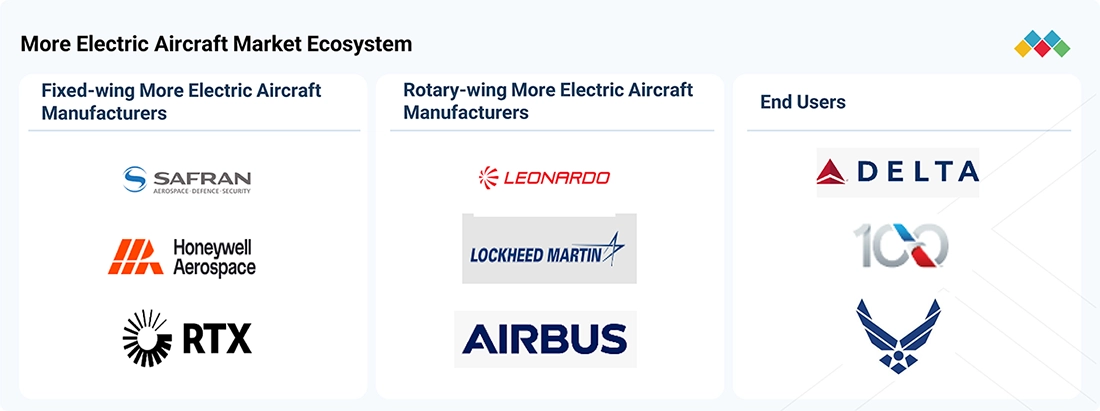
Logos and trademarks shown above are the property of their respective owners. Their use here is for informational and illustrative purposes only.
MARKET SEGMENTS
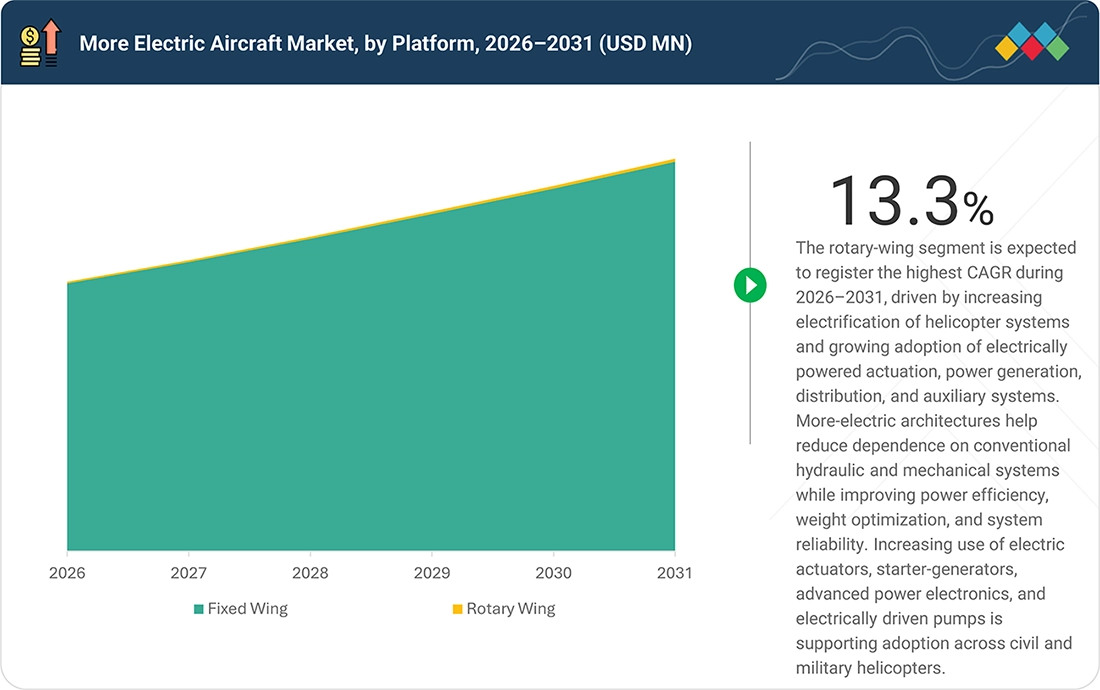
Source: Secondary Research, Interviews with Experts, MarketsandMarkets Analysis
More Electric Aircraft Market, By Platform
The market is segmented into fixed-wing and rotary-wing aircraft. Fixed-wing aircraft include narrow-body aircraft, wide-body aircraft, regional aircraft, and fighter jets, while rotary-wing aircraft include medium and heavy helicopters. Fixed-wing aircraft account for a major share due to higher production volumes, increasing electrical content per aircraft, and wider adoption of electric actuation, power generation, power distribution, and electrically driven aircraft systems.
More Electric Aircraft Market, By System
The market is segmented into propulsion systems and aircraft systems. Propulsion systems include fuel-management systems and thrust-reverser systems, while aircraft systems include environmental control systems, accessory drive systems, power management systems, cabin interior systems, and flight control systems. Aircraft systems represent a significant application area as OEMs increasingly replace hydraulic, pneumatic, and mechanically driven functions with electrically powered alternatives to improve efficiency, reliability, and maintainability.
More Electric Aircraft Market, By Component
The market includes engines, batteries, fuel cells, solar cells, generators, actuators, electric pumps, power electronics, distribution devices, valves, and landing gear. Generators include starter generators, auxiliary power units, and VSCF generators, while actuators include electric actuators, hybrid electric actuators, electro-hydro-static actuators, electromechanical actuators, and electrical backup hydraulic actuators. Power electronics and actuators are gaining importance due to increasing onboard electrical loads, adoption of high-voltage architectures, and gradual replacement of conventional hydraulic and pneumatic systems.
More Electric Aircraft Market, By Application
The market is segmented into power generation, power distribution, power conversion, and energy storage. Power generation represents a major application due to increasing electrical requirements across avionics, environmental control, actuation, pumps, cabin systems, and mission equipment. Power conversion and distribution are also becoming increasingly important as aircraft move toward higher-voltage architectures and digitally controlled electrical networks.
More Electric Aircraft Market, By End User
Major end users include civil aviation and military aviation. Civil aviation accounts for a significant share due to high commercial aircraft production, fleet renewal and increasing electrical content across narrow-body, wide-body and regional aircraft. Military aviation demand is supported by fighter aircraft modernization, increasing electrical requirements for sensors and mission systems, and greater adoption of advanced power generation, actuation, and power management technologies.
REGION
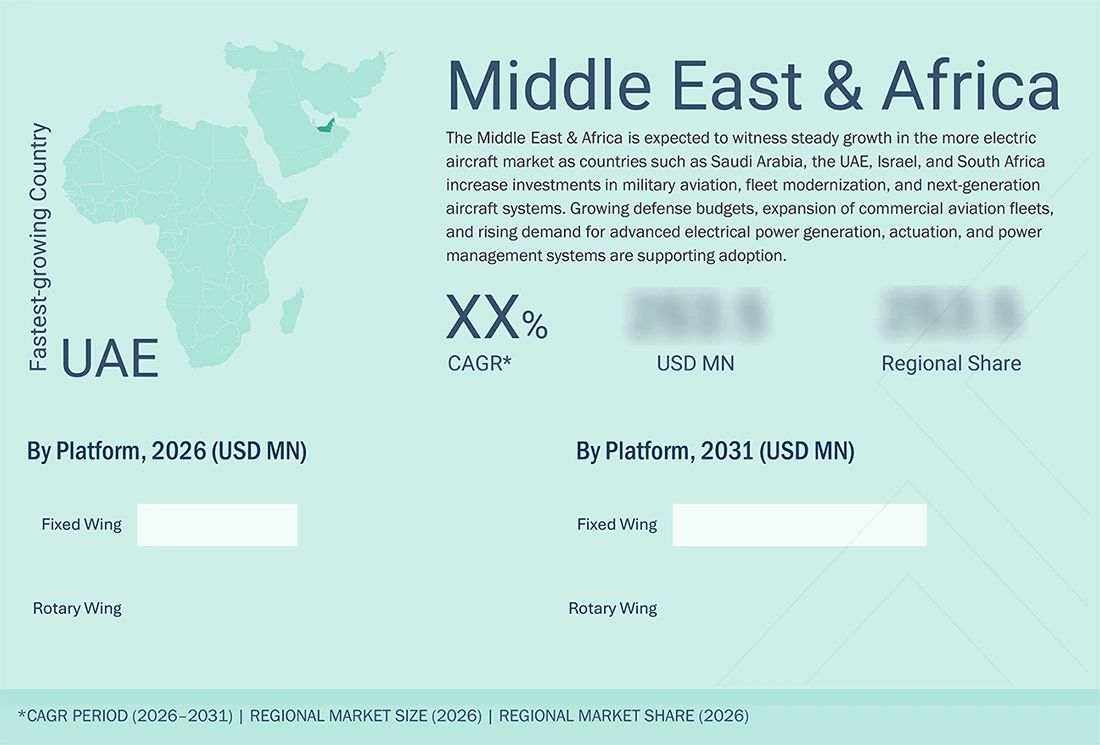
Middle East & Africa to be Fastest-Growing Region in More Electric Aircraft Market During Forecast Period
The Middle East & Africa is expected to witness steady growth in the more electric aircraft market as countries across the region increase investments in commercial aviation expansion, military aircraft modernization, and advanced aerospace technologies. Rising demand for fuel-efficient aircraft, fleet replacement, and higher onboard electrical power requirements is increasing adoption of electric actuation, advanced power generation, power conversion, and intelligent distribution systems. Countries such as Saudi Arabia, the UAE, Israel, Turkey, and South Africa are expanding aviation infrastructure, defense procurement, and local aerospace capabilities while also investing in next-generation aircraft programs. Growing adoption of high-voltage architectures, starter-generators, solid-state power distribution, and advanced power electronics is further supporting regional demand for more electric systems across commercial and military aircraft platforms.
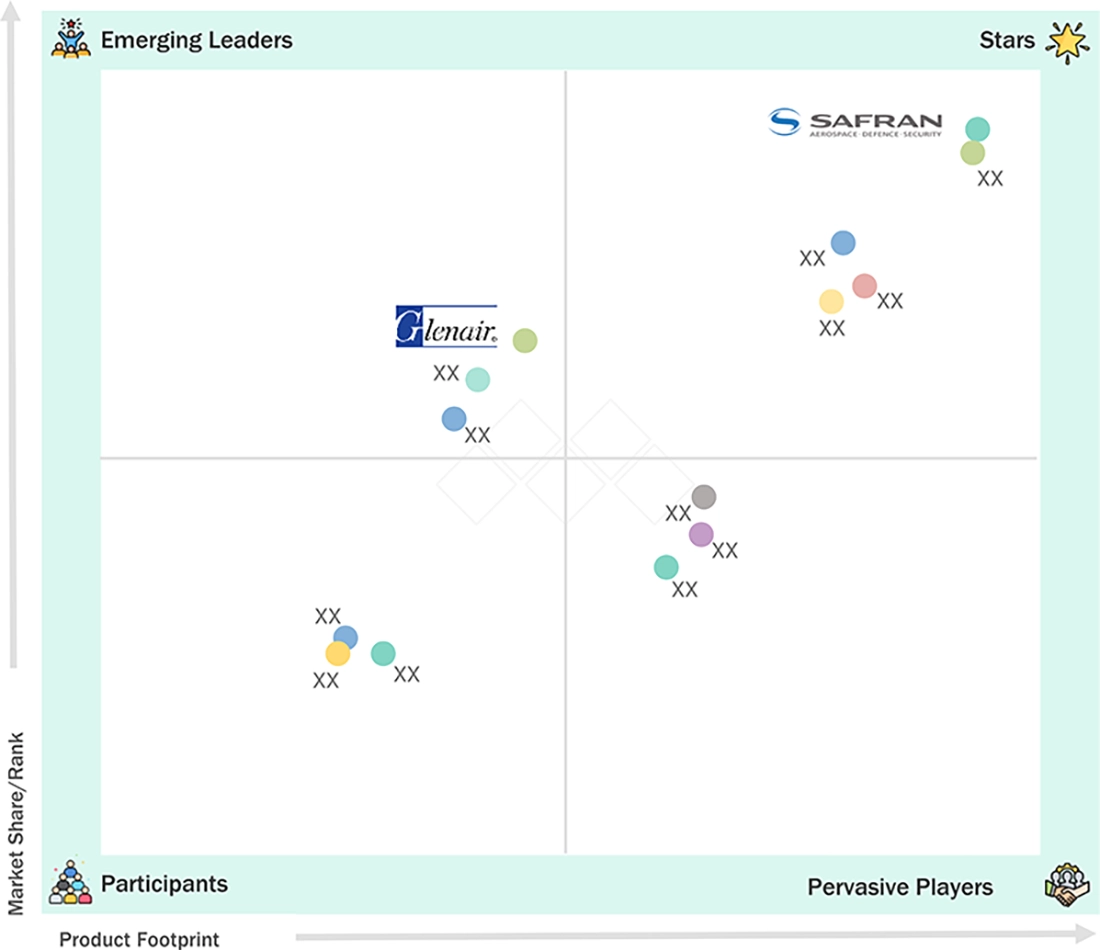
MORE ELECTRIC AIRCRAFT MARKET SIZE, SHARE & GROWTH: COMPANY EVALUATION MATRIX
In the more electric aircraft market matrix, Safran SA (Star) can be positioned strongly because of its broad presence across aircraft electrical power generation, distribution, conversion, and actuation systems. Its portfolio includes generators, starter-generators, electrical wiring systems, power distribution equipment, electric motors, and electromechanical actuation technologies supporting commercial and military aircraft. This gives Safran exposure to major aircraft programs, increasing onboard electrical power requirements and the transition from conventional hydraulic and pneumatic systems toward more-electric architectures, while its strong OEM relationships, system-integration capabilities, and global aerospace footprint strengthen its position across next-generation aircraft electrification programs.
Source: Secondary Research, Interviews with Experts, MarketsandMarkets Analysis
KEY MARKET PLAYERS -MORE ELECTRIC AIRCRAFT COMPANIES
- Safran SA (France)
- Honeywell Aerospace (US)
- RTX Corporation (US)
- GE Aerospace (US)
- Parker Hannifin Corporation (US)
- BAE Systems (UK)
- Liebherr-International Deutschland GmbH (Germany)
- AMETEK, Inc. (US)
- Nabtesco Corporation (Japan)
- Moog Inc. (US)
- Astronics Corporation (US)
- Eaton (Ireland)
- Thales (France)
- Curtiss-Wright Corporation (US)
- Crane Aerospace & Electronics (US)
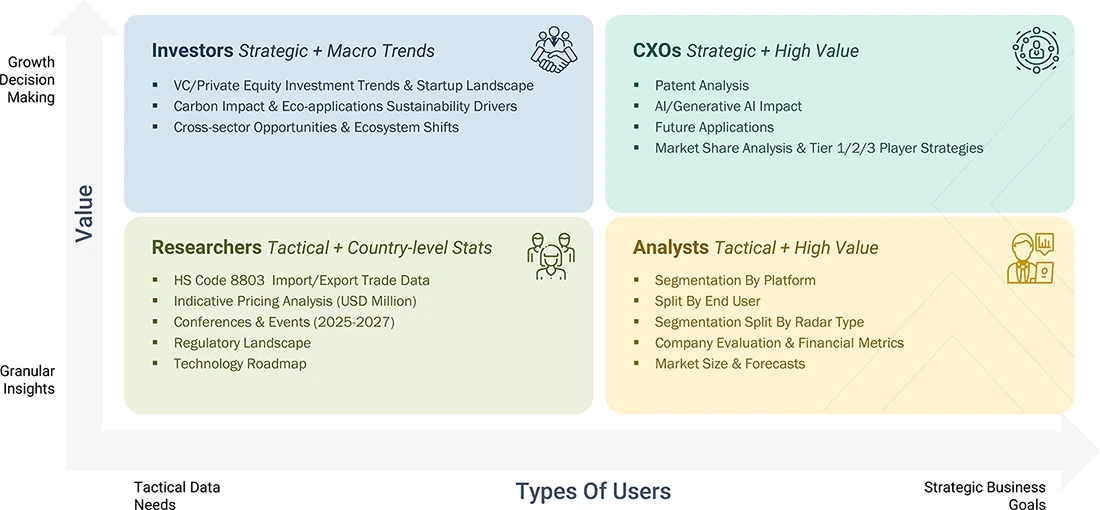
WHAT IS IN IT FOR YOU: MORE ELECTRIC AIRCRAFT MARKET SIZE, SHARE & GROWTH REPORT CONTENT GUIDE
DELIVERED CUSTOMIZATIONS
We have successfully delivered the following deep-dive customizations:
| CLIENT REQUEST | CUSTOMIZATION DELIVERED | VALUE ADDS |
|---|---|---|
| Leading Manufacturer | Additional segment breakdown for countries | Additional country-level market sizing tables for segments/subsegments covered at the regional/global level to gain an understanding of market potential by each country |
| Emerging Leader | Additional company profiles | Competitive information on targeted players to gain granular insights into direct competition |
| Regional Market Leader | Additional country market estimates | Additional country-level deep dive for a more targeted understanding of the total addressable market |
RECENT DEVELOPMENTS
- July 2026 : GE Aerospace completed the first hybrid-electric flight above 30,000 feet under NASA’s Electrified Powertrain Flight Demonstration program. The demonstration used an integrated hybrid-electric propulsion system with motor-generators, power converters, inverters, and associated controls. The achievement demonstrated the feasibility of megawatt-class electrical systems at commercial aircraft cruising altitudes and represents an important step toward higher electrical content in future narrow-body aircraft.
- March 2026 : RTX’s Collins Aerospace completed the HECATE project and achieved Technology Readiness Level 5 for high-voltage aircraft electrical power systems. The program successfully tested an electrical power generation and distribution system producing more than 500 kW using Safran Electrical & Power’s Copper Bird test platform. The development advances lightweight high-voltage power distribution technologies for future more-electric and hybrid-electric regional aircraft.
- February 2026 : Safran Electrical & Power launched the OSYRYS project under the European Clean Aviation initiative to develop electrical technologies for next-generation regional aircraft. The project focuses on onboard electrical power generation and distribution, advanced thermal management, and energy management avionics for hybrid-electric architectures. OSYRYS forms part of a wider Clean Aviation program supported by EUR 140 million in funding and more than EUR 200 million in industry contributions.
Table of Contents
 Exclusive indicates content/data unique to MarketsandMarkets and not available with any competitors.
TITLE
PAGE NO
1
INTRODUCTION
34
2
EXECUTIVE SUMMARY
39
3
PREMIUM INSIGHTS
45
4
MARKET OVERVIEW
Electrification advances promise cost-efficient, eco-friendly aircraft, despite integration and power challenges.
48
4.1
INTRODUCTION
4.2
MARKET DYNAMICS
4.2.1
DRIVERS
4.2.1.1
INCREASING ELECTRIFICATION OF AIRCRAFT SYSTEMS TO ENHANCE PERFORMANCE AND EFFICIENCY
4.2.1.2
GROWING EMPHASIS ON REDUCING AIRCRAFT OPERATING AND MAINTENANCE COSTS
4.2.1.3
GROWING PRESSURE TO REDUCE AIRCRAFT FUEL CONSUMPTION AND OPERATIONAL EMISSIONS
4.2.2
RESTRAINTS
4.2.2.1
HIGH DEVELOPMENT, INTEGRATION, AND CERTIFICATION COSTS OF MORE ELECTRIC AIRCRAFT ARCHITECTURES
4.2.2.2
POWER-DENSITY AND WEIGHT LIMITATIONS OF HIGH-POWER ELECTRICAL SYSTEMS
4.2.3
OPPORTUNITIES
4.2.3.1
INTEGRATION OF HIGH-VOLTAGE AND HIGH-POWER ELECTRICAL ARCHITECTURES IN NEXT-GENERATION COMMERCIAL AIRCRAFT
4.2.3.2
GROWING ELECTRICAL POWER REQUIREMENTS IN NEXT-GENERATION AND MODERNIZED MILITARY AIRCRAFT
4.2.3.3
GROWING AFTERMARKET AND MRO DEMAND FOR MORE ELECTRIC AIRCRAFT SYSTEMS
4.2.4
CHALLENGES
4.2.4.1
MANAGING THERMAL LOADS GENERATED BY HIGH-POWER ELECTRICAL SYSTEMS
4.2.4.2
ELECTROMAGNETIC INTERFERENCE AND COMPATIBILITY RISKS IN HIGH-POWER ELECTRICAL ARCHITECTURES
4.3
UNMET NEEDS AND WHITE SPACES IN MORE ELECTRIC AIRCRAFT MARKET
4.4
INTER-CONNECTED MARKETS AND CROSS-SECTOR OPPORTUNITIES
4.5
STRATEGIC MOVES BY TIER 1/2/3 PLAYERS
4.5.1
STRATEGIC MOVES BY TIER 1, 2, AND 3 PLAYERS
5
INDUSTRY TRENDS
Discover how electrification trends redefine aviation's economic landscape and investment opportunities.
57
5.1
INTRODUCTION
5.2
MACROECONOMIC OUTLOOK
5.2.1
INTRODUCTION
5.2.2
GDP TRENDS AND FORECAST
5.2.3
TRENDS IN GLOBAL MORE ELECTRIC AIRCRAFT MARKET
5.3
VALUE CHAIN ANALYSIS
5.4
ECOSYSTEM ANALYSIS
5.5
TRADE ANALYSIS
5.5.1
IMPORT SCENARIO (HS CODE 8807)
5.5.2
EXPORT SCENARIO (HS CODE 8807)
5.6
KEY CONFERENCES & EVENTS, 2026–2027
5.7
TRENDS & DISRUPTIONS IMPACTING CUSTOMER BUSINESS
5.8
INVESTMENT & FUNDING SCENARIO
5.9
PRICING ANALYSIS
5.9.1
AVERAGE SELLING PRICE RANGE, BY COMPONENT
5.9.2
INDICATIVE PRICING ANALYSIS, BY COMPONENT
5.9.3
AVERAGE SELLING PRICE RANGE, BY PLATFORM, 2025
5.10
OPERATIONAL DATA
5.11
CASE STUDIES
5.11.1
CASE STUDY 1: BOEING 787 IMPLEMENTS MORE-ELECTRIC AIRCRAFT ARCHITECTURE
5.11.2
CASE STUDY 2: AIRBUS A350 REDUCES HYDRAULIC DEPENDENCE THROUGH ELECTRIC ACTUATION
5.11.3
CASE STUDY 3: BELL SELECTS SAFRAN HIGH-VOLTAGE STARTER-GENERATION FOR FLRAA
5.12
TOTAL COST OF OWNERSHIP
5.12.1
INTEGRATION AND DEPLOYMENT COSTS
5.12.2
TRAINING AND SPARES COSTS
5.12.3
ANNUAL OPERATIONS & MAINTENANCE COSTS
5.12.4
MID-LIFE UPGRADE & SYSTEM REFRESH COSTS
5.12.5
OTHER COSTS
5.13
BILL OF MATERIALS
5.13.1
BUSINESS MODELS
5.13.2
DIRECT SYSTEM SALES (CAPITAL PROCUREMENT MODEL)
5.13.3
LONG-TERM OEM LINE-FIT SUPPLY MODEL
5.13.4
RETROFIT & MODERNIZATION MODEL
5.13.5
AFTERMARKET, SPARES, AND MRO MODEL
5.13.6
JOINT DEVELOPMENT/RISK-SHARING MODEL
STRATEGIC DISRUPTION THROUGH TECHNOLOGY, PATENTS,
6.1
KEY EMERGING TECHNOLOGIES
6.1.1
HIGH-VOLTAGE ELECTRICAL ARCHITECTURES AND SOLID-STATE POWER DISTRIBUTION
6.1.2
SILICON CARBIDE (SIC)–BASED HIGH-POWER-DENSITY POWER ELECTRONICS
6.1.3
ADVANCED ELECTROMECHANICAL ACTUATION AND DISTRIBUTED ELECTRIC ACTUATION
6.2
COMPLEMENTARY TECHNOLOGIES
6.2.1
INTEGRATED POWER & THERMAL MANAGEMENT SYSTEMS
6.2.2
DIGITAL TWINS & MODEL-BASED ELECTRICAL SYSTEM VALIDATION
6.3
ADJACENT TECHNOLOGIES
6.3.1
HYBRID-ELECTRIC PROPULSION
6.3.2
HYDROGEN FUEL-CELL ELECTRIC PROPULSION
6.4
TECHNOLOGY/PRODUCT ROADMAP
6.5
EMERGING TECHNOLOGY TRENDS
6.5.1
WIDE-BANDGAP SEMICONDUCTORS FOR AEROSPACE POWER ELECTRONICS
6.5.2
DISTRIBUTED AND ZONAL INTELLIGENT POWER-DISTRIBUTION ARCHITECTURES
6.5.3
SOLID-STATE CIRCUIT BREAKERS AND ULTRAFAST FAULT ISOLATION
6.5.4
HIGH-VOLTAGE ARC, PARTIAL-DISCHARGE, AND INSULATION FAULT MANAGEMENT
6.5.5
DIGITAL TWINS AND VIRTUAL VALIDATION OF AIRCRAFT ELECTRICAL ARCHITECTURES
6.5.6
PROGNOSTICS AND HEALTH MANAGEMENT OF ELECTRICAL POWER ASSETS
6.5.7
HIGH-DENSITY PACKAGING AND MODULAR POWER-ELECTRONICS BUILDING BLOCKS
6.6
PATENT ANALYSIS
6.7
FUTURE APPLICATIONS
6.8
IMPACT OF AI/GEN AI ON MORE ELECTRIC AIRCRAFT MARKET
6.8.1
TOP USE CASES AND MARKET POTENTIAL MORE ELECTRIC AIRCRAFT MARKET
6.8.2
BEST PRACTICES FOLLOWED BY MANUFACTURERS IN MORE ELECTRIC AIRCRAFT MARKET
6.8.3
CASE STUDIES OF AI IMPLEMENTATION IN MORE ELECTRIC AIRCRAFT MARKET
6.8.4
INTERCONNECTED ADJACENT ECOSYSTEM AND IMPACT ON MARKET PLAYERS
6.8.5
CLIENTS’ READINESS TO ADOPT GEN AI
6.9
SUCCESS STORIES AND REAL-WORLD APPLICATIONS
7
CUSTOMER LANDSCAPE AND BUYER BEHAVIOR
Understand stakeholder dynamics and unmet needs driving electrical system adoption and innovation.
104
7.1
DECISION-MAKING PROCESS
7.2
KEY STAKEHOLDERS IN BUYING PROCESS AND THEIR EVALUATION CRITERIA
7.2.1
KEY STAKEHOLDERS IN BUYING PROCESS
7.2.2
BUYING CRITERIA
7.3
ADOPTION BARRIERS AND INTERNAL CHALLENGES
7.4
UNMET NEEDS OF END USERS
7.4.1
NEED FOR HIGH-EFFICIENCY, RELIABLE, AND LIGHTWEIGHT ELECTRICAL SYSTEMS
7.4.2
NEED FOR INTEROPERABLE, SCALABLE, AND FUTURE-READY ELECTRICAL ARCHITECTURES
7.4.3
NEED FOR FLEET-WIDE COVERAGE AND LIFECYCLE PRODUCT CONTINUITY
8
SUSTAINABILITY AND REGULATORY LANDSCAPE
Navigate evolving regulations and eco-standards to enhance aircraft sustainability and market competitiveness.
111
8.1
REGIONAL REGULATIONS AND COMPLIANCE
REGULATORY BODIES, GOVERNMENT AGENCIES,
8.1.2
INDUSTRY STANDARDS
8.2
SUSTAINABILITY INITIATIVES
8.2.1
ECO-APPLICATIONS
8.3
SUSTAINABILITY IMPACT AND REGULATORY POLICY INITIATIVES
8.3.1
SUSTAINABILITY IMPACT ON MORE ELECTRIC AIRCRAFT MARKET
8.3.2
REGULATORY POLICIES GOVERNING MORE ELECTRIC AIRCRAFT CERTIFICATION, PROCUREMENT, AND DEPLOYMENT
8.4
CERTIFICATIONS, LABELING, AND ECO-STANDARDS
MORE ELECTRIC AIRCRAFT MARKET, BY PLATFORM
9.1
INTRODUCTION
9.2
FIXED-WING
9.2.1
INCREASING ELECTRICAL POWER REQUIREMENTS DRIVE ADOPTION IN FIXED-WING AIRCRAFT
9.2.2
NARROW-BODY AIRCRAFT
9.2.2.1
WEIGHT OPTIMIZATION AND OPERATIONAL EFFICIENCY TO DRIVE MARKET
9.2.3
WIDE-BODY AIRCRAFT
9.2.3.1
HIGHER ELECTRICAL POWER REQUIREMENTS AND FUEL EFFICIENCY TARGETS TO DRIVE MARKET
9.2.4
REGIONAL AIRCRAFT
9.2.4.1
HIGH-FLIGHT CYCLE INTENSITY AND MAINTENANCE COST OPTIMIZATION TO DRIVE MARKET
9.2.5
FIGHTER JETS
9.2.5.1
RISING MISSION-SYSTEM ELECTRICAL LOADS AND POWER DENSITY REQUIREMENTS TO DRIVE MARKET
9.3
ROTARY-WING
9.3.1
REDUCTION OF HYDRAULIC SYSTEM COMPLEXITY AND IMPROVEMENT IN MISSION RELIABILITY TO DRIVE MARKET
9.3.2
MEDIUM HELICOPTERS
9.3.2.1
INCREASING NEED FOR EFFICIENT ELECTRICAL POWER MANAGEMENT TO DRIVE MARKET
9.3.3
HEAVY HELICOPTERS
9.3.3.1
HIGH AUXILIARY POWER DEMAND AND PAYLOAD EFFICIENCY REQUIREMENTS TO DRIVE MARKET
MORE ELECTRIC AIRCRAFT MARKET, BY SYSTEM
10.1
INTRODUCTION
10.2
PROPULSION SYSTEM
10.2.1
INCREASING ELECTRIFICATION OF PROPULSION-ASSOCIATED FUNCTIONS TO DRIVE MARKET
10.2.2
FUEL MANAGEMENT SYSTEM
10.2.2.1
ELECTRIFICATION OF FUEL PUMPING AND METERING TO REDUCE PARASITIC POWER LOSSES AND OPTIMIZE FUEL DELIVERY TO DRIVE MARKET
10.2.3
THRUST REVERSER SYSTEM
10.2.3.1
REDUCED HYDRAULIC COMPLEXITY AND IMPROVED DEPLOYMENT RELIABILITY TO DRIVE MARKET
10.3
AIRCRAFT SYSTEM
10.3.1
INCREASING ELECTRIFICATION OF ONBOARD AIRCRAFT FUNCTIONS TO DRIVE MARKET
10.3.2
ENVIRONMENTAL CONTROL SYSTEM
10.3.2.1
ELIMINATION OF ENGINE BLEED-AIR DEPENDENCE TO IMPROVE AIRCRAFT ENERGY EFFICIENCY TO DRIVE MARKET
10.3.3
ACCESSORY DRIVE SYSTEM
10.3.3.1
SHIFT FROM MECHANICALLY DRIVEN ACCESSORIES TOWARD INDEPENDENTLY CONTROLLED ELECTRIC DRIVES TO DRIVE MARKET
10.3.4
POWER MANAGEMENT SYSTEM
10.3.4.1
RISING ELECTRICAL LOADS AND INCREASING POWER-NETWORK COMPLEXITY TO DRIVE INTELLIGENT POWER MANAGEMENT ADOPTION
10.3.5
CABIN INTERIOR SYSTEM
10.3.5.1
INCREASING ELECTRICAL DEMAND FROM CONNECTED AND DIGITALLY EQUIPPED CABINS TO DRIVE MARKET
MORE ELECTRIC AIRCRAFT MARKET, BY COMPONENT
11.1
INTRODUCTION
11.2
ENGINE
11.2.1
INCREASING ELECTRIFICATION OF ENGINE ACCESSORIES AND POWER OFFTAKE FOR PROPULSION EFFICIENCY TO DRIVE MARKET
11.3
BATTERY
11.3.1
GROWING NEED FOR HIGH-POWER ENERGY STORAGE AND PEAK-LOAD SUPPORT TO DRIVE MARKET
11.4
FUEL CELLS
11.4.1
DEMAND FOR LOW-EMISSION ONBOARD POWER GENERATION TO DRIVE MARKET
11.5
SOLAR CELLS
11.5.1
INCREASING DEMAND FOR SUPPLEMENTAL ELECTRICAL POWER AND EXTENDED ENERGY AVAILABILITY TO DRIVE MARKET
11.6
GENERATORS
11.6.1
RISING ONBOARD ELECTRICAL LOADS AND TRANSITION TOWARD HIGHER-CAPACITY POWER GENERATION TO DRIVE MARKET
11.6.2
STARTER GENERATORS
11.6.2.1
INTEGRATION OF ENGINE STARTING AND POWER GENERATION FUNCTIONS FOR REDUCED WEIGHT AND SYSTEM COMPLEXITY TO DRIVE MARKET
11.6.3
AUXILIARY POWER UNITS (APU)
11.6.3.1
GROWING DEMAND FOR INDEPENDENT ELECTRICAL POWER DURING GROUND AND NON-PROPULSIVE OPERATIONS TO DRIVE MARKET
11.6.4
VSCF GENERATORS
11.6.4.1
NEED FOR STABLE ELECTRICAL FREQUENCY ACROSS VARIABLE ENGINE SPEEDS TO DRIVE MARKET
11.7
ACTUATORS
11.7.1
SHIFT TOWARD DISTRIBUTED ELECTRIC ACTUATION FOR REDUCED HYDRAULIC DEPENDENCE AND IMPROVED SYSTEM EFFICIENCY TO DRIVE MARKET
11.7.2
ELECTRIC
11.7.2.1
REPLACEMENT OF CENTRALIZED HYDRAULIC ACTUATION WITH POINT-OF-USE ELECTRICAL MOTION CONTROL TO DRIVE MARKET
11.7.3
HYBRID ELECTRIC
11.7.3.1
NEED TO COMBINE HYDRAULIC FORCE DENSITY WITH DISTRIBUTED ELECTRICAL CONTROL AND REDUNDANCY TO DRIVE MARKET
11.7.4
ELECTRO-HYDRO-STATIC ACTUATORS (EHA)
11.7.4.1
INCREASING ADOPTION OF LOCALIZED HYDRAULIC POWER GENERATION TO REDUCE CENTRALIZED HYDRAULIC INFRASTRUCTURE TO DRIVE MARKET
11.7.5
ELECTRO-MECHANICAL ACTUATORS (EMA)
11.7.5.1
INCREASING REPLACEMENT OF FLUID-BASED ACTUATION WITH DIRECT ELECTRICAL-TO-MECHANICAL MOTION TO DRIVE MARKET
11.7.6
ELECTRICAL BACKUP HYDRAULIC ACTUATORS (EBHA)
11.7.6.1
GROWING REQUIREMENT FOR INDEPENDENT BACKUP ACTUATION AND ENHANCED FAULT TOLERANCE TO DRIVE MARKET
11.8
ELECTRIC PUMPS
11.8.1
SHIFT TOWARD DEMAND-BASED FLUID POWER GENERATION TO REDUCE MECHANICAL POWER EXTRACTION TO DRIVE MARKET
11.9
POWER ELECTRONICS
11.9.1
RISING NEED FOR HIGH-EFFICIENCY POWER CONVERSION ACROSS MULTI-VOLTAGE AIRCRAFT ELECTRICAL ARCHITECTURES TO DRIVE MARKET
11.9.2
RECTIFIERS
11.9.2.1
GROWING ADOPTION OF HIGH-VOLTAGE DC ARCHITECTURES TO INCREASE DEMAND FOR EFFICIENT AC-TO-DC CONVERSION
11.9.3
INVERTERS
11.9.3.1
INCREASING DEPLOYMENT OF VARIABLE-SPEED ELECTRIC MOTORS AND ACTUATION SYSTEMS TO DRIVE MARKET
11.9.4
POWER CONVERTERS
11.9.4.1
INCREASING INTEGRATION OF MULTIPLE VOLTAGE LEVELS AND ELECTRICAL POWER SOURCES TO DRIVE MARKET
11.10
DISTRIBUTION DEVICES
11.10.1
EXPANSION OF HIGH-VOLTAGE ELECTRICAL ARCHITECTURES AND NEED FOR LIGHTWEIGHT POWER DISTRIBUTION TO DRIVE MARKET
11.10.2
WIRES & CABLES
11.10.2.1
RISING HIGH-VOLTAGE POWER TRANSMISSION REQUIREMENTS AND NEED TO REDUCE WIRING WEIGHT TO DRIVE MARKET
11.10.3
CONNECTORS & CONNECTOR ACCESSORIES
11.10.3.1
INCREASING NEED FOR RELIABLE HIGH-VOLTAGE INTERCONNECTIONS IN HARSH AIRCRAFT OPERATING ENVIRONMENTS TO DRIVE MARKET
11.10.4
BUSBARS
11.10.4.1
GROWING DEMAND FOR COMPACT HIGH-CURRENT DISTRIBUTION AND IMPROVED POWER DENSITY TO DRIVE MARKET
11.11
VALVES
11.11.1
GROWING ADOPTION OF ELECTRICALLY CONTROLLED FLUID MANAGEMENT FOR PRECISION AND REDUCED HYDRAULIC SYSTEM COMPLEXITY TO DRIVE MARKET
11.12
LANDING GEARS
11.12.1
ELECTRIFICATION OF BRAKING, STEERING, AND GEAR ACTUATION TO DRIVE MARKET
MORE ELECTRIC AIRCRAFT MARKET, BY APPLICATION
12.1
INTRODUCTION
12.2
POWER GENERATION
12.2.1
RISING ONBOARD ELECTRICAL LOADS AND NEED FOR HIGHER POWER DENSITY GENERATION TO DRIVE MARKET
12.3
POWER DISTRIBUTION
12.3.1
EXPANSION OF HIGH-VOLTAGE ELECTRICAL NETWORKS AND NEED FOR LIGHTWEIGHT, RELIABLE POWER DELIVERY TO DRIVE MARKET
12.4
POWER CONVERSION
12.4.1
INCREASING INTEGRATION OF MULTI-VOLTAGE ELECTRICAL SOURCES AND LOADS TO DRIVE MARKET
12.5
ENERGY STORAGE
12.5.1
GROWING REQUIREMENT FOR PEAK-POWER SUPPORT, BACKUP CAPABILITY, AND ELECTRICAL SYSTEM RESILIENCE TO DRIVE MARKET
MORE ELECTRIC AIRCRAFT MARKET, BY END USER
13.1
INTRODUCTION
13.2
CIVIL
GROWING FOCUS ON FUEL EFFICIENCY, OPERATING COST REDUCTION,
13.3
MILITARY
13.3.1
RISING POWER DEMAND AND NEED FOR ENHANCED MISSION AVAILABILITY TO DRIVE MARKET
MORE ELECTRIC AIRCRAFT MARKET, BY REGION
14.1
INTRODUCTION
14.2
NORTH AMERICA
14.2.1
US
14.2.1.1
LARGE AIRCRAFT FLEET AND INCREASING ADOPTION OF MORE-ELECTRIC ARCHITECTURES ACROSS PLATFORMS TO DRIVE MARKET
14.2.2
CANADA
14.2.2.1
STRONG AEROSPACE MANUFACTURING BASE AND INCREASING INTEGRATION OF ELECTRICAL ARCHITECTURES TO BOOST MARKET
14.3
EUROPE
14.3.1
FRANCE
14.3.1.1
STRONG AIRCRAFT MANUFACTURING ECOSYSTEM AND ADVANCED ELECTRICAL-SYSTEM INTEGRATION TO DRIVE MARKET
14.3.2
GERMANY
14.3.2.1
ADVANCEMENT OF HIGH-EFFICIENCY POWER ELECTRONICS AND ELECTRICAL DISTRIBUTION TECHNOLOGIES TO DRIVE MARKET
14.3.3
UK
14.3.3.1
RISING MILITARY ELECTRICAL LOADS AND HIGH-POWER GENERATION REQUIREMENTS TO DRIVE MARKET
14.3.4
ITALY
14.3.4.1
INCREASING ELECTRIFICATION OF ACTUATION AND LANDING-GEAR FUNCTIONS TO DRIVE MARKET
14.3.5
RUSSIA
14.3.5.1
LOCALIZATION OF ELECTRICAL POWER GENERATION AND DISTRIBUTION TECHNOLOGIES TO DRIVE MARKET
14.3.6
REST OF EUROPE
14.3.6.1
EXPANSION OF SPECIALIZED ELECTRICAL COMPONENTS AND ENERGY-STORAGE TECHNOLOGIES TO DRIVE MARKET
14.4
ASIA PACIFIC
14.4.1
CHINA
14.4.1.1
EXPANSION OF DOMESTIC AIRCRAFT PROGRAMS AND LOCALIZATION OF ELECTRICAL-SYSTEM CAPABILITIES TO DRIVE MARKET
14.4.2
INDIA
14.4.2.1
EXPANSION OF LOCAL POWER-AND-CONTROL ENGINEERING CAPABILITIES TO DRIVE MARKET
14.4.3
JAPAN
14.4.3.1
INTEGRATED POWER AND THERMAL MANAGEMENT TECHNOLOGIES TO DRIVE MARKET GROWTH
14.4.4
SOUTH KOREA
14.4.4.1
INDIGENOUS FIGHTER PRODUCTION AND RISING MISSION-SYSTEM POWER DEMAND TO DRIVE MARKET GROWTH
14.4.5
AUSTRALIA
14.4.5.1
ADVANCED COMBAT AIRCRAFT MODERNIZATION AND INCREASING POWER-AND-THERMAL MANAGEMENT REQUIREMENTS TO DRIVE GROWTH
14.4.6
REST OF ASIA PACIFIC
14.4.6.1
EXPANSION OF AIRCRAFT ELECTRICAL-SYSTEM MANUFACTURING AND MRO CAPABILITIES TO DRIVE MARKET
14.5
LATIN AMERICA
14.5.1
BRAZIL
14.5.1.1
EMBRAER-LED INTEGRATION OF ADVANCED ELECTRICAL ARCHITECTURES TO DRIVE MARKET
14.5.2
MEXICO
14.5.2.1
EXPANSION OF AIRCRAFT ELECTRICAL INTERCONNECTION MANUFACTURING CAPACITY TO DRIVE MARKET
14.5.3
REST OF LATIN AMERICA
14.5.3.1
DEFENSE FLEET MODERNIZATION AND GROWING AEROSPACE INDUSTRIAL COOPERATION TO DRIVE MARKET
14.6
MIDDLE EAST & AFRICA
14.6.1
GCC COUNTRIES
14.6.1.1
SAUDI ARABIA
14.6.1.1.1
LARGE-SCALE ADOPTION OF MORE-ELECTRIC WIDEBODY ARCHITECTURES TO DRIVE MARKET GROWTH
14.6.1.2
UAE
14.6.1.2.1
LARGE-SCALE ADOPTION OF MORE ELECTRIC WIDEBODY AIRCRAFT TO DRIVE MARKET GROWTH
14.6.2
ISRAEL
14.6.2.1
EXPANSION OF APU AFTERMARKET AND AIRCRAFT ELECTRICAL-SYSTEM ENGINEERING CAPABILITIES TO DRIVE MARKET
14.6.3
SOUTH AFRICA
14.6.3.1
EXPANSION OF AIRCRAFT ELECTRICAL-SYSTEM MRO AND POWER GENERATION SUPPORT CAPABILITIES TO DRIVE MARKET
14.6.4
REST OF MIDDLE EAST & AFRICA
14.6.4.1
INCREASING ADOPTION OF MORE ELECTRIC WIDE-BODY AIRCRAFT TO DRIVE MARKET GROWTH
15
COMPETITIVE LANDSCAPE
Discover strategic insights and financial metrics shaping the competitive edge of key market players.
264
15.1
INTRODUCTION
15.2
KEY PLAYER STRATEGIES/RIGHT TO WIN, 2021–2026
15.3
REVENUE ANALYSIS, 2021–2025
15.4
MARKET SHARE ANALYSIS, 2025
15.5
BRAND/PRODUCT COMPARISON
15.6
COMPANY VALUATION AND FINANCIAL METRICS
15.7
COMPANY EVALUATION MATRIX: KEY PLAYERS, 2025
15.7.1
STARS
15.7.2
EMERGING LEADERS
15.7.3
PERVASIVE PLAYERS
15.7.4
PARTICIPANTS
15.7.5
COMPANY FOOTPRINT, KEY PLAYERS,2025
15.7.5.1
COMPANY FOOTPRINT
15.7.5.2
REGION FOOTPRINT
15.7.5.3
PLATFORM FOOTPRINT
15.7.5.4
SYSTEM FOOTPRINT
15.8
COMPANY EVALUATION MATRIX: STARTUPS/SMES, 2025
15.8.1
PROGRESSIVE COMPANIES
15.8.2
RESPONSIVE COMPANIES
15.8.3
DYNAMIC COMPANIES
15.8.4
STARTING BLOCKS
15.8.5
COMPETITIVE BENCHMARKING: STARTUPS/SMES, 2025
15.8.5.1
LIST OF STARTUPS/SMES
15.8.5.2
COMPETITIVE BENCHMARKING OF STARTUPS/SMES
15.9
COMPETITIVE SCENARIO
15.9.1
PRODUCT LAUNCHES/DEVELOPMENTS
15.9.2
DEALS
15.9.3
OTHER DEVELOPMENTS
16
COMPANY PROFILES
Discover strategic insights and competitive dynamics of leading aerospace companies shaping the industry landscape.
303
16.1
KEY PLAYERS
16.1.1
SAFRAN
16.1.1.1
BUSINESS OVERVIEW
16.1.1.2
PRODUCTS/SOLUTIONS/SERVICES OFFERED
16.1.1.3
RECENT DEVELOPMENTS
16.1.1.3.1
PRODUCT LAUNCHES/DEVELOPMENTS
16.1.1.3.2
DEALS
16.1.1.3.3
OTHER DEVELOPMENTS
16.1.1.4
MNM VIEW
16.1.1.4.1
RIGHT TO WIN
16.1.1.4.2
STRATEGIC CHOICES
16.1.1.4.3
WEAKNESSES AND COMPETITIVE THREATS
16.1.2
HONEYWELL AEROSPACE
16.1.3
RTX CORPORATION
16.1.4
GE AEROSPACE
16.1.5
PARKER HANNIFIN CORP
16.1.6
BAE SYSTEMS
16.1.7
LIEBHERR-AEROSPACE & TRANSPORTATION SAS
16.1.8
AMETEK INC.
16.1.9
NABTESCO CORPORATION
16.1.10
MOOG INC.
16.1.11
ASTRONICS CORPORATION
16.1.12
EATON
16.1.13
THALES
16.1.14
CURTISS-WRIGHT CORPORATION
16.1.15
CRANE COMPANY
16.2
OTHER PLAYERS
16.2.1
TAMAGAWA SEIKI CO., LTD.
16.2.2
GLENAIR
16.2.3
UMBRAGROUP
16.2.4
MAROTTA CONTROLS, INC.
16.2.5
H3X TECHNOLOGIES INC.
16.2.6
KGS ELECTRONICS
16.2.7
INGENIUM TECHNOLOGIES CORP.
16.2.8
LYNXEO
16.2.9
RADIALL
16.2.10
CROUZET
17
RESEARCH METHODOLOGY
Comprehensive data triangulation ensures robust market size and forecast accuracy.
392
17.1
RESEARCH DATA
17.1.1
SECONDARY DATA
17.1.1.1
KEY DATA FROM SECONDARY SOURCES
17.1.1.2
LIST OF KEY SECONDARY SOURCES
17.1.2
PRIMARY DATA
17.1.2.1
KEY DATA FROM PRIMARY SOURCES
17.1.2.2
KEY PRIMARY PARTICIPANTS
17.1.2.3
BREAKDOWN OF PRIMARY INTERVIEWS
17.2
MARKET SIZE ESTIMATION
17.2.1
BOTTOM-UP APPROACH
17.2.2
TOP-DOWN APPROACH
17.2.3
MARKET SIZE CALCULATION FOR BASE YEAR
17.3
MARKET FORECAST APPROACH
17.3.1
SUPPLY SIDE
17.3.2
DEMAND SIDE
17.4
DATA TRIANGULATION
17.5
FACTOR ANALYSIS
17.6
RESEARCH ASSUMPTIONS
17.7
RESEARCH LIMITATIONS
17.8
RISK ASSESSMENT
18
APPENDIX
Unlock tailored insights and deeper market analysis with customizable options and exclusive access.
435
18.1
DISCUSSION GUIDE
18.2
ANNEXURE
18.3
KNOWLEDGESTORE: MARKETSANDMARKETS’ SUBSCRIPTION PORTAL
18.4
CUSTOMIZATION OPTIONS
18.5
RELATED REPORTS
18.6
AUTHOR DETAILS
LIST OF TABLES
TABLE 1
MORE ELECTRIC AIRCRAFT MARKET: INCLUSIONS AND EXCLUSIONS
TABLE 2
USD EXCHANGE RATES, 2021–2025
TABLE 3
GDP PERCENTAGE CHANGE, BY COUNTRY, 2021–2030
TABLE 4
ROLE OF COMPANIES IN ECOSYSTEM
TABLE 5
IMPORT DATA FOR HS CODE 8807-COMPLIANT PRODUCTS, BY COUNTRY, 2021–2025 (USD THOUSAND)
TABLE 6
EXPORT DATA FOR HS CODE 8807-COMPLIANT PRODUCTS, BY COUNTRY, 2021–2025 (USD THOUSAND)
TABLE 7
MORE ELECTRIC AIRCRAFT MARKET: KEY CONFERENCES & EVENTS, 2026–2027
TABLE 8
AVERAGE SELLING PRICING RANGE FOR HYBRID ACTUATORS, 2025 (USD)
TABLE 9
AVERAGE SELLING PRICE RANGE, BY PLATFORM (USD MILLION), 2025
TABLE 10
MORE ELECTRIC AIRCRAFT: VOLUME DATA, BY AIRCRAFT TYPE (2021–2025) (UNITS)
TABLE 11
MORE ELECTRIC AIRCRAFT: VOLUME DATA, BY AIRCRAFT TYPE (2026–2031) (UNITS)
TABLE 12
TOTAL COST OF OWNERSHIP FOR MORE ELECTRIC AIRCRAFT MARKET
TABLE 13
BILL OF MATERIALS FOR MORE ELECTRIC AIRCRAFT MARKET
TABLE 14
MORE ELECTRIC AIRCRAFT MARKET: KEY PATENTS
TABLE 15
CASE STUDY – INTEGRATED AIRCRAFT-WIDE ELECTRICAL SECONDARY-POWER ARCHITECTURES
TABLE 16
DISTRIBUTED ELECTRIFICATION OF NEXT-GENERATION CIVIL AND MILITARY AIRCRAFT SUBSYSTEMS
TABLE 17
MORE ELECTRIC AIRCRAFT MARKET: SUCCESS STORY/REAL-WORLD APPLICATION AND MARKET IMPACT
TABLE 18
INFLUENCE OF STAKEHOLDERS ON BUYING PROCESS, BY SYSTEM
TABLE 19
KEY BUYING CRITERIA, BY END USER
TABLE 20
NORTH AMERICA: REGULATORY BODIES, GOVERNMENT AGENCIES, AND OTHER ORGANIZATIONS
TABLE 21
EUROPE: REGULATORY BODIES, GOVERNMENT AGENCIES, AND OTHER ORGANIZATIONS
TABLE 22
ASIA PACIFIC: REGULATORY BODIES, GOVERNMENT AGENCIES, AND OTHER ORGANIZATIONS
TABLE 23
MIDDLE-EAST: REGULATORY BODIES, GOVERNMENT AGENCIES, AND OTHER ORGANIZATIONS
TABLE 24
AFRICA: REGULATORY BODIES, GOVERNMENT AGENCIES, AND OTHER ORGANIZATIONS
TABLE 25
LATIN AMERICA: REGULATORY BODIES, GOVERNMENT AGENCIES, AND OTHER ORGANIZATIONS
TABLE 26
GLOBAL DESIGN, CERTIFICATION, AND OPERATIONAL STANDARDS
TABLE 27
GLOBAL ELECTRICAL, AVIONICS, COMMUNICATION, AND CYBERSECURITY STANDARDS
TABLE 28
CARBON IMPACT REDUCTION
TABLE 29
ECO APPLICATIONS FOR MORE ELECTRIC AIRCRAFT MARKET
TABLE 30
GLOBAL REGULATORY FRAMEWORKS IMPACTING MORE ELECTRIC AIRCRAFT MARKET
TABLE 31
CERTIFICATIONS, LABELING, AND ECO-STANDARDS
TABLE 32
MORE ELECTRIC AIRCRAFT MARKET, BY PLATFORM, 2021–2025 (USD MILLION)
TABLE 33
MORE ELECTRIC AIRCRAFT MARKET, BY PLATFORM, 2026–2031 (USD MILLION)
TABLE 34
FIXED-WING: MORE ELECTRIC AIRCRAFT MARKET, BY AIRCRAFT TYPE, 2021–2025 (USD MILLION)
TABLE 35
FIXED-WING: MORE ELECTRIC AIRCRAFT MARKET, BY AIRCRAFT TYPE, 2026–2031 (USD MILLION)
TABLE 36
ROTARY-WING: MORE ELECTRIC AIRCRAFT MARKET, BY AIRCRAFT TYPE, 2021–2025 (USD MILLION)
TABLE 37
ROTARY-WING: MORE ELECTRIC AIRCRAFT MARKET, BY AIRCRAFT TYPE, 2026–2031 (USD MILLION)
TABLE 38
MORE ELECTRIC AIRCRAFT MARKET, BY SYSTEM, 2021–2025 (USD MILLION)
TABLE 39
MORE ELECTRIC AIRCRAFT MARKET, BY SYSTEM, 2026–2031 (USD MILLION)
TABLE 40
MORE ELECTRIC AIRCRAFT MARKET, BY PROPULSION SYSTEM, 2021–2025 (USD MILLION)
TABLE 41
MORE ELECTRIC AIRCRAFT MARKET, PROPULSION SYSTEM, 2026–2031 (USD MILLION)
TABLE 42
MORE ELECTRIC AIRCRAFT MARKET, BY AIRCRAFT SYSTEM, 2021–2025 (USD MILLION)
TABLE 43
MORE ELECTRIC AIRCRAFT MARKET, AIRCRAFT SYSTEM, 2026–2031 (USD MILLION)
TABLE 44
MORE ELECTRIC AIRCRAFT MARKET, BY COMPONENT, 2021–2025 (USD MILLION)
TABLE 45
MORE ELECTRIC AIRCRAFT MARKET, BY COMPONENT, 2026–2031 (USD MILLION)
TABLE 46
GENERATORS: MORE ELECTRIC AIRCRAFT MARKET, BY COMPONENT, 2021–2025 (USD MILLION)
TABLE 47
GENERATORS: MORE ELECTRIC AIRCRAFT MARKET, BY COMPONENT, 2026–2031 (USD MILLION)
TABLE 48
ACTUATORS: MORE ELECTRIC AIRCRAFT MARKET, BY COMPONENT, 2021–2025 (USD MILLION)
TABLE 49
ACTUATORS: MORE ELECTRIC AIRCRAFT MARKET, BY COMPONENT, 2026–2031 (USD MILLION)
TABLE 50
HYBRID ELECTRIC ACTUATORS: MORE ELECTRIC AIRCRAFT MARKET, BY COMPONENT, 2021–2025 (USD MILLION)
TABLE 51
HYBRID ELECTRIC ACTUATORS: MORE ELECTRIC AIRCRAFT MARKET, BY COMPONENT, 2026–2031 (USD MILLION)
TABLE 52
POWER ELECTRONICS: MORE ELECTRIC AIRCRAFT MARKET, BY COMPONENT, 2021–2025 (USD MILLION)
TABLE 53
POWER ELECTRONICS: MORE ELECTRIC AIRCRAFT MARKET, BY COMPONENT, 2026–2031 (USD MILLION)
TABLE 54
DISTRIBUTION DEVICES: MORE ELECTRIC AIRCRAFT MARKET, BY COMPONENT, 2021–2025 (USD MILLION)
TABLE 55
DISTRIBUTION DEVICES: MORE ELECTRIC AIRCRAFT MARKET, BY COMPONENT, 2026–2031 (USD MILLION)
TABLE 56
MORE ELECTRIC AIRCRAFT MARKET, BY APPLICATION, 2021–2025 (USD MILLION)
TABLE 57
MORE ELECTRIC AIRCRAFT MARKET, BY APPLICATION, 2026–2031 (USD MILLION)
TABLE 58
MORE ELECTRIC AIRCRAFT MARKET, BY END USER, 2021–2025 (USD MILLION)
TABLE 59
MORE ELECTRIC AIRCRAFT MARKET, BY END USER, 2026–2031 (USD MILLION)
TABLE 60
MORE ELECTRIC AIRCRAFT MARKET, BY REGION, 2021–2025 (USD MILLION)
TABLE 61
MORE ELECTRIC AIRCRAFT MARKET, BY REGION, 2026–2031 (USD MILLION)
TABLE 62
NORTH AMERICA: MORE ELECTRIC AIRCRAFT MARKET, BY COUNTRY, 2021–2025 (USD MILLION)
TABLE 63
NORTH AMERICA: MORE ELECTRIC AIRCRAFT MARKET, BY COUNTRY, 2026–2031 (USD MILLION)
TABLE 64
NORTH AMERICA: MORE ELECTRIC AIRCRAFT MARKET, BY PLATFORM, 2021–2025 (USD MILLION)
TABLE 65
NORTH AMERICA: MORE ELECTRIC AIRCRAFT MARKET, BY PLATFORM TYPE, 2026–2031 (USD MILLION)
TABLE 66
NORTH AMERICA: MORE ELECTRIC AIRCRAFT MARKET, BY SYSTEM, 2021–2025 (USD MILLION)
TABLE 67
NORTH AMERICA: MORE ELECTRIC AIRCRAFT MARKET, BY SYSTEM, 2026–2031 (USD MILLION)
TABLE 68
NORTH AMERICA: MORE ELECTRIC AIRCRAFT MARKET, BY APPLICATION, 2021–2025 (USD MILLION)
TABLE 69
NORTH AMERICA: MORE ELECTRIC AIRCRAFT MARKET, BY APPLICATION, 2026–2031 (USD MILLION)
TABLE 70
NORTH AMERICA: MORE ELECTRIC AIRCRAFT MARKET, BY END USER, 2021–2025 (USD MILLION)
TABLE 71
NORTH AMERICA: MORE ELECTRIC AIRCRAFT MARKET, BY END USER, 2026–2031 (USD MILLION)
TABLE 72
US: MORE ELECTRIC AIRCRAFT MARKET, BY PLATFORM, 2021–2025 (USD MILLION)
TABLE 73
US: MORE ELECTRIC AIRCRAFT MARKET, BY PLATFORM TYPE, 2026–2031 (USD MILLION)
TABLE 74
US: MORE ELECTRIC AIRCRAFT MARKET, BY SYSTEM, 2021–2025 (USD MILLION)
TABLE 75
US: MORE ELECTRIC AIRCRAFT MARKET, BY SYSTEM, 2026–2031 (USD MILLION)
TABLE 76
US: MORE ELECTRIC AIRCRAFT MARKET, BY APPLICATION, 2021–2025 (USD MILLION)
TABLE 77
US: MORE ELECTRIC AIRCRAFT MARKET, BY APPLICATION, 2026–2031 (USD MILLION)
TABLE 78
US: MORE ELECTRIC AIRCRAFT MARKET, BY END USER, 2021–2025 (USD MILLION)
TABLE 79
US: MORE ELECTRIC AIRCRAFT MARKET, BY END USER, 2026–2031 (USD MILLION)
TABLE 80
CANADA: MORE ELECTRIC AIRCRAFT MARKET, BY PLATFORM, 2021–2025 (USD MILLION)
TABLE 81
CANADA: MORE ELECTRIC AIRCRAFT MARKET, BY PLATFORM TYPE, 2026–2031 (USD MILLION)
TABLE 82
CANADA: MORE ELECTRIC AIRCRAFT MARKET, BY SYSTEM, 2021–2025 (USD MILLION)
TABLE 83
CANADA: MORE ELECTRIC AIRCRAFT MARKET, BY SYSTEM, 2026–2031 (USD MILLION)
TABLE 84
CANADA: MORE ELECTRIC AIRCRAFT MARKET, BY APPLICATION, 2021–2025 (USD MILLION)
TABLE 85
CANADA: MORE ELECTRIC AIRCRAFT MARKET, BY APPLICATION, 2026–2031 (USD MILLION)
TABLE 86
CANADA: MORE ELECTRIC AIRCRAFT MARKET, BY END USER, 2021–2025 (USD MILLION)
TABLE 87
CANADA: MORE ELECTRIC AIRCRAFT MARKET, BY END USER, 2026–2031 (USD MILLION)
TABLE 88
EUROPE: MORE ELECTRIC AIRCRAFT MARKET, BY COUNTRY, 2021–2025 (USD MILLION)
TABLE 89
EUROPE: MORE ELECTRIC AIRCRAFT MARKET, BY COUNTRY, 2026–2031 (USD MILLION)
TABLE 90
EUROPE: MORE ELECTRIC AIRCRAFT MARKET, BY PLATFORM, 2021–2025 (USD MILLION)
TABLE 91
EUROPE: MORE ELECTRIC AIRCRAFT MARKET, BY PLATFORM, 2026–2031 (USD MILLION)
TABLE 92
EUROPE: MORE ELECTRIC AIRCRAFT MARKET, BY SYSTEM, 2021–2025 (USD MILLION)
TABLE 93
EUROPE: MORE ELECTRIC AIRCRAFT MARKET, BY SYSTEM, 2026–2031 (USD MILLION)
TABLE 94
EUROPE: MORE ELECTRIC AIRCRAFT MARKET, BY APPLICATION, 2021–2025 (USD MILLION)
TABLE 95
EUROPE: MORE ELECTRIC AIRCRAFT MARKET, BY APPLICATION, 2026–2031 (USD MILLION)
TABLE 96
EUROPE: MORE ELECTRIC AIRCRAFT MARKET, BY END USER, 2021–2025 (USD MILLION)
TABLE 97
EUROPE: MORE ELECTRIC AIRCRAFT MARKET, BY END USER, 2026–2031 (USD MILLION)
TABLE 98
FRANCE: MORE ELECTRIC AIRCRAFT MARKET, BY PLATFORM, 2021–2025 (USD MILLION)
TABLE 99
FRANCE: MORE ELECTRIC AIRCRAFT MARKET, BY PLATFORM TYPE, 2026–2031 (USD MILLION)
TABLE 100
FRANCE: MORE ELECTRIC AIRCRAFT MARKET, BY SYSTEM, 2021–2025 (USD MILLION)
TABLE 101
FRANCE: MORE ELECTRIC AIRCRAFT MARKET, BY SYSTEM, 2026–2031 (USD MILLION)
TABLE 102
FRANCE: MORE ELECTRIC AIRCRAFT MARKET, BY APPLICATION, 2021–2025 (USD MILLION)
TABLE 103
FRANCE: MORE ELECTRIC AIRCRAFT MARKET, BY APPLICATION, 2026–2031 (USD MILLION)
TABLE 104
FRANCE: MORE ELECTRIC AIRCRAFT MARKET, BY END USER, 2021–2025 (USD MILLION)
TABLE 105
FRANCE: MORE ELECTRIC AIRCRAFT MARKET, BY END USER, 2026–2031 (USD MILLION)
TABLE 106
GERMANY: MORE ELECTRIC AIRCRAFT MARKET, BY PLATFORM, 2021–2025 (USD MILLION)
TABLE 107
GERMANY: MORE ELECTRIC AIRCRAFT MARKET, BY PLATFORM TYPE, 2026–2031 (USD MILLION)
TABLE 108
GERMANY: MORE ELECTRIC AIRCRAFT MARKET, BY SYSTEM, 2021–2025 (USD MILLION)
TABLE 109
GERMANY: MORE ELECTRIC AIRCRAFT MARKET, BY SYSTEM, 2026–2031 (USD MILLION)
TABLE 110
GERMANY: MORE ELECTRIC AIRCRAFT MARKET, BY APPLICATION, 2021–2025 (USD MILLION)
TABLE 111
GERMANY: MORE ELECTRIC AIRCRAFT MARKET, BY APPLICATION, 2026–2031 (USD MILLION)
TABLE 112
GERMANY: MORE ELECTRIC AIRCRAFT MARKET, BY END USER, 2021–2025 (USD MILLION)
TABLE 113
GERMANY: MORE ELECTRIC AIRCRAFT MARKET, BY END USER, 2026–2031 (USD MILLION)
TABLE 114
UK: MORE ELECTRIC AIRCRAFT MARKET, BY PLATFORM, 2021–2025 (USD MILLION)
TABLE 115
UK: MORE ELECTRIC AIRCRAFT MARKET, BY PLATFORM, 2026–2031 (USD MILLION)
TABLE 116
UK: MORE ELECTRIC AIRCRAFT MARKET, BY SYSTEM, 2021–2025 (USD MILLION)
TABLE 117
UK: MORE ELECTRIC AIRCRAFT MARKET, BY SYSTEM, 2026–2031 (USD MILLION)
TABLE 118
UK: MORE ELECTRIC AIRCRAFT MARKET, BY APPLICATION, 2021–2025 (USD MILLION)
TABLE 119
UK: MORE ELECTRIC AIRCRAFT MARKET, BY APPLICATION, 2026–2031 (USD MILLION)
TABLE 120
UK: MORE ELECTRIC AIRCRAFT MARKET, BY END USER, 2021–2025 (USD MILLION)
TABLE 121
UK: MORE ELECTRIC AIRCRAFT MARKET, BY END USER, 2026–2031 (USD MILLION)
TABLE 122
ITALY: MORE ELECTRIC AIRCRAFT MARKET, BY PLATFORM, 2021–2025 (USD MILLION)
TABLE 123
ITALY: MORE ELECTRIC AIRCRAFT MARKET, BY PLATFORM, 2026–2031 (USD MILLION)
TABLE 124
ITALY: MORE ELECTRIC AIRCRAFT MARKET, BY SYSTEM, 2021–2025 (USD MILLION)
TABLE 125
ITALY: MORE ELECTRIC AIRCRAFT MARKET, BY SYSTEM, 2026–2031 (USD MILLION)
TABLE 126
ITALY: MORE ELECTRIC AIRCRAFT MARKET, BY APPLICATION, 2021–2025 (USD MILLION)
TABLE 127
ITALY: MORE ELECTRIC AIRCRAFT MARKET, BY APPLICATION, 2026–2031 (USD MILLION)
TABLE 128
ITALY: MORE ELECTRIC AIRCRAFT MARKET, BY END USER, 2021–2025 (USD MILLION)
TABLE 129
ITALY: MORE ELECTRIC AIRCRAFT MARKET, BY END USER, 2026–2031 (USD MILLION)
TABLE 130
RUSSIA: MORE ELECTRIC AIRCRAFT MARKET, BY PLATFORM, 2021–2025 (USD MILLION)
TABLE 131
RUSSIA: MORE ELECTRIC AIRCRAFT MARKET, BY PLATFORM, 2026–2031 (USD MILLION)
TABLE 132
RUSSIA: MORE ELECTRIC AIRCRAFT MARKET, BY SYSTEM, 2021–2025 (USD MILLION)
TABLE 133
RUSSIA: MORE ELECTRIC AIRCRAFT MARKET, BY SYSTEM, 2026–2031 (USD MILLION)
TABLE 134
RUSSIA: MORE ELECTRIC AIRCRAFT MARKET, BY APPLICATION, 2021–2025 (USD MILLION)
TABLE 135
RUSSIA: MORE ELECTRIC AIRCRAFT MARKET, BY APPLICATION, 2026–2031 (USD MILLION)
TABLE 136
RUSSIA: MORE ELECTRIC AIRCRAFT MARKET, BY END USER, 2021–2025 (USD MILLION)
TABLE 137
RUSSIA: MORE ELECTRIC AIRCRAFT MARKET, BY END USER, 2026–2031 (USD MILLION)
TABLE 138
REST OF EUROPE: MORE ELECTRIC AIRCRAFT MARKET, BY PLATFORM, 2021–2025 (USD MILLION)
TABLE 139
REST OF EUROPE: MORE ELECTRIC AIRCRAFT MARKET, BY PLATFORM, 2026–2031 (USD MILLION)
TABLE 140
REST OF EUROPE: MORE ELECTRIC AIRCRAFT MARKET, BY SYSTEM, 2021–2025 (USD MILLION)
TABLE 141
REST OF EUROPE: MORE ELECTRIC AIRCRAFT MARKET, BY SYSTEM, 2026–2031 (USD MILLION)
TABLE 142
REST OF EUROPE: MORE ELECTRIC AIRCRAFT MARKET, BY APPLICATION, 2021–2025 (USD MILLION)
TABLE 143
REST OF EUROPE: MORE ELECTRIC AIRCRAFT MARKET, BY APPLICATION, 2026–2031 (USD MILLION)
TABLE 144
REST OF EUROPE: MORE ELECTRIC AIRCRAFT MARKET, BY END USER, 2021–2025 (USD MILLION)
TABLE 145
REST OF EUROPE: MORE ELECTRIC AIRCRAFT MARKET, BY END USER, 2026–2031 (USD MILLION)
TABLE 146
ASIA PACIFIC: MORE ELECTRIC AIRCRAFT MARKET, BY COUNTRY, 2021–2025 (USD MILLION)
TABLE 147
ASIA PACIFIC: MORE ELECTRIC AIRCRAFT MARKET, BY COUNTRY, 2026–2031 (USD MILLION)
TABLE 148
ASIA PACIFIC: MORE ELECTRIC AIRCRAFT MARKET, BY PLATFORM, 2021–2025 (USD MILLION)
TABLE 149
ASIA PACIFIC: MORE ELECTRIC AIRCRAFT MARKET, BY PLATFORM, 2026–2031 (USD MILLION)
TABLE 150
ASIA PACIFIC: MORE ELECTRIC AIRCRAFT MARKET, BY SYSTEM, 2021–2025 (USD MILLION)
TABLE 151
ASIA PACIFIC: MORE ELECTRIC AIRCRAFT MARKET, BY SYSTEM, 2026–2031 (USD MILLION)
TABLE 152
ASIA PACIFIC: MORE ELECTRIC AIRCRAFT MARKET, BY APPLICATION, 2021–2025 (USD MILLION)
TABLE 153
ASIA PACIFIC: MORE ELECTRIC AIRCRAFT MARKET, BY APPLICATION, 2026–2031 (USD MILLION)
TABLE 154
ASIA PACIFIC: MORE ELECTRIC AIRCRAFT MARKET, BY END USER, 2021–2025 (USD MILLION)
TABLE 155
ASIA PACIFIC: MORE ELECTRIC AIRCRAFT MARKET, BY END USER, 2026–2031 (USD MILLION)
TABLE 156
CHINA: MORE ELECTRIC AIRCRAFT MARKET, BY PLATFORM, 2021–2025 (USD MILLION)
TABLE 157
CHINA: MORE ELECTRIC AIRCRAFT MARKET, BY PLATFORM, 2026–2031 (USD MILLION)
TABLE 158
CHINA: MORE ELECTRIC AIRCRAFT MARKET, BY SYSTEM, 2021–2025 (USD MILLION)
TABLE 159
CHINA: MORE ELECTRIC AIRCRAFT MARKET, BY SYSTEM, 2026–2031 (USD MILLION)
TABLE 160
CHINA: MORE ELECTRIC AIRCRAFT MARKET, BY APPLICATION, 2021–2025 (USD MILLION)
TABLE 161
CHINA: MORE ELECTRIC AIRCRAFT MARKET, BY APPLICATION, 2026–2031 (USD MILLION)
TABLE 162
CHINA: MORE ELECTRIC AIRCRAFT MARKET, BY END USER, 2021–2025 (USD MILLION)
TABLE 163
CHINA: MORE ELECTRIC AIRCRAFT MARKET, BY END USER, 2026–2031 (USD MILLION)
TABLE 164
INDIA: MORE ELECTRIC AIRCRAFT MARKET, BY PLATFORM, 2021–2025 (USD MILLION)
TABLE 165
INDIA: MORE ELECTRIC AIRCRAFT MARKET, BY PLATFORM, 2026–2031 (USD MILLION)
TABLE 166
INDIA: MORE ELECTRIC AIRCRAFT MARKET, BY SYSTEM, 2021–2025 (USD MILLION)
TABLE 167
INDIA: MORE ELECTRIC AIRCRAFT MARKET, BY SYSTEM, 2026–2031 (USD MILLION)
TABLE 168
INDIA: MORE ELECTRIC AIRCRAFT MARKET, BY APPLICATION, 2021–2025 (USD MILLION)
TABLE 169
INDIA: MORE ELECTRIC AIRCRAFT MARKET, BY APPLICATION, 2026–2031 (USD MILLION)
TABLE 170
INDIA: MORE ELECTRIC AIRCRAFT MARKET, BY END USER, 2021–2025 (USD MILLION)
TABLE 171
INDIA: MORE ELECTRIC AIRCRAFT MARKET, BY END USER, 2026–2031 (USD MILLION)
TABLE 172
JAPAN: MORE ELECTRIC AIRCRAFT MARKET, BY PLATFORM, 2021–2025 (USD MILLION)
TABLE 173
JAPAN: MORE ELECTRIC AIRCRAFT MARKET, BY PLATFORM, 2026–2031 (USD MILLION)
TABLE 174
JAPAN: MORE ELECTRIC AIRCRAFT MARKET, BY SYSTEM, 2021–2025 (USD MILLION)
TABLE 175
JAPAN: MORE ELECTRIC AIRCRAFT MARKET, BY SYSTEM, 2026–2031 (USD MILLION)
TABLE 176
JAPAN: MORE ELECTRIC AIRCRAFT MARKET, BY APPLICATION, 2021–2025 (USD MILLION)
TABLE 177
JAPAN: MORE ELECTRIC AIRCRAFT MARKET, BY APPLICATION, 2026–2031 (USD MILLION)
TABLE 178
JAPAN: MORE ELECTRIC AIRCRAFT MARKET, BY END USER, 2021–2025 (USD MILLION)
TABLE 179
JAPAN: MORE ELECTRIC AIRCRAFT MARKET, BY END USER, 2026–2031 (USD MILLION)
TABLE 180
SOUTH KOREA: MORE ELECTRIC AIRCRAFT MARKET, BY PLATFORM, 2021–2025 (USD MILLION)
TABLE 181
SOUTH KOREA: MORE ELECTRIC AIRCRAFT MARKET, BY PLATFORM, 2026–2031 (USD MILLION)
TABLE 182
SOUTH KOREA: MORE ELECTRIC AIRCRAFT MARKET, BY SYSTEM, 2021–2025 (USD MILLION)
TABLE 183
SOUTH KOREA: MORE ELECTRIC AIRCRAFT MARKET, BY SYSTEM, 2026–2031 (USD MILLION)
TABLE 184
SOUTH KOREA: MORE ELECTRIC AIRCRAFT MARKET, BY APPLICATION, 2021–2025 (USD MILLION)
TABLE 185
SOUTH KOREA: MORE ELECTRIC AIRCRAFT MARKET, BY APPLICATION, 2026–2031 (USD MILLION)
TABLE 186
SOUTH KOREA: MORE ELECTRIC AIRCRAFT MARKET, BY END USER, 2021–2025 (USD MILLION)
TABLE 187
SOUTH KOREA: MORE ELECTRIC AIRCRAFT MARKET, BY END USER, 2026–2031 (USD MILLION)
TABLE 188
AUSTRALIA: MORE ELECTRIC AIRCRAFT MARKET, BY PLATFORM, 2021–2025 (USD MILLION)
TABLE 189
AUSTRALIA: MORE ELECTRIC AIRCRAFT MARKET, BY PLATFORM, 2026–2031 (USD MILLION)
TABLE 190
AUSTRALIA: MORE ELECTRIC AIRCRAFT MARKET, BY SYSTEM, 2021–2025 (USD MILLION)
TABLE 191
AUSTRALIA: MORE ELECTRIC AIRCRAFT MARKET, BY SYSTEM, 2026–2031 (USD MILLION)
TABLE 192
AUSTRALIA: MORE ELECTRIC AIRCRAFT MARKET, BY APPLICATION, 2021–2025 (USD MILLION)
TABLE 193
AUSTRALIA: MORE ELECTRIC AIRCRAFT MARKET, BY APPLICATION, 2026–2031 (USD MILLION)
TABLE 194
AUSTRALIA: MORE ELECTRIC AIRCRAFT MARKET, BY END USER, 2021–2025 (USD MILLION)
TABLE 195
AUSTRALIA: MORE ELECTRIC AIRCRAFT MARKET, BY END USER, 2026–2031 (USD MILLION)
TABLE 196
REST OF ASIA PACIFIC: MORE ELECTRIC AIRCRAFT MARKET, BY PLATFORM, 2021–2025 (USD MILLION)
TABLE 197
REST OF ASIA PACIFIC: MORE ELECTRIC AIRCRAFT MARKET, BY PLATFORM, 2026–2031 (USD MILLION)
TABLE 198
REST OF ASIA PACIFIC: MORE ELECTRIC AIRCRAFT MARKET, BY SYSTEM, 2021–2025 (USD MILLION)
TABLE 199
REST OF ASIA PACIFIC: MORE ELECTRIC AIRCRAFT MARKET, BY SYSTEM, 2026–2031 (USD MILLION)
TABLE 200
REST OF ASIA PACIFIC: MORE ELECTRIC AIRCRAFT MARKET, BY APPLICATION, 2021–2025 (USD MILLION)
TABLE 201
REST OF ASIA PACIFIC: MORE ELECTRIC AIRCRAFT MARKET, BY APPLICATION, 2026–2031 (USD MILLION)
TABLE 202
REST OF ASIA PACIFIC: MORE ELECTRIC AIRCRAFT MARKET, BY END USER, 2021–2025 (USD MILLION)
TABLE 203
REST OF ASIA PACIFIC: MORE ELECTRIC AIRCRAFT MARKET, BY END USER, 2026–2031 (USD MILLION)
TABLE 204
LATIN AMERICA: MORE ELECTRIC AIRCRAFT MARKET, BY COUNTRY, 2021–2025 (USD MILLION)
TABLE 205
LATIN AMERICA: MORE ELECTRIC AIRCRAFT MARKET, BY COUNTRY, 2026–2031 (USD MILLION)
TABLE 206
LATIN AMERICA: MORE ELECTRIC AIRCRAFT MARKET, BY PLATFORM, 2021–2025 (USD MILLION)
TABLE 207
LATIN AMERICA: MORE ELECTRIC AIRCRAFT MARKET, BY PLATFORM, 2026–2031 (USD MILLION)
TABLE 208
LATIN AMERICA: MORE ELECTRIC AIRCRAFT MARKET, BY SYSTEM, 2021–2025 (USD MILLION)
TABLE 209
LATIN AMERICA: MORE ELECTRIC AIRCRAFT MARKET, BY SYSTEM, 2026–2031 (USD MILLION)
TABLE 210
LATIN AMERICA: MORE ELECTRIC AIRCRAFT MARKET, BY APPLICATION, 2021–2025 (USD MILLION)
TABLE 211
LATIN AMERICA: MORE ELECTRIC AIRCRAFT MARKET, BY APPLICATION, 2026–2031 (USD MILLION)
TABLE 212
LATIN AMERICA: MORE ELECTRIC AIRCRAFT MARKET, BY END USER, 2021–2025 (USD MILLION)
TABLE 213
LATIN AMERICA: MORE ELECTRIC AIRCRAFT MARKET, BY END USER, 2026–2031 (USD MILLION)
TABLE 214
BRAZIL: MORE ELECTRIC AIRCRAFT MARKET, BY PLATFORM, 2021–2025 (USD MILLION)
TABLE 215
BRAZIL: MORE ELECTRIC AIRCRAFT MARKET, BY PLATFORM, 2026–2031 (USD MILLION)
TABLE 216
BRAZIL: MORE ELECTRIC AIRCRAFT MARKET, BY SYSTEM, 2021–2025 (USD MILLION)
TABLE 217
BRAZIL: MORE ELECTRIC AIRCRAFT MARKET, BY SYSTEM, 2026–2031 (USD MILLION)
TABLE 218
BRAZIL: MORE ELECTRIC AIRCRAFT MARKET, BY APPLICATION, 2021–2025 (USD MILLION)
TABLE 219
BRAZIL: MORE ELECTRIC AIRCRAFT MARKET, BY APPLICATION, 2026–2031 (USD MILLION)
TABLE 220
BRAZIL: MORE ELECTRIC AIRCRAFT MARKET, BY END USER, 2021–2025 (USD MILLION)
TABLE 221
BRAZIL: MORE ELECTRIC AIRCRAFT MARKET, BY END USER, 2026–2031 (USD MILLION)
TABLE 222
MEXICO: MORE ELECTRIC AIRCRAFT MARKET, BY PLATFORM, 2021–2025 (USD MILLION)
TABLE 223
MEXICO: MORE ELECTRIC AIRCRAFT MARKET, BY PLATFORM, 2026–2031 (USD MILLION)
TABLE 224
MEXICO: MORE ELECTRIC AIRCRAFT MARKET, BY SYSTEM, 2021–2025 (USD MILLION)
TABLE 225
MEXICO: MORE ELECTRIC AIRCRAFT MARKET, BY SYSTEM, 2026–2031 (USD MILLION)
TABLE 226
MEXICO: MORE ELECTRIC AIRCRAFT MARKET, BY APPLICATION, 2021–2025 (USD MILLION)
TABLE 227
MEXICO: MORE ELECTRIC AIRCRAFT MARKET, BY APPLICATION, 2026–2031 (USD MILLION)
TABLE 228
MEXICO: MORE ELECTRIC AIRCRAFT MARKET, BY END USER, 2021–2025 (USD MILLION)
TABLE 229
MEXICO: MORE ELECTRIC AIRCRAFT MARKET, BY END USER, 2026–2031 (USD MILLION)
TABLE 230
REST OF LATIN AMERICA: MORE ELECTRIC AIRCRAFT MARKET, BY PLATFORM, 2021–2025 (USD MILLION)
TABLE 231
REST OF LATIN AMERICA: MORE ELECTRIC AIRCRAFT MARKET, BY PLATFORM, 2026–2031 (USD MILLION)
TABLE 232
REST OF LATIN AMERICA: MORE ELECTRIC AIRCRAFT MARKET, BY SYSTEM, 2021–2025 (USD MILLION)
TABLE 233
REST OF LATIN AMERICA: MORE ELECTRIC AIRCRAFT MARKET, BY SYSTEM, 2026–2031 (USD MILLION)
TABLE 234
REST OF LATIN AMERICA: MORE ELECTRIC AIRCRAFT MARKET, BY APPLICATION, 2021–2025 (USD MILLION)
TABLE 235
REST OF LATIN AMERICA: MORE ELECTRIC AIRCRAFT MARKET, BY APPLICATION, 2026–2031 (USD MILLION)
TABLE 236
REST OF LATIN AMERICA: MORE ELECTRIC AIRCRAFT MARKET, BY END USER, 2021–2025 (USD MILLION)
TABLE 237
REST OF LATIN AMERICA: MORE ELECTRIC AIRCRAFT MARKET, BY END USER, 2026–2031 (USD MILLION)
TABLE 238
MIDDLE EAST & AFRICA: MORE ELECTRIC AIRCRAFT MARKET, BY COUNTRY, 2021–2025 (USD MILLION)
TABLE 239
MIDDLE EAST & AFRICA: MORE ELECTRIC AIRCRAFT MARKET, BY COUNTRY, 2026–2031 (USD MILLION)
TABLE 240
MIDDLE EAST & AFRICA: MORE ELECTRIC AIRCRAFT MARKET, BY PLATFORM, 2021–2025 (USD MILLION)
TABLE 241
MIDDLE EAST & AFRICA: MORE ELECTRIC AIRCRAFT MARKET, BY PLATFORM, 2026–2031 (USD MILLION)
TABLE 242
MIDDLE EAST & AFRICA: MORE ELECTRIC AIRCRAFT MARKET, BY SYSTEM, 2021–2025 (USD MILLION)
TABLE 243
MIDDLE EAST & AFRICA: MORE ELECTRIC AIRCRAFT MARKET, BY SYSTEM, 2026–2031 (USD MILLION)
TABLE 244
MIDDLE EAST & AFRICA: MORE ELECTRIC AIRCRAFT MARKET, BY APPLICATION, 2021–2025 (USD MILLION)
TABLE 245
MIDDLE EAST & AFRICA: MORE ELECTRIC AIRCRAFT MARKET, BY APPLICATION, 2026–2031 (USD MILLION)
TABLE 246
MIDDLE EAST & AFRICA: MORE ELECTRIC AIRCRAFT MARKET, BY END USER, 2021–2025 (USD MILLION)
TABLE 247
MIDDLE EAST & AFRICA: MORE ELECTRIC AIRCRAFT MARKET, BY END USER, 2026–2031 (USD MILLION)
TABLE 248
SAUDI ARABIA: MORE ELECTRIC AIRCRAFT MARKET, BY PLATFORM, 2021–2025 (USD MILLION)
TABLE 249
SAUDI ARABIA: MORE ELECTRIC AIRCRAFT MARKET, BY PLATFORM TYPE, 2026–2031 (USD MILLION)
TABLE 250
SAUDI ARABIA: MORE ELECTRIC AIRCRAFT MARKET, BY SYSTEM, 2021–2025 (USD MILLION)
TABLE 251
SAUDI ARABIA: MORE ELECTRIC AIRCRAFT MARKET, BY SYSTEM, 2026–2031 (USD MILLION)
TABLE 252
SAUDI ARABIA: MORE ELECTRIC AIRCRAFT MARKET, BY APPLICATION, 2021–2025 (USD MILLION)
TABLE 253
SAUDI ARABIA: MORE ELECTRIC AIRCRAFT MARKET, BY APPLICATION, 2026–2031 (USD MILLION)
TABLE 254
SAUDI ARABIA: MORE ELECTRIC AIRCRAFT MARKET, BY END USER, 2021–2025 (USD MILLION)
TABLE 255
SAUDI ARABIA: MORE ELECTRIC AIRCRAFT MARKET, BY END USER, 2026–2031 (USD MILLION)
TABLE 256
UAE: MORE ELECTRIC AIRCRAFT MARKET, BY PLATFORM, 2021–2025 (USD MILLION)
TABLE 257
UAE: MORE ELECTRIC AIRCRAFT MARKET, BY PLATFORM TYPE, 2026–2031 (USD MILLION)
TABLE 258
UAE: MORE ELECTRIC AIRCRAFT MARKET, BY SYSTEM, 2021–2025 (USD MILLION)
TABLE 259
UAE: MORE ELECTRIC AIRCRAFT MARKET, BY SYSTEM, 2026–2031 (USD MILLION)
TABLE 260
UAE: MORE ELECTRIC AIRCRAFT MARKET, BY APPLICATION, 2021–2025 (USD MILLION)
TABLE 261
UAE: MORE ELECTRIC AIRCRAFT MARKET, BY APPLICATION, 2026–2031 (USD MILLION)
TABLE 262
UAE: MORE ELECTRIC AIRCRAFT MARKET, BY END USER, 2021–2025 (USD MILLION)
TABLE 263
UAE: MORE ELECTRIC AIRCRAFT MARKET, BY END USER, 2026–2031 (USD MILLION)
TABLE 264
ISRAEL: MORE ELECTRIC AIRCRAFT MARKET, BY PLATFORM, 2021–2025 (USD MILLION)
TABLE 265
ISRAEL: MORE ELECTRIC AIRCRAFT MARKET, BY PLATFORM TYPE, 2026–2031 (USD MILLION)
TABLE 266
ISRAEL: MORE ELECTRIC AIRCRAFT MARKET, BY SYSTEM, 2021–2025 (USD MILLION)
TABLE 267
ISRAEL: MORE ELECTRIC AIRCRAFT MARKET, BY SYSTEM, 2026–2031 (USD MILLION)
TABLE 268
ISRAEL: MORE ELECTRIC AIRCRAFT MARKET, BY APPLICATION, 2021–2025 (USD MILLION)
TABLE 269
ISRAEL: MORE ELECTRIC AIRCRAFT MARKET, BY APPLICATION, 2026–2031 (USD MILLION)
TABLE 270
ISRAEL: MORE ELECTRIC AIRCRAFT MARKET, BY END USER, 2021–2025 (USD MILLION)
TABLE 271
ISRAEL: MORE ELECTRIC AIRCRAFT MARKET, BY END USER, 2026–2031 (USD MILLION)
TABLE 272
SOUTH AFRICA: MORE ELECTRIC AIRCRAFT MARKET, BY PLATFORM, 2021–2025 (USD MILLION)
TABLE 273
SOUTH AFRICA: MORE ELECTRIC AIRCRAFT MARKET, BY PLATFORM TYPE, 2026–2031 (USD MILLION)
TABLE 274
SOUTH AFRICA: MORE ELECTRIC AIRCRAFT MARKET, BY SYSTEM, 2021–2025 (USD MILLION)
TABLE 275
SOUTH AFRICA: MORE ELECTRIC AIRCRAFT MARKET, BY SYSTEM, 2026–2031 (USD MILLION)
TABLE 276
SOUTH AFRICA: MORE ELECTRIC AIRCRAFT MARKET, BY APPLICATION, 2021–2025 (USD MILLION)
TABLE 277
SOUTH AFRICA: MORE ELECTRIC AIRCRAFT MARKET, BY APPLICATION, 2026–2031 (USD MILLION)
TABLE 278
SOUTH AFRICA: MORE ELECTRIC AIRCRAFT MARKET, BY END USER, 2021–2025 (USD MILLION)
TABLE 279
SOUTH AFRICA: MORE ELECTRIC AIRCRAFT MARKET, BY END USER, 2026–2031 (USD MILLION)
TABLE 280
REST OF MIDDLE EAST & AFRICA: MORE ELECTRIC AIRCRAFT MARKET, BY PLATFORM, 2021–2025 (USD MILLION)
TABLE 281
REST OF MIDDLE EAST & AFRICA: MORE ELECTRIC AIRCRAFT MARKET, BY PLATFORM TYPE, 2026–2031 (USD MILLION)
TABLE 282
REST OF MIDDLE EAST & AFRICA: MORE ELECTRIC AIRCRAFT MARKET, BY SYSTEM, 2021–2025 (USD MILLION)
TABLE 283
REST OF MIDDLE EAST & AFRICA: MORE ELECTRIC AIRCRAFT MARKET, BY SYSTEM, 2026–2031 (USD MILLION)
TABLE 284
REST OF MIDDLE EAST & AFRICA: MORE ELECTRIC AIRCRAFT MARKET, BY APPLICATION, 2021–2025 (USD MILLION)
TABLE 285
REST OF MIDDLE EAST & AFRICA: MORE ELECTRIC AIRCRAFT MARKET, BY APPLICATION, 2026–2031 (USD MILLION)
TABLE 286
REST OF MIDDLE EAST & AFRICA: MORE ELECTRIC AIRCRAFT MARKET, BY END USER, 2021–2025 (USD MILLION)
TABLE 287
REST OF MIDDLE EAST & AFRICA: MORE ELECTRIC AIRCRAFT MARKET, BY END USER, 2026–2031 (USD MILLION)
TABLE 288
KEY PLAYER STRATEGIES/RIGHT TO WIN, 2021–2026
TABLE 289
MORE ELECTRIC AIRCRAFT MARKET: DEGREE OF COMPETITION
TABLE 290
MORE ELECTRIC AIRCRAFT MARKET: REGION FOOTPRINT
TABLE 291
MORE ELECTRIC AIRCRAFT MARKET: PLATFORM FOOTPRINT
TABLE 292
MORE ELECTRIC AIRCRAFT MARKET: SYSTEM FOOTPRINT
TABLE 293
LIST OF KEY START-UPS/SMES
TABLE 294
COMPETITIVE BENCHMARKING OF STARTUPS/SMES
TABLE 295
MORE ELECTRIC AIRCRAFT MARKET: PRODUCT LAUNCHES/DEVELOPMENTS, JANUARY 2021–JULY 2026
TABLE 296
MORE ELECTRIC AIRCRAFT MARKET: DEALS, JANUARY 2021–JULY 2026
TABLE 297
MORE ELECTRIC AIRCRAFT MARKET: OTHER DEVELOPMENTS, JANUARY 2021– JULY 2026
TABLE 298
SAFRAN: COMPANY OVERVIEW
TABLE 299
SAFRAN: PRODUCTS/SOLUTIONS/SERVICES OFFERED
TABLE 300
SAFRAN: PRODUCT LAUNCHES/DEVELOPMENTS (2021-2026)
TABLE 301
SAFRAN: DEALS (2021-2026)
TABLE 302
SAFRAN: OTHER DEVELOPMENTS (2021-2026)
TABLE 303
HONEYWELL AEROSPACE: COMPANY OVERVIEW
TABLE 304
HONEYWELL AEROSPACE: PRODUCTS/SOLUTIONS/SERVICES OFFERED
TABLE 305
HONEYWELL AEROSPACE: PRODUCT LAUNCHES/DEVELOPMENTS (2021-2026)
TABLE 306
HONEYWELL AEROSPACE: DEALS (2021-2026)
TABLE 307
HONEYWELL AEROSPACE: OTHER DEVELOPMENTS (2021-2026)
TABLE 308
RTX CORPORATION: COMPANY OVERVIEW
TABLE 309
RTX CORPORATION: PRODUCTS/SOLUTIONS/SERVICES OFFERED
TABLE 310
RTX CORPORATION: PRODUCT LAUNCHES/DEVELOPMENTS (2021-2026)
TABLE 311
RTX CORPORATION: DEALS (2021-2026)
TABLE 312
RTX CORPORATION: OTHER DEVELOPMENTS (2021-2026)
TABLE 313
GE AEROSPACE: COMPANY OVERVIEW
TABLE 314
GE AEROSPACE: PRODUCTS/SOLUTIONS/SERVICES OFFERED
TABLE 315
GE AEROSPACE: PRODUCT LAUNCHES/DEVELOPMENTS (2021-2026)
TABLE 316
GE AEROSPACE: DEALS (2021-2026)
TABLE 317
GE AEROSPACE: OTHER DEVELOPMENTS (2021-2026)
TABLE 318
PARKER HANNIFIN CORP: COMPANY OVERVIEW
TABLE 319
PARKER HANNIFIN CORP: PRODUCTS/SOLUTIONS/SERVICES OFFERED
TABLE 320
PARKER HANNIFIN CORP: PRODUCT LAUNCHES/DEVELOPMENTS (2021-2026)
TABLE 321
PARKER HANNIFIN CORP: DEALS (2021-2026)
TABLE 322
BAE SYSTEMS: COMPANY OVERVIEW
TABLE 323
BAE SYSTEMS: PRODUCTS/SOLUTIONS/SERVICES OFFERED
TABLE 324
BAE SYSTEMS: PRODUCT LAUNCHES/DEVELOPMENTS (2021-2026)
TABLE 325
BAE SYSTEMS: DEALS (2021-2026)
TABLE 326
BAE SYSTEMS: OTHER DEVELOPMENTS (2021-2026)
TABLE 327
LIEBHERR-AEROSPACE & TRANSPORTATION SAS: COMPANY OVERVIEW
TABLE 328
LIEBHERR AEROSPACE & TRANSPORTATION SAS: PRODUCTS/SOLUTIONS/SERVICES OFFERED
TABLE 329
LIEBHERR AEROSPACE & TRANSPORTATION SAS: PRODUCT LAUNCHES/DEVELOPMENTS (2021-2026)
TABLE 330
LIEBHERR AEROSPACE & TRANSPORTATION SAS: DEALS (2021-2026)
TABLE 331
LIEBHERR AEROSPACE & TRANSPORTATION SAS: OTHER DEVELOPMENTS (2021-2026)
TABLE 332
AMETEK INC.: COMPANY OVERVIEW
TABLE 333
AMETEK INC.: PRODUCTS/SOLUTIONS/SERVICES OFFERED
TABLE 334
AMETEK INC.: PRODUCT LAUNCHES/DEVELOPMENTS (2021-2026)
TABLE 335
AMETEK INC.: DEALS (2021-2026)
TABLE 336
AMETEK INC.: OTHER DEVELOPMENTS (2021-2026)
TABLE 337
NABTESCO CORPORATION: COMPANY OVERVIEW
TABLE 338
NABTESCO CORPORATION: PRODUCTS/SOLUTIONS/SERVICES OFFERED
TABLE 339
NABTESCO CORPORATION: PRODUCT LAUNCHES/DEVELOPMENTS (2021-2026)
TABLE 340
MOOG INC.: COMPANY OVERVIEW
TABLE 341
MOOG INC.: PRODUCTS/SOLUTIONS/SERVICES OFFERED
TABLE 342
MOOG INC.: PRODUCT LAUNCHES/DEVELOPMENTS (2021-2026)
TABLE 343
MOOG INC.: DEALS (2021-2026)
TABLE 344
ASTRONICS CORPORATION: COMPANY OVERVIEW
TABLE 345
ASTRONICS CORPORATION: PRODUCTS/SOLUTIONS/SERVICES OFFERED
TABLE 346
ASTRONICS CORPORATION.: PRODUCT LAUNCHES/DEVELOPMENTS (2021-2026)
TABLE 347
ASTRONICS CORPORATION: OTHER DEVELOPMENTS (2021-2026)
TABLE 348
EATON: COMPANY OVERVIEW
TABLE 349
EATON: PRODUCTS/SOLUTIONS/SERVICES OFFERED
TABLE 350
EATON: PRODUCT LAUNCHES/DEVELOPMENTS (2021-2026)
TABLE 351
EATON: DEALS (2021-2026)
TABLE 352
EATON: OTHER DEVELOPMENTS (2021-2026)
TABLE 353
THALES: COMPANY OVERVIEW
TABLE 354
THALES: PRODUCTS/SOLUTIONS/SERVICES OFFERED
TABLE 355
THALES: DEALS (2021–2026)
TABLE 356
CURTISS-WRIGHT CORPORATION: COMPANY OVERVIEW
TABLE 357
CURTISS-WRIGHT CORPORATION: PRODUCTS/SOLUTIONS/SERVICES OFFERED
TABLE 358
CURTISS-WRIGHT CORPORATION: DEALS (2021-2026)
TABLE 359
CRANE COMPANY: COMPANY OVERVIEW
TABLE 360
CRANE COMPANY: PRODUCTS/SOLUTIONS/SERVICES OFFERED
TABLE 361
CRANE COMPANY: PRODUCT LAUNCHES/DEVELOPMENTS (2021-2026)
TABLE 362
CRANE COMPANY: DEALS (2021-2026)
TABLE 363
TAMAGAWA SEIKI CO., LTD.: COMPANY OVERVIEW
TABLE 364
GLENAIR: COMPANY OVERVIEW
TABLE 365
UMBRAGROUP: COMPANY OVERVIEW
TABLE 366
MAROTTA CONTROLS, INC.: COMPANY OVERVIEW
TABLE 367
H3X TECHNOLOGIES INC.: COMPANY OVERVIEW
TABLE 368
KGS ELECTRONICS: COMPANY OVERVIEW
TABLE 369
INGENIUM TECHNOLOGIES CORP.: COMPANY OVERVIEW
TABLE 370
LYNXEO: COMPANY OVERVIEW
TABLE 371
RADIALL: COMPANY OVERVIEW
TABLE 372
CROUZET: COMPANY OVERVIEW
TABLE 373
MARKET SIZE CALCULATION FOR BASE YEAR
TABLE 374
FACTOR ANALYSIS FRAMEWORK
TABLE 375
RESEARCH LIMITATIONS
TABLE 376
RISK ASSESSMENT
TABLE 377
MORE ELECTRIC AIRCRAFT MARKET: LAUNDRY LIST OF OTHER MAPPED COMPANIES
LIST OF FIGURES
FIGURE 1
MORE ELECTRIC AIRCRAFT MARKET: SEGMENTATION & REGIONAL SNAPSHOT
FIGURE 2
MARKET SCENARIO
FIGURE 3
MORE ELECTRIC AIRCRAFT MARKET, 2021–2031
FIGURE 4
MAJOR STRATEGIES ADOPTED BY KEY PLAYERS IN MORE ELECTRIC AIRCRAFT MARKET
FIGURE 5
DISRUPTIONS INFLUENCING GROWTH OF MORE ELECTRIC AIRCRAFT MARKET
FIGURE 6
HIGH-GROWTH SEGMENTS IN MORE ELECTRIC AIRCRAFT MARKET (2026–2031)
FIGURE 7
MIDDLE EAST & AFRICA TO BE FASTEST-GROWING MARKET DURING FORECAST PERIOD
FIGURE 8
FLEET MODERNIZATION AND GROWING EMPHASIS ON AIRCRAFT ELECTRIFICATION TO CREATE ATTRACTIVE OPPORTUNITIES IN MARKET
FIGURE 9
FIXED-WING PLATFORM SEGMENT TO HOLD LARGEST MARKET SHARE IN 2026
FIGURE 10
AIRCRAFT SYSTEM SEGMENT TO EXHIBIT FASTEST GROWTH DURING FORECAST PERIOD
FIGURE 11
CIVIL END USER SEGMENT TO GROW AT HIGHER CAGR DURING FORECAST PERIOD
FIGURE 12
POWER CONVERSION TO BE FASTEST-GROWING APPLICATION SEGMENT
FIGURE 13
MORE ELECTRIC AIRCRAFT MARKET: DRIVERS, RESTRAINTS, OPPORTUNITIES, AND CHALLENGES
FIGURE 14
VALUE CHAIN ANALYSIS
FIGURE 15
ECOSYSTEM ANALYSIS
FIGURE 16
IMPORT DATA FOR HS CODE 8807-COMPLIANT PRODUCTS, BY COUNTRY, 2021–2025 (USD THOUSAND)
FIGURE 17
EXPORT DATA FOR HS CODE 8807-COMPLIANT PRODUCTS, BY COUNTRY, 2021–2025 (USD THOUSAND)
FIGURE 18
TRENDS & DISRUPTIONS IMPACTING CUSTOMER BUSINESS
FIGURE 19
INVESTMENT & FUNDING SCENARIO (MILITARY CONTRACTS), 2021–2025 (USD MILLION)
FIGURE 20
AVERAGE SELLING PRICE RANGE, BY COMPONENT
FIGURE 21
AVERAGE SELLING PRICE RANGE FOR HYBRID ACTUATORS, 2025
FIGURE 22
TECHNOLOGY ROADMAP, 2020–2035
FIGURE 23
PATENT ANALYSIS
FIGURE 24
FUTURE APPLICATIONS
FIGURE 25
IMPACT OF AI/GEN AI
FIGURE 26
DECISION-MAKING FACTORS
FIGURE 27
INFLUENCE OF STAKEHOLDERS ON BUYING PROCESS, BY SYSTEM
FIGURE 28
KEY BUYING CRITERIA, BY END USER
FIGURE 29
ADOPTION BARRIERS AND INTERNAL CHALLENGES
MORE ELECTRIC AIRCRAFT MARKET, BY PLATFORM,
2026
VS. 2031 (USD MILLION)
146
FIGURE 31
MORE ELECTRIC AIRCRAFT MARKET, BY SYSTEM, 2026 VS. 2031 (USD MILLION)
MORE ELECTRIC AIRCRAFT MARKET, BY COMPONENT,
2026
VS. 2031 (USD MILLION)
162
MORE ELECTRIC AIRCRAFT MARKET, BY APPLICATION,
2026
VS. 2031 (USD MILLION)
180
FIGURE 34
MORE ELECTRIC AIRCRAFT MARKET, BY END USER, 2026–2031 (USD MILLION)
FIGURE 35
MORE ELECTRIC AIRCRAFT MARKET, BY REGION, 2026–2031 (USD MILLION)
FIGURE 36
NORTH AMERICA: MORE ELECTRIC AIRCRAFT MARKET SNAPSHOT
FIGURE 37
EUROPE: MORE ELECTRIC AIRCRAFT MARKET SNAPSHOT
FIGURE 38
ASIA PACIFIC: MORE ELECTRIC AIRCRAFT MARKET SNAPSHOT
FIGURE 39
LATIN AMERICA: MORE ELECTRIC AIRCRAFT MARKET SNAPSHOT
FIGURE 40
MIDDLE EAST & AFRICA: MORE ELECTRIC AIRCRAFT MARKET SNAPSHOT
FIGURE 41
REVENUE ANALYSIS OF TOP FIVE PLAYERS, 2021–2025
FIGURE 42
MARKET SHARE ANALYSIS OF KEY PLAYERS, 2025
FIGURE 43
BRAND/PRODUCT COMPARISON
FIGURE 44
FINANCIAL METRICS (EV/EBITDA)
FIGURE 45
COMPANY VALUATION (USD BILLION)
FIGURE 46
COMPANY EVALUATION MATRIX (KEY PLAYERS), 2025
FIGURE 47
MORE ELECTRIC AIRCRAFT MARKET: COMPANY FOOTPRINT
FIGURE 48
COMPANY EVALUATION MATRIX (STARTUPS/SMES), 2025
FIGURE 49
SAFRAN: COMPANY SNAPSHOT
FIGURE 50
HONEYWELL AEROSPACE: COMPANY SNAPSHOT
FIGURE 51
RTX CORPORATION: COMPANY SNAPSHOT
FIGURE 52
GE AEROSPACE: COMPANY SNAPSHOT
FIGURE 53
PARKER HANNIFIN CORP: COMPANY SNAPSHOT
FIGURE 54
BAE SYSTEMS: COMPANY SNAPSHOT
FIGURE 55
AMETEK INC.: COMPANY SNAPSHOT
FIGURE 56
NABTESCO CORPORATION: COMPANY SNAPSHOT
FIGURE 57
MOOG INC.: COMPANY SNAPSHOT
FIGURE 58
ASTRONICS CORPORATION COMPANY SNAPSHOT
FIGURE 59
EATON: COMPANY SNAPSHOT
FIGURE 60
THALES: COMPANY SNAPSHOT
FIGURE 61
CURTISS-WRIGHT CORPORATION: COMPANY SNAPSHOT
FIGURE 62
CRANE COMPANY: COMPANY SNAPSHOT
FIGURE 63
RESEARCH DESIGN MODEL
FIGURE 64
RESEARCH DESIGN
FIGURE 65
LIST OF KEY SECONDARY SOURCES
FIGURE 66
KEY DATA FROM PRIMARY SOURCES
FIGURE 67
KEY INDUSTRY INSIGHTS
FIGURE 68
BOTTOM-UP APPROACH
FIGURE 69
TOP-DOWN APPROACH
FIGURE 70
DATA TRIANGULATION
Methodology
The study involved four key activities to estimate the current size of the more electric aircraft market. Extensive secondary research was undertaken to collect information on the market, aircraft deliveries, fleet composition, aircraft electrical architectures, installed electrical systems, supplier contracts, airline and military procurement programs, and adjacent aerospace electrical systems markets. The findings, assumptions, and preliminary market estimates were validated through expert inputs across the value chain. A demand-side analysis was conducted to determine the overall market size. Finally, data triangulation was used to estimate the size of individual segments and subsegments within the more electric aircraft market
Secondary Research
During the secondary research phase, a wide range of sources was reviewed to identify and gather relevant information for the study. These sources included government procurement databases and budget documents; aircraft OEM annual reports, delivery databases, order books, production-rate guidance, investor presentations, product brochures, press releases, and contract announcements; electrical system and component supplier publications; airline fleet and annual reports; military procurement documents; GAMA, ICAO, IATA, FAA, EASA, CAAC, DGCA, SIPRI, and other aviation databases; technical white papers, journals, and certified publications; as well as articles from recognized authors, industry experts, and databases.
Primary Research
Primary research was structured after the collection of initial market information through secondary sources. Interviews and expert discussions were used to validate product positioning, electrical system content per aircraft, pricing, fitment rates, aircraft production and delivery trends, retrofit and replacement activity, procurement patterns, technology adoption, and market shares. Respondents represented both the demand and supply sides across key countries in North America, Europe, Asia Pacific, the Middle East, Latin America, and Africa. Primary information was gathered through questionnaires, email interactions, and telephonic or virtual interviews.
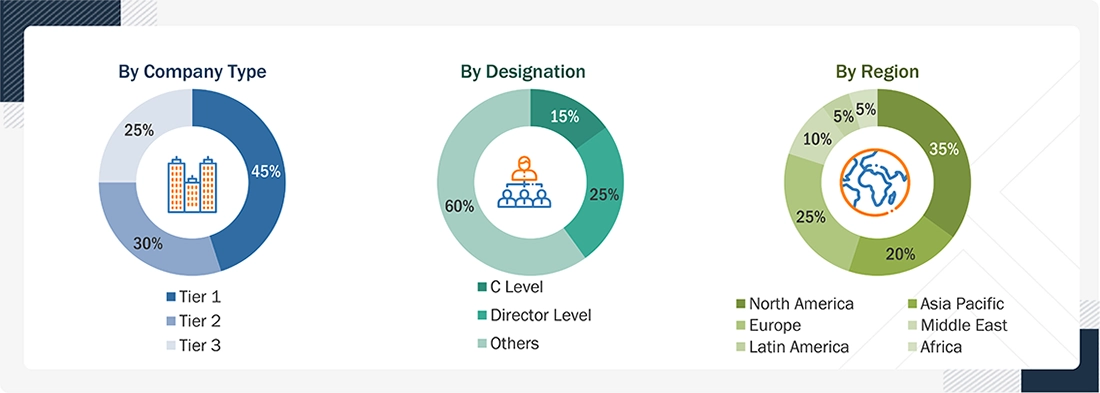
To know about the assumptions considered for the study, download the pdf brochure
Market Size Estimation
Top-down and bottom-up approaches were used to estimate and validate the size of the more electric aircraft market. The research methodology used to estimate the size of the market included the following details:
- Key players in the More Electric Aircraft market were identified through secondary research, and their market shares were determined through a combination of primary and secondary research. This included a review of annual and financial reports, aerospace electrical system revenues, aircraft program contracts, platform integration programs, supplier selections, product portfolios, and interviews with industry stakeholders.
- All percentage shares, splits, and breakdowns were derived using secondary sources and validated against supplier portfolios, procurement evidence, country demand, and expert inputs.
- All major parameters affecting the More Electric Aircraft market were considered in detail, including commercial and military aircraft deliveries, business jet and helicopter production, aircraft fleet modernization, electrical system content per aircraft, aircraft electrical generation requirements, retrofit and replacement activity, aircraft production rates, supplier contracts, backlog, technological developments, and increasing adoption of electrically driven aircraft systems. The resulting quantitative and qualitative data were consolidated and cross-validated for the final market model. This data was consolidated, enhanced with detailed input, analyzed by MarketsandMarkets, and presented in this report.
More Electric Aircraft Market: Top-Down and Bottom-Up Approach
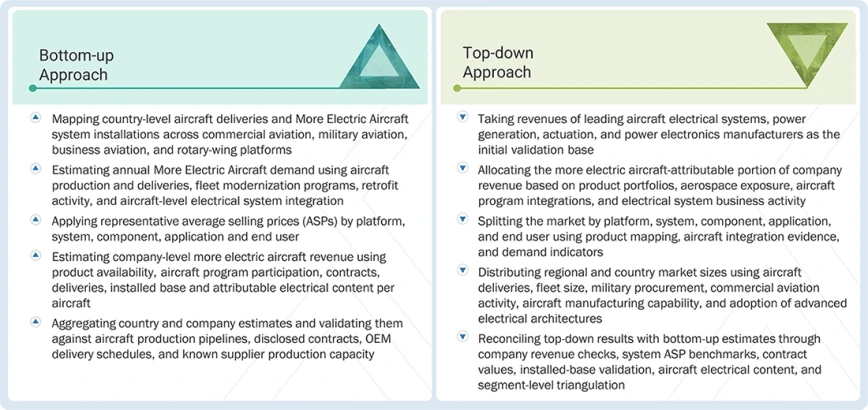
Data Triangulation
After estimating the overall market size, the market was categorized into multiple segments and subsegments. The data triangulation and market breakdown procedures were applied, wherever relevant, to complete the market engineering process and derive estimated values for each segment and subsegment. The data was triangulated by assessing key factors and trends across both demand-side and supply-side perspectives. In addition, the market estimates were cross-validated using top-down and bottom-up approaches, company revenues, aircraft production and deliveries, electrical system content per aircraft, supplier contracts, product pricing, aircraft order backlog, military procurement programs, installed fleet, retrofit activity, and country-level aviation demand.
Market Definition
The more electric aircraft market includes electrical systems, subsystems, and associated components used to replace, reduce, or optimize conventionally hydraulic, pneumatic, and mechanically powered secondary aircraft functions. The market includes electrical power generation, power conversion, power distribution and management, electrically driven actuation, electrical environmental control, electric engine starting, electric braking, electrically driven pumps, electric ice protection, electrical wiring and interconnect systems, energy storage and emergency power, and associated thermal and electrical power management equipment integrated into fixed-wing aircraft and rotorcraft. The market primarily covers non-propulsive aircraft electrification.
Key Stakeholders
- Commercial Aircraft OEMs
- Military Aircraft and Rotorcraft OEMs
- Business and General Aviation Aircraft Manufacturers
- Aircraft Electrical Power Generation System Manufacturers
- Power Conversion and Power Electronics Manufacturers
- Electrical Power Distribution and Management System Suppliers
- Electromechanical and Electro-hydrostatic Actuation System Manufacturers
- Electric Motor and Motor Controller Suppliers
- Environmental Control System Manufacturers
- Aircraft Braking and Landing System Suppliers
- Aircraft Pump and Utility Actuation Suppliers
- Energy Storage and Battery System Manufacturers
- Electrical Wiring, Connector, and EWIS Suppliers
- Airlines and Aircraft Operators
- Defense Ministries, Air Forces, and Government Procurement Agencies
- MRO, Retrofit, and Aircraft Upgrade Providers
- Aircraft Leasing Companies
- Regulatory and Civil Aviation Authorities
- Aerospace Research Organizations and Technology Developers
Report Objectives
- To define, describe, and forecast the more electric aircraft market based on platform, system, component, application, end user, and region in terms of value
- To forecast the size of various segments of the market across North America, Europe, Asia Pacific, the Middle East & Africa, and Latin America in terms of value
- To identify and analyze drivers, restraints, opportunities, and challenges influencing the growth of the market
- To identify industry trends, market trends, procurement trends, and technology trends currently prevailing in the market
- To provide an overview of the regulatory and airspace landscape relevant to more electric aircraft deployment across regions
- To analyze micro markets with respect to individual growth trends, prospects, and their contribution to the overall market
- To analyze opportunities in the market for stakeholders by identifying key market trends
- To profile key market players and comprehensively analyze their market shares and core competencies
- To evaluate the degree of competition in the market by analyzing recent developments, such as contracts, agreements, partnerships, product launches, integrations, investments, and acquisitions
- To identify the financial position, key products, aircraft programs, technology capabilities, and unique selling points of leading companies in the market
- To provide a detailed competitive landscape of the market, along with market share analysis and revenue analysis of key players
Available customizations:
MarketsandMarkets offers the following customizations for this market report:
- Additional country-level analysis of the more electric aircraft market
- Profiling of other market players (up to 10)
Product Analysis
- Product matrix, which provides a detailed comparison of the product portfolios of each company in the more electric aircraft market
Key Questions Addressed by the Report
What is the projected size of the More Electric Aircraft Market by 2031?
The More Electric Aircraft Market is projected to grow from USD 5.95 billion in 2026 to USD 8.66 billion by 2031, registering a CAGR of 7.8% during 2026–2031.
What are the major factors driving the growth of the More Electric Aircraft Market?
Market growth is driven by the increasing electrification of onboard aircraft systems, the need to improve fuel efficiency, reduce aircraft weight and maintenance requirements, and growing adoption of advanced electrical architectures. Development of high-density battery solutions and increasing use of electric technologies to optimize aircraft performance are also key drivers.
Which region is expected to grow at the highest CAGR in the More Electric Aircraft Market?
Middle East & Africa is projected to register the highest CAGR of 9.9% during the forecast period. Increasing investments in aviation infrastructure, fleet modernization, and advanced aircraft technologies are supporting regional growth.
Which platform segment is expected to grow at the highest CAGR?
The rotary-wing aircraft segment is expected to register the highest CAGR of 13.3% during the forecast period. Growing electrification of helicopter systems and demand for efficient electric power generation, actuation, and aircraft systems are supporting this growth.
Which system segment dominates the More Electric Aircraft Market?
The aircraft systems segment is expected to account for the dominant share, representing approximately 70.1% of the market in 2026. Increasing replacement of conventional hydraulic, pneumatic, and mechanically driven functions with electrically powered systems is supporting its leading position.
Which component segment is expected to grow at the fastest rate?
Engines are expected to record the strongest growth rate, with a CAGR of 10.4% during the forecast period. Advancements in electric power generation, starter-generators, and high-efficiency aircraft electrical systems are contributing to demand.
What are the major challenges facing the More Electric Aircraft Market?
Key challenges include high capital requirements, lengthy certification and clearance processes, potential overheating of electrical systems, requirements for highly reliable cable systems, and increases in maximum take-off weight associated with additional electrical equipment.
What opportunities exist in the More Electric Aircraft Market?
Major opportunities include the development of alternative power sources, advanced batteries, fuel cells, high-power-density generators, SiC-based power electronics, solid-state power distribution, intelligent power management, and high-voltage electrical architectures.
Who are the key companies operating in the More Electric Aircraft Market?
Major companies include Safran SA, Honeywell Aerospace, RTX Corporation, GE Aerospace, Parker Hannifin Corporation, BAE Systems, Liebherr, AMETEK, Moog, Eaton, Thales, Curtiss-Wright, and Crane Aerospace & Electronics.
What are the key trends shaping the More Electric Aircraft Market?
Key trends include the adoption of high-voltage electrical architectures, electric actuation, advanced power electronics, high-power starter-generators, solid-state power distribution, intelligent power management, electrically driven pumps, advanced energy-storage systems, and integrated thermal management. These technologies are helping aircraft manufacturers improve efficiency, reliability, and overall aircraft performance.
Fact checked
Personalize This Research
- Triangulate with your Own Data
- Get Data as per your Format and Definition
- Gain a Deeper Dive on a Specific Application, Geography, Customer or Competitor
- Any level of Personalization
Let Us Help You
- What are the Known and Unknown Adjacencies Impacting the More Electric Aircraft Market
- What will your New Revenue Sources be?
- Who will be your Top Customer; what will make them switch?
- Defend your Market Share or Win Competitors
- Get a Scorecard for Target Partners

Custom Market Research Services
We Will Customise The Research For You, In Case The Report Listed Above Does Not Meet With Your Requirements
Get 10% Free CustomisationTESTIMONIALS
- Canada More Electric Aircraft Market
- US More Electric Aircraft Market
- UK More Electric Aircraft Market
- France More Electric Aircraft Market
- Germany More Electric Aircraft Market
- Russia More Electric Aircraft Market
- Italy More Electric Aircraft Market
- China More Electric Aircraft Market
- India More Electric Aircraft Market
- Japan More Electric Aircraft Market
- South Korea More Electric Aircraft Market
- Australia More Electric Aircraft Market
- Brazil More Electric Aircraft Market
- Mexico More Electric Aircraft Market
- UAE More Electric Aircraft Market
- Saudi Arabia More Electric Aircraft Market
- Israel More Electric Aircraft Market
- South Africa More Electric Aircraft Market
Growth opportunities and latent adjacency in More Electric Aircraft Market






Gareth
Apr, 2026
Does the study provide insights into electric propulsion, energy storage systems, and power distribution technologies across aircraft platforms?.
Sean
Apr, 2026
Does the report analyze regulatory frameworks and certification challenges impacting electric aircraft adoption globally?.